Up and Down Worksheet: Circle the Up Picture!
This worksheet helps children ages 3-5 understand the concepts of 'up' and 'down' by examining pairs of pictures and identifying which one shows something moving or positioned upward. Comparing two opposite pictures side by side also builds early skills in noticing contrast and difference, which supports later comparison-based reasoning in math and science.
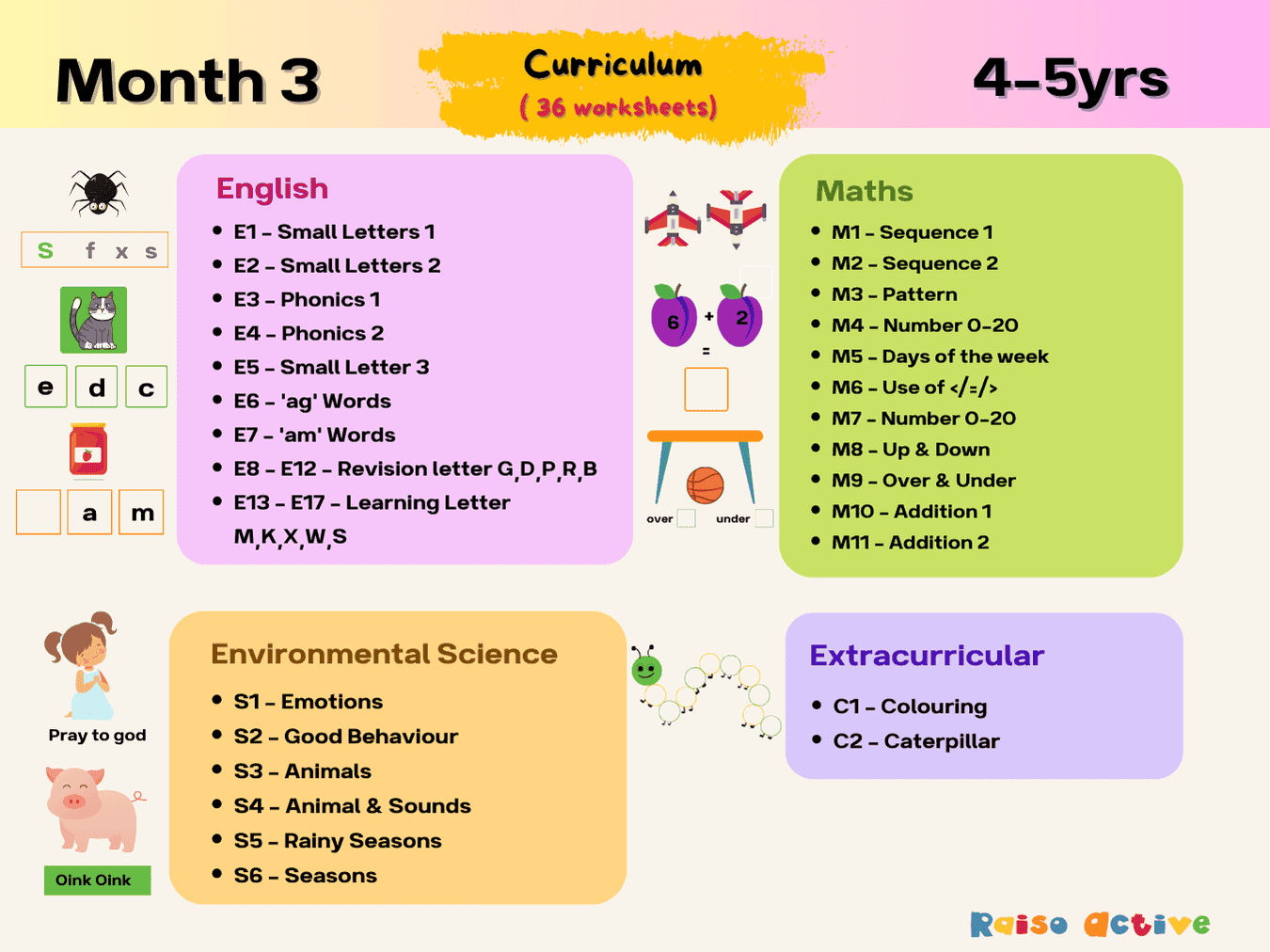
Part of the pack
Month 3: Learning & Development | Ages 4-5
This is page 28 of the pack. Ages 4-5 · Pre-KAges 4-5 · ReceptionAges 4-5 · LKGAges 4-5

Made for your child
Counting to 10, made for your child
A maths pack with your child's name in it: pictures that explain, practice at three levels, puzzles and story sums about them. Print a new set whenever they finish.
Make a maths packFree preview · free for members
Curriculum
- Spatial Sense > Spatial Concepts
How to use this worksheet
Look at the first pair of pictures together and describe what's happening in each one. Ask your child which picture shows something going 'up' and have them circle it. Then have them find the picture showing something going 'down' and cross it out. Continue through the remaining pairs, encouraging your child to say 'up' or 'down' out loud as they mark each answer.
Materials needed
- Pencil
- Crayons
Extension activities
- 1Draw your own pictures of things going up and down, like a kite rising or a leaf falling.
- 2Go on a nature walk and point out things that are up, like clouds or treetops, and things that are down, like puddles or roots.
- 3Play a physical game where your child jumps up and crouches down on command.
- 4Watch a ball bounce together and describe its movement using up and down as it happens.

Written by
Hemsweta Jain · Teacher Cheena
MBA and Early Childhood Educator, teaching since 2014 · Founder of RaisoActive, Mumbai
Every RaisoActive worksheet is designed and checked by the founder before publishing.
Published · Last reviewed
More from Month 3: Learning & Development | Ages 4-5

Caterpillar Number Sequencing Worksheet for Preschoolers
Ages 3-5 · Preschool–Pre-KAges 3-5 · Nursery–ReceptionAges 3-5 · Nursery–LKGAges 3-5
This worksheet helps children ages 3-5 practice number recognition and sequencing skills by cutting out numbered circles and arranging them in the correct order to build a caterpillar's body. The hands-on cut-and-paste format adds fine motor practice to the numeracy task, since children must precisely place each circle in its correct spot.

Shape Pattern Worksheet: Identify and Color the Next Shape!
Ages 3-5 · Preschool–Pre-KAges 3-5 · Nursery–ReceptionAges 3-5 · Nursery–LKGAges 3-5
This worksheet helps children ages 3-5 recognize and continue simple repeating shape patterns, an early form of the logical reasoning that later supports algebraic thinking. Coloring the shape that comes next also requires children to first identify each shape by name, reinforcing basic geometry vocabulary.
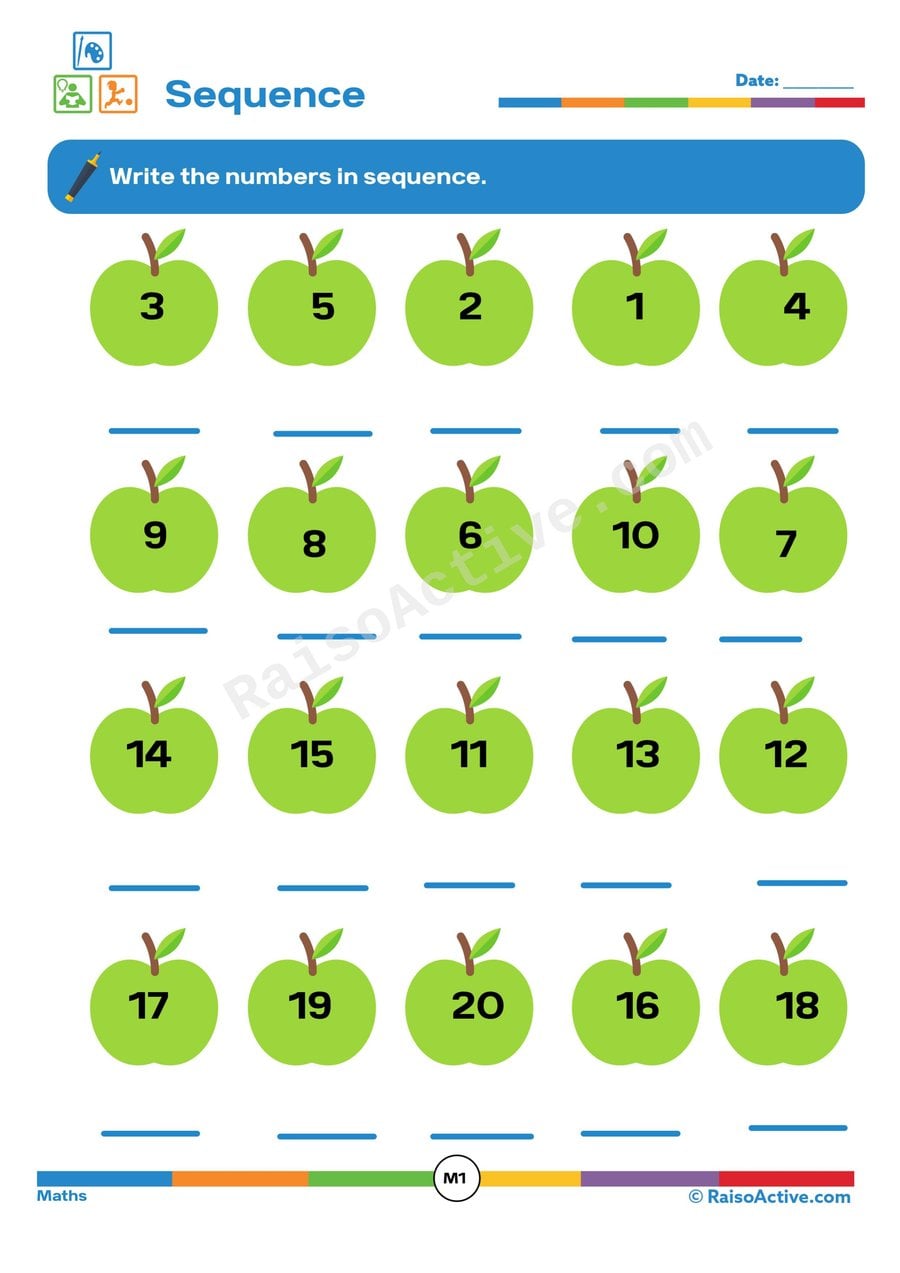
Sequence Fun: Writing Numbers in Order Worksheet
Ages 4-5 · Pre-KAges 4-5 · ReceptionAges 4-5 · LKGAges 4-5
This worksheet helps children ages 4-5 practice writing numbers in the correct sequence, reinforcing both number recognition and the concept that numbers have a fixed, predictable order. Filling in missing numbers along a row of apples also builds the pattern-recognition skills that underlie later skip-counting and place value work.
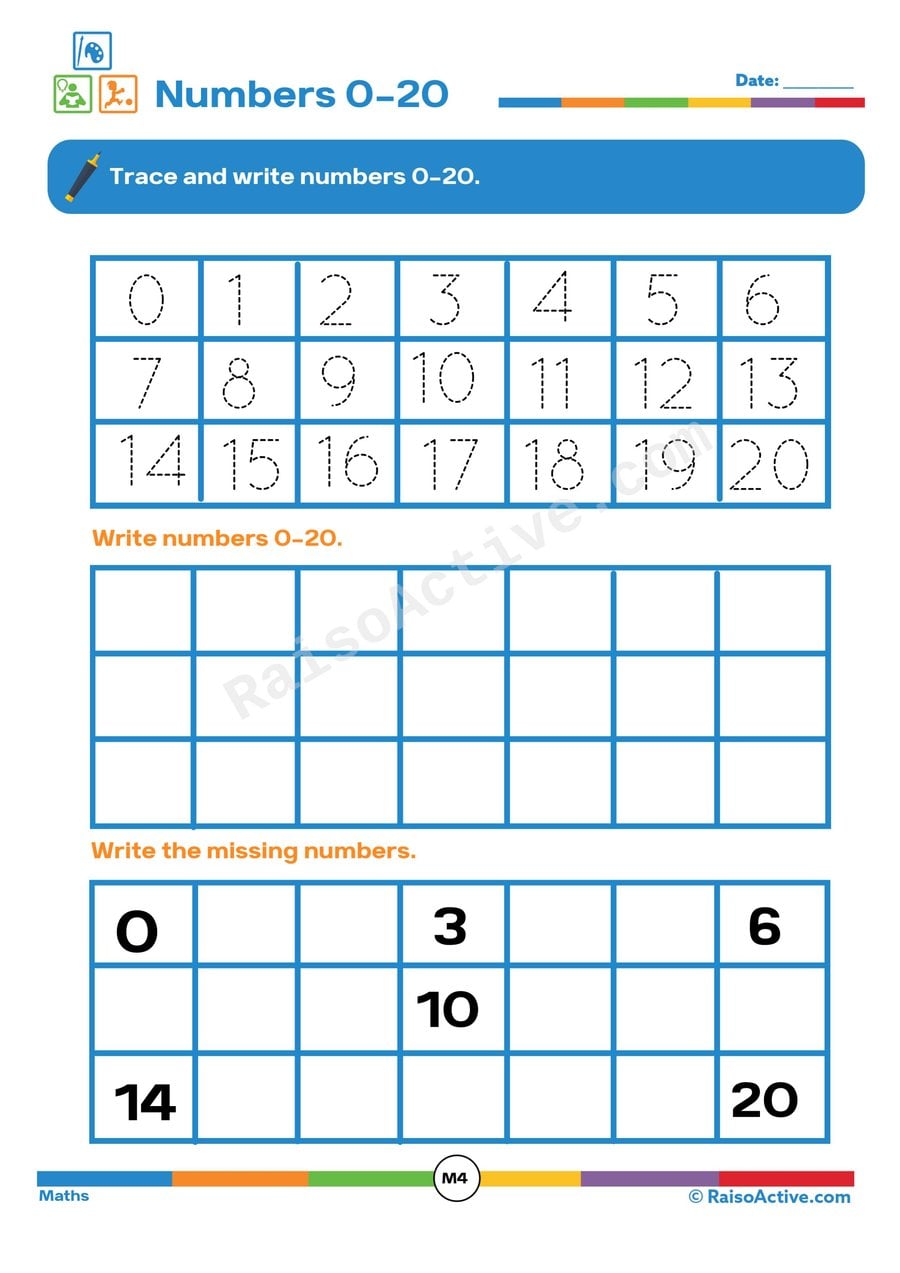
Trace and Write Numbers 0-20 Worksheet
Ages 4-6 · Pre-K–KindergartenAges 4-6 · Reception–Year 1Ages 4-6 · LKG–UKGAges 4-6
This worksheet extends number formation practice across the full range from 0 to 20, giving children repeated tracing and writing practice on both single-digit and two-digit numerals. For four- to six-year-olds, moving past 10 into the teens and twenties is an important milestone, since it introduces the idea that numbers can be built from combinations of digits rather than each needing its own unique symbol.
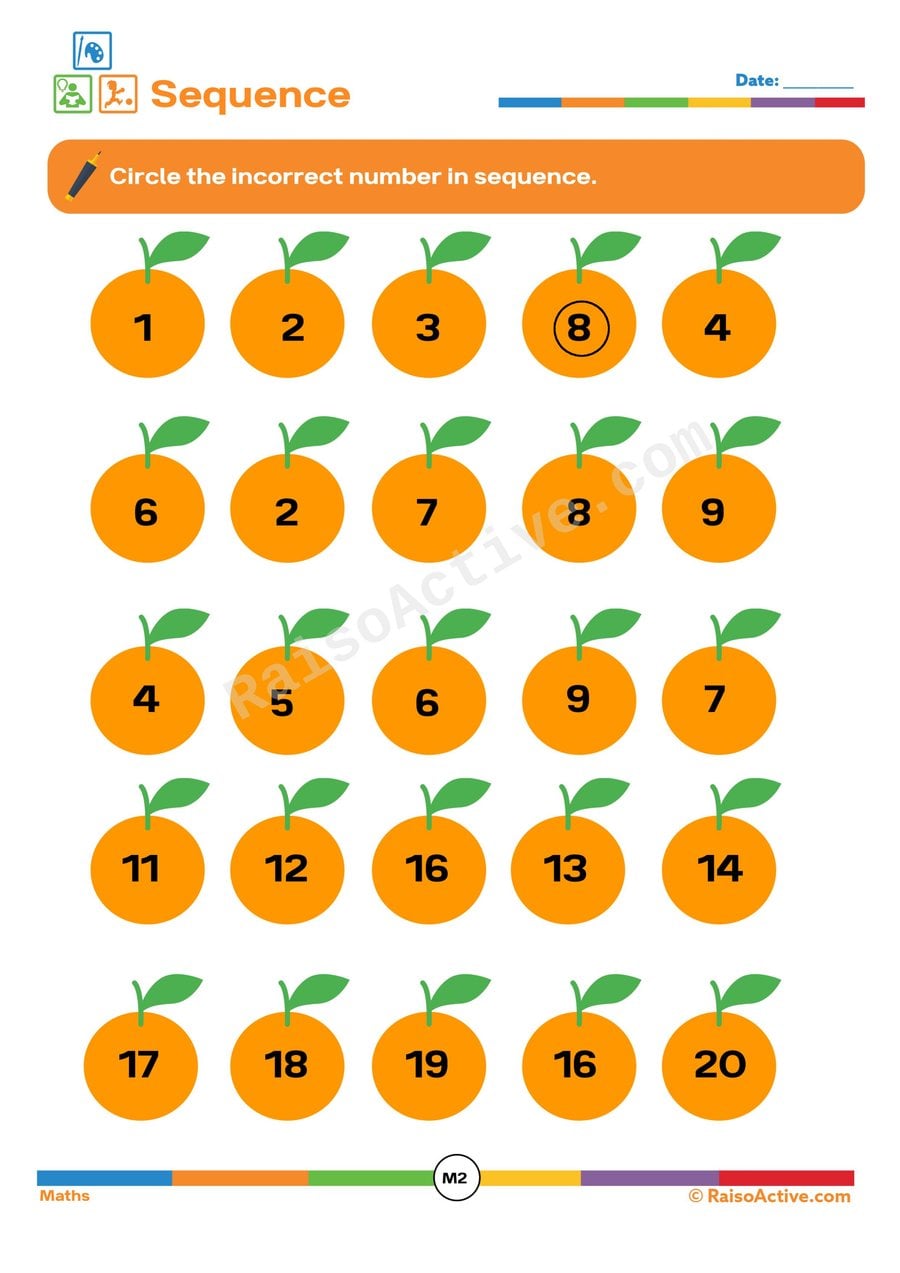
Sequence Worksheet: Find the Incorrect Number!
Ages 4-5 · Pre-KAges 4-5 · ReceptionAges 4-5 · LKGAges 4-5
This worksheet sharpens number pattern recognition by having children scan a row of numbers in sequence and spot the one number that breaks the pattern. For four- and five-year-olds, this kind of 'odd one out' task requires holding the counting sequence in mind while comparing it against what's actually written, building both number sense and early attention to detail.

Letter B Tracing and Identification Worksheet for Preschoolers
Ages 3-5 · Preschool–Pre-KAges 3-5 · Nursery–ReceptionAges 3-5 · Nursery–LKGAges 3-5
This worksheet helps children ages 3-5 practice tracing and writing the letter B, identifying B among other letters, and recognizing objects that start with the letter B. Circling the correct letter within a small group builds the visual scanning skill children need before they can read words fluently.

Rainy Season Coloring Worksheet for Preschoolers
Ages 3-5 · Preschool–Pre-KAges 3-5 · Nursery–ReceptionAges 3-5 · Nursery–LKGAges 3-5
This worksheet helps children ages 3-5 identify and learn about objects and scenes associated with the rainy season, like umbrellas, puddles, and raincoats, while practicing coloring skills that build hand control. Connecting a familiar season to specific vocabulary words gives children concrete language for describing the weather they experience.
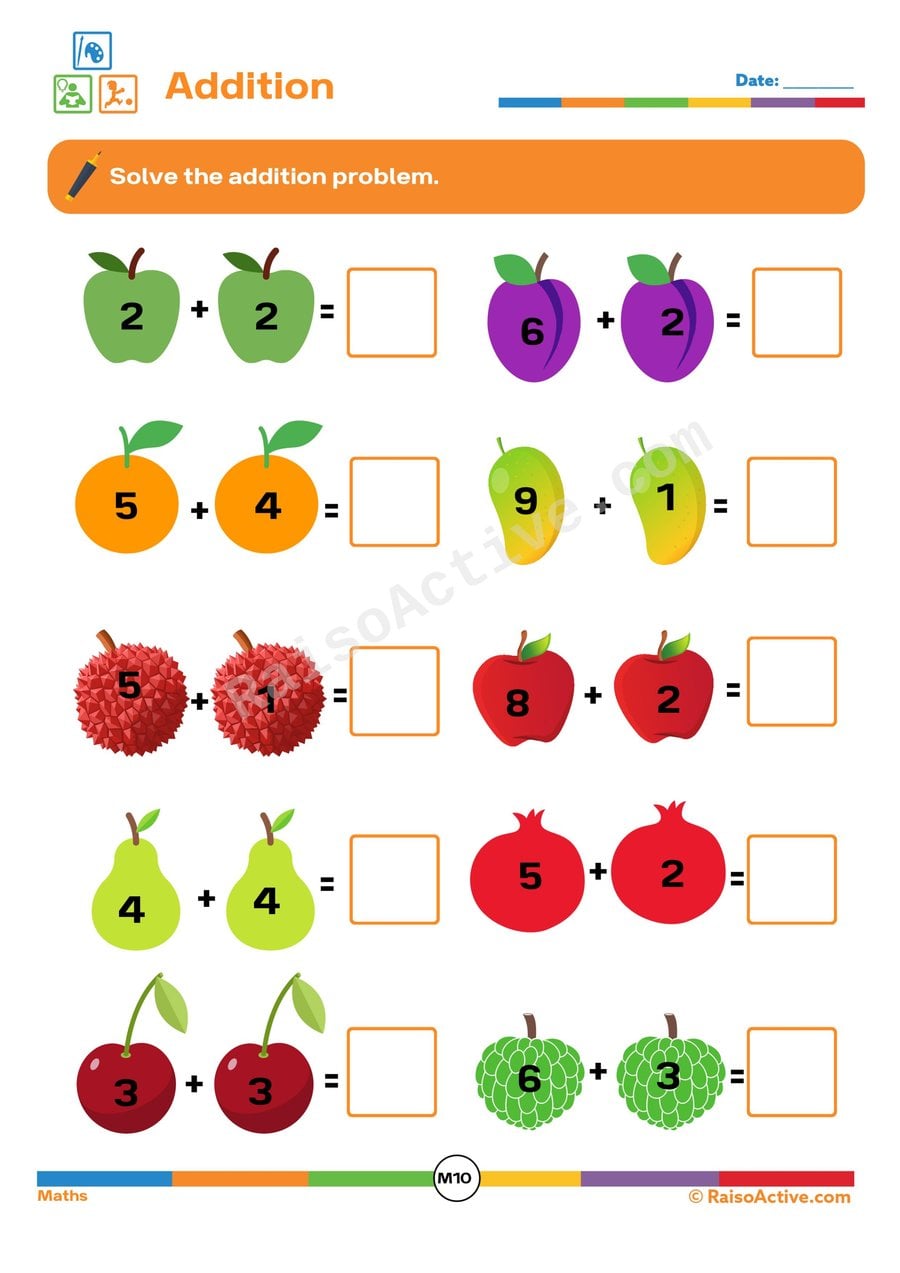
Fruit Addition Worksheet for Preschoolers
Ages 4-6 · Pre-K–KindergartenAges 4-6 · Reception–Year 1Ages 4-6 · LKG–UKGAges 4-6
This worksheet practices basic addition by having children count two separate groups of fruit and combine the totals into one sum. For four- to six-year-olds, working with pictures of real, countable objects like apples and bananas makes the abstract idea of 'adding' concrete before they're asked to add using numbers alone.
Related worksheets

Front or Behind Sorting Worksheet for Preschoolers
Ages 3-5 · Preschool–Pre-KAges 3-5 · Nursery–ReceptionAges 3-5 · Nursery–LKGAges 3-5
Positional words like 'front' and 'behind' describe relationships between objects rather than the objects themselves, which makes them a genuinely trickier concept for a 3-5 year old than sorting by color or size. Deciding where each picture belongs and sorting it into the right box builds early spatial reasoning that later supports following multi-step directions and understanding maps or diagrams.
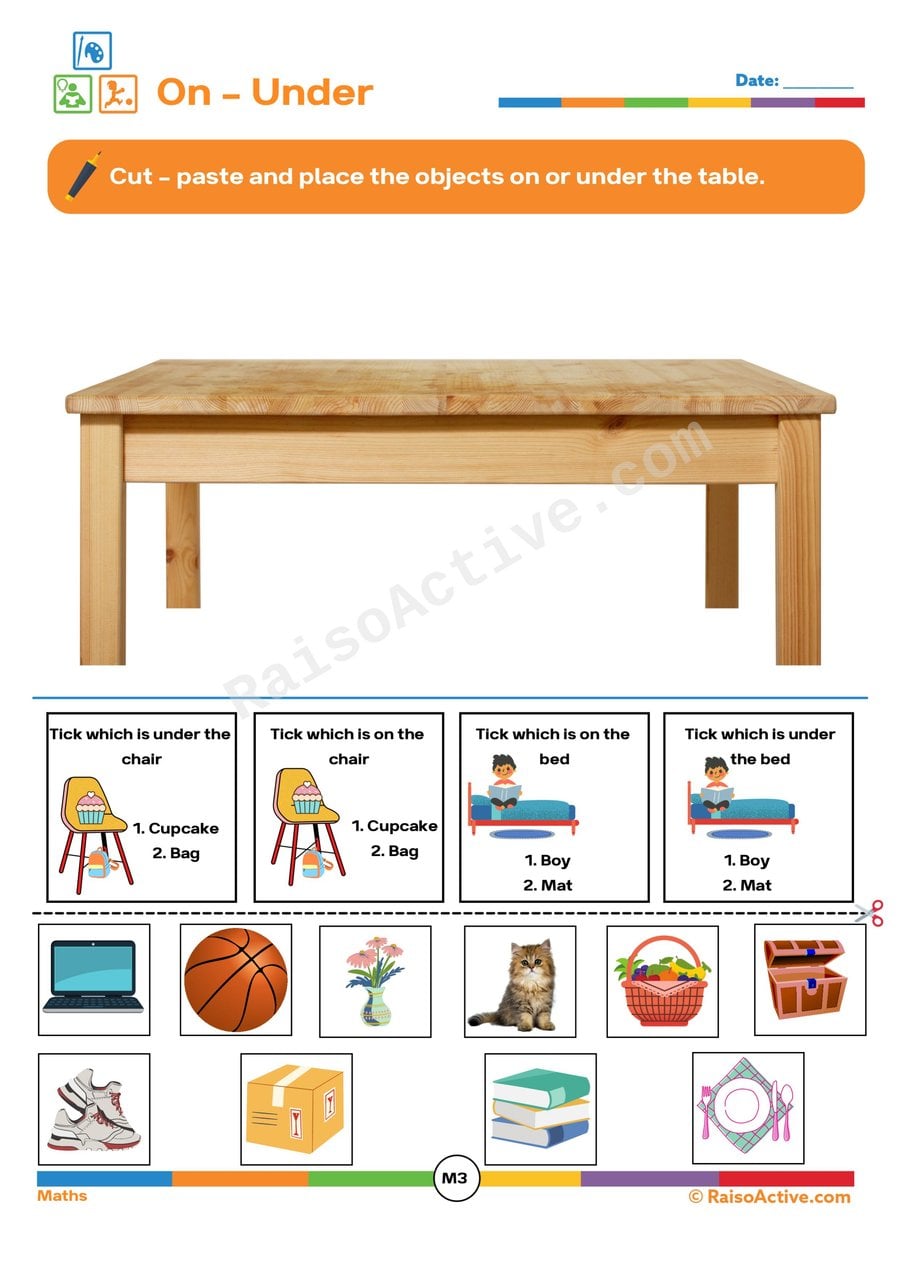
On and Under Worksheet: Table Placement Fun!
Ages 3-5 · Preschool–Pre-KAges 3-5 · Nursery–ReceptionAges 3-5 · Nursery–LKGAges 3-5
Cutting out pictures and gluing them either on or under a table teaches children ages 3-5 the spatial prepositions 'on' and 'under' by requiring them to physically place an object according to a specific instruction rather than just hearing the words. This hands-on placement task builds spatial reasoning and reinforces receptive language, since children must correctly interpret which word means which position before acting on it. Prepositions like these are often tricky to grasp through listening alone, so the visual, hands-on nature of this worksheet makes the concept concrete.
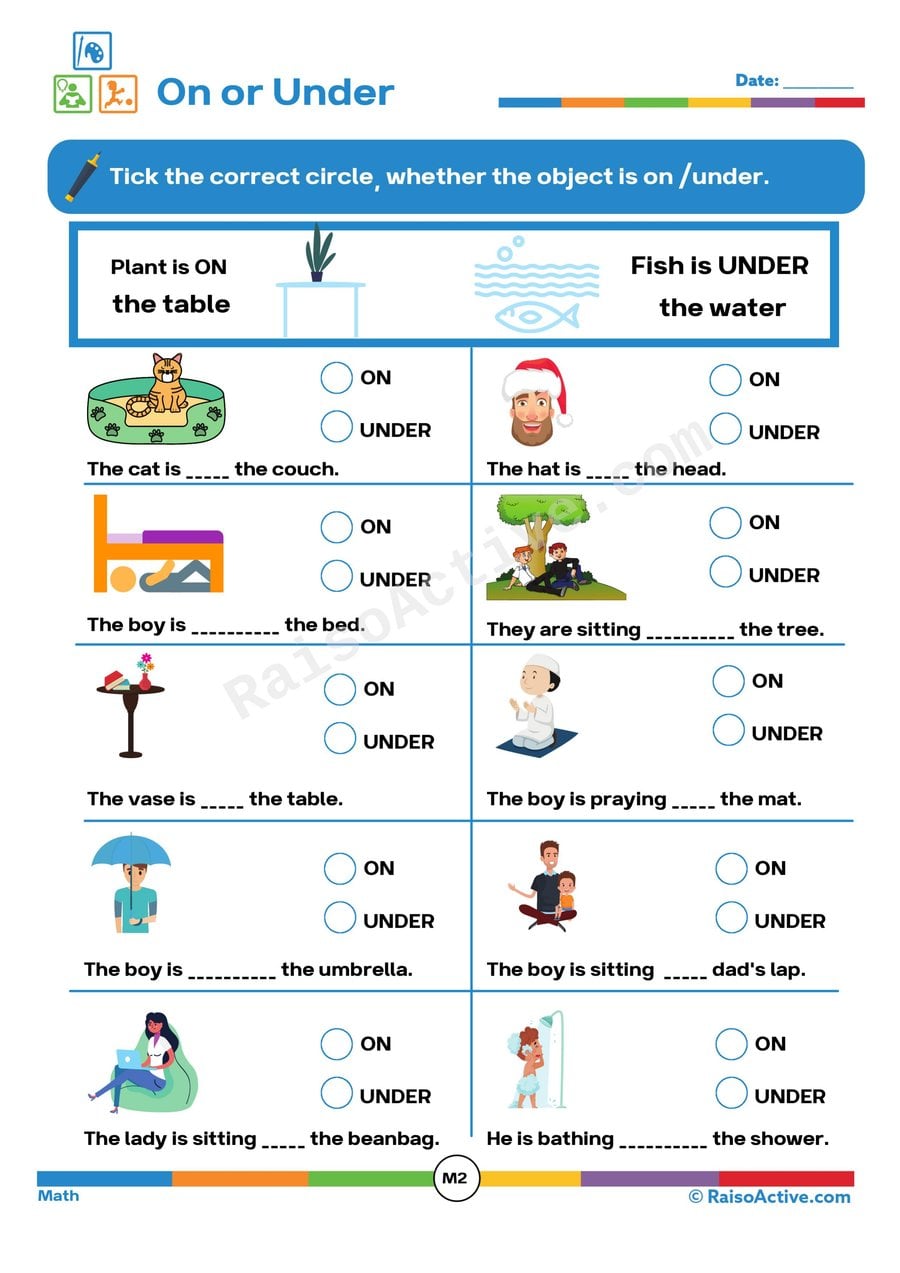
On or Under Worksheet: Where is the Object?
Ages 3-5 · Preschool–Pre-KAges 3-5 · Nursery–ReceptionAges 3-5 · Nursery–LKGAges 3-5
Reading a short sentence describing an object's location and then ticking the picture that matches teaches children ages 3-5 to connect spoken or written prepositions, 'on' and 'under,' to a visual representation, strengthening both listening comprehension and spatial vocabulary. This worksheet requires children to hold a sentence in mind and compare it against a picture, which is a slightly more advanced skill than simply naming a position they can already see. Understanding prepositions like these supports later reading comprehension, since so many simple stories depend on describing where things are.
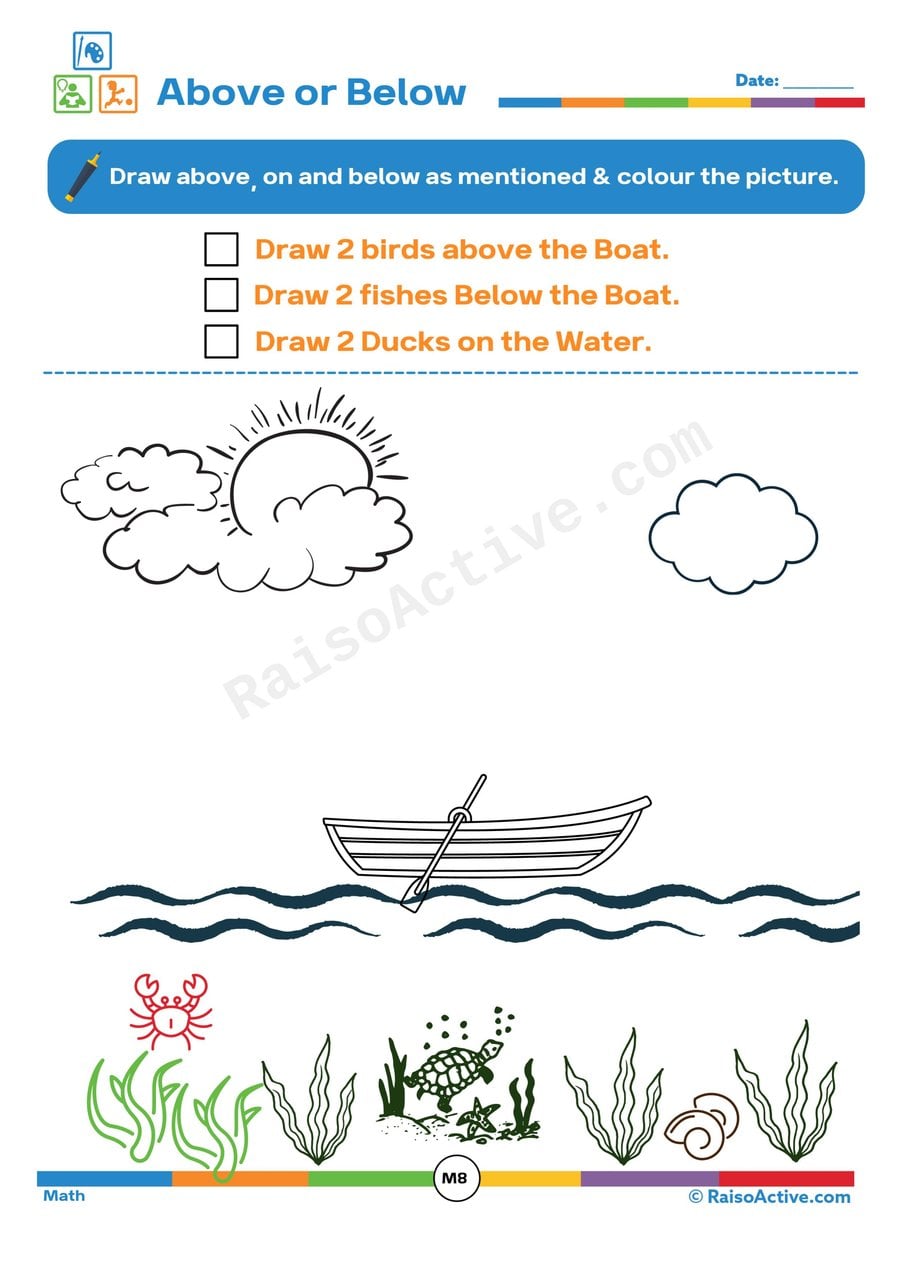
Above or Below Worksheet: Draw and Color!
Ages 3-5 · Preschool–Pre-KAges 3-5 · Nursery–ReceptionAges 3-5 · Nursery–LKGAges 3-5
This worksheet asks children ages 3-5 to apply the positional concepts of 'above,' 'below,' and 'on' by actively drawing new objects into a scene rather than simply pointing or circling. Drawing an item in a specific spatial position, like a bird above a boat, requires children to translate a verbal instruction into an accurate visual placement, which is a more demanding test of spatial understanding than passive matching. Coloring the finished scene afterward adds a satisfying creative finish to the activity.

Front and Behind Worksheet: Identifying Positional Words
Ages 3-5 · Preschool–Pre-KAges 3-5 · Nursery–ReceptionAges 3-5 · Nursery–LKGAges 3-5
Understanding 'front' and 'behind' gives children ages 3-5 the spatial vocabulary they need to follow instructions and describe the world around them accurately, an important stepping stone toward later concepts like ordinal position and basic geometry. This worksheet asks them to apply the words to specific pictures rather than just hear them in passing, which cements the connection between the word and the physical relationship it describes. Positional language like this also supports following multi-step directions at home and in the classroom.
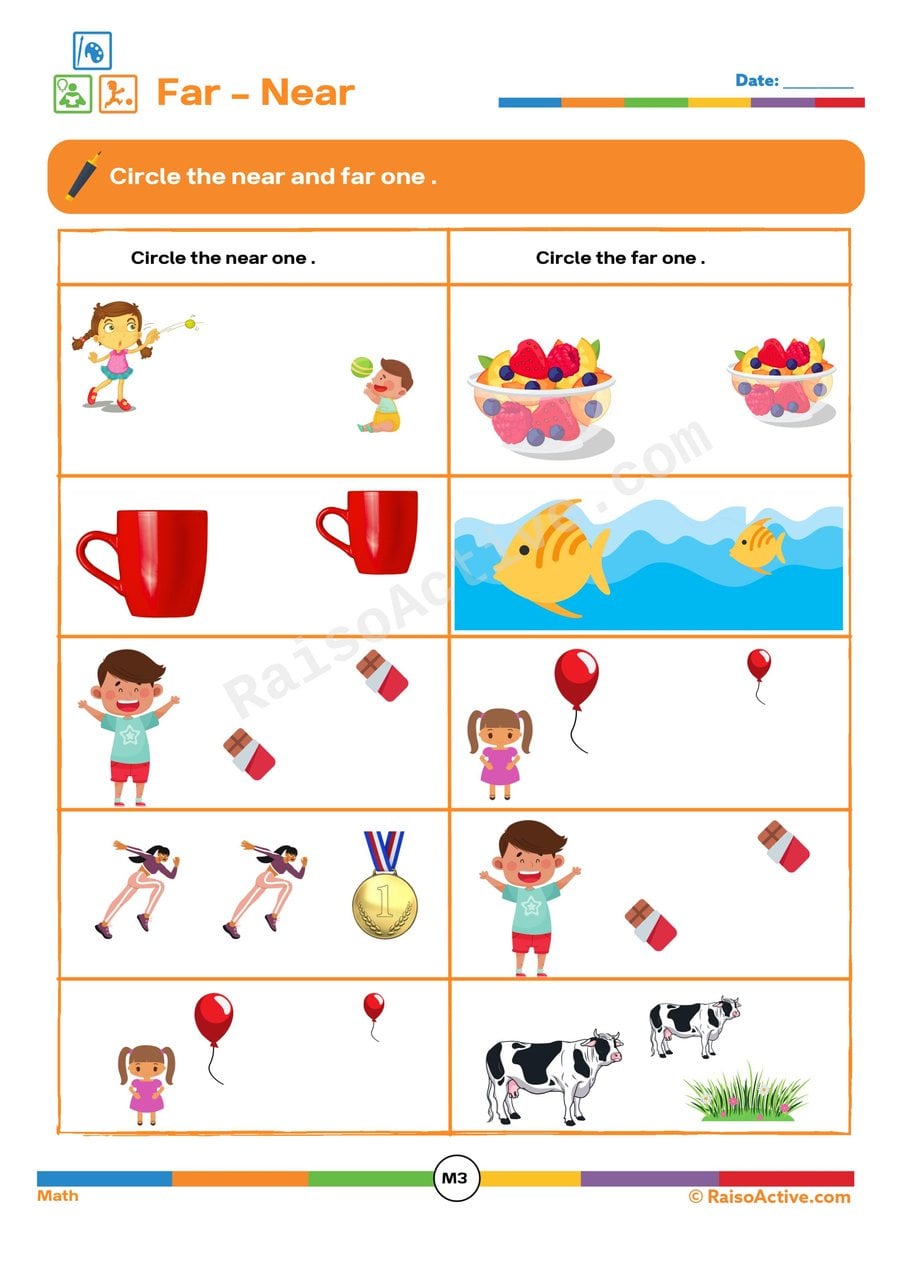
Far and Near Worksheet: Circle the Objects!
Ages 3-5 · Preschool–Pre-KAges 3-5 · Nursery–ReceptionAges 3-5 · Nursery–LKGAges 3-5
Children ages 3-5 build early spatial reasoning by comparing the relative distance of paired objects and deciding which is 'near' and which is 'far,' a foundational concept for understanding position and distance in the world around them. This kind of comparative thinking also supports later math concepts like measurement and estimation.
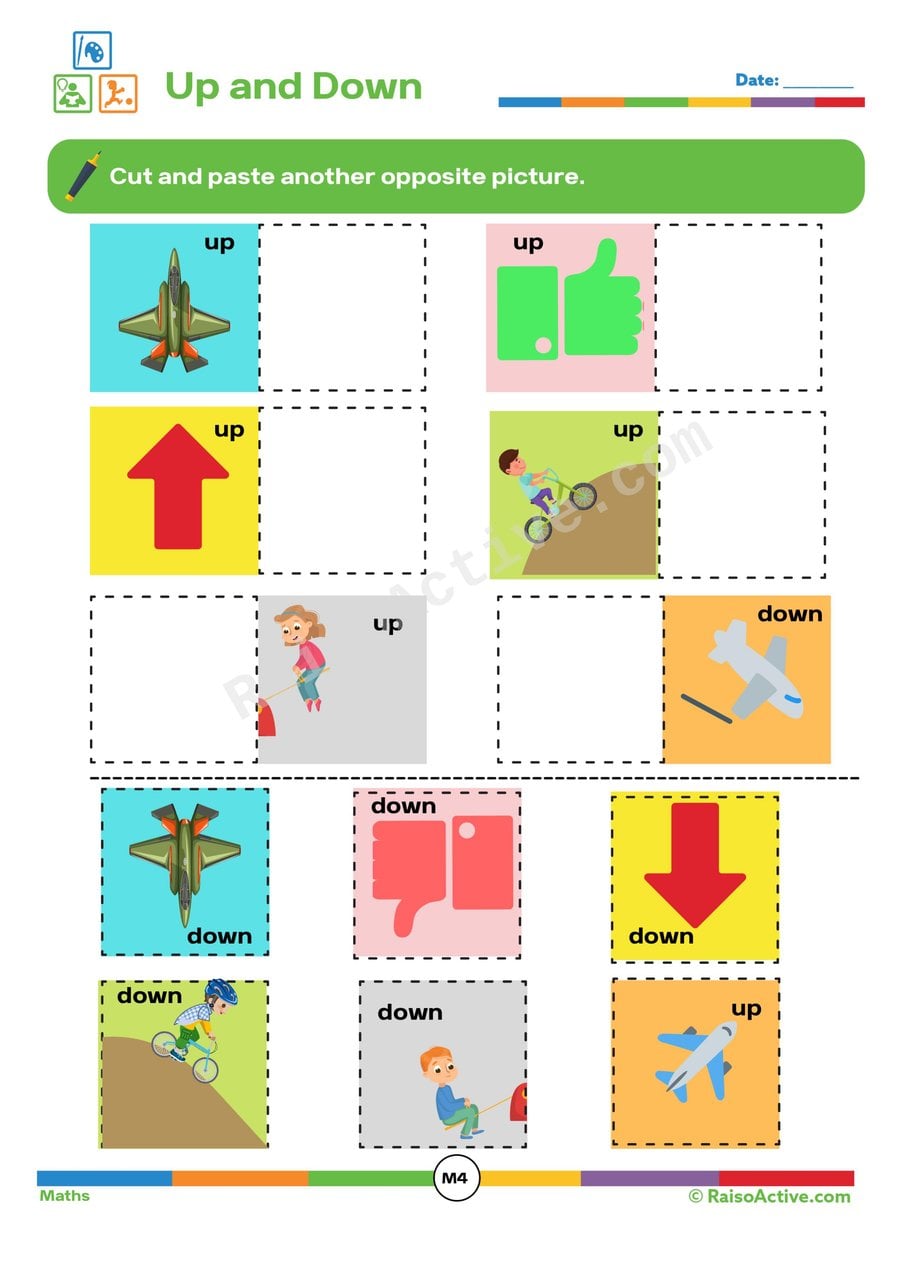
Up and Down Worksheet: Cut and Paste Opposites!
Ages 3-5 · Preschool–Pre-KAges 3-5 · Nursery–ReceptionAges 3-5 · Nursery–LKGAges 3-5
Children ages 3-5 build spatial vocabulary and comparative reasoning as they identify pictures representing 'up' and match them to their opposite, 'down,' by cutting and pasting. Understanding opposite pairs like up/down strengthens both language development and the early logical thinking needed to compare and categorize.

Front and Back Matching Worksheet for Preschoolers
Ages 3-5 · Preschool–Pre-KAges 3-5 · Nursery–ReceptionAges 3-5 · Nursery–LKGAges 3-5
This cut-and-paste worksheet builds spatial reasoning by asking children to recognize that many objects and animals look different from the front versus the back, and to match each front view to its correct back view. For ages 3-5, this kind of visual matching strengthens observational skills and the beginning of perspective-taking, understanding that the same object can look different depending on which side you're viewing.
Guides for this topic

Age-Appropriate Problem-Solving Activities: Building Critical Thinkers from the Ground Up
Discover fun, age-appropriate problem-solving activities for children ages 1-8. Build critical thinking, logic, and reasoning skills through play-based learning.
Critical Thinking Activities That Actually Work for Young Children: Building Tomorrow's Thinkers Today
Discover proven critical thinking activities for young children. Age-wise logic games, questioning techniques, and hands-on ideas to build thinking skills at home.

Preparing Your Child for a Rapidly Changing World: Essential Skills for Future Success
Discover the essential 21st century skills your child needs for future success. Practical tips on creativity, critical thinking, digital literacy & emotional intelligence for ages 1-8.
Reviews
Every worksheet for ages 3–5, no watermark
Members download the full library of 1,000+ worksheets and every activity pack without watermarks or daily limits. One year costs ₹999 in India or $20 elsewhere.
See membership plansOr download any worksheet free with a watermark (5 a day).