Animal Habitats Cut and Paste Worksheet for Preschoolers
Children ages 3-5 learn about different animal habitats — like the ocean, forest, or desert — by cutting out animal pictures and pasting each one into its correct home environment. Matching an animal to where it actually lives builds early science classification skills and introduces the idea that living things are adapted to survive in specific environments, a concept children will revisit in more depth throughout school.
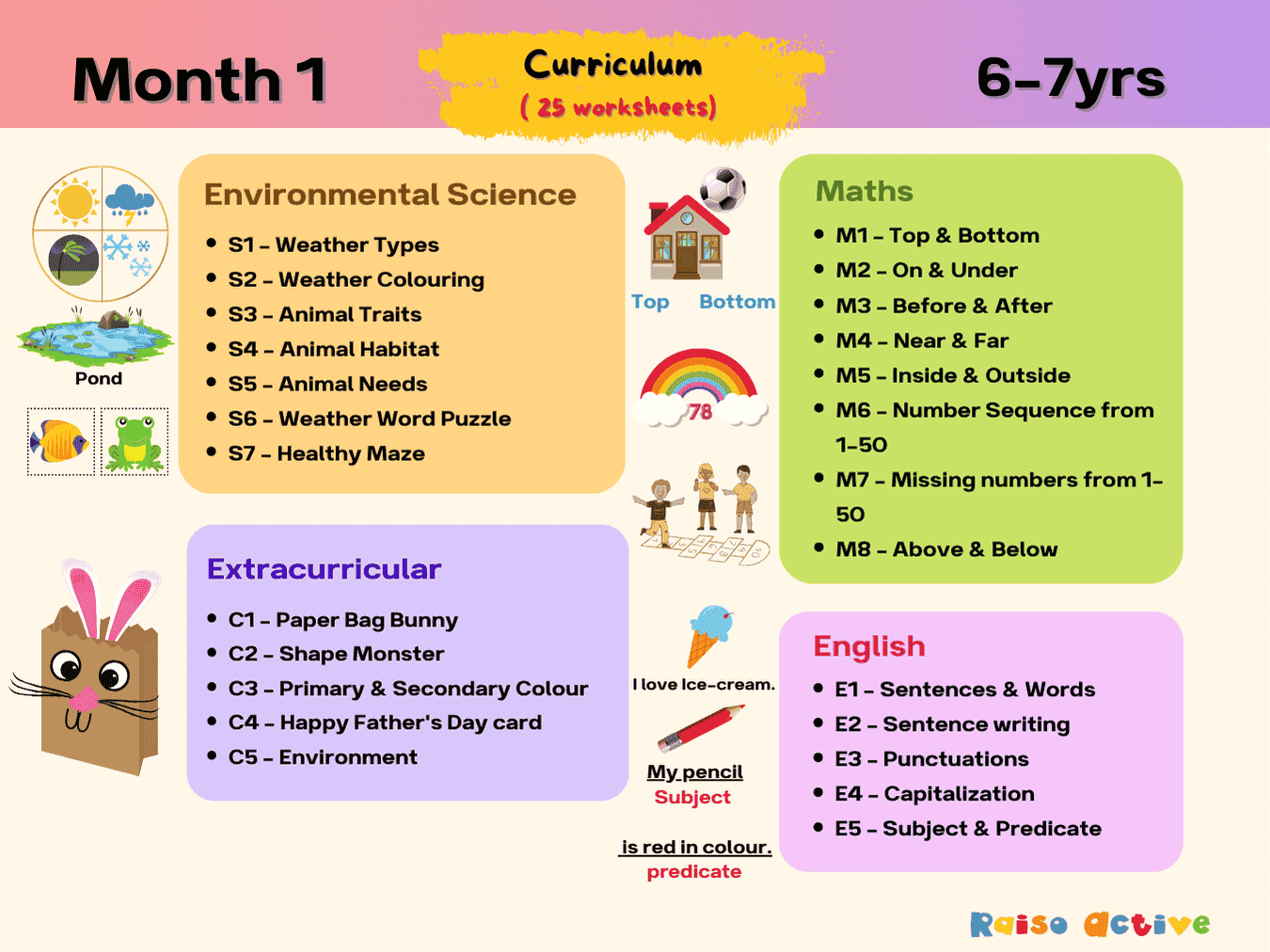
Part of the pack
Month 1: Learning & Development | Ages 6-7
This is page 20 of the pack. Ages 6-7 · Grade 1Ages 6-7 · Year 2Ages 6-7 · Class 1Ages 6-7
Curriculum
- Living Things - Animals > Animals & Habitats
How to use this worksheet
Look at the animals on the right side of the page together and name each one, talking briefly about where that animal actually lives in the wild. Have your child cut out each animal picture carefully, then decide together which habitat on the left side of the page matches it best. Paste each animal into its correct habitat, checking your child's reasoning together before moving to the next animal.
Materials needed
- Scissors
- Glue
- Pencil
Extension activities
- 1Draw your favorite animal in its habitat, adding details like trees, water, or sand depending on where it lives.
- 2Research and learn about other animals and their habitats using a book or age-appropriate video.
- 3Visit a zoo or aquarium and talk about how the enclosures are designed to resemble each animal's natural habitat.
- 4Sort a collection of toy animals into groups by habitat, like ocean animals versus forest animals.

Written by
Hemsweta Jain · Teacher Cheena
MBA and Early Childhood Educator, teaching since 2014 · Founder of RaisoActive, Mumbai
Every RaisoActive worksheet is designed and checked by the founder before publishing.
Published · Last reviewed
More from Month 1: Learning & Development | Ages 6-7

Hopscotch Numbers 1-50 Worksheet: Fill in the Missing Numbers!
Ages 4-6 · Pre-K–KindergartenAges 4-6 · Reception–Year 1Ages 4-6 · LKG–UKGAges 4-6
This hopscotch-themed worksheet gives children ages 4-6 practice filling in missing numbers within the 1-50 range, extending their number sequencing beyond the more commonly rehearsed 1-20 range and building familiarity with two-digit number patterns like the '20s' or '30s.' Framing the numbers as a hopscotch grid connects the paper activity to a familiar physical game, helping children mentally picture themselves counting forward as they move up the grid. This kind of extended-range practice is an important bridge toward comfortable counting to 100.

Capitalization Worksheet: Practice Writing Sentences Correctly!
Ages 4-6 · Pre-K–KindergartenAges 4-6 · Reception–Year 1Ages 4-6 · LKG–UKGAges 4-6
This worksheet teaches children ages 4-6 the rule that sentences begin with a capital letter, along with an introduction to capitalizing proper nouns like names and places. Rewriting sentences correctly, rather than just circling errors, gives children active practice applying the capitalization rule themselves, which builds the habit more effectively than passive correction exercises.

Weather Color by Number Worksheet for Preschoolers
Ages 3-5 · Preschool–Pre-KAges 3-5 · Nursery–ReceptionAges 3-5 · Nursery–LKGAges 3-5
This color-by-number activity has children ages 3-5 practice matching numerals to a color key while completing a weather-themed picture, combining number recognition with color recognition and the fine motor control needed for careful, contained coloring. Because each numbered section must be colored correctly for the picture to look right, children get immediate visual feedback on whether their number identification was accurate. The weather theme also gives a natural opportunity to talk about the picture's subject once it's revealed.
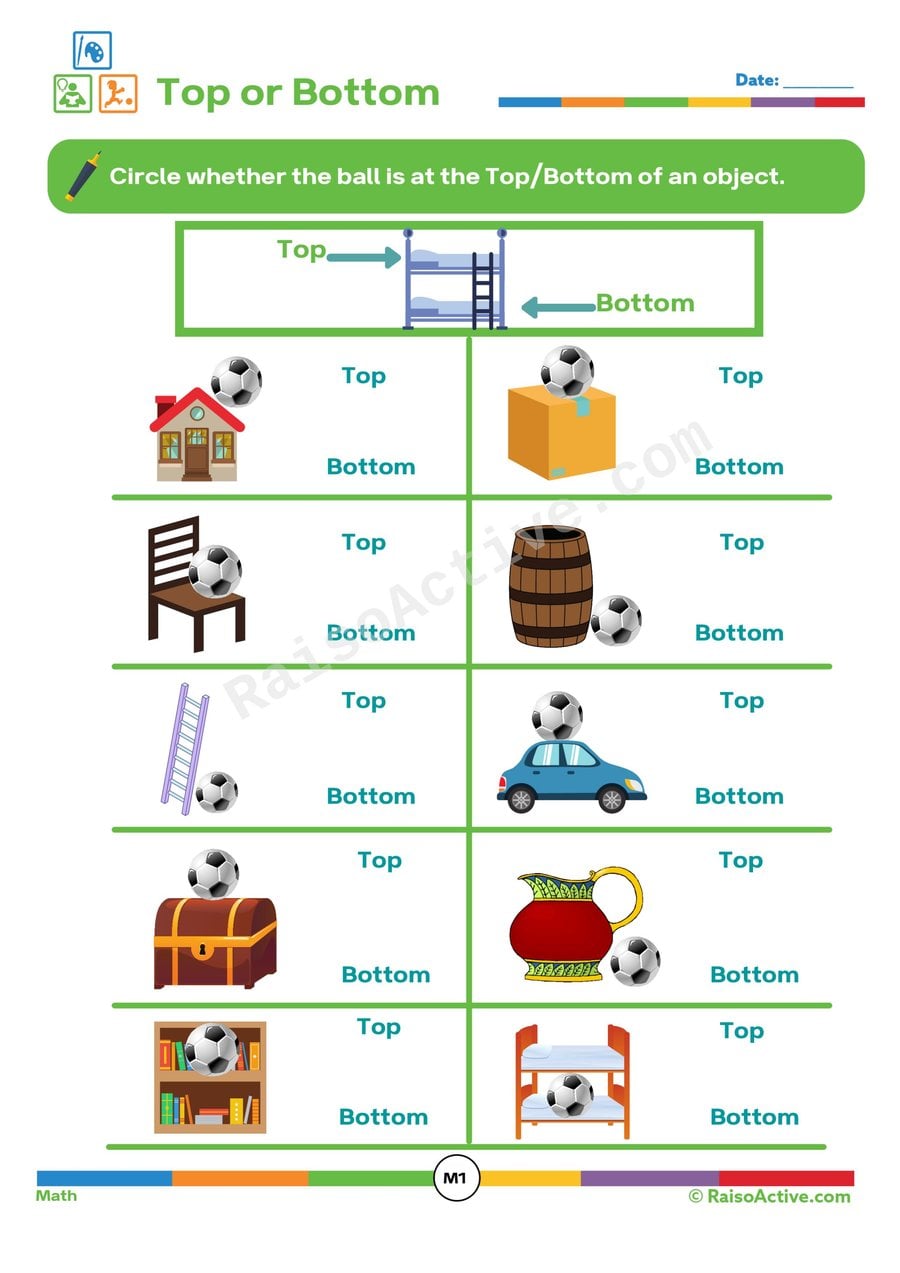
Top or Bottom? Fun Worksheet for Kids!
Ages 3-5 · Preschool–Pre-KAges 3-5 · Nursery–ReceptionAges 3-5 · Nursery–LKGAges 3-5
Deciding whether a ball is positioned at the top or bottom of another object teaches children ages 3-5 the spatial concepts of 'top' and 'bottom,' foundational positional vocabulary that supports later skills like reading a page from top to bottom or following multi-step directions. This worksheet asks children to look carefully at a picture and make a judgment about relative position, which strengthens visual-spatial reasoning alongside vocabulary development. Positional words like these are often first understood through pictures before children can reliably use them in their own speech.

Sheep's Barnyard Adventure: A Fun Counting and Movement Worksheet
Ages 4-6 · Pre-K–KindergartenAges 4-6 · Reception–Year 1Ages 4-6 · LKG–UKGAges 4-6
This board-game-style worksheet helps children ages 4-6 practice counting and number recognition by rolling a die and moving a sheep piece along a numbered path, following simple instructions at each stop. Turning counting practice into a game with chance and movement keeps children engaged far longer than a static worksheet, while still reinforcing accurate counting and number sequence recognition along the path.
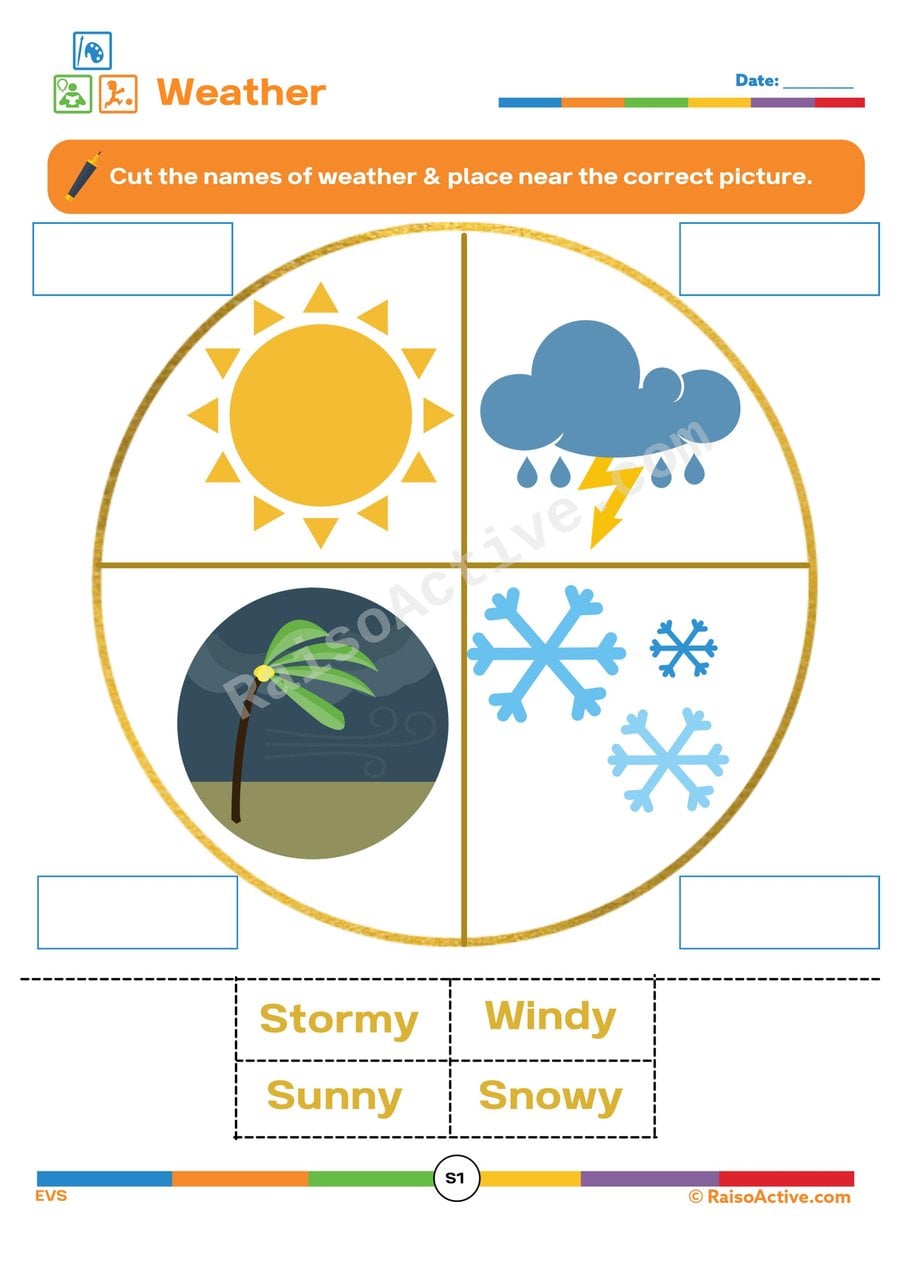
Weather Matching Worksheet for Preschoolers
Ages 3-5 · Preschool–Pre-KAges 3-5 · Nursery–ReceptionAges 3-5 · Nursery–LKGAges 3-5
Cutting out weather name labels and gluing them beside the matching picture teaches children ages 3-5 vocabulary for common weather types, like sunny, rainy, or snowy, while connecting a written word to something they can observe outside every day. Because the labels must be read and correctly matched rather than simply circled, this worksheet also builds early sight-word recognition tied to real, familiar concepts. Weather is something children experience daily, which makes this an especially concrete entry point into word-to-picture matching.

Handprint Father's Day Card Craft Worksheet for Kids
Ages 3-5 · Preschool–Pre-KAges 3-5 · Nursery–ReceptionAges 3-5 · Nursery–LKGAges 3-5
Painting a handprint and turning it into a Father's Day card gives children ages 3-5 a sensory, hands-on art experience while also creating a lasting keepsake that captures their current hand size. Writing or dictating a message for dad afterward adds an early writing or storytelling component, helping children practice expressing appreciation and affection in words. This project blends fine motor and sensory play with an emotional, relationship-building purpose that goes beyond typical coloring practice.
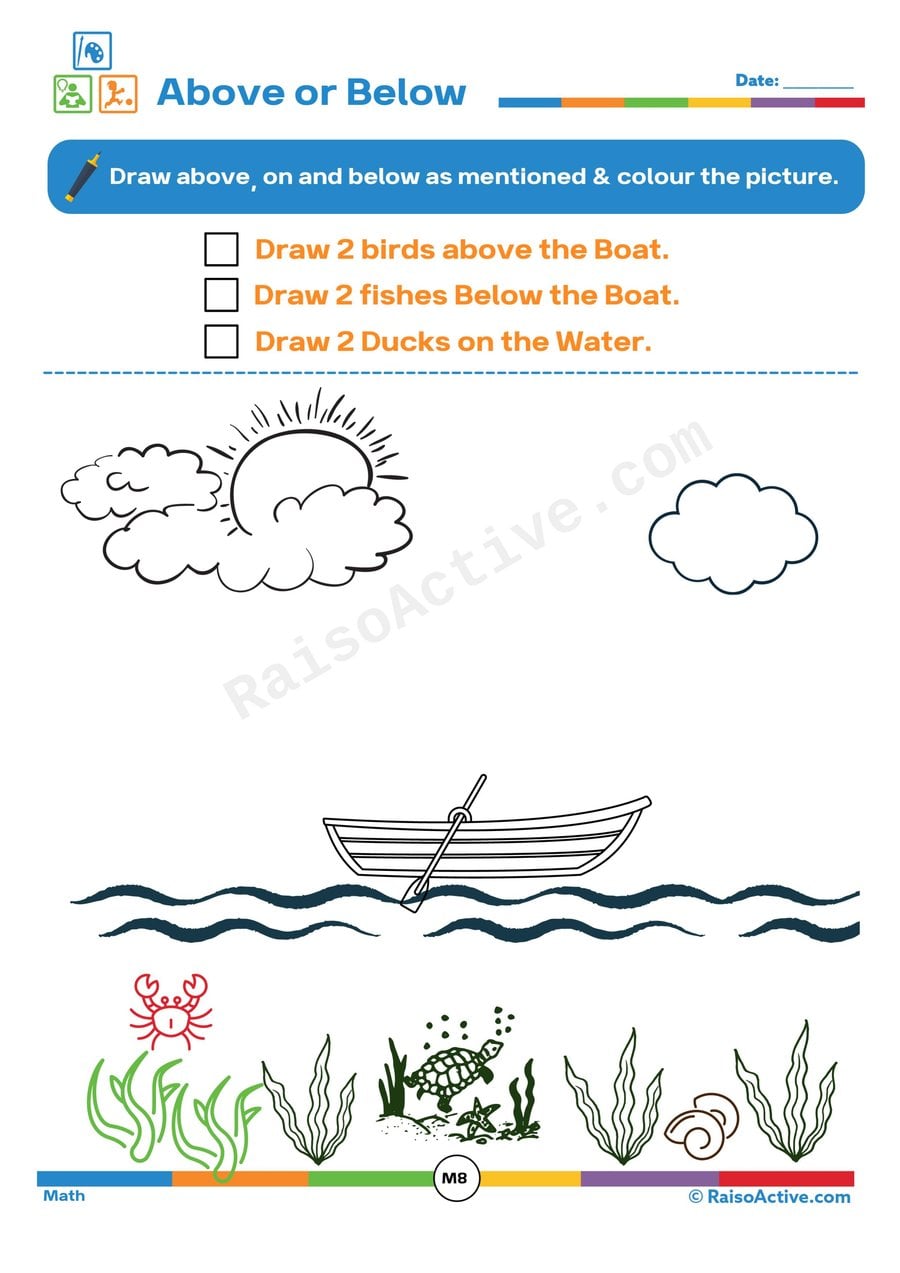
Above or Below Worksheet: Draw and Color!
Ages 3-5 · Preschool–Pre-KAges 3-5 · Nursery–ReceptionAges 3-5 · Nursery–LKGAges 3-5
This worksheet asks children ages 3-5 to apply the positional concepts of 'above,' 'below,' and 'on' by actively drawing new objects into a scene rather than simply pointing or circling. Drawing an item in a specific spatial position, like a bird above a boat, requires children to translate a verbal instruction into an accurate visual placement, which is a more demanding test of spatial understanding than passive matching. Coloring the finished scene afterward adds a satisfying creative finish to the activity.
Related worksheets

Farm Animal Fun: Cut and Paste Worksheet for Preschoolers
Ages 3-5 · Preschool–Pre-KAges 3-5 · Nursery–ReceptionAges 3-5 · Nursery–LKGAges 3-5
Coloring, cutting, and pasting farm animals onto a scene teaches children ages 3-5 farm animal vocabulary while giving substantial fine motor practice through careful cutting along lines. Building the completed farm scene also lets children practice spatial placement, deciding where each animal fits within the picture.

Wild Animals Cut and Paste Worksheet for Preschoolers
Ages 3-5 · Preschool–Pre-KAges 3-5 · Nursery–ReceptionAges 3-5 · Nursery–LKGAges 3-5
Children ages 3-5 practice scissor control and glue placement while learning to identify wild animals and place them into a jungle habitat, connecting the idea that specific animals belong to specific environments. This activity builds fine motor precision — cutting along a line and centering an object with glue — while introducing early habitat vocabulary like jungle, forest floor, and trees.

Animal Dice: Fun Movement Activity Worksheet for Kids
Ages 3-5 · Preschool–Pre-KAges 3-5 · Nursery–ReceptionAges 3-5 · Nursery–LKGAges 3-5
This hands-on activity combines craft-making with imaginative movement for children ages 3-5, having them build a paper dice and then act out the animal that lands face-up on each roll. Assembling the cube itself builds fine motor and spatial skills, since folding a flat template into a three-dimensional shape requires understanding how the sides connect. The movement portion that follows then builds gross motor skills, body awareness, and imaginative play as children physically embody different animals' distinctive movements, like hopping like a frog or slithering like a snake.
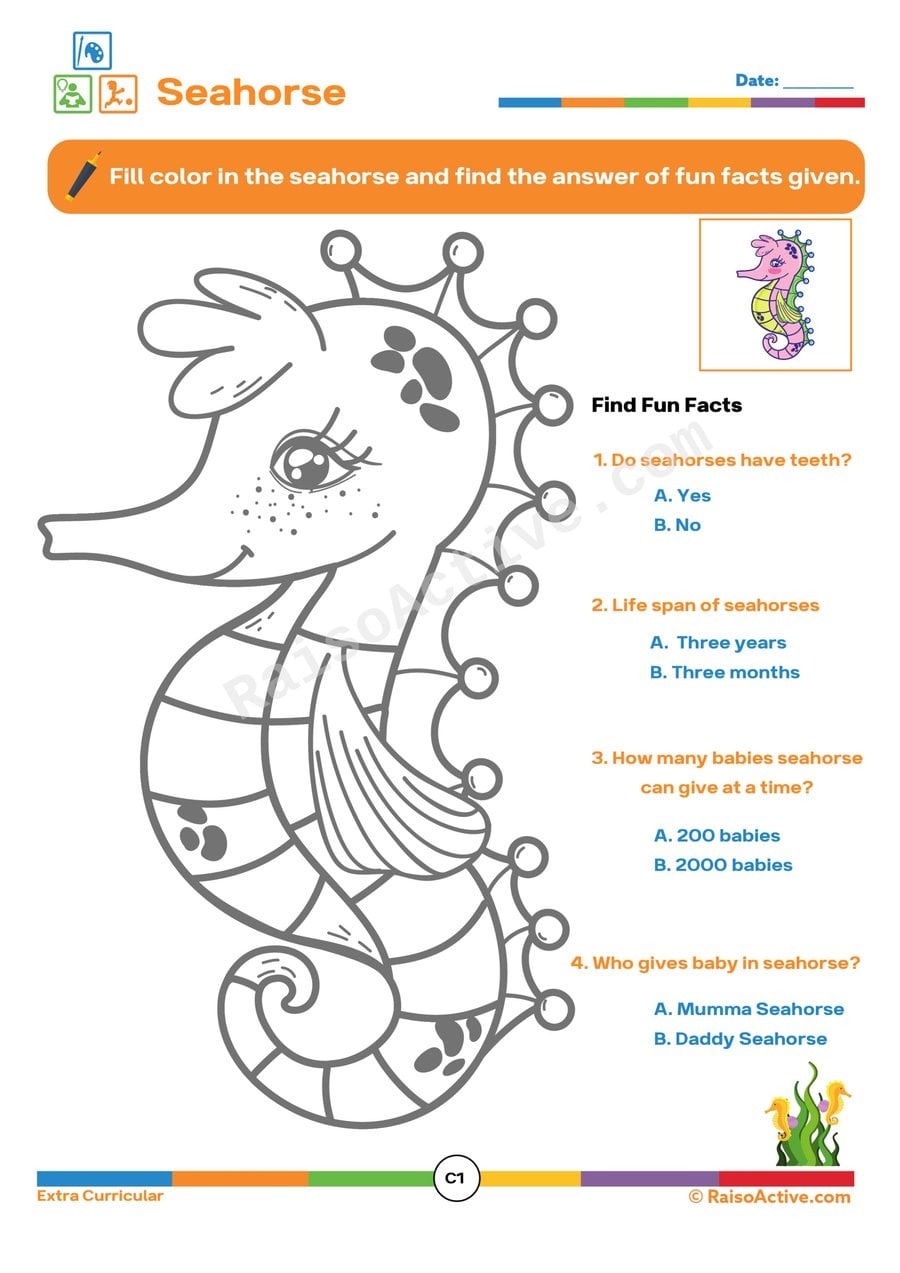
Seahorse Fun Facts Worksheet for Kids
Ages 3-5 · Preschool–Pre-KAges 3-5 · Nursery–ReceptionAges 3-5 · Nursery–LKGAges 3-5
This worksheet combines coloring practice with early reading comprehension by having children ages 3-5 color a seahorse illustration and then answer simple fact-based questions about it by circling the correct choice. Learning specific facts about an unusual sea creature — like that seahorses swim upright or that males carry the eggs — builds background science knowledge that supports later reading comprehension in nonfiction texts. The coloring portion also keeps fine motor practice woven into a subject-focused activity.

Animal Food Matching Worksheet for Preschoolers
Ages 3-5 · Preschool–Pre-KAges 3-5 · Nursery–ReceptionAges 3-5 · Nursery–LKGAges 3-5
This worksheet teaches children ages 3-5 which foods different animals eat by matching each animal to its correct food, building early classification skills and expanding their vocabulary around animals and diets. Learning that a rabbit eats carrots while a bird eats worms also introduces the idea that living things have different needs, a first step toward basic life-science thinking.

Animal's World: Sorting Animals by Land, Water, and Air - Printable Worksheet
Ages 4-6 · Pre-K–KindergartenAges 4-6 · Reception–Year 1Ages 4-6 · LKG–UKGAges 4-6
This sorting worksheet teaches children ages 4-6 to classify animals into three habitat categories — land, water, and air — based on where each animal naturally lives and moves. Classifying by habitat rather than by appearance alone encourages children to think about an animal's features, like fins, wings, or legs, and connect them to function. This three-way sort is more complex than a simple two-category sort, building more advanced categorization skills.
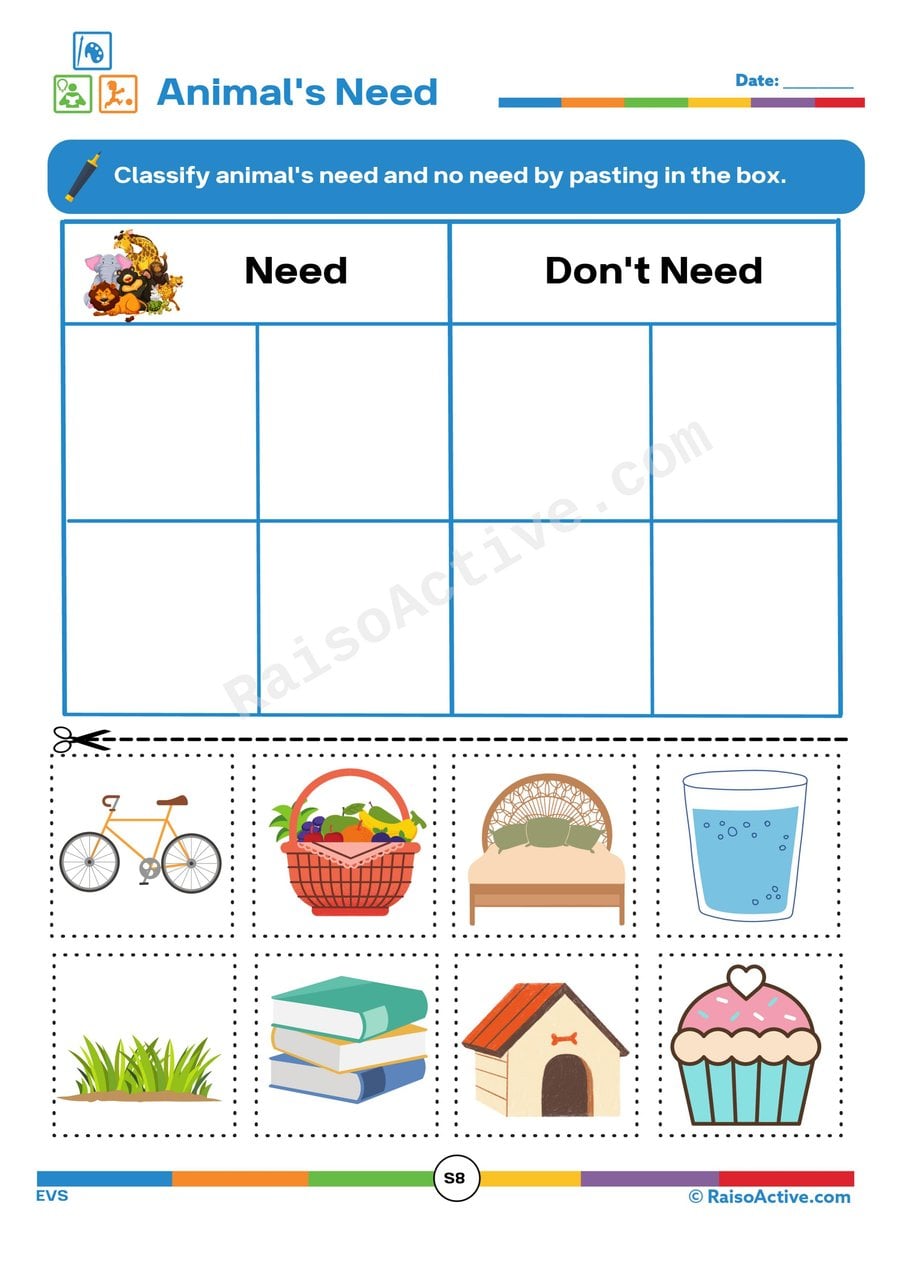
Animal Needs Sorting Worksheet for Preschoolers
Ages 3-5 · Preschool–Pre-KAges 3-5 · Nursery–ReceptionAges 3-5 · Nursery–LKGAges 3-5
This sorting activity helps children ages 3-5 understand that animals have specific survival needs — food, water, shelter, air — by cutting out picture cards and classifying each one as something an animal 'needs' or 'doesn't need.' Making this distinction requires children to reason about cause and effect in a simple form: what happens to an animal without food or water. This early exposure to classification and survival needs lays groundwork for more formal life science concepts children will encounter in later grades.

Animals in Hot Climate Cut and Paste Worksheet for Preschoolers
Ages 3-5 · Preschool–Pre-KAges 3-5 · Nursery–ReceptionAges 3-5 · Nursery–LKGAges 3-5
Preschoolers ages 3-5 learn which animals are adapted to live in hot climates, like camels or lions, by cutting them out and pasting them into a matching habitat scene. This activity builds early science understanding of how animals are suited to their environments, connecting a visual habitat cue to specific animal knowledge. The scissor and glue work also continues developing the fine motor precision needed for later handwriting tasks.
Guides for this topic

Age-Appropriate Problem-Solving Activities: Building Critical Thinkers from the Ground Up
Discover fun, age-appropriate problem-solving activities for children ages 1-8. Build critical thinking, logic, and reasoning skills through play-based learning.
Critical Thinking Activities That Actually Work for Young Children: Building Tomorrow's Thinkers Today
Discover proven critical thinking activities for young children. Age-wise logic games, questioning techniques, and hands-on ideas to build thinking skills at home.

Preparing Your Child for a Rapidly Changing World: Essential Skills for Future Success
Discover the essential 21st century skills your child needs for future success. Practical tips on creativity, critical thinking, digital literacy & emotional intelligence for ages 1-8.
Reviews
Every worksheet for ages 3–5, no watermark
Members download the full library of 1,000+ worksheets and every activity pack without watermarks or daily limits. One year costs ₹999 in India or $20 elsewhere.
See membership plansOr download any worksheet free with a watermark (5 a day).