Farm Animal Fun: Cut and Paste Worksheet for Preschoolers
Coloring, cutting, and pasting farm animals onto a scene teaches children ages 3-5 farm animal vocabulary while giving substantial fine motor practice through careful cutting along lines. Building the completed farm scene also lets children practice spatial placement, deciding where each animal fits within the picture.
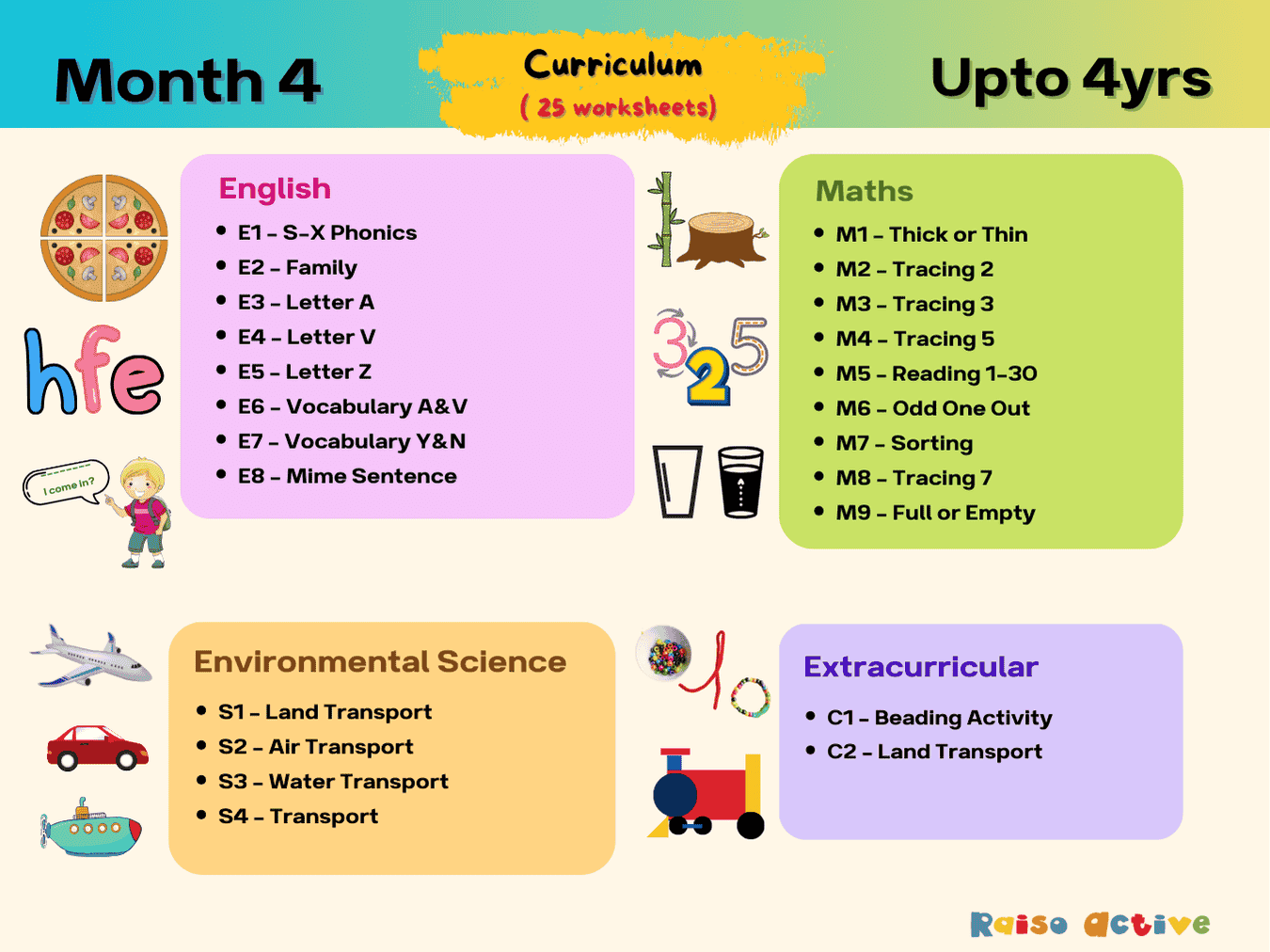
Part of the pack
Month 4: Learning & Development | Ages Up to 4
This is page 21 of the pack. Ages 2-4 · PreschoolAges 2-4 · NurseryAges 2-4
Curriculum
- Living Things - Animals > Animals & Habitats
How to use this worksheet
Have your child color each farm animal on the page first, choosing whatever colors they like. Once colored, help them carefully cut each animal out along the dotted lines. Then have them arrange and glue the animals onto the farm scene background, naming each one as they place it.
Materials needed
- Crayons or colored pencils
- Scissors
- Glue or glue stick
Extension activities
- 1Visit a local farm or petting zoo to see real farm animals in person, if possible.
- 2Play an animal sound matching game, guessing which farm animal makes each noise.
- 3Read a picture book featuring farm animals and compare it to the worksheet.
- 4Build a three-dimensional farm diorama using a shoebox and the animal cutouts.
- 5Make farm animal masks out of paper plates for imaginative play.

Written by
Hemsweta Jain · Teacher Cheena
MBA and Early Childhood Educator, teaching since 2014 · Founder of RaisoActive, Mumbai
Every RaisoActive worksheet is designed and checked by the founder before publishing.
Published · Last reviewed
More from Month 4: Learning & Development | Ages Up to 4
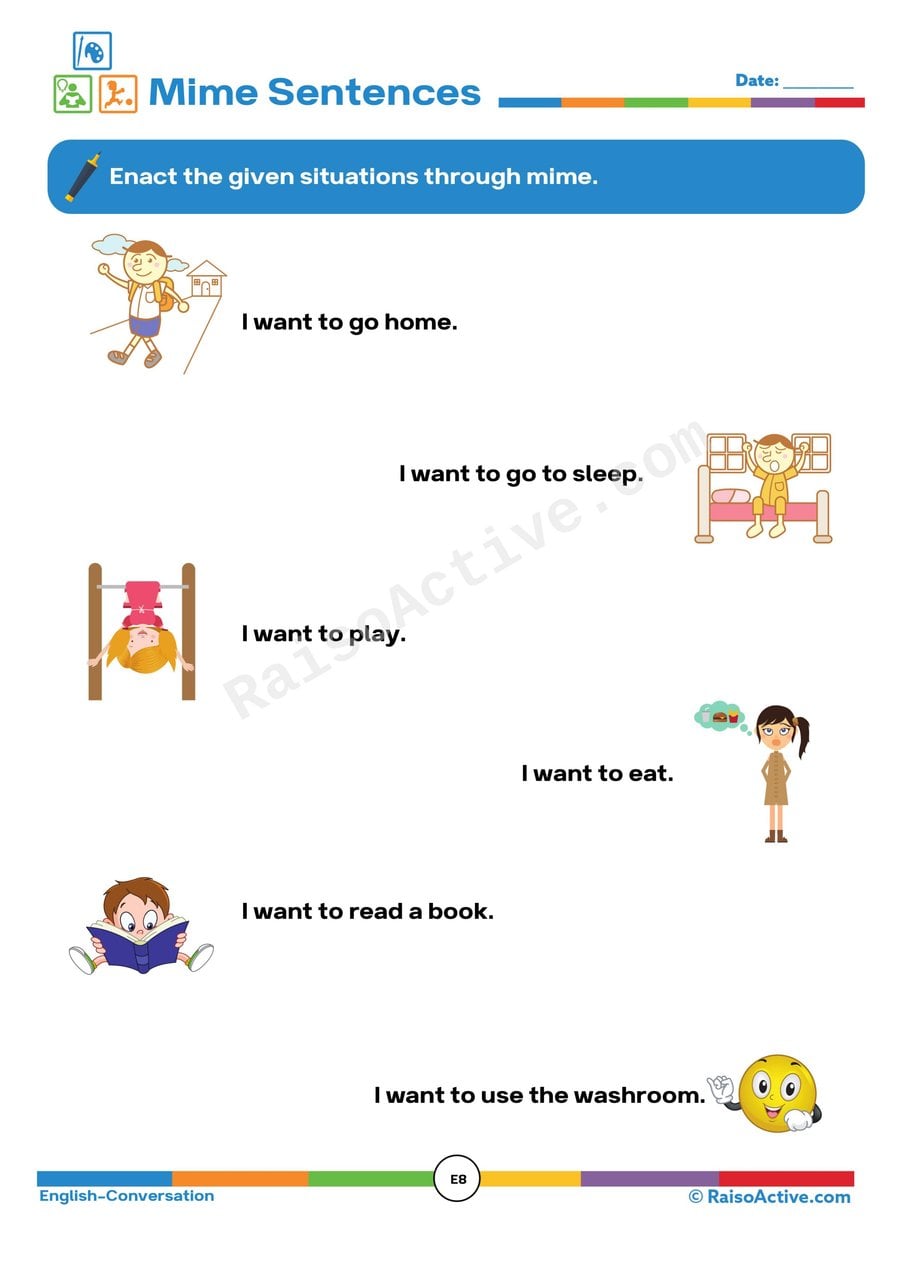
Mime Sentences Worksheet: Act Out Actions!
Ages 3-5 · Preschool–Pre-KAges 3-5 · Nursery–ReceptionAges 3-5 · Nursery–LKGAges 3-5
Reading a sentence and then acting it out through mime teaches children ages 3-5 to connect written or spoken language with physical expression, deepening comprehension of action verbs in a memorable, embodied way. This kind of kinesthetic practice also builds confidence with performance and body awareness alongside early reading skills.

Phonics Fun: Connect the Letters S-X with Starting Sounds Worksheet
Ages 4-6 · Pre-K–KindergartenAges 4-6 · Reception–Year 1Ages 4-6 · LKG–UKGAges 4-6
Connecting pictures to their correct beginning letter across the range S through X helps children ages 4-6 extend their phonics practice beyond the most common early letters, building broader letter-sound matching skills. This wider range also introduces children to less frequently practiced sounds, rounding out their overall phonemic awareness.

Letter A Tracing Worksheet: Learn to Write and Color!
Ages 3-5 · Preschool–Pre-KAges 3-5 · Nursery–ReceptionAges 3-5 · Nursery–LKGAges 3-5
Tracing the uppercase letter A builds the fine motor control and stroke memory children ages 3-5 need for handwriting, while coloring pictures that start with A connects the written letter to its spoken sound and familiar objects. Repeating the tracing after the picture activity provides extra reinforcement of correct letter formation.

Fun Parent's Guide: Vocabulary, Phonics, and Animal Activities!
Ages 3-5 · Preschool–Pre-KAges 3-5 · Nursery–ReceptionAges 3-5 · Nursery–LKGAges 3-5
This parent's guide bundles together activities for vocabulary building, phonics practice, and animal-themed learning, giving children ages 3-5 varied exposure to language concepts like left and right, letter-object matching, and number sorting through hands-on play. Because the activities span several skill areas, the guide offers flexibility to match whatever your child is most interested in on a given day.
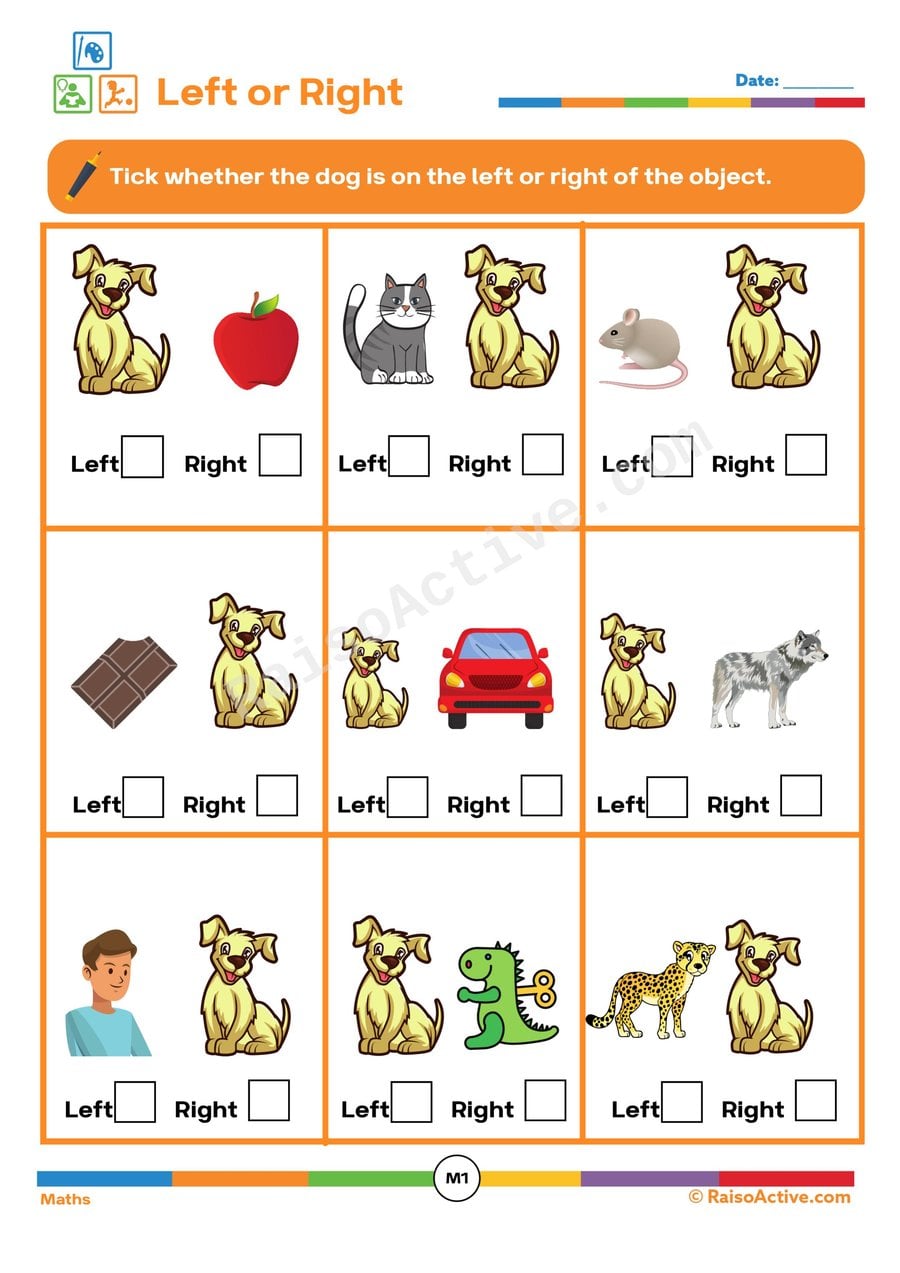
Left or Right Worksheet: Where is the Dog?
Ages 3-5 · Preschool–Pre-KAges 3-5 · Nursery–ReceptionAges 3-5 · Nursery–LKGAges 3-5
Children ages 3-5 build an early sense of directionality as they determine whether the dog sits to the left or right of another object in each picture. This 'left' and 'right' vocabulary is a foundational spatial-reasoning skill that later supports reading direction, map use, and following multi-step instructions. Naming a location relative to another object also strengthens comparative thinking.

Old MacDonald Farm Animal Rhyme Cut and Paste Worksheet
Ages 3-5 · Preschool–Pre-KAges 3-5 · Nursery–ReceptionAges 3-5 · Nursery–LKGAges 3-5
This worksheet connects a familiar nursery rhyme to print as children ages 3-5 cut out pictures of farm animals and paste them into the boxes that match the song's lyrics, linking spoken language to sequence and print concepts. Following the song's order while placing pictures also supports early reading comprehension — understanding that a story or song follows events in a specific order.

Domestic Animals Worksheet for Preschoolers: Circle the Animals!
Ages 3-5 · Preschool–Pre-KAges 3-5 · Nursery–ReceptionAges 3-5 · Nursery–LKGAges 3-5
Circling only the domestic animals among a mixed group teaches children ages 3-5 to apply a category rule to unfamiliar examples, an early reasoning skill that goes beyond simply naming animals they recognize. This visual discrimination task also builds vocabulary as children practice identifying each animal before deciding whether it belongs.

Trace and Write the Number 0 Worksheet for Preschoolers
Ages 3-5 · Preschool–Pre-KAges 3-5 · Nursery–ReceptionAges 3-5 · Nursery–LKGAges 3-5
This worksheet gives children ages 3-5 focused practice forming the number 0, building the fine motor control and pencil grip needed for handwriting while reinforcing that 0 represents 'none' or an empty group. Tracing the curved stroke repeatedly also helps children internalize the shape through muscle memory, which supports faster, more confident number writing later.
Related worksheets

Animal Dice: Fun Movement Activity Worksheet for Kids
Ages 3-5 · Preschool–Pre-KAges 3-5 · Nursery–ReceptionAges 3-5 · Nursery–LKGAges 3-5
This hands-on activity combines craft-making with imaginative movement for children ages 3-5, having them build a paper dice and then act out the animal that lands face-up on each roll. Assembling the cube itself builds fine motor and spatial skills, since folding a flat template into a three-dimensional shape requires understanding how the sides connect. The movement portion that follows then builds gross motor skills, body awareness, and imaginative play as children physically embody different animals' distinctive movements, like hopping like a frog or slithering like a snake.

Animal Sorting Worksheet: Wild, Domestic, and Sea Animals!
Ages 3-5 · Preschool–Pre-KAges 3-5 · Nursery–ReceptionAges 3-5 · Nursery–LKGAges 3-5
This worksheet asks children ages 3-5 to classify animals into three categories - wild, domestic, and sea animals - based on where and how each one lives, building early categorization skills alongside animal and habitat vocabulary. Learning to sort by a shared characteristic, like habitat, is foundational scientific thinking that children will use again and again as they group and compare other things in the world around them.

Animal Sounds Matching Worksheet for Preschoolers
Ages 3-5 · Preschool–Pre-KAges 3-5 · Nursery–ReceptionAges 3-5 · Nursery–LKGAges 3-5
This worksheet strengthens vocabulary and auditory-visual association in children ages 3-5 as they connect each animal picture to the written word for the sound it makes, like 'moo' or 'quack.' Matching sounds to animals also supports early literacy by pairing a familiar spoken word with its printed form, giving children an early, low-pressure introduction to reading words in context.

Peacock Coloring Worksheet for Kids: Fun Facts and Colors!
Ages 3-5 · Preschool–Pre-KAges 3-5 · Nursery–ReceptionAges 3-5 · Nursery–LKGAges 3-5
This worksheet combines creative coloring practice with early science learning for children ages 3-5, as they color a detailed peacock illustration and then read fun facts about this colorful bird. Beyond fine motor and color skills, exposure to real animal facts in a low-pressure, playful format builds curiosity and early nonfiction reading interest.

Animal Needs Worksheet for Kids: Matching and Identifying
Ages 3-5 · Preschool–Pre-KAges 3-5 · Nursery–ReceptionAges 3-5 · Nursery–LKGAges 3-5
This worksheet helps children ages 3-5 understand and articulate the basic survival needs of animals — food, water, air, shelter — by completing sentences with the correct need word and then circling matching pictures. Requiring both a writing and a circling response means children practice the vocabulary in two different formats, reinforcing recall from multiple angles. This groundwork in animal needs also supports later, more complex science concepts about habitats and ecosystems.

Animal Babies Matching Worksheet for Preschoolers
Ages 3-5 · Preschool–Pre-KAges 3-5 · Nursery–ReceptionAges 3-5 · Nursery–LKGAges 3-5
Children ages 3-5 practice matching adult animals to their correct babies, like a cow to a calf or a dog to a puppy, building early animal vocabulary and reinforcing the concept that animal babies often have entirely different names from their parents. This kind of family-relationship matching also strengthens visual comparison and reasoning skills.

Bird Parts Cut and Paste Worksheet for Preschoolers
Ages 3-5 · Preschool–Pre-KAges 3-5 · Nursery–ReceptionAges 3-5 · Nursery–LKGAges 3-5
Children ages 3-5 learn the names of specific bird body parts — such as wings, beak, tail, and feathers — by cutting out labels and pasting them next to the correct part of a bird illustration. This activity builds early scientific vocabulary and observational skills, teaching children to notice distinct features rather than viewing an animal as one shape. The cutting and pasting also develops the scissor control and hand-eye coordination needed for fine motor growth.

Animal Action Cards: Fun Movement Worksheet for Kids!
Ages 3-5 · Preschool–Pre-KAges 3-5 · Nursery–ReceptionAges 3-5 · Nursery–LKGAges 3-5
These animal action cards get children ages 3-5 moving as they follow simple instructions, like hopping like a rabbit or slithering like a snake, combining gross motor development with listening and instruction-following skills. Because each card requires reading or recalling a specific action tied to a specific animal, children also reinforce animal vocabulary and movement-based descriptive language. Turning learning into physical movement is especially valuable for this age group, whose attention and retention often improve dramatically when a body movement is involved.
Guides for this topic

Christmas and Winter Activities That Combine Fun and Learning: Creating Magical Educational Experiences
Discover Christmas and winter activities that combine festive fun with real learning. Crafts, counting, literacy, and printable worksheets for ages 2 to 8 — perfect for home and school.

Creating Engaging Themed Learning Units for Young Children: A Complete Guide to Integrated Learning
Discover how to create engaging themed learning units for young children that integrate literacy, maths, science, and art — with practical examples and free worksheets.
Age-Appropriate Halloween Learning Activities: Balancing Spooks and Skills for Young Learners
Discover fun, age-appropriate Halloween learning activities for young children. Spooky crafts, counting games, literacy ideas, and printable worksheets for ages 2 to 8.
Reviews
Every worksheet for ages 3–5, no watermark
Members download the full library of 1,000+ worksheets and every activity pack without watermarks or daily limits. One year costs ₹999 in India or $20 elsewhere.
See membership plansOr download any worksheet free with a watermark (5 a day).