Animal Sounds Matching Worksheet for Preschoolers
This worksheet strengthens vocabulary and auditory-visual association in children ages 3-5 as they connect each animal picture to the written word for the sound it makes, like 'moo' or 'quack.' Matching sounds to animals also supports early literacy by pairing a familiar spoken word with its printed form, giving children an early, low-pressure introduction to reading words in context.
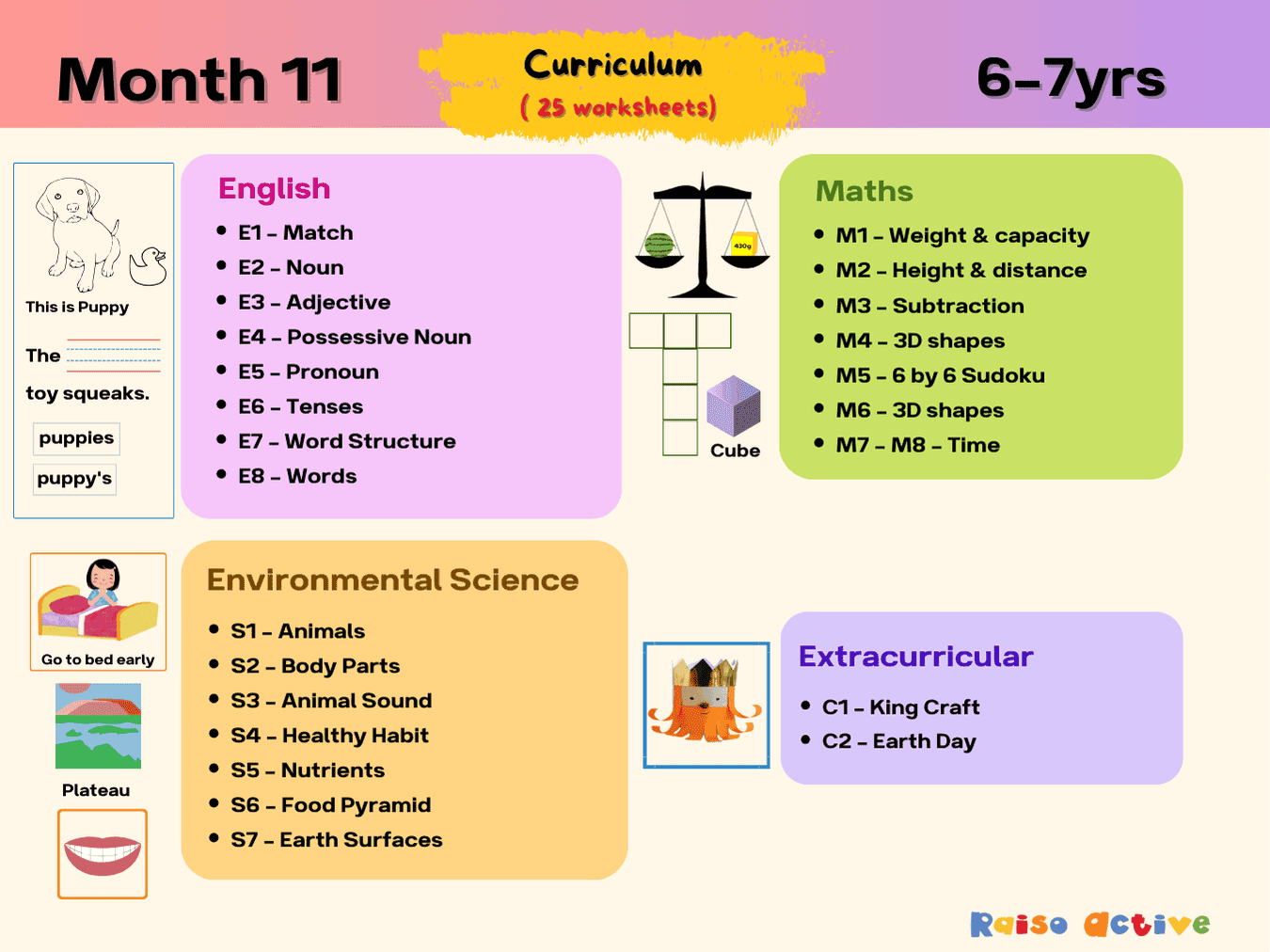
Part of the pack
Month 11: Learning & Development | Ages 6-7
This is page 22 of the pack. Ages 6-7 · Grade 1Ages 6-7 · Year 2Ages 6-7 · Class 1Ages 6-7
Made for your child
Counting to 10, made for your child
A maths pack with your child's name in it: pictures that explain, practice at three levels, puzzles and story sums about them. Print a new set whenever they finish.
Make a maths packFree preview · free for members
Curriculum
- Living Things - Animals > Animals & Habitats
How to use this worksheet
Look at each animal picture together and ask your child to make that animal's sound before looking at the word choices. Read the sound words aloud if your child isn't reading independently yet, and have them draw a line from the animal to the word that matches the sound they just made. Work through the whole page animal by animal, checking each line as you go rather than leaving all the checking for the end. Finish by coloring the animals for extra engagement.
Materials needed
- Pencil
- Crayons
Extension activities
- 1Play an animal sounds guessing game — make a sound and have your child name the animal, then switch roles.
- 2Watch a short video or look at picture books of farm or zoo animals and imitate each sound together.
- 3Make matching flashcards with an animal on one card and its sound word on another to shuffle and pair up.
- 4Visit a farm, zoo, or park and listen for real animal sounds, comparing them to the words on the worksheet.

Written by
Hemsweta Jain · Teacher Cheena
MBA and Early Childhood Educator, teaching since 2014 · Founder of RaisoActive, Mumbai
Every RaisoActive worksheet is designed and checked by the founder before publishing.
Published · Last reviewed
More from Month 11: Learning & Development | Ages 6-7
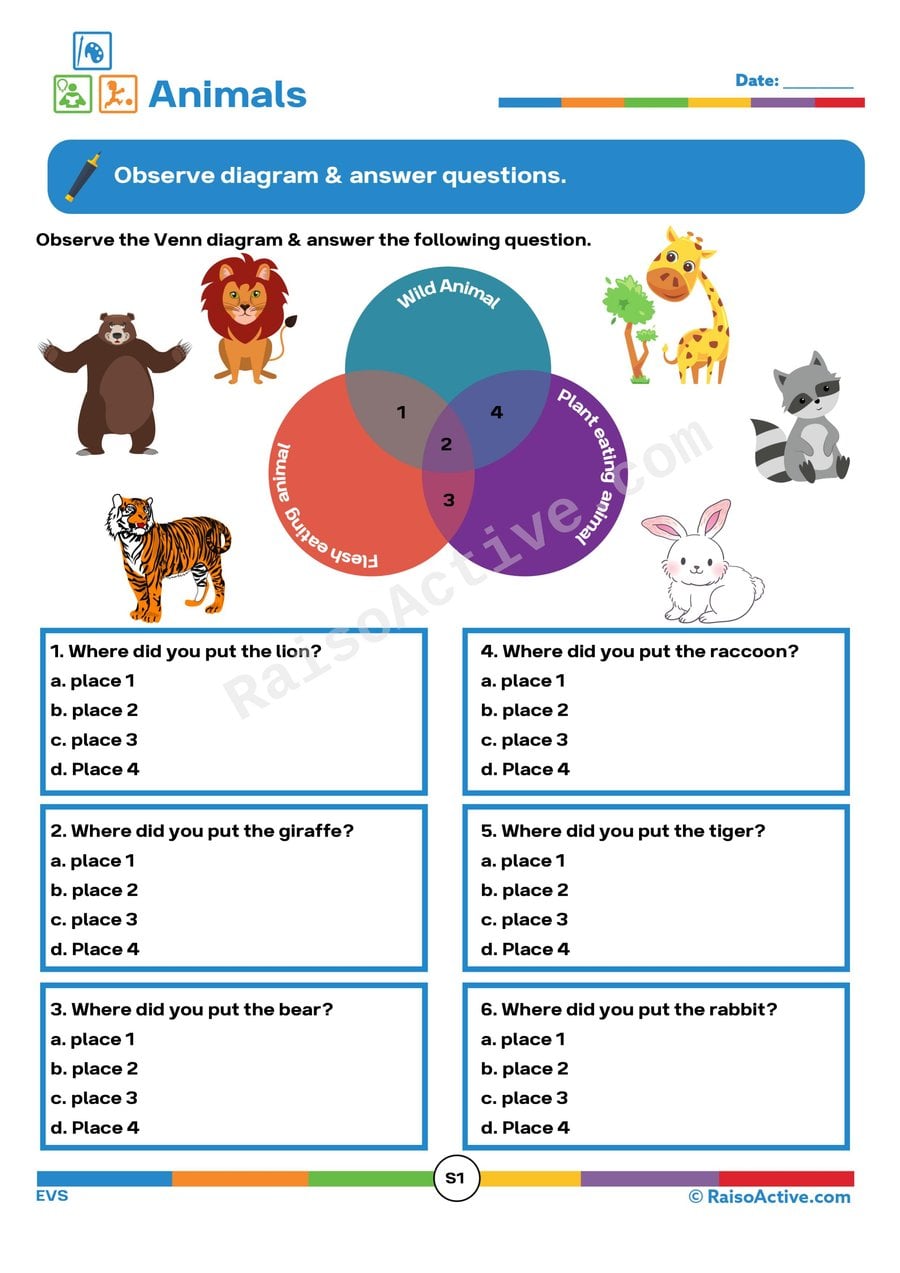
Animal Venn Diagram Worksheet for Kids
Ages 4-6 · Pre-K–KindergartenAges 4-6 · Reception–Year 1Ages 4-6 · LKG–UKGAges 4-6
This worksheet introduces children ages 4-6 to the Venn diagram as a tool for classifying animals by shared and distinct characteristics, such as habitat, number of legs, or covering (fur, feathers, scales). Deciding where an animal belongs — in one circle, the other, or the overlapping middle — builds comparative reasoning and categorization skills that are foundational to later scientific classification work.

Words Worksheet: Unscramble, Capitalize, and Choose the Best Word!
Ages 4-6 · Pre-K–KindergartenAges 4-6 · Reception–Year 1Ages 4-6 · LKG–UKGAges 4-6
This multi-part worksheet challenges children ages 4-6 to unscramble jumbled letters into real words, identify correctly capitalized sentences, and choose the most fitting word to complete a sentence. Combining these three tasks on one page builds spelling, sentence-level grammar awareness, and vocabulary precision together, pushing children to apply several early literacy skills in a single sitting rather than practicing them in isolation.

Food Pyramid Worksheet: Learn About Healthy Eating!
Ages 3-5 · Preschool–Pre-KAges 3-5 · Nursery–ReceptionAges 3-5 · Nursery–LKGAges 3-5
This worksheet introduces children ages 3-5 to the food pyramid as a visual guide for balanced eating, helping them understand that different food groups should be eaten in different amounts. Filling in the blanks about food groups and serving sizes builds early nutrition literacy and reinforces the idea that a healthy diet includes variety, not just favorite foods.
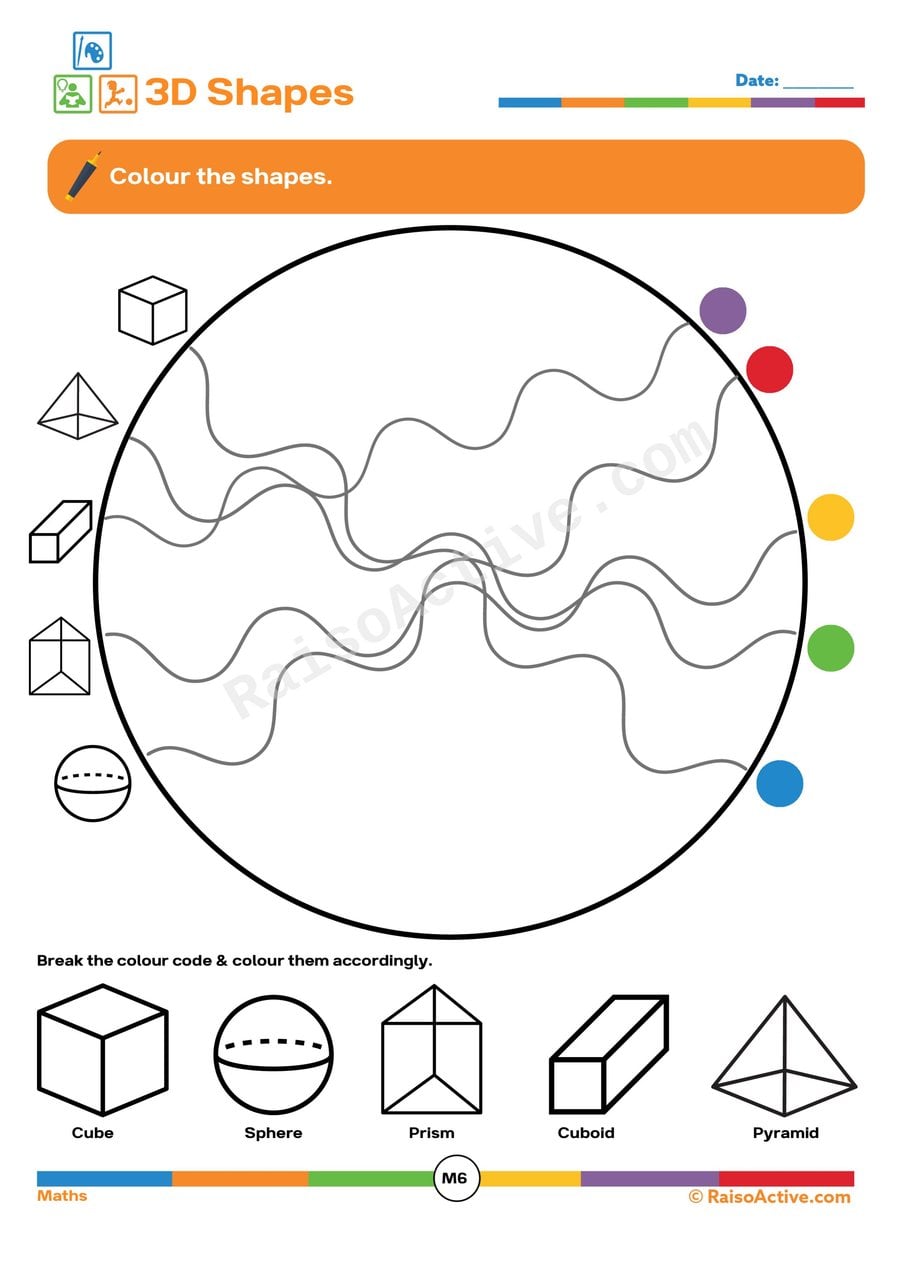
Color the 3D Shapes Worksheet for Kids
Ages 3-5 · Preschool–Pre-KAges 3-5 · Nursery–ReceptionAges 3-5 · Nursery–LKGAges 3-5
Children ages 3-5 build early geometry vocabulary by learning to name and visually recognize five 3D shapes — cube, sphere, prism, cuboid, and pyramid — a step beyond the flat 2D shapes most preschool worksheets cover. Following a color-code instruction while coloring also strengthens their ability to hold and apply a rule, and the repeated coloring motion builds hand strength and control useful for future writing.

Earth Day Sorting Worksheet: Good vs. Bad for the Environment!
Ages 4-6 · Pre-K–KindergartenAges 4-6 · Reception–Year 1Ages 4-6 · LKG–UKGAges 4-6
Sorting pictures of everyday actions into 'good for the environment' and 'bad for the environment' introduces children ages 4-6 to cause-and-effect reasoning about human impact, an early building block for environmental awareness and responsible habits.
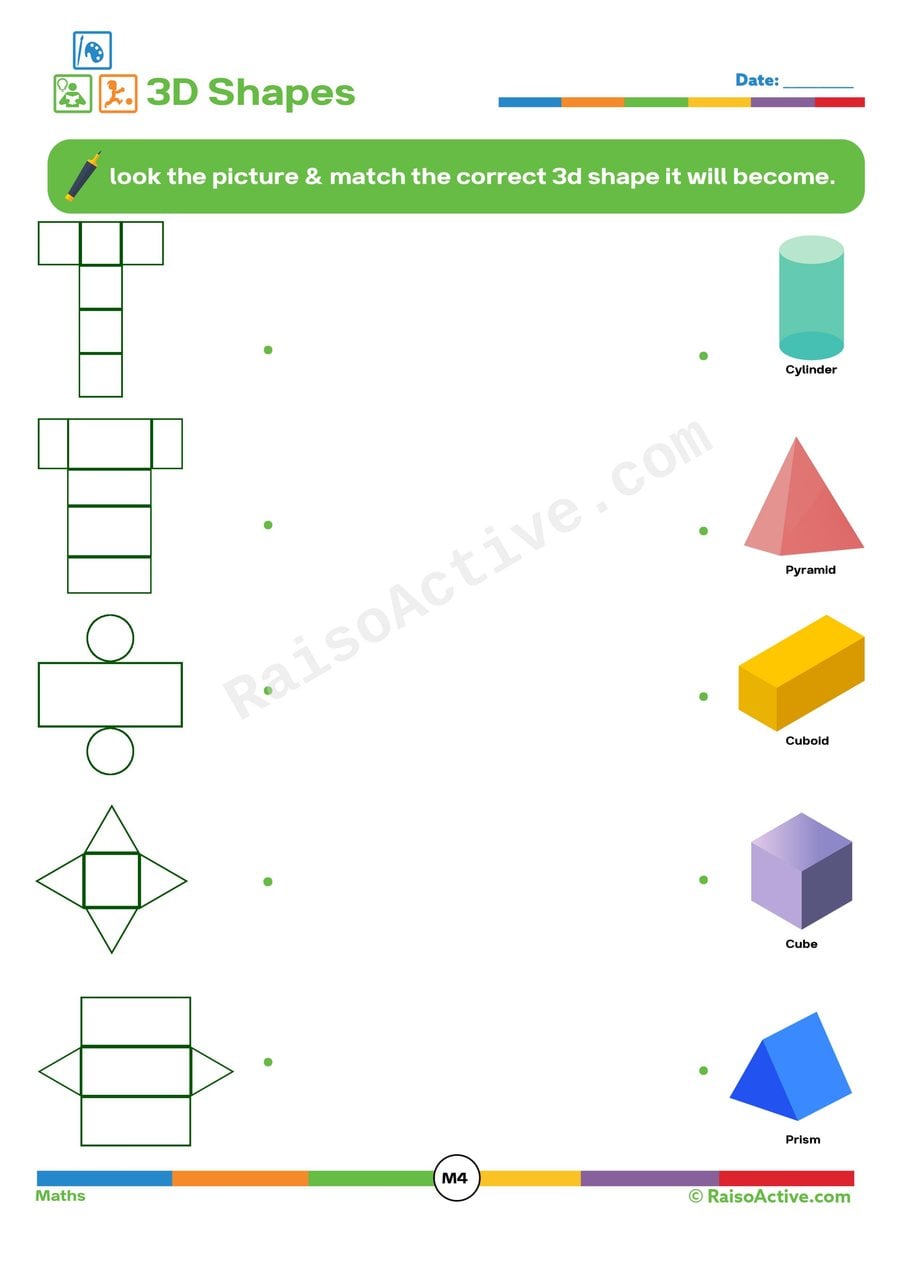
3D Shapes Matching Worksheet for Preschoolers
Ages 3-5 · Preschool–Pre-KAges 3-5 · Nursery–ReceptionAges 3-5 · Nursery–LKGAges 3-5
Connecting a flat, unfolded 2D net to the 3D shape it forms when folded builds spatial reasoning for children ages 3-5, an early introduction to geometry that helps them visualize how flat surfaces combine into solid forms like cubes and cones.

Subtraction Fun: Practice Problems for Early Learners
Ages 4-6 · Pre-K–KindergartenAges 4-6 · Reception–Year 1Ages 4-6 · LKG–UKGAges 4-6
This worksheet gives children ages 4-6 repeated practice with basic subtraction, working through simple equations and word problems that build number sense before formal arithmetic instruction begins. Filling in missing numbers within equations also introduces the idea that subtraction is reversible and connected to addition, an early step toward flexible number thinking. Repeated, varied practice like this helps subtraction facts move from effortful counting to quick recall.

Noun, Pronoun, or Adjective? Match the Words! Worksheet for Kids
Ages 4-6 · Pre-K–KindergartenAges 4-6 · Reception–Year 1Ages 4-6 · LKG–UKGAges 4-6
This worksheet introduces children ages 4-6 to three foundational parts of speech — nouns, pronouns, and adjectives — by asking them to sort individual words into the correct grammatical category. Learning to tell these word types apart early gives children a vocabulary for talking about language itself, which supports both reading comprehension and their own sentence writing later on. Matching words to pictures also keeps an abstract grammar concept grounded in something concrete and visual.
Related worksheets

Farm Animal Fun: Cut and Paste Worksheet for Preschoolers
Ages 3-5 · Preschool–Pre-KAges 3-5 · Nursery–ReceptionAges 3-5 · Nursery–LKGAges 3-5
Coloring, cutting, and pasting farm animals onto a scene teaches children ages 3-5 farm animal vocabulary while giving substantial fine motor practice through careful cutting along lines. Building the completed farm scene also lets children practice spatial placement, deciding where each animal fits within the picture.

Animal Action Cards: Fun Movement Worksheet for Kids!
Ages 3-5 · Preschool–Pre-KAges 3-5 · Nursery–ReceptionAges 3-5 · Nursery–LKGAges 3-5
These animal action cards get children ages 3-5 moving as they follow simple instructions, like hopping like a rabbit or slithering like a snake, combining gross motor development with listening and instruction-following skills. Because each card requires reading or recalling a specific action tied to a specific animal, children also reinforce animal vocabulary and movement-based descriptive language. Turning learning into physical movement is especially valuable for this age group, whose attention and retention often improve dramatically when a body movement is involved.

Animal Babies Matching Worksheet for Preschoolers
Ages 3-5 · Preschool–Pre-KAges 3-5 · Nursery–ReceptionAges 3-5 · Nursery–LKGAges 3-5
Children ages 3-5 practice matching adult animals to their correct babies, like a cow to a calf or a dog to a puppy, building early animal vocabulary and reinforcing the concept that animal babies often have entirely different names from their parents. This kind of family-relationship matching also strengthens visual comparison and reasoning skills.

Peacock Coloring Worksheet for Kids: Fun Facts and Colors!
Ages 3-5 · Preschool–Pre-KAges 3-5 · Nursery–ReceptionAges 3-5 · Nursery–LKGAges 3-5
This worksheet combines creative coloring practice with early science learning for children ages 3-5, as they color a detailed peacock illustration and then read fun facts about this colorful bird. Beyond fine motor and color skills, exposure to real animal facts in a low-pressure, playful format builds curiosity and early nonfiction reading interest.

Animal Dice: Fun Movement Activity Worksheet for Kids
Ages 3-5 · Preschool–Pre-KAges 3-5 · Nursery–ReceptionAges 3-5 · Nursery–LKGAges 3-5
This hands-on activity combines craft-making with imaginative movement for children ages 3-5, having them build a paper dice and then act out the animal that lands face-up on each roll. Assembling the cube itself builds fine motor and spatial skills, since folding a flat template into a three-dimensional shape requires understanding how the sides connect. The movement portion that follows then builds gross motor skills, body awareness, and imaginative play as children physically embody different animals' distinctive movements, like hopping like a frog or slithering like a snake.
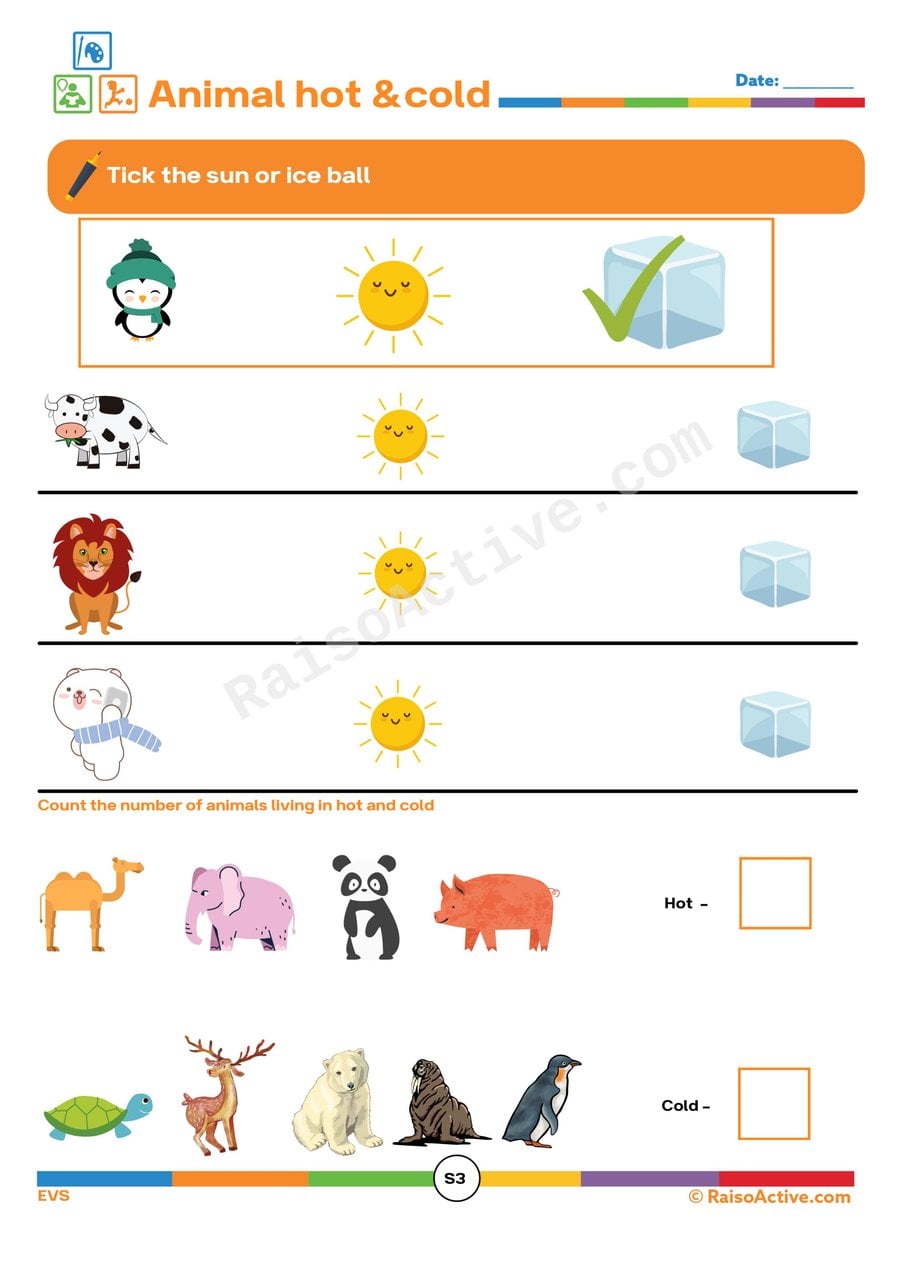
Animal Hot and Cold Worksheet for Preschoolers
Ages 3-5 · Preschool–Pre-KAges 3-5 · Nursery–ReceptionAges 3-5 · Nursery–LKGAges 3-5
This worksheet asks children to reason about which environment, hot or cold, best suits a given animal, then apply a counting task on top of that sorting decision. Combining habitat reasoning with counting practice keeps two important skill areas, science classification and numeracy, active in the same activity, which helps preschoolers see connections across subjects rather than treating them separately.
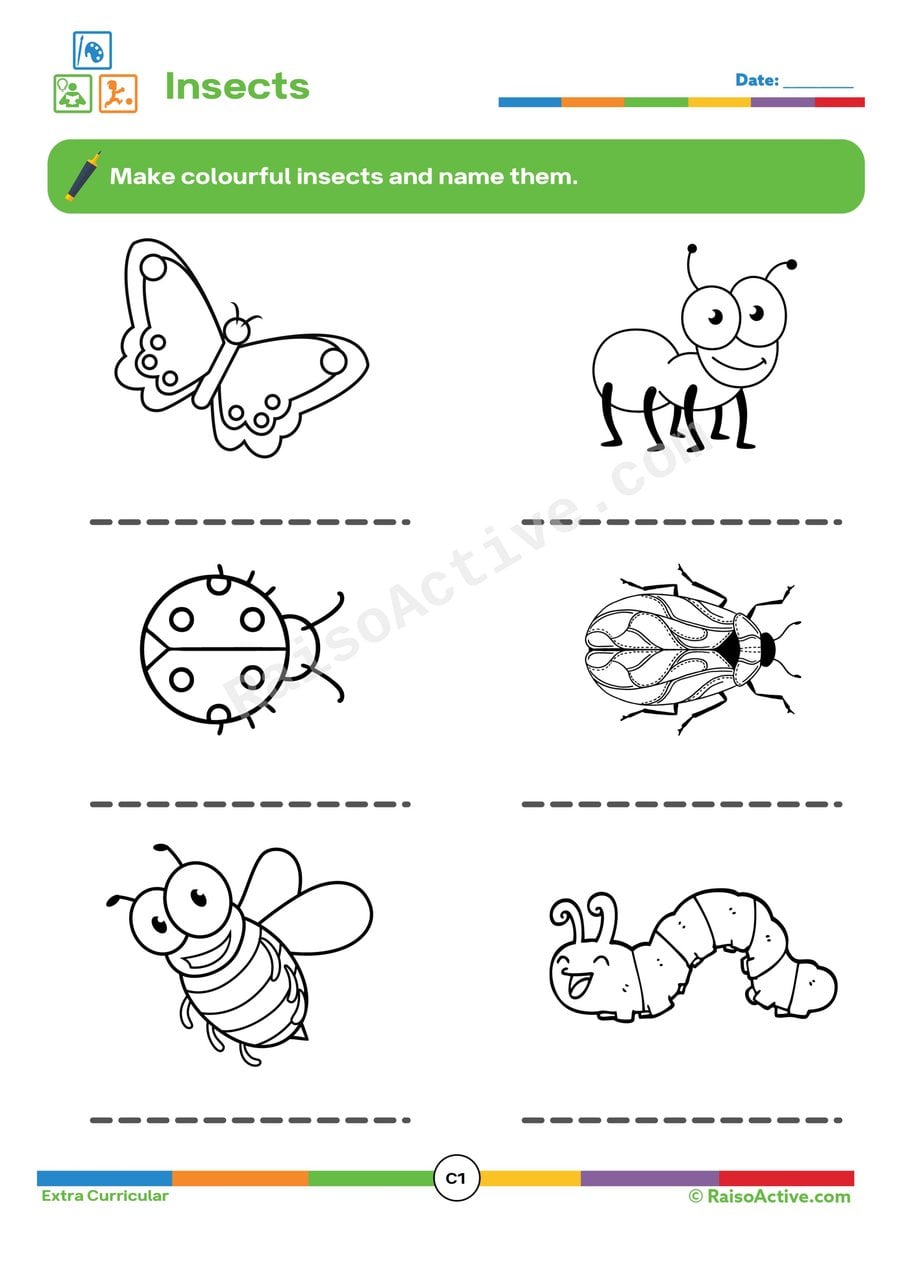
Color the Insects Worksheet for Preschoolers
Ages 3-5 · Preschool–Pre-KAges 3-5 · Nursery–ReceptionAges 3-5 · Nursery–LKGAges 3-5
Coloring a set of insects and writing their names afterward helps children ages 3-5 build insect vocabulary while practicing fine motor coloring control and connecting a picture to its written word. This combination of art and labeling reinforces new vocabulary more effectively than looking at pictures alone.

Young and Old Animals Worksheet: Circle the Correct Ones!
Ages 3-5 · Preschool–Pre-KAges 3-5 · Nursery–ReceptionAges 3-5 · Nursery–LKGAges 3-5
Distinguishing between young and old animals introduces children ages 3-5 to basic life cycle concepts and comparative observation, asking them to notice visual cues like size and features that indicate an animal's age. This worksheet has children first sort animals by age category and then match young animals to their adult counterparts, layering categorization practice on top of matching skills. Understanding that a puppy grows into a dog or a chick grows into a hen also lays early groundwork for later science topics like animal life cycles and growth.
Guides for this topic

Best Worksheets for 3-Year-Olds: What Works and What to Avoid
What works on worksheets for 3-year-olds: short sessions, crayons, tracing lines, matching, cutting, a free weekly plan, and signs one is too advanced.

Discovering Wonder: Nature-Based Learning Activities That Captivate Young Children
Explore nature-based learning activities for children ages 2–7 — leaf rubbings, bug hunts, nature journals, and seasonal Indian outdoor ideas that spark wonder.

Creating Engaging Themed Learning Units for Young Children: A Complete Guide to Integrated Learning
Discover how to create engaging themed learning units for young children that integrate literacy, maths, science, and art — with practical examples and free worksheets.
Reviews
Every worksheet for ages 3–5, no watermark
Members download the full library of 1,000+ worksheets and every activity pack without watermarks or daily limits. One year costs ₹999 in India or $20 elsewhere.
See membership plansOr download any worksheet free with a watermark (5 a day).