Animal Venn Diagram Worksheet for Kids
This worksheet introduces children ages 4-6 to the Venn diagram as a tool for classifying animals by shared and distinct characteristics, such as habitat, number of legs, or covering (fur, feathers, scales). Deciding where an animal belongs — in one circle, the other, or the overlapping middle — builds comparative reasoning and categorization skills that are foundational to later scientific classification work.
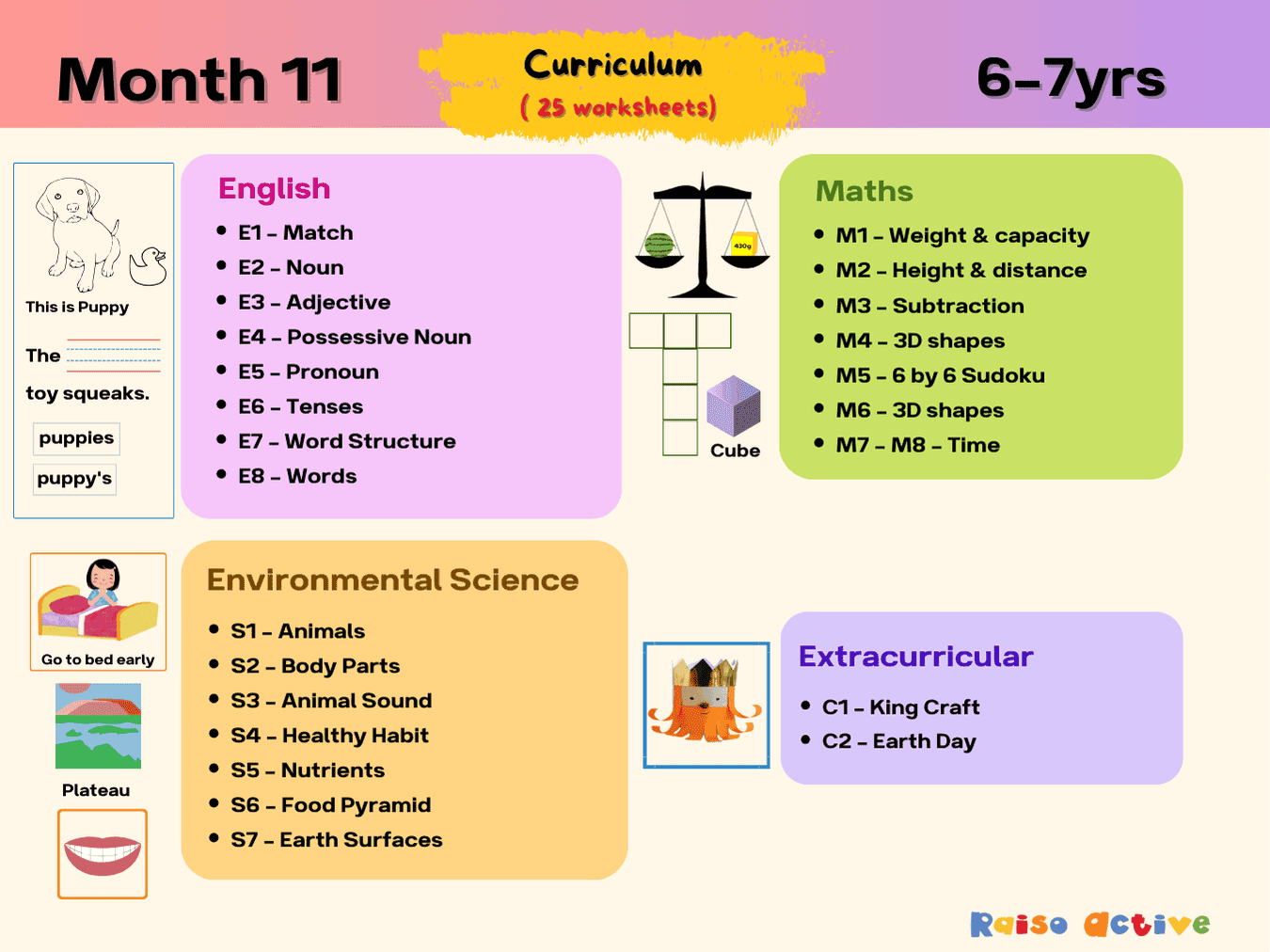
Part of the pack
Month 11: Learning & Development | Ages 6-7
This is page 20 of the pack. Ages 6-7 · Grade 1Ages 6-7 · Year 2Ages 6-7 · Class 1Ages 6-7
Curriculum
- Living Things - Animals > Animals & Habitats
How to use this worksheet
Look at the two circles and their labels together, discussing what characteristic each circle represents. Read the first question and look at the animal choices, talking through which circle — or the overlapping middle section — best fits each one based on its features. Have your child mark or write their answer in the correct section of the diagram. Continue through each remaining question, encouraging your child to explain why an animal belongs where they've placed it.
Materials needed
- Pencil
Extension activities
- 1Draw your own two-circle Venn diagram comparing two categories your child is interested in, like pets versus wild animals.
- 2Research one animal from the diagram in more detail and find out other interesting facts about it.
- 3Sort toy animals into physical groups on the floor that mirror a Venn diagram's overlapping circles.
- 4Compare two family members' favorite foods or activities using a simple Venn diagram.

Written by
Hemsweta Jain · Teacher Cheena
MBA and Early Childhood Educator, teaching since 2014 · Founder of RaisoActive, Mumbai
Every RaisoActive worksheet is designed and checked by the founder before publishing.
Published · Last reviewed
More from Month 11: Learning & Development | Ages 6-7

Adjective Adventure: Circle the Correct Words Worksheet
Ages 4-6 · Pre-K–KindergartenAges 4-6 · Reception–Year 1Ages 4-6 · LKG–UKGAges 4-6
Children ages 4-6 practice identifying adjectives, the describing words that tell more about a noun, by reading sentences and circling the word that adds detail or description. Learning to spot adjectives is a foundational grammar skill that also helps children add more vivid, specific description to their own writing and speech.
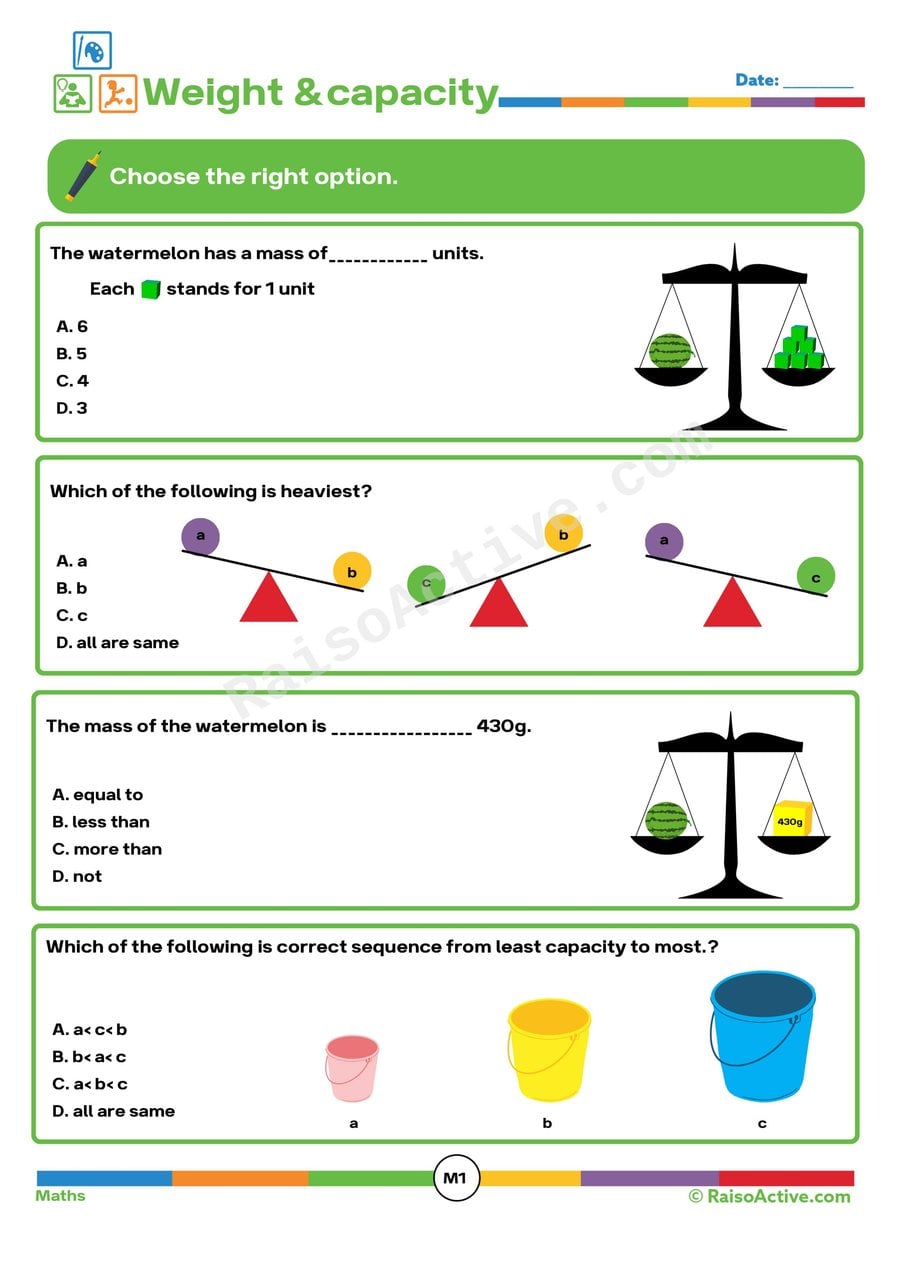
Weight and Capacity Worksheet for Preschoolers
Ages 4-6 · Pre-K–KindergartenAges 4-6 · Reception–Year 1Ages 4-6 · LKG–UKGAges 4-6
Comparing objects visually to judge which is heavier or holds more introduces children ages 4-6 to early measurement concepts, building the comparative reasoning that underlies later formal measurement with scales and measuring cups.

Pronoun Power: Cut & Paste Matching Worksheet for Preschoolers
Ages 4-6 · Pre-K–KindergartenAges 4-6 · Reception–Year 1Ages 4-6 · LKG–UKGAges 4-6
Children ages 4-6 practice recognizing and applying pronouns — he, she, it, they, and similar words — by reading a short sentence, deciding which pronoun fits the picture, and physically placing it in the right spot. Cutting and pasting adds a fine motor and sequencing component on top of the grammar skill, since children must locate, cut, and correctly position each pronoun piece. This hands-on format helps pronoun concepts stick better than reading alone.

Tenses Worksheet: Identifying Past, Present, and Future Verbs
Ages 4-6 · Pre-K–KindergartenAges 4-6 · Reception–Year 1Ages 4-6 · LKG–UKGAges 4-6
Identifying whether an underlined verb describes something that already happened, is happening now, or will happen later introduces children ages 4-6 to verb tense, an important step toward constructing grammatically correct sentences of their own.
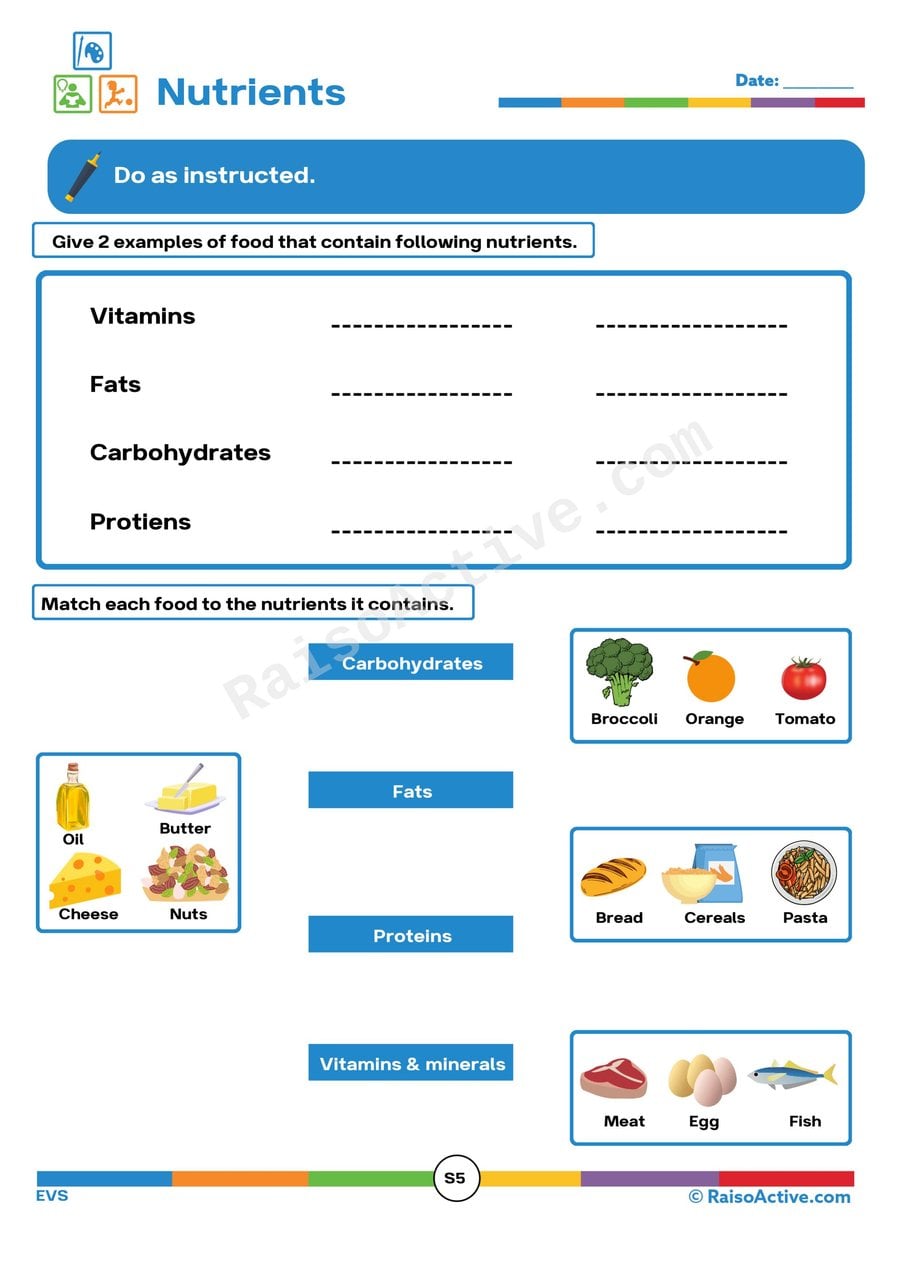
Nutrient Match: Food Examples Worksheet for Kids
Ages 4-6 · Pre-K–KindergartenAges 4-6 · Reception–Year 1Ages 4-6 · LKG–UKGAges 4-6
This worksheet introduces children ages 4-6 to basic nutrition concepts by having them match food items to the nutrient category they belong to — vitamins, fats, carbohydrates, or proteins — and then name additional food examples for each. Going beyond a simple healthy/unhealthy sort, this task builds a more detailed understanding of why different foods matter for the body, an early foundation for lifelong healthy eating habits.

Healthy Habits Worksheet for Kids: Sorting Activities
Ages 3-5 · Preschool–Pre-KAges 3-5 · Nursery–ReceptionAges 3-5 · Nursery–LKGAges 3-5
This worksheet helps children ages 3-5 build early health literacy by looking at pictures of daily habits, like brushing teeth or eating vegetables, and deciding whether each one is healthy or unhealthy. Making this judgment requires applying general knowledge about wellbeing to a specific picture, which builds reasoning skills alongside foundational health awareness that supports good routines.
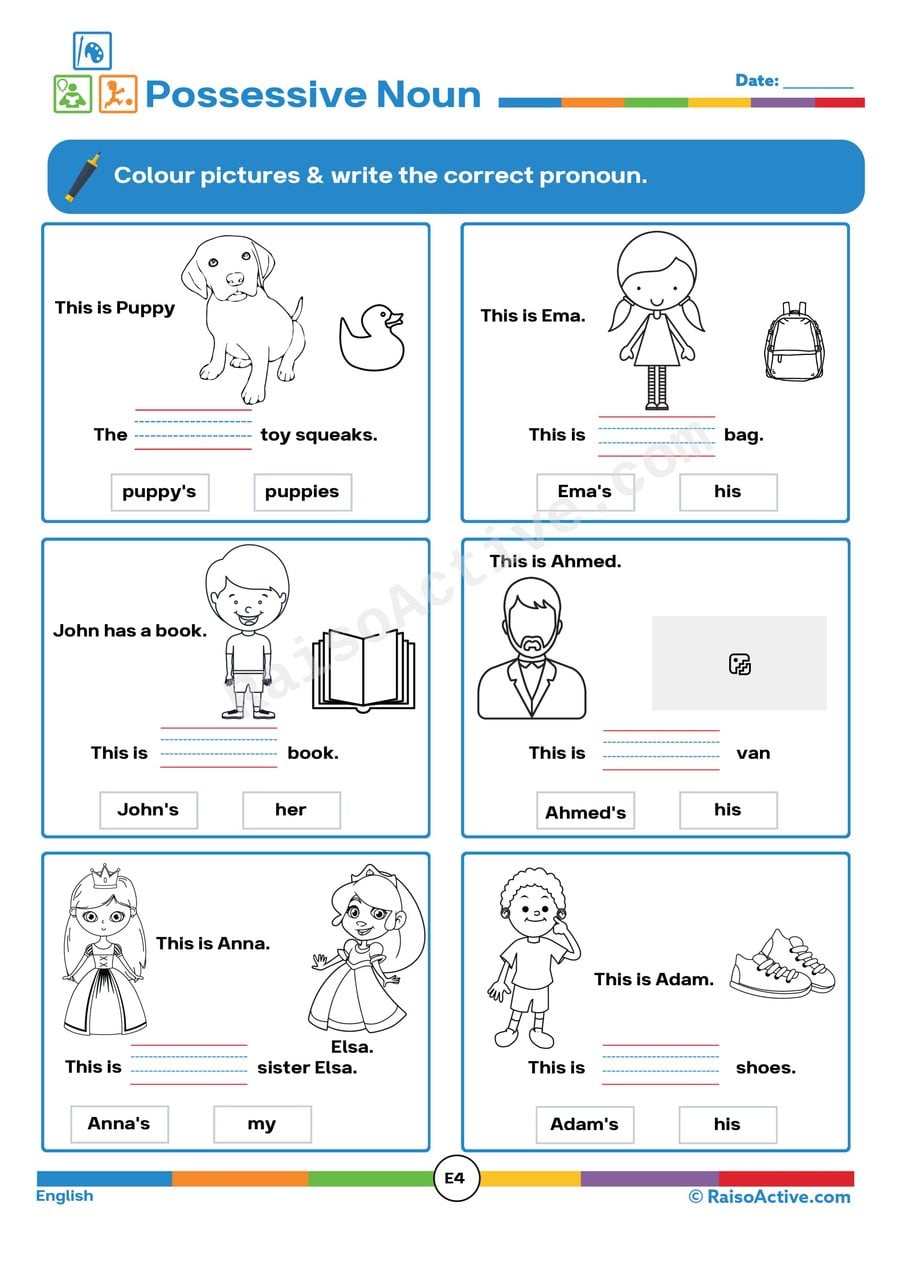
Possessive Nouns Worksheet: Color and Write!
Ages 4-6 · Pre-K–KindergartenAges 4-6 · Reception–Year 1Ages 4-6 · LKG–UKGAges 4-6
Children ages 4-6 practice forming possessive nouns, learning to add an apostrophe and 's' to show that something belongs to someone, like 'the dog's bone.' This is a specific grammar rule that children will use constantly once they start writing about ownership in their own sentences.
Month 11: Learning & Development | Ages 6-7 - Page 16
Ages 6-7 · Grade 1Ages 6-7 · Year 2Ages 6-7 · Class 1Ages 6-7
This page serves as the table of contents for Month 11 of the Ages 6-7 Learning & Development plan, giving parents and teachers a clear map of the skills and worksheets covered that month, from literacy and math practice to critical thinking activities. Reviewing it first sets expectations for the pacing and variety of learning a 6-7 year old will encounter across the month.
Related worksheets

Animals in Cold Climates Cut and Paste Worksheet for Kids
Ages 3-5 · Preschool–Pre-KAges 3-5 · Nursery–ReceptionAges 3-5 · Nursery–LKGAges 3-5
Sorting animals into the cold-climate habitats where they actually live introduces preschoolers to the idea that different animals are adapted to survive in different environments, an early building block for later lessons in ecosystems and animal science. The cutting and pasting also reinforces fine motor control while giving children a reason to look closely at each animal picture and recall what they know about it.

Animal Dice: Fun Movement Activity Worksheet for Kids
Ages 3-5 · Preschool–Pre-KAges 3-5 · Nursery–ReceptionAges 3-5 · Nursery–LKGAges 3-5
This hands-on activity combines craft-making with imaginative movement for children ages 3-5, having them build a paper dice and then act out the animal that lands face-up on each roll. Assembling the cube itself builds fine motor and spatial skills, since folding a flat template into a three-dimensional shape requires understanding how the sides connect. The movement portion that follows then builds gross motor skills, body awareness, and imaginative play as children physically embody different animals' distinctive movements, like hopping like a frog or slithering like a snake.

Animal Habitats Matching Worksheet for Preschoolers
Ages 3-5 · Preschool–Pre-KAges 3-5 · Nursery–ReceptionAges 3-5 · Nursery–LKGAges 3-5
This worksheet helps children ages 3-5 connect specific animals to their natural homes, reinforcing early science vocabulary around habitats like forests, oceans, and deserts. Matching an animal to its habitat circle first, then cutting and pasting the same animal into a corresponding box, gives two rounds of practice with the same concept using different formats. This repetition helps solidify the animal-habitat pairing in memory.

Animal Sorting Worksheet: Wild vs. Domestic Animals
Ages 3-5 · Preschool–Pre-KAges 3-5 · Nursery–ReceptionAges 3-5 · Nursery–LKGAges 3-5
Sorting animal pictures into wild and domestic categories teaches children ages 3-5 an early form of classification, deciding where an animal belongs based on how it lives rather than its size or appearance alone. Cutting and pasting the animals also builds fine motor precision while reinforcing new animal vocabulary along the way.

Animal Food Matching Worksheet for Preschoolers
Ages 3-5 · Preschool–Pre-KAges 3-5 · Nursery–ReceptionAges 3-5 · Nursery–LKGAges 3-5
This worksheet teaches children ages 3-5 which foods different animals eat by matching each animal to its correct food, building early classification skills and expanding their vocabulary around animals and diets. Learning that a rabbit eats carrots while a bird eats worms also introduces the idea that living things have different needs, a first step toward basic life-science thinking.

Animal Sounds Worksheet: Circle the Correct Sound!
Ages 3-5 · Preschool–Pre-KAges 3-5 · Nursery–ReceptionAges 3-5 · Nursery–LKGAges 3-5
This worksheet strengthens vocabulary and reading readiness for children ages 3-5 by asking them to match each animal picture to the word describing the sound it makes, such as 'moo' for a cow or 'quack' for a duck. Connecting a familiar sound to its written word form is an early step toward reading, since it links spoken vocabulary your child already knows to print they are just beginning to recognize.

Peacock Coloring Worksheet for Kids: Fun Facts and Colors!
Ages 3-5 · Preschool–Pre-KAges 3-5 · Nursery–ReceptionAges 3-5 · Nursery–LKGAges 3-5
This worksheet combines creative coloring practice with early science learning for children ages 3-5, as they color a detailed peacock illustration and then read fun facts about this colorful bird. Beyond fine motor and color skills, exposure to real animal facts in a low-pressure, playful format builds curiosity and early nonfiction reading interest.

Wild or Domestic? Animal Sorting Worksheet for Kids
Ages 3-5 · Preschool–Pre-KAges 3-5 · Nursery–ReceptionAges 3-5 · Nursery–LKGAges 3-5
Preschoolers ages 3-5 practice classifying animals into wild and domestic categories, an early science skill that builds understanding of how living things relate to their environment and to humans. Cutting, sorting, and labeling each animal with 'W' or 'D' reinforces the vocabulary of the two categories while strengthening fine motor skills through scissor and glue work. This classification task is a foundational step toward broader scientific thinking about categories and groups.
Guides for this topic

Age-Appropriate Problem-Solving Activities: Building Critical Thinkers from the Ground Up
Discover fun, age-appropriate problem-solving activities for children ages 1-8. Build critical thinking, logic, and reasoning skills through play-based learning.
Critical Thinking Activities That Actually Work for Young Children: Building Tomorrow's Thinkers Today
Discover proven critical thinking activities for young children. Age-wise logic games, questioning techniques, and hands-on ideas to build thinking skills at home.

Preparing Your Child for a Rapidly Changing World: Essential Skills for Future Success
Discover the essential 21st century skills your child needs for future success. Practical tips on creativity, critical thinking, digital literacy & emotional intelligence for ages 1-8.
Reviews
Every worksheet for ages 4–6, no watermark
Members download the full library of 1,000+ worksheets and every activity pack without watermarks or daily limits. One year costs ₹999 in India or $20 elsewhere.
See membership plansOr download any worksheet free with a watermark (5 a day).