Animal Action Cards: Fun Movement Worksheet for Kids!
These animal action cards get children ages 3-5 moving as they follow simple instructions, like hopping like a rabbit or slithering like a snake, combining gross motor development with listening and instruction-following skills. Because each card requires reading or recalling a specific action tied to a specific animal, children also reinforce animal vocabulary and movement-based descriptive language. Turning learning into physical movement is especially valuable for this age group, whose attention and retention often improve dramatically when a body movement is involved.
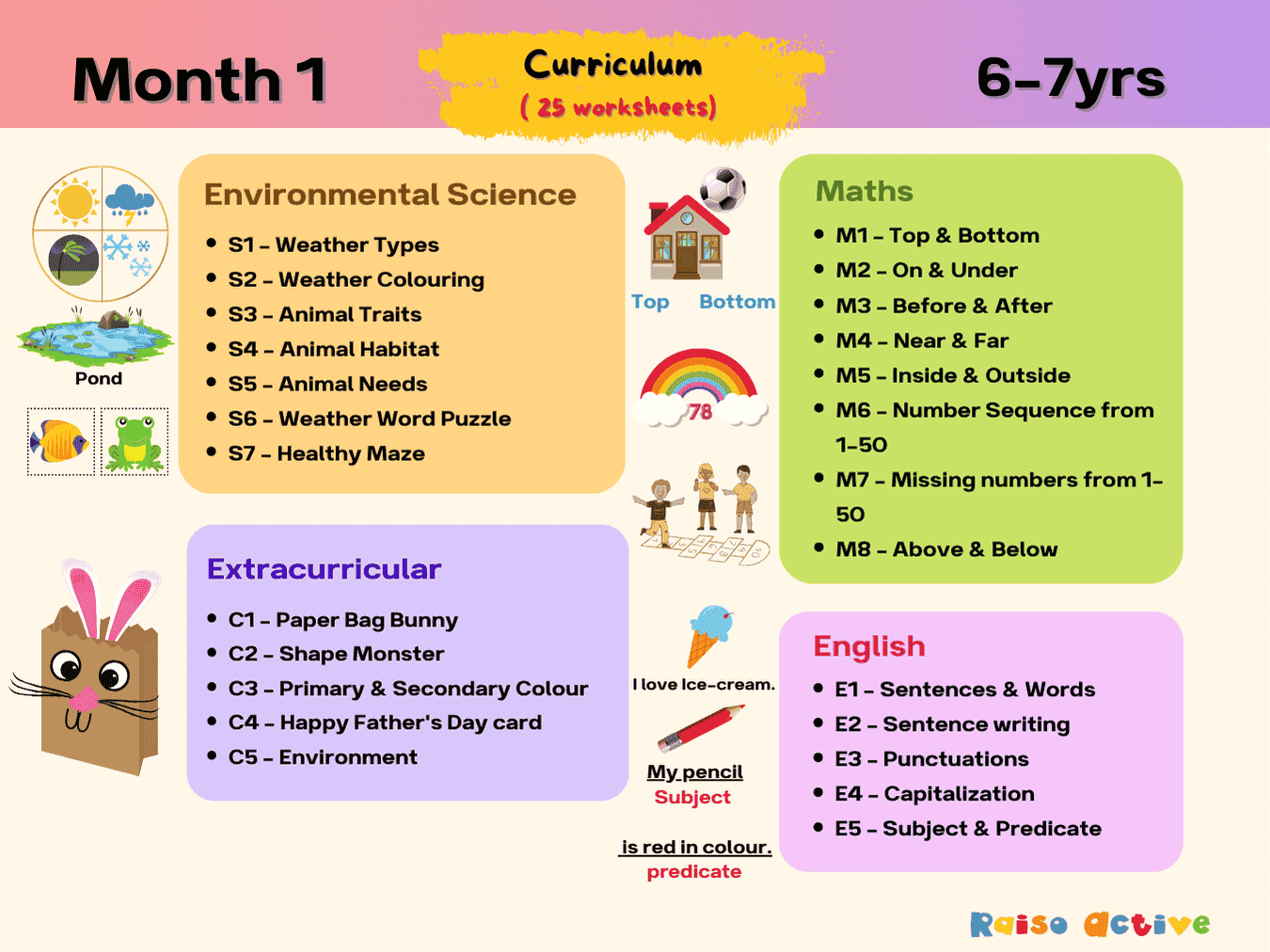
Part of the pack
Month 1: Learning & Development | Ages 6-7
This is page 19 of the pack. Ages 6-7 · Grade 1Ages 6-7 · Year 2Ages 6-7 · Class 1Ages 6-7
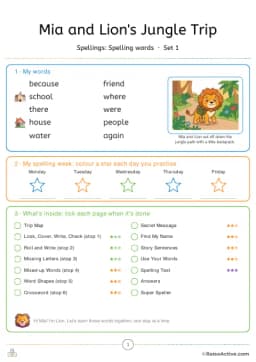
Made for your child
Spelling practice, made for your child
Their own spelling words turned into a pack: trace or look-cover-write-check, roll and write, a secret picture code, a word search, a crossword and a test, with their name in it.
Make a spelling packFree preview · free for members
Or start free: a word search with sight wordsCurriculum
- Living Things - Animals > Animals & Habitats
How to use this worksheet
Cut out each animal action card along the lines. Turn all the cards face down and mix them up, then have your child pick one at random. Read the action printed on the card together, then have your child act out that movement, like hopping, crawling, or flapping. Continue picking and acting out cards until everyone has had several turns.
Materials needed
- Scissors
- Optional: Crayons or markers
Extension activities
- 1Create your own animal action cards for animals not already included.
- 2Act out the actions in a group, taking turns leading while everyone else copies.
- 3Play animal action charades, guessing which animal is being acted out without reading the card.
- 4Make an obstacle course where each station requires a different animal movement.
- 5Talk about how each animal actually moves in real life and why.

Written by
Hemsweta Jain · Teacher Cheena
MBA and Early Childhood Educator, teaching since 2014 · Founder of RaisoActive, Mumbai
Every RaisoActive worksheet is designed and checked by the founder before publishing.
Published · Last reviewed
More from Month 1: Learning & Development | Ages 6-7

Subject and Predicate Sorting Worksheet for Preschoolers
Ages 4-5 · Pre-KAges 4-5 · ReceptionAges 4-5 · LKGAges 4-5
This worksheet introduces children ages 4-5 to a basic building block of sentence grammar, teaching them that every sentence has a subject — who or what it's about — and a predicate — what that subject does or is. Sorting sentence fragments into these two categories helps children start to notice sentence structure, which supports both reading comprehension and their own sentence writing later on. This early grammar awareness lays groundwork for more formal sentence study in kindergarten and beyond.

Handprint Father's Day Card Craft Worksheet for Kids
Ages 3-5 · Preschool–Pre-KAges 3-5 · Nursery–ReceptionAges 3-5 · Nursery–LKGAges 3-5
Painting a handprint and turning it into a Father's Day card gives children ages 3-5 a sensory, hands-on art experience while also creating a lasting keepsake that captures their current hand size. Writing or dictating a message for dad afterward adds an early writing or storytelling component, helping children practice expressing appreciation and affection in words. This project blends fine motor and sensory play with an emotional, relationship-building purpose that goes beyond typical coloring practice.
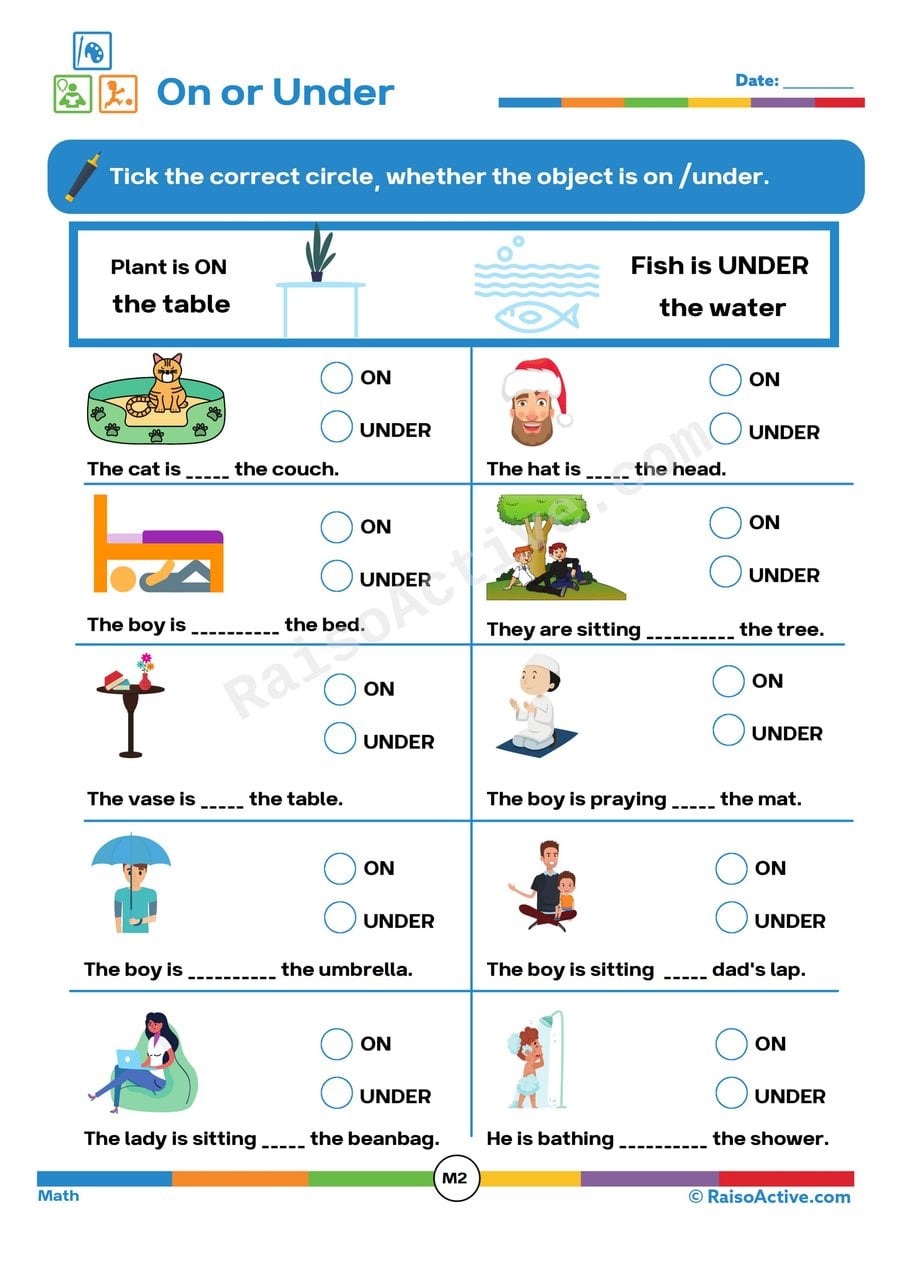
On or Under Worksheet: Where is the Object?
Ages 3-5 · Preschool–Pre-KAges 3-5 · Nursery–ReceptionAges 3-5 · Nursery–LKGAges 3-5
Reading a short sentence describing an object's location and then ticking the picture that matches teaches children ages 3-5 to connect spoken or written prepositions, 'on' and 'under,' to a visual representation, strengthening both listening comprehension and spatial vocabulary. This worksheet requires children to hold a sentence in mind and compare it against a picture, which is a slightly more advanced skill than simply naming a position they can already see. Understanding prepositions like these supports later reading comprehension, since so many simple stories depend on describing where things are.

Keeping Our Environment Clean Worksheet for Kids
Ages 3-5 · Preschool–Pre-KAges 3-5 · Nursery–ReceptionAges 3-5 · Nursery–LKGAges 3-5
This worksheet builds early environmental awareness in children ages 3-5 by having them evaluate pictured actions — like throwing litter in a bin versus littering on the ground — and mark each one as good or bad for the environment. Making this judgment call requires children to connect a specific action to a broader consequence, an early form of cause-and-effect reasoning applied to environmental responsibility. Introducing this concept young helps normalize caring for shared spaces as a natural part of daily behavior rather than an abstract adult concern.

Punctuation Practice Worksheet for Early Learners
Ages 4-6 · Pre-K–KindergartenAges 4-6 · Reception–Year 1Ages 4-6 · LKG–UKGAges 4-6
Children ages 4-6 learn to distinguish between statements and questions by deciding whether each sentence needs a period or a question mark, an early step in understanding how punctuation changes meaning and tone. Recognizing the difference between a question and a statement also supports reading fluency, since readers naturally use rising or falling intonation depending on the punctuation at the end of a sentence.

Paper Bag Bunny Craft Worksheet for Preschoolers
Ages 3-5 · Preschool–Pre-KAges 3-5 · Nursery–ReceptionAges 3-5 · Nursery–LKGAges 3-5
This paper bag craft has children ages 3-5 follow a multi-step sequence of instructions — attaching a pom pom nose, spoon ears, googly eyes, and whisker details — while practicing the fine motor control needed to place and glue small materials precisely. Because the craft uses several different textures and materials in one project, children also get sensory-rich practice beyond typical paper-and-crayon activities. Successfully completing each step in order builds confidence in following sequential, multi-part directions.

My Name is: Sentence Building Worksheet for Early Learners
Ages 3-5 · Preschool–Pre-KAges 3-5 · Nursery–ReceptionAges 3-5 · Nursery–LKGAges 3-5
This sentence-building activity asks children ages 3-5 to cut apart puzzle pieces of words and arrange them in the correct order to form a complete sentence, giving hands-on practice with sentence structure before they write full sentences independently. Physically manipulating word pieces lets children experiment with word order and self-correct by reading the sentence aloud, which is more forgiving than committing straight to writing. Copying the assembled sentence onto lines afterward then bridges the gap from arranging words to writing them from scratch.

Sheep's Barnyard Adventure: A Fun Counting and Movement Worksheet
Ages 4-6 · Pre-K–KindergartenAges 4-6 · Reception–Year 1Ages 4-6 · LKG–UKGAges 4-6
This board-game-style worksheet helps children ages 4-6 practice counting and number recognition by rolling a die and moving a sheep piece along a numbered path, following simple instructions at each stop. Turning counting practice into a game with chance and movement keeps children engaged far longer than a static worksheet, while still reinforcing accurate counting and number sequence recognition along the path.
Related worksheets

Wild Animals Cut and Paste Worksheet for Preschoolers
Ages 3-5 · Preschool–Pre-KAges 3-5 · Nursery–ReceptionAges 3-5 · Nursery–LKGAges 3-5
Children ages 3-5 practice scissor control and glue placement while learning to identify wild animals and place them into a jungle habitat, connecting the idea that specific animals belong to specific environments. This activity builds fine motor precision — cutting along a line and centering an object with glue — while introducing early habitat vocabulary like jungle, forest floor, and trees.

Animal Food Matching Worksheet for Preschoolers
Ages 3-5 · Preschool–Pre-KAges 3-5 · Nursery–ReceptionAges 3-5 · Nursery–LKGAges 3-5
This worksheet teaches children ages 3-5 which foods different animals eat by matching each animal to its correct food, building early classification skills and expanding their vocabulary around animals and diets. Learning that a rabbit eats carrots while a bird eats worms also introduces the idea that living things have different needs, a first step toward basic life-science thinking.

Animal Homes Cut and Paste Worksheet for Preschoolers
Ages 3-5 · Preschool–Pre-KAges 3-5 · Nursery–ReceptionAges 3-5 · Nursery–LKGAges 3-5
Cutting out animal home pictures and pasting each one next to its matching animal teaches children ages 3-5 to connect an animal with where it lives, building categorization skills alongside new vocabulary like nest, den, or kennel. This hands-on matching also strengthens fine motor control through repeated cutting and pasting.

Young and Old Animals Worksheet: Circle the Correct Ones!
Ages 3-5 · Preschool–Pre-KAges 3-5 · Nursery–ReceptionAges 3-5 · Nursery–LKGAges 3-5
Distinguishing between young and old animals introduces children ages 3-5 to basic life cycle concepts and comparative observation, asking them to notice visual cues like size and features that indicate an animal's age. This worksheet has children first sort animals by age category and then match young animals to their adult counterparts, layering categorization practice on top of matching skills. Understanding that a puppy grows into a dog or a chick grows into a hen also lays early groundwork for later science topics like animal life cycles and growth.

Animal Sorting Worksheet: Wild, Domestic, and Sea Animals!
Ages 3-5 · Preschool–Pre-KAges 3-5 · Nursery–ReceptionAges 3-5 · Nursery–LKGAges 3-5
This worksheet asks children ages 3-5 to classify animals into three categories - wild, domestic, and sea animals - based on where and how each one lives, building early categorization skills alongside animal and habitat vocabulary. Learning to sort by a shared characteristic, like habitat, is foundational scientific thinking that children will use again and again as they group and compare other things in the world around them.
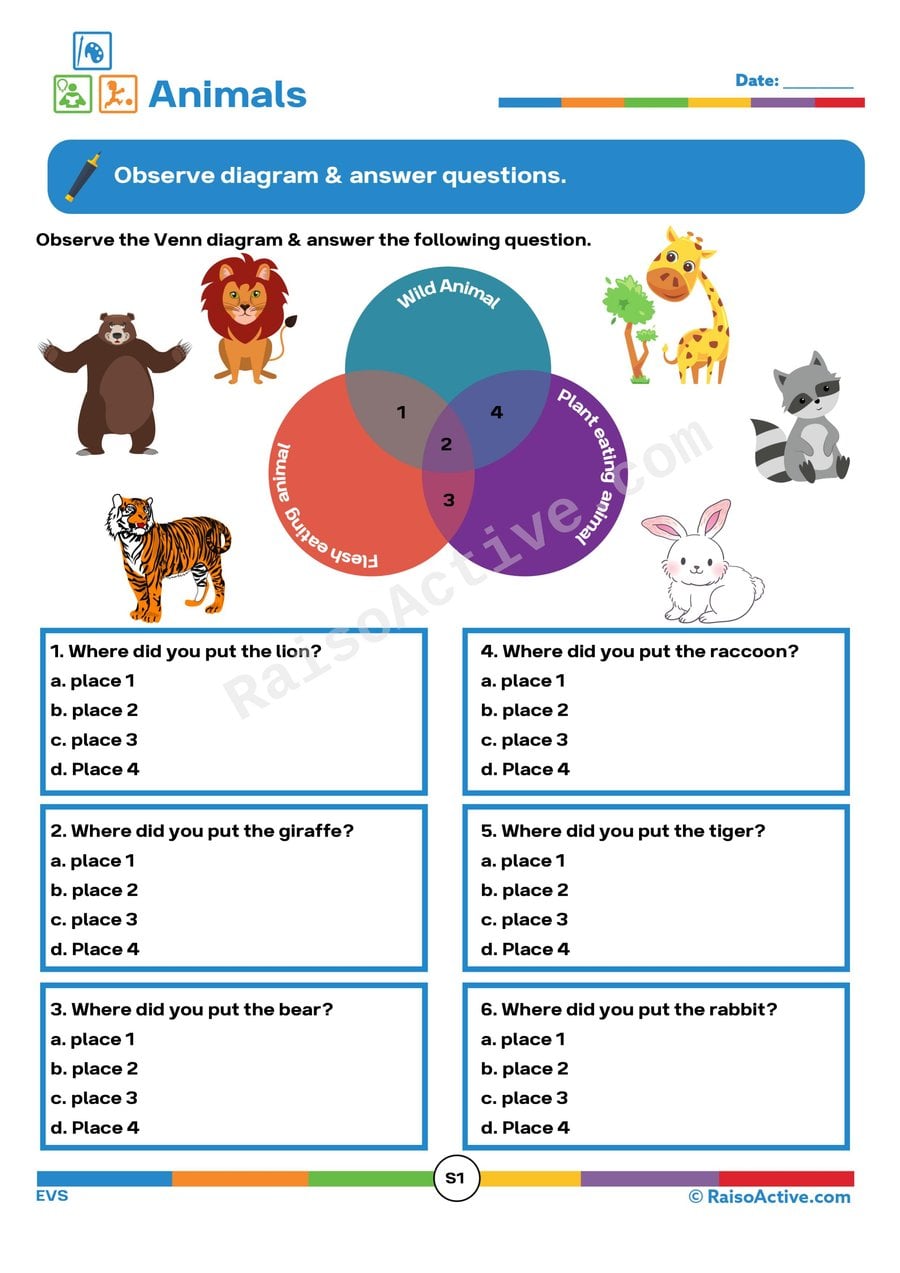
Animal Venn Diagram Worksheet for Kids
Ages 4-6 · Pre-K–KindergartenAges 4-6 · Reception–Year 1Ages 4-6 · LKG–UKGAges 4-6
This worksheet introduces children ages 4-6 to the Venn diagram as a tool for classifying animals by shared and distinct characteristics, such as habitat, number of legs, or covering (fur, feathers, scales). Deciding where an animal belongs — in one circle, the other, or the overlapping middle — builds comparative reasoning and categorization skills that are foundational to later scientific classification work.

Animal Sorting Worksheet: Wild vs. Domestic Animals
Ages 3-5 · Preschool–Pre-KAges 3-5 · Nursery–ReceptionAges 3-5 · Nursery–LKGAges 3-5
Sorting animal pictures into wild and domestic categories teaches children ages 3-5 an early form of classification, deciding where an animal belongs based on how it lives rather than its size or appearance alone. Cutting and pasting the animals also builds fine motor precision while reinforcing new animal vocabulary along the way.

Peacock Coloring Worksheet for Kids: Fun Facts and Colors!
Ages 3-5 · Preschool–Pre-KAges 3-5 · Nursery–ReceptionAges 3-5 · Nursery–LKGAges 3-5
This worksheet combines creative coloring practice with early science learning for children ages 3-5, as they color a detailed peacock illustration and then read fun facts about this colorful bird. Beyond fine motor and color skills, exposure to real animal facts in a low-pressure, playful format builds curiosity and early nonfiction reading interest.
Guides for this topic

Best Worksheets for 3-Year-Olds: What Works and What to Avoid
What works on worksheets for 3-year-olds: short sessions, crayons, tracing lines, matching, cutting, a free weekly plan, and signs one is too advanced.
Documenting Learning Without Drowning in Data: A Practical Guide for Parents and Teachers
Learn practical ways to document your child's learning without overwhelm. Simple portfolios, observation tips, and printable trackers for ages 1-8.

Discovering Wonder: Nature-Based Learning Activities That Captivate Young Children
Explore nature-based learning activities for children ages 2–7 — leaf rubbings, bug hunts, nature journals, and seasonal Indian outdoor ideas that spark wonder.
Reviews
Every worksheet for ages 3–5, no watermark
Members download the full library of 1,000+ worksheets and every activity pack without watermarks or daily limits. One year costs ₹999 in India or $20 elsewhere.
See membership plansOr download any worksheet free with a watermark (5 a day).