3D Shapes Matching Worksheet for Preschoolers
Connecting a flat, unfolded 2D net to the 3D shape it forms when folded builds spatial reasoning for children ages 3-5, an early introduction to geometry that helps them visualize how flat surfaces combine into solid forms like cubes and cones.
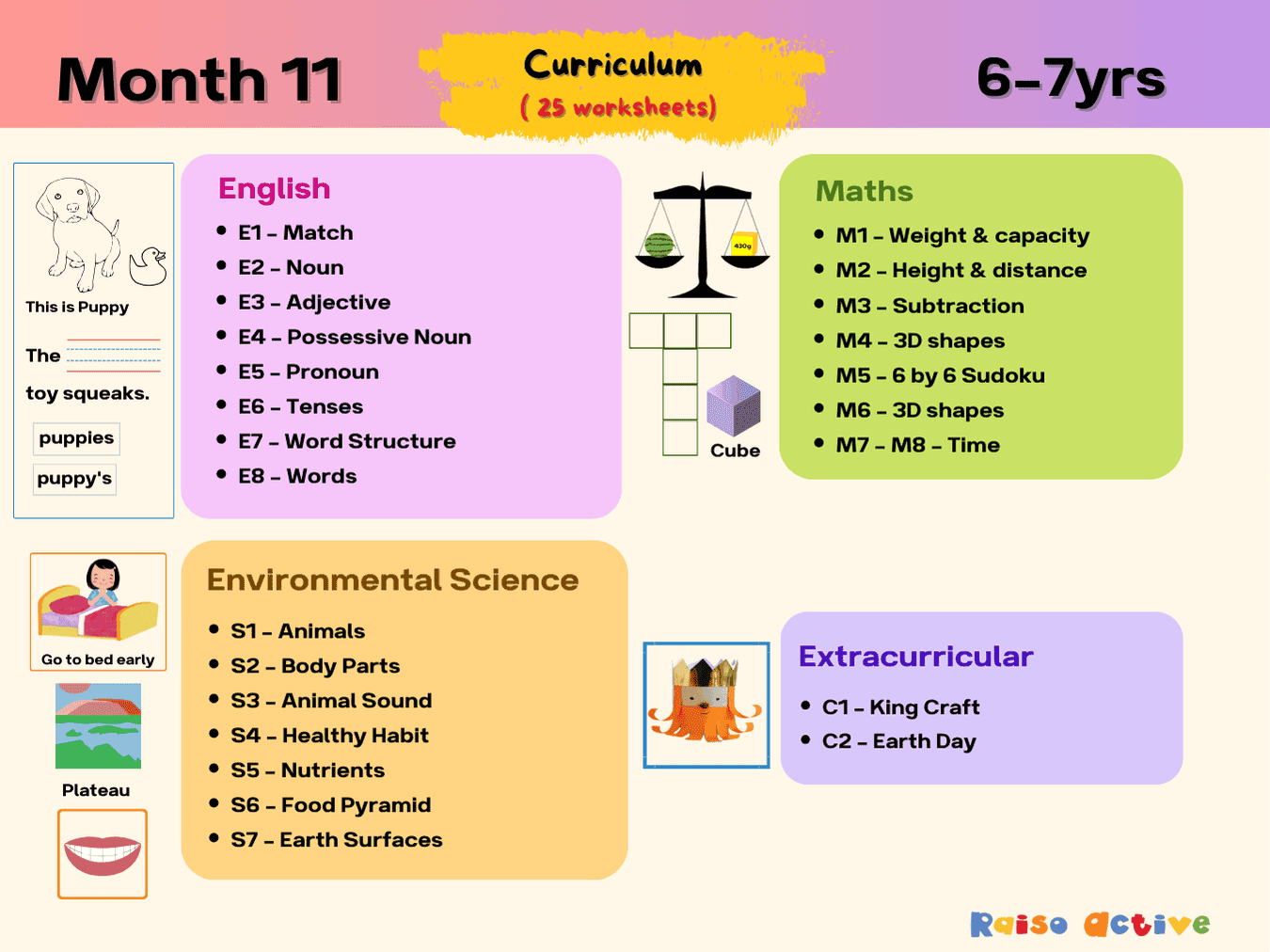
Part of the pack
Month 11: Learning & Development | Ages 6-7
This is page 15 of the pack. Ages 6-7 · Grade 1Ages 6-7 · Year 2Ages 6-7 · Class 1Ages 6-7
Made for your child
Counting to 10, made for your child
A maths pack with your child's name in it: pictures that explain, practice at three levels, puzzles and story sums about them. Print a new set whenever they finish.
Make a maths packFree preview · free for members
Curriculum
- 3D Shapes > 3D Shapes
How to use this worksheet
Look at the first 2D net on the left side of the page and ask your child what shape they think it might fold into. Have them scan the 3D shapes on the right and draw a line connecting the net to its matching solid shape. Continue through each net, encouraging your child to trace its outline with a finger to imagine it folding up before drawing their connecting line.
Materials needed
- Pencil
- Eraser
Extension activities
- 1Draw or print a simple net of a cube and fold it together to watch the shape form.
- 2Go on a shape hunt around the house, naming 3D shapes like boxes (cubes) or cans (cylinders).
- 3Build the 3D shapes using building blocks or clay to compare with their flat nets.
- 4Sort household containers by their 3D shape name.

Written by
Hemsweta Jain · Teacher Cheena
MBA and Early Childhood Educator, teaching since 2014 · Founder of RaisoActive, Mumbai
Every RaisoActive worksheet is designed and checked by the founder before publishing.
Published · Last reviewed
Related worksheets

3D Shapes Worksheet: Explore Faces, Vertices, and Edges!
Ages 4-6 · Pre-K–KindergartenAges 4-6 · Reception–Year 1Ages 4-6 · LKG–UKGAges 4-6
This worksheet pushes children ages 4-6 beyond simply naming 3D shapes into analyzing their structural properties — counting faces, vertices, and edges — while also connecting those properties to how each shape moves (rolling, sliding, or stacking). Understanding that a shape's number of flat surfaces and corners directly determines its physical behavior is an early but genuine geometric reasoning skill.

Shape Properties Worksheet: Identify and Match Shapes!
Ages 4-6 · Pre-K–KindergartenAges 4-6 · Reception–Year 1Ages 4-6 · LKG–UKGAges 4-6
This worksheet moves beyond simply naming 3D shapes to analyzing their properties — counting faces, edges, and vertices — which builds the early geometric reasoning children need before formal geometry lessons. For four- to six-year-olds, learning that a cube has 6 faces while a sphere has none introduces the idea that shapes can be described by measurable features, not just their overall look.
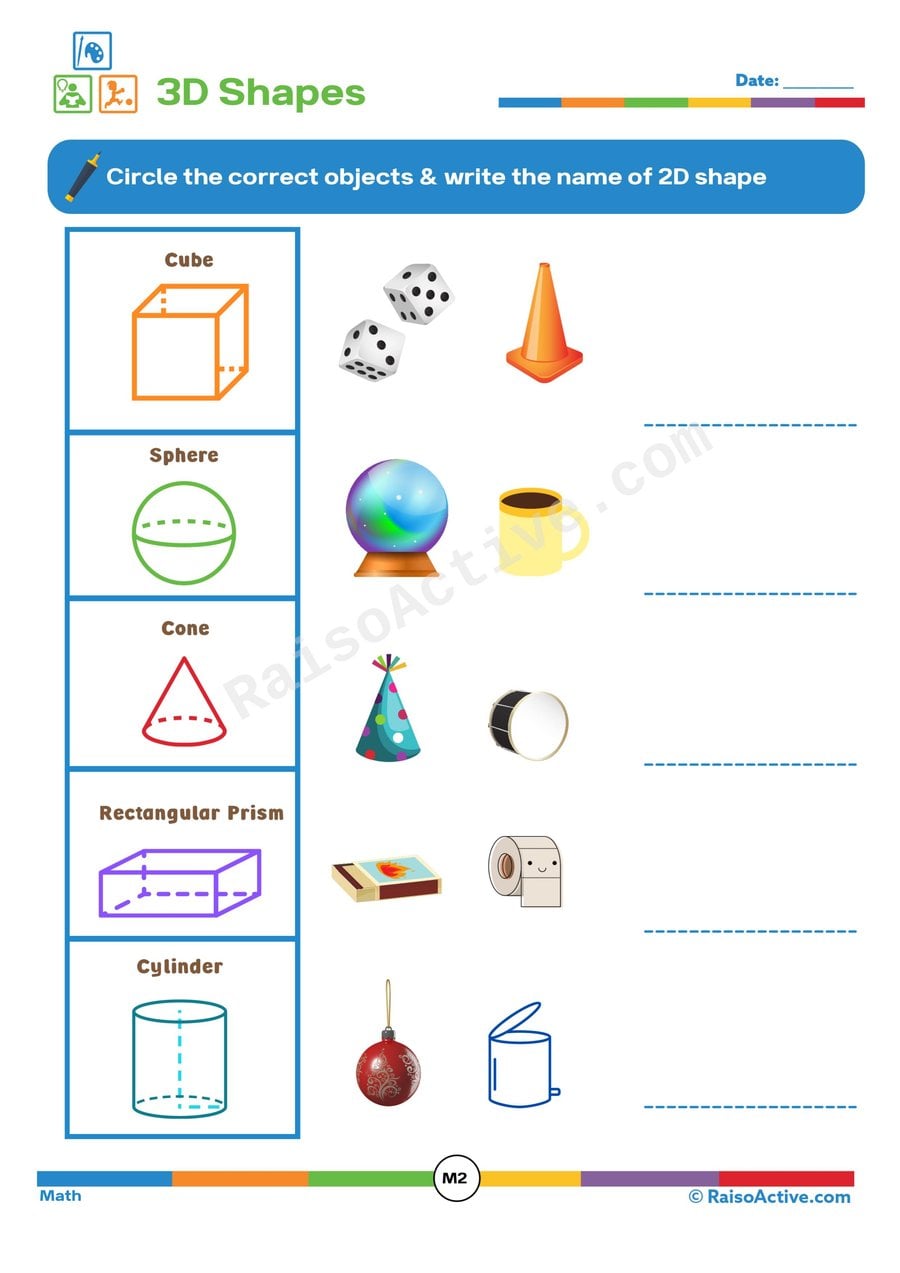
3D Shapes Worksheet: Circle and Name the Shapes!
Ages 4-6 · Pre-K–KindergartenAges 4-6 · Reception–Year 1Ages 4-6 · LKG–UKGAges 4-6
This worksheet helps children ages 4-6 identify common 3D shapes like spheres, cubes, and cylinders by matching them to real objects, then connects each 3D shape to its related 2D shape, such as a cube's square face or a sphere's circular outline. Understanding that 3D shapes are built from 2D shapes is an important early geometry concept that supports later spatial reasoning and measurement skills.

Shape Properties Worksheet: Identify Faces, Edges, and Vertices!
Ages 4-6 · Pre-K–KindergartenAges 4-6 · Reception–Year 1Ages 4-6 · LKG–UKGAges 4-6
This worksheet introduces the specific vocabulary of 3D geometry, faces, edges, and vertices, asking children to count each feature on shapes like cubes, cones, and spheres. For ages 4-6, learning to describe shapes by their properties rather than just their names builds an early foundation for more formal geometry later in school.
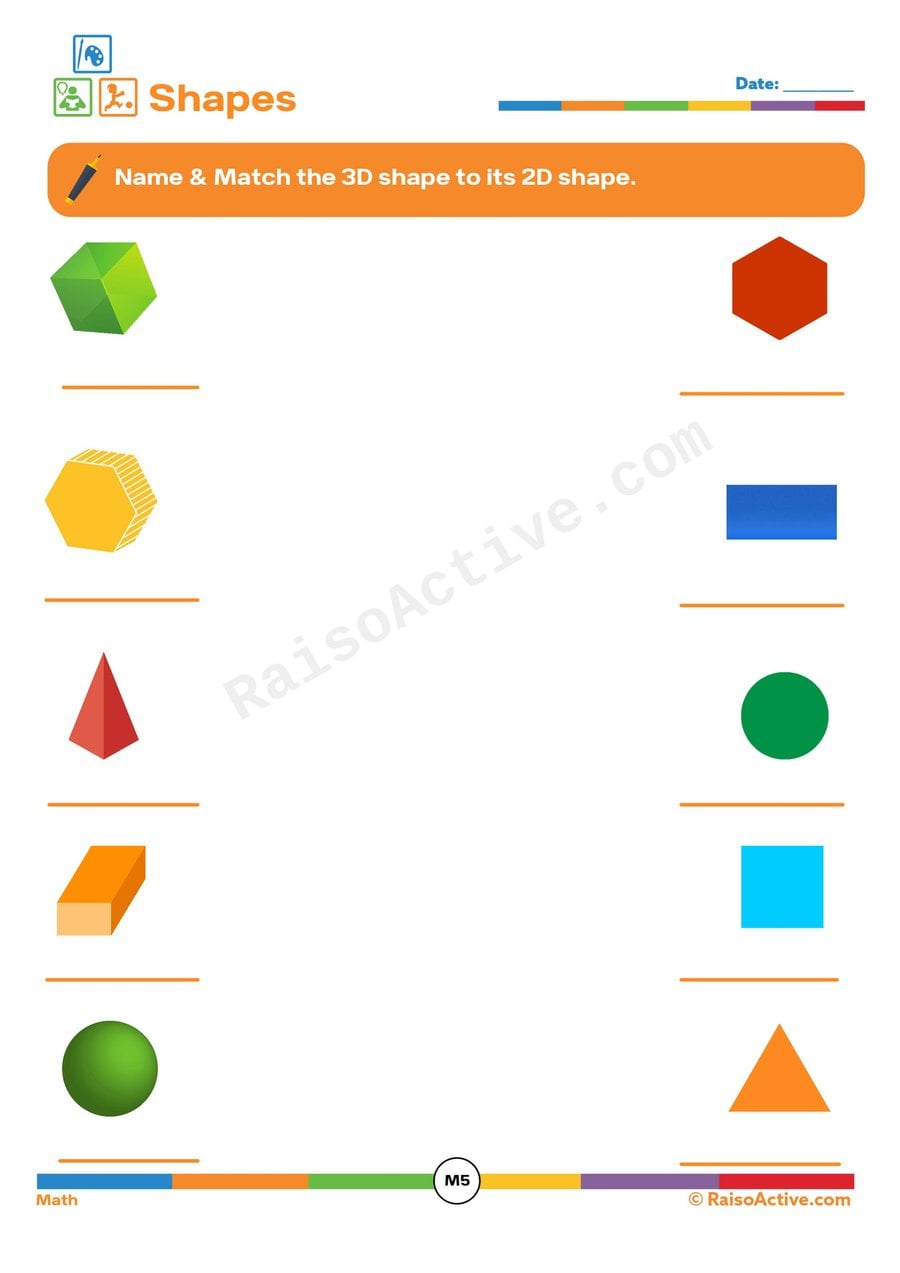
Shape Match: 3D to 2D Shapes Worksheet
Ages 4-5 · Pre-KAges 4-5 · ReceptionAges 4-5 · LKGAges 4-5
This worksheet builds an important geometric connection by asking children to match 3D shapes, like a cube or sphere, to the 2D shape that appears on their flat faces, such as a square or circle. For ages 4-5, understanding that solid shapes are made up of flat shapes is a foundational geometry concept that bridges basic shape recognition with more advanced spatial reasoning.

Cone Shape Worksheet for Preschoolers: Circle & Match!
Ages 3-5 · Preschool–Pre-KAges 3-5 · Nursery–ReceptionAges 3-5 · Nursery–LKGAges 3-5
This worksheet gives children ages 3-5 focused practice identifying the cone as a distinct 3D shape among a set of pictured objects, building the visual discrimination skills needed to tell shapes apart by their form rather than by color or size. Matching the shape to its printed word 'CONE' also introduces early print awareness, connecting a familiar geometric form to its written name.

Pumpkin Shapes and Sizes: Halloween Ordering and Shapes Worksheet
Ages 4-8 · Pre-K–Grade 2Ages 4-8 · Reception–Year 3Ages 4-8 · LKG–Class 2Ages 4-8
Children order objects by size, recognise and count triangles, circles, squares and stars, and use shapes to design a face.
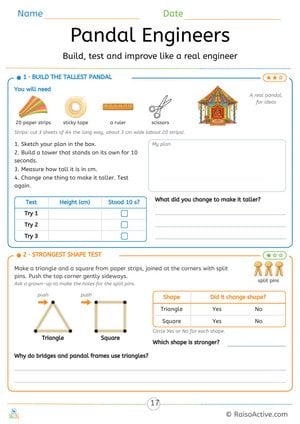
Pandal Engineers: Navratri Paper Tower and Strong Shapes STEM Challenge
Ages 7-11 · Grade 2–Grade 3Ages 7-11 · Year 3–Year 4Ages 7-11 · Class 2–Class 3Ages 7-11
Children plan, build, measure and improve a paper-strip tower, record three tries in a table, and test a triangle and a square made with split pins to find out why bridges and pandal frames use triangles.
Guides for this topic

Best Worksheets for 3-Year-Olds: What Works and What to Avoid
What works on worksheets for 3-year-olds: short sessions, crayons, tracing lines, matching, cutting, a free weekly plan, and signs one is too advanced.

Age-Appropriate Problem-Solving Activities: Building Critical Thinkers from the Ground Up
Discover fun, age-appropriate problem-solving activities for children ages 1-8. Build critical thinking, logic, and reasoning skills through play-based learning.
Critical Thinking Activities That Actually Work for Young Children: Building Tomorrow's Thinkers Today
Discover proven critical thinking activities for young children. Age-wise logic games, questioning techniques, and hands-on ideas to build thinking skills at home.
Reviews
Every worksheet for ages 3–5, no watermark
Members download the full library of 1,000+ worksheets and every activity pack without watermarks or daily limits. One year costs ₹999 in India or $20 elsewhere.
See membership plansOr download any worksheet free with a watermark (5 a day).