Time Worksheet: Observe Events and Find the Duration!
Children ages 4-6 practice an early concept of time and duration by reading about a series of daily events and calculating how long an activity lasted by adding up time spent. This introduces the idea that time can be measured and combined, a stepping stone toward reading clocks and understanding schedules later on.
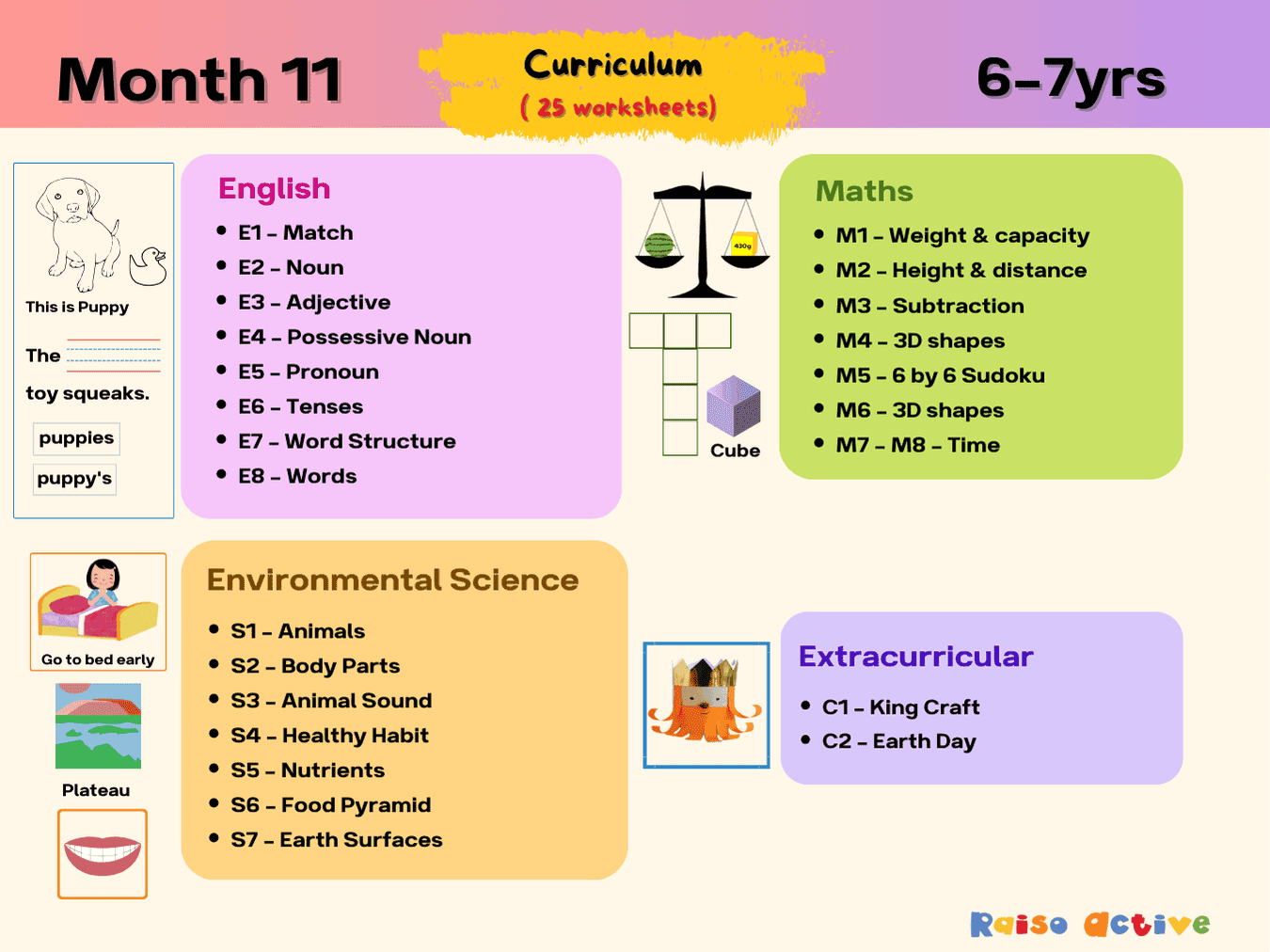
Part of the pack
Month 11: Learning & Development | Ages 6-7
This is page 18 of the pack. Ages 6-7 · Grade 1Ages 6-7 · Year 2Ages 6-7 · Class 1Ages 6-7
Made for your child
Telling the time, made for your child
A maths pack with your child's name in it: pictures that explain, practice at three levels, puzzles and story sums about them. Print a new set whenever they finish.
Make a maths packFree preview · free for members
Curriculum
- Time > Telling Time
How to use this worksheet
Look at the first day's events together, reading through the activities and the time listed for each one. Help your child understand that adding the times together tells us the total time spent on an activity, like total play time across the day. Have your child add the times and write the total in the box provided, then repeat the process for each remaining day shown on the page.
Materials needed
- Pencil
- Crayons
Extension activities
- 1Create a simple daily schedule together and track how much time is spent on different activities.
- 2Talk about how long other everyday activities take, like eating breakfast or getting dressed.
- 3Use a timer to measure exactly how long five minutes or ten minutes feels during an activity.
- 4Ask your child to guess how long an activity will take, then time it to see how close their guess was.

Written by
Hemsweta Jain · Teacher Cheena
MBA and Early Childhood Educator, teaching since 2014 · Founder of RaisoActive, Mumbai
Every RaisoActive worksheet is designed and checked by the founder before publishing.
Published · Last reviewed
More from Month 11: Learning & Development | Ages 6-7

Pronoun Power: Cut & Paste Matching Worksheet for Preschoolers
Ages 4-6 · Pre-K–KindergartenAges 4-6 · Reception–Year 1Ages 4-6 · LKG–UKGAges 4-6
Children ages 4-6 practice recognizing and applying pronouns — he, she, it, they, and similar words — by reading a short sentence, deciding which pronoun fits the picture, and physically placing it in the right spot. Cutting and pasting adds a fine motor and sequencing component on top of the grammar skill, since children must locate, cut, and correctly position each pronoun piece. This hands-on format helps pronoun concepts stick better than reading alone.
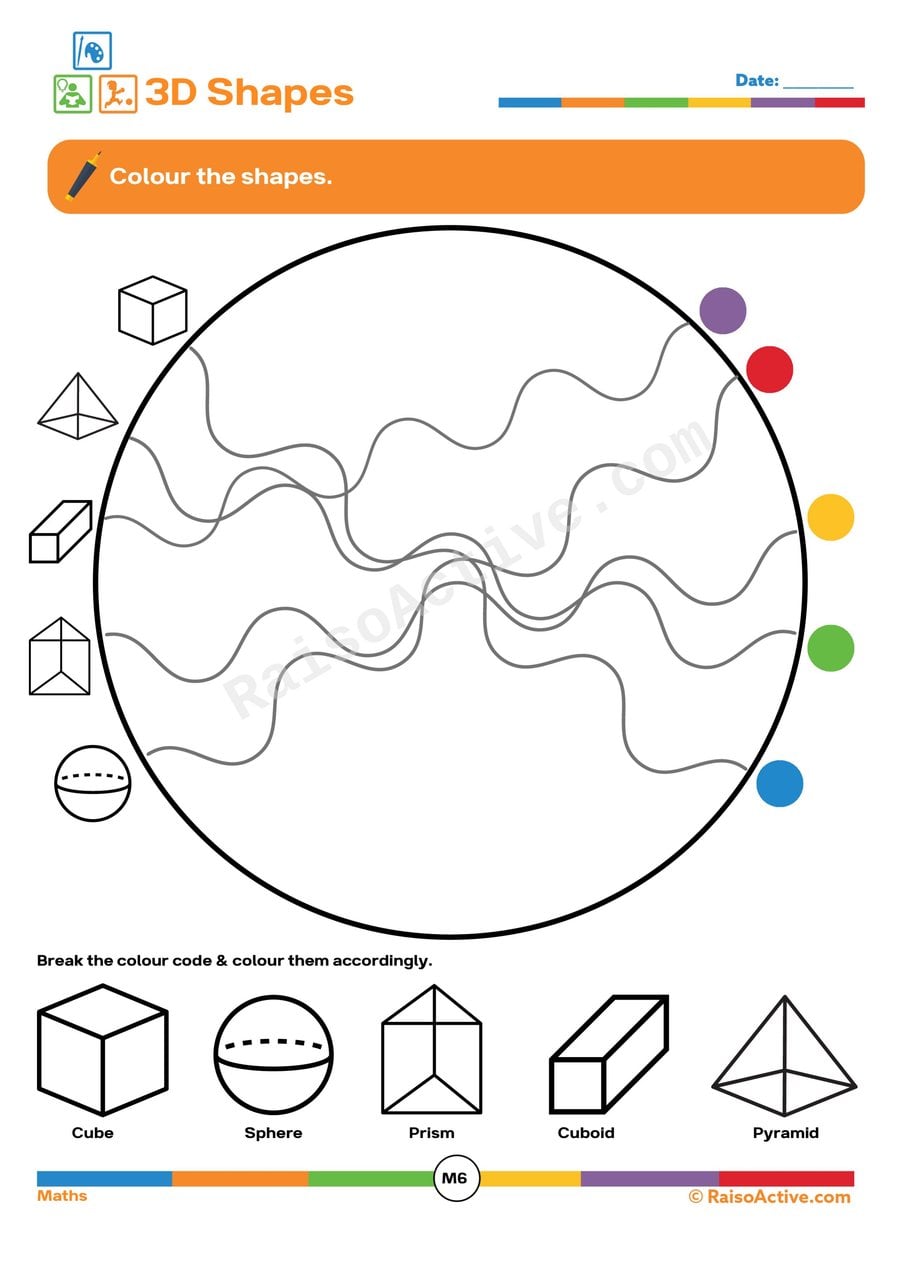
Color the 3D Shapes Worksheet for Kids
Ages 3-5 · Preschool–Pre-KAges 3-5 · Nursery–ReceptionAges 3-5 · Nursery–LKGAges 3-5
Children ages 3-5 build early geometry vocabulary by learning to name and visually recognize five 3D shapes — cube, sphere, prism, cuboid, and pyramid — a step beyond the flat 2D shapes most preschool worksheets cover. Following a color-code instruction while coloring also strengthens their ability to hold and apply a rule, and the repeated coloring motion builds hand strength and control useful for future writing.

Food Pyramid Worksheet: Learn About Healthy Eating!
Ages 3-5 · Preschool–Pre-KAges 3-5 · Nursery–ReceptionAges 3-5 · Nursery–LKGAges 3-5
This worksheet introduces children ages 3-5 to the food pyramid as a visual guide for balanced eating, helping them understand that different food groups should be eaten in different amounts. Filling in the blanks about food groups and serving sizes builds early nutrition literacy and reinforces the idea that a healthy diet includes variety, not just favorite foods.

Proper Noun Practice Worksheet for Early Learners
Ages 4-6 · Pre-K–KindergartenAges 4-6 · Reception–Year 1Ages 4-6 · LKG–UKGAges 4-6
This worksheet introduces children ages 4-6 to the concept of proper nouns — specific names for people, places, or things — by having them choose or write the correct proper noun to complete each sentence. Understanding the difference between a general word like 'city' and a specific name like 'Mumbai' is an early grammar concept that also supports capitalization rules children will need once they start writing independently.

Adjective Adventure: Circle the Correct Words Worksheet
Ages 4-6 · Pre-K–KindergartenAges 4-6 · Reception–Year 1Ages 4-6 · LKG–UKGAges 4-6
Children ages 4-6 practice identifying adjectives, the describing words that tell more about a noun, by reading sentences and circling the word that adds detail or description. Learning to spot adjectives is a foundational grammar skill that also helps children add more vivid, specific description to their own writing and speech.
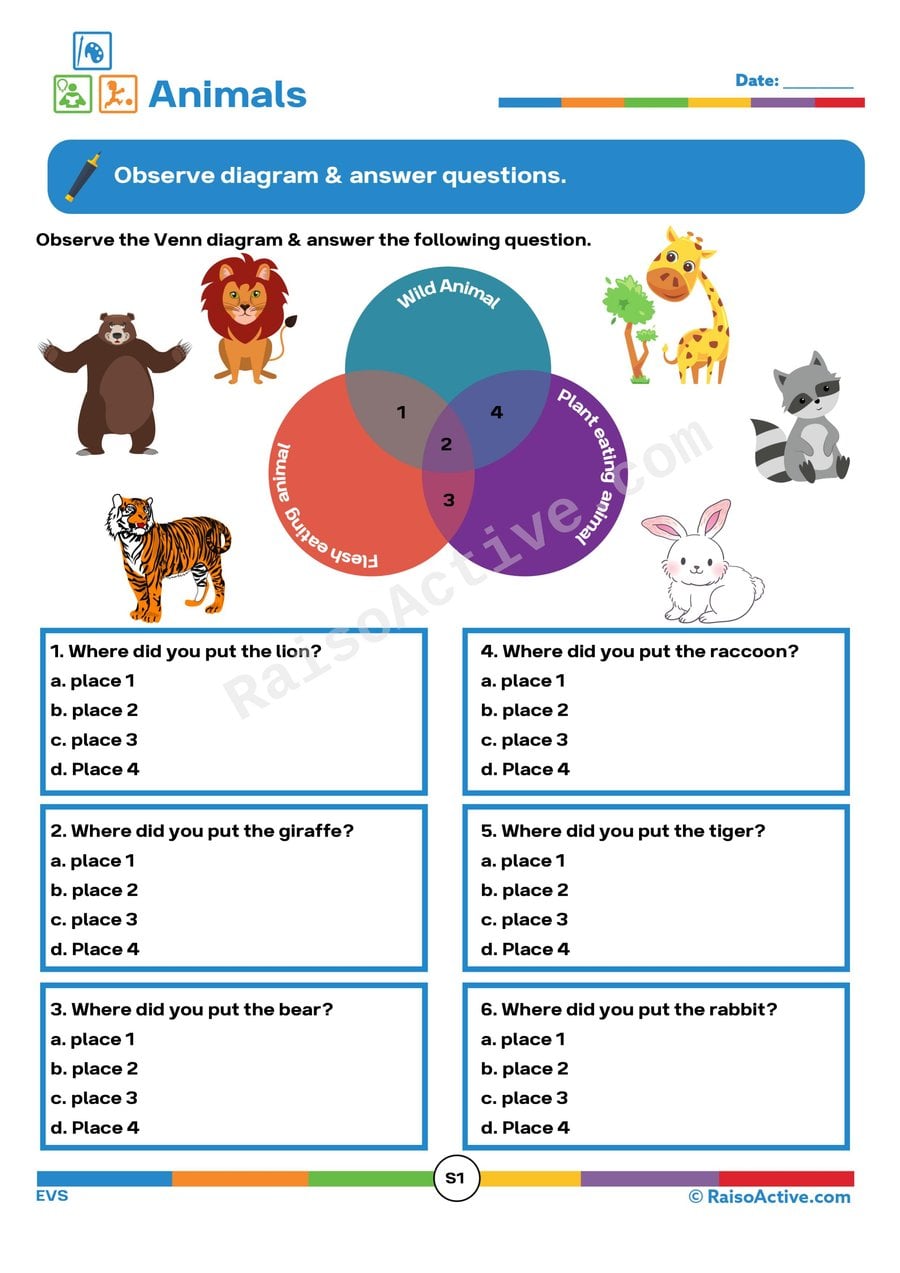
Animal Venn Diagram Worksheet for Kids
Ages 4-6 · Pre-K–KindergartenAges 4-6 · Reception–Year 1Ages 4-6 · LKG–UKGAges 4-6
This worksheet introduces children ages 4-6 to the Venn diagram as a tool for classifying animals by shared and distinct characteristics, such as habitat, number of legs, or covering (fur, feathers, scales). Deciding where an animal belongs — in one circle, the other, or the overlapping middle — builds comparative reasoning and categorization skills that are foundational to later scientific classification work.

Subtraction Fun: Practice Problems for Early Learners
Ages 4-6 · Pre-K–KindergartenAges 4-6 · Reception–Year 1Ages 4-6 · LKG–UKGAges 4-6
This worksheet gives children ages 4-6 repeated practice with basic subtraction, working through simple equations and word problems that build number sense before formal arithmetic instruction begins. Filling in missing numbers within equations also introduces the idea that subtraction is reversible and connected to addition, an early step toward flexible number thinking. Repeated, varied practice like this helps subtraction facts move from effortful counting to quick recall.

Animal Sounds Matching Worksheet for Preschoolers
Ages 3-5 · Preschool–Pre-KAges 3-5 · Nursery–ReceptionAges 3-5 · Nursery–LKGAges 3-5
This worksheet strengthens vocabulary and auditory-visual association in children ages 3-5 as they connect each animal picture to the written word for the sound it makes, like 'moo' or 'quack.' Matching sounds to animals also supports early literacy by pairing a familiar spoken word with its printed form, giving children an early, low-pressure introduction to reading words in context.
Related worksheets

Earlier and Later Time Worksheet for Preschoolers
Ages 4-6 · Pre-K–KindergartenAges 4-6 · Reception–Year 1Ages 4-6 · LKG–UKGAges 4-6
Children ages 4-6 build early time-sequencing skills by comparing clocks and everyday activities to decide which happens earlier and which happens later in the day. This worksheet introduces the abstract idea of time passing through the concrete lens of familiar routines, like meals or bedtime, which children already experience daily. Tracing the arrow toward the later activity also reinforces the logical, forward direction that time moves.
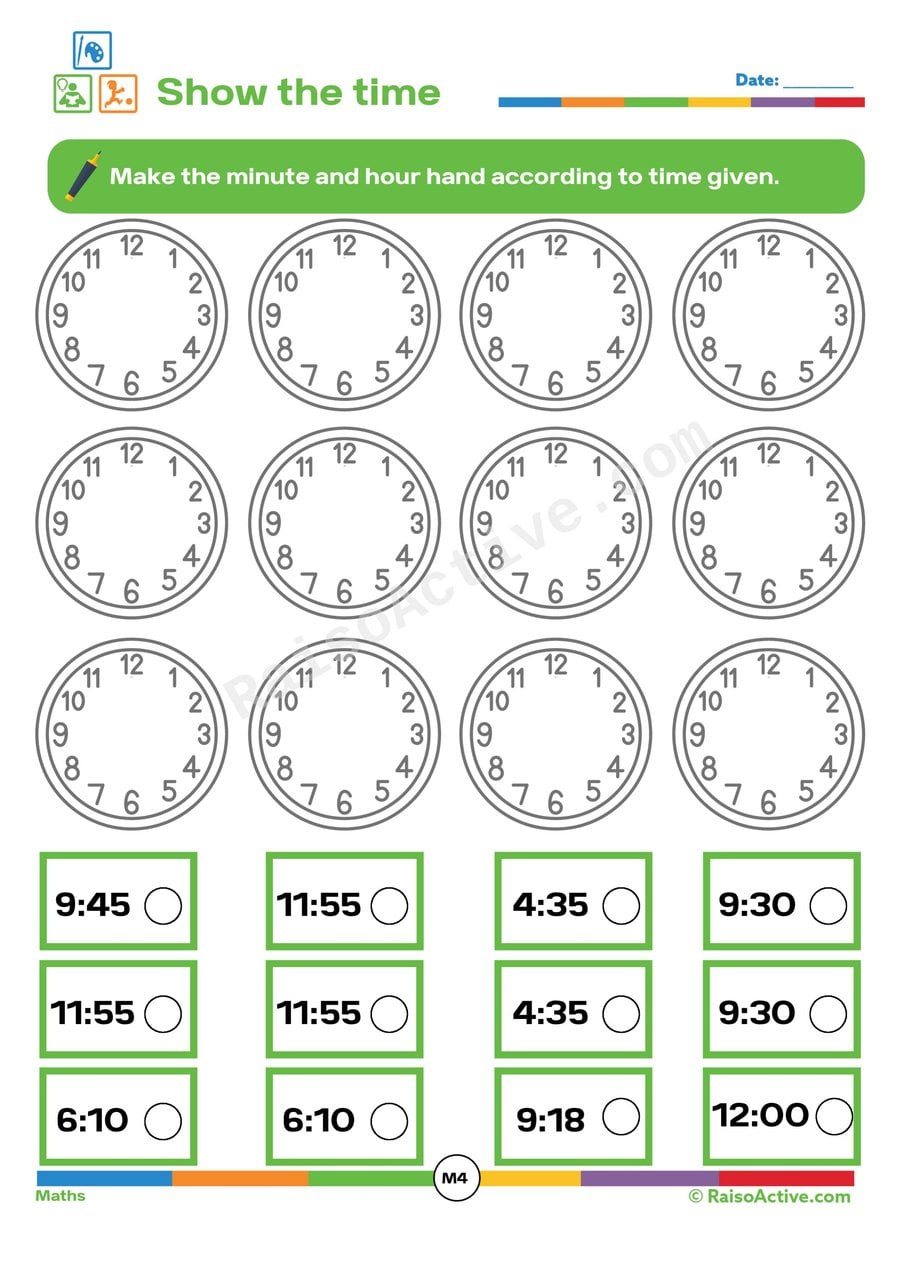
Time Telling Fun: Draw the Clock Hands! (3-5 Years)
Ages 3-5 · Preschool–Pre-KAges 3-5 · Nursery–ReceptionAges 3-5 · Nursery–LKGAges 3-5
This clock-hands activity teaches children ages 3-5 the very first steps of telling time by having them draw the hour and minute hands onto a blank clock face to match a given time. Because young children at this age typically focus on hour-level time recognition, the worksheet builds foundational awareness of how a clock's two hands work together before introducing the more complex idea of minutes. Repeated practice drawing hands in the correct position and length also reinforces fine motor control alongside the time concept.
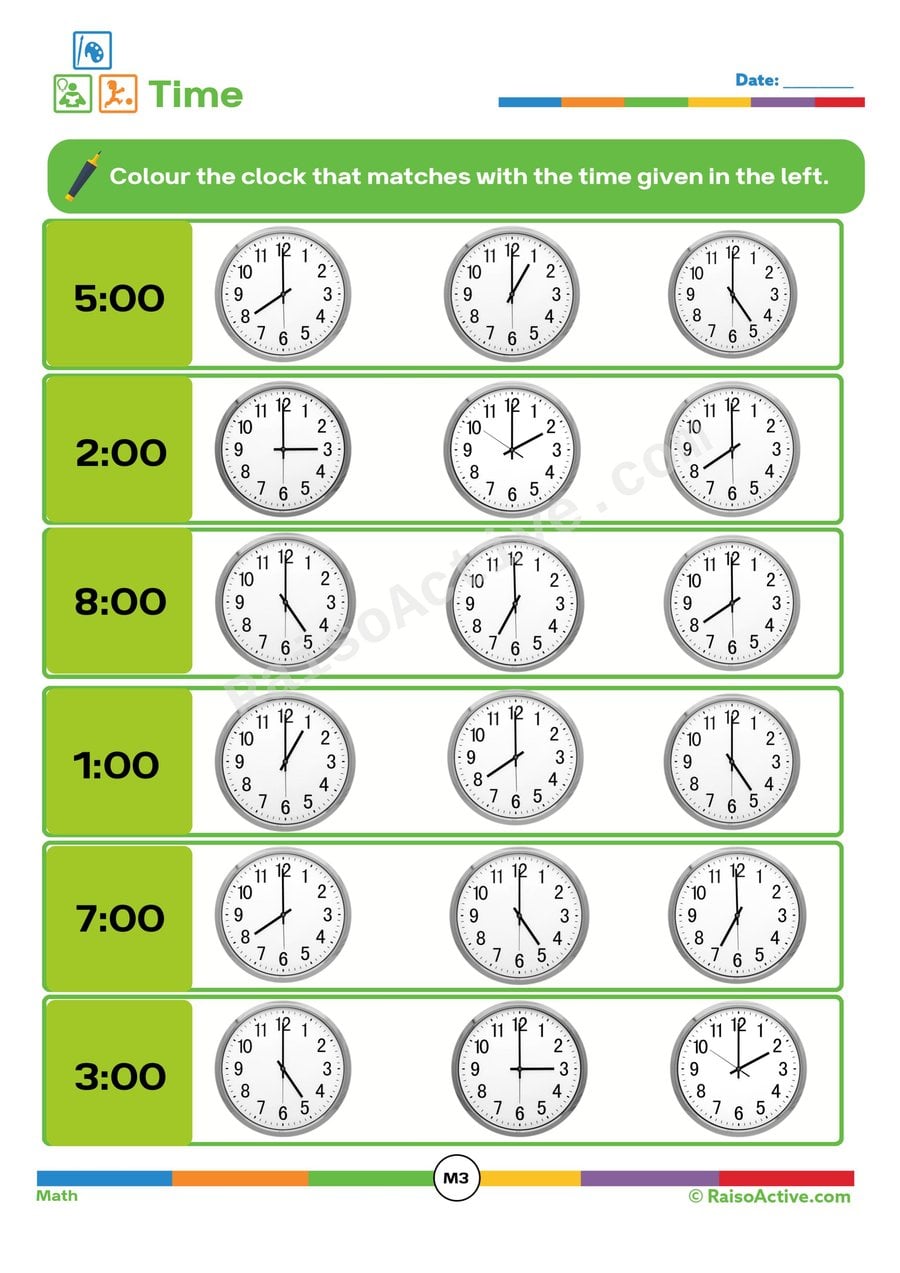
Time Matching Worksheet: Color the Clock!
Ages 4-6 · Pre-K–KindergartenAges 4-6 · Reception–Year 1Ages 4-6 · LKG–UKGAges 4-6
Matching a written or digital time to the analog clock showing the same time builds clock-reading skills for children ages 4-6, requiring them to translate between two different ways of representing the same moment.

Earlier and Later Time Worksheet: Telling Time Practice
Ages 4-5 · Pre-KAges 4-5 · ReceptionAges 4-5 · LKGAges 4-5
Comparing clock times to determine which is earlier or later is an early step toward telling time for children ages 4-5, requiring them to read a clock face and reason about the order of events across a day. This worksheet builds that skill in two directions: first identifying a time earlier than a given reference point, then identifying a time later than a different clock shown. Practicing both directions helps children understand that 'earlier' and 'later' are relative concepts depending on what they're being compared to, not fixed labels attached to specific times.

Tell the Time Worksheet: Clock Reading Practice for Kids
Ages 4-6 · Pre-K–KindergartenAges 4-6 · Reception–Year 1Ages 4-6 · LKG–UKGAges 4-6
This worksheet helps children ages 4-6 practice reading an analog clock by looking at the position of the hour and minute hands and writing down the time shown. Analog clock reading is a genuinely challenging skill that combines number recognition with an understanding of two hands moving at different speeds, making repeated, varied practice like this essential before a child can read time confidently on their own.
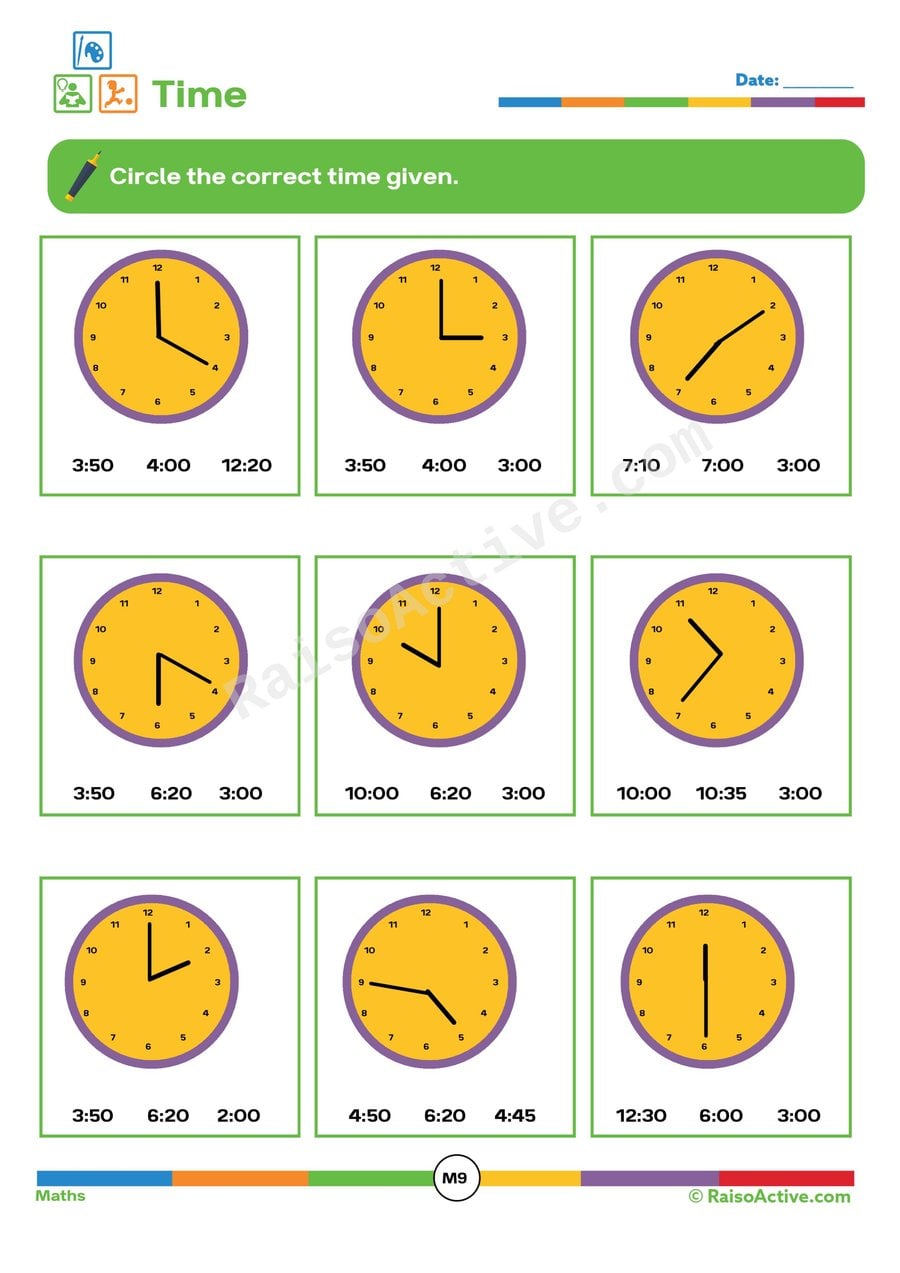
Time Telling Worksheet: Circle the Correct Time!
Ages 5-7 · Kindergarten–Grade 1Ages 5-7 · Year 1–Year 2Ages 5-7 · UKG–Class 1Ages 5-7
Reading an analog clock face and choosing the matching time from three written options builds clock-reading fluency for children ages 5-7, requiring them to interpret both the hour and minute hands together rather than guessing from a single hand.

Time Telling Worksheet: Write the Time on the Clocks!
Ages 4-6 · Pre-K–KindergartenAges 4-6 · Reception–Year 1Ages 4-6 · LKG–UKGAges 4-6
Reading the position of the hour and minute hands on an analog clock and writing the matching time builds clock-reading fluency for children ages 4-6, a more advanced step than simply recognizing a given time, since it requires producing the answer independently.
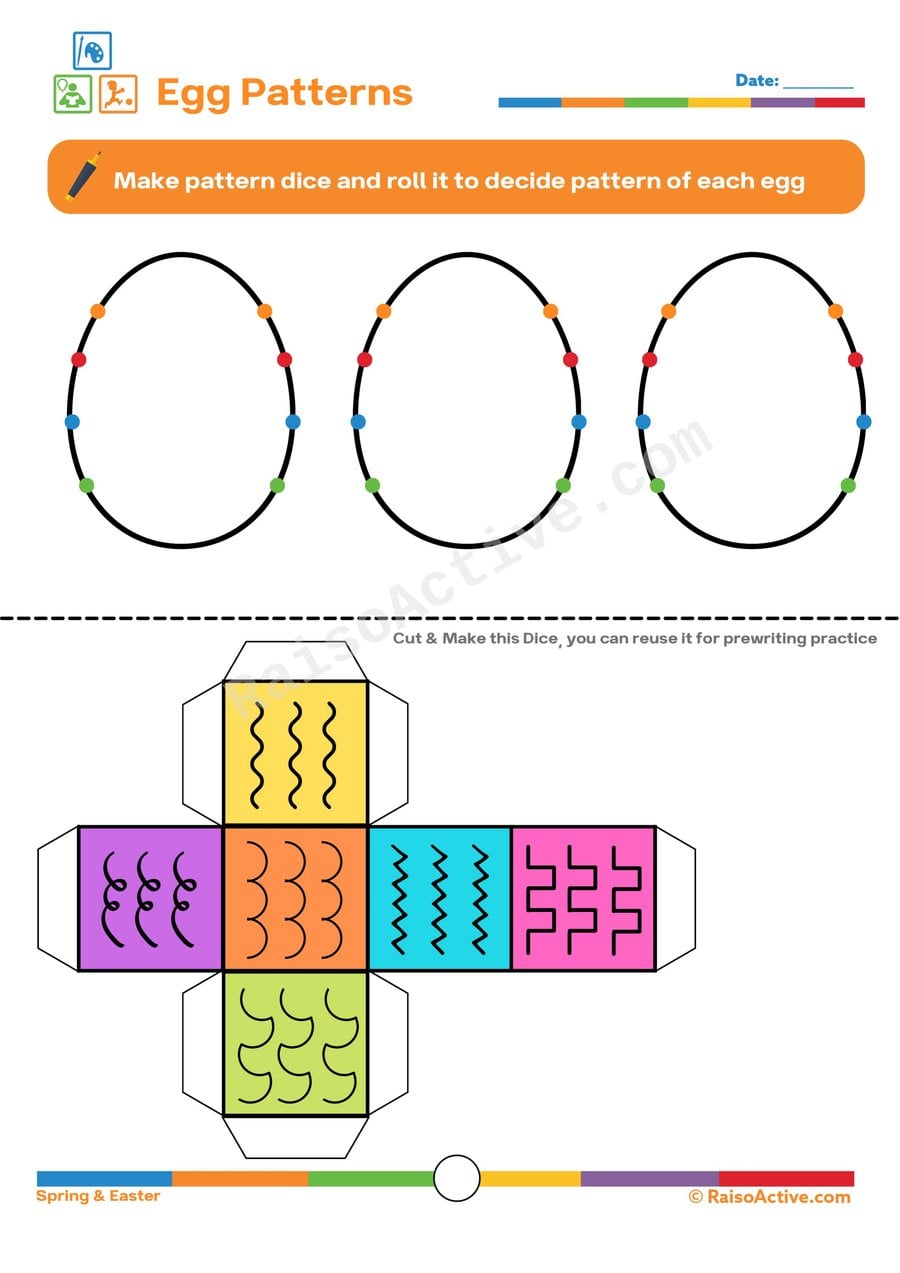
Egg Pattern Worksheet: Create and Match Patterns!
Ages 3-5 · Preschool–Pre-KAges 3-5 · Nursery–ReceptionAges 3-5 · Nursery–LKGAges 3-5
This egg-pattern activity has children ages 3-5 build a simple pattern dice and use it to generate and recreate repeating designs, developing pattern-recognition skills that underpin later math concepts like sequencing and multiplication. Rolling the dice and transferring the result onto each egg also connects a random outcome to a deliberate drawing action, strengthening cause-and-effect thinking.
Guides for this topic

Age-Appropriate Problem-Solving Activities: Building Critical Thinkers from the Ground Up
Discover fun, age-appropriate problem-solving activities for children ages 1-8. Build critical thinking, logic, and reasoning skills through play-based learning.
Critical Thinking Activities That Actually Work for Young Children: Building Tomorrow's Thinkers Today
Discover proven critical thinking activities for young children. Age-wise logic games, questioning techniques, and hands-on ideas to build thinking skills at home.

Preparing Your Child for a Rapidly Changing World: Essential Skills for Future Success
Discover the essential 21st century skills your child needs for future success. Practical tips on creativity, critical thinking, digital literacy & emotional intelligence for ages 1-8.
Reviews
Every worksheet for ages 4–6, no watermark
Members download the full library of 1,000+ worksheets and every activity pack without watermarks or daily limits. One year costs ₹999 in India or $20 elsewhere.
See membership plansOr download any worksheet free with a watermark (5 a day).