Time Telling Worksheet: Write the Time on the Clocks!
Reading the position of the hour and minute hands on an analog clock and writing the matching time builds clock-reading fluency for children ages 4-6, a more advanced step than simply recognizing a given time, since it requires producing the answer independently.
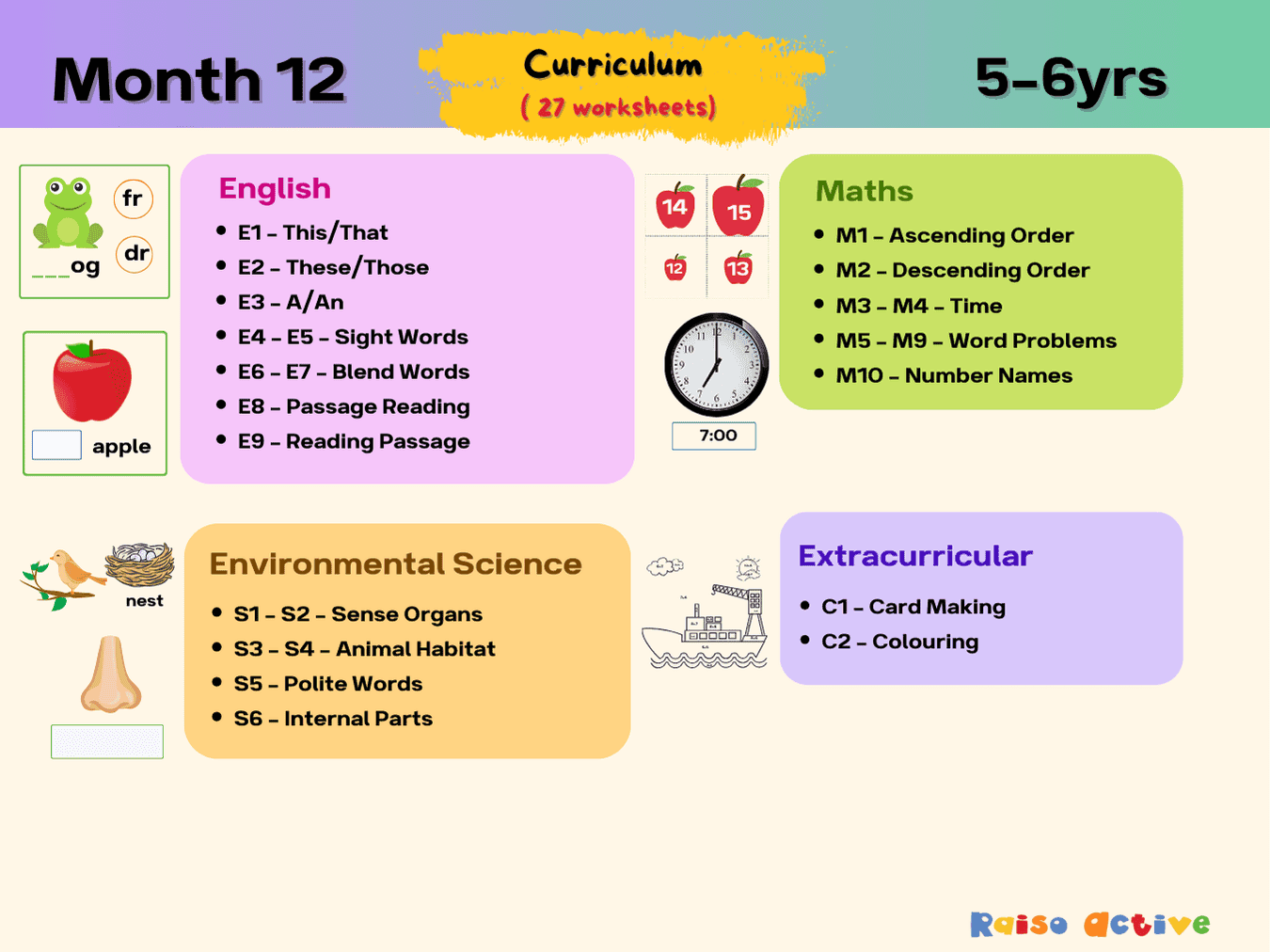
Part of the pack
Month 12: Learning & Development | Ages 5-6
This is page 16 of the pack. Ages 5-6 · KindergartenAges 5-6 · Year 1Ages 5-6 · UKGAges 5-6
Made for your child
Telling the time, made for your child
A maths pack with your child's name in it: pictures that explain, practice at three levels, puzzles and story sums about them. Print a new set whenever they finish.
Make a maths packFree preview · free for members
Curriculum
- Time > Telling Time
How to use this worksheet
Look at the first clock and identify where the hour hand and minute hand are pointing. Help your child figure out the correct time based on the hands' positions, then have them write it in the box below the clock. Continue through each remaining clock on the page, checking their answers against a real clock if helpful.
Materials needed
- Pencil
Extension activities
- 1Have the child draw their own clocks and write the time shown.
- 2Use a real clock to practice telling time throughout the day.
- 3Create flashcards showing clock faces and quiz each other on the time.
- 4Set a timer for a specific number of minutes and check the clock before and after.

Written by
Hemsweta Jain · Teacher Cheena
MBA and Early Childhood Educator, teaching since 2014 · Founder of RaisoActive, Mumbai
Every RaisoActive worksheet is designed and checked by the founder before publishing.
Published · Last reviewed
More from Month 12: Learning & Development | Ages 5-6

Farm Animals Reading Comprehension Worksheet for Preschoolers
Ages 3-5 · Preschool–Pre-KAges 3-5 · Nursery–ReceptionAges 3-5 · Nursery–LKGAges 3-5
Reading a short passage about farm animals and answering questions about it builds early reading comprehension for children ages 3-5, teaching them to recall specific details from a text rather than just recognizing individual words.

Internal Parts Worksheet: Cut and Paste the Organs!
Ages 4-6 · Pre-K–KindergartenAges 4-6 · Reception–Year 1Ages 4-6 · LKG–UKGAges 4-6
This worksheet introduces children ages 4-6 to basic human anatomy by having them cut out pictures of internal organs, such as the heart, lungs, and stomach, and glue each one into its correct location on a body outline. Beyond scissor and gluing practice, this activity builds spatial body awareness and early scientific vocabulary, giving children a first mental map of what's inside their own bodies.

Coloring Fun: Addition Worksheet for Preschoolers
Ages 4-6 · Pre-K–KindergartenAges 4-6 · Reception–Year 1Ages 4-6 · LKG–UKGAges 4-6
Solving each addition problem reinforces single-digit sums, while matching the answer to a color-by-number key trains children ages 4-6 to connect a symbol — the number — to a category — the color, an early bridge between arithmetic and following multi-step visual instructions.

Blend Words Worksheet: Circle the Correct Picture!
Ages 4-6 · Pre-K–KindergartenAges 4-6 · Reception–Year 1Ages 4-6 · LKG–UKGAges 4-6
This worksheet strengthens blending skills for children ages 4-6, asking them to say a consonant blend like 'bl' or 'st' together with different word endings and identify which resulting word matches a picture. Blending two consonant sounds smoothly before adding a vowel is a more advanced phonics skill than single-letter sounds, and this practice directly supports decoding multisyllabic and blended words during independent reading.

Polite Words Worksheet: Circle the Correct Option!
Ages 3-5 · Preschool–Pre-KAges 3-5 · Nursery–ReceptionAges 3-5 · Nursery–LKGAges 3-5
Children ages 3-5 practice recognizing which polite word fits a given social scenario, like saying 'please' when asking for something or 'sorry' after bumping into someone, building early social-emotional vocabulary alongside reading skills. Learning to match politeness to situation helps children apply good manners appropriately rather than just memorizing words in isolation.

Word Problem Fun: Solving Burger and Bird Problems!
Ages 4-6 · Pre-K–KindergartenAges 4-6 · Reception–Year 1Ages 4-6 · LKG–UKGAges 4-6
Solving addition and subtraction word problems featuring burgers and birds gives children ages 4-6 practice applying arithmetic to playful, concrete scenarios, strengthening the link between story context and the correct math operation.

Card Making Worksheet: Create a Heartfelt Valentine's Day Card!
Ages 3-5 · Preschool–Pre-KAges 3-5 · Nursery–ReceptionAges 3-5 · Nursery–LKGAges 3-5
Cutting along the card's outer lines strengthens scissor control and hand strength, while folding the card in half builds the bilateral coordination of holding with one hand and creasing with the other. Composing a short message inside also introduces children ages 3-5 to early written expression tied to a real feeling.

Word Problem Fun: Balloon and Mango Math Worksheet for Kids
Ages 4-6 · Pre-K–KindergartenAges 4-6 · Reception–Year 1Ages 4-6 · LKG–UKGAges 4-6
Solving addition word problems featuring balloons and mangoes teaches children ages 4-6 to translate a short story into a number sentence, practicing both reading comprehension and basic addition in a playful, visual context.
Related worksheets

Earlier and Later Time Worksheet: Telling Time Practice
Ages 4-5 · Pre-KAges 4-5 · ReceptionAges 4-5 · LKGAges 4-5
Comparing clock times to determine which is earlier or later is an early step toward telling time for children ages 4-5, requiring them to read a clock face and reason about the order of events across a day. This worksheet builds that skill in two directions: first identifying a time earlier than a given reference point, then identifying a time later than a different clock shown. Practicing both directions helps children understand that 'earlier' and 'later' are relative concepts depending on what they're being compared to, not fixed labels attached to specific times.

Time Routine Cut and Paste Worksheet for Preschoolers
Ages 4-6 · Pre-K–KindergartenAges 4-6 · Reception–Year 1Ages 4-6 · LKG–UKGAges 4-6
Matching a clock face showing a specific time to the daily activity that happens then — like breakfast or bedtime — connects the abstract skill of clock reading to concrete routines, helping children ages 4-6 build a real-world sense of how time structures a day.

Earlier and Later Time Worksheet for Preschoolers
Ages 4-6 · Pre-K–KindergartenAges 4-6 · Reception–Year 1Ages 4-6 · LKG–UKGAges 4-6
Children ages 4-6 build early time-sequencing skills by comparing clocks and everyday activities to decide which happens earlier and which happens later in the day. This worksheet introduces the abstract idea of time passing through the concrete lens of familiar routines, like meals or bedtime, which children already experience daily. Tracing the arrow toward the later activity also reinforces the logical, forward direction that time moves.

Tell the Time Worksheet: Clock Reading Practice for Kids
Ages 4-6 · Pre-K–KindergartenAges 4-6 · Reception–Year 1Ages 4-6 · LKG–UKGAges 4-6
This worksheet helps children ages 4-6 practice reading an analog clock by looking at the position of the hour and minute hands and writing down the time shown. Analog clock reading is a genuinely challenging skill that combines number recognition with an understanding of two hands moving at different speeds, making repeated, varied practice like this essential before a child can read time confidently on their own.

Time Worksheet: Observe Events and Find the Duration!
Ages 4-6 · Pre-K–KindergartenAges 4-6 · Reception–Year 1Ages 4-6 · LKG–UKGAges 4-6
Children ages 4-6 practice an early concept of time and duration by reading about a series of daily events and calculating how long an activity lasted by adding up time spent. This introduces the idea that time can be measured and combined, a stepping stone toward reading clocks and understanding schedules later on.
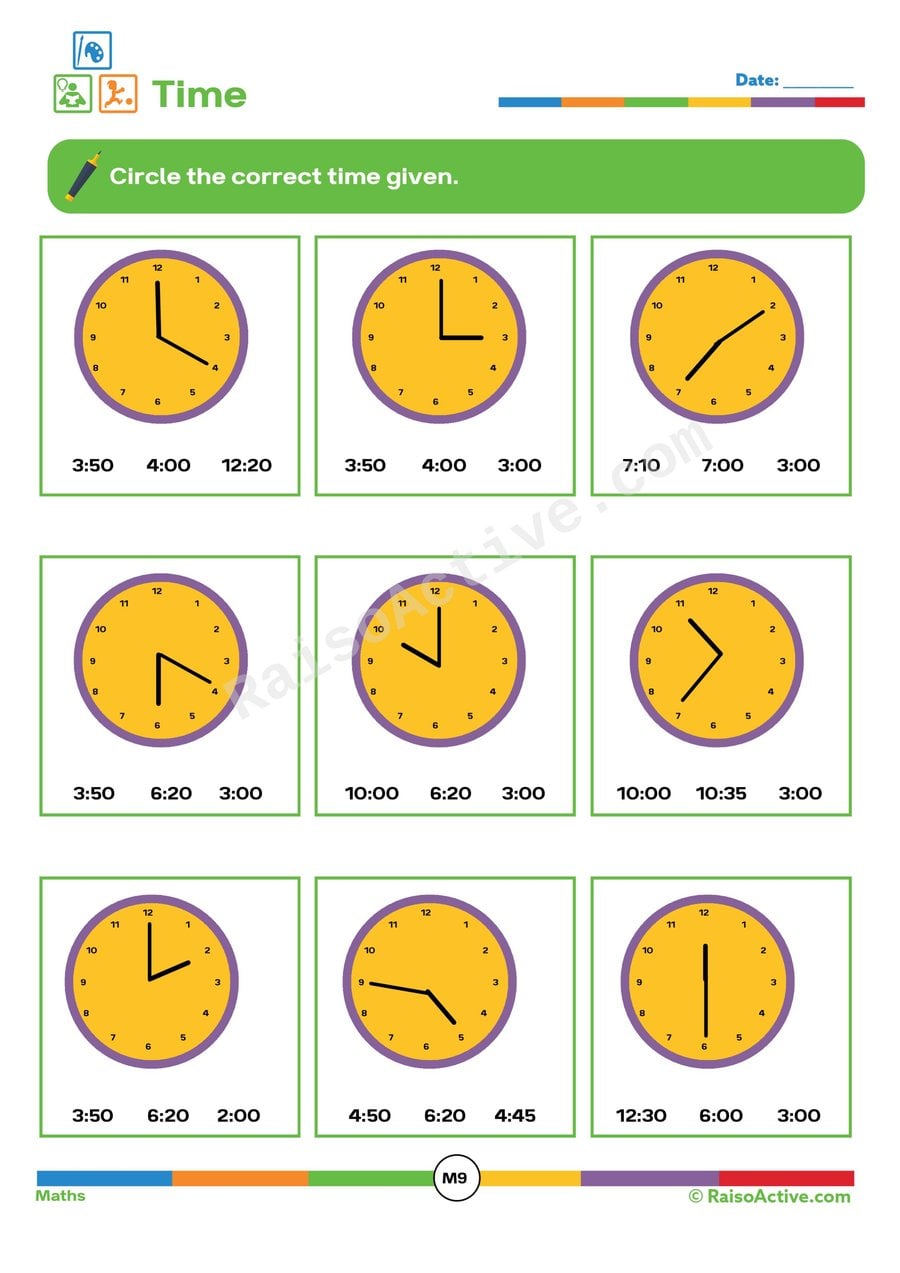
Time Telling Worksheet: Circle the Correct Time!
Ages 5-7 · Kindergarten–Grade 1Ages 5-7 · Year 1–Year 2Ages 5-7 · UKG–Class 1Ages 5-7
Reading an analog clock face and choosing the matching time from three written options builds clock-reading fluency for children ages 5-7, requiring them to interpret both the hour and minute hands together rather than guessing from a single hand.
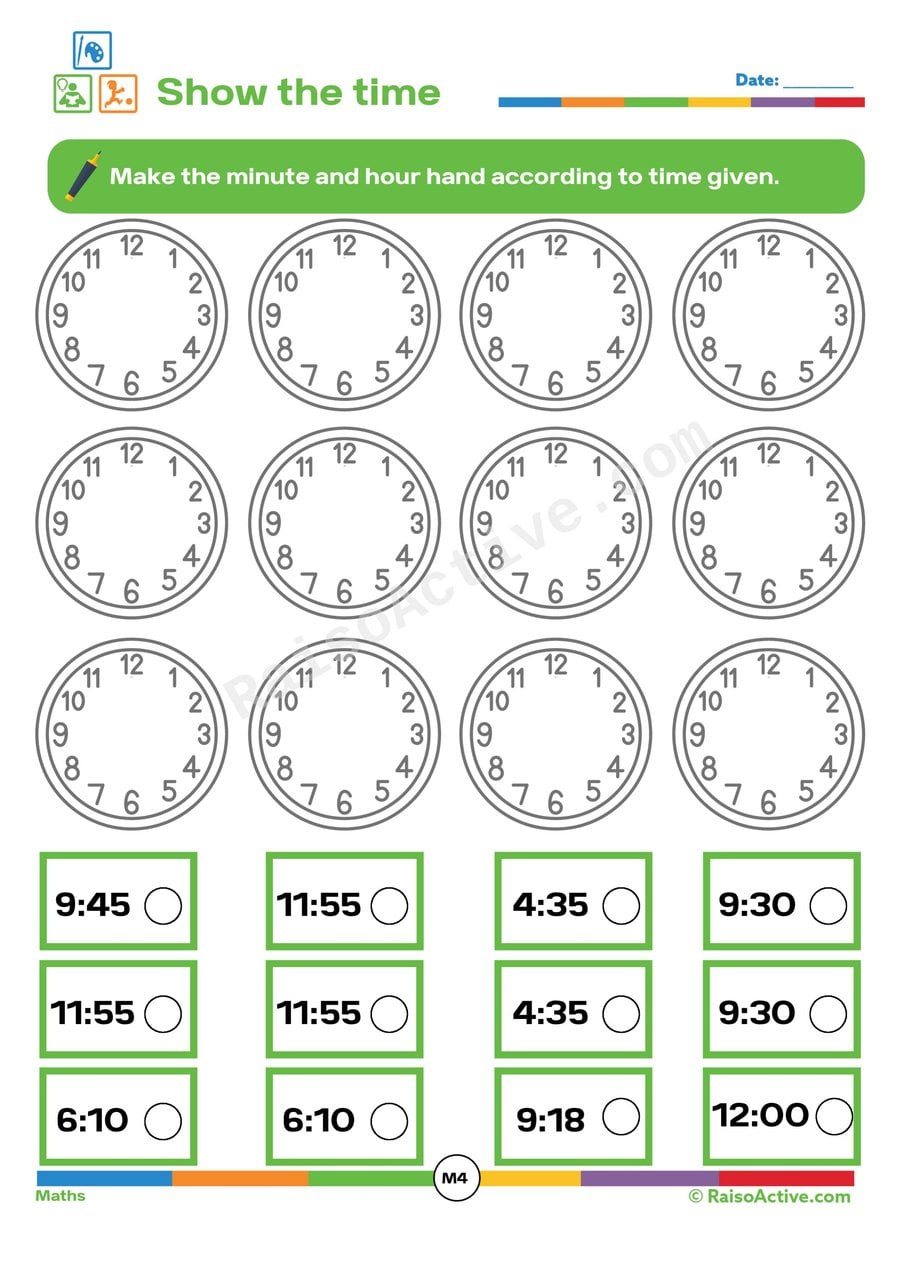
Time Telling Fun: Draw the Clock Hands! (3-5 Years)
Ages 3-5 · Preschool–Pre-KAges 3-5 · Nursery–ReceptionAges 3-5 · Nursery–LKGAges 3-5
This clock-hands activity teaches children ages 3-5 the very first steps of telling time by having them draw the hour and minute hands onto a blank clock face to match a given time. Because young children at this age typically focus on hour-level time recognition, the worksheet builds foundational awareness of how a clock's two hands work together before introducing the more complex idea of minutes. Repeated practice drawing hands in the correct position and length also reinforces fine motor control alongside the time concept.
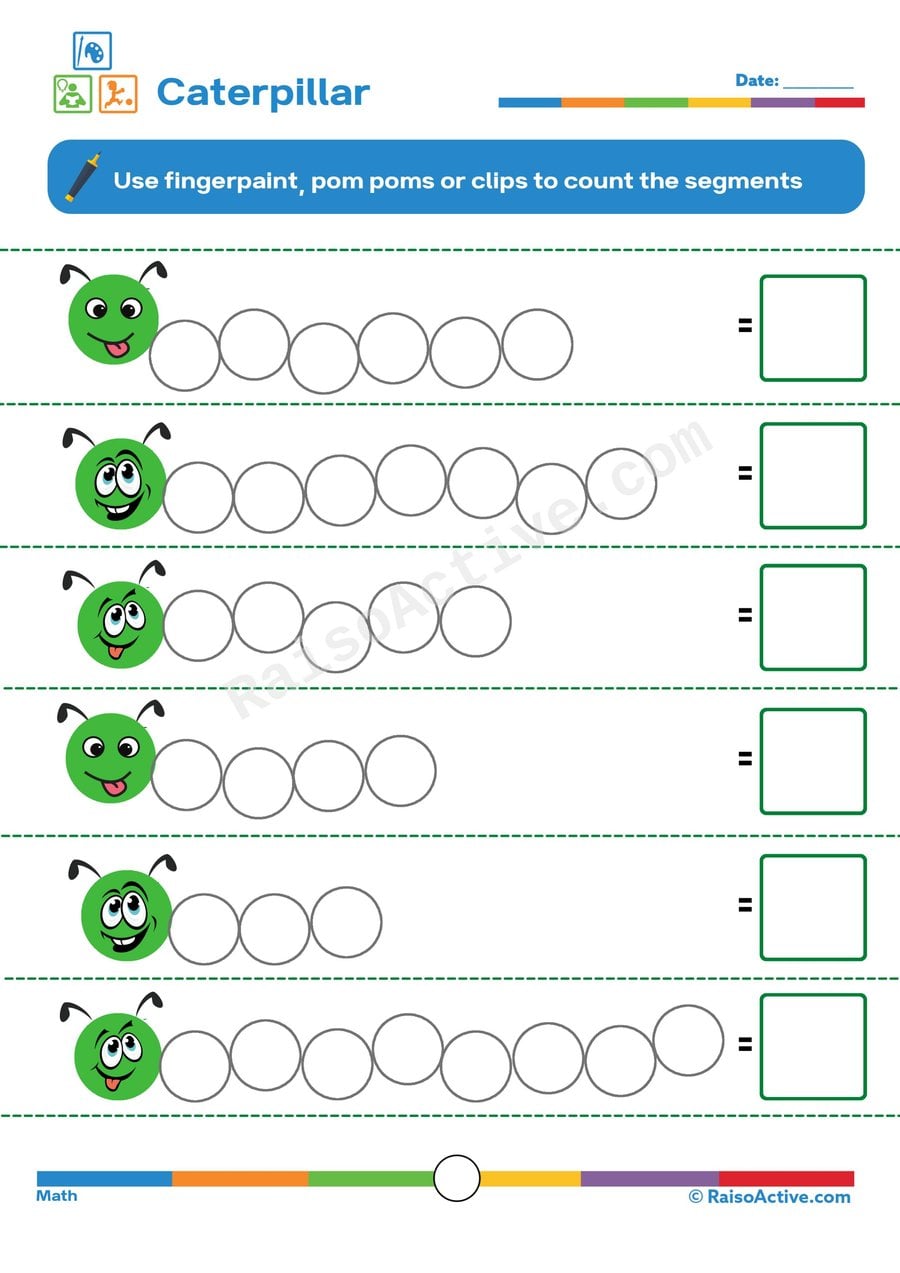
Caterpillar Counting Worksheet for Preschoolers
Ages 3-5 · Preschool–Pre-KAges 3-5 · Nursery–ReceptionAges 3-5 · Nursery–LKGAges 3-5
Counting the segments of each caterpillar teaches children ages 3-5 one-to-one correspondence — touching or marking each segment exactly once while saying a number — which is the core skill underlying accurate counting. Writing the final total in a box also connects the physical act of counting to its written numeral, reinforcing early number-writing practice.
Guides for this topic

Number Formation Rhymes 0–9 and How to Fix Reversals
Original number formation rhymes for 0–9, the correct stroke order for each digit, why 3, 5 and 7 get reversed most often, and multisensory fixes that work.

Documenting Learning Without Drowning in Data: A Practical Guide for Parents and Teachers
Learn practical ways to document your child's learning without overwhelm. Simple portfolios, observation tips, and printable trackers for ages 1-8.

Age-Appropriate Problem-Solving Activities: Building Critical Thinkers from the Ground Up
Discover fun, age-appropriate problem-solving activities for children ages 1-8. Build critical thinking, logic, and reasoning skills through play-based learning.
Reviews
Every worksheet for ages 4–6, no watermark
Members download the full library of 1,000+ worksheets and every activity pack without watermarks or daily limits. One year costs ₹999 in India or $20 elsewhere.
See membership plansOr download any worksheet free with a watermark (5 a day).