Internal Parts Worksheet: Cut and Paste the Organs!
This worksheet introduces children ages 4-6 to basic human anatomy by having them cut out pictures of internal organs, such as the heart, lungs, and stomach, and glue each one into its correct location on a body outline. Beyond scissor and gluing practice, this activity builds spatial body awareness and early scientific vocabulary, giving children a first mental map of what's inside their own bodies.
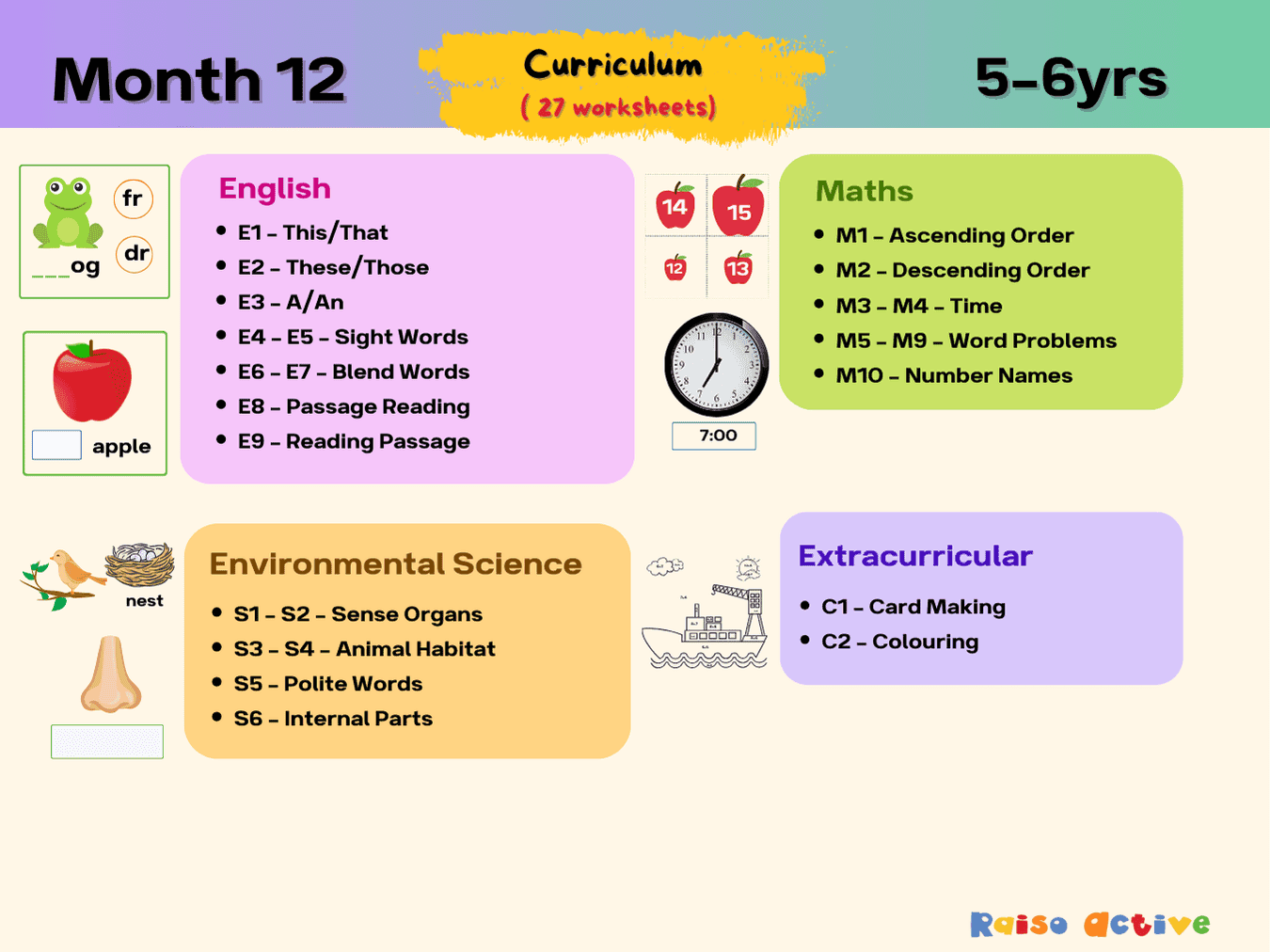
Part of the pack
Month 12: Learning & Development | Ages 5-6
This is page 28 of the pack. Ages 5-6 · KindergartenAges 5-6 · Year 1Ages 5-6 · UKGAges 5-6
Curriculum
- My Body > Sense Organs
How to use this worksheet
Look at each organ picture at the bottom of the page and name it together, briefly explaining what that organ does — for example, 'the heart pumps blood.' Have your child cut out each organ shape carefully along its outline. One organ at a time, ask where on the body diagram it belongs before applying glue and placing it in the matching box. Once every organ is glued into place, review the completed diagram and have your child point to and name each organ again.
Materials needed
- Scissors
- Glue
- Pencil
Extension activities
- 1Draw and label a large outline of the human body and add other body parts you know.
- 2Make organs out of playdough and place them onto a body-shaped cutout.
- 3Listen to your own heartbeat with a hand on your chest after light exercise, and talk about what the heart is doing.
- 4Read a simple book about the human body to reinforce organ names and functions.

Written by
Hemsweta Jain · Teacher Cheena
MBA and Early Childhood Educator, teaching since 2014 · Founder of RaisoActive, Mumbai
Every RaisoActive worksheet is designed and checked by the founder before publishing.
Published · Last reviewed
More from Month 12: Learning & Development | Ages 5-6

Sense Organs Worksheet for Kids: Identify and Name!
Ages 3-5 · Preschool–Pre-KAges 3-5 · Nursery–ReceptionAges 3-5 · Nursery–LKGAges 3-5
Children ages 3-5 practice identifying and naming the five sense organs — ears, eyes, nose, tongue, and skin — by looking at pictures of body parts and writing their names, combining early science vocabulary with beginning writing practice. Naming each organ by its correct term builds precise vocabulary beyond simply knowing that people can see, hear, and smell.

Color the Sight Words! A Fun Coloring Worksheet for Preschoolers
Ages 3-5 · Preschool–Pre-KAges 3-5 · Nursery–ReceptionAges 3-5 · Nursery–LKGAges 3-5
This worksheet helps children ages 3-5 recognize common sight words by finding and coloring them within a brick-wall design according to a color key. Because sight words like 'the,' 'and,' or 'is' don't follow regular phonics rules, repeated visual exposure like this coloring task is one of the most effective ways for young children to memorize them by sight rather than sounding them out each time.

Descending Order Fruits Worksheet for Preschoolers
Ages 4-5 · Pre-KAges 4-5 · ReceptionAges 4-5 · LKGAges 4-5
Arranging fruits labeled with numbers from largest to smallest builds descending order recognition for children ages 4-5, reinforcing number comparison skills that complement the more commonly practiced ascending order.
Blend Words Worksheet: Practice Blending Sounds!
Ages 4-6 · Pre-K–KindergartenAges 4-6 · Reception–Year 1Ages 4-6 · LKG–UKGAges 4-6
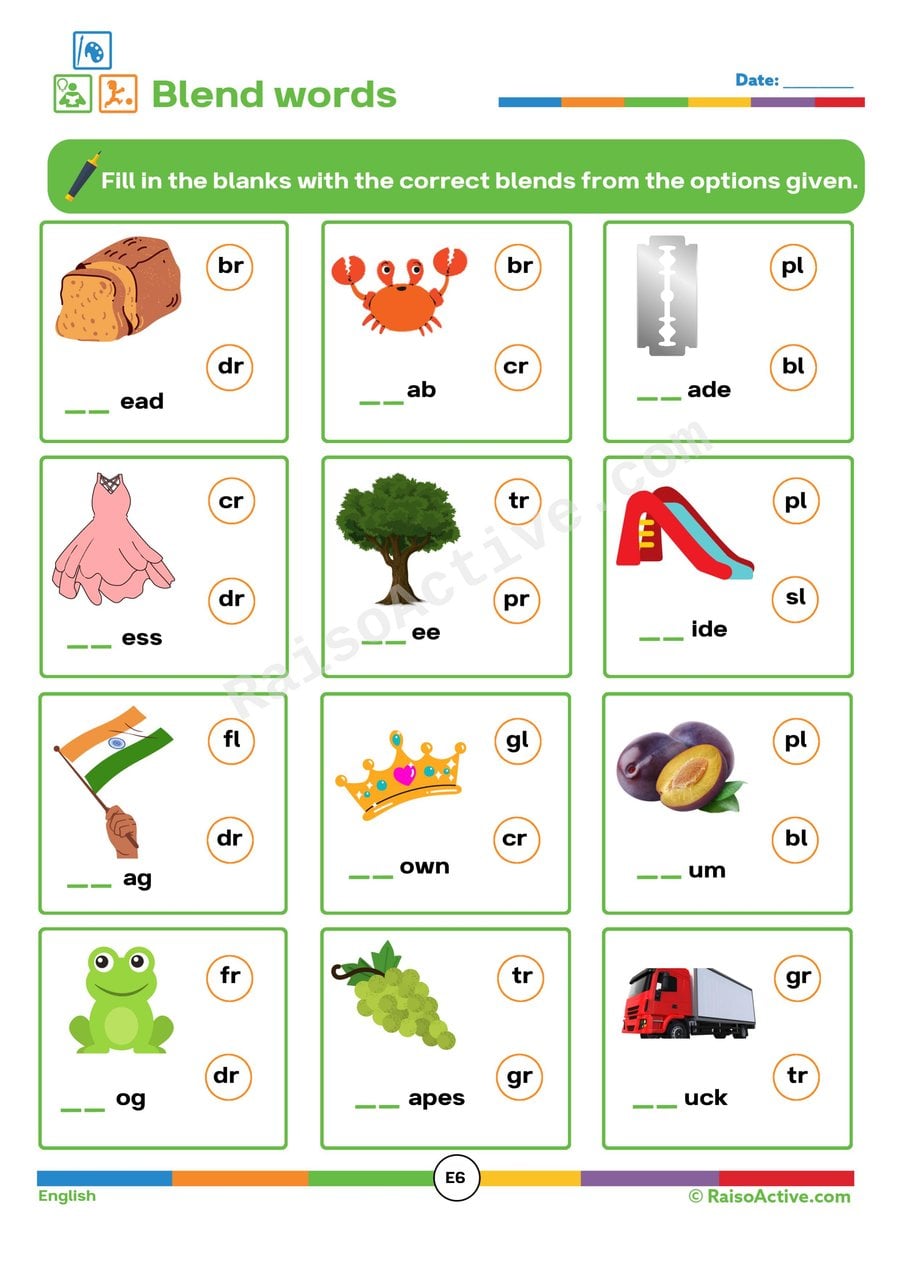
This worksheet gives children ages 4-6 focused practice blending initial consonant sounds, like 'cl' or 'fr,' with the rest of a word to complete a picture-labeled word. Unlike simple picture matching, writing the missing blend requires children to actively produce the correct letter combination from memory, which is a more demanding and valuable phonics skill than recognition alone.

Word Problems Worksheet: Solving Addition and Subtraction
Ages 4-6 · Pre-K–KindergartenAges 4-6 · Reception–Year 1Ages 4-6 · LKG–UKGAges 4-6
Solving a mix of addition and subtraction word problems trains children ages 4-6 to decide which operation a story calls for, based on whether it describes combining groups or taking something away, a key reasoning skill before formal equation writing.

Time Telling Worksheet: Write the Time on the Clocks!
Ages 4-6 · Pre-K–KindergartenAges 4-6 · Reception–Year 1Ages 4-6 · LKG–UKGAges 4-6
Reading the position of the hour and minute hands on an analog clock and writing the matching time builds clock-reading fluency for children ages 4-6, a more advanced step than simply recognizing a given time, since it requires producing the answer independently.

Sight Word Fun: Fill-in-the-Blank Worksheet for Preschoolers
Ages 4-5 · Pre-KAges 4-5 · ReceptionAges 4-5 · LKGAges 4-5
Reading a sentence with a missing sight word and selecting the correct choice builds early reading fluency for children ages 4-5, since recognizing common sight words by sight — rather than sounding them out — speeds up overall reading comprehension.

Animal Homes Matching Worksheet for Preschoolers
Ages 3-5 · Preschool–Pre-KAges 3-5 · Nursery–ReceptionAges 3-5 · Nursery–LKGAges 3-5
Children ages 3-5 practice matching animals to their correct habitats, like a bird to a nest or a fish to water, building early science knowledge about how different animals are suited to different environments. This kind of habitat matching lays groundwork for later ecosystem and adaptation concepts in school science.
Related worksheets
Body Parts Crossword Puzzle Worksheet for Kids
Ages 3-5 · Preschool–Pre-KAges 3-5 · Nursery–ReceptionAges 3-5 · Nursery–LKGAges 3-5
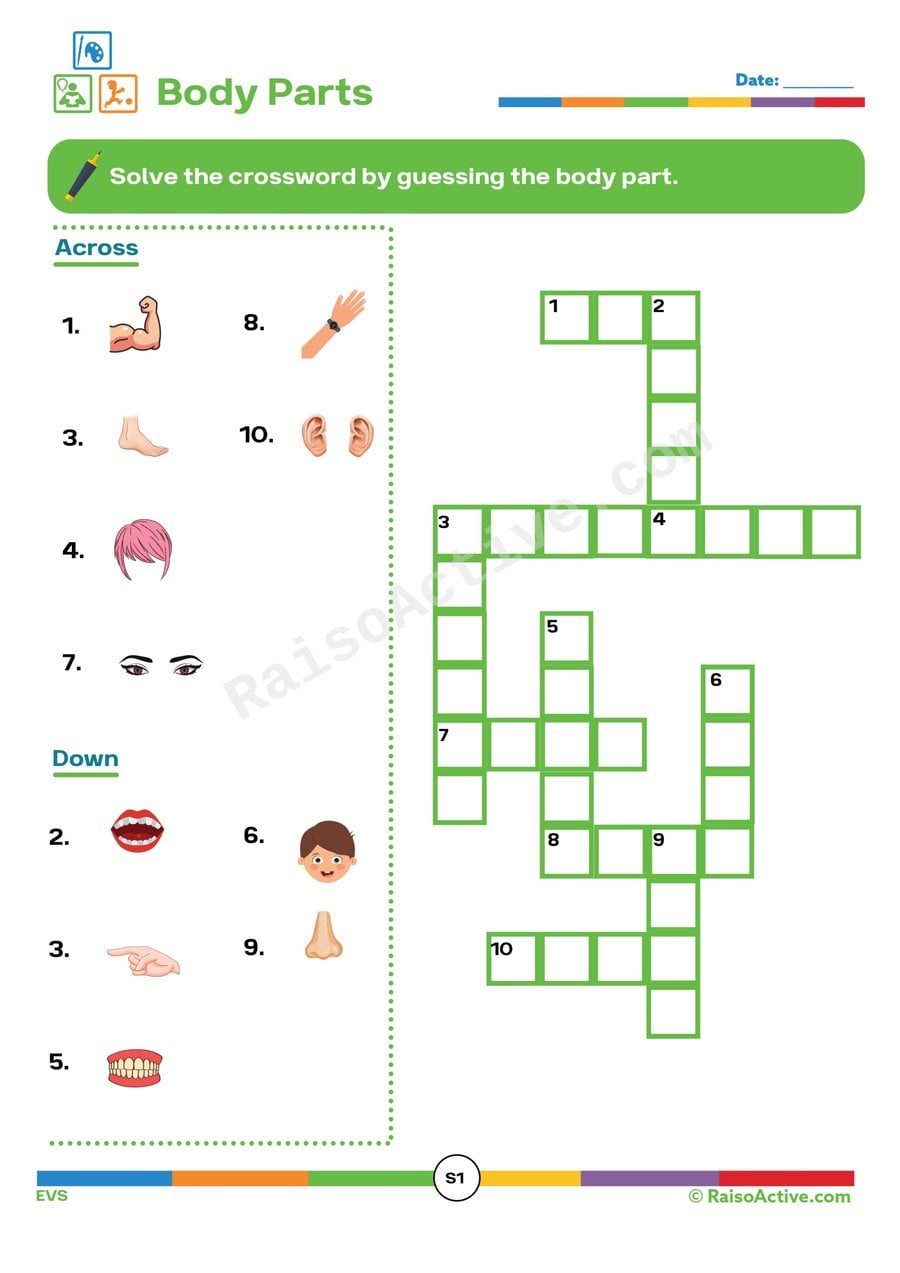
Solving a crossword using body part picture clues teaches children ages 3-5 to connect a visual image with its written name, building both vocabulary and early spelling skills. Working through the crossword's number grid also introduces the format of organizing answers into specific boxes, a small but useful pre-literacy skill.

Internal Organs Worksheet: Find and Match the Body Parts!
Ages 4-6 · Pre-K–KindergartenAges 4-6 · Reception–Year 1Ages 4-6 · LKG–UKGAges 4-6
Finding organ names hidden in a word search and then cutting and pasting the organs onto the correct spot on a body diagram teaches children ages 4-6 the names and general locations of internal organs, like the heart, lungs, and stomach, introducing basic human biology. Searching the word grid builds visual scanning and word recognition, while the cut-and-paste placement step reinforces spatial understanding of where each organ sits inside the body. Combining a word search with a hands-on placement task gives this worksheet both a literacy and a science learning goal.
5 Senses Worksheet: Explore the World!
Ages 4-6 · Pre-K–KindergartenAges 4-6 · Reception–Year 1Ages 4-6 · LKG–UKGAges 4-6
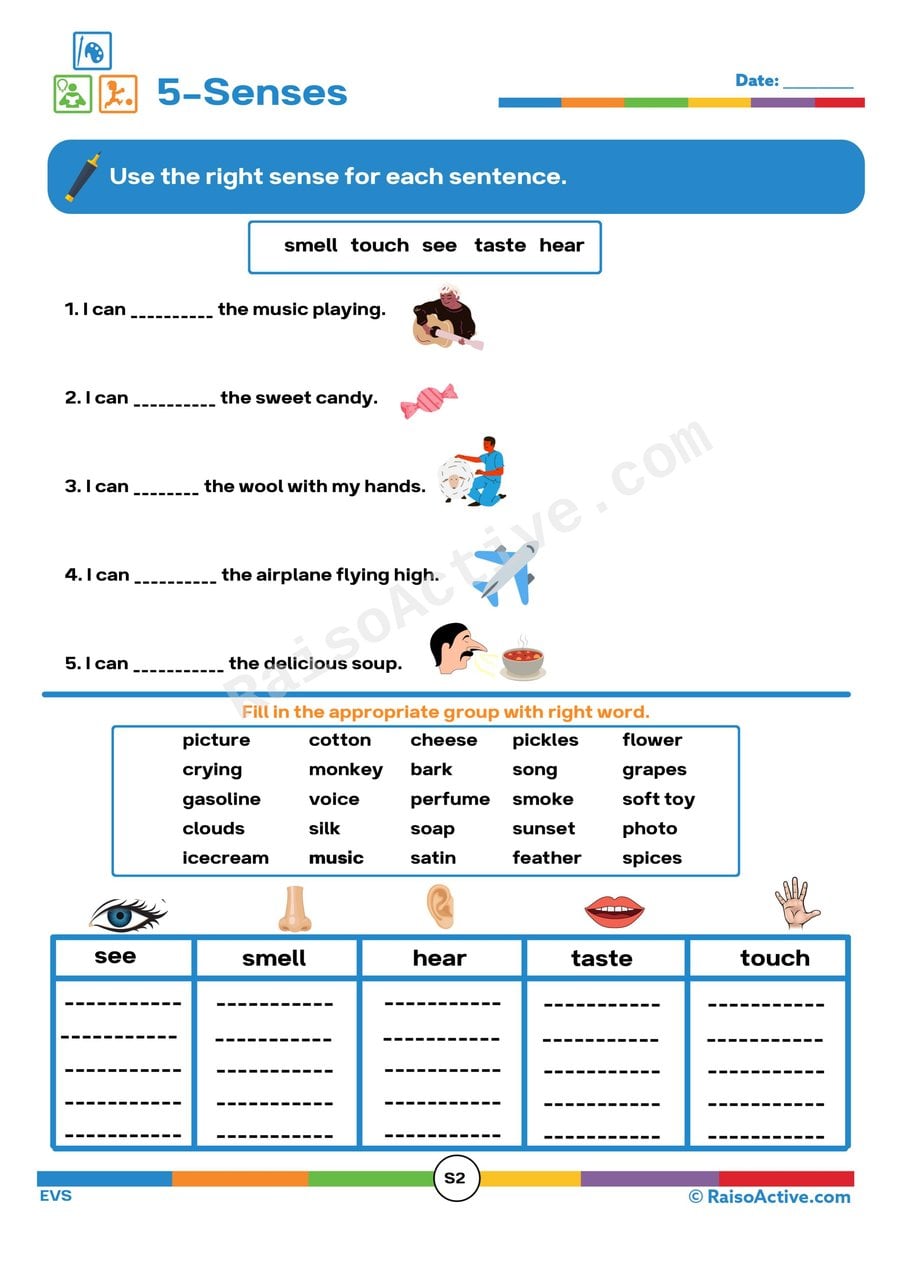
Identifying which of the five senses, sight, smell, hearing, taste, or touch, is being used in each picture or sentence helps children ages 4-6 build scientific observation vocabulary and connect abstract sense words to concrete everyday actions. Matching the words to senses in a table afterward reinforces the vocabulary in a second, different format.
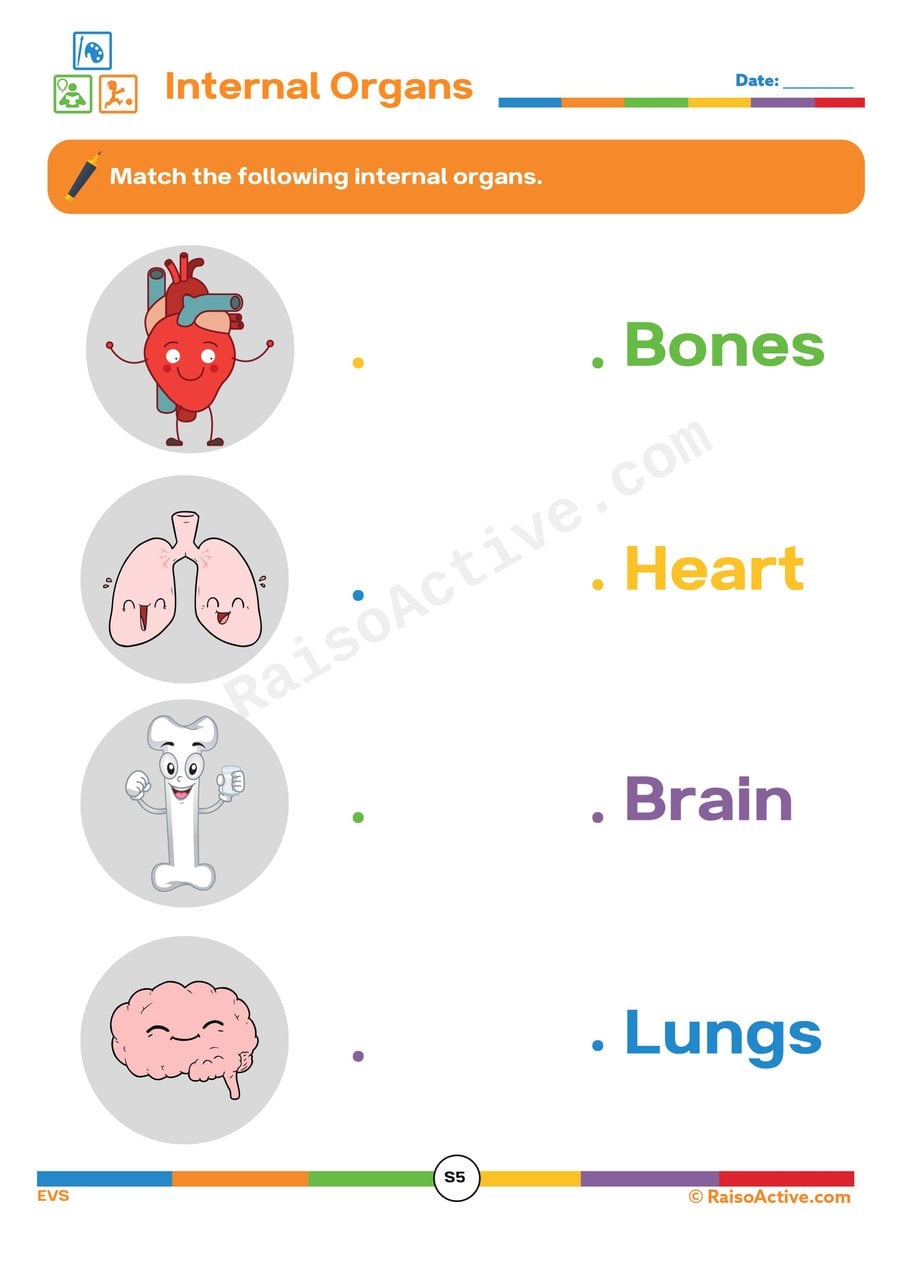
Match the Internal Organs Worksheet for Kids
Ages 3-5 · Preschool–Pre-KAges 3-5 · Nursery–ReceptionAges 3-5 · Nursery–LKGAges 3-5
Drawing lines to connect organ pictures to their correct names teaches children ages 3-5 an early introduction to human biology, helping them recognize that the body has specific parts inside it with their own names and jobs, beyond just the body parts they can see and touch. This matching task builds visual discrimination, since organs can look somewhat similar in simple illustrations, requiring children to look closely at shape and detail before connecting a picture to its label. Coloring the organs afterward adds a fine motor and creative finishing step to the science lesson.

Human Body Parts Cut and Paste Worksheet for Kids
Ages 3-5 · Preschool–Pre-KAges 3-5 · Nursery–ReceptionAges 3-5 · Nursery–LKGAges 3-5
This cut-and-paste activity teaches children ages 3-5 to identify and correctly place major body parts — like the head, arms, legs, and torso — onto a body outline, reinforcing body awareness alongside cutting and gluing fine motor skills. Understanding where each part belongs on the body supports early self-awareness and vocabulary that children use constantly, from getting dressed to describing how they feel. Physically assembling the body from separate pieces also helps children see how individual parts combine into a whole, functioning figure.

Body Parts Worksheet: Identify and Paste the Correct Organ!
Ages 4-6 · Pre-K–KindergartenAges 4-6 · Reception–Year 1Ages 4-6 · LKG–UKGAges 4-6
Reading a clue about a body part's function and finding the matching organ builds science vocabulary and reading comprehension for children ages 4-6, linking what a body part does to its correct name.
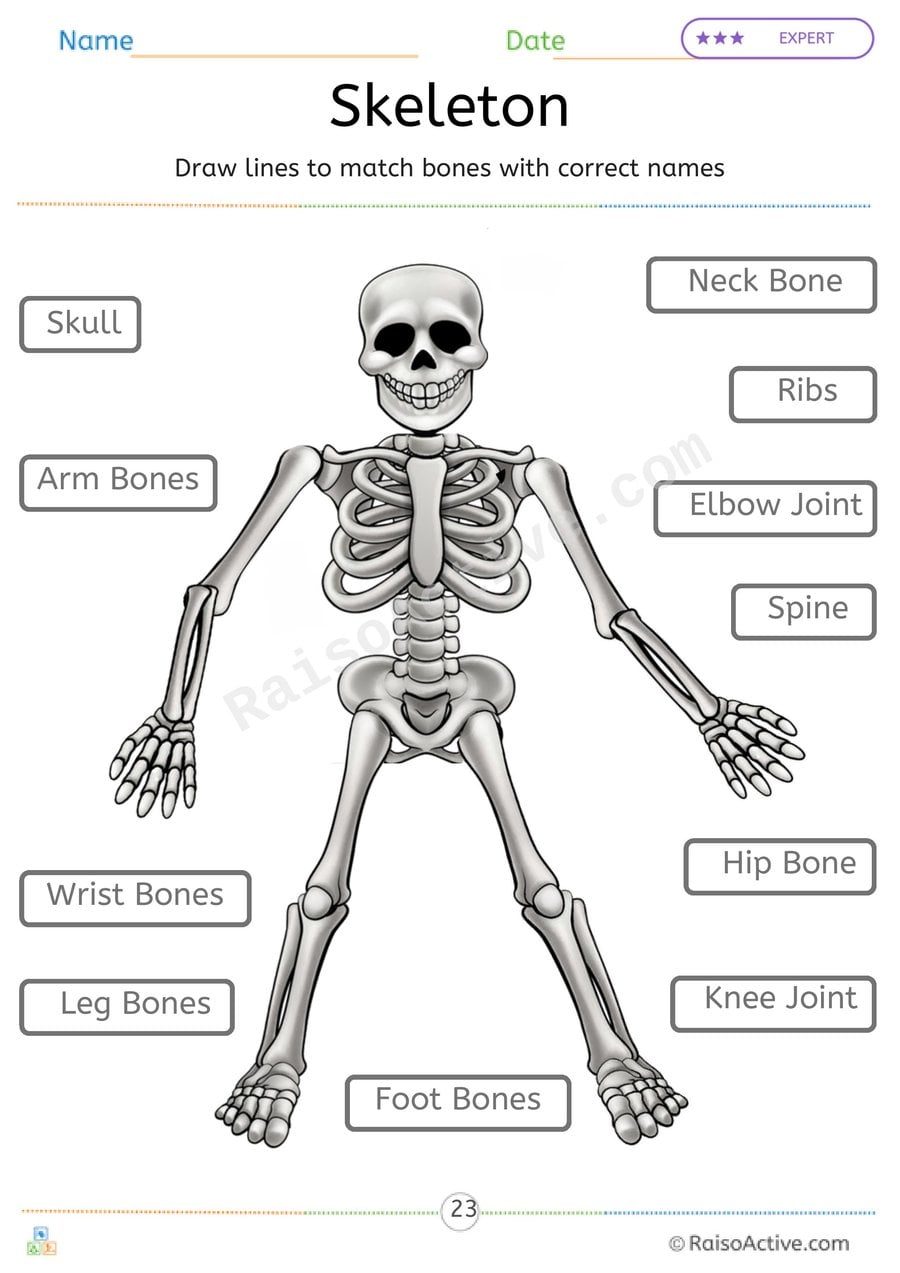
Skeleton Matching Worksheet: Learn About Bones!
Ages 4-6 · Pre-K–KindergartenAges 4-6 · Reception–Year 1Ages 4-6 · LKG–UKGAges 4-6
Drawing lines from bone names to their locations on a skeleton diagram introduces children ages 4-6 to basic human anatomy vocabulary, such as skull, ribs, or spine, while practicing left-to-right reading and matching skills. Because children must read a word and then visually locate the correct part of the body, this worksheet also strengthens the connection between written language and real-world objects, an important step toward reading comprehension. The Halloween-skeleton framing makes an otherwise academic science topic feel playful and approachable.

Body Parts Cut and Paste Worksheet for Preschoolers
Ages 3-5 · Preschool–Pre-KAges 3-5 · Nursery–ReceptionAges 3-5 · Nursery–LKGAges 3-5
This worksheet introduces children ages 3-5 to basic human anatomy by having them cut out pictures of internal organs, like the heart, lungs, or stomach, and glue each one onto its correct location on a body outline. Beyond early science vocabulary, the activity strengthens spatial reasoning, since children must judge where inside the body each organ actually belongs, along with fine motor precision through cutting and gluing small pieces.
Guides for this topic

How to Teach Cutting Skills to Your Preschooler: A Complete Guide for Parents and Teachers
Help your child master scissor skills safely. Expert guide covering readiness signs, scissor types, progression steps, pre-cutting exercises, and fun practice ideas for ages 2-6.
Christmas and Winter Activities That Combine Fun and Learning: Creating Magical Educational Experiences
Discover Christmas and winter activities that combine festive fun with real learning. Crafts, counting, literacy, and printable worksheets for ages 2 to 8 — perfect for home and school.
Age-Appropriate Halloween Learning Activities: Balancing Spooks and Skills for Young Learners
Discover fun, age-appropriate Halloween learning activities for young children. Spooky crafts, counting games, literacy ideas, and printable worksheets for ages 2 to 8.
Reviews
Every worksheet for ages 4–6, no watermark
Members download the full library of 1,000+ worksheets and every activity pack without watermarks or daily limits. One year costs ₹999 in India or $20 elsewhere.
See membership plansOr download any worksheet free with a watermark (5 a day).