5 Senses Worksheet: Explore the World!
Identifying which of the five senses, sight, smell, hearing, taste, or touch, is being used in each picture or sentence helps children ages 4-6 build scientific observation vocabulary and connect abstract sense words to concrete everyday actions. Matching the words to senses in a table afterward reinforces the vocabulary in a second, different format.
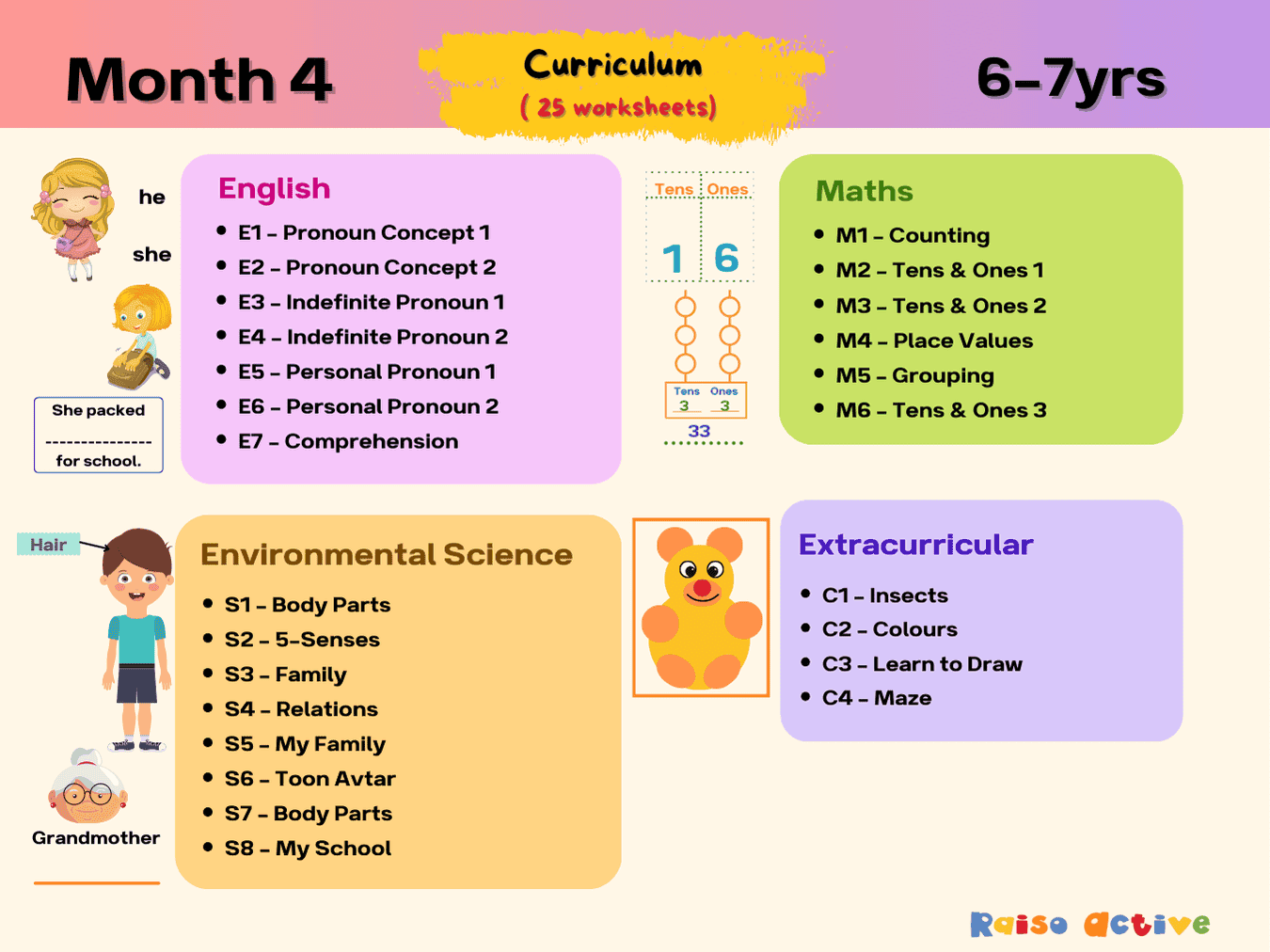
Part of the pack
Month 4: Learning & Development | Ages 6-7
This is page 18 of the pack. Ages 6-7 · Grade 1Ages 6-7 · Year 2Ages 6-7 · Class 1Ages 6-7
Curriculum
- My Body > Human Body
How to use this worksheet
Look at the first picture or sentence together and talk about what is happening in it. Ask your child which sense is being used, then have them write the correct sense word in the blank space. Once all the blanks are filled in, have them match each word to its correct sense in the table provided.
Materials needed
- Pencil
- Eraser
Extension activities
- 1Go on a sensory walk outside, describing what you can see, hear, smell, and touch along the way.
- 2Play a blindfolded taste or smell guessing game with safe household items.
- 3Create a sensory bin filled with different textures for a hands-on touch exploration.
- 4Draw a favorite thing associated with each of the five senses.
- 5Cover your eyes and try identifying household sounds to focus purely on hearing.

Written by
Hemsweta Jain · Teacher Cheena
MBA and Early Childhood Educator, teaching since 2014 · Founder of RaisoActive, Mumbai
Every RaisoActive worksheet is designed and checked by the founder before publishing.
Published · Last reviewed
More from Month 4: Learning & Development | Ages 6-7

Help the Boy Get Home! A Fun Maze Worksheet for Kids
Ages 3-5 · Preschool–Pre-KAges 3-5 · Nursery–ReceptionAges 3-5 · Nursery–LKGAges 3-5
Tracing a path through a maze to help a boy get home builds visual tracking and route-planning skills for children ages 3-5, since they must scan ahead and mentally test paths before committing to one. This kind of trial-and-error problem solving also strengthens the fine motor control needed to keep a pencil line steady along a winding path.
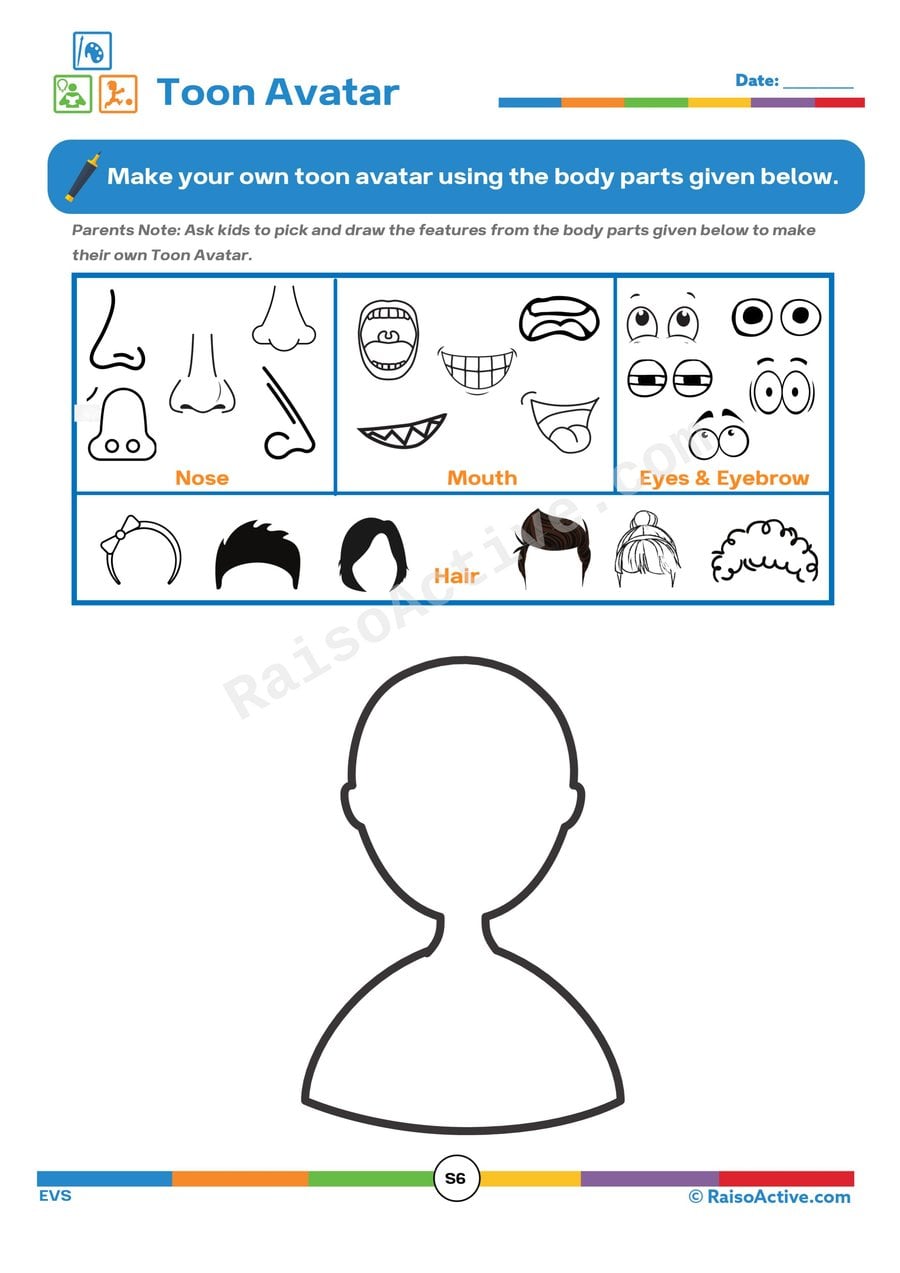
Create Your Own Toon Avatar Worksheet for Kids
Ages 3-5 · Preschool–Pre-KAges 3-5 · Nursery–ReceptionAges 3-5 · Nursery–LKGAges 3-5
Choosing and drawing features like eyes, nose, mouth, and hair onto a blank avatar outline builds creative self-expression and fine motor drawing control for children ages 3-5, while also introducing the idea that a face can be assembled from separate, swappable parts. This open-ended activity encourages decision-making as children choose which features best represent the character they imagine.

Tens and Ones Counting Worksheet for Preschoolers
Ages 4-6 · Pre-K–KindergartenAges 4-6 · Reception–Year 1Ages 4-6 · LKG–UKGAges 4-6
Counting grouped tens and ones blocks introduces children ages 4-6 to place value, the idea that a two-digit number is really made up of groups of ten plus some leftover ones. This concept is foundational for understanding larger numbers and for later work with addition and subtraction that involves regrouping.

Color Mixing Worksheet for Preschoolers: Learn Primary and Secondary Colors!
Ages 4-6 · Pre-K–KindergartenAges 4-6 · Reception–Year 1Ages 4-6 · LKG–UKGAges 4-6
Identifying primary colors and predicting which two combine to create each secondary color introduces children ages 4-6 to basic color theory, an early scientific concept about how colors interact. This worksheet builds the vocabulary and reasoning skills needed to understand color mixing before testing it out with real paint or crayons.

Indefinite Pronouns Worksheet: Fill-in-the-Blanks Fun!
Ages 4-6 · Pre-K–KindergartenAges 4-6 · Reception–Year 1Ages 4-6 · LKG–UKGAges 4-6
Filling in the blanks with indefinite pronouns like something, someone, and somewhere teaches children ages 4-6 how these flexible words stand in for people, places, or things without naming them specifically, an important step in building more natural, varied sentences. Using picture clues alongside the sentences also helps children connect abstract grammar terms to concrete, familiar scenes.
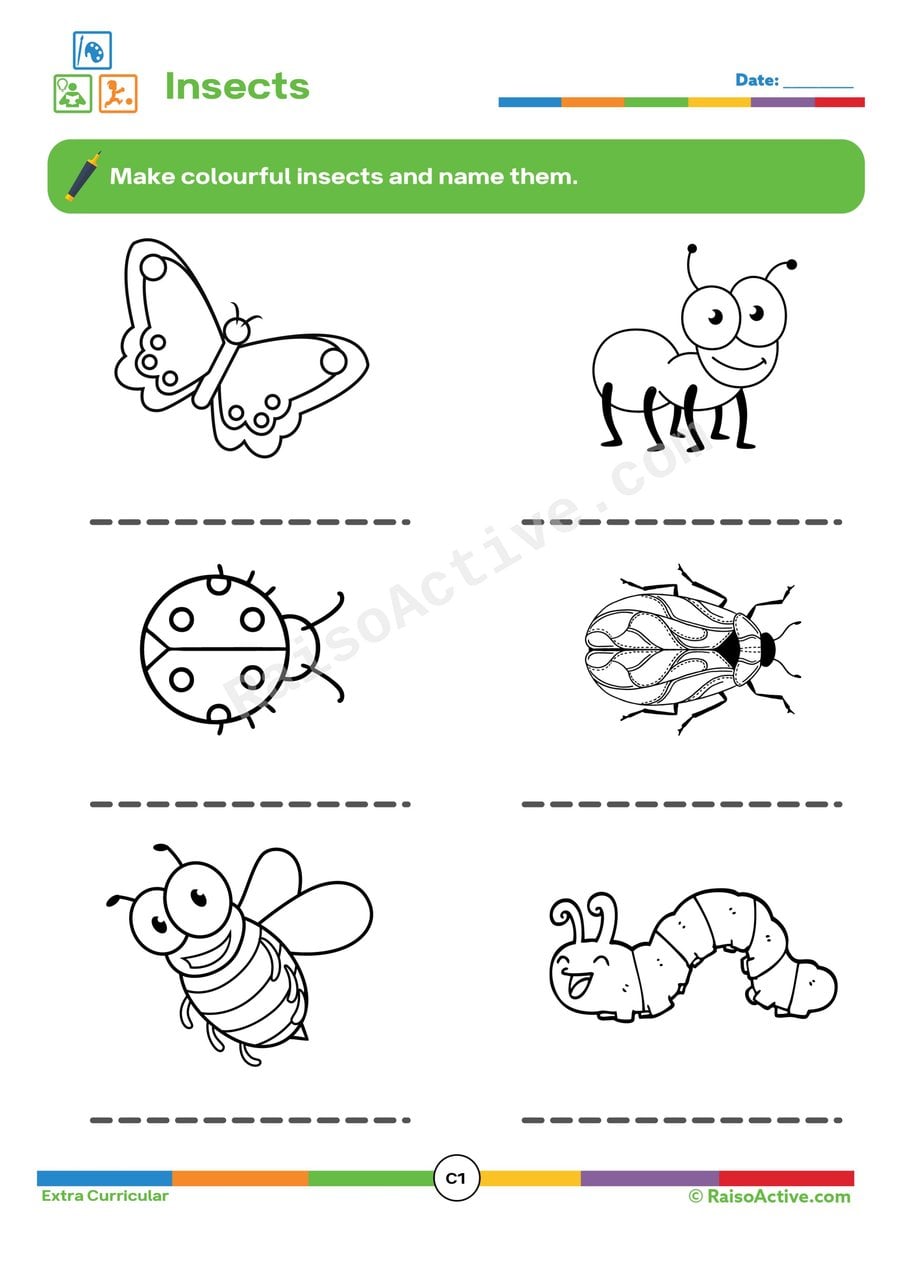
Color the Insects Worksheet for Preschoolers
Ages 3-5 · Preschool–Pre-KAges 3-5 · Nursery–ReceptionAges 3-5 · Nursery–LKGAges 3-5
Coloring a set of insects and writing their names afterward helps children ages 3-5 build insect vocabulary while practicing fine motor coloring control and connecting a picture to its written word. This combination of art and labeling reinforces new vocabulary more effectively than looking at pictures alone.

My Family Worksheet: Learn About Family Members!
Ages 3-5 · Preschool–Pre-KAges 3-5 · Nursery–ReceptionAges 3-5 · Nursery–LKGAges 3-5
Writing the names of family members next to their pictures helps children ages 3-5 connect written words to real relationships in their own lives, combining early handwriting practice with meaningful, personal vocabulary. Because the content is about their own family, this worksheet tends to feel especially engaging and easy to talk about.

Pronoun Power: Matching and Writing Practice Worksheet
Ages 4-6 · Pre-K–KindergartenAges 4-6 · Reception–Year 1Ages 4-6 · LKG–UKGAges 4-6
Matching nouns to their correct pronouns and then rewriting sentences with a pronoun in place of an underlined word teaches children ages 4-6 how pronouns work as stand-ins for people, places, or things, a key grammar concept for writing smoother sentences. Practicing both matching and substitution gives two different angles on the same underlying skill.
Related worksheets

Internal Parts Worksheet: Cut and Paste the Organs!
Ages 4-6 · Pre-K–KindergartenAges 4-6 · Reception–Year 1Ages 4-6 · LKG–UKGAges 4-6
This worksheet introduces children ages 4-6 to basic human anatomy by having them cut out pictures of internal organs, such as the heart, lungs, and stomach, and glue each one into its correct location on a body outline. Beyond scissor and gluing practice, this activity builds spatial body awareness and early scientific vocabulary, giving children a first mental map of what's inside their own bodies.

Lungs Activity Worksheet for Kids: Color, Cut, and Learn!
Ages 3-5 · Preschool–Pre-KAges 3-5 · Nursery–ReceptionAges 3-5 · Nursery–LKGAges 3-5
This hands-on activity has children ages 3-5 color and cut out lung shapes, then build a simple working model using a straw and balloons to demonstrate how lungs expand and contract when we breathe. Watching a physical model move mimics a real body process, making an invisible internal organ's function suddenly visible and understandable.

Human Skeleton Cut and Join Worksheet for Preschoolers
Ages 4-6 · Pre-K–KindergartenAges 4-6 · Reception–Year 1Ages 4-6 · LKG–UKGAges 4-6
This hands-on worksheet introduces children ages 4-6 to basic human anatomy as they cut out individual bone shapes, like the skull, ribs, arms, and legs, and assemble them into a complete skeleton. Beyond scissor control, the activity requires spatial reasoning, since children must figure out where each bone belongs relative to the others to build an accurate body shape.

Body Parts Worksheet: Identify and Paste the Correct Organ!
Ages 4-6 · Pre-K–KindergartenAges 4-6 · Reception–Year 1Ages 4-6 · LKG–UKGAges 4-6
Reading a clue about a body part's function and finding the matching organ builds science vocabulary and reading comprehension for children ages 4-6, linking what a body part does to its correct name.

Cut and Paste Body Parts Worksheet for Preschoolers
Ages 4-6 · Pre-K–KindergartenAges 4-6 · Reception–Year 1Ages 4-6 · LKG–UKGAges 4-6
This worksheet helps children ages 4-6 learn to name and correctly place major body parts by cutting them out and pasting each one onto the right location on a body outline. Physically assembling a body diagram builds body awareness and vocabulary at the same time, while the cutting and gluing sharpens fine motor precision that supports later handwriting.
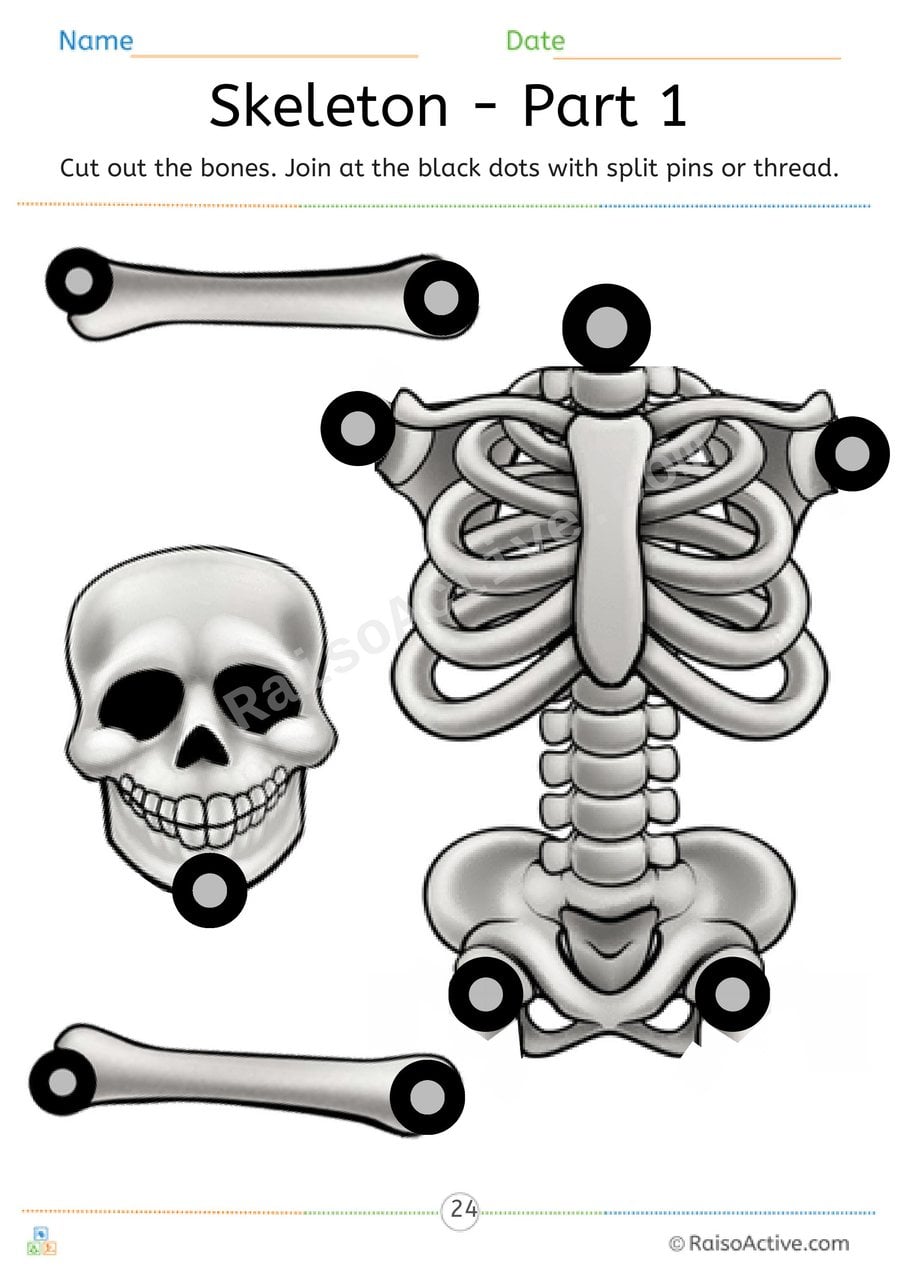
Skeleton Cut and Join Worksheet for Kids
Ages 3-5 · Preschool–Pre-KAges 3-5 · Nursery–ReceptionAges 3-5 · Nursery–LKGAges 3-5
This worksheet has children ages 3-5 cut out individual bone shapes and piece them together to assemble a skeleton, building scissor control and spatial reasoning as they figure out where each bone belongs relative to the others. Gluing the assembled bones onto a backing sheet also gives the activity a lasting, displayable result.

Internal Organs Worksheet: Find and Match the Body Parts!
Ages 4-6 · Pre-K–KindergartenAges 4-6 · Reception–Year 1Ages 4-6 · LKG–UKGAges 4-6
Finding organ names hidden in a word search and then cutting and pasting the organs onto the correct spot on a body diagram teaches children ages 4-6 the names and general locations of internal organs, like the heart, lungs, and stomach, introducing basic human biology. Searching the word grid builds visual scanning and word recognition, while the cut-and-paste placement step reinforces spatial understanding of where each organ sits inside the body. Combining a word search with a hands-on placement task gives this worksheet both a literacy and a science learning goal.

Human Body Parts Cut and Paste Worksheet for Kids
Ages 3-5 · Preschool–Pre-KAges 3-5 · Nursery–ReceptionAges 3-5 · Nursery–LKGAges 3-5
This cut-and-paste activity teaches children ages 3-5 to identify and correctly place major body parts — like the head, arms, legs, and torso — onto a body outline, reinforcing body awareness alongside cutting and gluing fine motor skills. Understanding where each part belongs on the body supports early self-awareness and vocabulary that children use constantly, from getting dressed to describing how they feel. Physically assembling the body from separate pieces also helps children see how individual parts combine into a whole, functioning figure.
Guides for this topic

Age-Appropriate Problem-Solving Activities: Building Critical Thinkers from the Ground Up
Discover fun, age-appropriate problem-solving activities for children ages 1-8. Build critical thinking, logic, and reasoning skills through play-based learning.
Critical Thinking Activities That Actually Work for Young Children: Building Tomorrow's Thinkers Today
Discover proven critical thinking activities for young children. Age-wise logic games, questioning techniques, and hands-on ideas to build thinking skills at home.

Preparing Your Child for a Rapidly Changing World: Essential Skills for Future Success
Discover the essential 21st century skills your child needs for future success. Practical tips on creativity, critical thinking, digital literacy & emotional intelligence for ages 1-8.
Reviews
Every worksheet for ages 4–6, no watermark
Members download the full library of 1,000+ worksheets and every activity pack without watermarks or daily limits. One year costs ₹999 in India or $20 elsewhere.
See membership plansOr download any worksheet free with a watermark (5 a day).