Lungs Activity Worksheet for Kids: Color, Cut, and Learn!
This hands-on activity has children ages 3-5 color and cut out lung shapes, then build a simple working model using a straw and balloons to demonstrate how lungs expand and contract when we breathe. Watching a physical model move mimics a real body process, making an invisible internal organ's function suddenly visible and understandable.
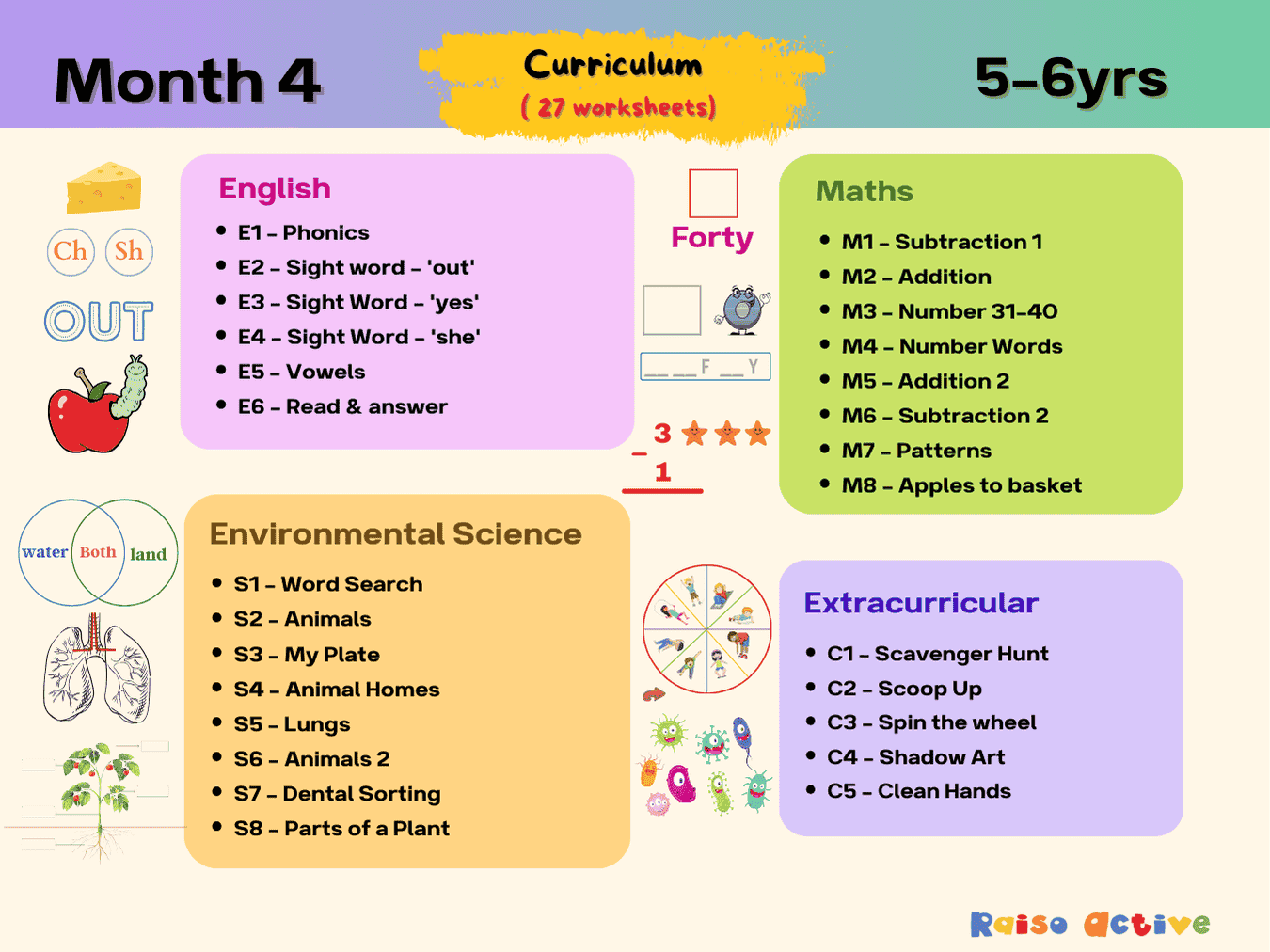
Part of the pack
Month 4: Learning & Development | Ages 5-6
This is page 22 of the pack. Ages 5-6 · KindergartenAges 5-6 · Year 1Ages 5-6 · UKGAges 5-6
Curriculum
- My Body > Human Body
How to use this worksheet
Have your child color the lung cutout using their choice of colors, then help them cut it out carefully. Follow the model-building steps together: attach a balloon to one end of a straw with tape, and if the activity calls for it, attach a second balloon or bag to represent the diaphragm at the base. Once assembled, gently blow into or pull on the model parts as instructed to show the balloons inflating like real lungs filling with air. Talk about what's happening in your own chest as you both take a deep breath together.
Materials needed
- Crayons or colored pencils
- Scissors
- Straw
- Balloons
- Tape
Extension activities
- 1Take turns feeling your chest rise and fall while breathing deeply, then compare that movement to the model.
- 2Research and draw one other part of the respiratory system, like the nose, throat, or diaphragm.
- 3Time how many breaths you take in one minute while resting versus right after jumping around.
- 4Blow up a real balloon together and talk about how it's similar to how lungs fill with air.
- 5Read a simple book or watch a video about how the body breathes to add more detail to the lesson.

Written by
Hemsweta Jain · Teacher Cheena
MBA and Early Childhood Educator, teaching since 2014 · Founder of RaisoActive, Mumbai
Every RaisoActive worksheet is designed and checked by the founder before publishing.
Published · Last reviewed
More from Month 4: Learning & Development | Ages 5-6

Parent's Guide: Sight Words, Vowels, and Early Math Activities
Ages 3-5 · Preschool–Pre-KAges 3-5 · Nursery–ReceptionAges 3-5 · Nursery–LKGAges 3-5
This parent's guide combines sight word recognition, vowel puppet play, simple subtraction with blocks, and living-versus-non-living observation, giving children ages 3-5 broad exposure to early literacy, number sense, and basic science reasoning through varied hands-on activities. Because each section targets a different skill, the guide offers something to match whatever your child feels drawn to that day.
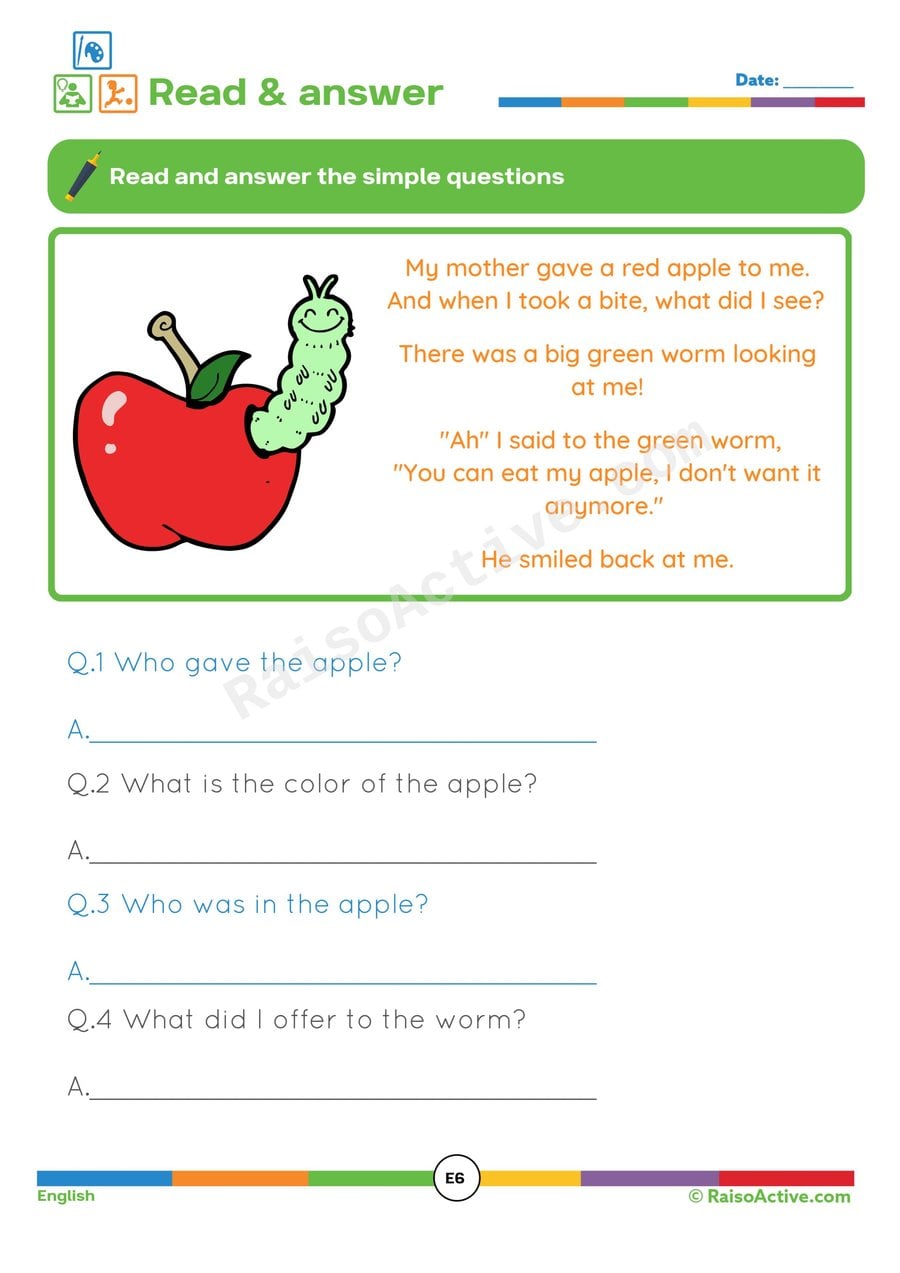
Read and Answer: The Red Apple Worksheet
Ages 3-5 · Preschool–Pre-KAges 3-5 · Nursery–ReceptionAges 3-5 · Nursery–LKGAges 3-5
Reading the short Red Apple story and answering questions afterward helps children ages 3-5 practice basic reading comprehension, recalling simple details from a story and expressing their understanding in writing. This early comprehension practice builds the habit of checking back with a text to support an answer, a skill that grows more important throughout school.
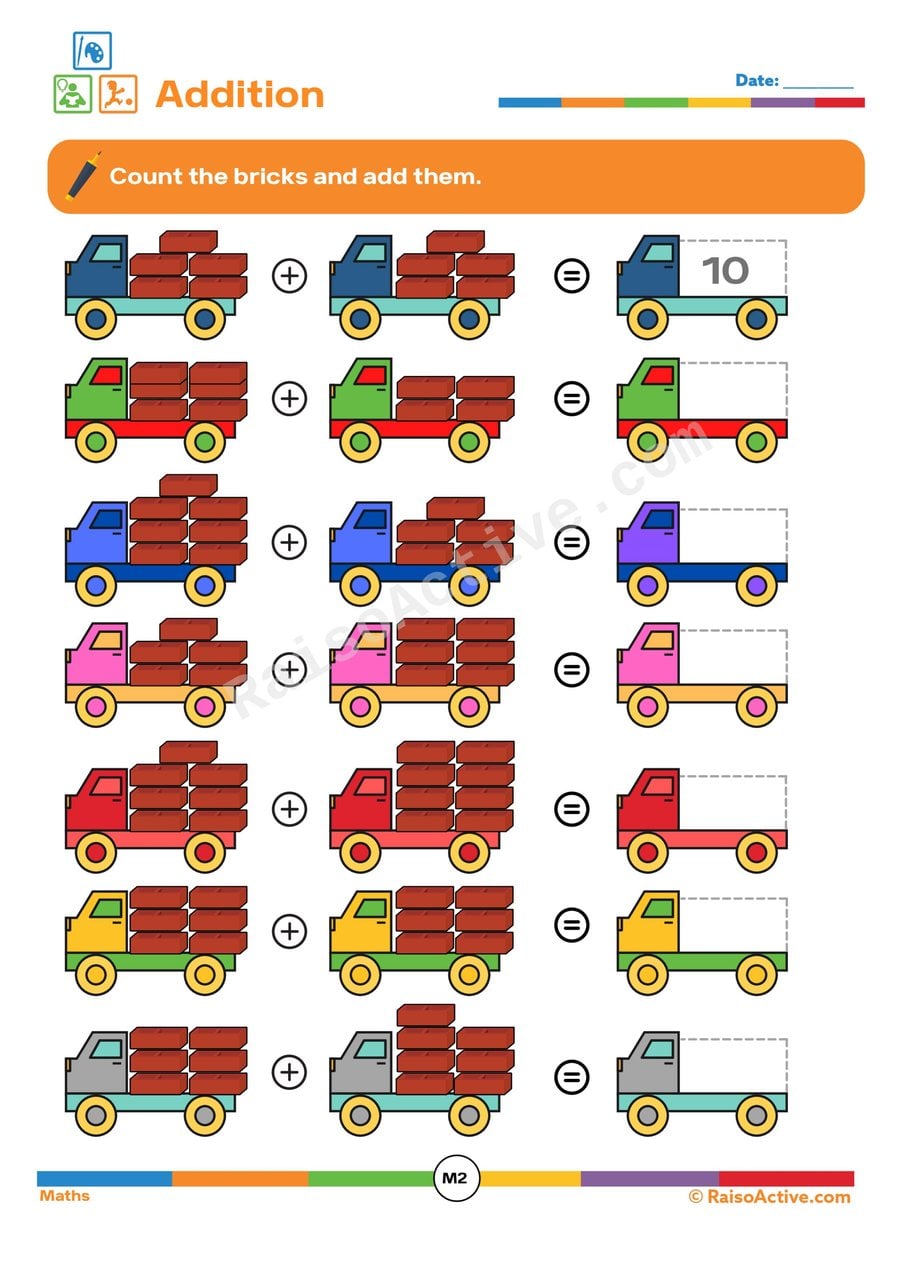
Truckload Addition Worksheet for Preschoolers
Ages 4-5 · Pre-KAges 4-5 · ReceptionAges 4-5 · LKGAges 4-5
Counting bricks loaded on two trucks and adding the totals together teaches children ages 4-5 basic addition through a playful, visual context that makes the abstract idea of combining quantities easier to grasp. This truck theme also keeps counting practice engaging for children who love vehicles, building both number sense and sustained attention.

Animal Homes Matching Worksheet for Preschoolers
Ages 3-5 · Preschool–Pre-KAges 3-5 · Nursery–ReceptionAges 3-5 · Nursery–LKGAges 3-5
This worksheet helps children ages 3-5 learn where different animals live by matching each animal to its correct home, such as a bird to a nest or a bear to a cave, then writing the home's name. Understanding that animals have specific habitats suited to their needs is an early life-science concept that also builds descriptive vocabulary.

Apples to Basket: Sorting Math Worksheet for Preschoolers
Ages 4-6 · Pre-K–KindergartenAges 4-6 · Reception–Year 1Ages 4-6 · LKG–UKGAges 4-6
This worksheet combines basic addition and subtraction practice with sorting skills as children ages 4-6 solve a math problem written on each apple, then decide which basket it belongs in based on whether the answer is more or less than a target number. Categorizing numbers by size after calculating them adds a layer of number-sense reasoning beyond simply finding the right answer.
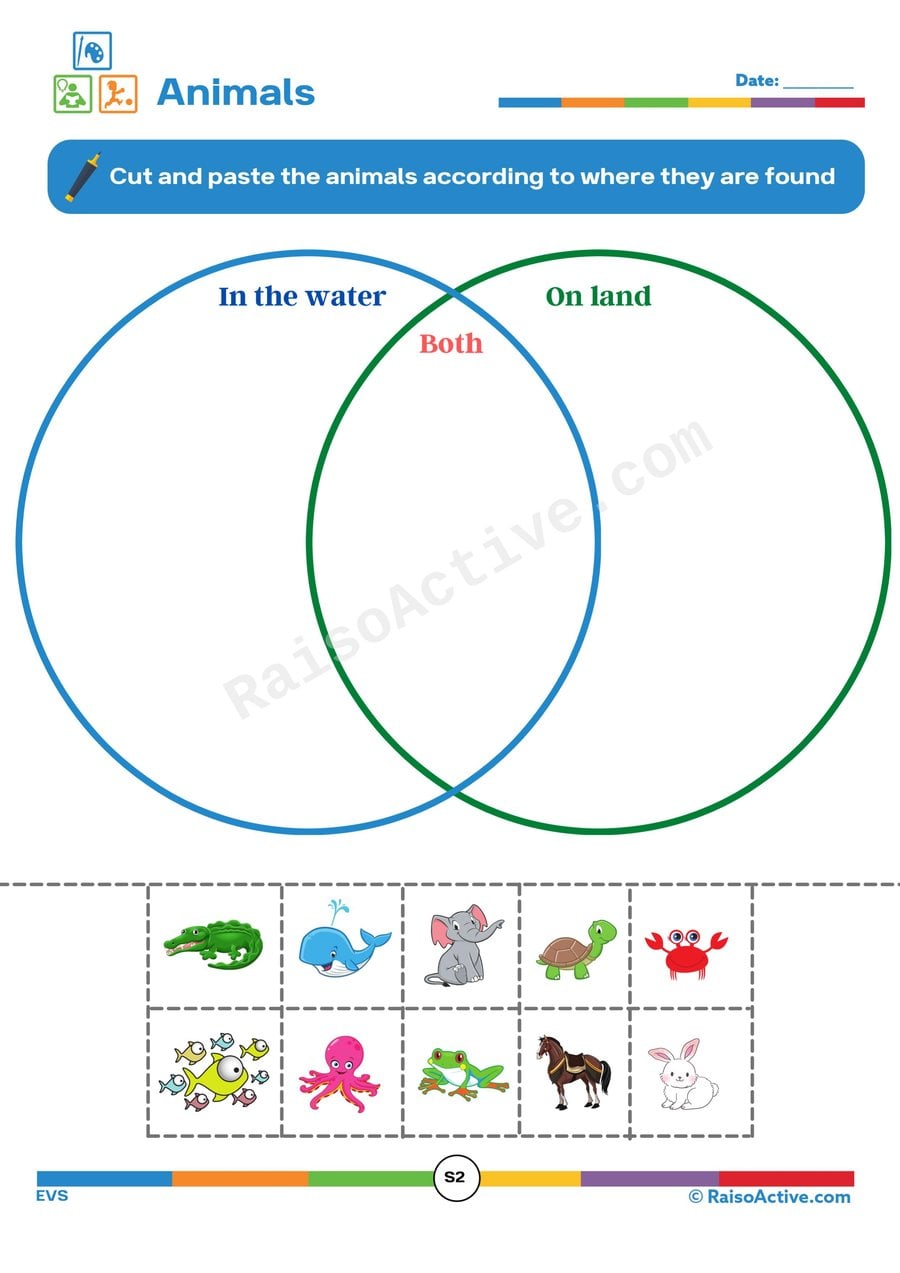
Animals: Sorting Worksheet for Preschoolers
Ages 3-5 · Preschool–Pre-KAges 3-5 · Nursery–ReceptionAges 3-5 · Nursery–LKGAges 3-5
This sorting worksheet has children ages 3-5 cut out animal pictures and paste each one into either a water or land habitat circle, building an early classification skill around where different animals naturally live. Sorting animals by habitat, rather than by type or size, introduces the idea that an animal's environment is a meaningful category on its own.
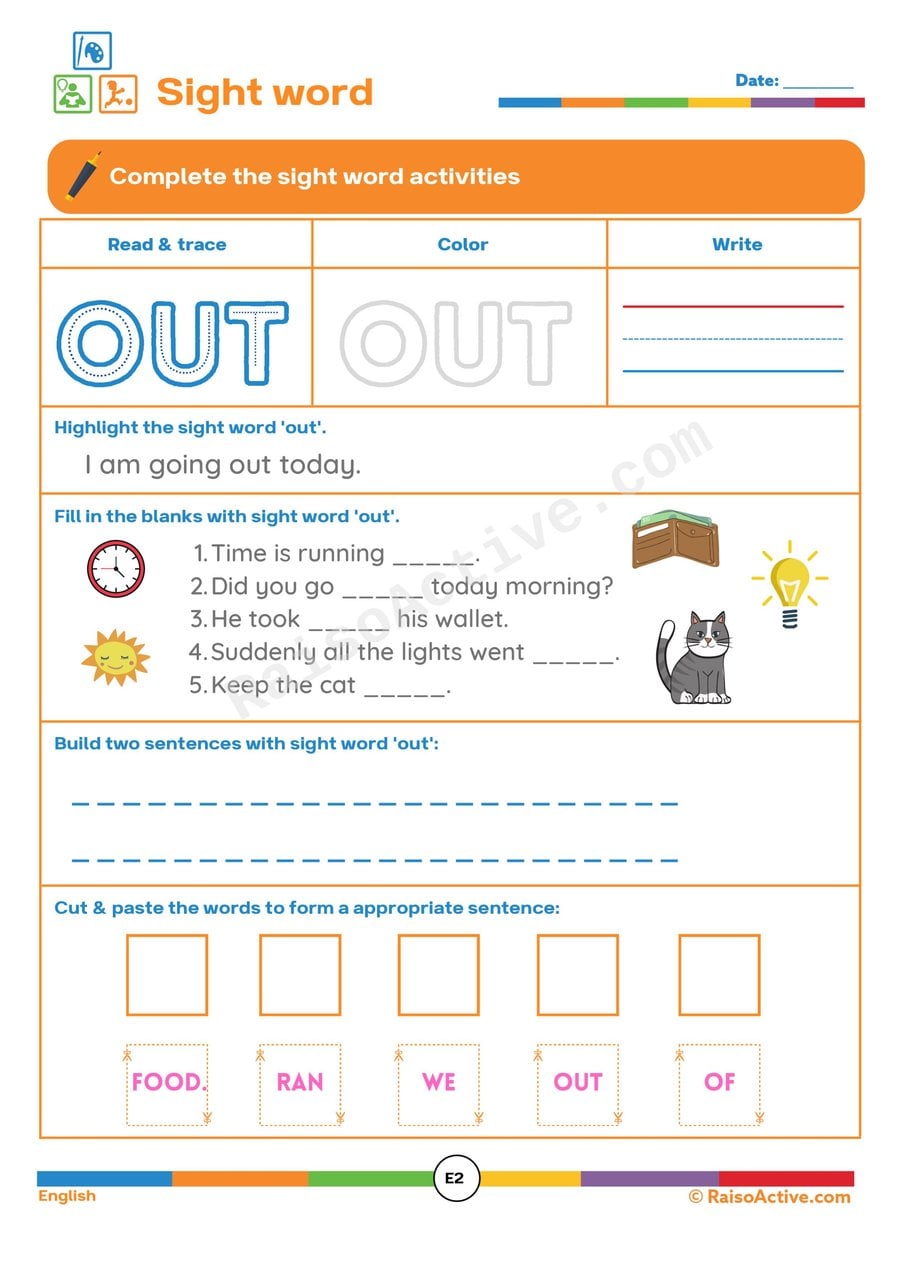
Sight Word 'Out' Worksheet: Read, Trace, and Write!
Ages 3-5 · Preschool–Pre-KAges 3-5 · Nursery–ReceptionAges 3-5 · Nursery–LKGAges 3-5
Reading fluency for young children depends on instantly recognizing common sight words that don't sound out easily, and this worksheet gives children ages 3-5 focused, repeated exposure to the word 'out' through tracing, coloring, and sentence practice. Seeing the word in context within simple sentences also helps children start connecting sight-word recognition to real reading comprehension.
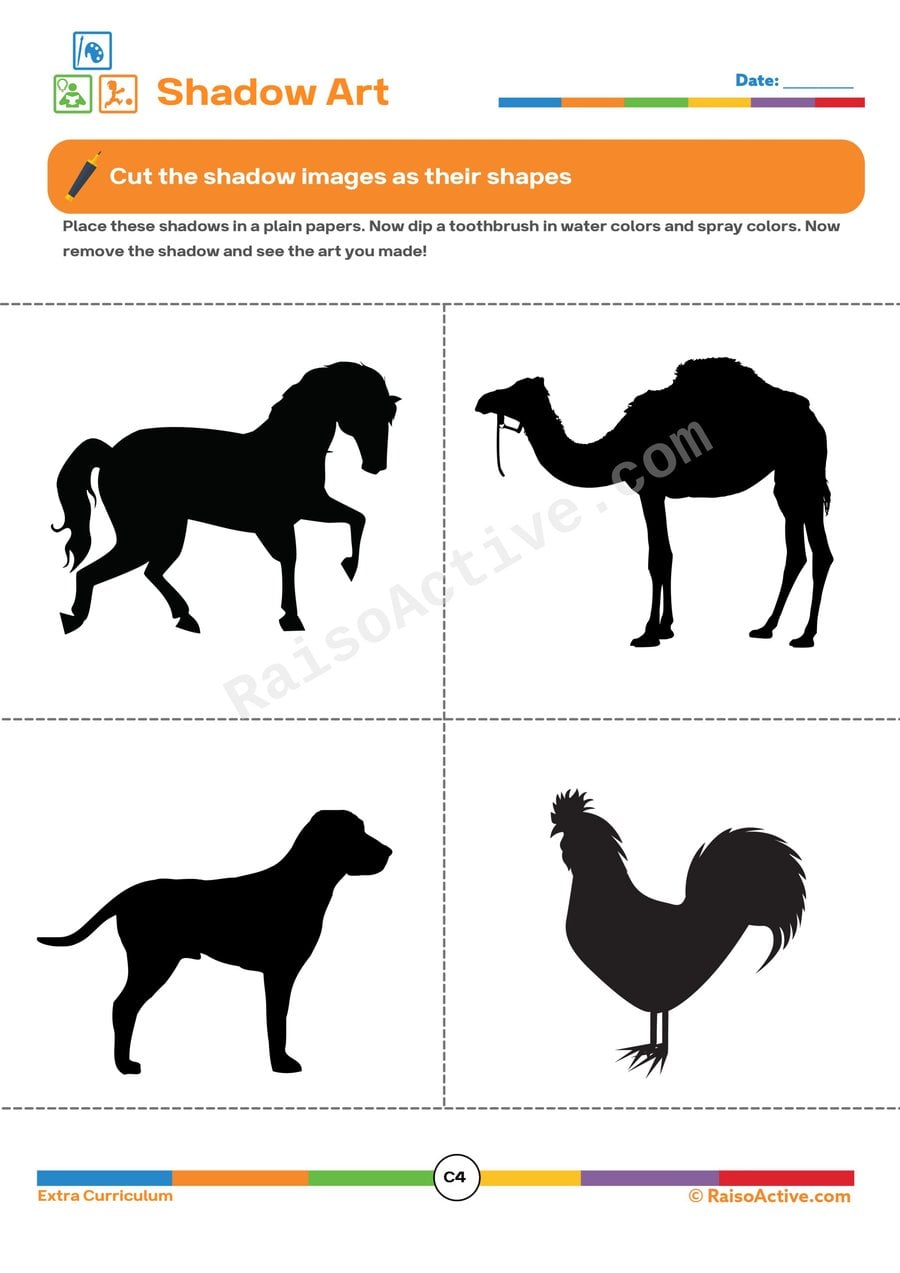
Shadow Art Fun: Cut and Create Animal Shapes!
Ages 3-5 · Preschool–Pre-KAges 3-5 · Nursery–ReceptionAges 3-5 · Nursery–LKGAges 3-5
This worksheet turns a science concept — how shadows block light — into a hands-on art project, as children ages 3-5 cut out animal silhouettes and use them to create splatter-paint shadow art. Beyond fine motor cutting practice, the activity introduces the early science idea that a solid shape stops color or light from reaching the paper beneath it, leaving a clean outline behind.
Related worksheets

Human Body Parts Cut and Paste Worksheet for Kids
Ages 3-5 · Preschool–Pre-KAges 3-5 · Nursery–ReceptionAges 3-5 · Nursery–LKGAges 3-5
This cut-and-paste activity teaches children ages 3-5 to identify and correctly place major body parts — like the head, arms, legs, and torso — onto a body outline, reinforcing body awareness alongside cutting and gluing fine motor skills. Understanding where each part belongs on the body supports early self-awareness and vocabulary that children use constantly, from getting dressed to describing how they feel. Physically assembling the body from separate pieces also helps children see how individual parts combine into a whole, functioning figure.

Body Parts Worksheet for Kids: Identify and Label!
Ages 3-5 · Preschool–Pre-KAges 3-5 · Nursery–ReceptionAges 3-5 · Nursery–LKGAges 3-5
This worksheet builds vocabulary and early writing skills as children ages 3-5 identify parts of the human body in a picture and write each body part's name in its labeled box. Connecting a spoken word to its written form and to the correct location on a diagram strengthens both language development and body awareness, an important self-knowledge skill at this age.

Internal Organs Worksheet: Find and Match the Body Parts!
Ages 4-6 · Pre-K–KindergartenAges 4-6 · Reception–Year 1Ages 4-6 · LKG–UKGAges 4-6
Finding organ names hidden in a word search and then cutting and pasting the organs onto the correct spot on a body diagram teaches children ages 4-6 the names and general locations of internal organs, like the heart, lungs, and stomach, introducing basic human biology. Searching the word grid builds visual scanning and word recognition, while the cut-and-paste placement step reinforces spatial understanding of where each organ sits inside the body. Combining a word search with a hands-on placement task gives this worksheet both a literacy and a science learning goal.
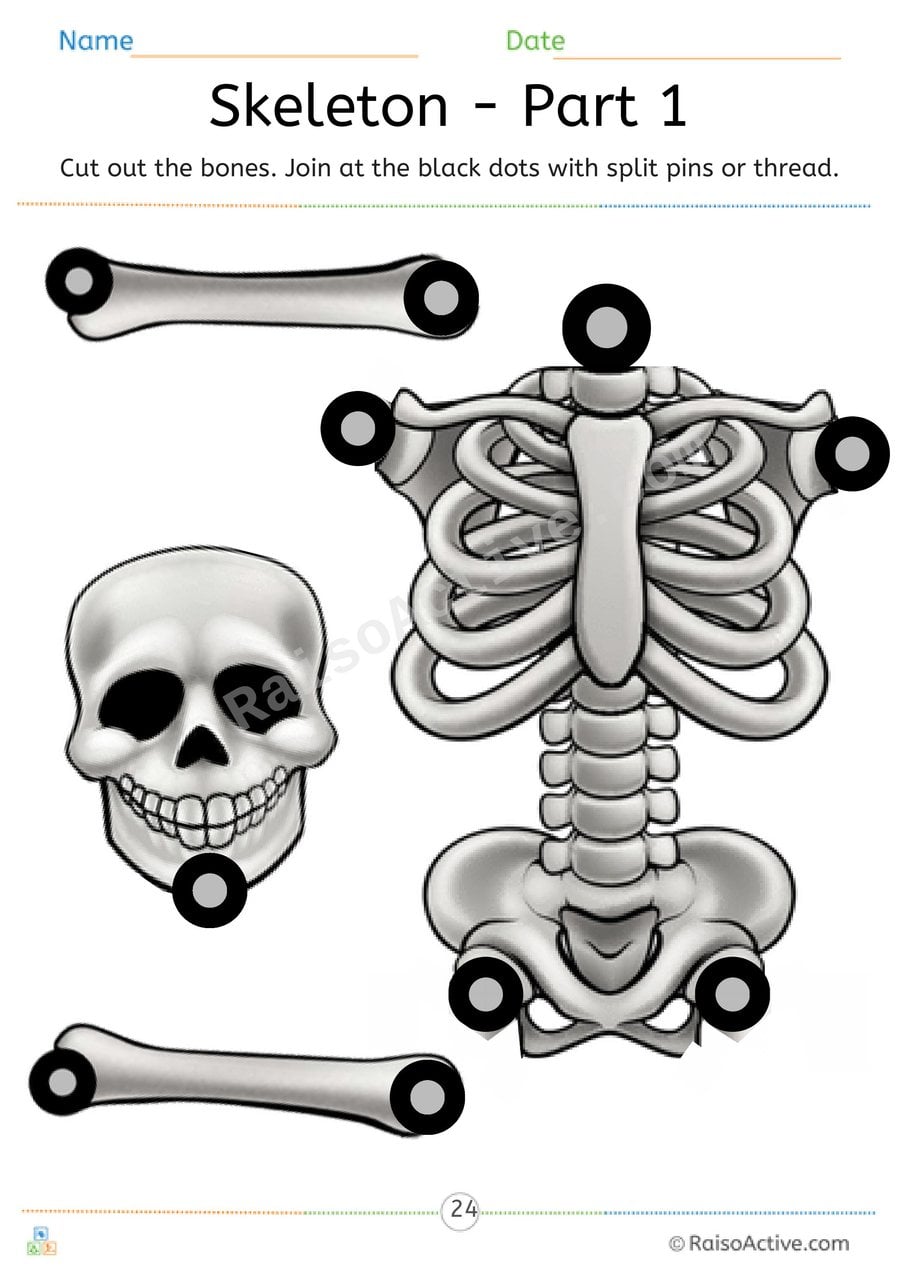
Skeleton Cut and Join Worksheet for Kids
Ages 3-5 · Preschool–Pre-KAges 3-5 · Nursery–ReceptionAges 3-5 · Nursery–LKGAges 3-5
This worksheet has children ages 3-5 cut out individual bone shapes and piece them together to assemble a skeleton, building scissor control and spatial reasoning as they figure out where each bone belongs relative to the others. Gluing the assembled bones onto a backing sheet also gives the activity a lasting, displayable result.
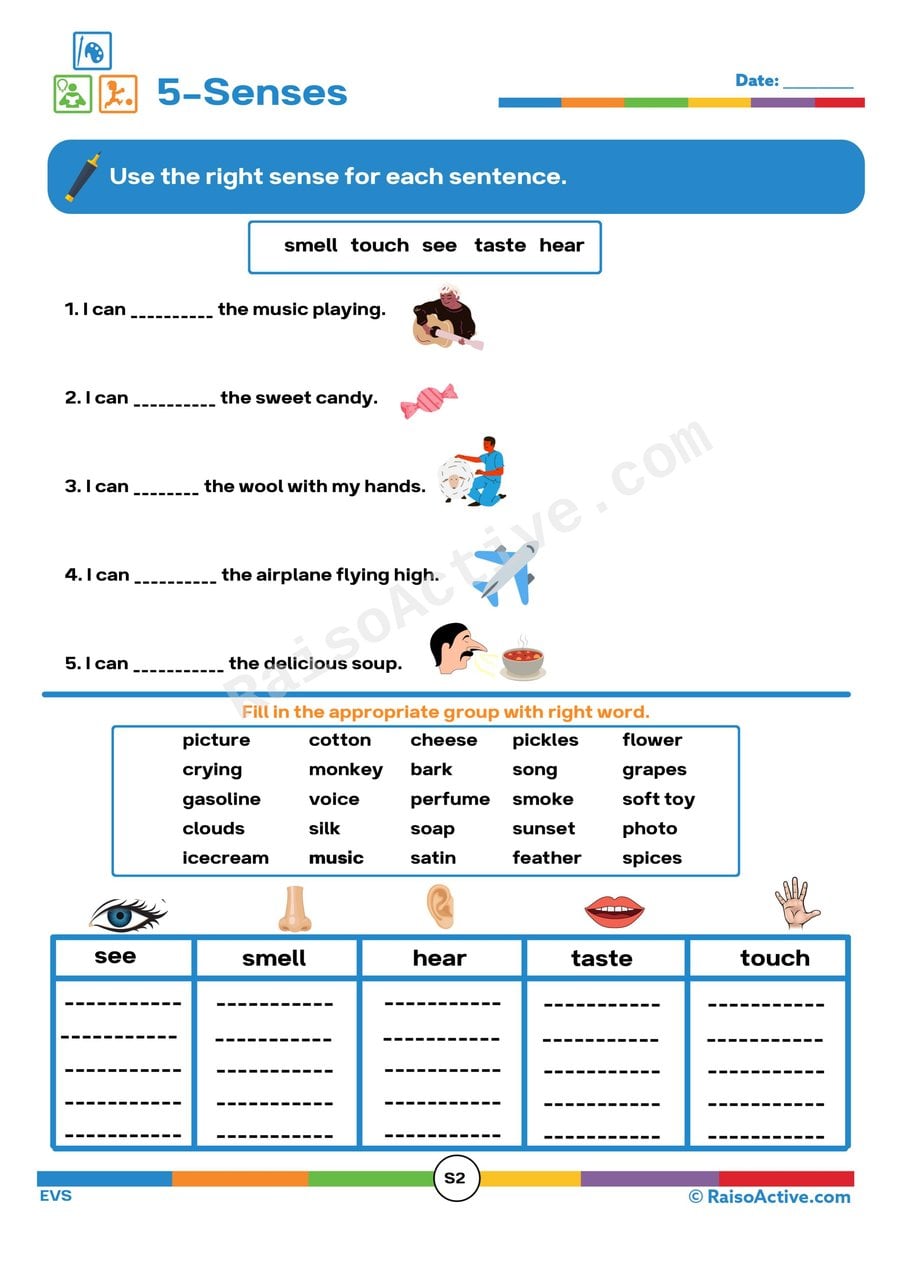
5 Senses Worksheet: Explore the World!
Ages 4-6 · Pre-K–KindergartenAges 4-6 · Reception–Year 1Ages 4-6 · LKG–UKGAges 4-6
Identifying which of the five senses, sight, smell, hearing, taste, or touch, is being used in each picture or sentence helps children ages 4-6 build scientific observation vocabulary and connect abstract sense words to concrete everyday actions. Matching the words to senses in a table afterward reinforces the vocabulary in a second, different format.
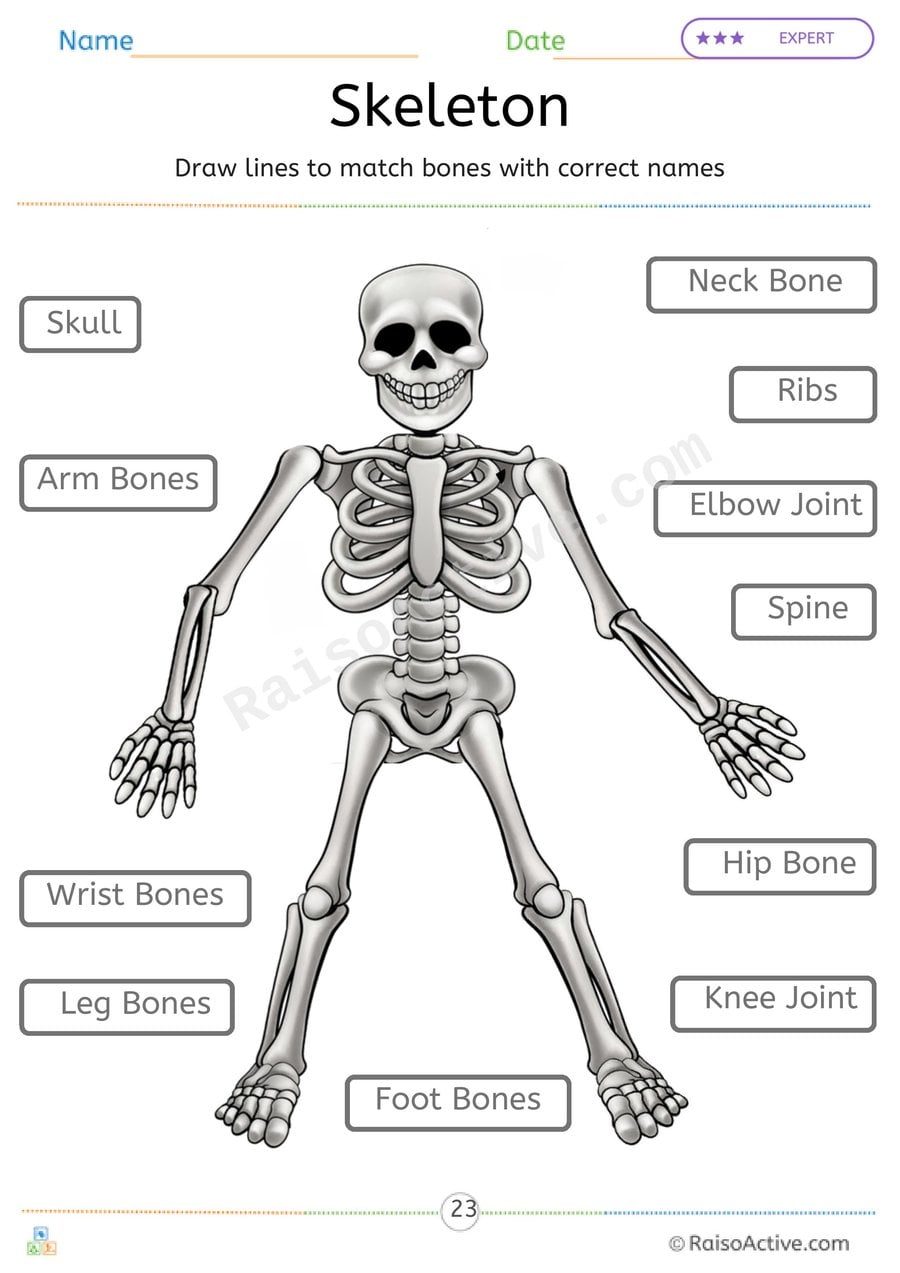
Skeleton Matching Worksheet: Learn About Bones!
Ages 4-6 · Pre-K–KindergartenAges 4-6 · Reception–Year 1Ages 4-6 · LKG–UKGAges 4-6
Drawing lines from bone names to their locations on a skeleton diagram introduces children ages 4-6 to basic human anatomy vocabulary, such as skull, ribs, or spine, while practicing left-to-right reading and matching skills. Because children must read a word and then visually locate the correct part of the body, this worksheet also strengthens the connection between written language and real-world objects, an important step toward reading comprehension. The Halloween-skeleton framing makes an otherwise academic science topic feel playful and approachable.

Body Parts Worksheet: Identify and Paste the Correct Organ!
Ages 4-6 · Pre-K–KindergartenAges 4-6 · Reception–Year 1Ages 4-6 · LKG–UKGAges 4-6
Reading a clue about a body part's function and finding the matching organ builds science vocabulary and reading comprehension for children ages 4-6, linking what a body part does to its correct name.

Internal Parts Worksheet: Cut and Paste the Organs!
Ages 4-6 · Pre-K–KindergartenAges 4-6 · Reception–Year 1Ages 4-6 · LKG–UKGAges 4-6
This worksheet introduces children ages 4-6 to basic human anatomy by having them cut out pictures of internal organs, such as the heart, lungs, and stomach, and glue each one into its correct location on a body outline. Beyond scissor and gluing practice, this activity builds spatial body awareness and early scientific vocabulary, giving children a first mental map of what's inside their own bodies.
Guides for this topic

Growing Green Hearts: A Comprehensive Guide to Teaching Environmental Awareness to Preschoolers
Practical guide to teaching preschoolers ages 2-6 about nature, recycling, water conservation, and Earth Day with Indian context and simple home activities.

Christmas and Winter Activities That Combine Fun and Learning: Creating Magical Educational Experiences
Discover Christmas and winter activities that combine festive fun with real learning. Crafts, counting, literacy, and printable worksheets for ages 2 to 8 — perfect for home and school.
Age-Appropriate Halloween Learning Activities: Balancing Spooks and Skills for Young Learners
Discover fun, age-appropriate Halloween learning activities for young children. Spooky crafts, counting games, literacy ideas, and printable worksheets for ages 2 to 8.
Reviews
Every worksheet for ages 3–5, no watermark
Members download the full library of 1,000+ worksheets and every activity pack without watermarks or daily limits. One year costs ₹999 in India or $20 elsewhere.
See membership plansOr download any worksheet free with a watermark (5 a day).