Read and Answer: The Red Apple Worksheet
Reading the short Red Apple story and answering questions afterward helps children ages 3-5 practice basic reading comprehension, recalling simple details from a story and expressing their understanding in writing. This early comprehension practice builds the habit of checking back with a text to support an answer, a skill that grows more important throughout school.
Part of the pack
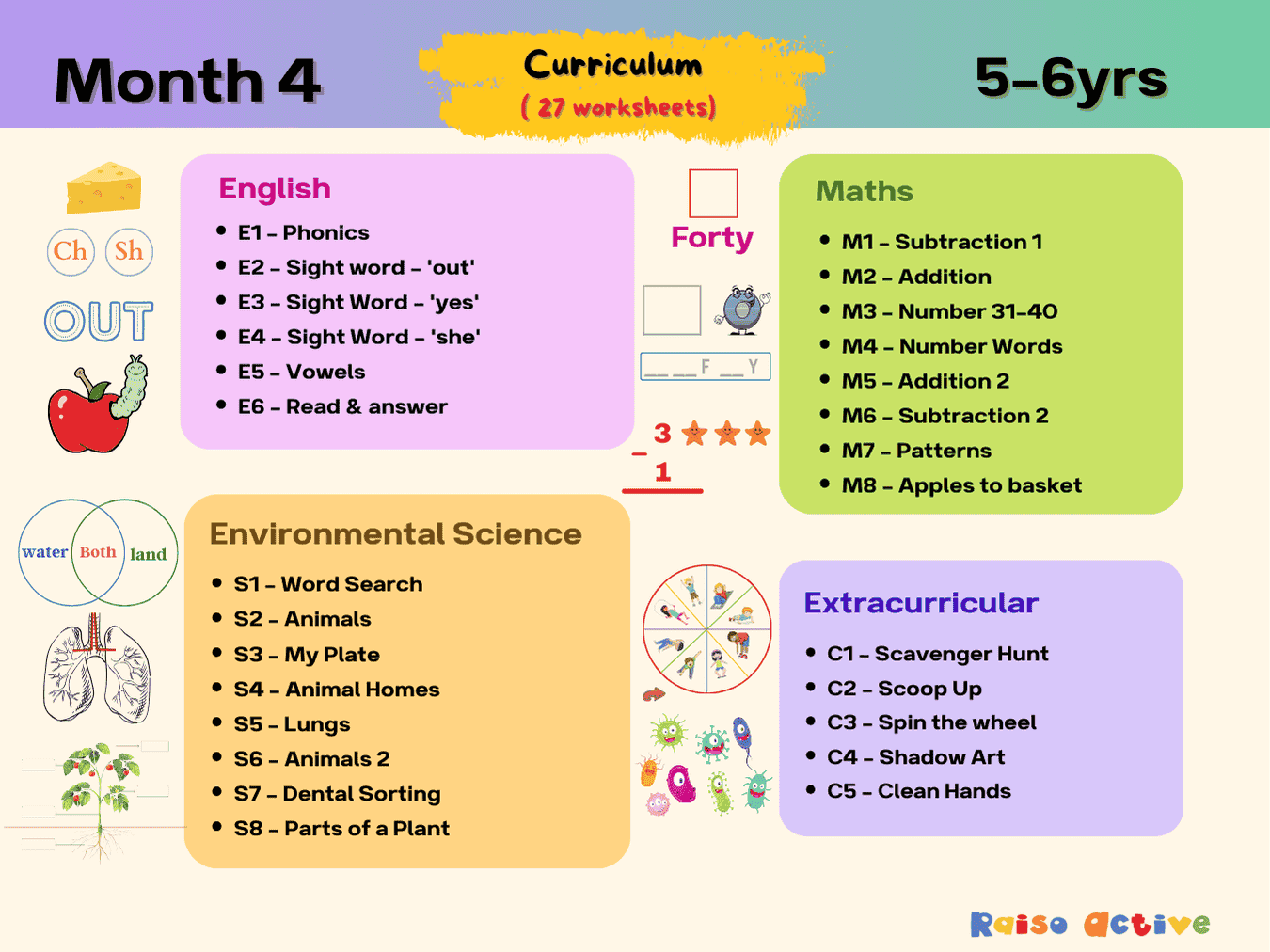
Month 4: Learning & Development | Ages 5-6
This is page 9 of the pack. Ages 5-6 · KindergartenAges 5-6 · Year 1Ages 5-6 · UKGAges 5-6
Made for your child
Spelling practice, made for your child
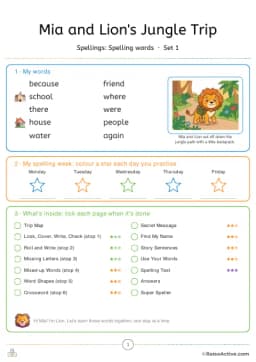
Their own spelling words turned into a pack: trace or look-cover-write-check, roll and write, a secret picture code, a word search, a crossword and a test, with their name in it.
Make a spelling packFree preview · free for members
Or start free: a word search with sight wordsCurriculum
- Reading Comprehension - Literature > Reading Comprehension
How to use this worksheet
Read the Red Apple story aloud together, pointing to the words as you go. Look at the first question beneath the story and encourage your child to think back to what happened before answering. Have them write their answer on the line provided, continuing through each remaining question the same way.
Materials needed
- Pencil
Extension activities
- 1Draw a picture of the red apple from the story.
- 2Retell the story in your own words without looking back at the page.
- 3Make up a brand new short story about a different colored fruit.
- 4Act out the events of the story using simple props or toys.
- 5Talk about your child's own favorite fruit and why they like it.

Written by
Hemsweta Jain · Teacher Cheena
MBA and Early Childhood Educator, teaching since 2014 · Founder of RaisoActive, Mumbai
Every RaisoActive worksheet is designed and checked by the founder before publishing.
Published · Last reviewed
More from Month 4: Learning & Development | Ages 5-6
Addition Coloring Worksheet: Color by Sum!
Ages 4-6 · Pre-K–KindergartenAges 4-6 · Reception–Year 1Ages 4-6 · LKG–UKGAges 4-6
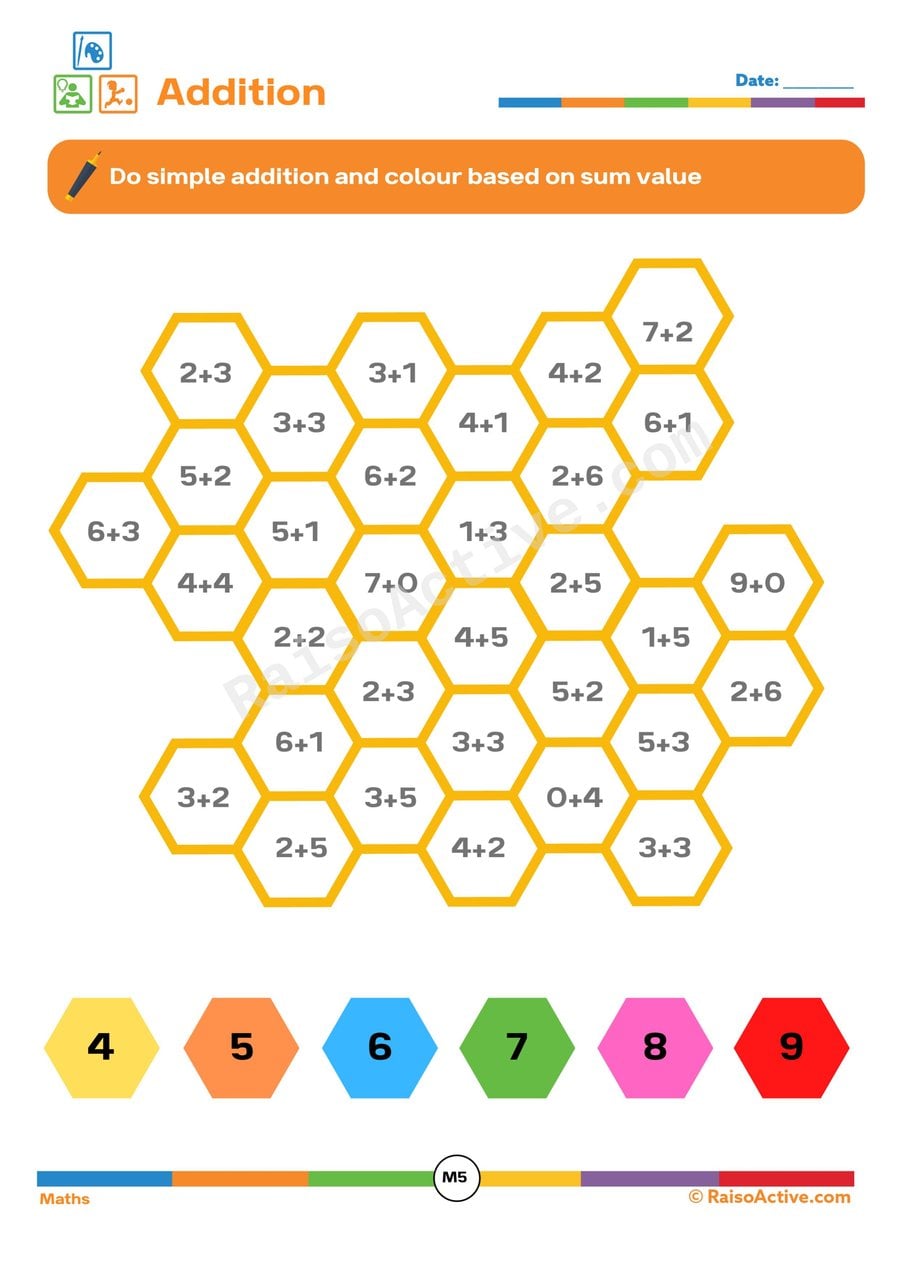
This worksheet combines addition practice with a color-by-number format, giving children ages 4-6 motivation to solve simple addition problems in each hexagon since the correct sum determines which color to use. Repeated, low-pressure practice adding small numbers builds fluency and speed, while the reveal of a colorful picture at the end rewards accurate calculation.

Subtraction Worksheet: Counting and Subtracting for Preschoolers
Ages 4-5 · Pre-KAges 4-5 · ReceptionAges 4-5 · LKGAges 4-5
This worksheet introduces children ages 4-5 to the concept of subtraction as 'taking away' by having them count a group of objects, cross out the number indicated, and write how many remain. Building this concrete, visual understanding of subtraction before introducing abstract number sentences helps children grasp what the minus sign actually means rather than just memorizing a procedure.

Subtraction Fun: Counting and Subtracting Worksheet for Kids
Ages 4-6 · Pre-K–KindergartenAges 4-6 · Reception–Year 1Ages 4-6 · LKG–UKGAges 4-6
This worksheet teaches children ages 4-6 the concept of subtraction by having them count a group of stars, cross out a specified number, and write how many remain — making the abstract idea of 'taking away' visible and countable rather than purely symbolic. Physically crossing out objects before writing the answer helps children understand subtraction as an action, which is more intuitive at this age than memorizing subtraction facts.

Cut and Paste Number Matching Worksheet: Numbers 31-40
Ages 4-6 · Pre-K–KindergartenAges 4-6 · Reception–Year 1Ages 4-6 · LKG–UKGAges 4-6
Matching number words like thirty-one through forty to their correct numerals teaches children ages 4-6 to recognize larger two-digit numbers by both their written word form and their numeral form, extending number recognition well beyond the more familiar numbers under twenty. Cutting and pasting the matching numeral also reinforces careful visual comparison, since numbers in this range can look similar to one another.
Sight Word 'Out' Worksheet: Read, Trace, and Write!
Ages 3-5 · Preschool–Pre-KAges 3-5 · Nursery–ReceptionAges 3-5 · Nursery–LKGAges 3-5
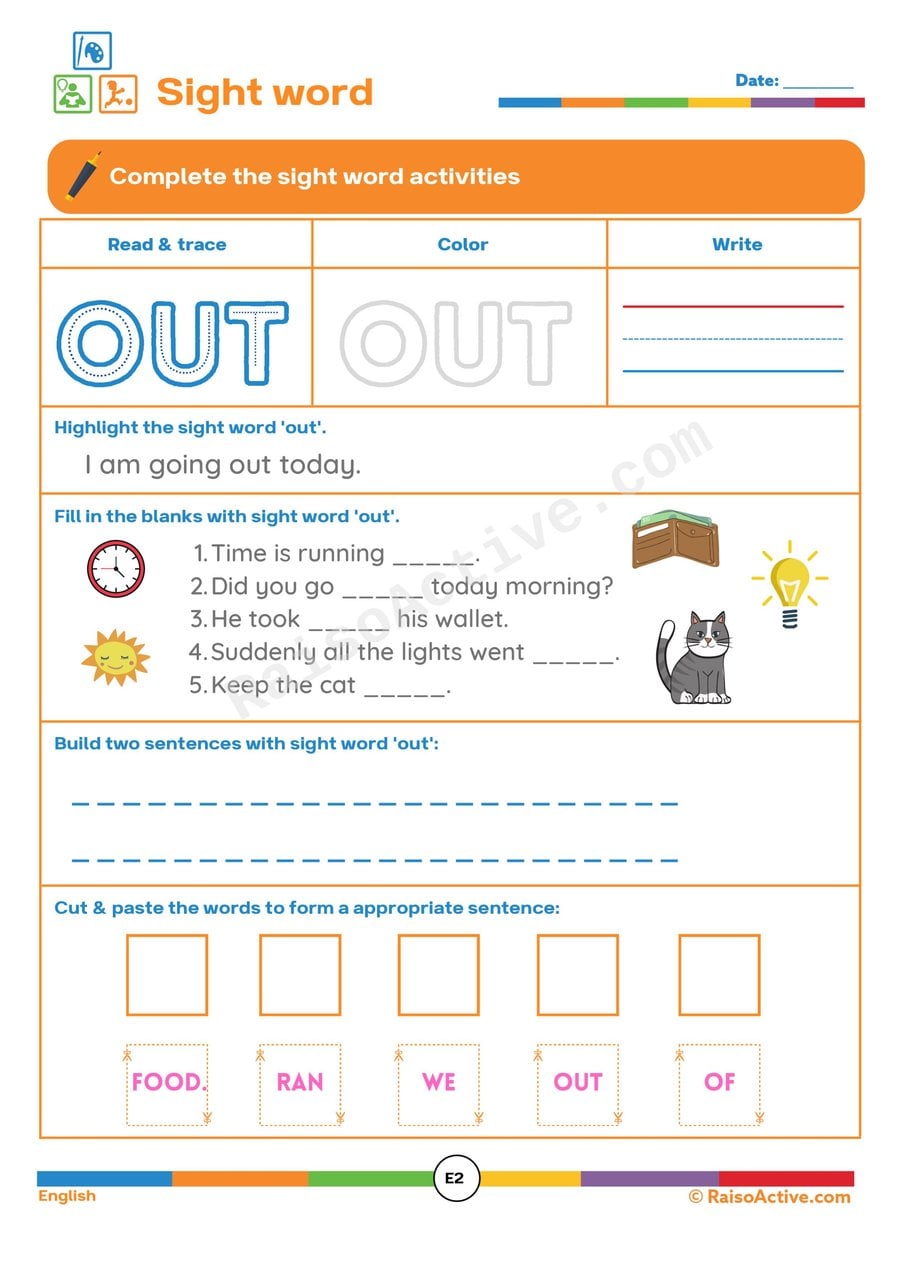
Reading fluency for young children depends on instantly recognizing common sight words that don't sound out easily, and this worksheet gives children ages 3-5 focused, repeated exposure to the word 'out' through tracing, coloring, and sentence practice. Seeing the word in context within simple sentences also helps children start connecting sight-word recognition to real reading comprehension.

Parent's Guide: Sight Words, Vowels, and Early Math Activities
Ages 3-5 · Preschool–Pre-KAges 3-5 · Nursery–ReceptionAges 3-5 · Nursery–LKGAges 3-5
This parent's guide combines sight word recognition, vowel puppet play, simple subtraction with blocks, and living-versus-non-living observation, giving children ages 3-5 broad exposure to early literacy, number sense, and basic science reasoning through varied hands-on activities. Because each section targets a different skill, the guide offers something to match whatever your child feels drawn to that day.

Animal Homes Matching Worksheet for Preschoolers
Ages 3-5 · Preschool–Pre-KAges 3-5 · Nursery–ReceptionAges 3-5 · Nursery–LKGAges 3-5
This worksheet helps children ages 3-5 learn where different animals live by matching each animal to its correct home, such as a bird to a nest or a bear to a cave, then writing the home's name. Understanding that animals have specific habitats suited to their needs is an early life-science concept that also builds descriptive vocabulary.

Animal Homes Worksheet: Cut and Paste Activity for Kids
Ages 3-5 · Preschool–Pre-KAges 3-5 · Nursery–ReceptionAges 3-5 · Nursery–LKGAges 3-5
This cut-and-paste worksheet teaches children ages 3-5 to match specific animals to their correct habitats — like a fish to water or a bird to a tree — building early understanding of how animals are suited to where they live. Sorting by habitat rather than by animal type (like farm versus wild) adds a layer of reasoning about why an environment fits a particular animal.
Related worksheets

Reading Comprehension Worksheet: Max and Tuffy's Adventures!
Ages 4-6 · Pre-K–KindergartenAges 4-6 · Reception–Year 1Ages 4-6 · LKG–UKGAges 4-6
Reading the short story about Max and Tuffy and answering questions afterward helps children ages 4-6 practice true reading comprehension, recalling specific details like who did what and where, rather than just decoding words on the page. Writing out their answers also builds the connection between understanding a story and expressing that understanding in writing.

My Pet Dog Reading Comprehension Worksheet for Preschoolers
Ages 3-5 · Preschool–Pre-KAges 3-5 · Nursery–ReceptionAges 3-5 · Nursery–LKGAges 3-5
This worksheet builds early reading comprehension for children ages 3-5 by having them read or listen to a short passage about a pet dog and then answer simple questions about what they understood. Moving beyond decoding individual words, this task requires children to hold information from the text in mind and use it to answer questions, an essential skill for comprehension that develops alongside basic reading fluency.

Farm Animals Reading Comprehension Worksheet for Preschoolers
Ages 3-5 · Preschool–Pre-KAges 3-5 · Nursery–ReceptionAges 3-5 · Nursery–LKGAges 3-5
Reading a short passage about farm animals and answering questions about it builds early reading comprehension for children ages 3-5, teaching them to recall specific details from a text rather than just recognizing individual words.

Roll a Story Worksheet: Create Fun Stories with Dice!
Ages 4-7 · Pre-K–Grade 1Ages 4-7 · Reception–Year 2Ages 4-7 · LKG–Class 1Ages 4-7
This dice-based storytelling worksheet helps children ages 4-7 practice narrative construction by rolling dice to randomly select a character, setting, and prop, then weaving those elements into an original story. Because the combination is different every time, children must think flexibly and creatively rather than relying on a memorized story, which builds oral language, sequencing, and imaginative reasoning skills that underpin later creative writing.

Apple Picking Fun: A Reading Comprehension Worksheet for Kids
Ages 4-6 · Pre-K–KindergartenAges 4-6 · Reception–Year 1Ages 4-6 · LKG–UKGAges 4-6
This worksheet builds early reading comprehension skills in children ages 4-6 by having them read a short story about apple picking and then answer simple questions that check their understanding of what happened. Answering questions after reading, rather than just decoding words, pushes children to hold the story's meaning in mind and recall specific details, a critical skill for all future reading. Coloring an apple afterward gives a relaxing, creative close to the comprehension task.

Zoo Adventure: Reading Comprehension Worksheet for Preschoolers
Ages 4-5 · Pre-KAges 4-5 · ReceptionAges 4-5 · LKGAges 4-5
Reading a short passage about a zoo and then answering multiple-choice questions builds early reading comprehension in children ages 4-5, teaching them to hold information in mind after reading rather than just decoding words on a page. Choosing answers from provided options also introduces test-taking skills like eliminating wrong choices and rereading for clarification, both useful habits for later school assessments. Zoo animals as the subject matter keep the reading engaging enough to sustain focus through the full passage and question set.

Festival Fun Facts Quiz: True or False and Which Festival Am I?
Ages 4-8 · Pre-K–Grade 2Ages 4-8 · Reception–Year 3Ages 4-8 · LKG–Class 2Ages 4-8
Children check what they know about India's festivals and meet more festivals, such as Raksha Bandhan, Janmashtami, Chhath Puja and the Hornbill Festival.
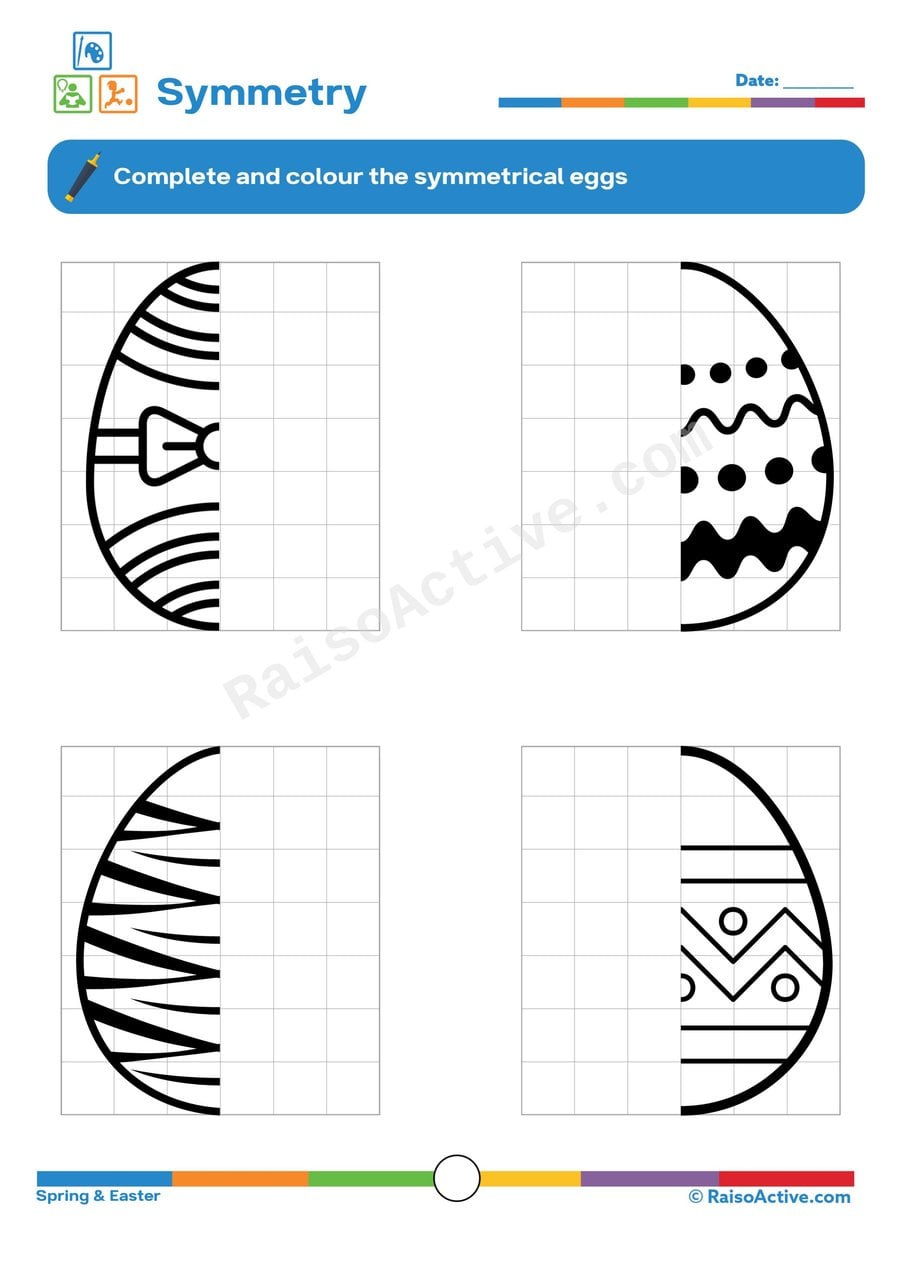
Symmetry Eggs Worksheet for Preschoolers
Ages 4-6 · Pre-K–KindergartenAges 4-6 · Reception–Year 1Ages 4-6 · LKG–UKGAges 4-6
This worksheet introduces children ages 4-6 to the concept of symmetry by having them complete the missing mirrored half of an egg design. Drawing a matching reflection requires children to closely observe shape, size, and placement on one side and reproduce it accurately on the other — an early geometry skill that also sharpens visual attention to detail.
Guides for this topic

Documenting Learning Without Drowning in Data: A Practical Guide for Parents and Teachers
Learn practical ways to document your child's learning without overwhelm. Simple portfolios, observation tips, and printable trackers for ages 1-8.

Age-Appropriate Problem-Solving Activities: Building Critical Thinkers from the Ground Up
Discover fun, age-appropriate problem-solving activities for children ages 1-8. Build critical thinking, logic, and reasoning skills through play-based learning.
Critical Thinking Activities That Actually Work for Young Children: Building Tomorrow's Thinkers Today
Discover proven critical thinking activities for young children. Age-wise logic games, questioning techniques, and hands-on ideas to build thinking skills at home.
Reviews
Every worksheet for ages 3–5, no watermark
Members download the full library of 1,000+ worksheets and every activity pack without watermarks or daily limits. One year costs ₹999 in India or $20 elsewhere.
See membership plansOr download any worksheet free with a watermark (5 a day).