My Pet Dog Reading Comprehension Worksheet for Preschoolers
This worksheet builds early reading comprehension for children ages 3-5 by having them read or listen to a short passage about a pet dog and then answer simple questions about what they understood. Moving beyond decoding individual words, this task requires children to hold information from the text in mind and use it to answer questions, an essential skill for comprehension that develops alongside basic reading fluency.
Part of the pack
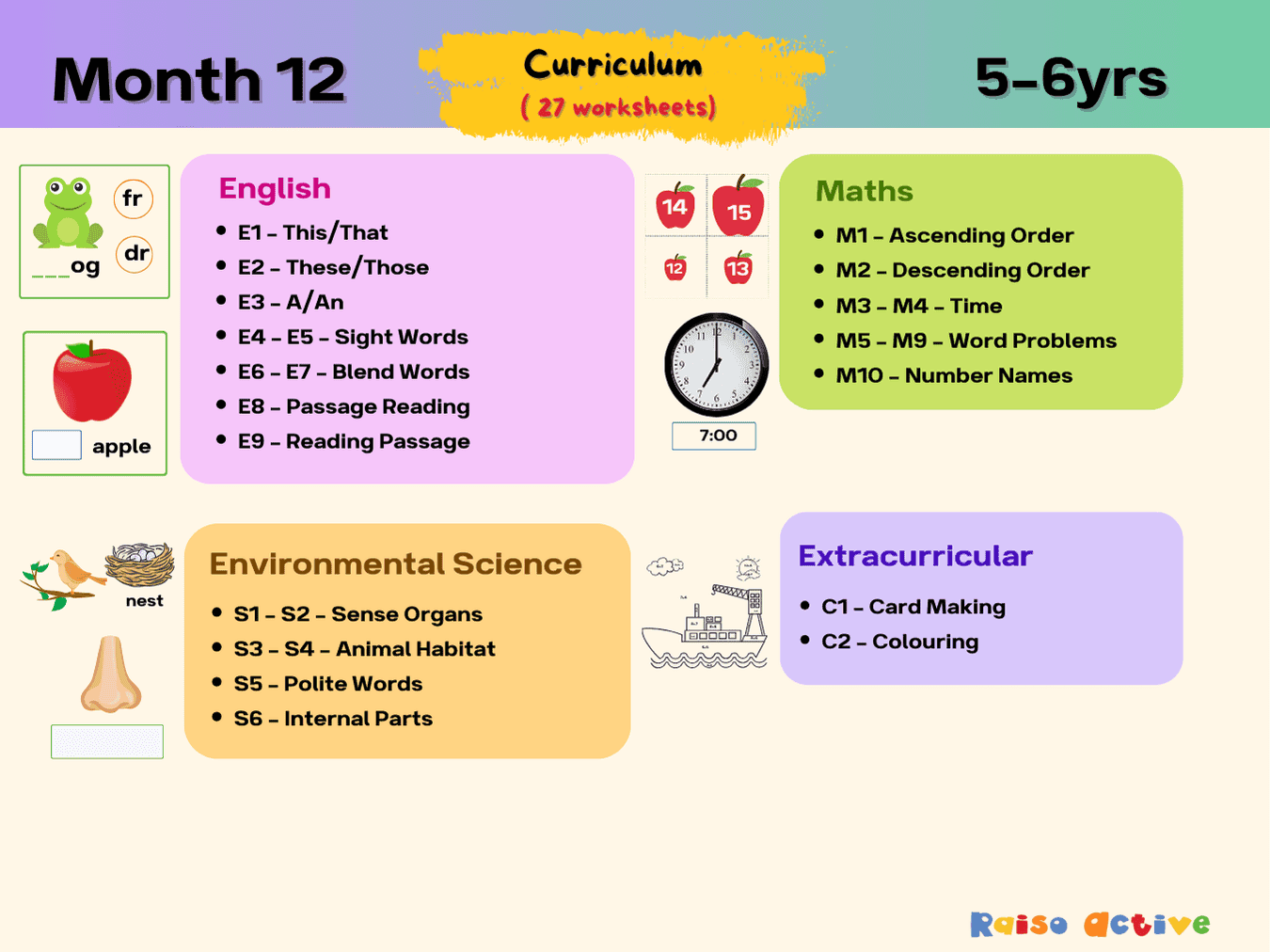
Month 12: Learning & Development | Ages 5-6
This is page 11 of the pack. Ages 5-6 · KindergartenAges 5-6 · Year 1Ages 5-6 · UKGAges 5-6
Made for your child
Spelling practice, made for your child
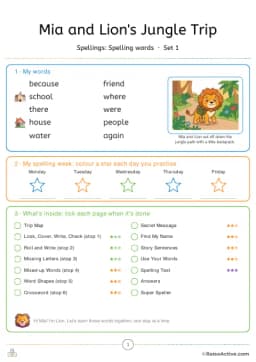
Their own spelling words turned into a pack: trace or look-cover-write-check, roll and write, a secret picture code, a word search, a crossword and a test, with their name in it.
Make a spelling packFree preview · free for members
Or start free: a word search with sight wordsCurriculum
- Reading Comprehension - Literature > Reading Comprehension Basics
How to use this worksheet
Read the passage about the dog aloud together, pointing to each word as you go so your child can follow along. Ask your child to retell what happened in the passage in their own words before looking at the questions. Read each question aloud and have your child choose the correct answer based on what they remember from the passage, looking back at the text together if needed. Once the questions are answered, let your child color the picture of the dog to finish the page.
Materials needed
- Pencil
- Crayons
Extension activities
- 1Draw your own pet dog, real or imagined, and write or say a sentence describing it.
- 2Find pictures of different dog breeds and describe their size, color, and features.
- 3Retell the story of the passage in your own words without looking back at the text.
- 4Read another short pet-themed story together and ask similar comprehension questions.

Written by
Hemsweta Jain · Teacher Cheena
MBA and Early Childhood Educator, teaching since 2014 · Founder of RaisoActive, Mumbai
Every RaisoActive worksheet is designed and checked by the founder before publishing.
Published · Last reviewed
More from Month 12: Learning & Development | Ages 5-6

Color the Sight Words! A Fun Coloring Worksheet for Preschoolers
Ages 3-5 · Preschool–Pre-KAges 3-5 · Nursery–ReceptionAges 3-5 · Nursery–LKGAges 3-5
This worksheet helps children ages 3-5 recognize common sight words by finding and coloring them within a brick-wall design according to a color key. Because sight words like 'the,' 'and,' or 'is' don't follow regular phonics rules, repeated visual exposure like this coloring task is one of the most effective ways for young children to memorize them by sight rather than sounding them out each time.

Sense Organs Worksheet: Circle the Objects We Use!
Ages 4-6 · Pre-K–KindergartenAges 4-6 · Reception–Year 1Ages 4-6 · LKG–UKGAges 4-6
Children ages 4-6 practice connecting each of the five senses to real objects and experiences, like identifying what they might see, hear, smell, taste, or touch. This builds early science vocabulary and body awareness while reinforcing that different body parts are used to experience the world in different ways.

Word Problems Worksheet: Solving Addition and Subtraction
Ages 4-6 · Pre-K–KindergartenAges 4-6 · Reception–Year 1Ages 4-6 · LKG–UKGAges 4-6
Solving a mix of addition and subtraction word problems trains children ages 4-6 to decide which operation a story calls for, based on whether it describes combining groups or taking something away, a key reasoning skill before formal equation writing.

Sight Word Fun: Fill-in-the-Blank Worksheet for Preschoolers
Ages 4-5 · Pre-KAges 4-5 · ReceptionAges 4-5 · LKGAges 4-5
Reading a sentence with a missing sight word and selecting the correct choice builds early reading fluency for children ages 4-5, since recognizing common sight words by sight — rather than sounding them out — speeds up overall reading comprehension.

Fun Activities for Kids: Blend Words, Reading, and Science Experiments!
Ages 3-5 · Preschool–Pre-KAges 3-5 · Nursery–ReceptionAges 3-5 · Nursery–LKGAges 3-5
This multi-activity guide introduces children ages 3-5 to blend words, simple story reading, and hands-on science experiments like making a chocolate shake and testing dissolving, all in one session. Moving between literacy and science tasks builds flexible thinking and shows children that reading and hands-on exploration are connected, reinforcing that new vocabulary can describe real, observable experiments.

Animal Homes Worksheet: Match the Animals to Their Habitats!
Ages 4-6 · Pre-K–KindergartenAges 4-6 · Reception–Year 1Ages 4-6 · LKG–UKGAges 4-6
Children ages 4-6 build early life-science knowledge as they match each animal to the habitat where it actually lives, such as a fish to water or a bird to a nest. This worksheet moves beyond simple animal identification into understanding the relationship between a living thing and its environment, an important building block for later ecosystem and habitat topics in science class.
Blend Words Worksheet: Practice Blending Sounds!
Ages 4-6 · Pre-K–KindergartenAges 4-6 · Reception–Year 1Ages 4-6 · LKG–UKGAges 4-6
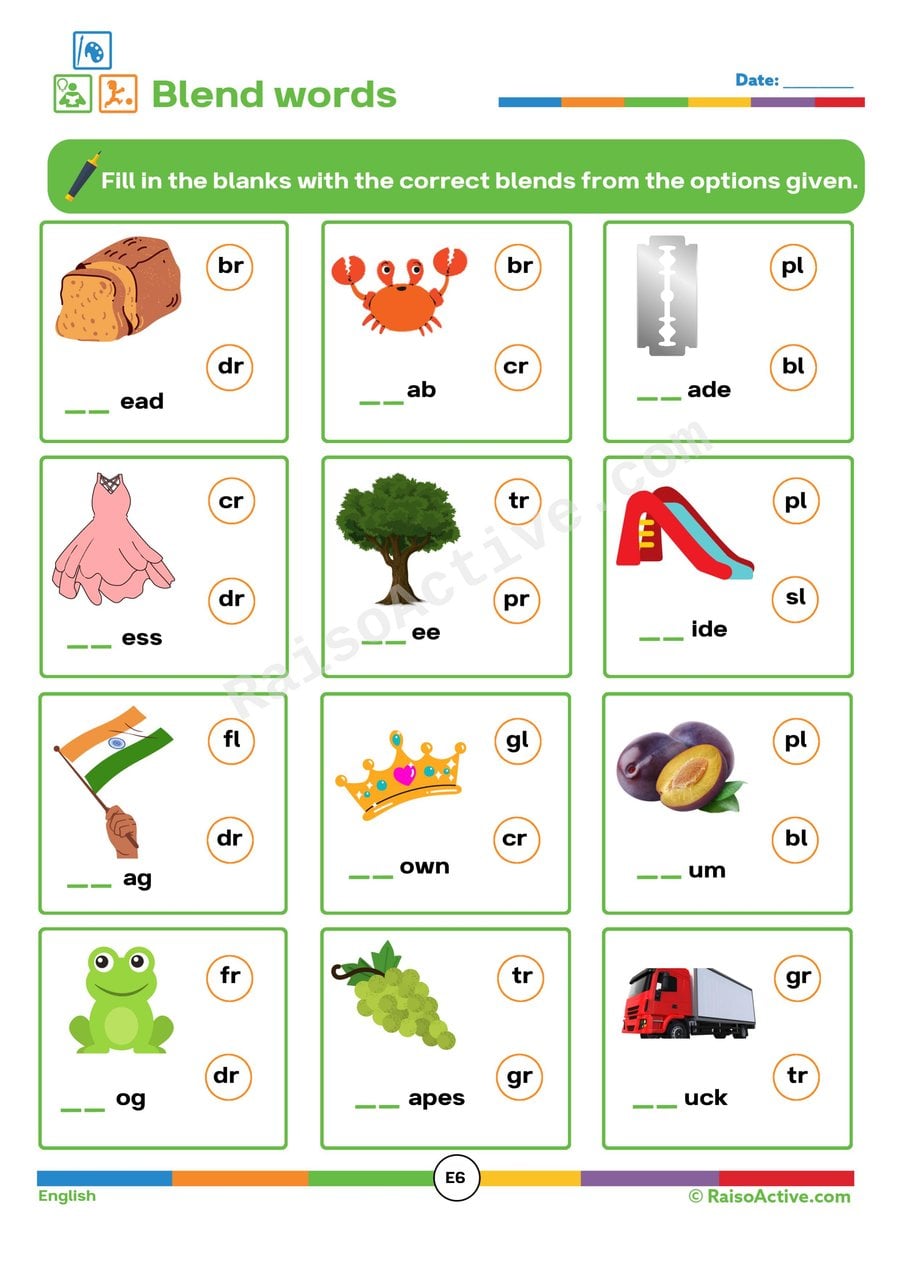
This worksheet gives children ages 4-6 focused practice blending initial consonant sounds, like 'cl' or 'fr,' with the rest of a word to complete a picture-labeled word. Unlike simple picture matching, writing the missing blend requires children to actively produce the correct letter combination from memory, which is a more demanding and valuable phonics skill than recognition alone.

Word Problems Worksheet: Solving for Addition and Subtraction
Ages 4-6 · Pre-K–KindergartenAges 4-6 · Reception–Year 1Ages 4-6 · LKG–UKGAges 4-6
This worksheet builds the ability to translate real-world scenarios into number sentences, teaching children ages 4-6 to spot clue words like 'gave away' or 'found more' that signal whether to add or subtract. It also practices reading comprehension applied to math, a key step as children move from rote counting toward applied reasoning.
Related worksheets

Zoo Adventure: Reading Comprehension Worksheet for Preschoolers
Ages 4-5 · Pre-KAges 4-5 · ReceptionAges 4-5 · LKGAges 4-5
Reading a short passage about a zoo and then answering multiple-choice questions builds early reading comprehension in children ages 4-5, teaching them to hold information in mind after reading rather than just decoding words on a page. Choosing answers from provided options also introduces test-taking skills like eliminating wrong choices and rereading for clarification, both useful habits for later school assessments. Zoo animals as the subject matter keep the reading engaging enough to sustain focus through the full passage and question set.

Reading Comprehension Worksheet: Max and Tuffy's Adventures!
Ages 4-6 · Pre-K–KindergartenAges 4-6 · Reception–Year 1Ages 4-6 · LKG–UKGAges 4-6
Reading the short story about Max and Tuffy and answering questions afterward helps children ages 4-6 practice true reading comprehension, recalling specific details like who did what and where, rather than just decoding words on the page. Writing out their answers also builds the connection between understanding a story and expressing that understanding in writing.

Apple Picking Fun: A Reading Comprehension Worksheet for Kids
Ages 4-6 · Pre-K–KindergartenAges 4-6 · Reception–Year 1Ages 4-6 · LKG–UKGAges 4-6
This worksheet builds early reading comprehension skills in children ages 4-6 by having them read a short story about apple picking and then answer simple questions that check their understanding of what happened. Answering questions after reading, rather than just decoding words, pushes children to hold the story's meaning in mind and recall specific details, a critical skill for all future reading. Coloring an apple afterward gives a relaxing, creative close to the comprehension task.
Read and Answer: The Red Apple Worksheet
Ages 3-5 · Preschool–Pre-KAges 3-5 · Nursery–ReceptionAges 3-5 · Nursery–LKGAges 3-5
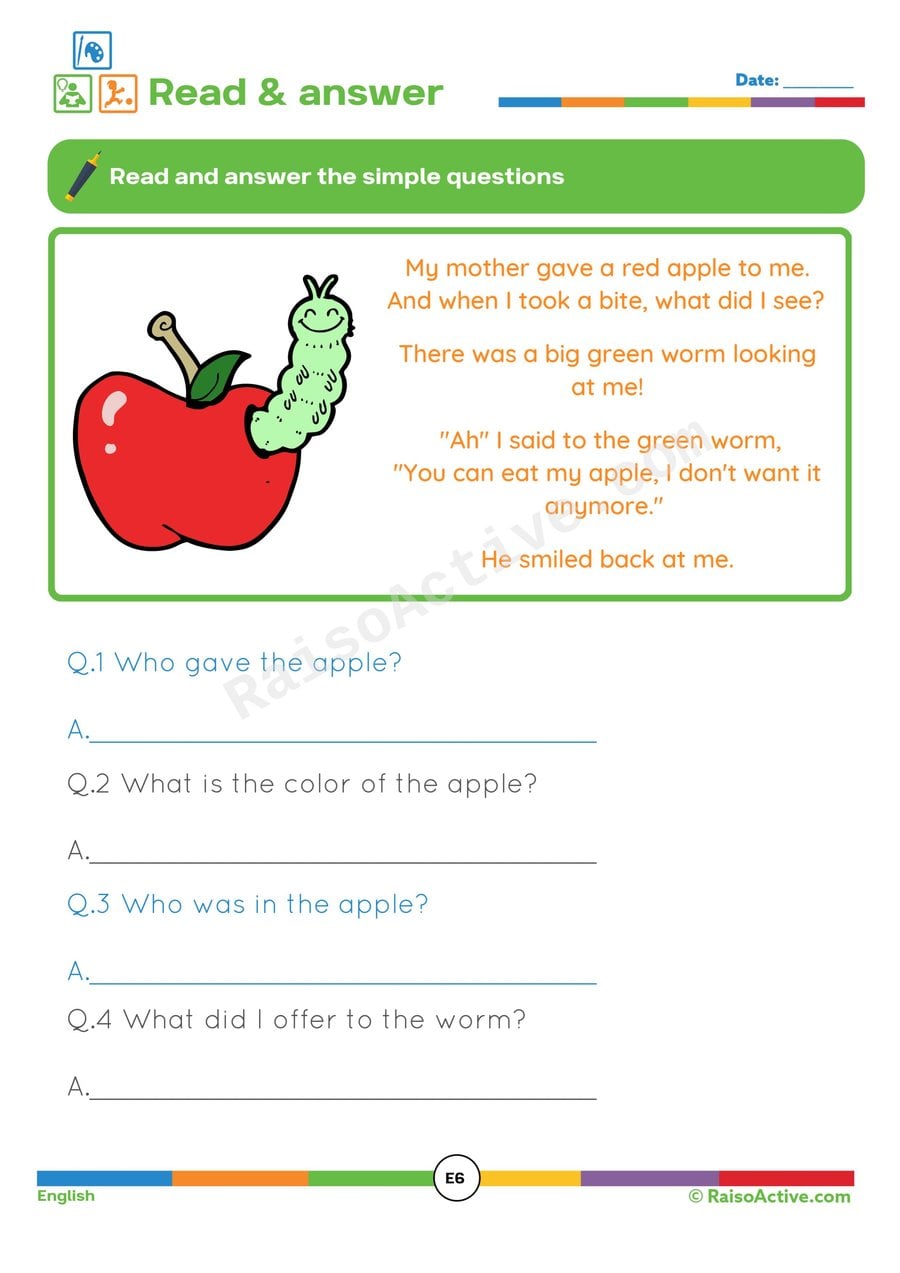
Reading the short Red Apple story and answering questions afterward helps children ages 3-5 practice basic reading comprehension, recalling simple details from a story and expressing their understanding in writing. This early comprehension practice builds the habit of checking back with a text to support an answer, a skill that grows more important throughout school.

Roll a Story Worksheet: Create Fun Stories with Dice!
Ages 4-7 · Pre-K–Grade 1Ages 4-7 · Reception–Year 2Ages 4-7 · LKG–Class 1Ages 4-7
This dice-based storytelling worksheet helps children ages 4-7 practice narrative construction by rolling dice to randomly select a character, setting, and prop, then weaving those elements into an original story. Because the combination is different every time, children must think flexibly and creatively rather than relying on a memorized story, which builds oral language, sequencing, and imaginative reasoning skills that underpin later creative writing.

Identify and Complete the Names Worksheet for Preschoolers
Ages 4-5 · Pre-KAges 4-5 · ReceptionAges 4-5 · LKGAges 4-5
Children ages 4-5 build on early spelling skills by identifying pictures and completing their names using provided letter hints, strengthening both vocabulary and phonics awareness. Using hints rather than a fully blank space offers just enough support to keep the task achievable while still requiring active problem-solving.
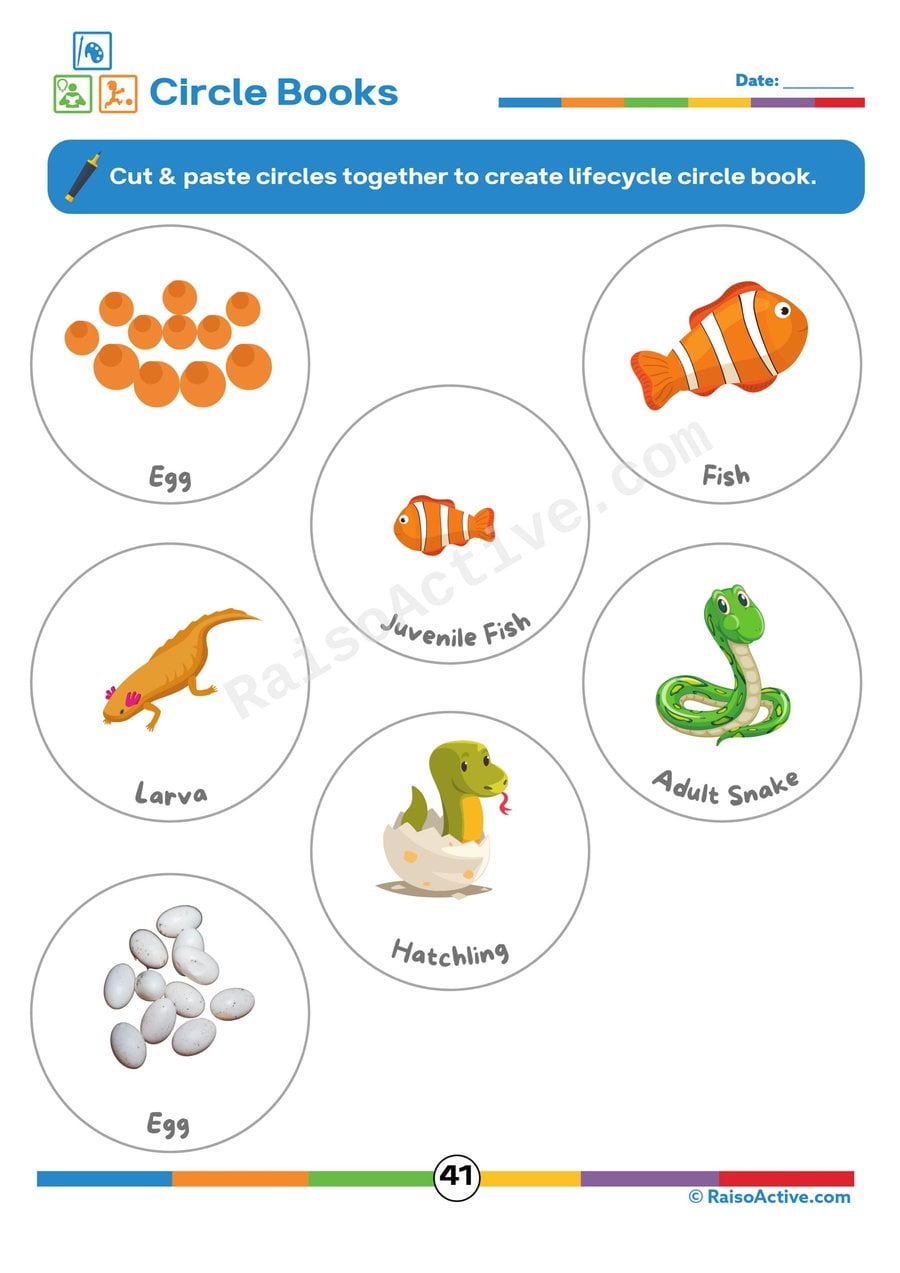
Lifecycle Circle Book: Cut and Paste Worksheet
Ages 3-5 · Preschool–Pre-KAges 3-5 · Nursery–ReceptionAges 3-5 · Nursery–LKGAges 3-5
This worksheet gives children ages 3-5 practice matching pictures to the correct stage of an animal's life cycle while assembling a hands-on circular book. Beyond sequencing, the rotating format helps children internalize that growth is a continuous, repeating process rather than a fixed line from start to finish.

Phonics Level 2 Certificate of Achievement: Super Reader
Ages 4-7 · Pre-K–Grade 1Ages 4-7 · Reception–Year 2Ages 4-7 · LKG–Class 1Ages 4-7
Children celebrate reading and spelling words with blends and digraphs, and tick what they can read: CVC words, blends and digraphs.
Guides for this topic

Documenting Learning Without Drowning in Data: A Practical Guide for Parents and Teachers
Learn practical ways to document your child's learning without overwhelm. Simple portfolios, observation tips, and printable trackers for ages 1-8.

What's the Best Way to Teach Sight Words? A Complete Guide for Parents and Teachers
Discover the most effective methods to teach sight words to young children — flashcards, games, Dolch vs Fry lists, rainbow writing, and how to combine them with phonics.

Creating Engaging Themed Learning Units for Young Children: A Complete Guide to Integrated Learning
Discover how to create engaging themed learning units for young children that integrate literacy, maths, science, and art — with practical examples and free worksheets.
Reviews
Every worksheet for ages 3–5, no watermark
Members download the full library of 1,000+ worksheets and every activity pack without watermarks or daily limits. One year costs ₹999 in India or $20 elsewhere.
See membership plansOr download any worksheet free with a watermark (5 a day).