
Body Parts Worksheet for Kids: Identify and Label!
This worksheet builds vocabulary and early writing skills as children ages 3-5 identify parts of the human body in a picture and write each body part's name in its labeled box. Connecting a spoken word to its written form and to the correct location on a diagram strengthens both language development and body awareness, an important self-knowledge skill at this age.
Part of the pack
Month 4: Learning & Development | Ages 6-7Curriculum
How to use this worksheet
Look at the picture together and point to each body part, saying its name aloud first. Have your child write the name of each body part in the box provided, sounding out the letters as they go. Once a word is written, ask your child to draw a line or arrow connecting the word to the correct spot on the picture. Read through all the labels together once finished, touching each body part on themselves as you say it.
Materials needed
- Pencil
- Eraser
Extension activities
- •Play 'Simon Says' using body part names, like 'touch your shoulder' or 'wiggle your elbow.'
- •Trace your child's body outline on large paper and label the parts together.
- •Sing 'Head, Shoulders, Knees, and Toes' and add in extra body parts from the worksheet.
- •Look in a mirror together and name body parts you can see.
Tips for parents and teachers
If your child isn't writing independently yet, let them trace over dotted letters or copy the word beneath your handwriting rather than skipping it entirely — seeing the letters form the sound helps early literacy. Expect some body parts, like 'elbow' or 'shoulder,' to need extra sounding-out support since they're less commonly used words. Keep the activity moving and physical by having them point to their own body as they go.

Written by
Hemsweta Jain · Teacher Cheena
MBA and Early Childhood Educator, teaching since 2014 · Founder of RaisoActive, Mumbai
Every RaisoActive worksheet is designed and checked by the founder before publishing.
Published · Last reviewed
Related worksheets

Human Skeleton Cut and Join Worksheet for Preschoolers
This hands-on worksheet introduces children ages 4-6 to basic human anatomy as they cut out individual bone shapes, like the skull, ribs, arms, and legs, and assemble them into a complete skeleton. Beyond scissor control, the activity requires spatial reasoning, since children must figure out where each bone belongs relative to the others to build an accurate body shape.
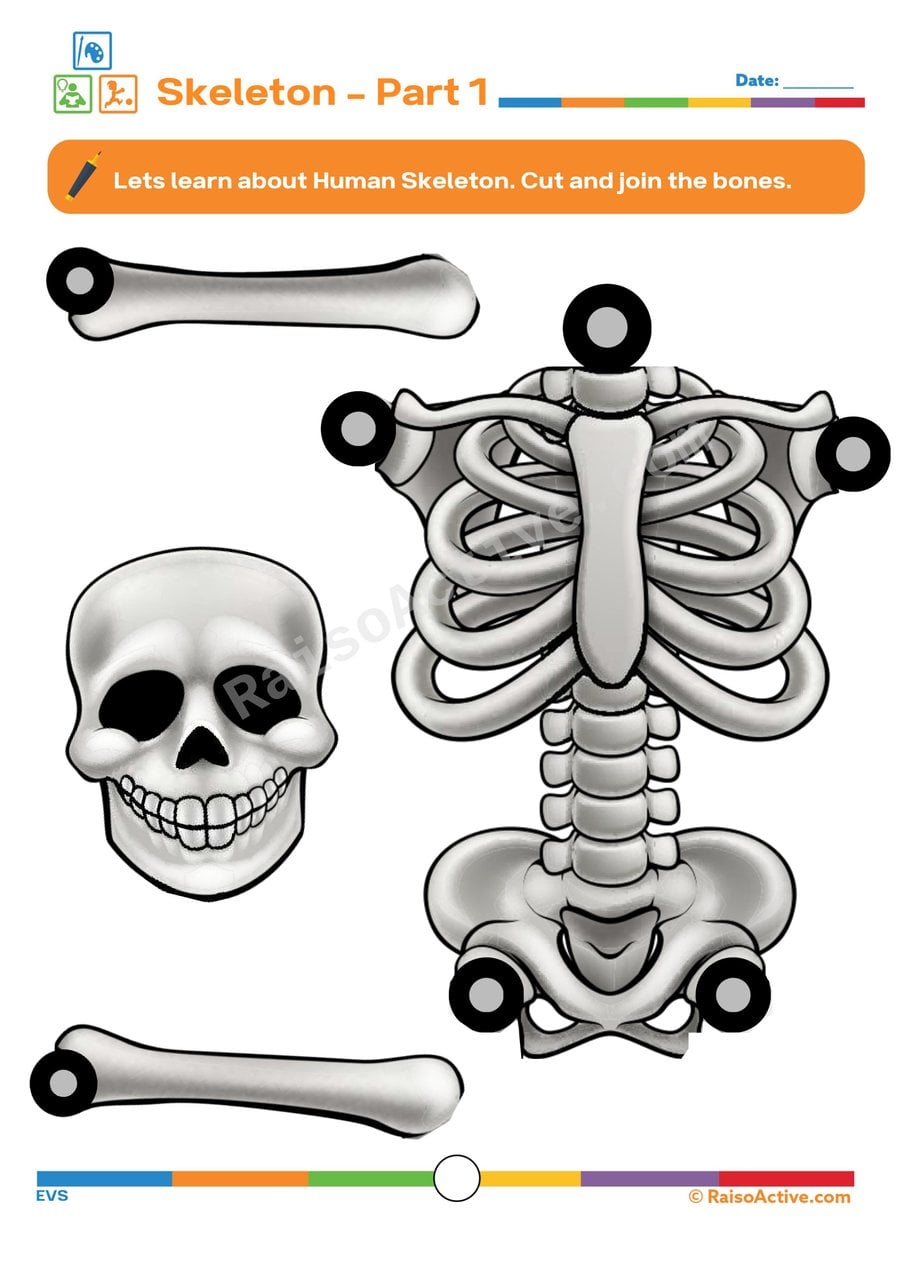
Skeleton Cut and Join Worksheet for Kids
This worksheet has children ages 3-5 cut out individual bone shapes and piece them together to assemble a skeleton, building scissor control and spatial reasoning as they figure out where each bone belongs relative to the others. Gluing the assembled bones onto a backing sheet also gives the activity a lasting, displayable result.
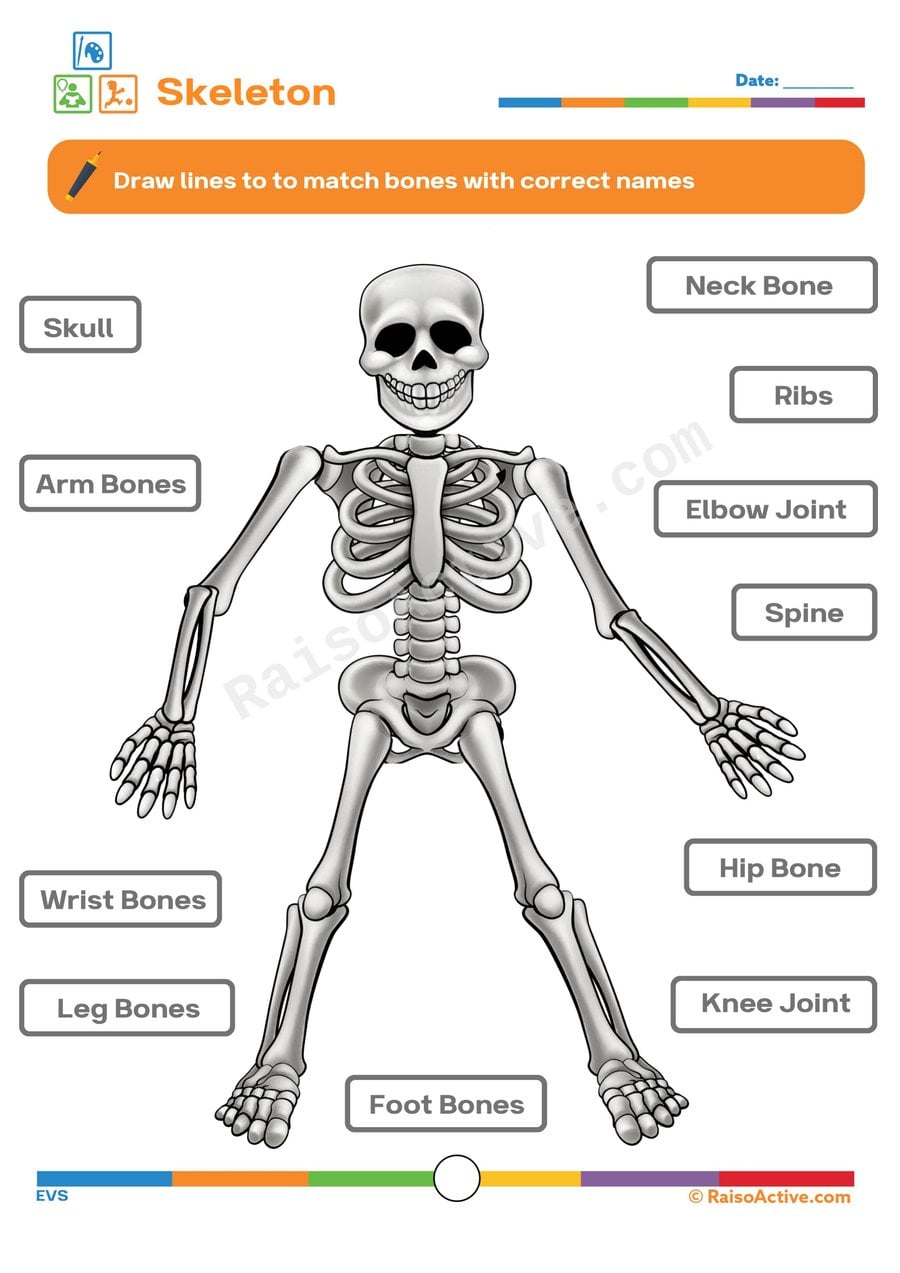
Skeleton Matching Worksheet: Learn About Bones!
Drawing lines from bone names to their locations on a skeleton diagram introduces children ages 4-6 to basic human anatomy vocabulary, such as skull, ribs, or spine, while practicing left-to-right reading and matching skills. Because children must read a word and then visually locate the correct part of the body, this worksheet also strengthens the connection between written language and real-world objects, an important step toward reading comprehension. The Halloween-skeleton framing makes an otherwise academic science topic feel playful and approachable.
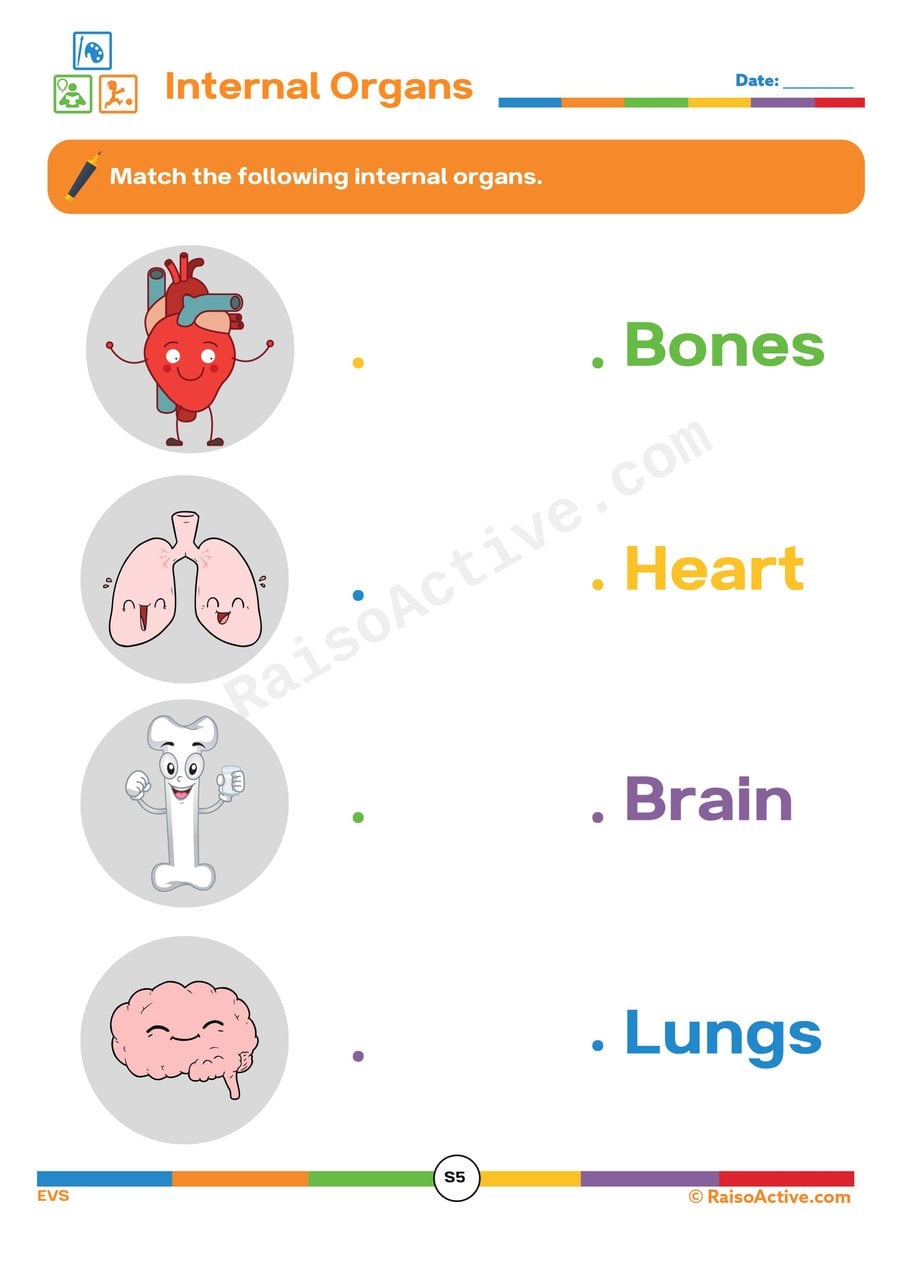
Match the Internal Organs Worksheet for Kids
Drawing lines to connect organ pictures to their correct names teaches children ages 3-5 an early introduction to human biology, helping them recognize that the body has specific parts inside it with their own names and jobs, beyond just the body parts they can see and touch. This matching task builds visual discrimination, since organs can look somewhat similar in simple illustrations, requiring children to look closely at shape and detail before connecting a picture to its label. Coloring the organs afterward adds a fine motor and creative finishing step to the science lesson.

Internal Organs Worksheet: Find and Match the Body Parts!
Finding organ names hidden in a word search and then cutting and pasting the organs onto the correct spot on a body diagram teaches children ages 4-6 the names and general locations of internal organs, like the heart, lungs, and stomach, introducing basic human biology. Searching the word grid builds visual scanning and word recognition, while the cut-and-paste placement step reinforces spatial understanding of where each organ sits inside the body. Combining a word search with a hands-on placement task gives this worksheet both a literacy and a science learning goal.

Human Body Parts Cut and Paste Worksheet for Kids
This cut-and-paste activity teaches children ages 3-5 to identify and correctly place major body parts — like the head, arms, legs, and torso — onto a body outline, reinforcing body awareness alongside cutting and gluing fine motor skills. Understanding where each part belongs on the body supports early self-awareness and vocabulary that children use constantly, from getting dressed to describing how they feel. Physically assembling the body from separate pieces also helps children see how individual parts combine into a whole, functioning figure.

Body Parts Worksheet: Identify and Paste the Correct Organ!
Reading a clue about a body part's function and finding the matching organ builds science vocabulary and reading comprehension for children ages 4-6, linking what a body part does to its correct name.

Internal Parts Worksheet: Cut and Paste the Organs!
This worksheet introduces children ages 4-6 to basic human anatomy by having them cut out pictures of internal organs, such as the heart, lungs, and stomach, and glue each one into its correct location on a body outline. Beyond scissor and gluing practice, this activity builds spatial body awareness and early scientific vocabulary, giving children a first mental map of what's inside their own bodies.
Guides for this topic
Sight Words by Age: The First 50 Words and How to Teach Them Without Flashcard Fatigue
Which sight words to teach first and why, the heart-word method, a read-trace-write-find routine, games, and a by-age table of typical sight-word progress.
How to Teach CVC Blending: A Step-by-Step Method That Works in Two Weeks
A step-by-step method for teaching CVC blending, covering continuous sounds, word families, common errors, and a 14-day plan that most children finish reading CVC words.
Documenting Learning Without Drowning in Data: A Practical Guide for Parents and Teachers
Learn practical ways to document your child's learning without overwhelm. Simple portfolios, observation tips, and printable trackers for ages 1-8.
Reviews
Every worksheet for ages 3–5, no watermark
Members download the full library of 1,000+ worksheets and every activity pack without watermarks or daily limits. One year costs ₹1,000 in India or $20 elsewhere.
See membership plansOr download any worksheet free with a watermark (5 a day).