My Family Worksheet: Learn About Family Members!
Writing the names of family members next to their pictures helps children ages 3-5 connect written words to real relationships in their own lives, combining early handwriting practice with meaningful, personal vocabulary. Because the content is about their own family, this worksheet tends to feel especially engaging and easy to talk about.
Part of the pack
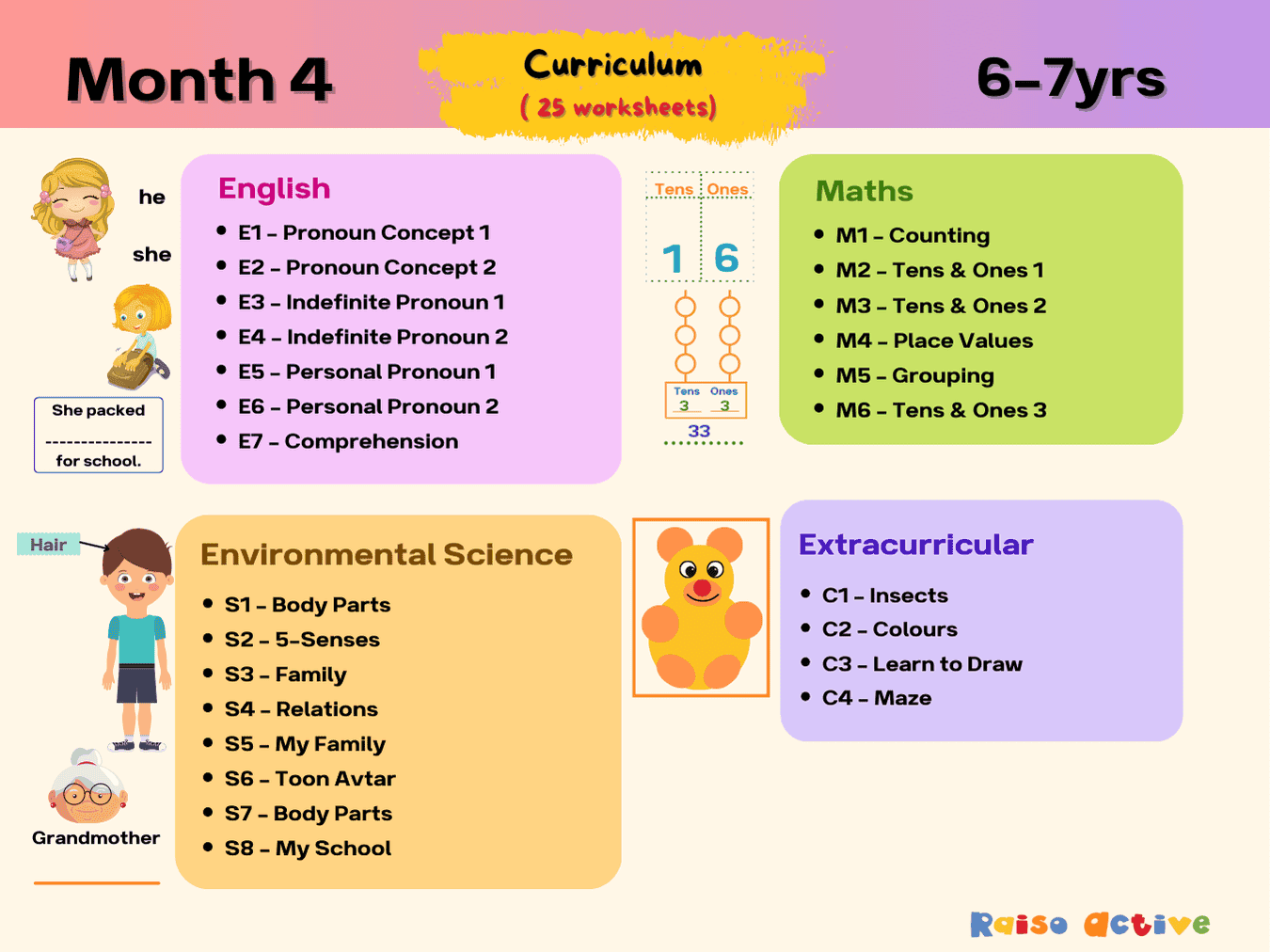
Month 4: Learning & Development | Ages 6-7
This is page 21 of the pack. Ages 6-7 · Grade 1Ages 6-7 · Year 2Ages 6-7 · Class 1Ages 6-7
Made for your child
Spelling practice, made for your child
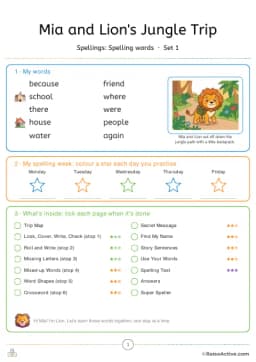
Their own spelling words turned into a pack: trace or look-cover-write-check, roll and write, a secret picture code, a word search, a crossword and a test, with their name in it.
Make a spelling packFree preview · free for members
Or start free: a word search with sight wordsCurriculum
- Earth & Environment > Environment Awareness
How to use this worksheet
Look at each picture of a family member together and talk about who they are. Ask your child to think about the correct name or relationship word, then have them write it on the line provided. Continue through each remaining family member picture, letting your child share a memory or detail about each person as they write.
Materials needed
- Pencil
- Crayons
Extension activities
- 1Draw pictures of your own family members to go along with the worksheet.
- 2Make a simple family photo book with names written under each photo.
- 3Interview a family member and write down one fact they share.
- 4Create a basic family tree using names practiced on the worksheet.
- 5Write a short 'about my family' sentence together.

Written by
Hemsweta Jain · Teacher Cheena
MBA and Early Childhood Educator, teaching since 2014 · Founder of RaisoActive, Mumbai
Every RaisoActive worksheet is designed and checked by the founder before publishing.
Published · Last reviewed
More from Month 4: Learning & Development | Ages 6-7

Indefinite Pronoun Worksheet: Fill-in-the-Blanks Fun!
Ages 3-5 · Preschool–Pre-KAges 3-5 · Nursery–ReceptionAges 3-5 · Nursery–LKGAges 3-5
Choosing the correct indefinite pronoun to complete each sentence introduces children ages 3-5 to words like something, someone, and anywhere in simple, everyday sentence contexts, building early grammar awareness alongside vocabulary. This gentle, sentence-level practice lays groundwork for more advanced grammar work in later years.

Learn to Draw: Teddy Bear Worksheet for Preschoolers
Ages 3-5 · Preschool–Pre-KAges 3-5 · Nursery–ReceptionAges 3-5 · Nursery–LKGAges 3-5
Following numbered steps to draw a teddy bear teaches children ages 3-5 that complex pictures can be broken down into simple shapes like circles, building both sequencing skills and hand-eye coordination. This step-by-step approach to drawing also builds confidence for children who feel intimidated by open-ended drawing tasks.
Color the Insects Worksheet for Preschoolers
Ages 3-5 · Preschool–Pre-KAges 3-5 · Nursery–ReceptionAges 3-5 · Nursery–LKGAges 3-5
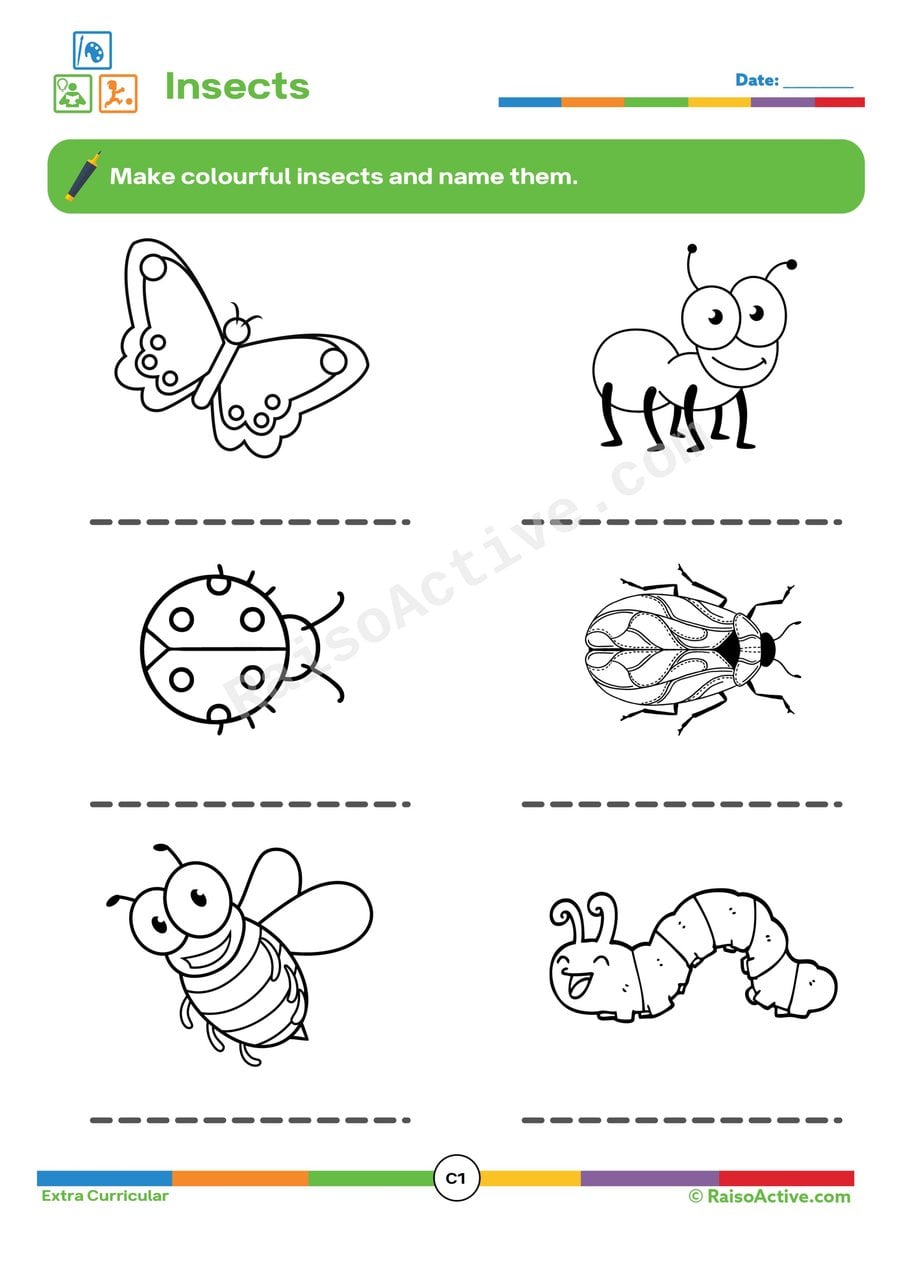
Coloring a set of insects and writing their names afterward helps children ages 3-5 build insect vocabulary while practicing fine motor coloring control and connecting a picture to its written word. This combination of art and labeling reinforces new vocabulary more effectively than looking at pictures alone.
Create Your Own Toon Avatar Worksheet for Kids
Ages 3-5 · Preschool–Pre-KAges 3-5 · Nursery–ReceptionAges 3-5 · Nursery–LKGAges 3-5
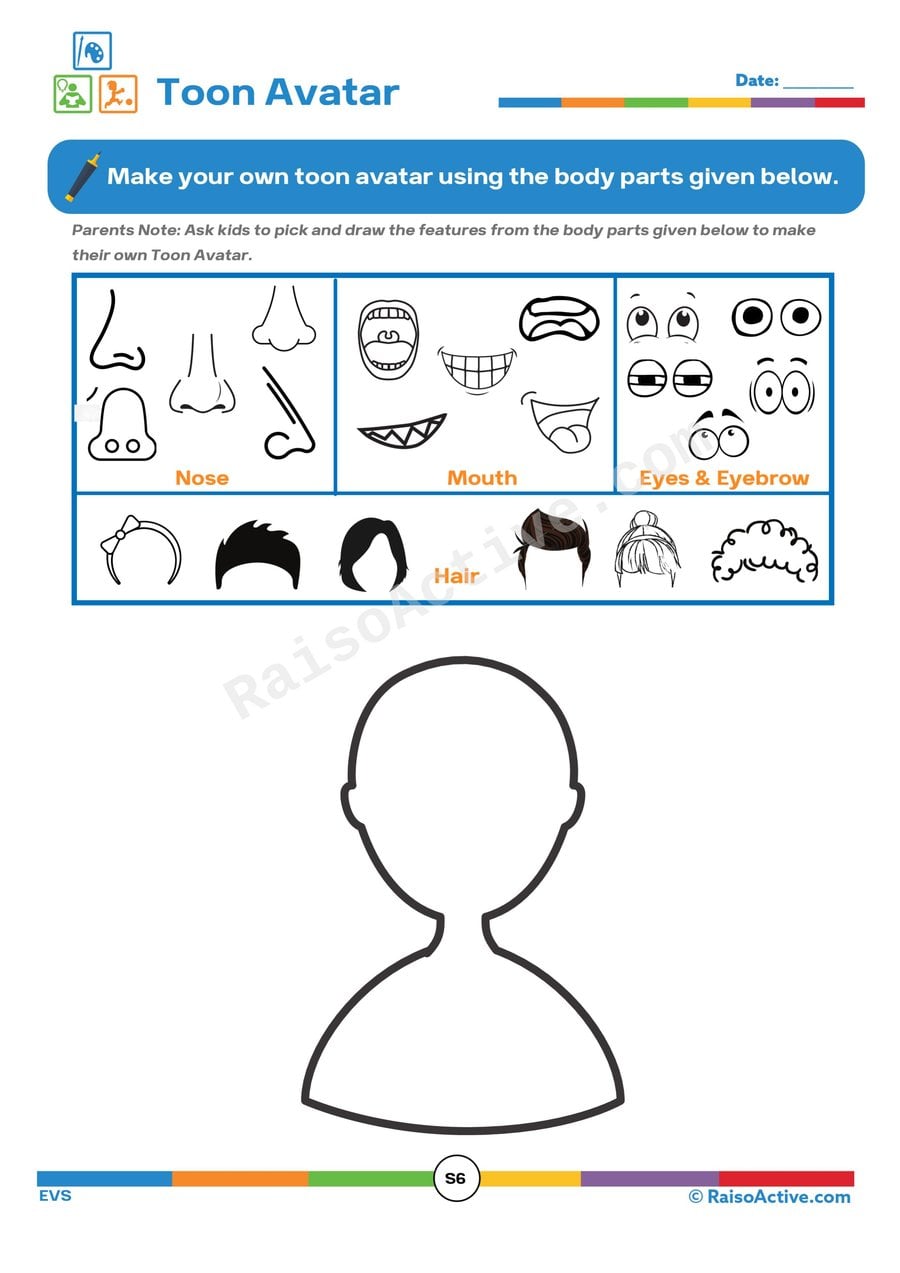
Choosing and drawing features like eyes, nose, mouth, and hair onto a blank avatar outline builds creative self-expression and fine motor drawing control for children ages 3-5, while also introducing the idea that a face can be assembled from separate, swappable parts. This open-ended activity encourages decision-making as children choose which features best represent the character they imagine.

Place Value Beads: Count and Fill the Numbers Worksheet
Ages 3-5 · Preschool–Pre-KAges 3-5 · Nursery–ReceptionAges 3-5 · Nursery–LKGAges 3-5
Counting beads on an abacus-style picture and writing the tens and ones totals teaches children ages 3-5 place value through a visual, hands-on representation rather than abstract numerals alone. Solving the final abacus total afterward reinforces that a two-digit number is really the sum of its tens and ones parts.

Body Parts Worksheet for Kids: Identify and Label!
Ages 3-5 · Preschool–Pre-KAges 3-5 · Nursery–ReceptionAges 3-5 · Nursery–LKGAges 3-5
This worksheet builds vocabulary and early writing skills as children ages 3-5 identify parts of the human body in a picture and write each body part's name in its labeled box. Connecting a spoken word to its written form and to the correct location on a diagram strengthens both language development and body awareness, an important self-knowledge skill at this age.
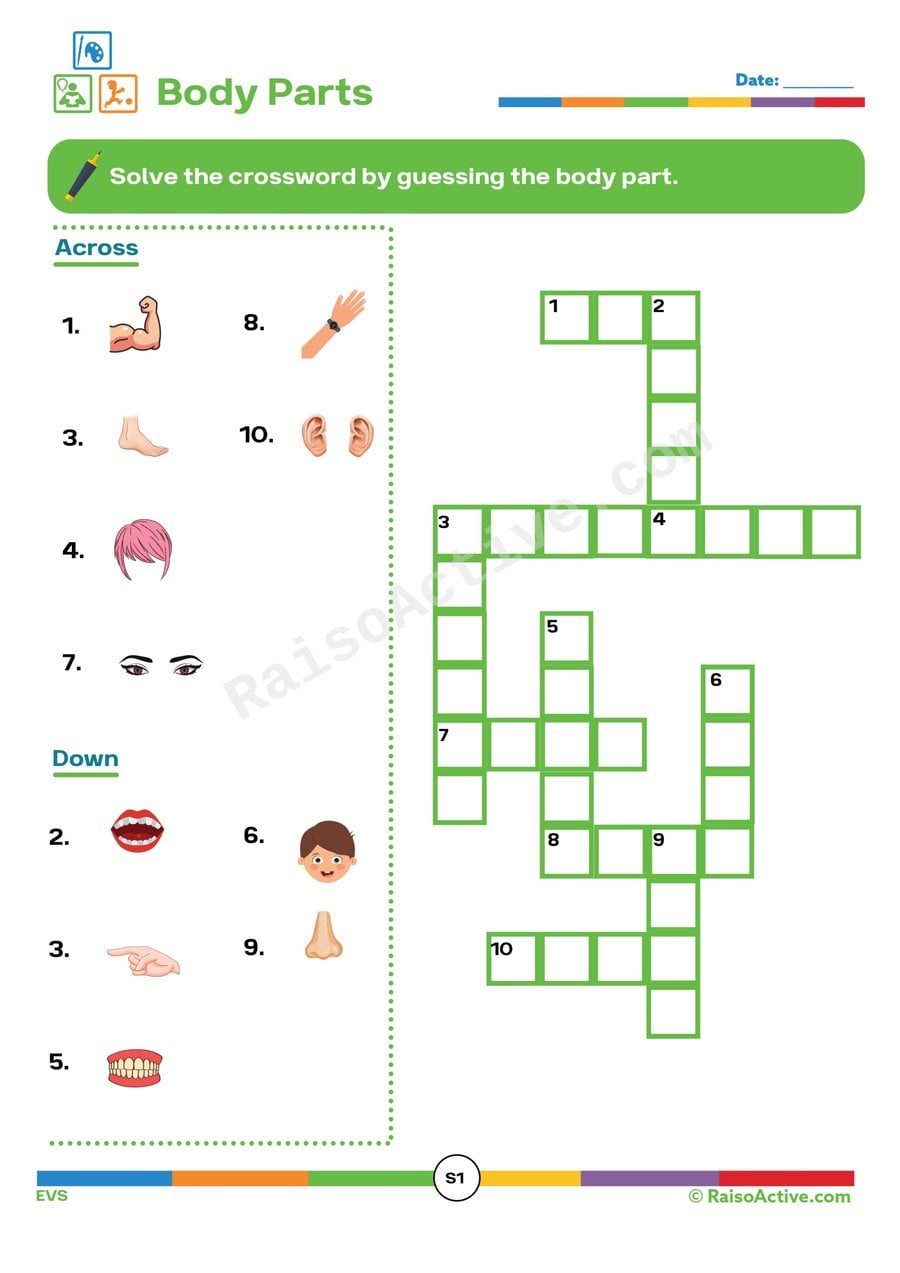
Body Parts Crossword Puzzle Worksheet for Kids
Ages 3-5 · Preschool–Pre-KAges 3-5 · Nursery–ReceptionAges 3-5 · Nursery–LKGAges 3-5
Solving a crossword using body part picture clues teaches children ages 3-5 to connect a visual image with its written name, building both vocabulary and early spelling skills. Working through the crossword's number grid also introduces the format of organizing answers into specific boxes, a small but useful pre-literacy skill.

Pronoun Power: Circle the Correct Pronoun Worksheet
Ages 4-6 · Pre-K–KindergartenAges 4-6 · Reception–Year 1Ages 4-6 · LKG–UKGAges 4-6
This worksheet helps children ages 4-6 practice using the pronouns 'he' and 'she' correctly by looking at a picture of a person and circling the pronoun that matches. Correctly substituting a pronoun for a person's name is an early grammar milestone that makes spoken and written sentences smoother and less repetitive.
Related worksheets

Keeping Our Environment Clean Worksheet for Kids
Ages 3-5 · Preschool–Pre-KAges 3-5 · Nursery–ReceptionAges 3-5 · Nursery–LKGAges 3-5
This worksheet builds early environmental awareness in children ages 3-5 by having them evaluate pictured actions — like throwing litter in a bin versus littering on the ground — and mark each one as good or bad for the environment. Making this judgment call requires children to connect a specific action to a broader consequence, an early form of cause-and-effect reasoning applied to environmental responsibility. Introducing this concept young helps normalize caring for shared spaces as a natural part of daily behavior rather than an abstract adult concern.

Earth Day Sorting Worksheet: Good vs. Bad for the Environment!
Ages 4-6 · Pre-K–KindergartenAges 4-6 · Reception–Year 1Ages 4-6 · LKG–UKGAges 4-6
Sorting pictures of everyday actions into 'good for the environment' and 'bad for the environment' introduces children ages 4-6 to cause-and-effect reasoning about human impact, an early building block for environmental awareness and responsible habits.
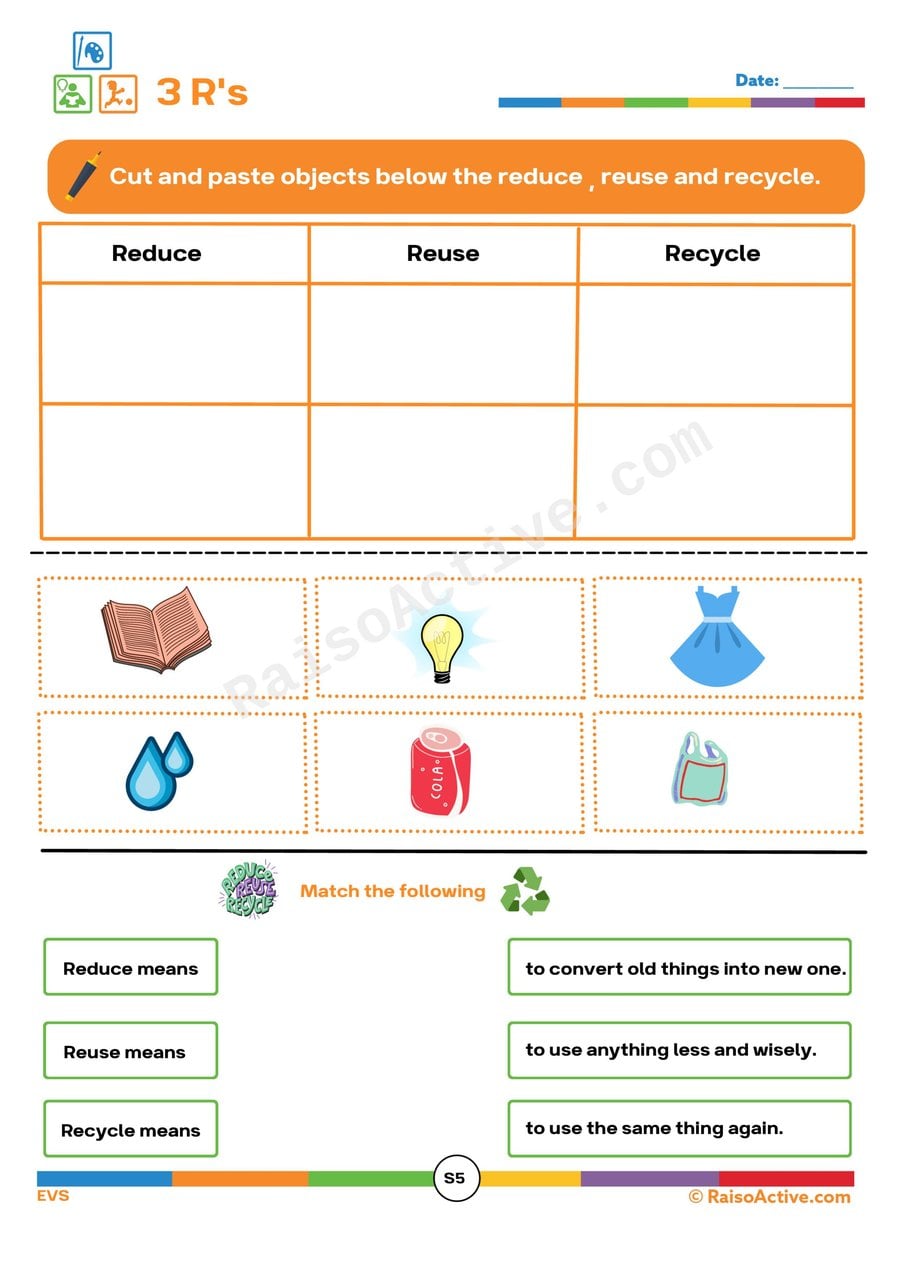
Reduce, Reuse, Recycle Worksheet for Kids
Ages 4-6 · Pre-K–KindergartenAges 4-6 · Reception–Year 1Ages 4-6 · LKG–UKGAges 4-6
Children ages 4-6 learn the three pillars of environmental responsibility — reduce, reuse, and recycle — by sorting pictures of everyday items into the correct category and matching each term to its definition. This worksheet builds early environmental literacy and categorical thinking, asking children to consider not just what an item is, but what should happen to it once it's no longer needed. It's a concrete entry point into sustainability concepts that will expand in later grades.
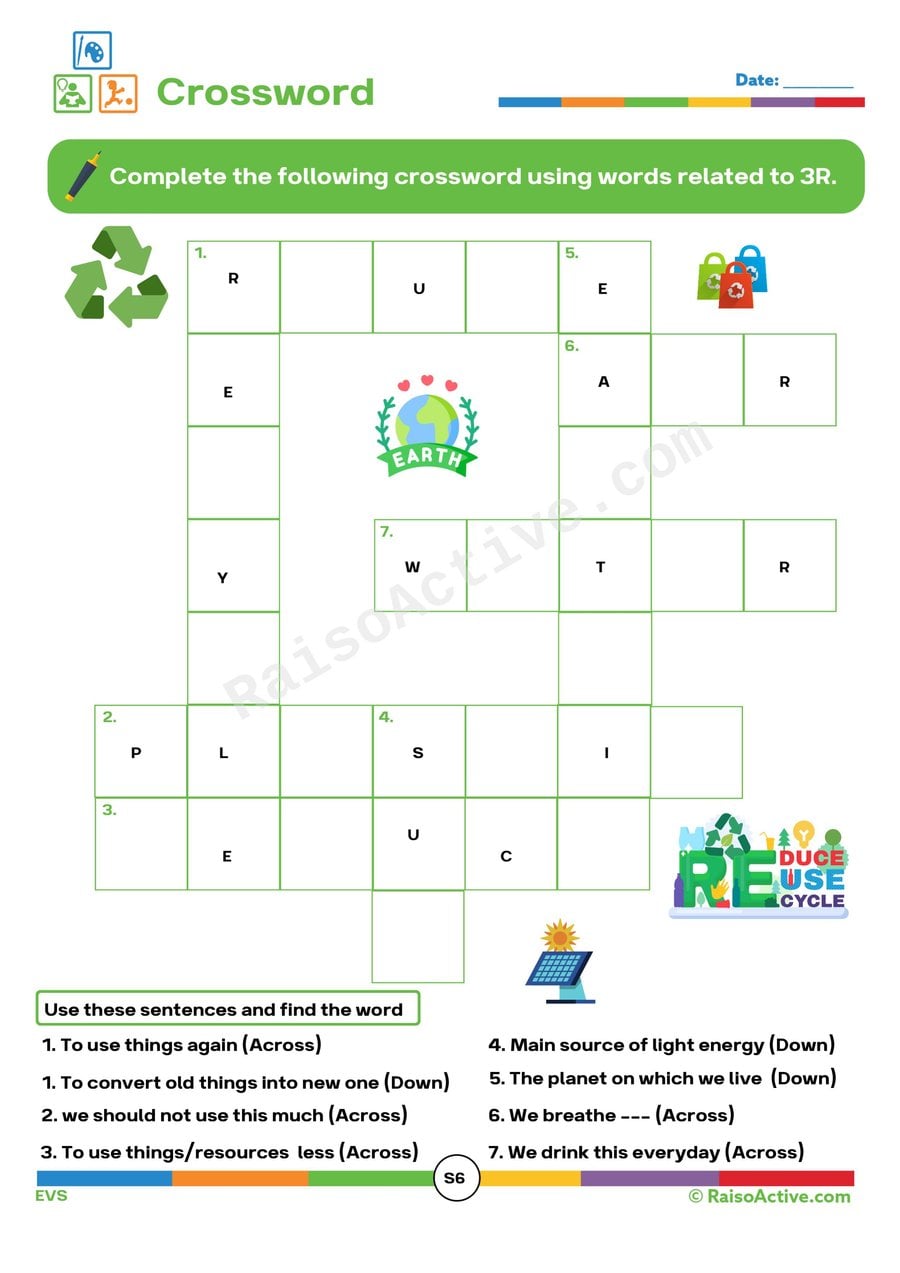
3R Crossword Puzzle Worksheet for Kids
Ages 4-6 · Pre-K–KindergartenAges 4-6 · Reception–Year 1Ages 4-6 · LKG–UKGAges 4-6
This crossword puzzle challenges children ages 4-6 to connect vocabulary about reducing, reusing, and recycling to its written spelling, reinforcing environmental concepts through reading and word-building rather than picture matching alone. Using clues to determine the correct word and then filling in letter boxes practices phonics, spelling, and logical deduction together, since letters that cross with other answers must match on both words.
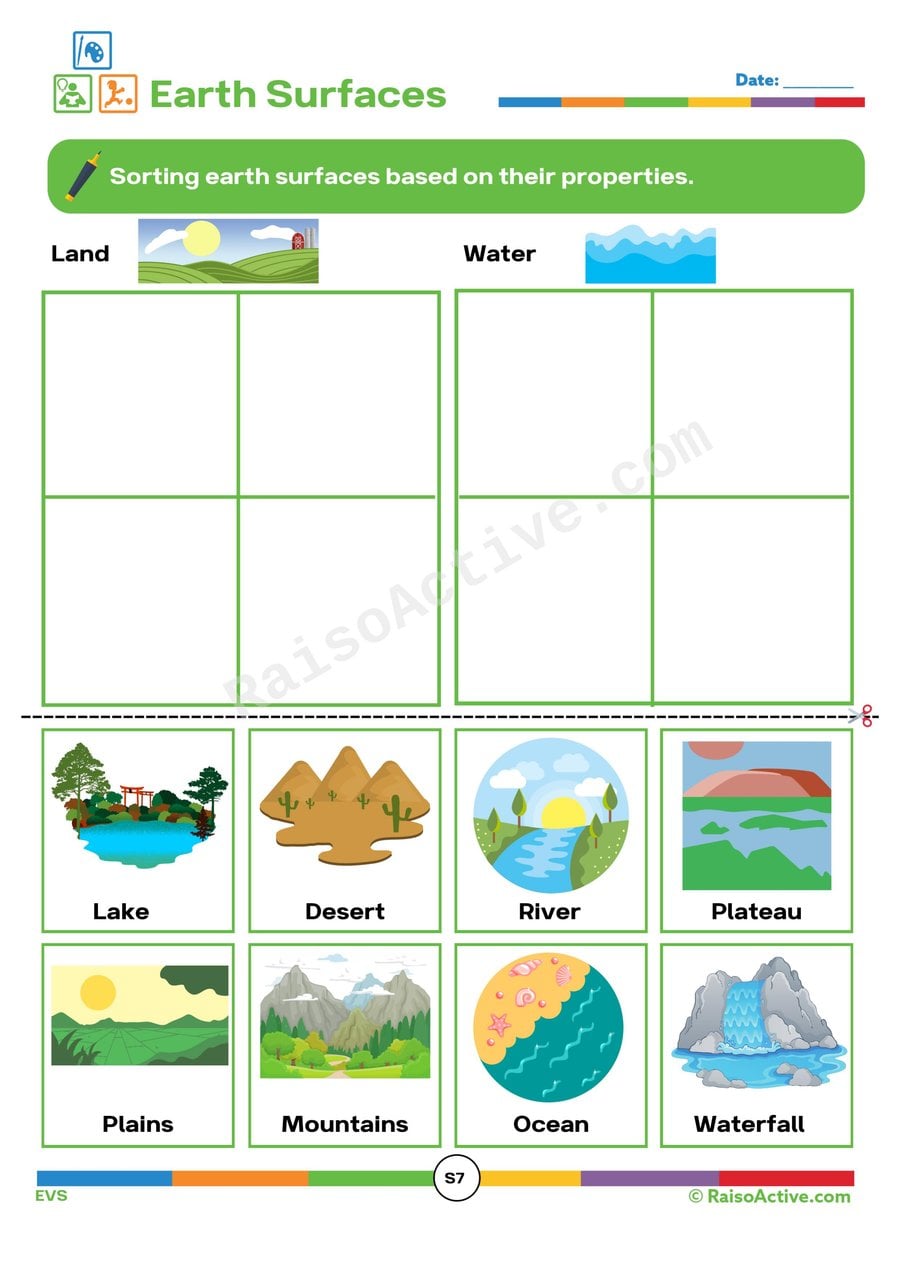
Earth Surfaces Sorting Worksheet for Kids
Ages 4-6 · Pre-K–KindergartenAges 4-6 · Reception–Year 1Ages 4-6 · LKG–UKGAges 4-6
Sorting pictures into 'land' and 'water' categories builds early classification skills and basic earth science vocabulary for children ages 4-6, helping them notice physical differences between surfaces they see in daily life.
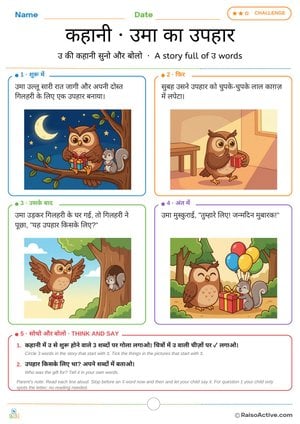
Letter उ Story: Uma's Birthday Gift | कहानी उमा का उपहार
Ages 3-7 · Preschool–Grade 1Ages 3-7 · Nursery–Year 2Ages 3-7 · Nursery–Class 1Ages 3-7
Uma the owl stays up all night to make a gift for her friend the squirrel, then flies to her home and says it is a birthday present just for her. Children listen, look at the four pictures, spot the words that start with उ and retell what happened in their own words.
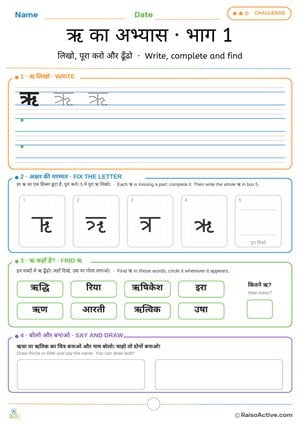
Hindi Letter ऋ (ri) Practice 1: Write, Fix the Letter and Find | ऋ का अभ्यास · भाग 1
Ages 4-7 · Pre-K–Grade 1Ages 4-7 · Reception–Year 2Ages 4-7 · LKG–Class 1Ages 4-7
A challenge page: write ऋ between the lines, complete four letters that are each missing a part and then write the whole ऋ in box 5, find ऋ in words such as ऋद्धि, ऋषिकेश, ऋण and ऋत्विक, and draw a picture. Because ऋ is a special vowel, this page helps adults say it as 'ri' and keep it apart from इ and र.
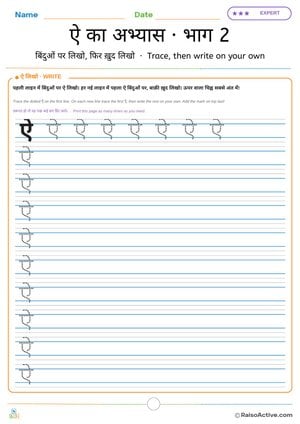
Hindi Letter ऐ (ai) Practice 2: Trace, then Write on Your Own | ऐ का अभ्यास · भाग 2
Ages 5-7 · Kindergarten–Grade 1Ages 5-7 · Year 1–Year 2Ages 5-7 · UKG–Class 1Ages 5-7
An expert page for confident writers: trace the dotted ऐ on the first line, then on each new line trace the first ऐ and write the rest on your own, adding the mark on top last.
Guides for this topic

Sight Words by Age: The First 50 Words and How to Teach Them Without Flashcard Fatigue
Which sight words to teach first and why, the heart-word method, a read-trace-write-find routine, games, and a by-age table of typical sight-word progress.
How to Teach CVC Blending: A Step-by-Step Method That Works in Two Weeks
A step-by-step method for teaching CVC blending, covering continuous sounds, word families, common errors, and a 14-day plan that most children finish reading CVC words.

Documenting Learning Without Drowning in Data: A Practical Guide for Parents and Teachers
Learn practical ways to document your child's learning without overwhelm. Simple portfolios, observation tips, and printable trackers for ages 1-8.
Reviews
Every worksheet for ages 3–5, no watermark
Members download the full library of 1,000+ worksheets and every activity pack without watermarks or daily limits. One year costs ₹999 in India or $20 elsewhere.
See membership plansOr download any worksheet free with a watermark (5 a day).