Earth Surfaces Sorting Worksheet for Kids
Sorting pictures into 'land' and 'water' categories builds early classification skills and basic earth science vocabulary for children ages 4-6, helping them notice physical differences between surfaces they see in daily life.
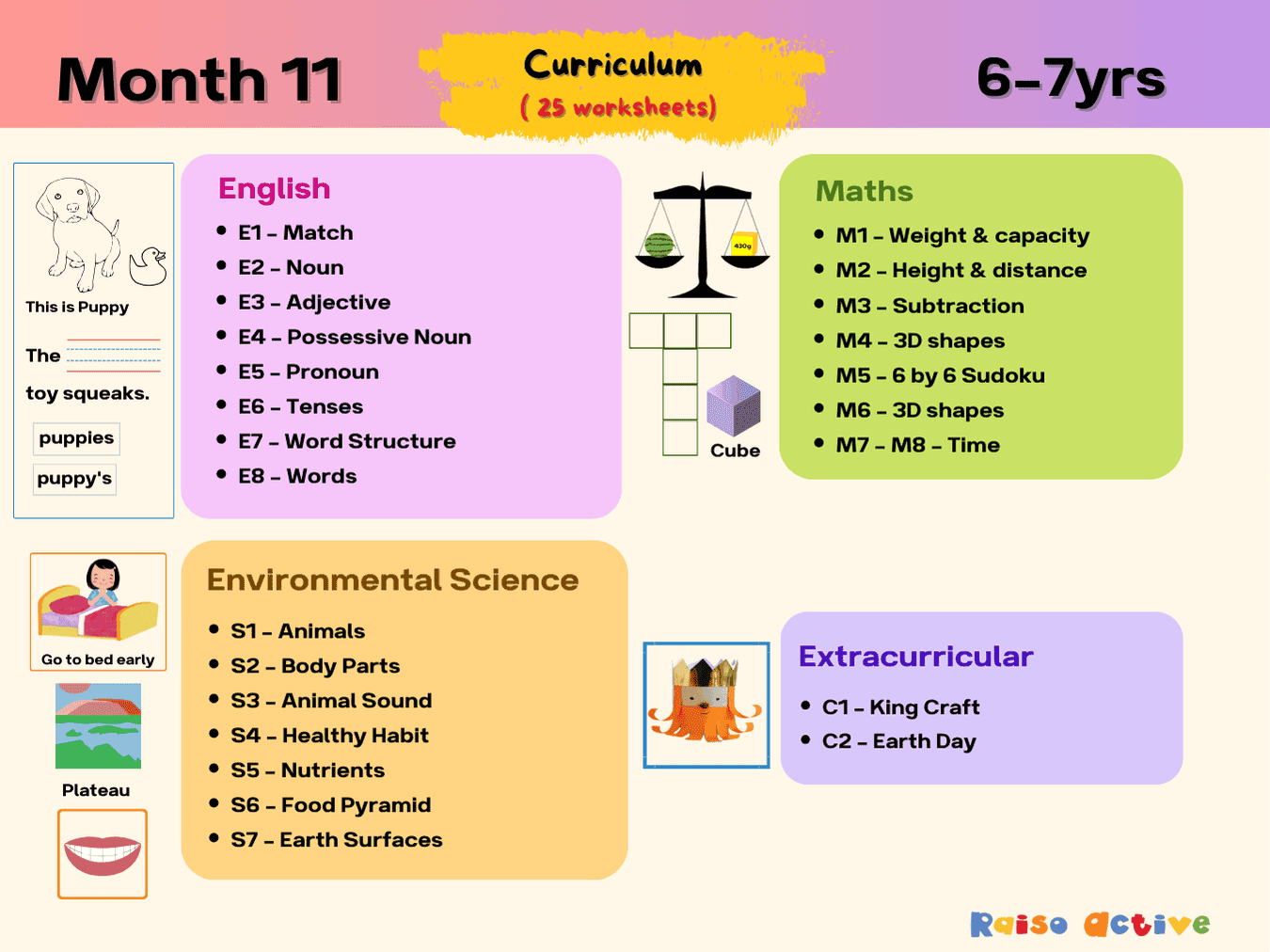
Part of the pack
Month 11: Learning & Development | Ages 6-7
This is page 26 of the pack. Ages 6-7 · Grade 1Ages 6-7 · Year 2Ages 6-7 · Class 1Ages 6-7
Made for your child
Numbers to 20, made for your child
A maths pack with your child's name in it: pictures that explain, practice at three levels, puzzles and story sums about them. Print a new set whenever they finish.
Make a maths packFree preview · free for members
Curriculum
- Earth & Environment > Environment Awareness
How to use this worksheet
Cut out the pictures of different earth surfaces at the bottom of the page. Look at each picture together and decide whether it shows land or water. Glue each picture into the correct column, discussing what makes it land or water as you go, until every picture has been sorted.
Materials needed
- Scissors
- Glue
- Pencil
Extension activities
- 1Go on a nature walk and point out examples of land and water surfaces.
- 2Look at a globe or map together and find large bodies of water versus land masses.
- 3Fill a tray with sand and water to physically compare the two surfaces.
- 4Draw a picture that includes both land and water features.

Written by
Hemsweta Jain · Teacher Cheena
MBA and Early Childhood Educator, teaching since 2014 · Founder of RaisoActive, Mumbai
Every RaisoActive worksheet is designed and checked by the founder before publishing.
Published · Last reviewed
More from Month 11: Learning & Development | Ages 6-7

Earth Day Sorting Worksheet: Good vs. Bad for the Environment!
Ages 4-6 · Pre-K–KindergartenAges 4-6 · Reception–Year 1Ages 4-6 · LKG–UKGAges 4-6
Sorting pictures of everyday actions into 'good for the environment' and 'bad for the environment' introduces children ages 4-6 to cause-and-effect reasoning about human impact, an early building block for environmental awareness and responsible habits.
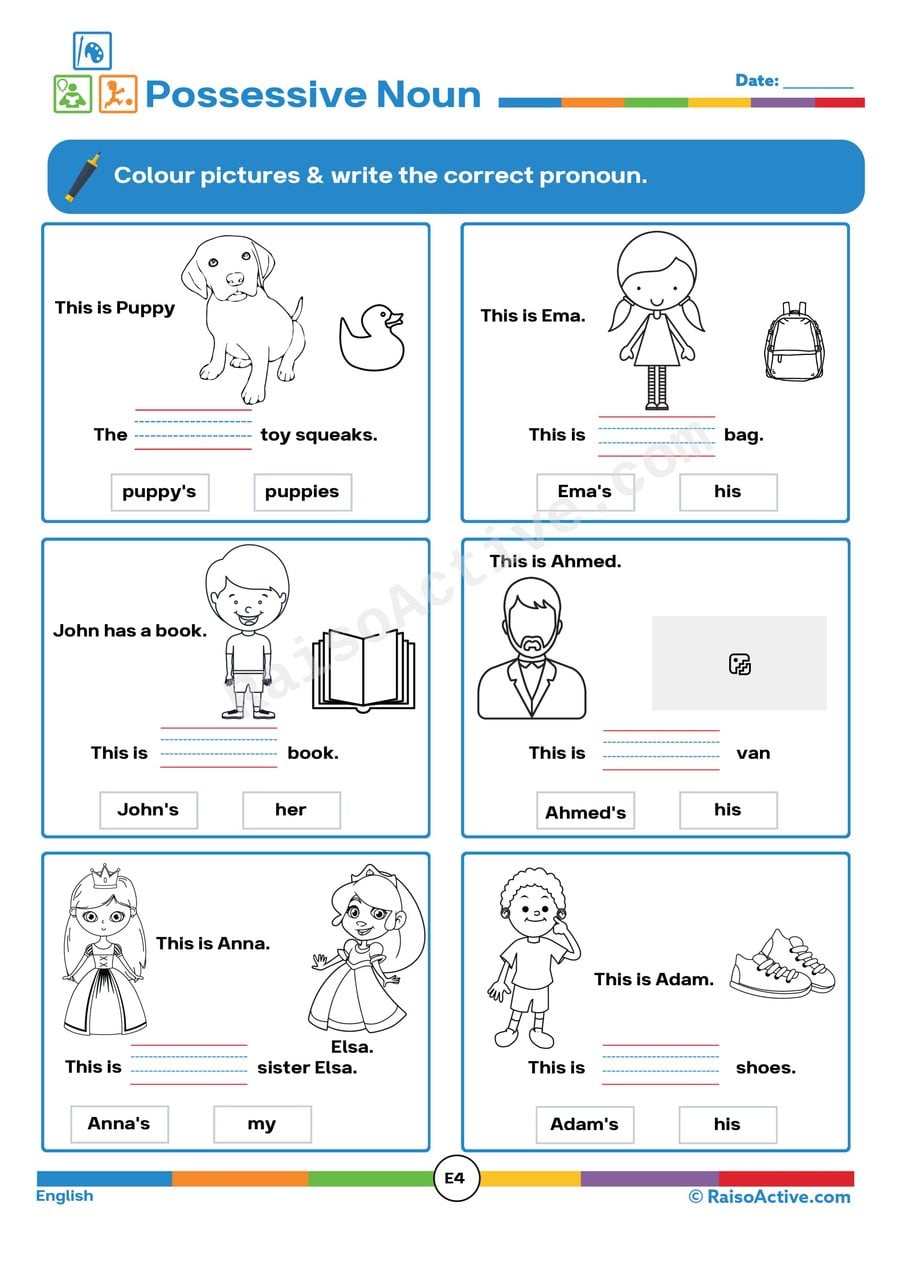
Possessive Nouns Worksheet: Color and Write!
Ages 4-6 · Pre-K–KindergartenAges 4-6 · Reception–Year 1Ages 4-6 · LKG–UKGAges 4-6
Children ages 4-6 practice forming possessive nouns, learning to add an apostrophe and 's' to show that something belongs to someone, like 'the dog's bone.' This is a specific grammar rule that children will use constantly once they start writing about ownership in their own sentences.

Healthy Habits Worksheet for Kids: Sorting Activities
Ages 3-5 · Preschool–Pre-KAges 3-5 · Nursery–ReceptionAges 3-5 · Nursery–LKGAges 3-5
This worksheet helps children ages 3-5 build early health literacy by looking at pictures of daily habits, like brushing teeth or eating vegetables, and deciding whether each one is healthy or unhealthy. Making this judgment requires applying general knowledge about wellbeing to a specific picture, which builds reasoning skills alongside foundational health awareness that supports good routines.
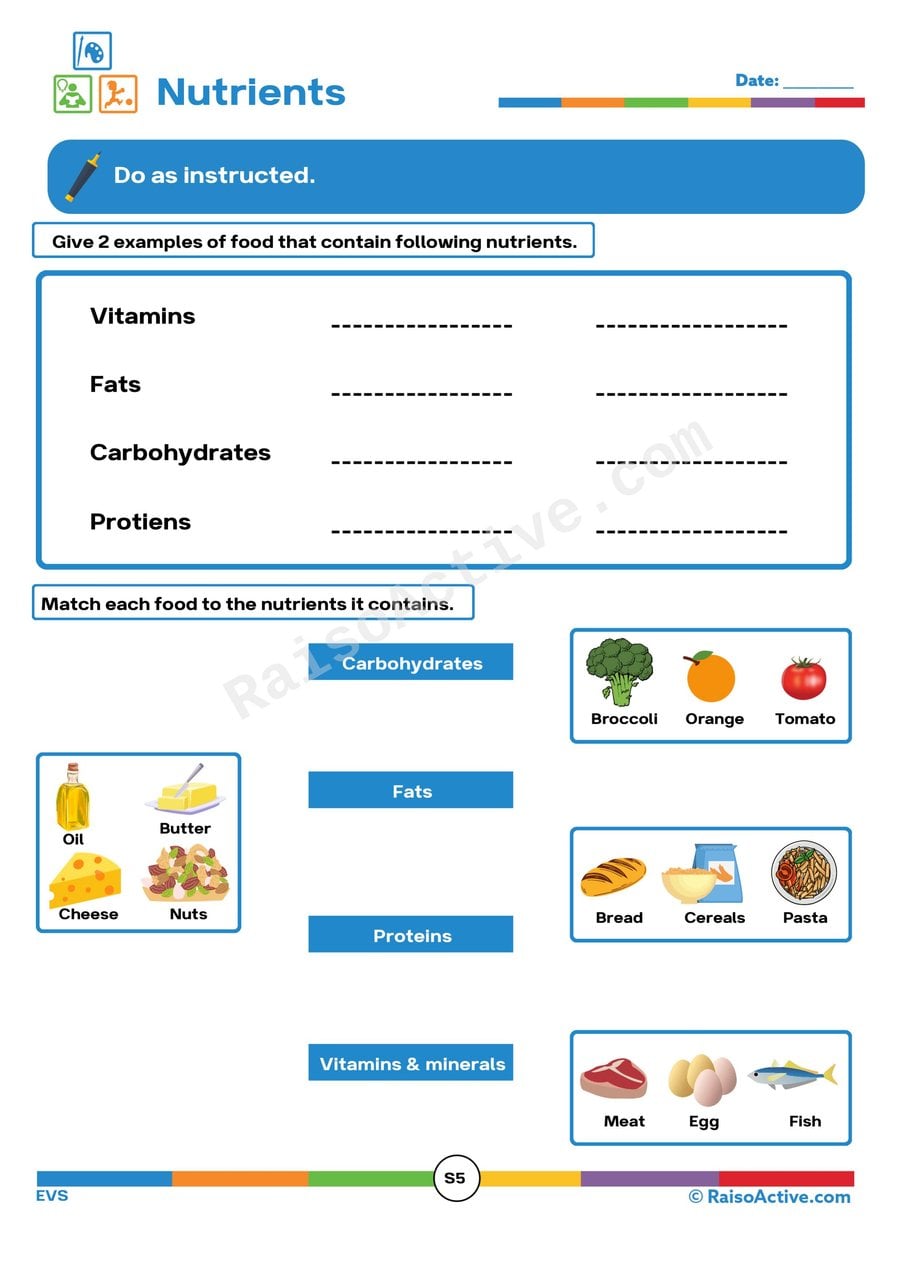
Nutrient Match: Food Examples Worksheet for Kids
Ages 4-6 · Pre-K–KindergartenAges 4-6 · Reception–Year 1Ages 4-6 · LKG–UKGAges 4-6
This worksheet introduces children ages 4-6 to basic nutrition concepts by having them match food items to the nutrient category they belong to — vitamins, fats, carbohydrates, or proteins — and then name additional food examples for each. Going beyond a simple healthy/unhealthy sort, this task builds a more detailed understanding of why different foods matter for the body, an early foundation for lifelong healthy eating habits.

Adjective Adventure: Circle the Correct Words Worksheet
Ages 4-6 · Pre-K–KindergartenAges 4-6 · Reception–Year 1Ages 4-6 · LKG–UKGAges 4-6
Children ages 4-6 practice identifying adjectives, the describing words that tell more about a noun, by reading sentences and circling the word that adds detail or description. Learning to spot adjectives is a foundational grammar skill that also helps children add more vivid, specific description to their own writing and speech.

Animal Sounds Matching Worksheet for Preschoolers
Ages 3-5 · Preschool–Pre-KAges 3-5 · Nursery–ReceptionAges 3-5 · Nursery–LKGAges 3-5
This worksheet strengthens vocabulary and auditory-visual association in children ages 3-5 as they connect each animal picture to the written word for the sound it makes, like 'moo' or 'quack.' Matching sounds to animals also supports early literacy by pairing a familiar spoken word with its printed form, giving children an early, low-pressure introduction to reading words in context.

Word Structure Worksheet: Choose the Correct Word!
Ages 4-6 · Pre-K–KindergartenAges 4-6 · Reception–Year 1Ages 4-6 · LKG–UKGAges 4-6
Reading a sentence with a missing word and selecting the correct option from a word bank builds vocabulary and context-clue reasoning for children ages 4-6, both essential for early reading fluency and comprehension.

Tenses Worksheet: Identifying Past, Present, and Future Verbs
Ages 4-6 · Pre-K–KindergartenAges 4-6 · Reception–Year 1Ages 4-6 · LKG–UKGAges 4-6
Identifying whether an underlined verb describes something that already happened, is happening now, or will happen later introduces children ages 4-6 to verb tense, an important step toward constructing grammatically correct sentences of their own.
Related worksheets
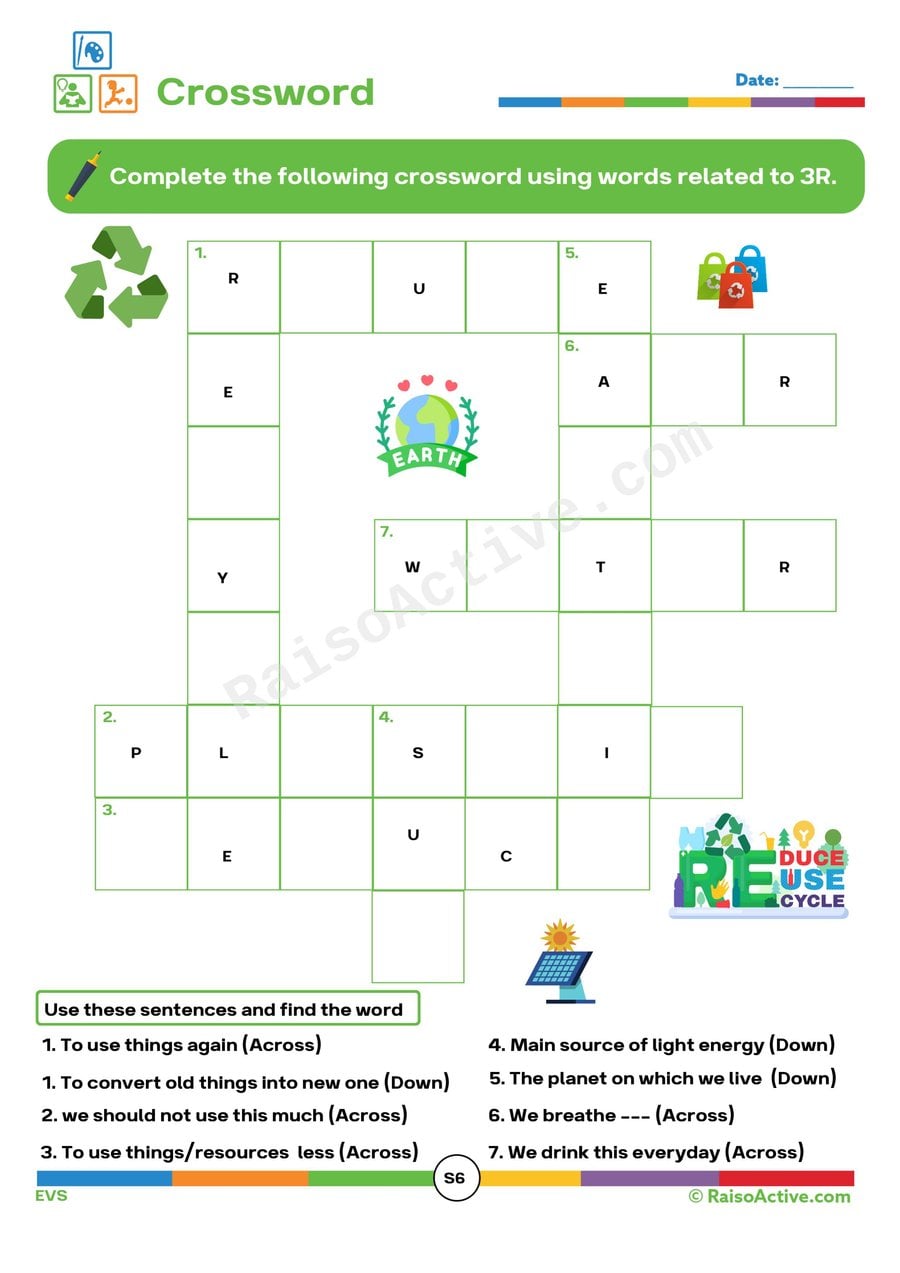
3R Crossword Puzzle Worksheet for Kids
Ages 4-6 · Pre-K–KindergartenAges 4-6 · Reception–Year 1Ages 4-6 · LKG–UKGAges 4-6
This crossword puzzle challenges children ages 4-6 to connect vocabulary about reducing, reusing, and recycling to its written spelling, reinforcing environmental concepts through reading and word-building rather than picture matching alone. Using clues to determine the correct word and then filling in letter boxes practices phonics, spelling, and logical deduction together, since letters that cross with other answers must match on both words.
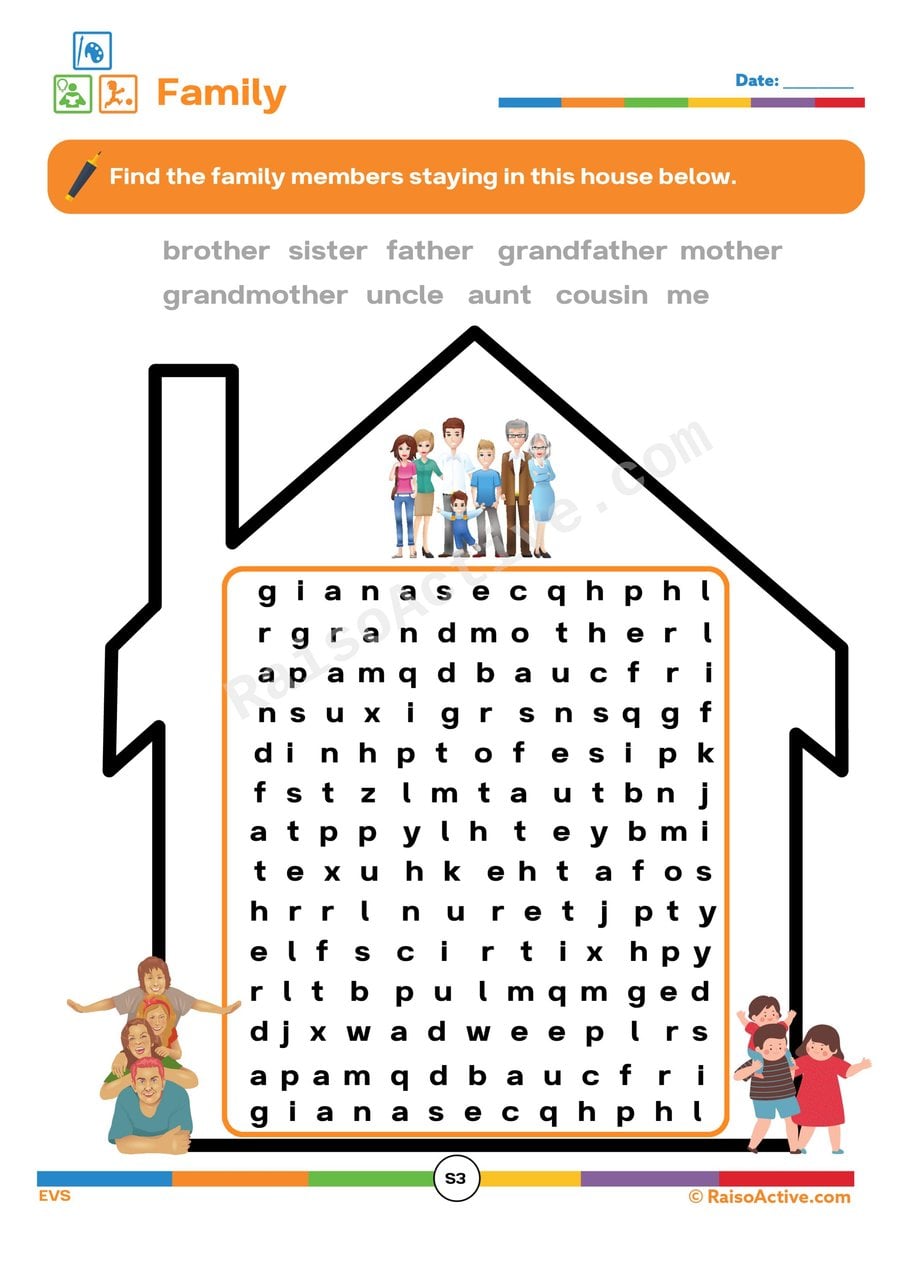
Family Word Search Worksheet for Kids
Ages 4-6 · Pre-K–KindergartenAges 4-6 · Reception–Year 1Ages 4-6 · LKG–UKGAges 4-6
Searching a grid for hidden family member words like mother, father, and sister builds vocabulary and visual scanning skills for children ages 4-6, requiring them to track letters carefully across rows, columns, and sometimes diagonals. This kind of focused letter tracking is excellent early practice for the visual attention reading fluency depends on later.
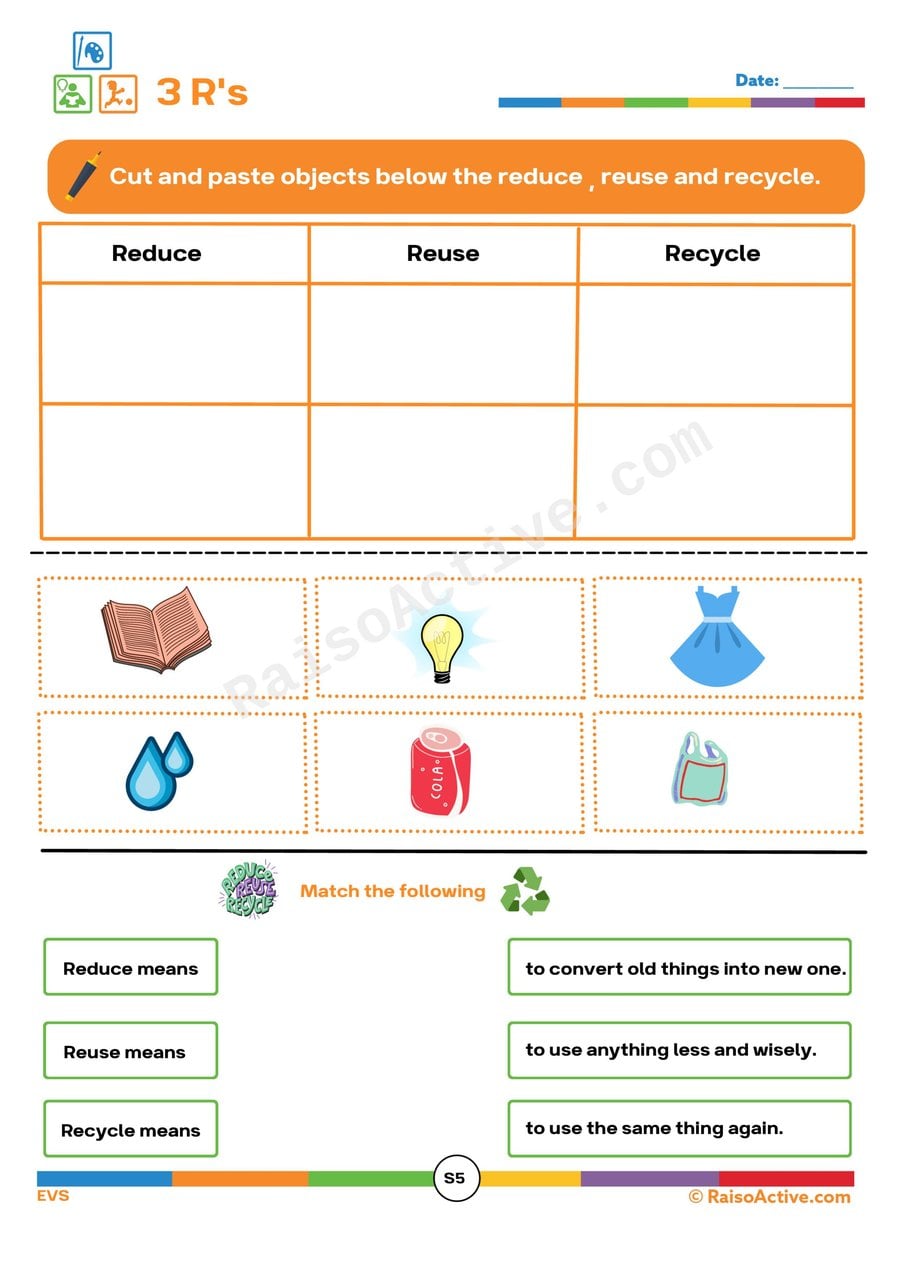
Reduce, Reuse, Recycle Worksheet for Kids
Ages 4-6 · Pre-K–KindergartenAges 4-6 · Reception–Year 1Ages 4-6 · LKG–UKGAges 4-6
Children ages 4-6 learn the three pillars of environmental responsibility — reduce, reuse, and recycle — by sorting pictures of everyday items into the correct category and matching each term to its definition. This worksheet builds early environmental literacy and categorical thinking, asking children to consider not just what an item is, but what should happen to it once it's no longer needed. It's a concrete entry point into sustainability concepts that will expand in later grades.

Keeping Our Environment Clean Worksheet for Kids
Ages 3-5 · Preschool–Pre-KAges 3-5 · Nursery–ReceptionAges 3-5 · Nursery–LKGAges 3-5
This worksheet builds early environmental awareness in children ages 3-5 by having them evaluate pictured actions — like throwing litter in a bin versus littering on the ground — and mark each one as good or bad for the environment. Making this judgment call requires children to connect a specific action to a broader consequence, an early form of cause-and-effect reasoning applied to environmental responsibility. Introducing this concept young helps normalize caring for shared spaces as a natural part of daily behavior rather than an abstract adult concern.

Family Relations Worksheet: Learn About Family Members!
Ages 3-5 · Preschool–Pre-KAges 3-5 · Nursery–ReceptionAges 3-5 · Nursery–LKGAges 3-5
Writing the correct family member name next to each person on a family tree helps children ages 3-5 understand family relationships and structure, connecting a written word to a specific role like mother, father, or sibling. This early exposure to family trees also introduces the idea of organizing information visually, a skill used across many later school subjects.

My School Cut and Paste Worksheet for Preschoolers
Ages 3-5 · Preschool–Pre-KAges 3-5 · Nursery–ReceptionAges 3-5 · Nursery–LKGAges 3-5
Cutting out school-related pictures and pasting them into the correct spaces on a school building teaches children ages 3-5 vocabulary for familiar school spaces, like a classroom or playground, while also strengthening spatial matching and fine motor cutting and pasting skills. This activity helps children who are new to school, or preparing to start, connect words to places they'll actually encounter.

My Family Worksheet: Learn About Family Members!
Ages 3-5 · Preschool–Pre-KAges 3-5 · Nursery–ReceptionAges 3-5 · Nursery–LKGAges 3-5
Writing the names of family members next to their pictures helps children ages 3-5 connect written words to real relationships in their own lives, combining early handwriting practice with meaningful, personal vocabulary. Because the content is about their own family, this worksheet tends to feel especially engaging and easy to talk about.

Halloween Shadow Match Worksheet for Preschoolers
Ages 3-5 · Preschool–Pre-KAges 3-5 · Nursery–ReceptionAges 3-5 · Nursery–LKGAges 3-5
This shadow-matching worksheet sharpens visual discrimination in children ages 3-5 as they compare the outline of each Halloween object to its silhouette and identify the correct match. Because shadows strip away color and detail, children must focus purely on shape, which builds a skill that transfers directly to letter and shape recognition later on.
Guides for this topic

Age-Appropriate Problem-Solving Activities: Building Critical Thinkers from the Ground Up
Discover fun, age-appropriate problem-solving activities for children ages 1-8. Build critical thinking, logic, and reasoning skills through play-based learning.
Critical Thinking Activities That Actually Work for Young Children: Building Tomorrow's Thinkers Today
Discover proven critical thinking activities for young children. Age-wise logic games, questioning techniques, and hands-on ideas to build thinking skills at home.

Preparing Your Child for a Rapidly Changing World: Essential Skills for Future Success
Discover the essential 21st century skills your child needs for future success. Practical tips on creativity, critical thinking, digital literacy & emotional intelligence for ages 1-8.
Reviews
Every worksheet for ages 4–6, no watermark
Members download the full library of 1,000+ worksheets and every activity pack without watermarks or daily limits. One year costs ₹999 in India or $20 elsewhere.
See membership plansOr download any worksheet free with a watermark (5 a day).