Reduce, Reuse, Recycle Worksheet for Kids
Children ages 4-6 learn the three pillars of environmental responsibility — reduce, reuse, and recycle — by sorting pictures of everyday items into the correct category and matching each term to its definition. This worksheet builds early environmental literacy and categorical thinking, asking children to consider not just what an item is, but what should happen to it once it's no longer needed. It's a concrete entry point into sustainability concepts that will expand in later grades.
Part of the pack
Month 12: Learning & Development | Ages 6-7
This is page 22 of the pack. Ages 6-7 · Grade 1Ages 6-7 · Year 2Ages 6-7 · Class 1Ages 6-7
Curriculum
- Earth & Environment > Environment Awareness
How to use this worksheet
Begin by reading the three headings — Reduce, Reuse, Recycle — together and briefly explaining what each word means in simple terms. Have your child cut out the pictures at the bottom of the page and sort them, one at a time, into the column where they best belong, gluing each into place. Next, move to the matching section and help your child draw a line connecting each definition to the correct 'R.' Finish by reviewing the completed page and asking your child to give one more example for each category.
Materials needed
- Scissors
- Glue
- Pencil or Pen
Extension activities
- 1Sort your household recycling together, naming which 'R' applies to each item as you go.
- 2Make a poster of the 3 R's to hang up as a reminder in the kitchen.
- 3Turn an empty container into a new toy or storage box to demonstrate 'reuse' hands-on.
- 4Take a walk and count how many recycling bins or reused items you can spot.

Written by
Hemsweta Jain · Teacher Cheena
MBA and Early Childhood Educator, teaching since 2014 · Founder of RaisoActive, Mumbai
Every RaisoActive worksheet is designed and checked by the founder before publishing.
Published · Last reviewed
More from Month 12: Learning & Development | Ages 6-7
Time Telling Worksheet: Circle the Correct Time!
Ages 5-7 · Kindergarten–Grade 1Ages 5-7 · Year 1–Year 2Ages 5-7 · UKG–Class 1Ages 5-7
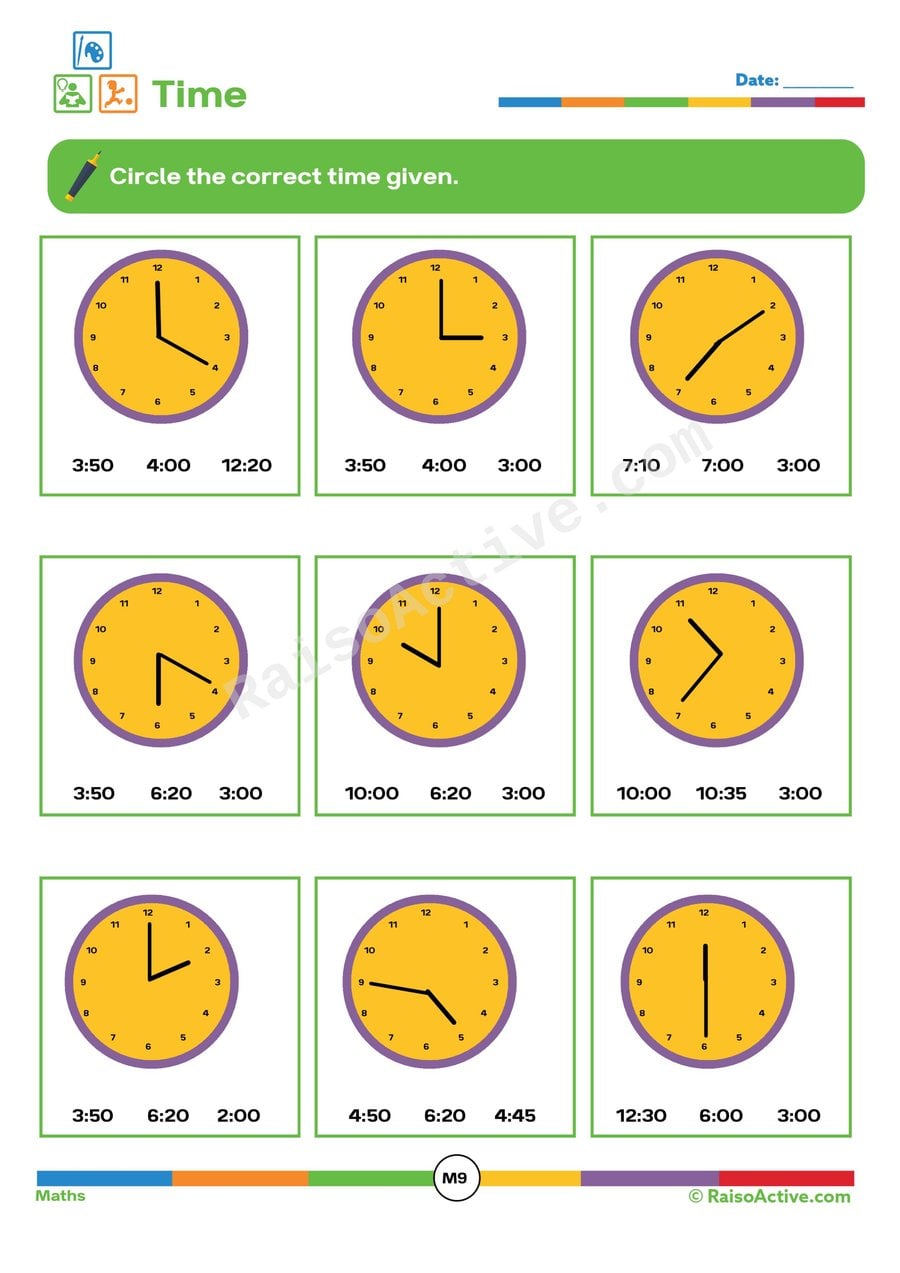
Reading an analog clock face and choosing the matching time from three written options builds clock-reading fluency for children ages 5-7, requiring them to interpret both the hour and minute hands together rather than guessing from a single hand.

Sentence Building Fun: Join the Sentences Worksheet
Ages 4-6 · Pre-K–KindergartenAges 4-6 · Reception–Year 1Ages 4-6 · LKG–UKGAges 4-6
Children ages 4-6 practice combining two short, simple sentences into one longer, connected sentence using a spinning-wheel format, building an early understanding of how sentence structure works and how ideas can be joined together. This hands-on approach to sentence combining lays groundwork for more complex writing later on.

Taller or Shorter? Comparing Heights Worksheet for Preschoolers
Ages 3-5 · Preschool–Pre-KAges 3-5 · Nursery–ReceptionAges 3-5 · Nursery–LKGAges 3-5
This worksheet builds early measurement vocabulary for children ages 3-5 as they compare the heights of pictured objects and people, circling the taller or shorter one as instructed. Beyond simple height comparison, the final section asks your child to identify both the tallest and smallest in a group, requiring them to compare more than two items at once, a step up in reasoning from simple pairwise comparison.

Material Properties Sorting Worksheet for Preschoolers
Ages 3-5 · Preschool–Pre-KAges 3-5 · Nursery–ReceptionAges 3-5 · Nursery–LKGAges 3-5
Children ages 3-5 practice identifying basic material properties, like hard, soft, rough, or smooth, and sorting everyday objects accordingly, an early science observation skill that builds the foundation for later lessons on states of matter and physical properties. Describing why an object belongs in a category also strengthens descriptive vocabulary.

Under the Sea Shapes Cut and Paste Worksheet for Preschoolers
Ages 3-5 · Preschool–Pre-KAges 3-5 · Nursery–ReceptionAges 3-5 · Nursery–LKGAges 3-5
This worksheet combines shape recognition with fine motor practice as children ages 3-5 cut out geometric shapes and arrange them into an underwater scene. Identifying each shape before placing it, and cutting along the provided lines, builds both early geometry vocabulary and the scissor control needed for more advanced cutting tasks.

This, That, These, and Those Worksheet: Practice with Demonstrative Pronouns
Ages 3-5 · Preschool–Pre-KAges 3-5 · Nursery–ReceptionAges 3-5 · Nursery–LKGAges 3-5
This worksheet introduces children ages 3-5 to demonstrative pronouns — 'this,' 'that,' 'these,' and 'those' — words used to point out objects based on their distance and number. Filling in the correct pronoun for each picture builds early grammar awareness and helps children notice the subtle rules of singular versus plural and near versus far that govern everyday speech.
Prepositions Worksheet: Where Are the Cats?
Ages 3-5 · Preschool–Pre-KAges 3-5 · Nursery–ReceptionAges 3-5 · Nursery–LKGAges 3-5
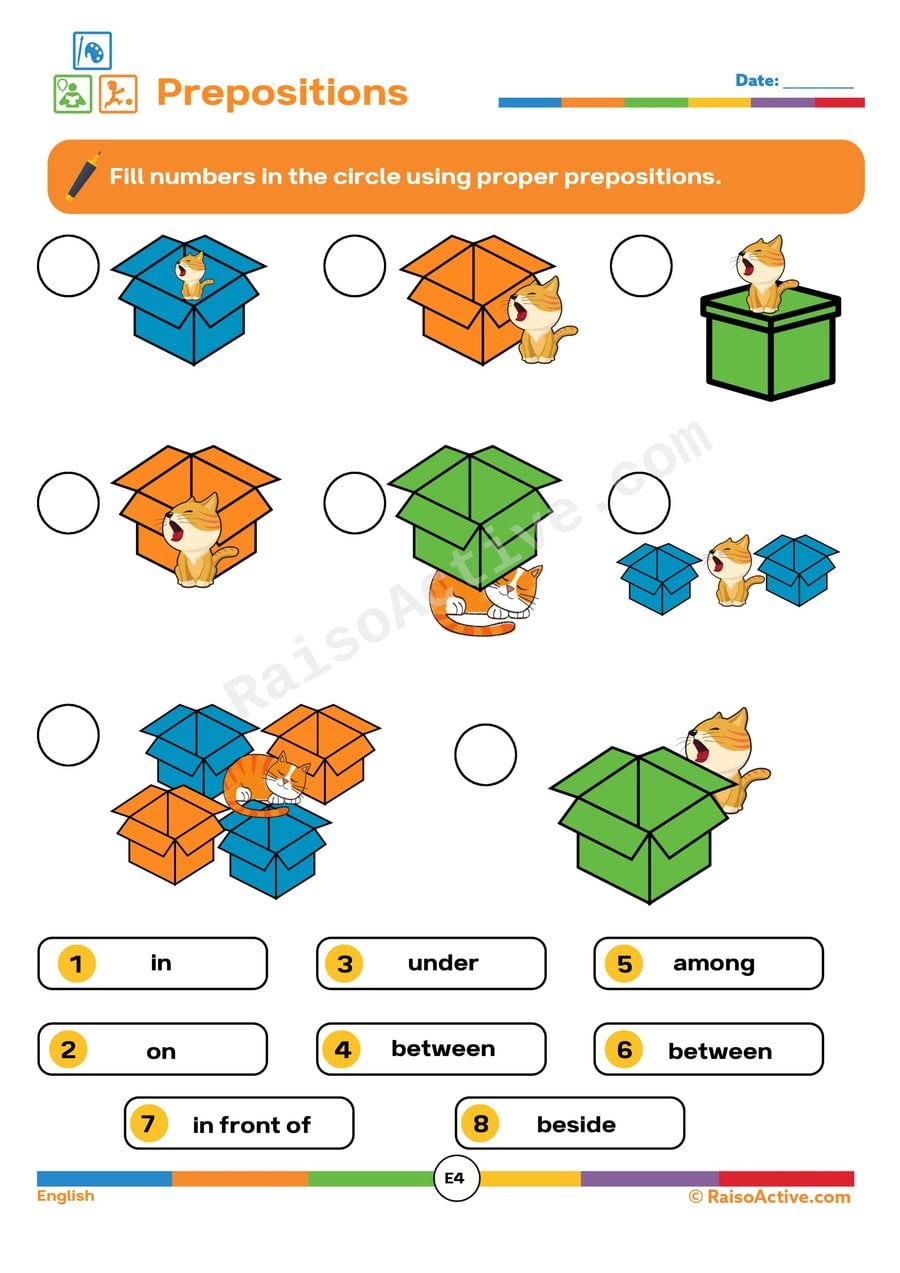
This worksheet helps children ages 3-5 learn positional prepositions — words like 'under,' 'on,' 'behind,' and 'in' — by matching each word to a picture showing exactly where a cat is located. Understanding these small but essential words builds spatial vocabulary and comprehension skills that are used constantly in both everyday instructions and later reading comprehension.
Color by Number Addition Worksheet: The Turtle!
Ages 4-6 · Pre-K–KindergartenAges 4-6 · Reception–Year 1Ages 4-6 · LKG–UKGAges 4-6
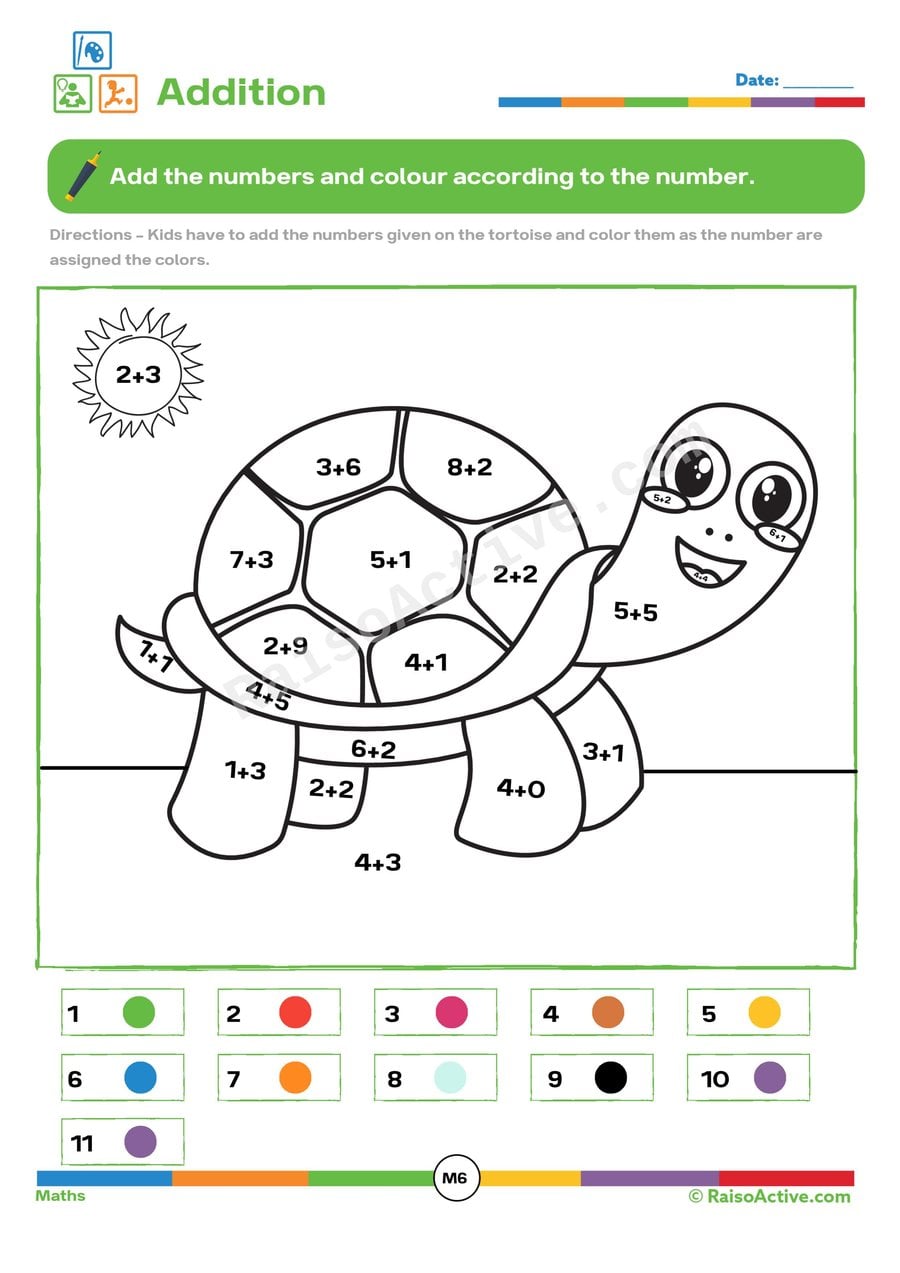
Children ages 4-6 practice single-digit addition facts and then apply a color key to their answers, combining math fluency with careful visual matching as the turtle picture is revealed. The immediate visual payoff of a colored picture gives children a clear, motivating way to check whether their addition was correct.
Related worksheets

My Family Worksheet: Learn About Family Members!
Ages 3-5 · Preschool–Pre-KAges 3-5 · Nursery–ReceptionAges 3-5 · Nursery–LKGAges 3-5
Writing the names of family members next to their pictures helps children ages 3-5 connect written words to real relationships in their own lives, combining early handwriting practice with meaningful, personal vocabulary. Because the content is about their own family, this worksheet tends to feel especially engaging and easy to talk about.
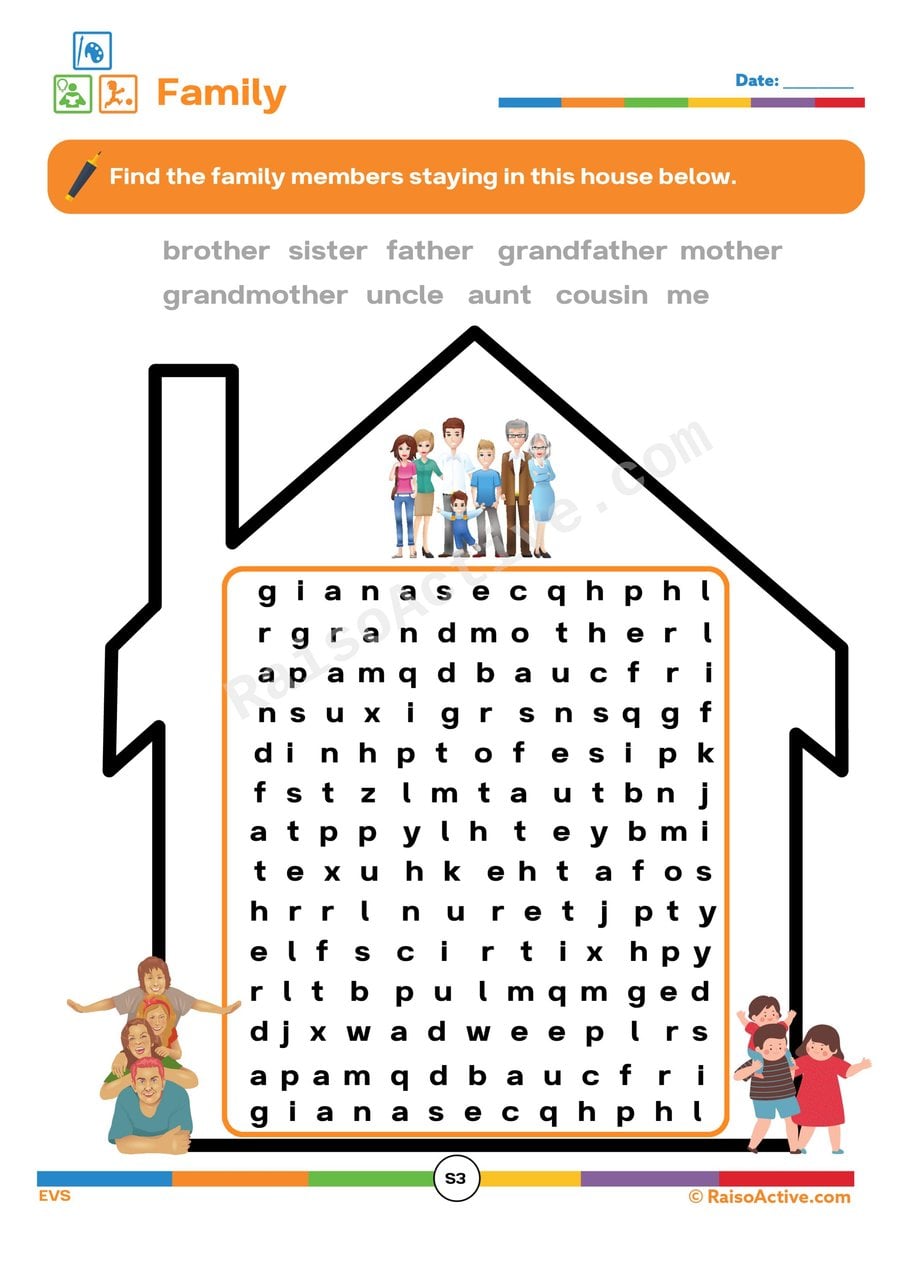
Family Word Search Worksheet for Kids
Ages 4-6 · Pre-K–KindergartenAges 4-6 · Reception–Year 1Ages 4-6 · LKG–UKGAges 4-6
Searching a grid for hidden family member words like mother, father, and sister builds vocabulary and visual scanning skills for children ages 4-6, requiring them to track letters carefully across rows, columns, and sometimes diagonals. This kind of focused letter tracking is excellent early practice for the visual attention reading fluency depends on later.

Earth Day Sorting Worksheet: Good vs. Bad for the Environment!
Ages 4-6 · Pre-K–KindergartenAges 4-6 · Reception–Year 1Ages 4-6 · LKG–UKGAges 4-6
Sorting pictures of everyday actions into 'good for the environment' and 'bad for the environment' introduces children ages 4-6 to cause-and-effect reasoning about human impact, an early building block for environmental awareness and responsible habits.

Family Relations Worksheet: Learn About Family Members!
Ages 3-5 · Preschool–Pre-KAges 3-5 · Nursery–ReceptionAges 3-5 · Nursery–LKGAges 3-5
Writing the correct family member name next to each person on a family tree helps children ages 3-5 understand family relationships and structure, connecting a written word to a specific role like mother, father, or sibling. This early exposure to family trees also introduces the idea of organizing information visually, a skill used across many later school subjects.
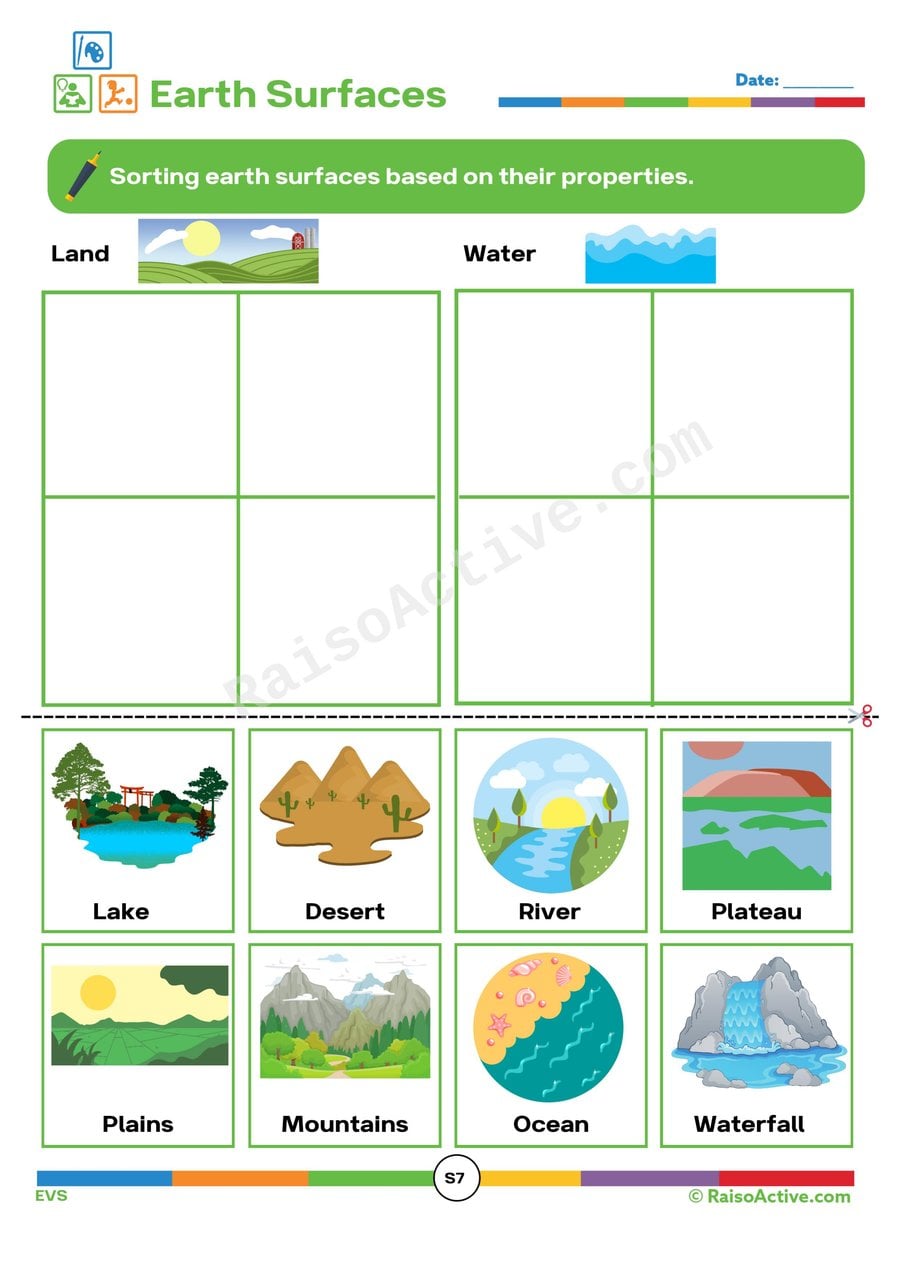
Earth Surfaces Sorting Worksheet for Kids
Ages 4-6 · Pre-K–KindergartenAges 4-6 · Reception–Year 1Ages 4-6 · LKG–UKGAges 4-6
Sorting pictures into 'land' and 'water' categories builds early classification skills and basic earth science vocabulary for children ages 4-6, helping them notice physical differences between surfaces they see in daily life.

My School Cut and Paste Worksheet for Preschoolers
Ages 3-5 · Preschool–Pre-KAges 3-5 · Nursery–ReceptionAges 3-5 · Nursery–LKGAges 3-5
Cutting out school-related pictures and pasting them into the correct spaces on a school building teaches children ages 3-5 vocabulary for familiar school spaces, like a classroom or playground, while also strengthening spatial matching and fine motor cutting and pasting skills. This activity helps children who are new to school, or preparing to start, connect words to places they'll actually encounter.

Keeping Our Environment Clean Worksheet for Kids
Ages 3-5 · Preschool–Pre-KAges 3-5 · Nursery–ReceptionAges 3-5 · Nursery–LKGAges 3-5
This worksheet builds early environmental awareness in children ages 3-5 by having them evaluate pictured actions — like throwing litter in a bin versus littering on the ground — and mark each one as good or bad for the environment. Making this judgment call requires children to connect a specific action to a broader consequence, an early form of cause-and-effect reasoning applied to environmental responsibility. Introducing this concept young helps normalize caring for shared spaces as a natural part of daily behavior rather than an abstract adult concern.
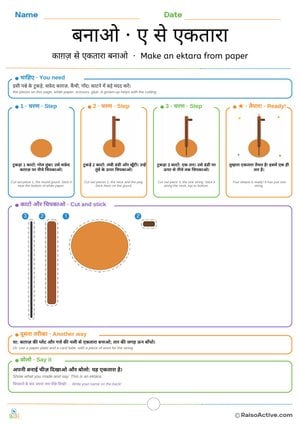
Make a Paper Ektara: Hindi Letter ए (e) Cut and Stick Craft | बनाओ · ए से एकतारा
Ages 4-7 · Pre-K–Grade 1Ages 4-7 · Reception–Year 2Ages 4-7 · LKG–Class 1Ages 4-7
Children cut out the numbered pieces and stick them in order to make a one-string ektara from a gourd, a neck and a single string, then show it and say a full sentence about it. It links the letter ए with a real picture word, एकतारा, and practises scissor control and following steps.
Guides for this topic

Age-Appropriate Problem-Solving Activities: Building Critical Thinkers from the Ground Up
Discover fun, age-appropriate problem-solving activities for children ages 1-8. Build critical thinking, logic, and reasoning skills through play-based learning.

Growing Green Hearts: A Comprehensive Guide to Teaching Environmental Awareness to Preschoolers
Practical guide to teaching preschoolers ages 2-6 about nature, recycling, water conservation, and Earth Day with Indian context and simple home activities.

Discovering Wonder: Nature-Based Learning Activities That Captivate Young Children
Explore nature-based learning activities for children ages 2–7 — leaf rubbings, bug hunts, nature journals, and seasonal Indian outdoor ideas that spark wonder.
Reviews
Every worksheet for ages 4–6, no watermark
Members download the full library of 1,000+ worksheets and every activity pack without watermarks or daily limits. One year costs ₹999 in India or $20 elsewhere.
See membership plansOr download any worksheet free with a watermark (5 a day).