Positional Words Worksheet: Near and Far
This worksheet introduces children ages 3-5 to the positional concepts of 'near' and 'far,' asking them to look at a picture and tick the word that correctly describes an object's distance from a reference point. Positional vocabulary like this is an important building block for spatial reasoning and later geometry and direction-following skills. Because near and far are relative concepts rather than fixed labels, this practice also builds flexible thinking about how position depends on comparison.
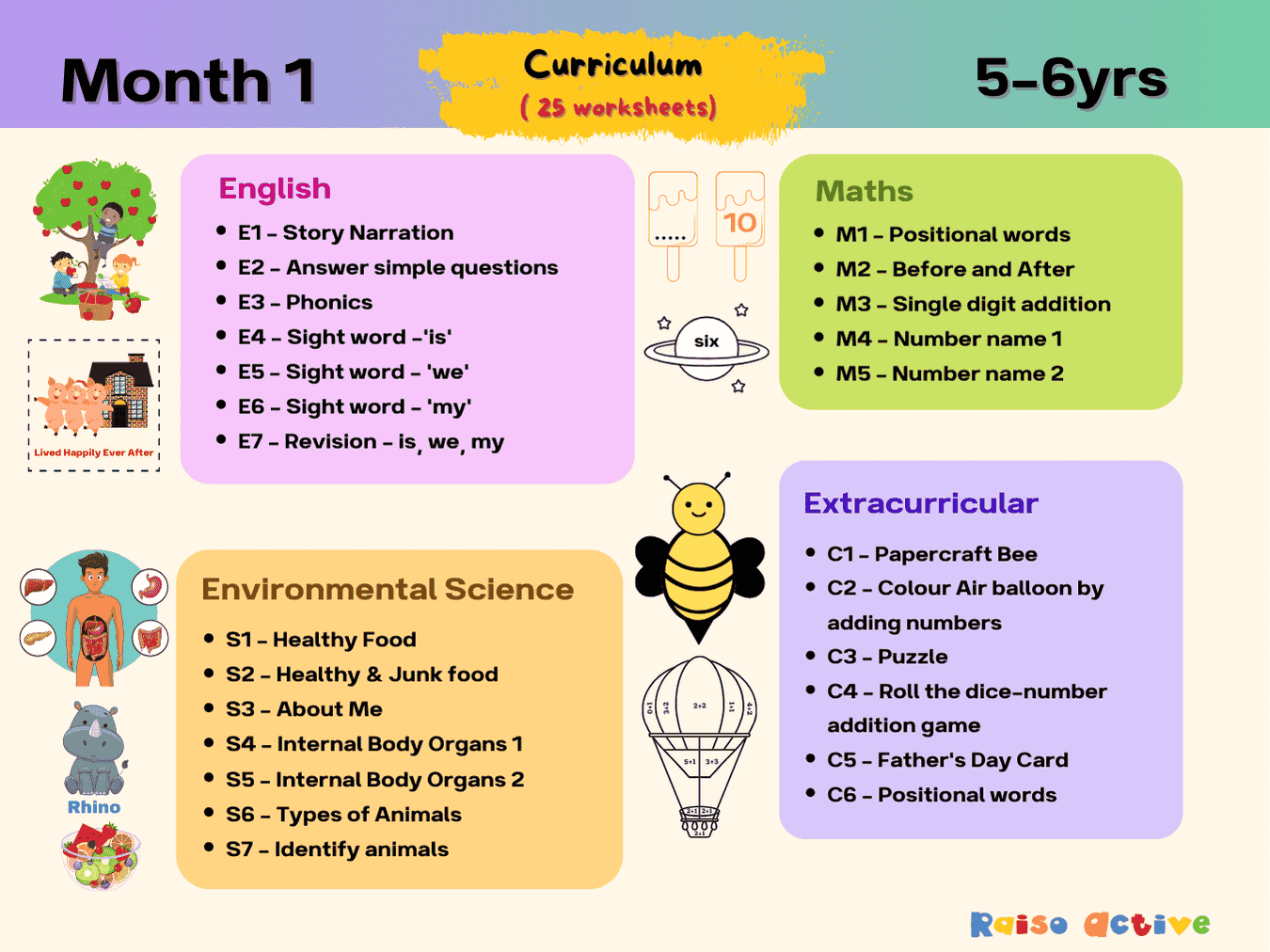
Part of the pack
Month 1: Learning & Development | Ages 5-6
This is page 11 of the pack. Ages 5-6 · KindergartenAges 5-6 · Year 1Ages 5-6 · UKGAges 5-6
Made for your child
Counting to 10, made for your child
A maths pack with your child's name in it: pictures that explain, practice at three levels, puzzles and story sums about them. Print a new set whenever they finish.
Make a maths packFree preview · free for members
Curriculum
- Spatial Sense > Spatial Concepts
How to use this worksheet
Look at each picture together and identify the reference point, such as a house or a person, along with the object being compared to it. Discuss whether the object appears close to or far away from that reference point. Have your child tick the word — 'near' or 'far' — that correctly describes the position shown. Continue through the page, discussing the reasoning for each choice.
Materials needed
- Pencil
- Crayons
Extension activities
- 1Have the child point out objects in the room that are near and far from where they're standing.
- 2Create a drawing with objects placed near and far from each other.
- 3Play a game where you give directions using near and far, like 'walk near the door' or 'stand far from the wall.'
- 4Set up two toys at different distances and ask your child to describe their positions.
- 5Go on a walk and describe objects you pass as near or far from you.

Written by
Hemsweta Jain · Teacher Cheena
MBA and Early Childhood Educator, teaching since 2014 · Founder of RaisoActive, Mumbai
Every RaisoActive worksheet is designed and checked by the founder before publishing.
Published · Last reviewed
More from Month 1: Learning & Development | Ages 5-6
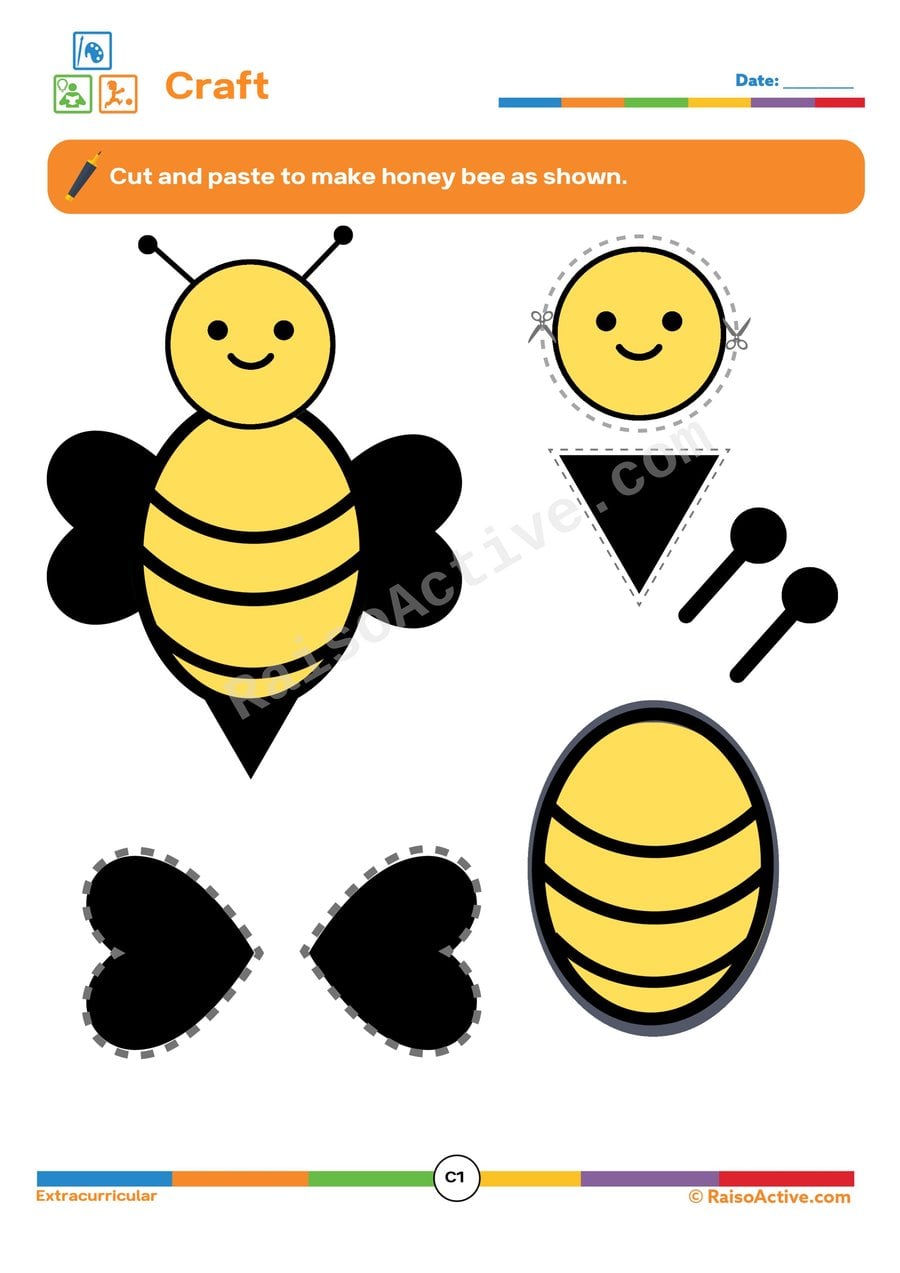
Honey Bee Craft Worksheet: Cut and Paste Fun!
Ages 3-5 · Preschool–Pre-KAges 3-5 · Nursery–ReceptionAges 3-5 · Nursery–LKGAges 3-5
This honey bee craft gives children ages 3-5 targeted practice with scissor control as they cut along dotted lines to separate bee body parts, then reassemble them by pasting into a complete bee shape. Because the pieces must be cut accurately to fit together correctly afterward, this activity demands more precision than simple free-cutting practice. Assembling a multi-piece figure also reinforces spatial reasoning, since children have to recognize how each cut piece relates to the whole.

Air Balloon Color by Sums Worksheet for Preschoolers
Ages 3-5 · Preschool–Pre-KAges 3-5 · Nursery–ReceptionAges 3-5 · Nursery–LKGAges 3-5
This color-by-sums worksheet combines basic addition practice with color-by-number skills, asking children ages 3-5 to solve simple addition problems within each section of an air balloon and then color that section according to a matching color key. Solving a math problem correctly before coloring turns each section into a small, self-checking task, since an incorrect sum would lead to the wrong color choice. This blend of math and art keeps repetitive addition practice feeling like a creative activity rather than a drill.

The Three Little Pigs Storytelling Worksheet for Preschoolers
Ages 3-5 · Preschool–Pre-KAges 3-5 · Nursery–ReceptionAges 3-5 · Nursery–LKGAges 3-5
This storytelling worksheet helps children ages 3-5 practice narrative sequencing and oral language skills by retelling the classic tale of the Three Little Pigs in their own words, using picture prompts as a guide. Putting a familiar story into their own sentences builds comprehension and expressive vocabulary far more actively than just listening to the story read aloud. The cut-and-paste sequencing option adds a second layer of practice with story order.

Phonics Fun: Matching Letters and Words Worksheet for Preschoolers
Ages 4-5 · Pre-KAges 4-5 · ReceptionAges 4-5 · LKGAges 4-5
Identifying the beginning sound of a pictured word and writing the matching letter teaches children ages 4-5 phonemic awareness, the ability to isolate individual sounds within spoken words, which is one of the strongest predictors of future reading success. Saying each word aloud after writing the letter reinforces the connection between the printed letter and its spoken sound, closing the loop between listening, writing, and speaking. This worksheet moves children from simply recognizing letters to actively applying letter-sound knowledge, a more advanced early literacy skill.
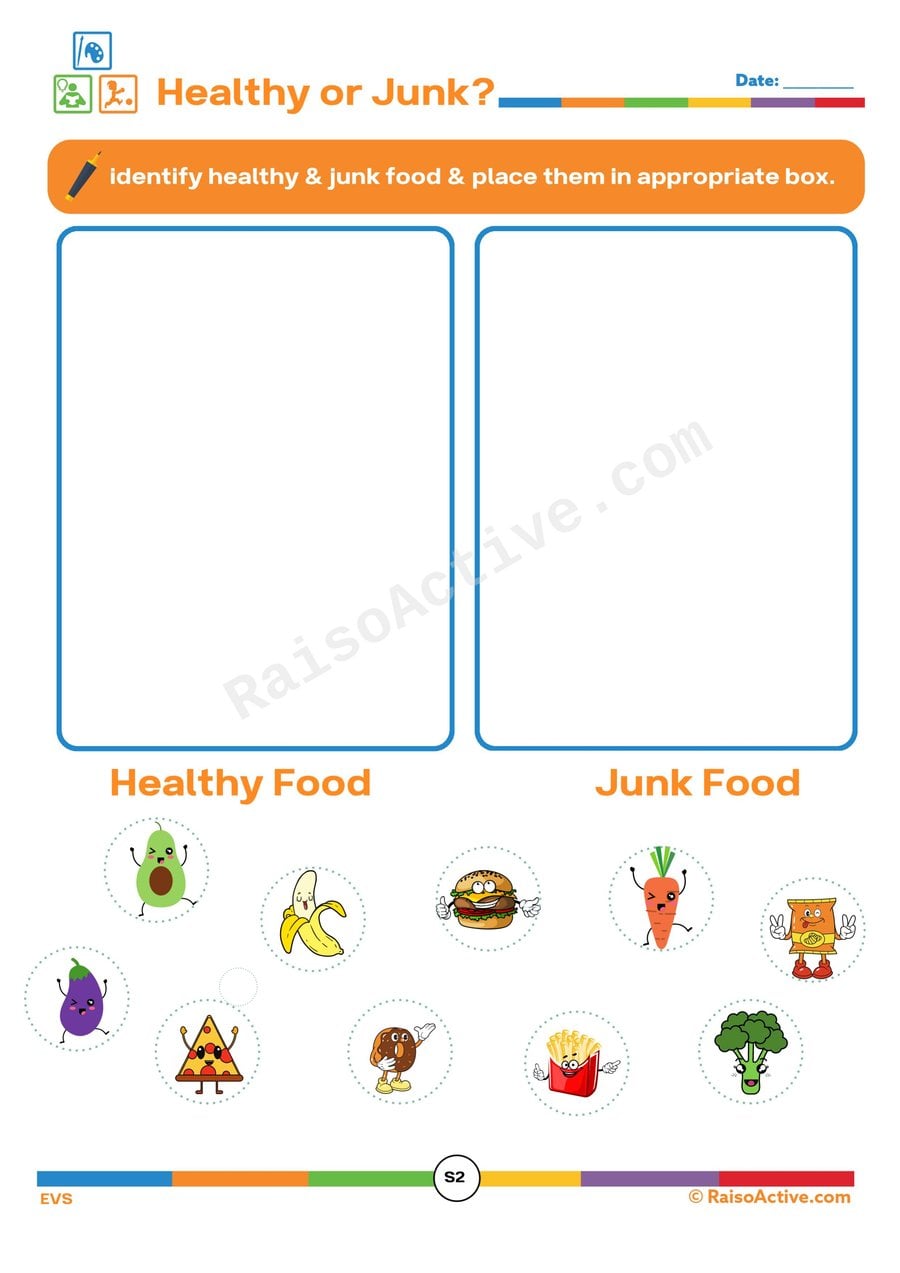
Healthy Food Sorting Worksheet for Preschoolers
Ages 3-5 · Preschool–Pre-KAges 3-5 · Nursery–ReceptionAges 3-5 · Nursery–LKGAges 3-5
Sorting food pictures into 'Healthy' and 'Junk Food' boxes teaches children ages 3-5 to classify items by a shared characteristic, an early categorization skill that underlies later science and math thinking. At the same time, it introduces basic nutrition concepts — that fruits, vegetables, and whole foods nourish the body differently than sugary or fried treats. Talking through each choice also builds vocabulary around food and health.

Solar System Number Matching Worksheet for Preschoolers
Ages 4-6 · Pre-K–KindergartenAges 4-6 · Reception–Year 1Ages 4-6 · LKG–UKGAges 4-6
This worksheet combines number-word recognition with a color-by-key coloring task for children ages 4-6, asking them to match number names written on planets to their corresponding numerals before coloring each planet according to a color code. Matching written number words in a space-themed context adds novelty that keeps repeated number-word practice fresh, while the color-key step reinforces careful, sequential following of visual instructions. Together, these two tasks combine literacy and numeracy practice in one engaging page.

Missing Numbers: Ice Cream Fun Worksheet for Kids
Ages 3-5 · Preschool–Pre-KAges 3-5 · Nursery–ReceptionAges 3-5 · Nursery–LKGAges 3-5
This worksheet helps children ages 3-5 practice number sequencing by identifying and writing in the missing numerals within a series of ice cream cones and cars, numbers 1 through 10. Filling in a gap within an otherwise familiar sequence requires children to hold the whole counting order in mind and recognize what number logically belongs in the empty spot, which is more demanding than counting forward from the start each time. The playful ice cream and car theme keeps the repeated number practice visually engaging.
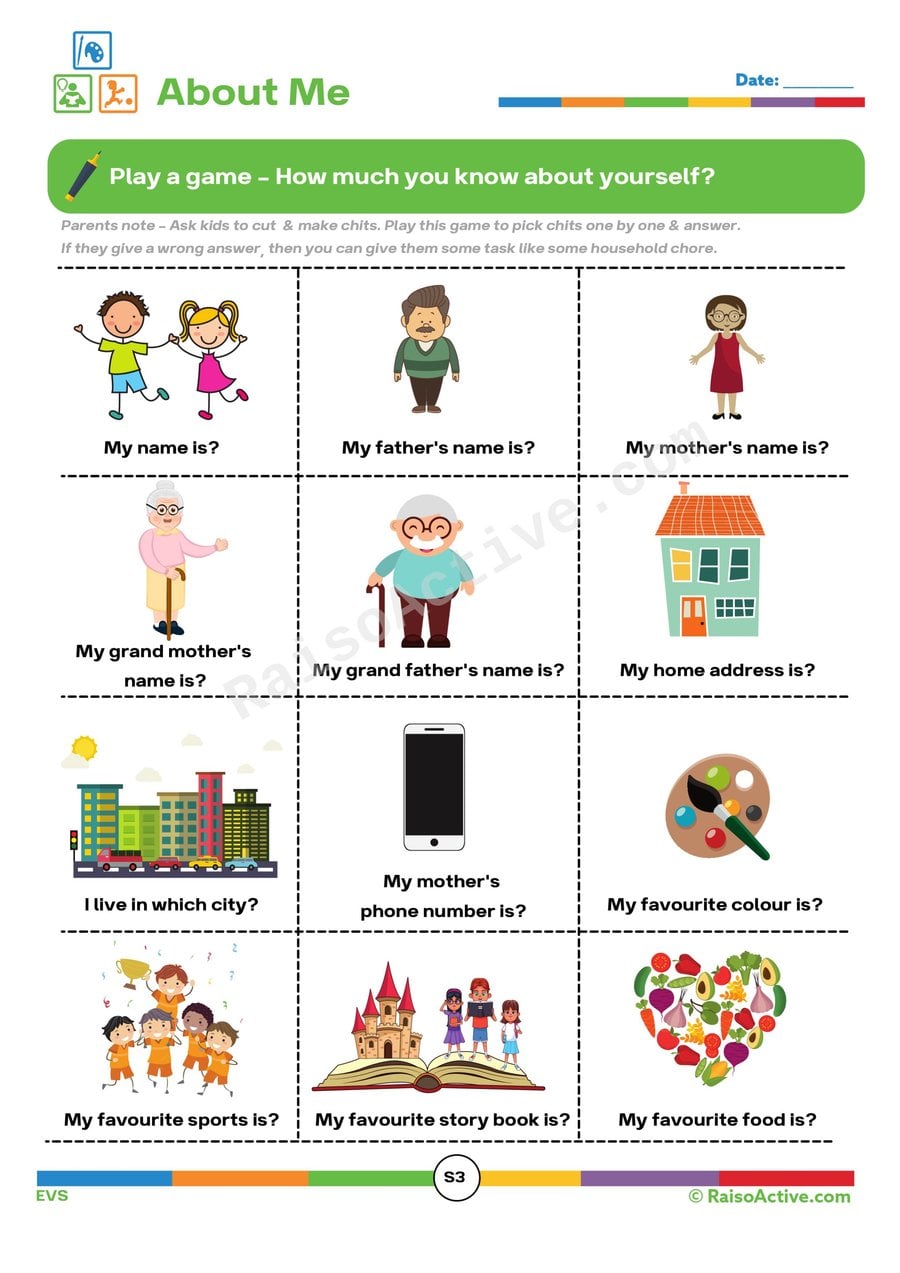
About Me Worksheet: Learn About Yourself!
Ages 3-5 · Preschool–Pre-KAges 3-5 · Nursery–ReceptionAges 3-5 · Nursery–LKGAges 3-5
This 'About Me' worksheet helps children ages 3-5 build self-awareness and early identity vocabulary by prompting them to describe their name, family, favorites, and feelings. Putting personal facts into words or pictures strengthens expressive language and gives children practice sharing information about themselves in a structured way. It's also a gentle first step into autobiographical writing, well before children can spell full sentences.
Related worksheets
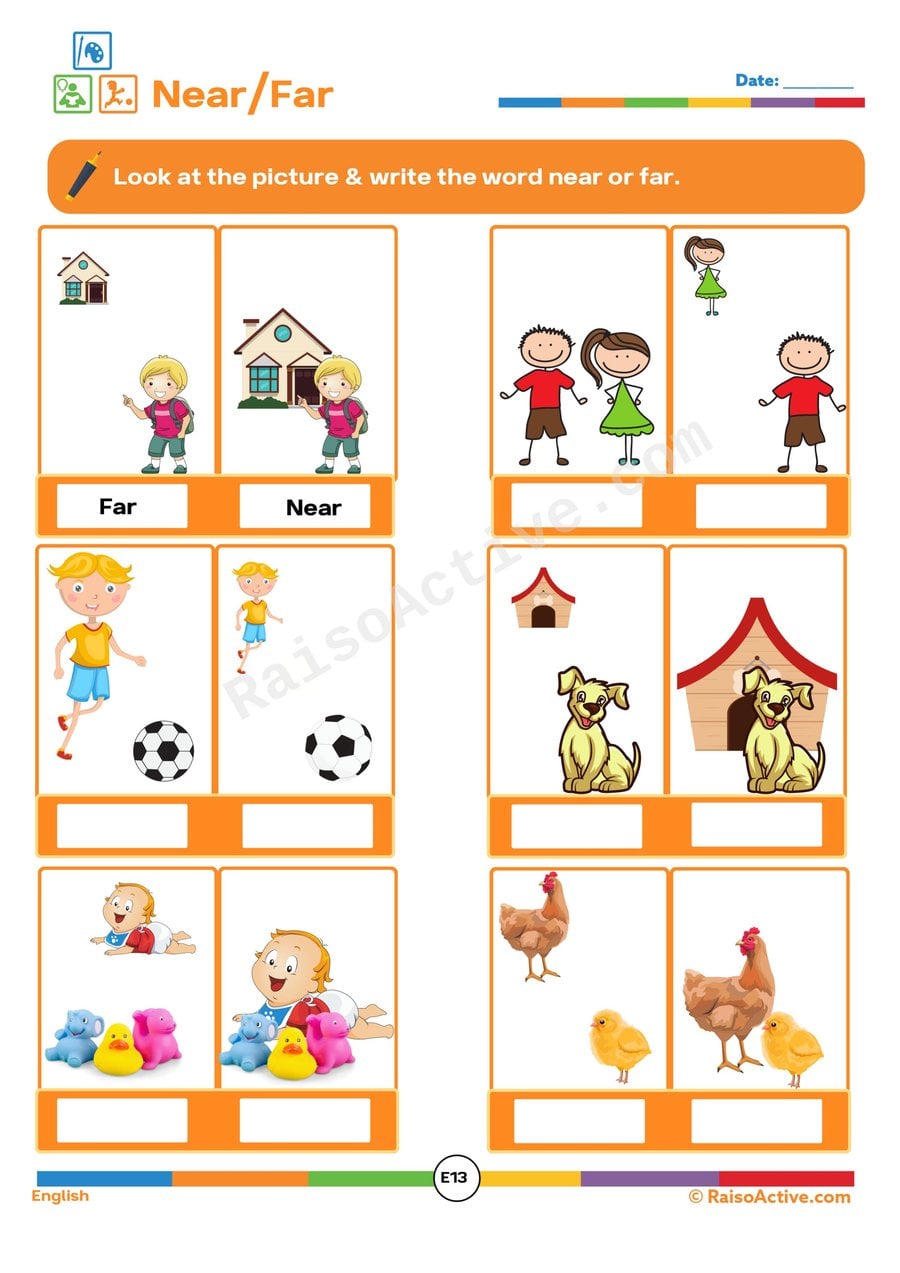
Near and Far Worksheet for Preschoolers
Ages 3-5 · Preschool–Pre-KAges 3-5 · Nursery–ReceptionAges 3-5 · Nursery–LKGAges 3-5
Understanding 'near' and 'far' introduces children ages 3-5 to relative distance, a spatial concept that supports later skills like reading maps, estimating measurement, and following directional instructions. This worksheet asks children to look at pictures and judge whether an object or person is positioned close by or at a distance, sharpening visual observation alongside vocabulary development. Because near and far are relative terms rather than fixed categories, this practice also introduces the idea that some concepts depend on comparison rather than having one single correct answer.

Top and Bottom Fun: Observe and Tick the Correct Position!
Ages 3-5 · Preschool–Pre-KAges 3-5 · Nursery–ReceptionAges 3-5 · Nursery–LKGAges 3-5
Children ages 3-5 build spatial reasoning and positional vocabulary as they observe pictures and decide whether an object is positioned at the top or the bottom. Understanding positional words like 'top' and 'bottom' supports children's ability to follow multi-step directions and later helps with concepts like graphing and map reading.
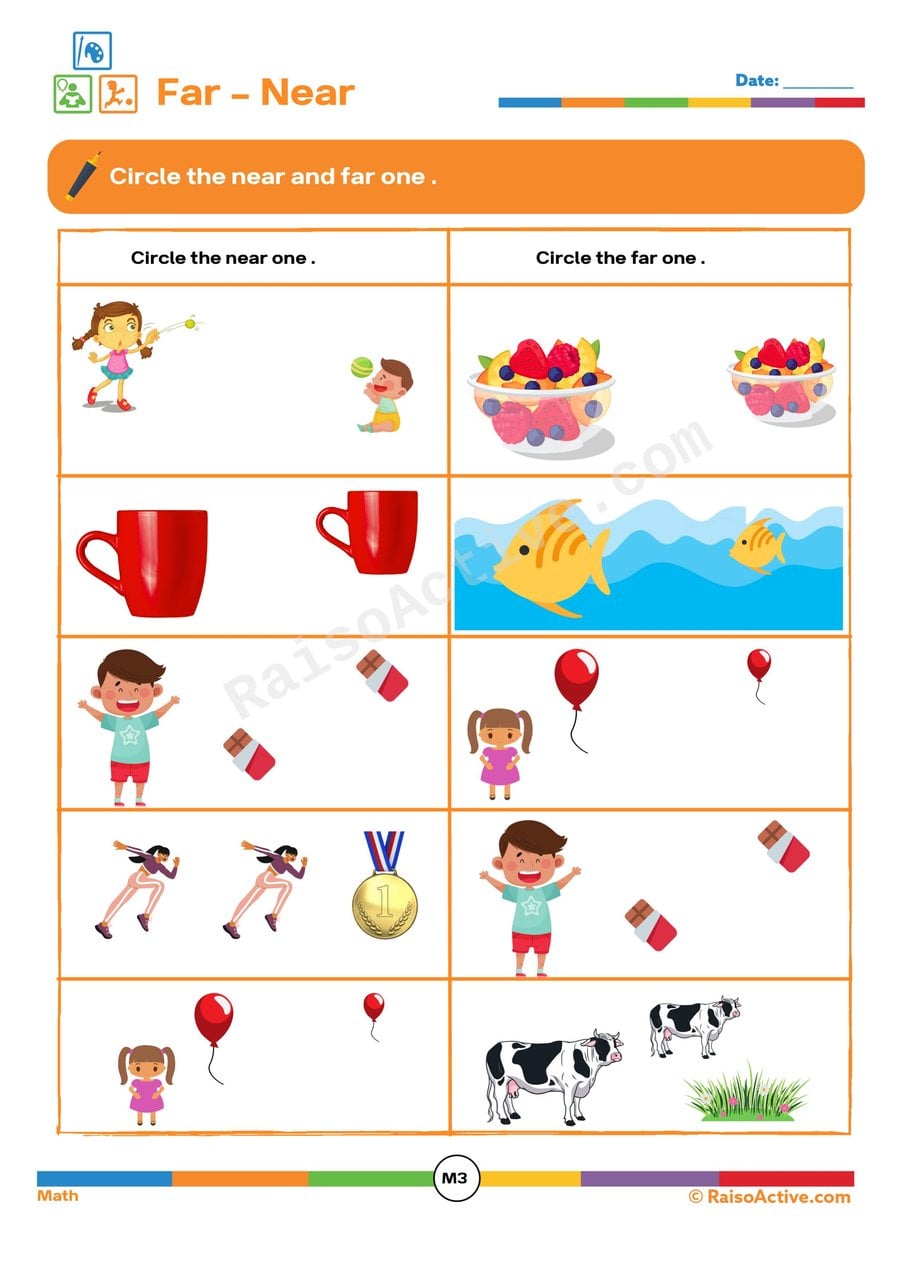
Far and Near Worksheet: Circle the Objects!
Ages 3-5 · Preschool–Pre-KAges 3-5 · Nursery–ReceptionAges 3-5 · Nursery–LKGAges 3-5
Children ages 3-5 build early spatial reasoning by comparing the relative distance of paired objects and deciding which is 'near' and which is 'far,' a foundational concept for understanding position and distance in the world around them. This kind of comparative thinking also supports later math concepts like measurement and estimation.

Inside or Outside Sorting Worksheet for Preschoolers
Ages 3-5 · Preschool–Pre-KAges 3-5 · Nursery–ReceptionAges 3-5 · Nursery–LKGAges 3-5
This worksheet teaches children ages 3-5 to apply the spatial concepts of 'inside' and 'outside' by sorting pictures of objects into the location where they typically belong. Deciding where an object usually belongs requires children to draw on their own real-world experience and apply it to a new sorting task, strengthening both spatial vocabulary and everyday reasoning. This kind of applied sorting is more demanding than simply naming inside or outside items when shown a single picture.
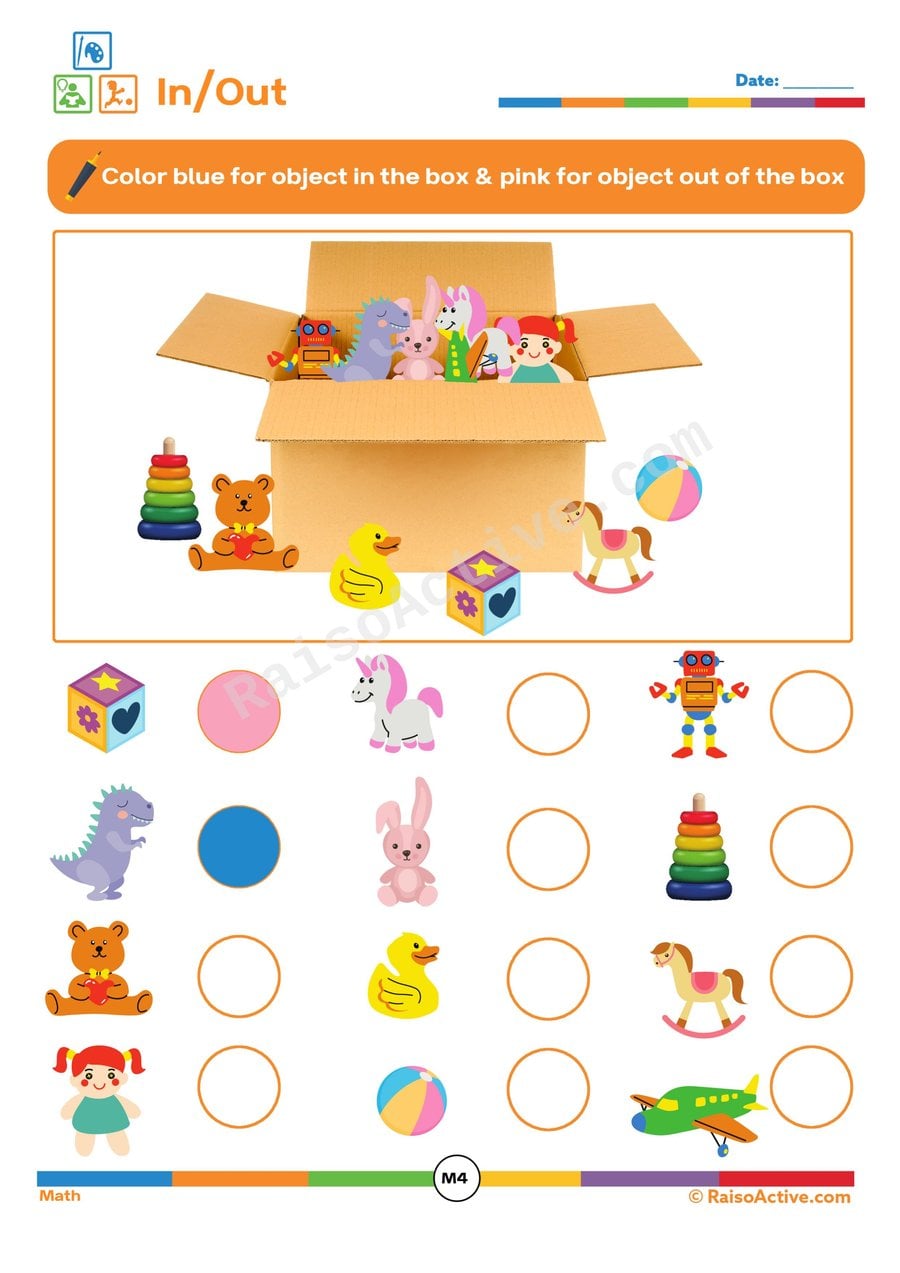
In/Out Sorting Worksheet: Color the Objects!
Ages 3-5 · Preschool–Pre-KAges 3-5 · Nursery–ReceptionAges 3-5 · Nursery–LKGAges 3-5
Sorting objects as 'in' or 'out' of a box builds on the positional vocabulary preschoolers need before they can follow multi-step directions or understand simple math concepts like sets and groups. Using color as the sorting tool here, blue for inside and pink for outside, also strengthens the ability to hold two rules in mind simultaneously and apply the correct one to each object in turn.

Above and Below Worksheet: Counting and Spatial Reasoning for Kids
Ages 4-6 · Pre-K–KindergartenAges 4-6 · Reception–Year 1Ages 4-6 · LKG–UKGAges 4-6
This worksheet combines spatial reasoning and counting for children ages 4-6, asking them to identify whether objects are positioned above or below a reference point and then use that understanding to answer counting questions. Understanding relative position words like 'above' and 'below' supports later skills in reading diagrams, maps, and graphs. Pairing the concept with counting also reinforces that spatial language can describe quantities, not just single objects.

Above and Below Worksheet: Identifying Objects' Positions
Ages 3-5 · Preschool–Pre-KAges 3-5 · Nursery–ReceptionAges 3-5 · Nursery–LKGAges 3-5
Understanding positional words like 'above' and 'below' helps children ages 3-5 build the spatial vocabulary that later supports following multi-step directions, reading maps, and even understanding math concepts like number lines. This worksheet asks children to look closely at a scene and judge the position of different objects relative to one another, which sharpens visual observation alongside language development. Marking each object with a tick or a cross also introduces early symbol-based recording, a small step toward more formal worksheet conventions used in later grades.

Near and Far Worksheet: Identifying and Connecting Objects
Ages 3-5 · Preschool–Pre-KAges 3-5 · Nursery–ReceptionAges 3-5 · Nursery–LKGAges 3-5
This worksheet introduces children ages 3-5 to the comparative spatial concepts of 'near' and 'far' by having them draw connecting lines based on relative distance in a picture. Understanding proximity words builds an early vocabulary foundation for describing the physical world, which later supports map reading and measurement concepts. The connect-the-line format also reinforces visual tracking and following printed instructions accurately.
Guides for this topic

Best Worksheets for 3-Year-Olds: What Works and What to Avoid
What works on worksheets for 3-year-olds: short sessions, crayons, tracing lines, matching, cutting, a free weekly plan, and signs one is too advanced.
Documenting Learning Without Drowning in Data: A Practical Guide for Parents and Teachers
Learn practical ways to document your child's learning without overwhelm. Simple portfolios, observation tips, and printable trackers for ages 1-8.

Age-Appropriate Problem-Solving Activities: Building Critical Thinkers from the Ground Up
Discover fun, age-appropriate problem-solving activities for children ages 1-8. Build critical thinking, logic, and reasoning skills through play-based learning.
Reviews
Every worksheet for ages 3–5, no watermark
Members download the full library of 1,000+ worksheets and every activity pack without watermarks or daily limits. One year costs ₹999 in India or $20 elsewhere.
See membership plansOr download any worksheet free with a watermark (5 a day).