Color Mixing Fun: Primary and Secondary Colors Worksheet
This hands-on painting activity teaches children ages 3-5 the basics of color theory by having them paint the three primary colors first, then physically mix pairs of them to discover the secondary colors that result. Watching red and yellow blend into orange, or blue and yellow become green, right in front of them makes color mixing feel like a small science experiment rather than an abstract fact to memorize.
Part of the pack
Month 1: Learning & Development | Ages 6-7
This is page 26 of the pack. Ages 6-7 · Grade 1Ages 6-7 · Year 2Ages 6-7 · Class 1Ages 6-7
Made for your child
A whole activity pack made with their name
60 pages to spot, build, trace and write their own name, plus pages about their favourites, feelings and family. See a free preview with their name.
Make an All About Me packFree preview · free for members
Or start free: a name tracing sheet with their nameCurriculum
- Art & Craft > Drawing & Art
How to use this worksheet
Set out the red, yellow, and blue paint along with paintbrushes and paper, and follow the worksheet's directions to paint the primary colors into the first set of clouds. Guide your child to dip their brush into two primary colors and mix them directly on the paper or a palette before painting the resulting secondary color into the remaining clouds. Talk through what happened after each mix — which two colors combined and what new color appeared — before moving to the next pair.
Materials needed
- Paint (red, yellow, blue)
- Paintbrushes
- Paper
Extension activities
- 1Create a simple color wheel together, arranging the primary and secondary colors in the correct order.
- 2Mix different amounts of two colors to create lighter or darker shades and compare the results.
- 3Find objects around the house that match the colors created and sort them by hue.
- 4Use colored transparent paper or cellophane and hold two pieces up to the light to see the color mixing effect without paint.

Written by
Hemsweta Jain · Teacher Cheena
MBA and Early Childhood Educator, teaching since 2014 · Founder of RaisoActive, Mumbai
Every RaisoActive worksheet is designed and checked by the founder before publishing.
Published · Last reviewed
More from Month 1: Learning & Development | Ages 6-7

Animal Needs Worksheet for Kids: Matching and Identifying
Ages 3-5 · Preschool–Pre-KAges 3-5 · Nursery–ReceptionAges 3-5 · Nursery–LKGAges 3-5
This worksheet helps children ages 3-5 understand and articulate the basic survival needs of animals — food, water, air, shelter — by completing sentences with the correct need word and then circling matching pictures. Requiring both a writing and a circling response means children practice the vocabulary in two different formats, reinforcing recall from multiple angles. This groundwork in animal needs also supports later, more complex science concepts about habitats and ecosystems.

Inside or Outside Sorting Worksheet for Preschoolers
Ages 3-5 · Preschool–Pre-KAges 3-5 · Nursery–ReceptionAges 3-5 · Nursery–LKGAges 3-5
This worksheet teaches children ages 3-5 to apply the spatial concepts of 'inside' and 'outside' by sorting pictures of objects into the location where they typically belong. Deciding where an object usually belongs requires children to draw on their own real-world experience and apply it to a new sorting task, strengthening both spatial vocabulary and everyday reasoning. This kind of applied sorting is more demanding than simply naming inside or outside items when shown a single picture.

Animal Action Cards: Fun Movement Worksheet for Kids!
Ages 3-5 · Preschool–Pre-KAges 3-5 · Nursery–ReceptionAges 3-5 · Nursery–LKGAges 3-5
These animal action cards get children ages 3-5 moving as they follow simple instructions, like hopping like a rabbit or slithering like a snake, combining gross motor development with listening and instruction-following skills. Because each card requires reading or recalling a specific action tied to a specific animal, children also reinforce animal vocabulary and movement-based descriptive language. Turning learning into physical movement is especially valuable for this age group, whose attention and retention often improve dramatically when a body movement is involved.

Before and After Numbers Worksheet for Preschoolers
Ages 4-6 · Pre-K–KindergartenAges 4-6 · Reception–Year 1Ages 4-6 · LKG–UKGAges 4-6
This number sequencing worksheet asks children ages 4-6 to identify the numbers that come immediately before and after a given number, strengthening their mental number line and reinforcing the concept that numbers exist in a fixed, ordered sequence. This before-and-after reasoning is more demanding than simple counting because it requires children to move both forward and backward from a starting point. Building this flexible number sense supports later addition and subtraction, which both rely on moving confidently along a mental number line.

Keeping Our Environment Clean Worksheet for Kids
Ages 3-5 · Preschool–Pre-KAges 3-5 · Nursery–ReceptionAges 3-5 · Nursery–LKGAges 3-5
This worksheet builds early environmental awareness in children ages 3-5 by having them evaluate pictured actions — like throwing litter in a bin versus littering on the ground — and mark each one as good or bad for the environment. Making this judgment call requires children to connect a specific action to a broader consequence, an early form of cause-and-effect reasoning applied to environmental responsibility. Introducing this concept young helps normalize caring for shared spaces as a natural part of daily behavior rather than an abstract adult concern.

Near or Far Worksheet: Following Instructions for Preschoolers
Ages 3-5 · Preschool–Pre-KAges 3-5 · Nursery–ReceptionAges 3-5 · Nursery–LKGAges 3-5
Reading an instruction and circling the object that is either near or far teaches children ages 3-5 relative distance vocabulary, helping them understand that 'near' and 'far' describe a relationship between two things rather than a fixed property of a single object. Following a written or spoken instruction to complete each picture also builds listening comprehension and the ability to carry out a one-step direction independently. This combination of spatial concept and instruction-following prepares children for the kind of directions they'll regularly encounter in a classroom setting.

Animal Habitats Cut and Paste Worksheet for Preschoolers
Ages 3-5 · Preschool–Pre-KAges 3-5 · Nursery–ReceptionAges 3-5 · Nursery–LKGAges 3-5
Children ages 3-5 learn about different animal habitats — like the ocean, forest, or desert — by cutting out animal pictures and pasting each one into its correct home environment. Matching an animal to where it actually lives builds early science classification skills and introduces the idea that living things are adapted to survive in specific environments, a concept children will revisit in more depth throughout school.
On or Under Worksheet: Where is the Object?
Ages 3-5 · Preschool–Pre-KAges 3-5 · Nursery–ReceptionAges 3-5 · Nursery–LKGAges 3-5
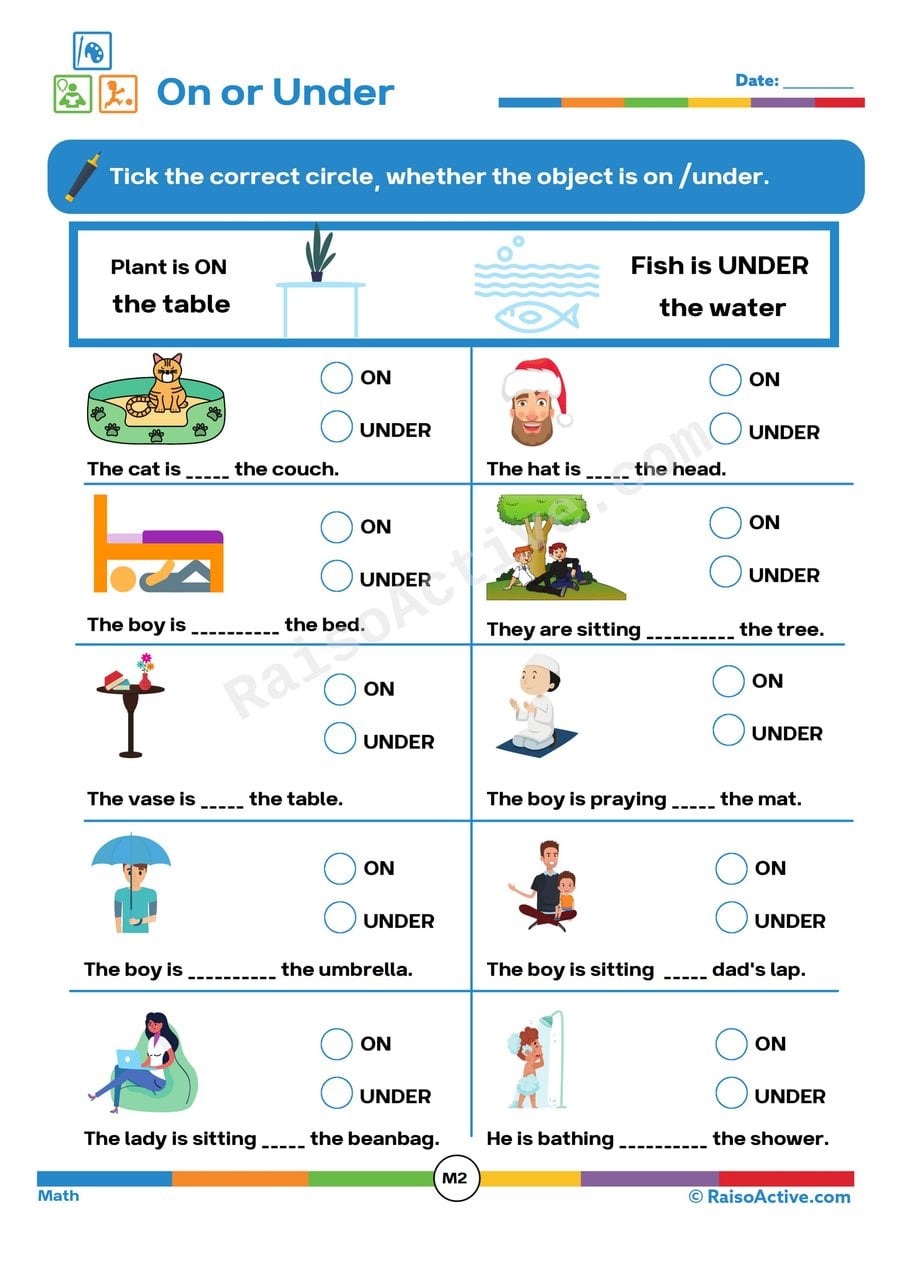
Reading a short sentence describing an object's location and then ticking the picture that matches teaches children ages 3-5 to connect spoken or written prepositions, 'on' and 'under,' to a visual representation, strengthening both listening comprehension and spatial vocabulary. This worksheet requires children to hold a sentence in mind and compare it against a picture, which is a slightly more advanced skill than simply naming a position they can already see. Understanding prepositions like these supports later reading comprehension, since so many simple stories depend on describing where things are.
Related worksheets
Create Your Own Toon Avatar Worksheet for Kids
Ages 3-5 · Preschool–Pre-KAges 3-5 · Nursery–ReceptionAges 3-5 · Nursery–LKGAges 3-5
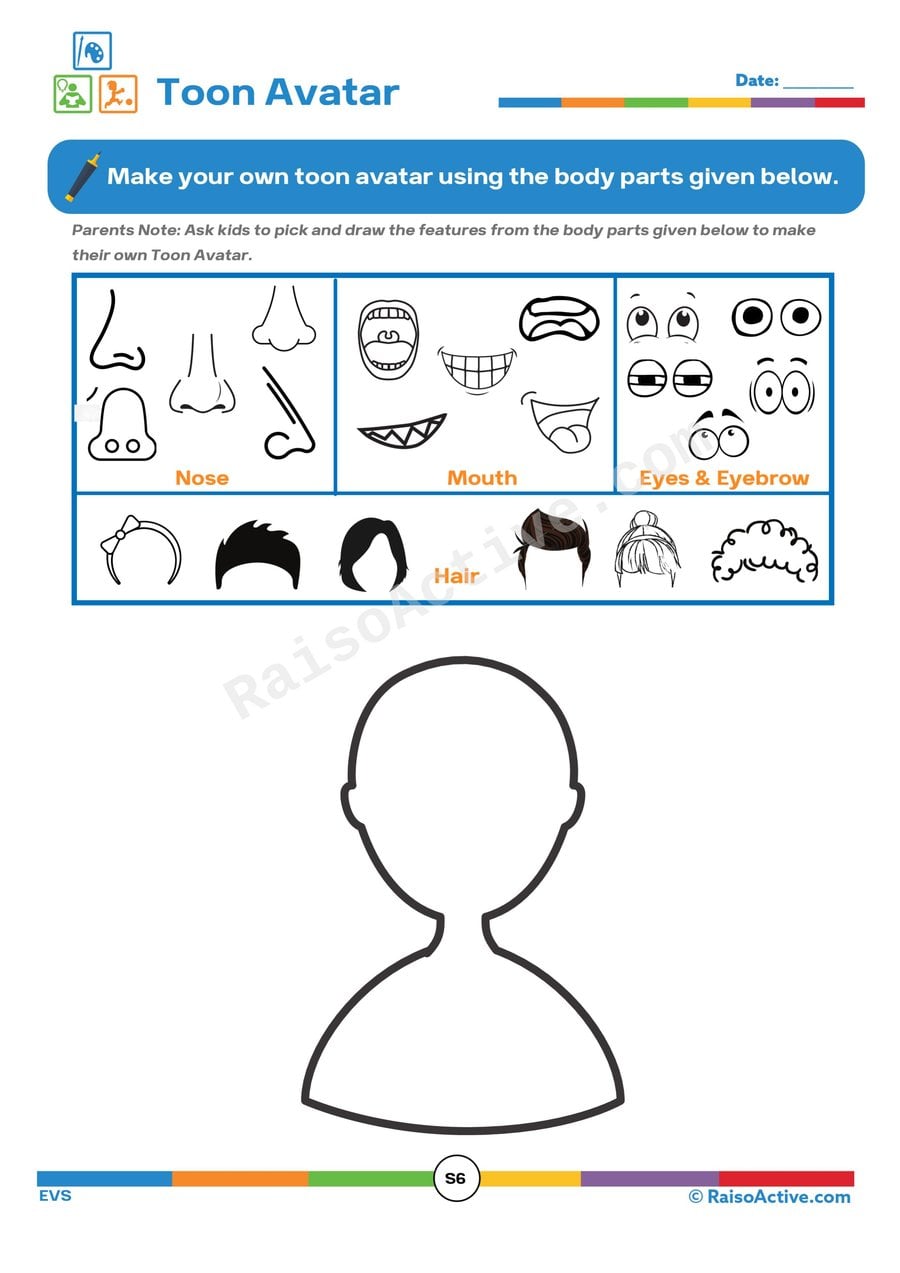
Choosing and drawing features like eyes, nose, mouth, and hair onto a blank avatar outline builds creative self-expression and fine motor drawing control for children ages 3-5, while also introducing the idea that a face can be assembled from separate, swappable parts. This open-ended activity encourages decision-making as children choose which features best represent the character they imagine.

My Address Worksheet: Color the State and Fill in Your Details!
Ages 3-5 · Preschool–Pre-KAges 3-5 · Nursery–ReceptionAges 3-5 · Nursery–LKGAges 3-5
This worksheet introduces children ages 3-5 to their personal address as a piece of core safety knowledge, while the map-coloring task builds early geography skills by having them physically locate and color their home state within India. Practicing house number, street, city, and PIN code also gives meaningful, motivated handwriting practice since the words are personally relevant.

Learn to Draw: Teddy Bear Worksheet for Preschoolers
Ages 3-5 · Preschool–Pre-KAges 3-5 · Nursery–ReceptionAges 3-5 · Nursery–LKGAges 3-5
Following numbered steps to draw a teddy bear teaches children ages 3-5 that complex pictures can be broken down into simple shapes like circles, building both sequencing skills and hand-eye coordination. This step-by-step approach to drawing also builds confidence for children who feel intimidated by open-ended drawing tasks.
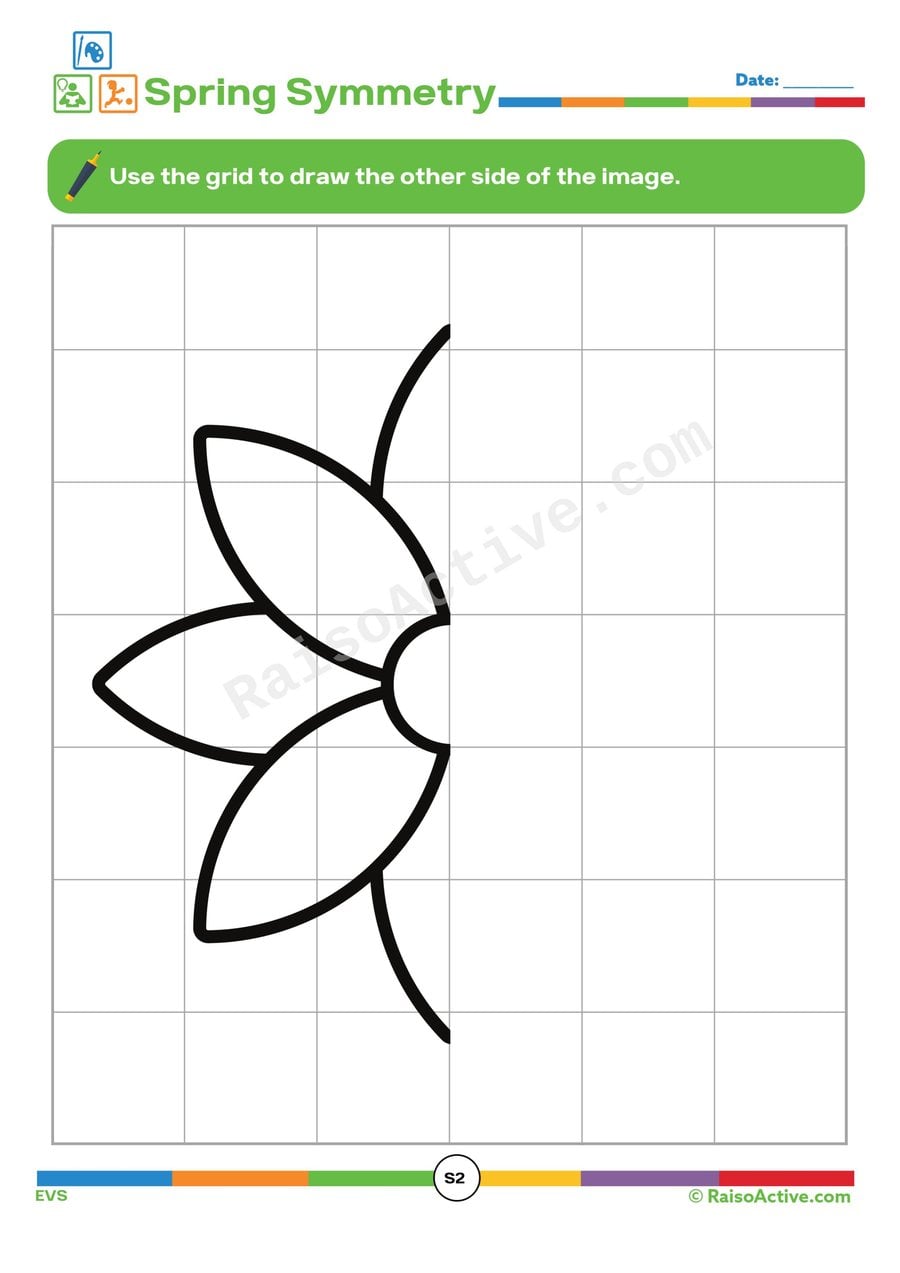
Spring Symmetry Worksheet: Draw the Other Half!
Ages 3-5 · Preschool–Pre-KAges 3-5 · Nursery–ReceptionAges 3-5 · Nursery–LKGAges 3-5
This worksheet introduces children ages 3-5 to the concept of symmetry by having them draw the missing half of a flower using a grid as a visual guide. Replicating a shape on the opposite side of a center line builds spatial reasoning and careful observation, while the drawing itself strengthens pencil control and hand-eye coordination in a way that's more open-ended than simple tracing.
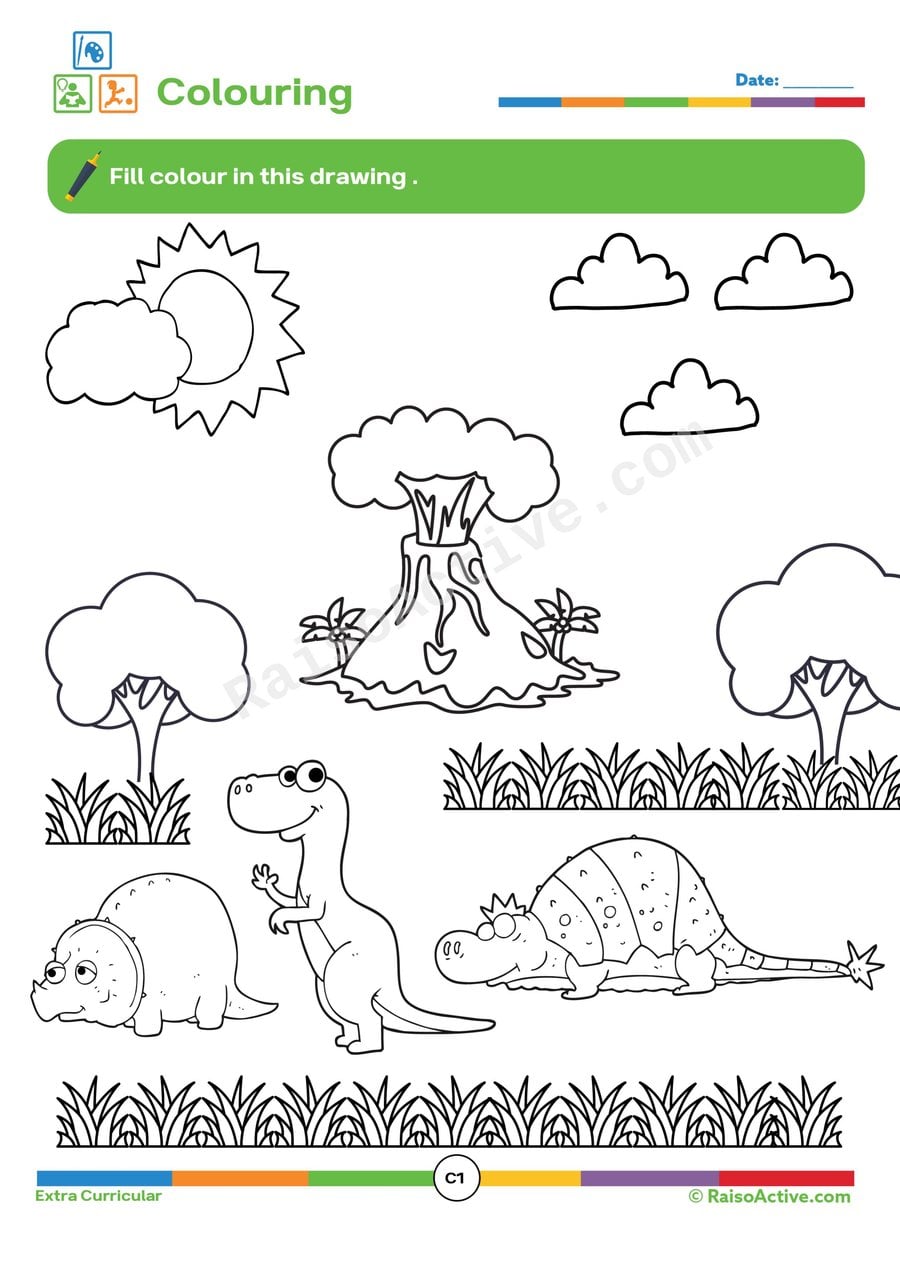
Dinosaur Coloring Worksheet for Kids
Ages 3-5 · Preschool–Pre-KAges 3-5 · Nursery–ReceptionAges 3-5 · Nursery–LKGAges 3-5
This dinosaur coloring page gives children ages 3-5 focused practice with fine motor control and color choice as they fill in a detailed illustration. Staying within defined lines and boundaries strengthens the hand and wrist muscles needed for future handwriting. Choosing colors thoughtfully for different parts of the dinosaur also builds early decision-making and creative expression.
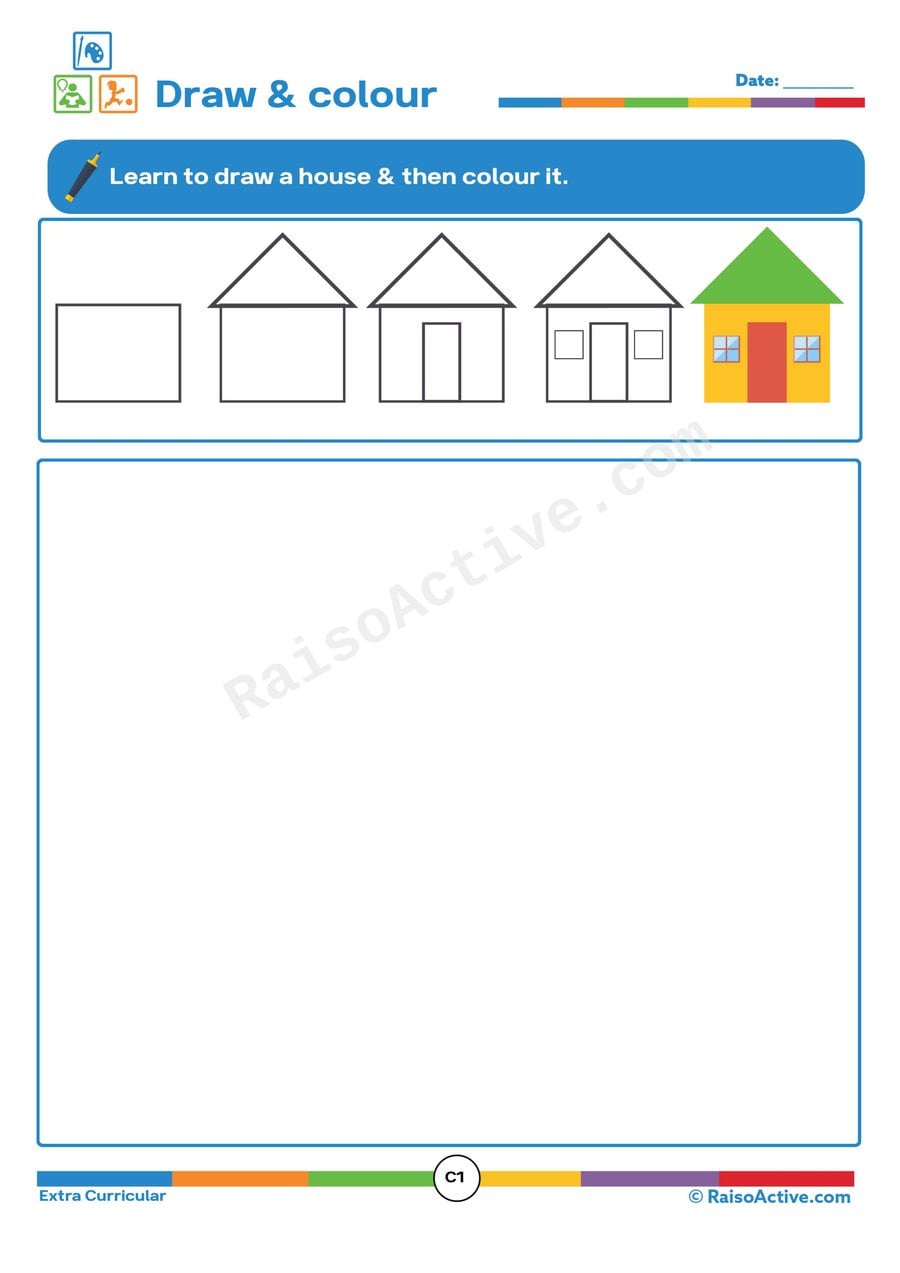
Draw and Color a House: A Fun Worksheet for Kids!
Ages 3-5 · Preschool–Pre-KAges 3-5 · Nursery–ReceptionAges 3-5 · Nursery–LKGAges 3-5
Children ages 3-5 build drawing confidence and step-by-step visual planning by following simple guided steps to construct a house shape, then adding color to complete the picture. Learning to build a picture from basic shapes, like a square, triangle, and rectangle, introduces early geometry concepts through creative expression. Coloring the finished house afterward continues strengthening fine motor control and thoughtful color choice.

Soap & Pepper Science Experiment Worksheet for Preschoolers
Ages 3-5 · Preschool–Pre-KAges 3-5 · Nursery–ReceptionAges 3-5 · Nursery–LKGAges 3-5
This hands-on demonstration shows children ages 3-5 how soap disrupts water's surface tension, using floating pepper as a simple, visible indicator of the change. Because the reaction happens instantly and dramatically, it gives young children a strong, memorable first experience with predicting an outcome and then observing whether their prediction was right.

3D Shapes Worksheet: Explore and Learn with Playdough!
Ages 4-6 · Pre-K–KindergartenAges 4-6 · Reception–Year 1Ages 4-6 · LKG–UKGAges 4-6
This worksheet teaches children ages 4-6 the basic components of 3D shapes — vertices, edges, and faces — by having them count each feature on shapes like cubes and cones, then build matching shapes out of playdough. Physically constructing a shape and counting its parts by hand builds a far deeper understanding of geometry than looking at flat pictures alone, since children can touch and rotate what they've made.
Guides for this topic

Best Worksheets for 3-Year-Olds: What Works and What to Avoid
What works on worksheets for 3-year-olds: short sessions, crayons, tracing lines, matching, cutting, a free weekly plan, and signs one is too advanced.

Age-Appropriate Problem-Solving Activities: Building Critical Thinkers from the Ground Up
Discover fun, age-appropriate problem-solving activities for children ages 1-8. Build critical thinking, logic, and reasoning skills through play-based learning.
Fostering Creativity in Structured Learning: The Perfect Balance for Young Minds
Learn how to blend creativity with structured learning for children ages 1-8. Practical strategies, activities, and printable worksheets for parents and teachers.
Reviews
Every worksheet for ages 3–5, no watermark
Members download the full library of 1,000+ worksheets and every activity pack without watermarks or daily limits. One year costs ₹999 in India or $20 elsewhere.
See membership plansOr download any worksheet free with a watermark (5 a day).