My Plate: Cut and Paste Food Groups Worksheet for Kids
Children ages 3-6 learn about balanced nutrition by cutting out pictures of different foods and pasting each one onto the correct section of a plate diagram representing food groups like fruits, vegetables, grains, and proteins. This hands-on sorting activity introduces the idea that a healthy meal includes a variety of food types, an early building block for lifelong healthy eating habits.
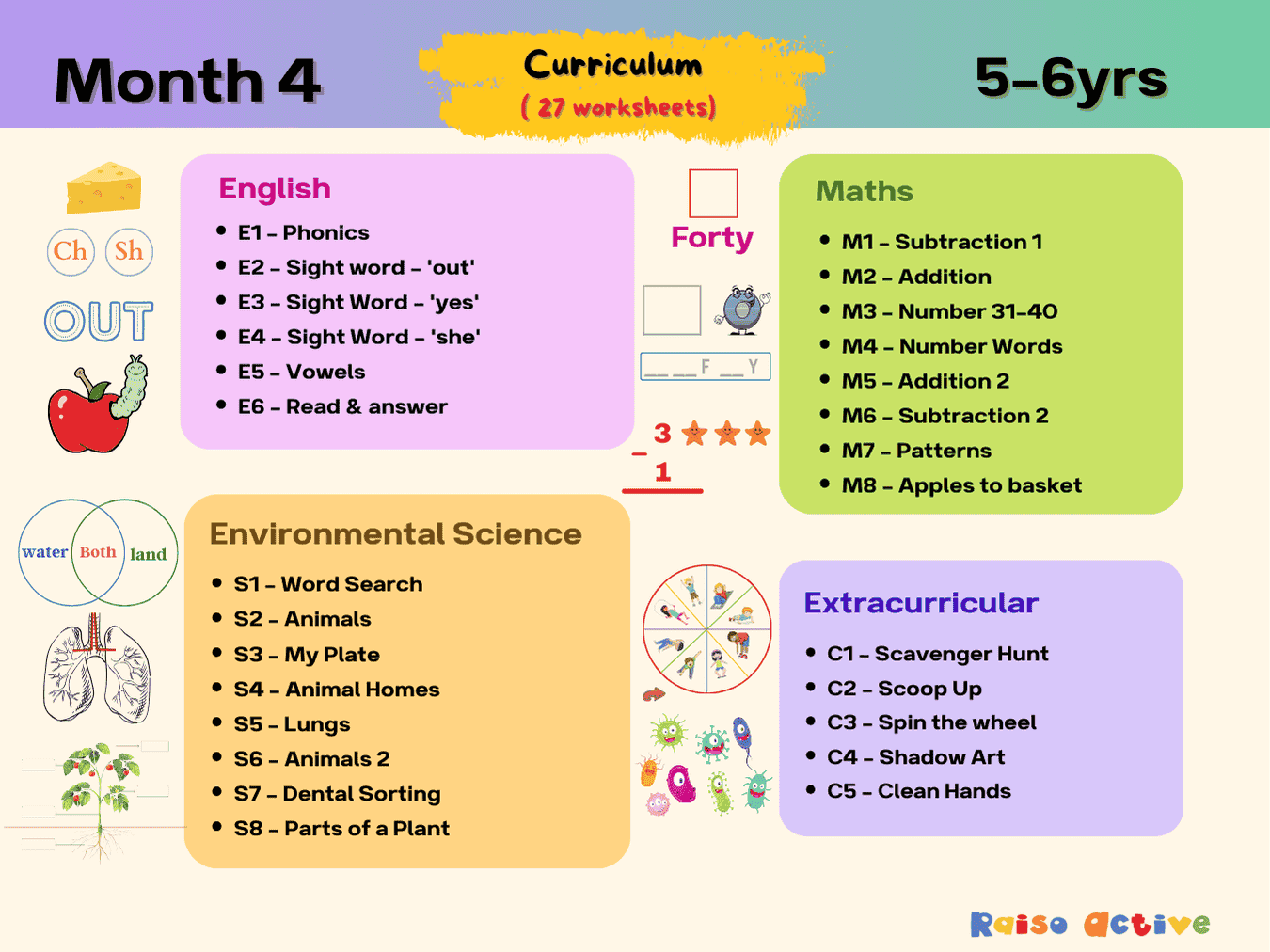
Part of the pack
Month 4: Learning & Development | Ages 5-6
This is page 20 of the pack. Ages 5-6 · KindergartenAges 5-6 · Year 1Ages 5-6 · UKGAges 5-6
Curriculum
- Health & Hygiene > Healthy Eating
How to use this worksheet
Talk with your child about the different sections of the plate and what kind of foods belong in each one. Have your child cut out the food pictures provided. Hold up each food picture, name it together, and ask which food group it belongs to. Have your child glue it into the correct section of the plate, then review the completed plate together, naming each food group and its foods.
Materials needed
- Scissors
- Glue
- Pencil
Extension activities
- 1Have your child draw their favorite healthy meal on a separate piece of paper, labeling each food group.
- 2Discuss the importance of each food group with your child during an actual mealtime.
- 3Build a real My Plate meal together using actual food items at lunch or dinner.
- 4Go grocery shopping together and sort items into a cart by food group.

Written by
Hemsweta Jain · Teacher Cheena
MBA and Early Childhood Educator, teaching since 2014 · Founder of RaisoActive, Mumbai
Every RaisoActive worksheet is designed and checked by the founder before publishing.
Published · Last reviewed
More from Month 4: Learning & Development | Ages 5-6

Parts of a Plant Cut and Paste Worksheet for Kids
Ages 3-5 · Preschool–Pre-KAges 3-5 · Nursery–ReceptionAges 3-5 · Nursery–LKGAges 3-5
This cut-and-paste worksheet teaches children ages 3-5 the names and locations of the main parts of a plant — roots, stem, leaves, flower, and fruit — by having them match labels to the correct spot on a plant diagram. Learning to label a diagram, rather than just naming parts verbally, is an early step toward the kind of labeled-illustration work children will do throughout their science education.

Animal Homes Worksheet: Cut and Paste Activity for Kids
Ages 3-5 · Preschool–Pre-KAges 3-5 · Nursery–ReceptionAges 3-5 · Nursery–LKGAges 3-5
This cut-and-paste worksheet teaches children ages 3-5 to match specific animals to their correct habitats — like a fish to water or a bird to a tree — building early understanding of how animals are suited to where they live. Sorting by habitat rather than by animal type (like farm versus wild) adds a layer of reasoning about why an environment fits a particular animal.

Clean Hands Worksheet: Germs and Handwashing Experiment
Ages 4-6 · Pre-K–KindergartenAges 4-6 · Reception–Year 1Ages 4-6 · LKG–UKGAges 4-6
This worksheet teaches children ages 4-6 the science behind why handwashing matters through a simple, visual experiment demonstrating how germs (represented by something like glitter or oil) transfer between hands and spread easily, then how washing removes them. Seeing germs 'in action' makes an invisible concept concrete, helping children understand the real reason behind a daily hygiene habit rather than just following a rule.

Happy or Sad Teeth: Dental Sorting Worksheet for Kids
Ages 3-5 · Preschool–Pre-KAges 3-5 · Nursery–ReceptionAges 3-5 · Nursery–LKGAges 3-5
This sorting worksheet has children ages 3-5 cut out pictures of foods and place them next to either a happy or sad tooth, teaching which foods support healthy teeth (like fruits, vegetables, and dairy) and which contribute to cavities (like candy and soda). Making the effects of food choices visible through a simple happy/sad symbol helps young children connect everyday eating decisions to a health outcome they can understand.
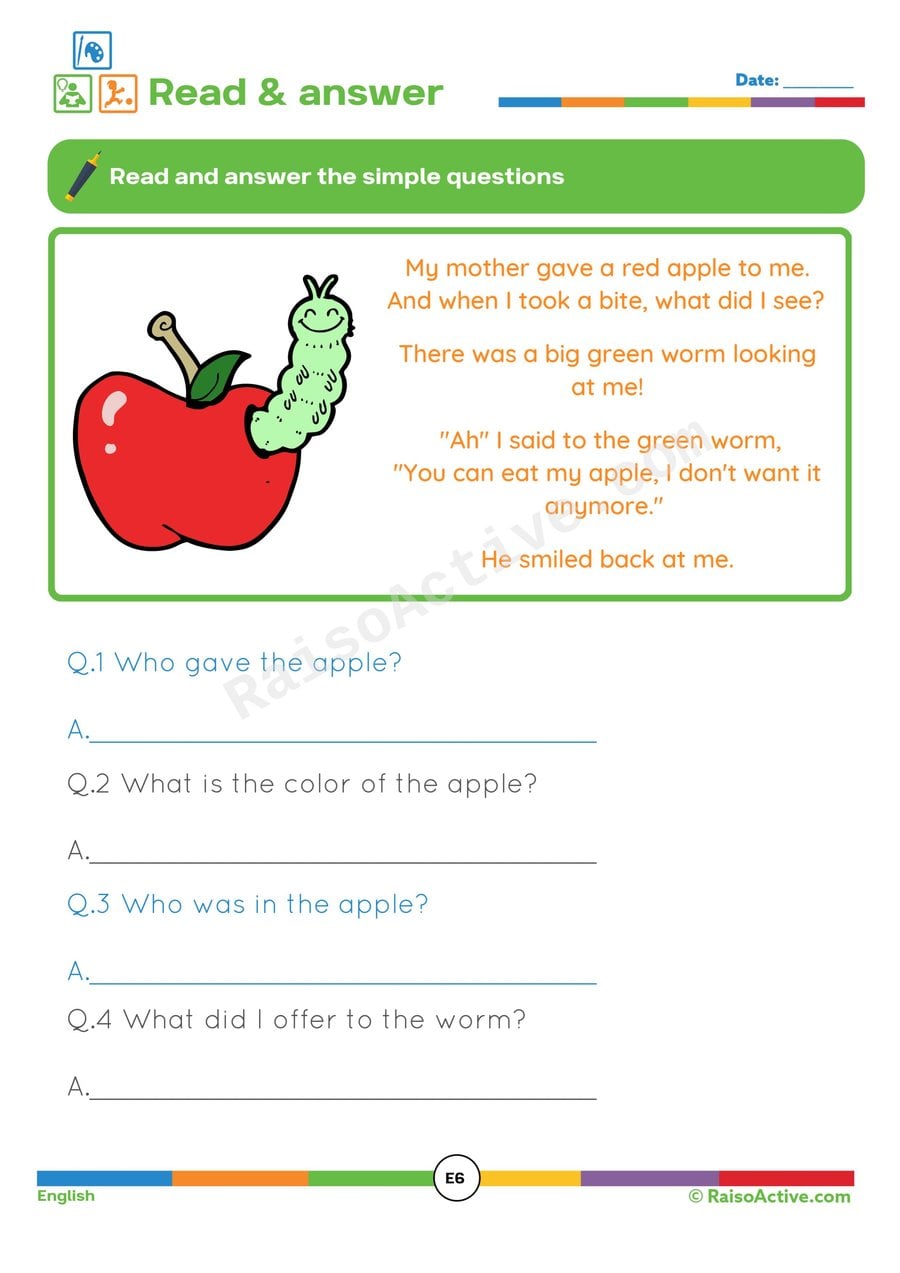
Read and Answer: The Red Apple Worksheet
Ages 3-5 · Preschool–Pre-KAges 3-5 · Nursery–ReceptionAges 3-5 · Nursery–LKGAges 3-5
Reading the short Red Apple story and answering questions afterward helps children ages 3-5 practice basic reading comprehension, recalling simple details from a story and expressing their understanding in writing. This early comprehension practice builds the habit of checking back with a text to support an answer, a skill that grows more important throughout school.

Parent's Guide: Sight Words, Vowels, and Early Math Activities
Ages 3-5 · Preschool–Pre-KAges 3-5 · Nursery–ReceptionAges 3-5 · Nursery–LKGAges 3-5
This parent's guide combines sight word recognition, vowel puppet play, simple subtraction with blocks, and living-versus-non-living observation, giving children ages 3-5 broad exposure to early literacy, number sense, and basic science reasoning through varied hands-on activities. Because each section targets a different skill, the guide offers something to match whatever your child feels drawn to that day.
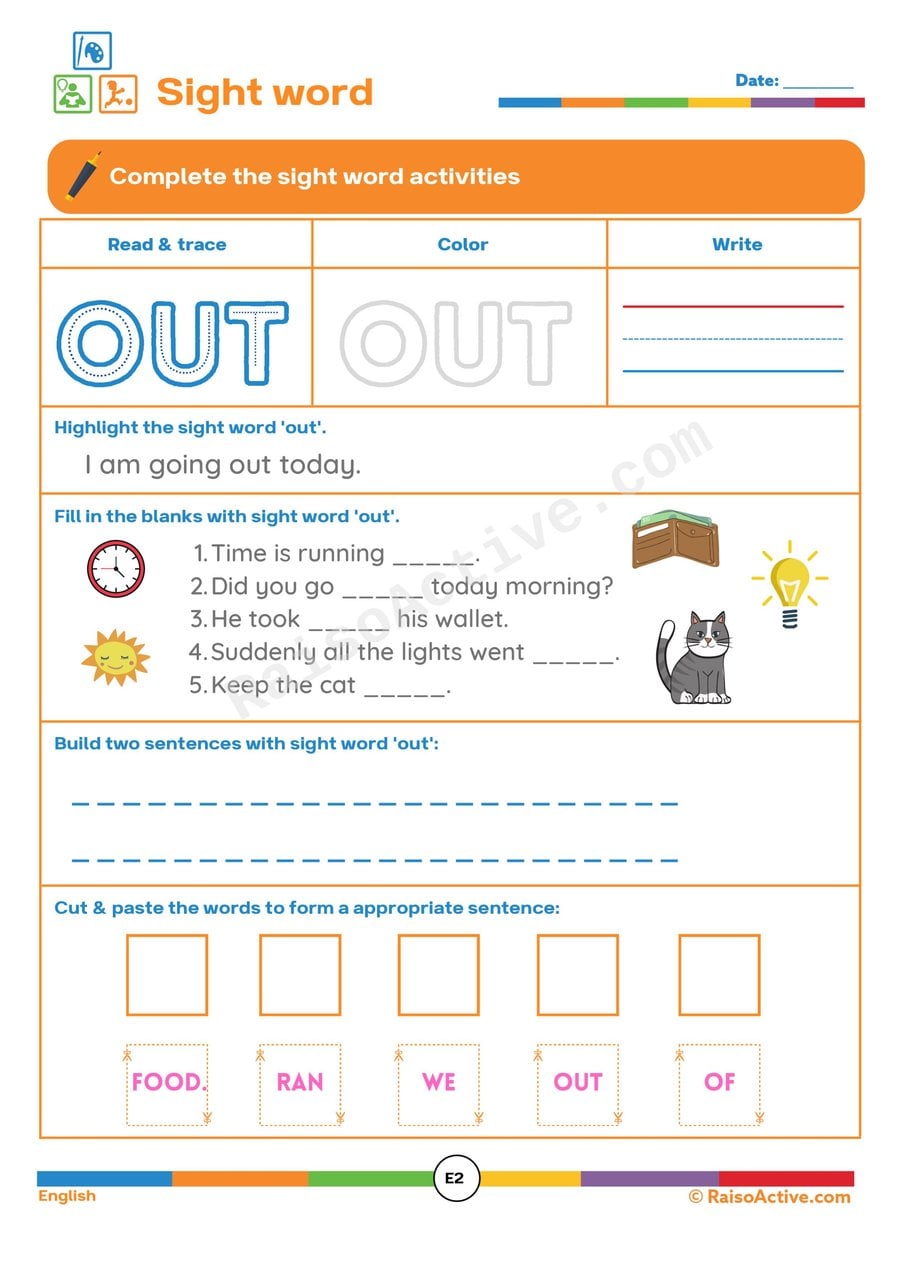
Sight Word 'Out' Worksheet: Read, Trace, and Write!
Ages 3-5 · Preschool–Pre-KAges 3-5 · Nursery–ReceptionAges 3-5 · Nursery–LKGAges 3-5
Reading fluency for young children depends on instantly recognizing common sight words that don't sound out easily, and this worksheet gives children ages 3-5 focused, repeated exposure to the word 'out' through tracing, coloring, and sentence practice. Seeing the word in context within simple sentences also helps children start connecting sight-word recognition to real reading comprehension.

Living and Non-Living Things Word Search Worksheet for Kids
Ages 4-6 · Pre-K–KindergartenAges 4-6 · Reception–Year 1Ages 4-6 · LKG–UKGAges 4-6
This word search worksheet has children ages 4-6 hunt for and identify living and non-living things, then sort them by color-coding — living things in red and non-living things in blue — building both spelling recognition and an early science classification skill. Distinguishing living from non-living is one of the foundational categories in early science education, underlying later lessons about biology and the natural world.
Related worksheets

Food Bingo Worksheet: Identify Healthy and Unhealthy Foods!
Ages 3-5 · Preschool–Pre-KAges 3-5 · Nursery–ReceptionAges 3-5 · Nursery–LKGAges 3-5
This bingo-style activity helps children ages 3-5 practice distinguishing healthy foods from unhealthy ones by physically placing tokens on matching pictures, turning nutrition education into an active game rather than a lecture. Scanning the board for matches also reinforces visual search skills similar to those used in matching and memory games. Because bingo requires a full row to win, children stay motivated to keep scanning and comparing even after finding a few matches.

Healthy vs. Unhealthy Eating Habits Worksheet for Kids
Ages 3-5 · Preschool–Pre-KAges 3-5 · Nursery–ReceptionAges 3-5 · Nursery–LKGAges 3-5
This worksheet helps children ages 3-5 begin distinguishing between healthy and unhealthy food choices by matching specific foods to a healthy or unhealthy person, building early awareness of how eating habits connect to wellbeing. Making this connection concrete and visual, rather than abstract, gives young children a first foothold in nutrition concepts well before they can understand more detailed health information.
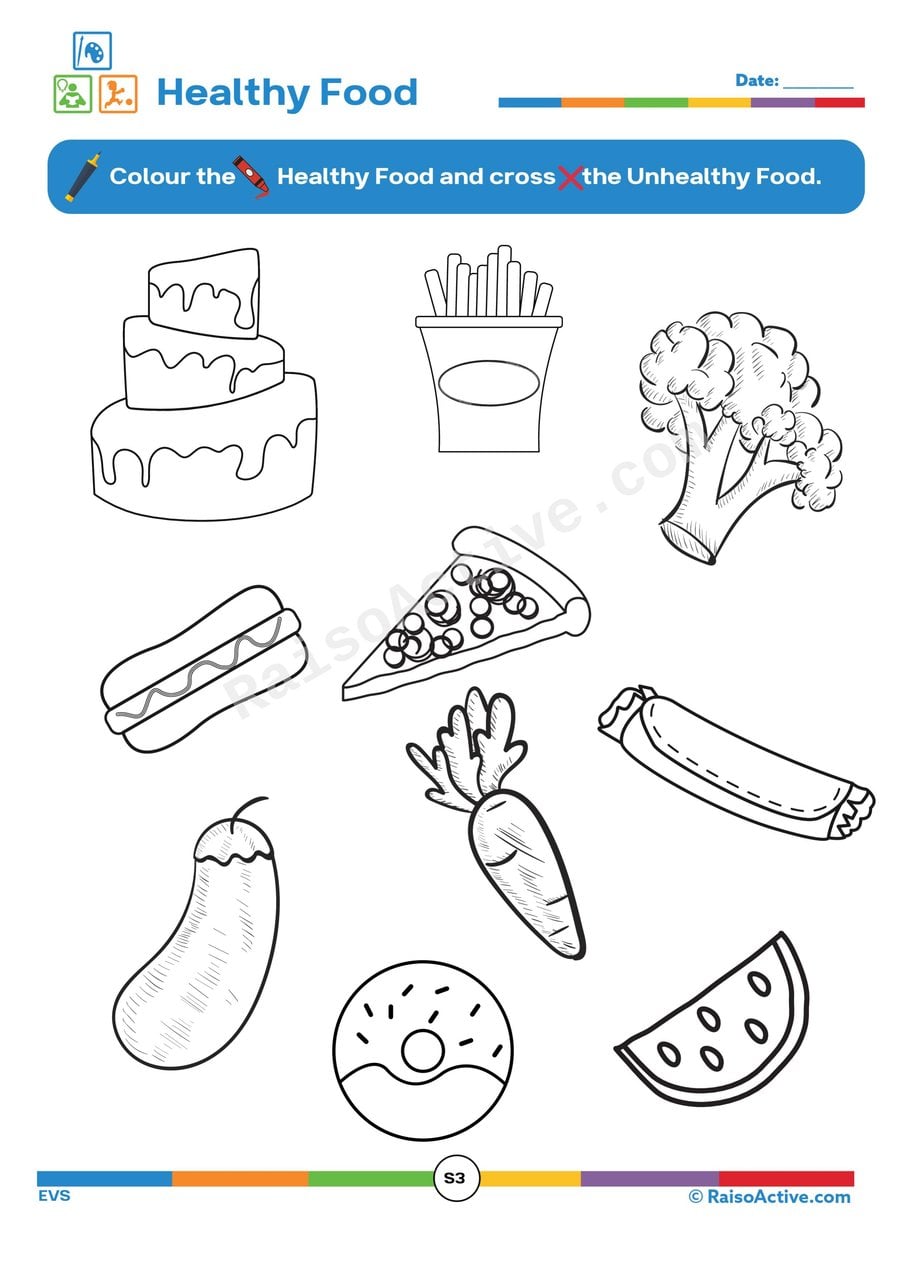
Healthy Food Fun: Color and Cross Out Worksheet
Ages 3-5 · Preschool–Pre-KAges 3-5 · Nursery–ReceptionAges 3-5 · Nursery–LKGAges 3-5
This worksheet builds nutrition awareness in children ages 3-5 by having them make an active choice about each pictured food — coloring the healthy ones and crossing out the unhealthy ones — rather than passively looking at a list. Requiring two different physical responses for two categories reinforces the distinction more strongly than a single sorting action would. Talking through the reasoning behind each choice also builds early critical thinking about cause and effect between food choices and health.

Food Pyramid Worksheet: Learn About Healthy Eating!
Ages 3-5 · Preschool–Pre-KAges 3-5 · Nursery–ReceptionAges 3-5 · Nursery–LKGAges 3-5
This worksheet introduces children ages 3-5 to the food pyramid as a visual guide for balanced eating, helping them understand that different food groups should be eaten in different amounts. Filling in the blanks about food groups and serving sizes builds early nutrition literacy and reinforces the idea that a healthy diet includes variety, not just favorite foods.
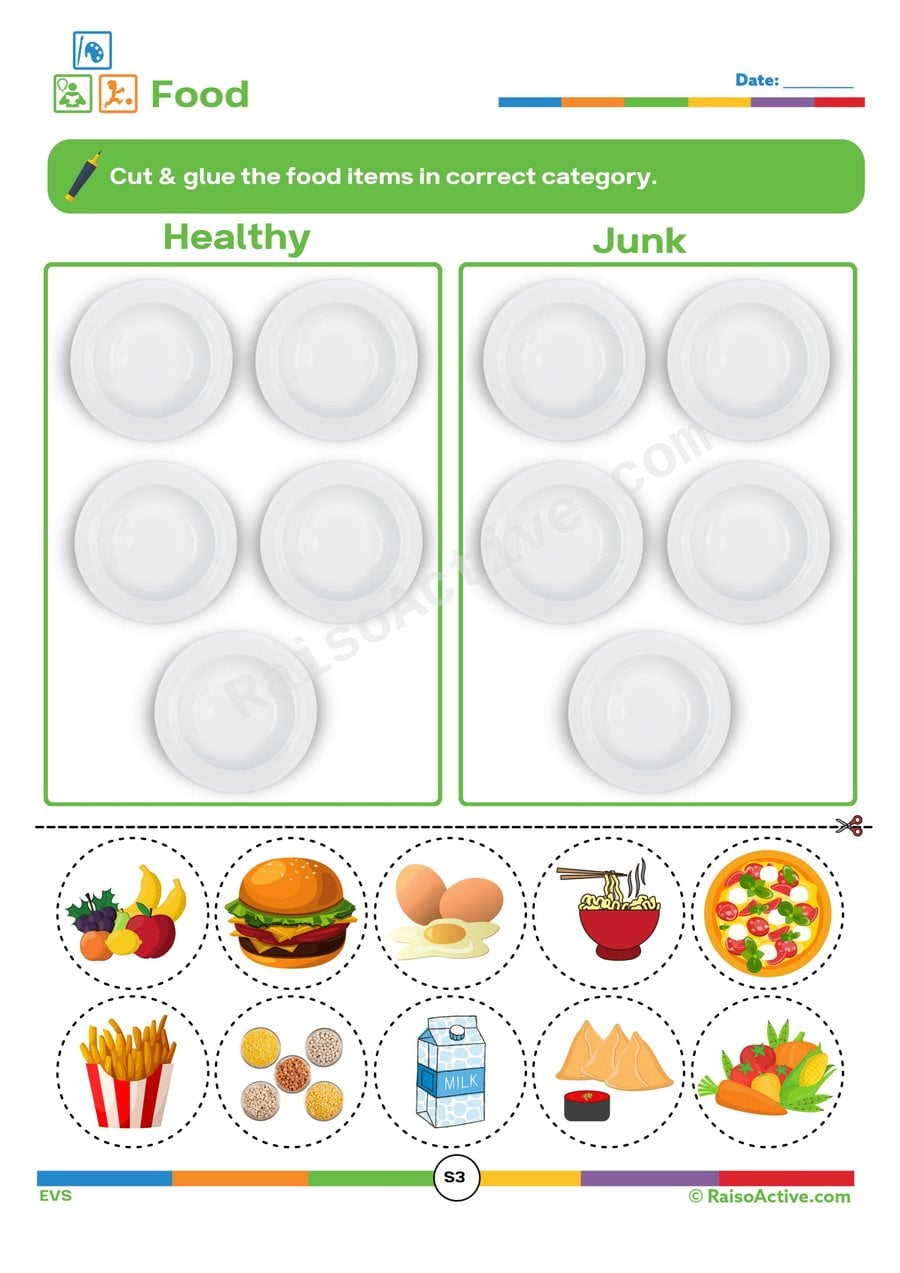
Healthy vs. Junk Food Sorting Worksheet for Kids
Ages 3-5 · Preschool–Pre-KAges 3-5 · Nursery–ReceptionAges 3-5 · Nursery–LKGAges 3-5
This worksheet asks children ages 3-5 to cut out pictures of different foods and sort them into 'Healthy' and 'Junk' categories, building early nutrition awareness alongside classification skills. Learning to categorize foods by type — rather than just naming them — introduces the idea that food choices matter for the body, a concept children will build on throughout their lives.

Healthy Maze Worksheet for Kids: Help the Girl Find Healthy Food!
Ages 3-5 · Preschool–Pre-KAges 3-5 · Nursery–ReceptionAges 3-5 · Nursery–LKGAges 3-5
This maze worksheet combines fine motor path-tracing with healthy-eating awareness for children ages 3-5, as they guide a character through a maze while avoiding unhealthy food obstacles to reach a healthy treat. Embedding a decision-making theme into the maze, rather than a neutral path, gives children a reason to think about food choices while also practicing visual scanning and planning. This combination makes an abstract nutrition lesson feel like part of a fun, goal-directed game.
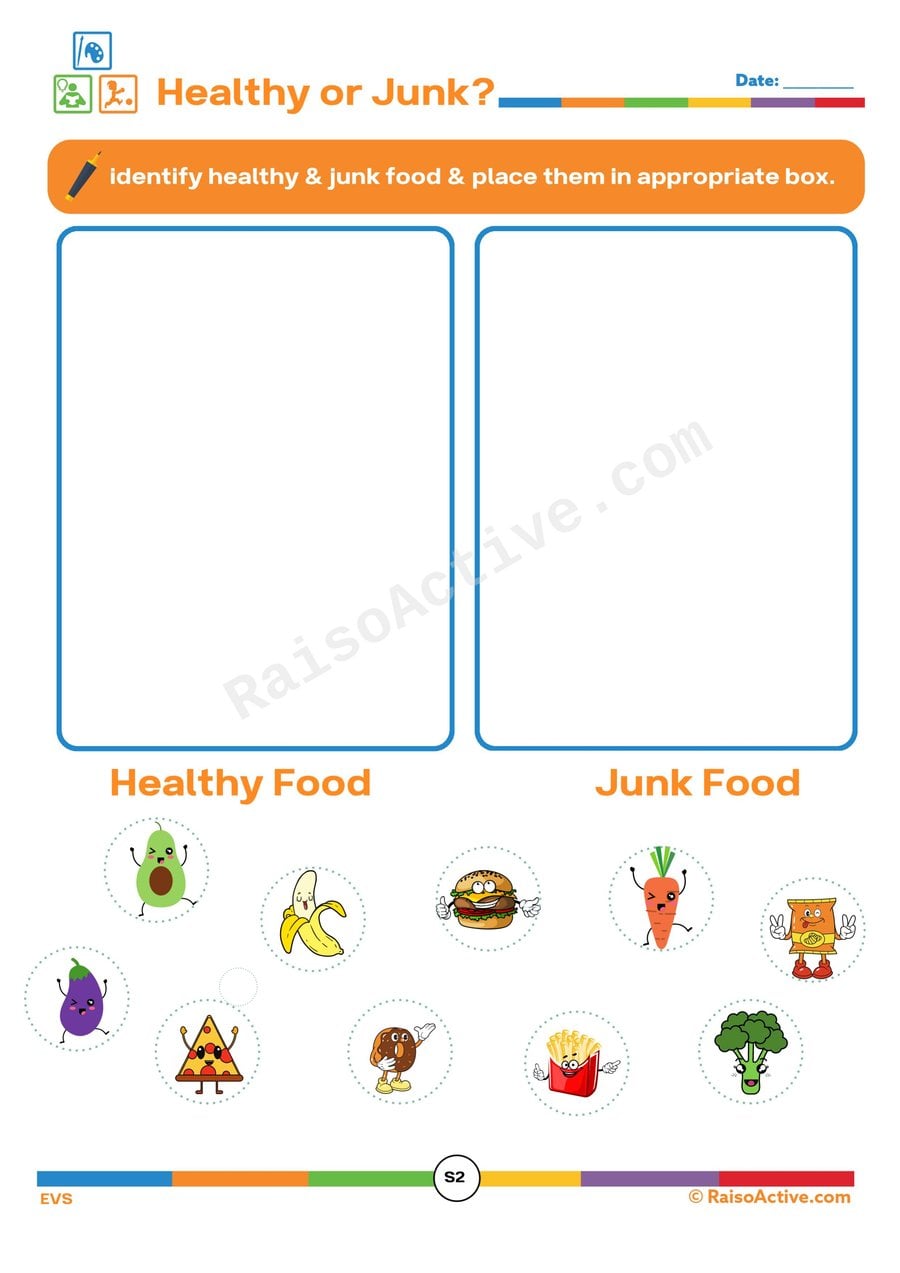
Healthy Food Sorting Worksheet for Preschoolers
Ages 3-5 · Preschool–Pre-KAges 3-5 · Nursery–ReceptionAges 3-5 · Nursery–LKGAges 3-5
Sorting food pictures into 'Healthy' and 'Junk Food' boxes teaches children ages 3-5 to classify items by a shared characteristic, an early categorization skill that underlies later science and math thinking. At the same time, it introduces basic nutrition concepts — that fruits, vegetables, and whole foods nourish the body differently than sugary or fried treats. Talking through each choice also builds vocabulary around food and health.

Healthy Eating Worksheet: Fruit Salad and Vegetable Soup!
Ages 3-5 · Preschool–Pre-KAges 3-5 · Nursery–ReceptionAges 3-5 · Nursery–LKGAges 3-5
This matching worksheet helps children ages 3-5 build food vocabulary by identifying pictures of fruits and vegetables and sorting them into the correct category — fruit salad ingredients or vegetable soup ingredients. Learning to classify foods by type, not just by whether they're healthy, supports early categorization skills that apply across many other subjects, from animals to shapes. The cooking-themed framing also connects the sorting task to a familiar, everyday context children may have experienced at home.
Guides for this topic

Age-Appropriate Problem-Solving Activities: Building Critical Thinkers from the Ground Up
Discover fun, age-appropriate problem-solving activities for children ages 1-8. Build critical thinking, logic, and reasoning skills through play-based learning.

Christmas and Winter Activities That Combine Fun and Learning: Creating Magical Educational Experiences
Discover Christmas and winter activities that combine festive fun with real learning. Crafts, counting, literacy, and printable worksheets for ages 2 to 8 — perfect for home and school.
Age-Appropriate Halloween Learning Activities: Balancing Spooks and Skills for Young Learners
Discover fun, age-appropriate Halloween learning activities for young children. Spooky crafts, counting games, literacy ideas, and printable worksheets for ages 2 to 8.
Reviews
Every worksheet for ages 3–6, no watermark
Members download the full library of 1,000+ worksheets and every activity pack without watermarks or daily limits. One year costs ₹999 in India or $20 elsewhere.
See membership plansOr download any worksheet free with a watermark (5 a day).