Sight Words Worksheet: Practice with 'is', 'we', and 'my'
This worksheet challenges children ages 4-6 to choose the correct sight word from a small word bank — 'is,' 'we,' or 'my' — to complete a sentence, rather than simply tracing or copying a single word. Selecting the right word based on sentence meaning requires a deeper level of reading comprehension than earlier single-word practice, since children must understand what each sentence is saying before choosing correctly. Writing the chosen word from memory also builds spelling recall for these common words.
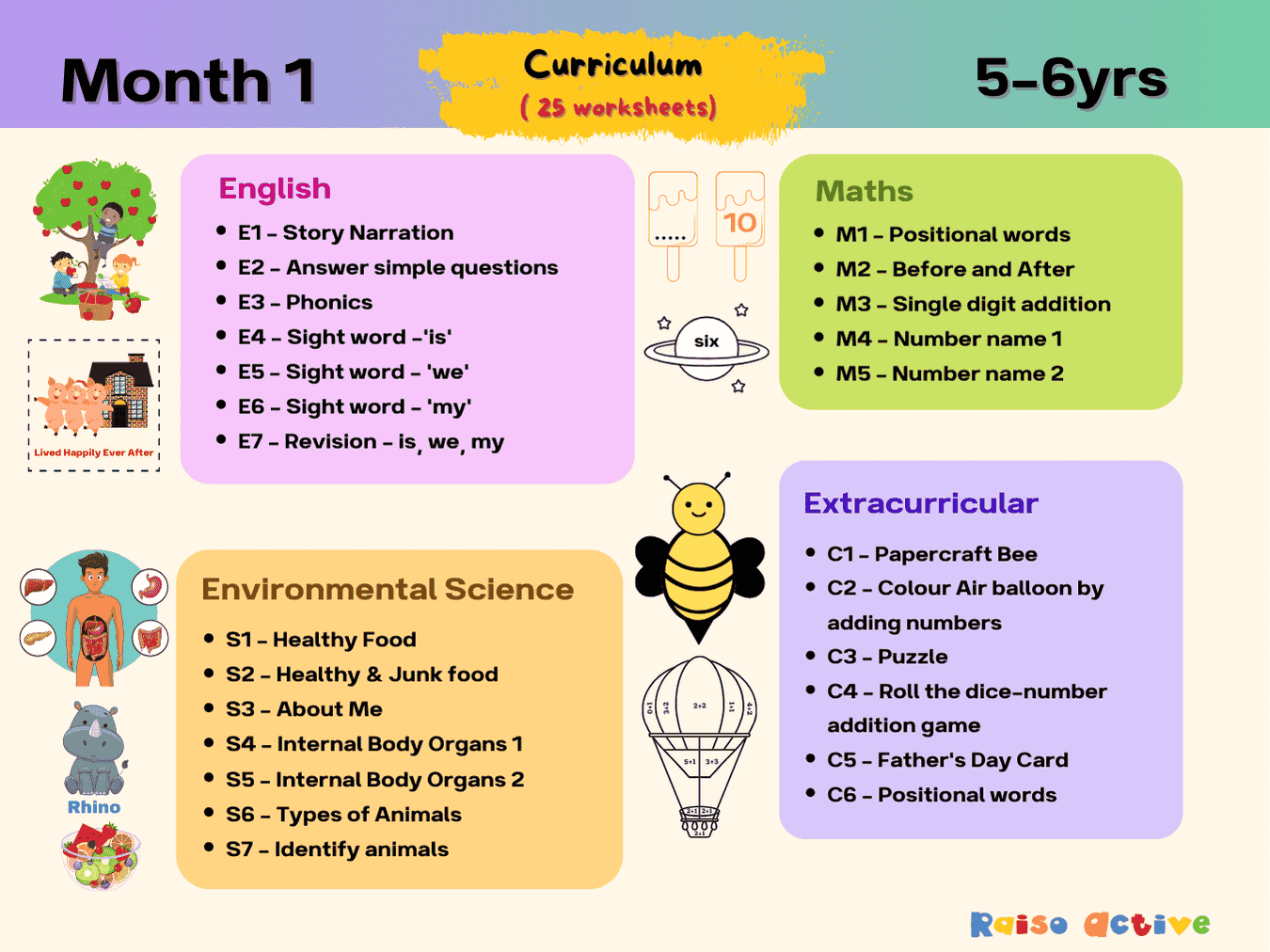
Part of the pack
Month 1: Learning & Development | Ages 5-6
This is page 10 of the pack. Ages 5-6 · KindergartenAges 5-6 · Year 1Ages 5-6 · UKGAges 5-6
Made for your child
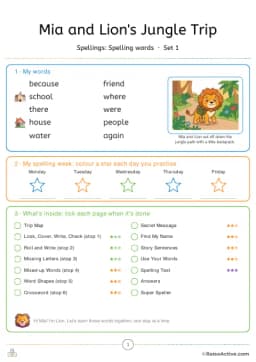
Spelling practice, made for your child
Their own spelling words turned into a pack: trace or look-cover-write-check, roll and write, a secret picture code, a word search, a crossword and a test, with their name in it.
Make a spelling packFree preview · free for members
Or start free: a word search with sight wordsCurriculum
- Fluency > Sight Words
How to use this worksheet
Read the first sentence aloud together, pausing at the blank space to let your child think about which word would make sense there. Show your child the word list at the top of the page — 'is,' 'we,' and 'my' — and have them decide which one fits the sentence. Ask your child to write their chosen word neatly in the blank. Continue through each remaining sentence the same way, rereading the completed sentence aloud afterward to check that it makes sense.
Materials needed
- Pencil
Extension activities
- 1Create your own sentences using the sight words.
- 2Use the sight words to describe pictures.
- 3Play a fill-in-the-blank game verbally, saying a sentence aloud and having your child supply the missing sight word.
- 4Make flashcards for 'is,' 'we,' and 'my' and quiz your child on quick recognition.
- 5Write a very short three-sentence story together using all three sight words at least once.

Written by
Hemsweta Jain · Teacher Cheena
MBA and Early Childhood Educator, teaching since 2014 · Founder of RaisoActive, Mumbai
Every RaisoActive worksheet is designed and checked by the founder before publishing.
Published · Last reviewed
More from Month 1: Learning & Development | Ages 5-6
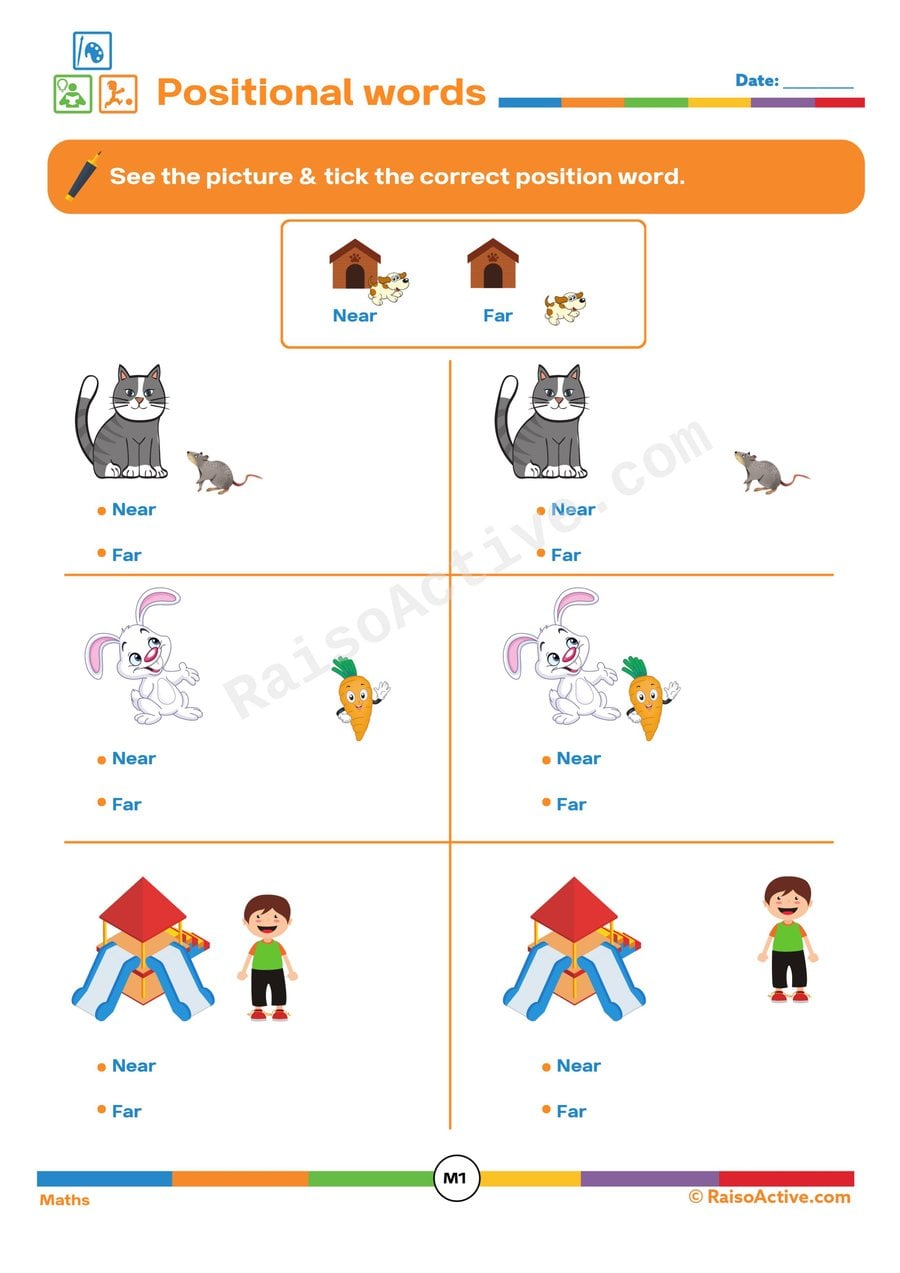
Positional Words Worksheet: Near and Far
Ages 3-5 · Preschool–Pre-KAges 3-5 · Nursery–ReceptionAges 3-5 · Nursery–LKGAges 3-5
This worksheet introduces children ages 3-5 to the positional concepts of 'near' and 'far,' asking them to look at a picture and tick the word that correctly describes an object's distance from a reference point. Positional vocabulary like this is an important building block for spatial reasoning and later geometry and direction-following skills. Because near and far are relative concepts rather than fixed labels, this practice also builds flexible thinking about how position depends on comparison.

The Three Little Pigs Storytelling Worksheet for Preschoolers
Ages 3-5 · Preschool–Pre-KAges 3-5 · Nursery–ReceptionAges 3-5 · Nursery–LKGAges 3-5
This storytelling worksheet helps children ages 3-5 practice narrative sequencing and oral language skills by retelling the classic tale of the Three Little Pigs in their own words, using picture prompts as a guide. Putting a familiar story into their own sentences builds comprehension and expressive vocabulary far more actively than just listening to the story read aloud. The cut-and-paste sequencing option adds a second layer of practice with story order.

Number Names Matching Worksheet for Preschoolers
Ages 3-5 · Preschool–Pre-KAges 3-5 · Nursery–ReceptionAges 3-5 · Nursery–LKGAges 3-5
This matching worksheet builds early number-word literacy for children ages 3-5 by asking them to connect each numeral with its written name. Learning that '5' and 'five' refer to the same quantity strengthens number sense and lays groundwork for reading math vocabulary later in school. The side-by-side layout also sharpens visual scanning and one-to-one matching skills.

Healthy Eating Worksheet: Fruit Salad and Vegetable Soup!
Ages 3-5 · Preschool–Pre-KAges 3-5 · Nursery–ReceptionAges 3-5 · Nursery–LKGAges 3-5
This matching worksheet helps children ages 3-5 build food vocabulary by identifying pictures of fruits and vegetables and sorting them into the correct category — fruit salad ingredients or vegetable soup ingredients. Learning to classify foods by type, not just by whether they're healthy, supports early categorization skills that apply across many other subjects, from animals to shapes. The cooking-themed framing also connects the sorting task to a familiar, everyday context children may have experienced at home.

Learn the Sight Word 'My' - Tracing, Writing, and Matching Worksheet
Ages 3-5 · Preschool–Pre-KAges 3-5 · Nursery–ReceptionAges 3-5 · Nursery–LKGAges 3-5
This worksheet builds sight-word fluency for the word 'my' in children ages 3-5 through a combination of tracing, independent writing, fill-in-the-blank sentences, and a matching activity. Working with the same word across several different formats helps cement recognition, since 'my' is a high-frequency word that appears constantly in early reading material but doesn't follow simple phonics patterns. The matching component adds a visual-recognition check to confirm the word sticks even without tracing cues.

Solar System Number Matching Worksheet for Preschoolers
Ages 4-6 · Pre-K–KindergartenAges 4-6 · Reception–Year 1Ages 4-6 · LKG–UKGAges 4-6
This worksheet combines number-word recognition with a color-by-key coloring task for children ages 4-6, asking them to match number names written on planets to their corresponding numerals before coloring each planet according to a color code. Matching written number words in a space-themed context adds novelty that keeps repeated number-word practice fresh, while the color-key step reinforces careful, sequential following of visual instructions. Together, these two tasks combine literacy and numeracy practice in one engaging page.
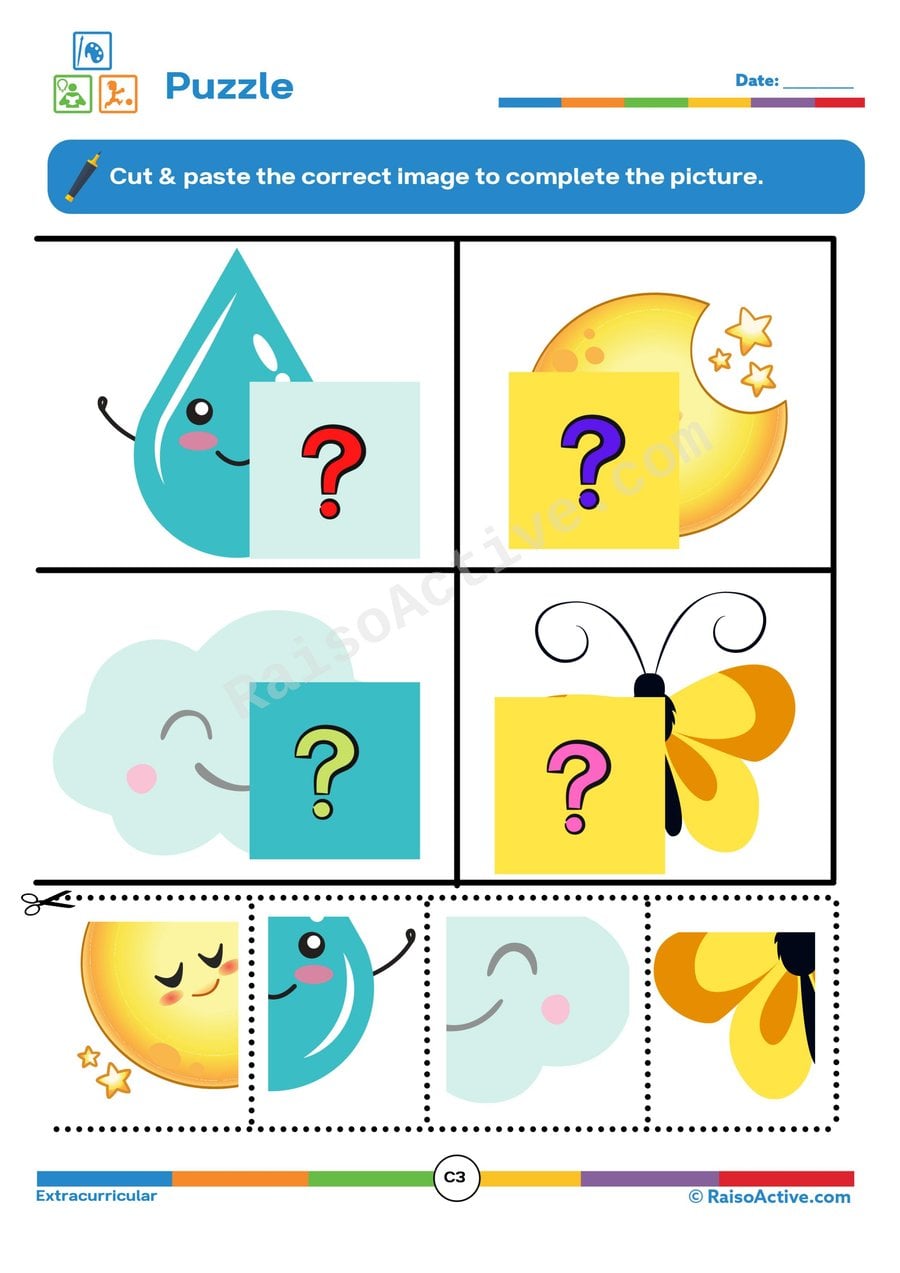
Cut and Paste Puzzle: Complete the Pictures!
Ages 3-5 · Preschool–Pre-KAges 3-5 · Nursery–ReceptionAges 3-5 · Nursery–LKGAges 3-5
This cut-and-paste puzzle challenges children ages 3-5 to visually compare cut-out image pieces to the gaps in a larger picture, strengthening visual discrimination and problem-solving as they figure out which piece fits where. Because more than one cut-out may look similar at a glance, children must attend closely to small details like color, shape, and orientation before gluing. This close visual comparison builds the same attention-to-detail skills used later in reading, where small differences between letters and words matter.
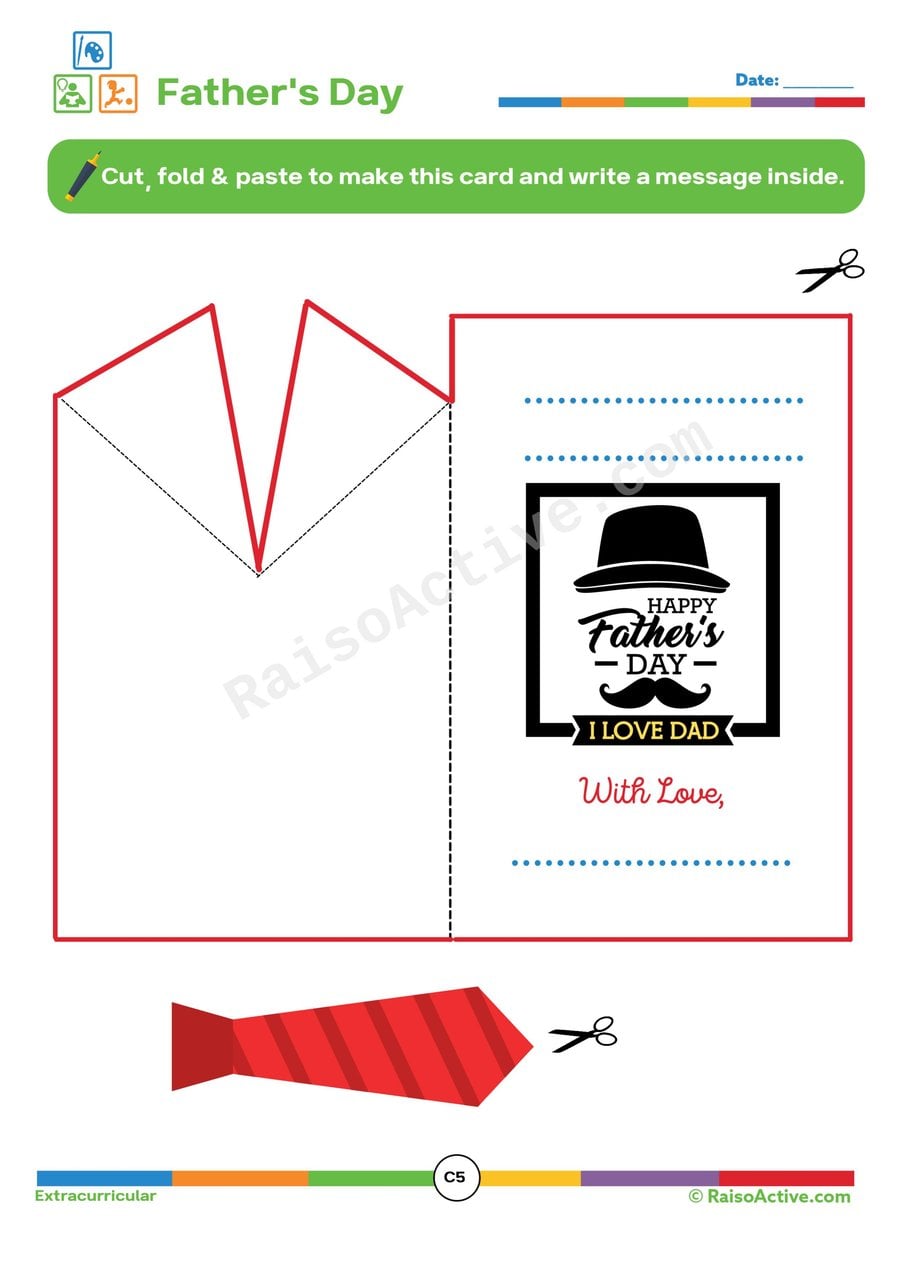
Father's Day Card Craft: Cut, Fold, and Paste!
Ages 3-5 · Preschool–Pre-KAges 3-5 · Nursery–ReceptionAges 3-5 · Nursery–LKGAges 3-5
This Father's Day card craft gives children ages 3-5 focused practice with three distinct fine motor actions in sequence — cutting along a line, folding paper neatly in half, and pasting a small piece precisely in place. Sequencing multiple craft steps in the right order also builds early executive-function skills like following multi-step directions. The personal, gift-making purpose adds meaning and motivation that keeps young children engaged through each step.
Related worksheets

Sight Word 'This' Worksheet: Trace, Write, and Identify!
Ages 3-5 · Preschool–Pre-KAges 3-5 · Nursery–ReceptionAges 3-5 · Nursery–LKGAges 3-5
This worksheet helps children ages 3-5 learn to recognize, write, and use the sight word 'this' in sentences, building automatic recognition of a word that appears constantly in early reading but doesn't sound out easily. Cutting and pasting letters to spell the word adds a hands-on layer that reinforces letter order alongside whole-word recognition.

Sight Word 'Away' Worksheet: Learn to Read and Write!
Ages 3-5 · Preschool–Pre-KAges 3-5 · Nursery–ReceptionAges 3-5 · Nursery–LKGAges 3-5
Like many high-frequency words, 'away' doesn't follow standard phonics rules cleanly, so children ages 3-5 need to build instant visual recognition of it as a whole sight word rather than sounding it out each time. This worksheet delivers that repetition through several varied tasks — coloring, tracing, word-hunting, sentence completion, and letter reassembly — which keeps a young learner engaged while reinforcing the same word from multiple angles. Strong sight-word recognition for common words like 'away' is one of the biggest accelerators of early reading fluency.
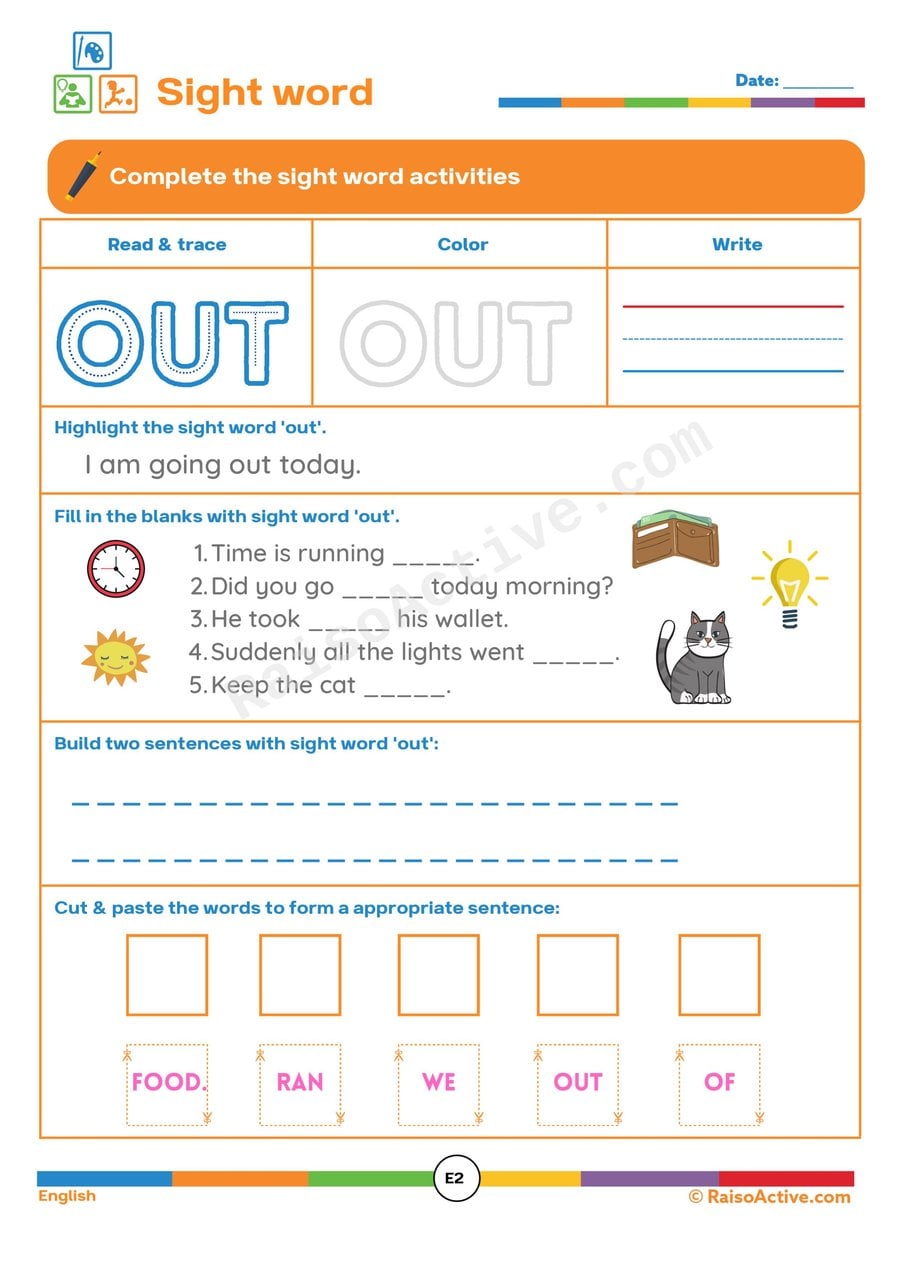
Sight Word 'Out' Worksheet: Read, Trace, and Write!
Ages 3-5 · Preschool–Pre-KAges 3-5 · Nursery–ReceptionAges 3-5 · Nursery–LKGAges 3-5
Reading fluency for young children depends on instantly recognizing common sight words that don't sound out easily, and this worksheet gives children ages 3-5 focused, repeated exposure to the word 'out' through tracing, coloring, and sentence practice. Seeing the word in context within simple sentences also helps children start connecting sight-word recognition to real reading comprehension.

Learn to Write the Sight Word 'I' Worksheet for Preschoolers
Ages 3-5 · Preschool–Pre-KAges 3-5 · Nursery–ReceptionAges 3-5 · Nursery–LKGAges 3-5
This worksheet gives children ages 3-5 focused, repeated practice recognizing, tracing, and writing the sight word 'I,' one of the very first words most children learn to read and write since it appears constantly in their own speech. Because 'I' is a single letter that stands for a whole word, it's also a gentle introduction to the idea that capitalization carries meaning.

Learn the Sight Word 'Had' | Fun Reading Worksheet for Preschoolers
Ages 4-5 · Pre-KAges 4-5 · ReceptionAges 4-5 · LKGAges 4-5
Children ages 4-5 build instant recognition of the sight word 'had', another high-frequency word that resists standard phonics decoding and must be memorized visually. This worksheet layers coloring, tracing, writing, grid-searching, and fill-in-the-blank practice, giving the word multiple forms of repeated exposure that solidify memory. Completing sentences with 'had' also shows children how the word is used naturally in storytelling, especially when talking about the past.

Sight Word 'THE' Worksheet: Trace, Write, and Identify!
Ages 4-5 · Pre-KAges 4-5 · ReceptionAges 4-5 · LKGAges 4-5
This worksheet builds automatic recognition of the sight word 'the,' one of the most frequently occurring words in English text, through repeated tracing, writing, and identification practice. For four- and five-year-olds, memorizing high-frequency sight words like 'the' by sight — rather than sounding them out each time — is essential for building reading fluency, since these words appear on nearly every page a child will read.

Learn the Sight Word 'Has' - Fun Tracing and Matching Worksheet!
Ages 3-5 · Preschool–Pre-KAges 3-5 · Nursery–ReceptionAges 3-5 · Nursery–LKGAges 3-5
'Has' is a high-frequency verb that children ages 3-5 encounter constantly in early sentences describing possession, like 'the dog has a bone,' making it an important addition to their sight word vocabulary. This worksheet builds recognition of the word through coloring, tracing, word searching, and sentence completion, giving repeated exposure across formats that reinforces memory more effectively than a single repetition. Practicing 'has' inside complete sentences also helps children understand its grammatical role, connecting a subject to something it possesses.
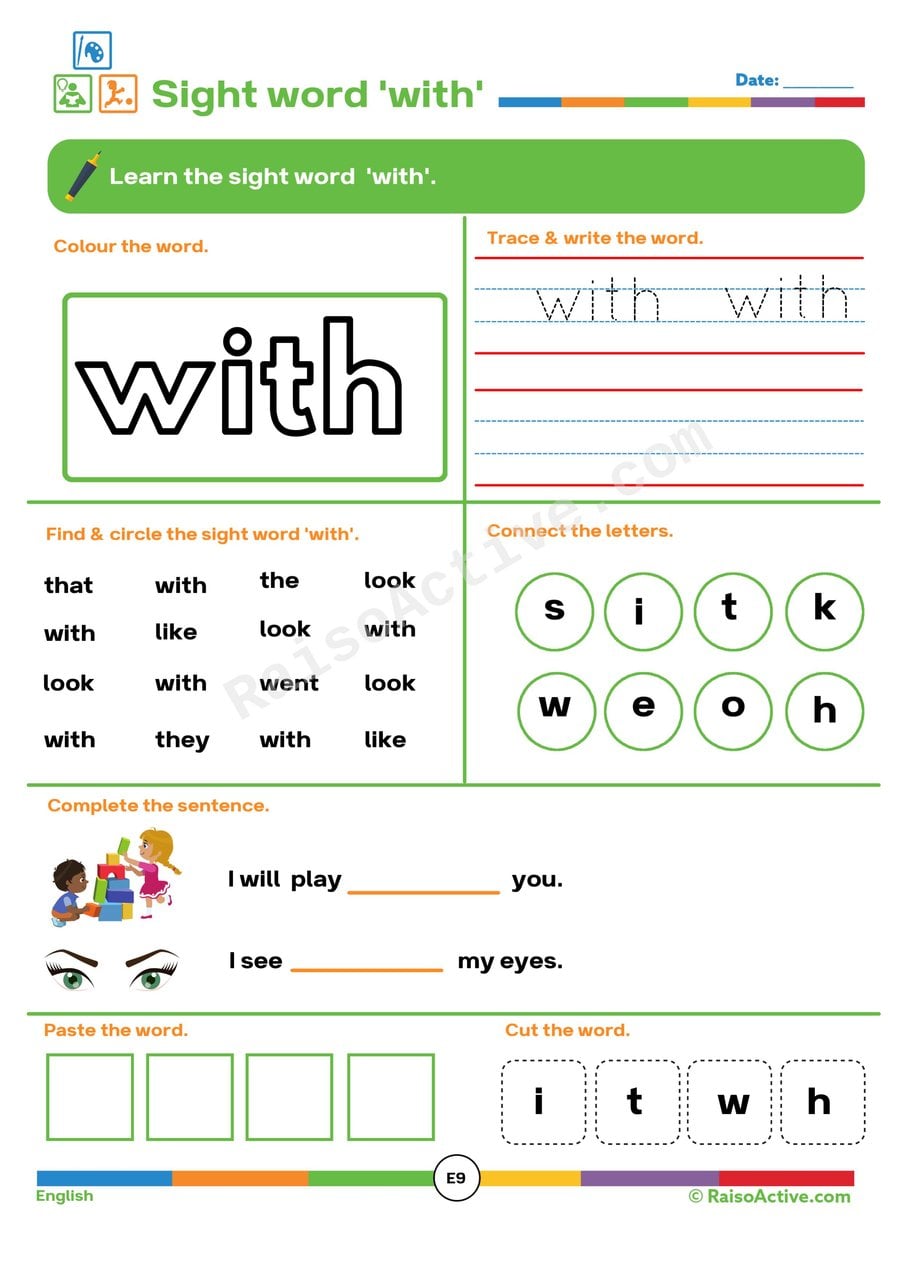
Sight Word 'With' Worksheet: Trace, Write, and Find!
Ages 4-5 · Pre-KAges 4-5 · ReceptionAges 4-5 · LKGAges 4-5
This worksheet gives 4-5 year olds repeated, varied practice with the sight word 'with' — coloring it, tracing and writing it, finding it in a list, completing a sentence, and cutting and pasting it — because sight words like 'with' don't follow simple sound-out rules and need to be recognized instantly by sight rather than decoded each time. That instant recognition is what lets a young reader move smoothly through a sentence instead of stumbling on common connector words.
Guides for this topic

Sight Words by Age: The First 50 Words and How to Teach Them Without Flashcard Fatigue
Which sight words to teach first and why, the heart-word method, a read-trace-write-find routine, games, and a by-age table of typical sight-word progress.
How to Teach CVC Blending: A Step-by-Step Method That Works in Two Weeks
A step-by-step method for teaching CVC blending, covering continuous sounds, word families, common errors, and a 14-day plan that most children finish reading CVC words.
Phase 2 Phonics at Home: Sound Order, Blending Games, Worksheets
Phase 2 phonics at home: the five sound sets in order, oral blending, tricky words, a two-week routine, common mistakes, and free worksheets.
Reviews
Every worksheet for ages 4–6, no watermark
Members download the full library of 1,000+ worksheets and every activity pack without watermarks or daily limits. One year costs ₹999 in India or $20 elsewhere.
See membership plansOr download any worksheet free with a watermark (5 a day).