Number Names Matching Worksheet for Preschoolers
This matching worksheet builds early number-word literacy for children ages 3-5 by asking them to connect each numeral with its written name. Learning that '5' and 'five' refer to the same quantity strengthens number sense and lays groundwork for reading math vocabulary later in school. The side-by-side layout also sharpens visual scanning and one-to-one matching skills.
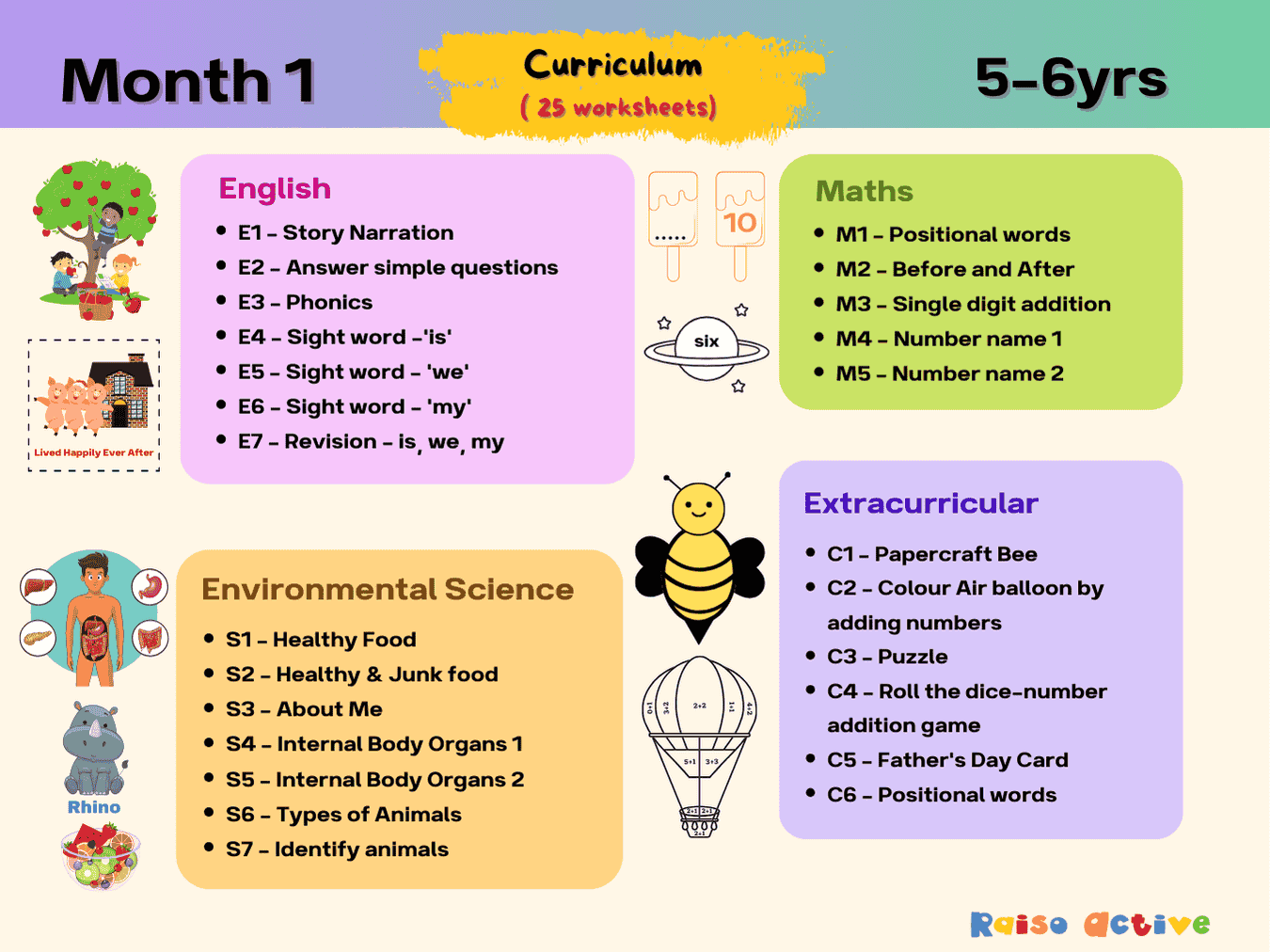
Part of the pack
Month 1: Learning & Development | Ages 5-6
This is page 14 of the pack. Ages 5-6 · KindergartenAges 5-6 · Year 1Ages 5-6 · UKGAges 5-6

Made for your child
Counting to 10, made for your child
A maths pack with your child's name in it: pictures that explain, practice at three levels, puzzles and story sums about them. Print a new set whenever they finish.
Make a maths packFree preview · free for members
Curriculum
- Number Recognition > Number Names
How to use this worksheet
Start by reading the numerals down the left column together, then read each number-name word on the right column aloud. Ask your child to find the number name that matches each numeral and draw a straight line connecting the pair with a pencil. Work through the list one row at a time rather than jumping around, since skipping ahead often causes crossed or tangled lines. Once every pair is connected, have your child trace back over each line while saying the number name aloud to double-check their work.
Materials needed
- Pencil
- Crayons
Extension activities
- 1Make a set of numeral cards and number-name word cards and play a memory-matching game.
- 2Write numbers 1-10 on sticky notes and hide them around the room for your child to find and read aloud.
- 3Have your child write the number name next to a group of counted objects, like five buttons or three spoons.
- 4Sing a counting song and pause on each number to say its written name together.

Written by
Hemsweta Jain · Teacher Cheena
MBA and Early Childhood Educator, teaching since 2014 · Founder of RaisoActive, Mumbai
Every RaisoActive worksheet is designed and checked by the founder before publishing.
Published · Last reviewed
More from Month 1: Learning & Development | Ages 5-6

Internal Organs Worksheet: Find and Match the Body Parts!
Ages 4-6 · Pre-K–KindergartenAges 4-6 · Reception–Year 1Ages 4-6 · LKG–UKGAges 4-6
Finding organ names hidden in a word search and then cutting and pasting the organs onto the correct spot on a body diagram teaches children ages 4-6 the names and general locations of internal organs, like the heart, lungs, and stomach, introducing basic human biology. Searching the word grid builds visual scanning and word recognition, while the cut-and-paste placement step reinforces spatial understanding of where each organ sits inside the body. Combining a word search with a hands-on placement task gives this worksheet both a literacy and a science learning goal.

Learn the Sight Word 'My' - Tracing, Writing, and Matching Worksheet
Ages 3-5 · Preschool–Pre-KAges 3-5 · Nursery–ReceptionAges 3-5 · Nursery–LKGAges 3-5
This worksheet builds sight-word fluency for the word 'my' in children ages 3-5 through a combination of tracing, independent writing, fill-in-the-blank sentences, and a matching activity. Working with the same word across several different formats helps cement recognition, since 'my' is a high-frequency word that appears constantly in early reading material but doesn't follow simple phonics patterns. The matching component adds a visual-recognition check to confirm the word sticks even without tracing cues.
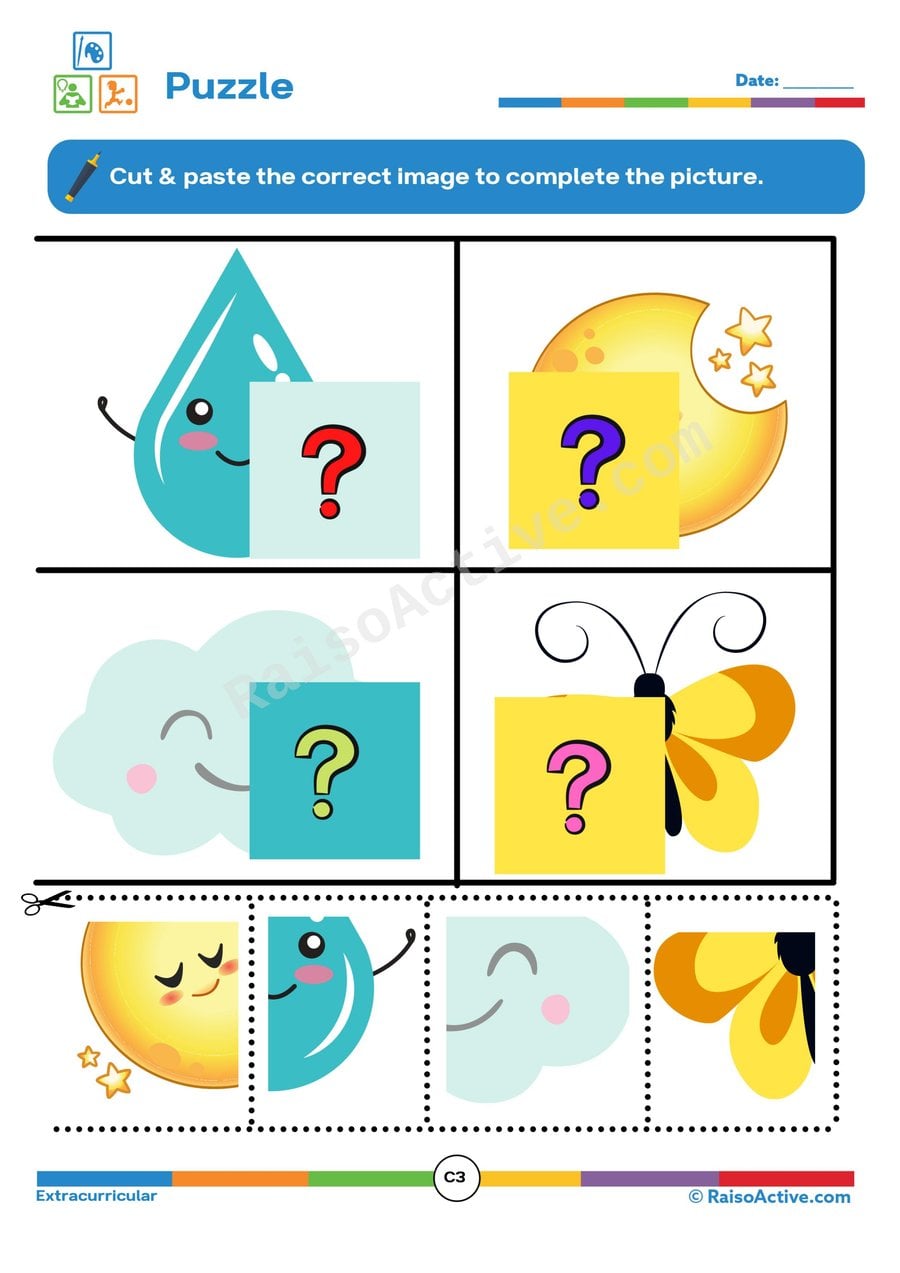
Cut and Paste Puzzle: Complete the Pictures!
Ages 3-5 · Preschool–Pre-KAges 3-5 · Nursery–ReceptionAges 3-5 · Nursery–LKGAges 3-5
This cut-and-paste puzzle challenges children ages 3-5 to visually compare cut-out image pieces to the gaps in a larger picture, strengthening visual discrimination and problem-solving as they figure out which piece fits where. Because more than one cut-out may look similar at a glance, children must attend closely to small details like color, shape, and orientation before gluing. This close visual comparison builds the same attention-to-detail skills used later in reading, where small differences between letters and words matter.
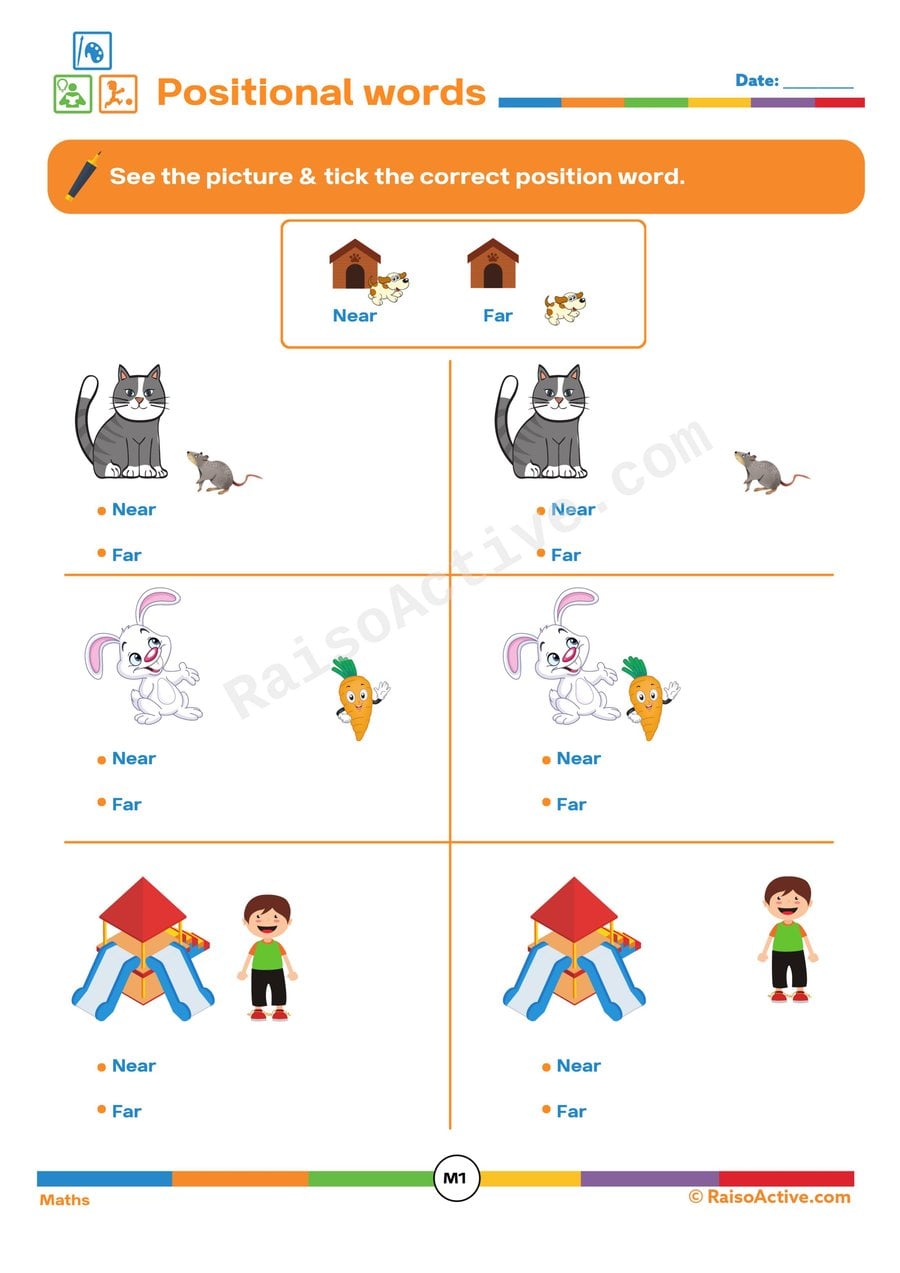
Positional Words Worksheet: Near and Far
Ages 3-5 · Preschool–Pre-KAges 3-5 · Nursery–ReceptionAges 3-5 · Nursery–LKGAges 3-5
This worksheet introduces children ages 3-5 to the positional concepts of 'near' and 'far,' asking them to look at a picture and tick the word that correctly describes an object's distance from a reference point. Positional vocabulary like this is an important building block for spatial reasoning and later geometry and direction-following skills. Because near and far are relative concepts rather than fixed labels, this practice also builds flexible thinking about how position depends on comparison.

Learn the Sight Word 'Is' - Tracing and Writing Worksheet for Preschoolers
Ages 4-5 · Pre-KAges 4-5 · ReceptionAges 4-5 · LKGAges 4-5
This worksheet helps children ages 4-5 build instant recognition of the sight word 'is' through a layered sequence of tracing, independent writing, sentence fill-in, coloring, and letter-order cut-and-paste practice. Because 'is' can't easily be sounded out using typical phonics rules, repeated multi-format exposure like this is exactly what helps a sight word move into a child's automatic reading vocabulary. Using the word inside real sentence blanks also connects the isolated word to meaningful, functional reading.

Domestic vs. Wild Animals Sorting Worksheet for Preschoolers
Ages 3-5 · Preschool–Pre-KAges 3-5 · Nursery–ReceptionAges 3-5 · Nursery–LKGAges 3-5
Sorting animal pictures into domestic and wild categories teaches children ages 3-5 early classification skills, requiring them to consider a shared trait, like whether an animal lives with humans or in the wild, rather than just naming individual animals. This kind of categorization is a foundational science and logical-thinking skill, since sorting by an abstract rule is more advanced than simply identifying objects one at a time. Cutting and gluing the animals into their correct groups also adds fine motor practice to the sorting task.

Missing Numbers: Ice Cream Fun Worksheet for Kids
Ages 3-5 · Preschool–Pre-KAges 3-5 · Nursery–ReceptionAges 3-5 · Nursery–LKGAges 3-5
This worksheet helps children ages 3-5 practice number sequencing by identifying and writing in the missing numerals within a series of ice cream cones and cars, numbers 1 through 10. Filling in a gap within an otherwise familiar sequence requires children to hold the whole counting order in mind and recognize what number logically belongs in the empty spot, which is more demanding than counting forward from the start each time. The playful ice cream and car theme keeps the repeated number practice visually engaging.
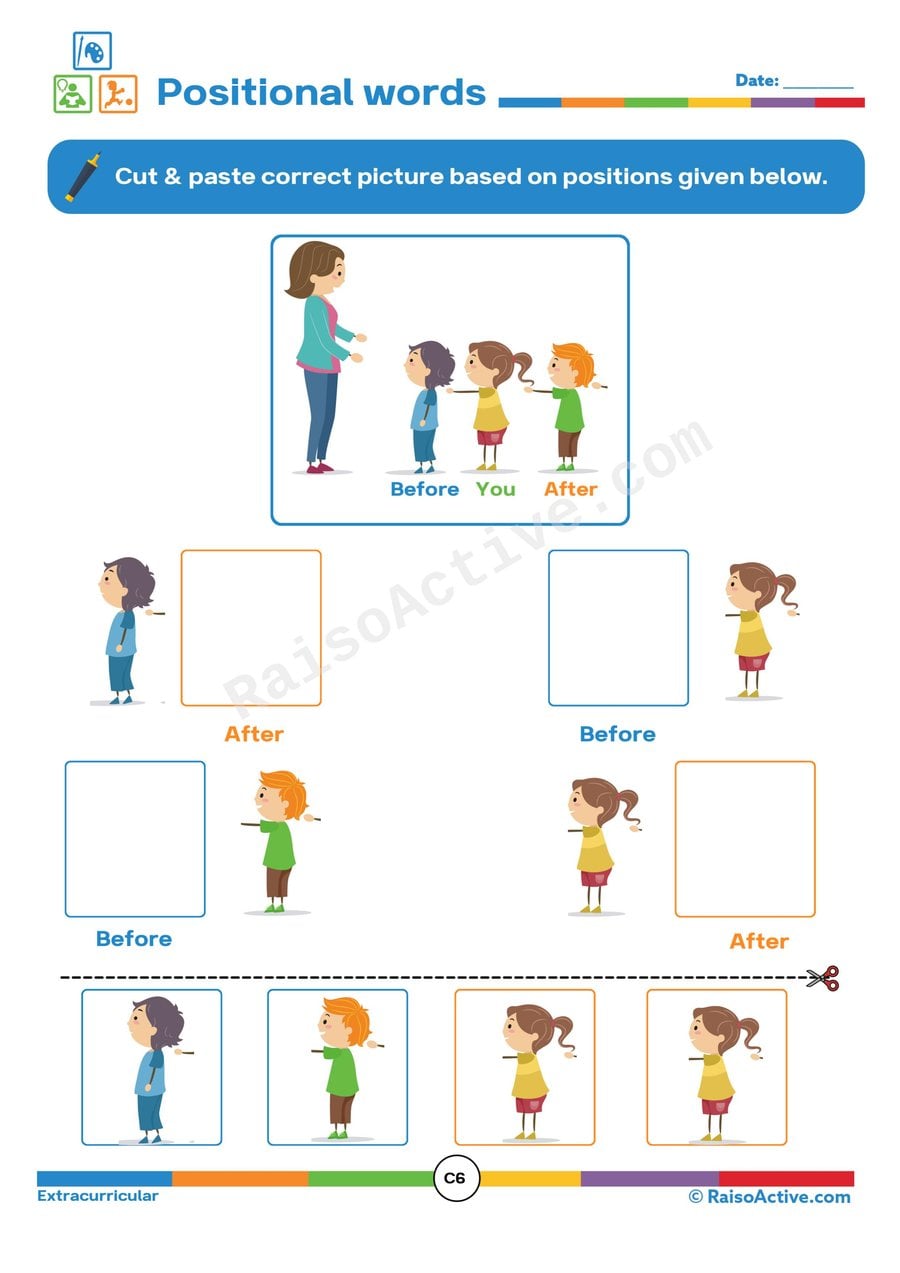
Positional Words Worksheet: Before, You, and After!
Ages 3-5 · Preschool–Pre-KAges 3-5 · Nursery–ReceptionAges 3-5 · Nursery–LKGAges 3-5
This cut-and-paste worksheet teaches children ages 3-5 to apply the positional words 'before' and 'after' to a sequence of objects or people, connecting an abstract language concept to a visual, hands-on task. Understanding order words like these is an important building block for later skills such as retelling stories in sequence and understanding time concepts like yesterday and tomorrow. Choosing and placing the correct picture also reinforces careful listening and following two-step directions.
Related worksheets
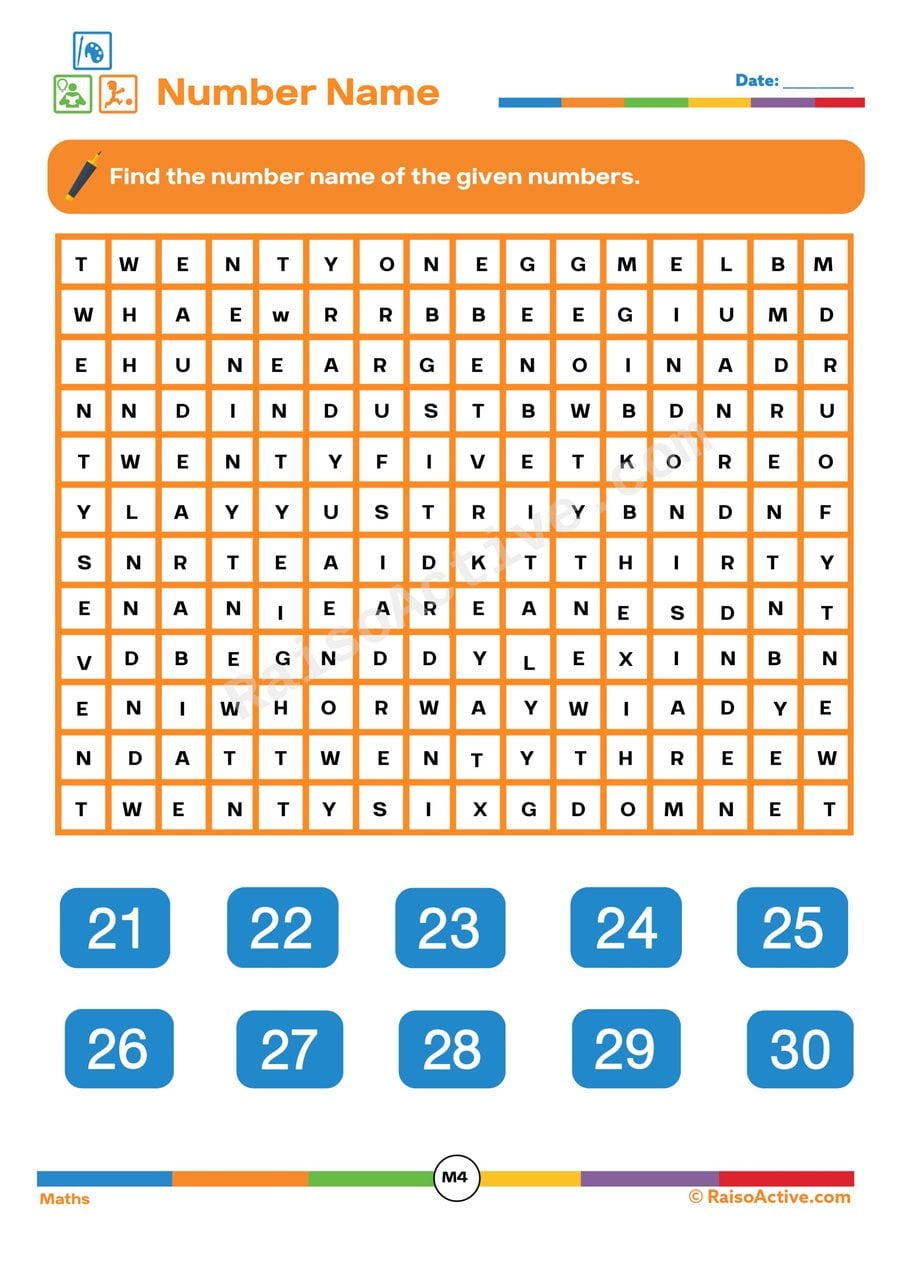
Number Name Word Search Worksheet for Kids
Ages 4-6 · Pre-K–KindergartenAges 4-6 · Reception–Year 1Ages 4-6 · LKG–UKGAges 4-6
This word search worksheet asks children ages 4-6 to visually scan a letter grid to find hidden number names, then match each found word to its numeral — combining spelling recognition, visual scanning, and number sense in one activity. Searching for whole words rather than single letters is a step up in difficulty that pushes early readers to recognize letter patterns quickly.

Place Value Beads: Count and Fill the Numbers Worksheet
Ages 3-5 · Preschool–Pre-KAges 3-5 · Nursery–ReceptionAges 3-5 · Nursery–LKGAges 3-5
Counting beads on an abacus-style picture and writing the tens and ones totals teaches children ages 3-5 place value through a visual, hands-on representation rather than abstract numerals alone. Solving the final abacus total afterward reinforces that a two-digit number is really the sum of its tens and ones parts.
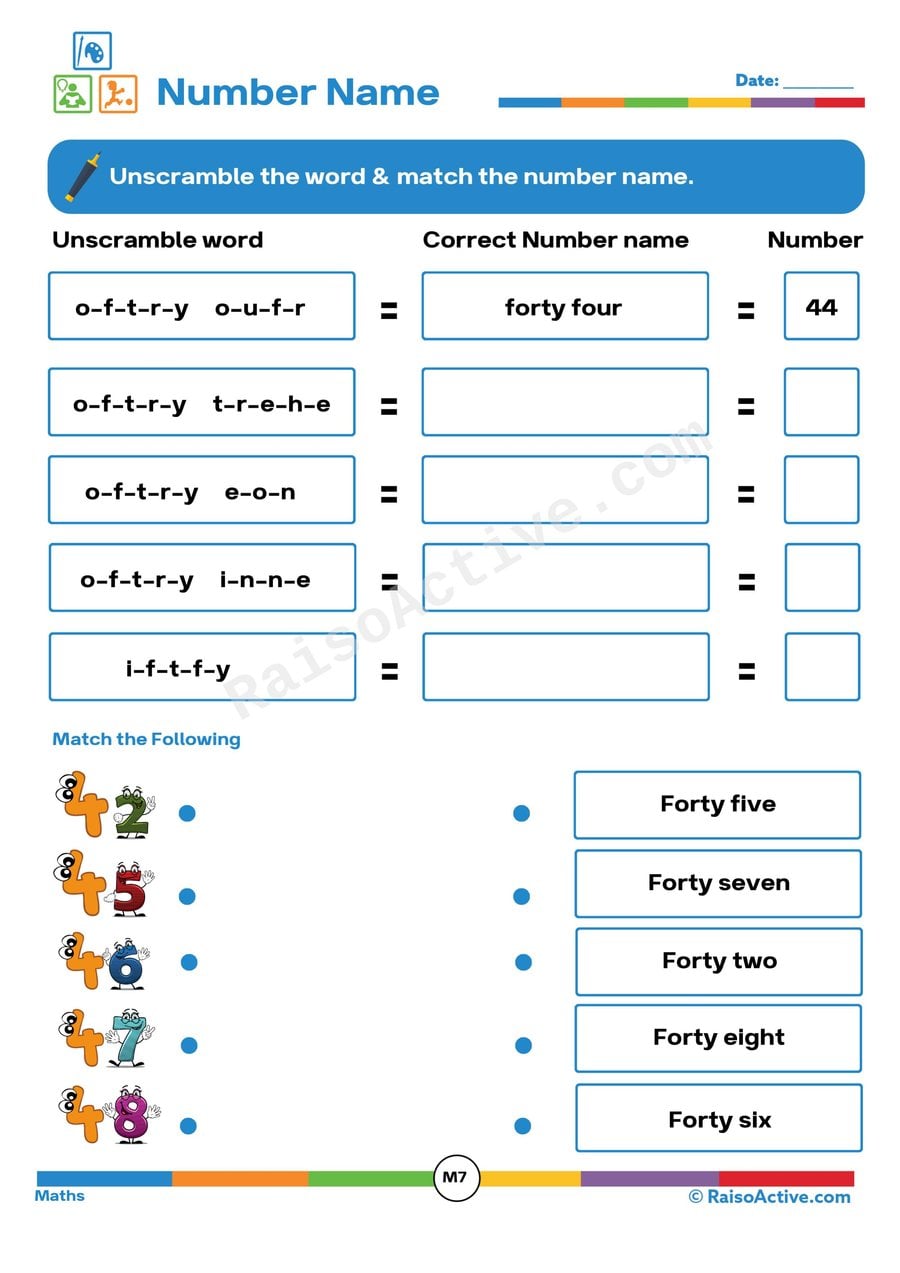
Number Name Matching Worksheet for Preschoolers
Ages 4-6 · Pre-K–KindergartenAges 4-6 · Reception–Year 1Ages 4-6 · LKG–UKGAges 4-6
This worksheet connects three related number skills at once: unscrambling a jumbled word to spell a number name correctly, writing that number name out, and then matching it to its numeral — a layered task that builds both early spelling and number recognition together. Because number-name spelling (like 'seven' or 'eight') doesn't always follow simple sound-out rules, this worksheet gives 4-6 year olds valuable repeated exposure to sight-word-style number vocabulary.

Number Names Worksheet: Addition Practice for Kids
Ages 4-6 · Pre-K–KindergartenAges 4-6 · Reception–Year 1Ages 4-6 · LKG–UKGAges 4-6
This worksheet combines addition practice with number-word writing for children ages 4-6, asking them to solve simple addition problems and then spell out the answer using its written name rather than a numeral. Requiring the answer in word form pushes children beyond calculation into applying number vocabulary correctly, reinforcing that 'seven' and '7' represent the same value. This dual task builds both math fluency and early spelling skills together.

Number Names Worksheet: Write the Missing Letters!
Ages 4-6 · Pre-K–KindergartenAges 4-6 · Reception–Year 1Ages 4-6 · LKG–UKGAges 4-6
This worksheet builds early spelling and number-word recognition as children ages 4-6 look at a numeral and fill in the missing letters to complete its written name, such as turning 'f_ve' into 'five.' Connecting the numeral, the spoken word, and its written spelling all in one task strengthens both literacy and numeracy at the same time.

Number Names Matching Worksheet for Preschoolers
Ages 4-5 · Pre-KAges 4-5 · ReceptionAges 4-5 · LKGAges 4-5
This worksheet layers two skills for children ages 4-5: unscrambling the letters of a number-name word and then matching that word to its correct numeral. Unscrambling requires children to recognize familiar letter sequences, an early word-recognition skill, while matching reinforces that written number words correspond to specific quantities. Together these tasks push number-word literacy a step further than simple copying or tracing.
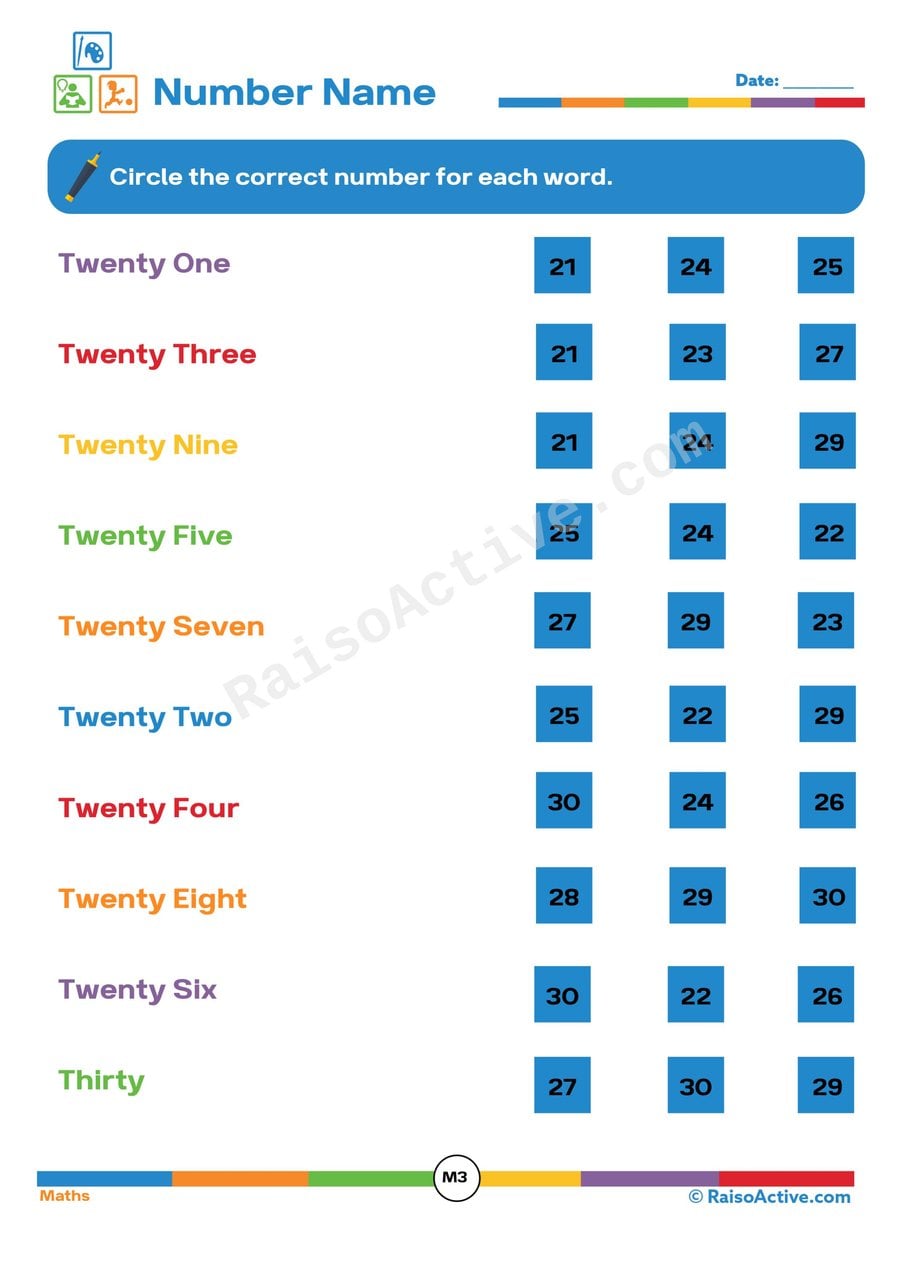
Number Names Matching Worksheet for Kids
Ages 4-6 · Pre-K–KindergartenAges 4-6 · Reception–Year 1Ages 4-6 · LKG–UKGAges 4-6
This worksheet helps children ages 4-6 connect written number words, like 'five' or 'nine,' to their numeral form by reading each word and circling the matching digit. Recognizing number names in text is a skill separate from counting objects, and it becomes important as soon as children start encountering numbers written out in books, signs, or math word problems.

Tens and Ones Counting Worksheet for Preschoolers
Ages 4-6 · Pre-K–KindergartenAges 4-6 · Reception–Year 1Ages 4-6 · LKG–UKGAges 4-6
Counting grouped tens and ones blocks introduces children ages 4-6 to place value, the idea that a two-digit number is really made up of groups of ten plus some leftover ones. This concept is foundational for understanding larger numbers and for later work with addition and subtraction that involves regrouping.
Guides for this topic

Number Formation Rhymes 0–9 and How to Fix Reversals
Original number formation rhymes for 0–9, the correct stroke order for each digit, why 3, 5 and 7 get reversed most often, and multisensory fixes that work.

Best Worksheets for 3-Year-Olds: What Works and What to Avoid
What works on worksheets for 3-year-olds: short sessions, crayons, tracing lines, matching, cutting, a free weekly plan, and signs one is too advanced.

Age-Appropriate Problem-Solving Activities: Building Critical Thinkers from the Ground Up
Discover fun, age-appropriate problem-solving activities for children ages 1-8. Build critical thinking, logic, and reasoning skills through play-based learning.
Reviews
Every worksheet for ages 3–5, no watermark
Members download the full library of 1,000+ worksheets and every activity pack without watermarks or daily limits. One year costs ₹999 in India or $20 elsewhere.
See membership plansOr download any worksheet free with a watermark (5 a day).