Number Names Matching Worksheet for Kids
This worksheet helps children ages 4-6 connect written number words, like 'five' or 'nine,' to their numeral form by reading each word and circling the matching digit. Recognizing number names in text is a skill separate from counting objects, and it becomes important as soon as children start encountering numbers written out in books, signs, or math word problems.
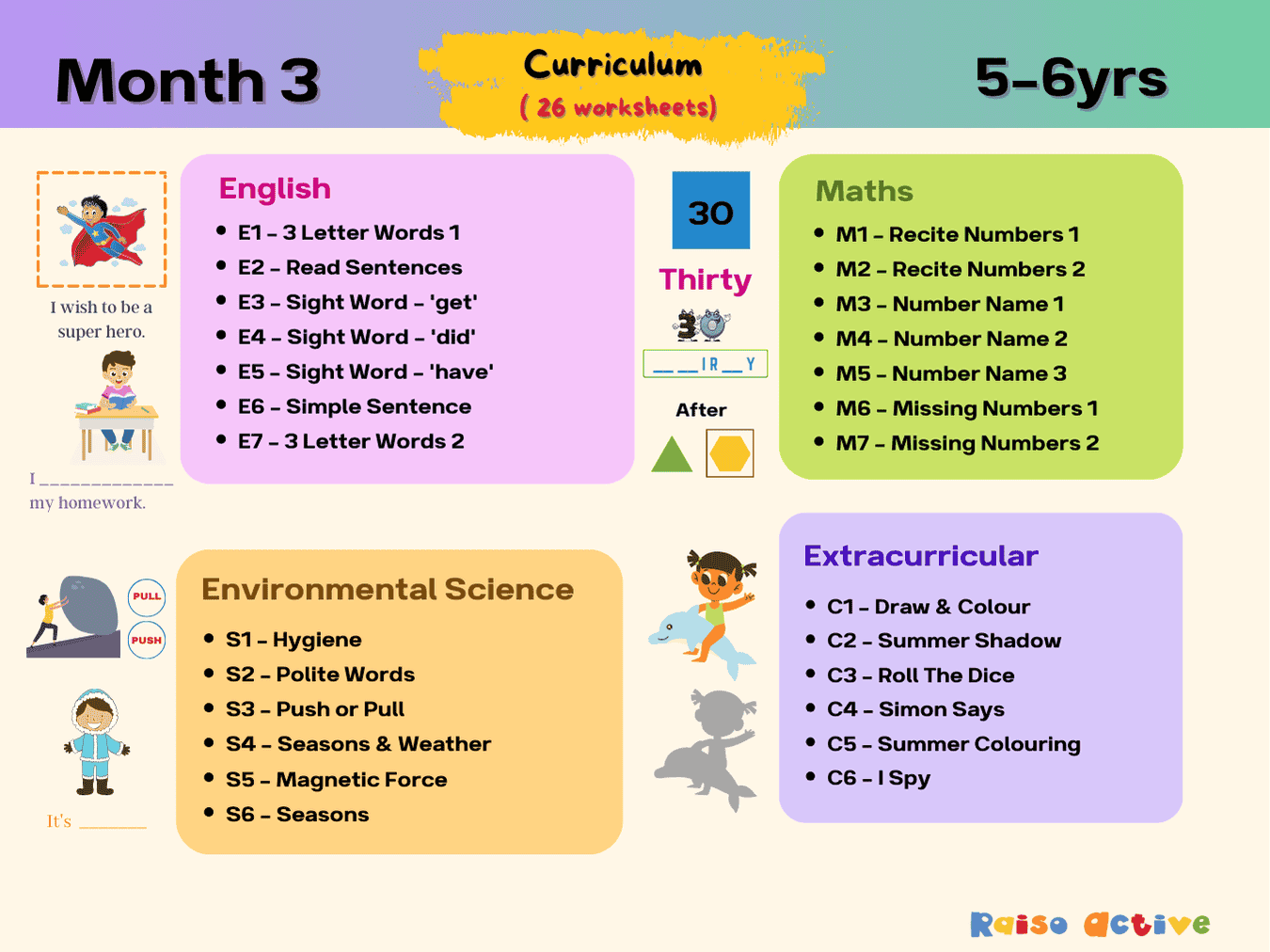
Part of the pack
Month 3: Learning & Development | Ages 5-6
This is page 13 of the pack. Ages 5-6 · KindergartenAges 5-6 · Year 1Ages 5-6 · UKGAges 5-6

Made for your child
Counting to 10, made for your child
A maths pack with your child's name in it: pictures that explain, practice at three levels, puzzles and story sums about them. Print a new set whenever they finish.
Make a maths packFree preview · free for members
Curriculum
- Number Recognition > Number Names
How to use this worksheet
Read the first number name aloud together, sounding it out slowly if needed. Ask your child which numeral they think it matches before looking at the choices provided. Have them circle the correct numeral for that word, then repeat the process for each remaining number name on the page. Once finished, go back through the page and have your child read each number name aloud one more time, pointing to the numeral they circled.
Materials needed
- Pencil
- Eraser
Extension activities
- 1Make matching cards with number words on one set and numerals on another, and play a memory-style matching game.
- 2Write a number word on paper and ask your child to draw that many objects to match it.
- 3Look for number words on food packaging, signs, or in books and point them out together.
- 4Practice writing the number names themselves, copying from the worksheet onto a blank sheet.
- 5Play 'number word bingo' using a simple homemade card with number words instead of numerals.

Written by
Hemsweta Jain · Teacher Cheena
MBA and Early Childhood Educator, teaching since 2014 · Founder of RaisoActive, Mumbai
Every RaisoActive worksheet is designed and checked by the founder before publishing.
Published · Last reviewed
More from Month 3: Learning & Development | Ages 5-6

Magnetic Force Worksheet: Test Objects with a Magnet!
Ages 4-6 · Pre-K–KindergartenAges 4-6 · Reception–Year 1Ages 4-6 · LKG–UKGAges 4-6
This hands-on science worksheet has children ages 4-6 test a range of everyday objects with a real magnet and record whether each one is magnetic or non-magnetic, building early scientific method skills like predicting, testing, and recording results. Discovering firsthand that magnetism depends on material (metal versus wood or plastic, for instance) rather than size or color is a genuine, memorable science concept at this age.

Seasons and Weather Worksheet: Fill in the Blanks!
Ages 3-5 · Preschool–Pre-KAges 3-5 · Nursery–ReceptionAges 3-5 · Nursery–LKGAges 3-5
This worksheet builds early science vocabulary by asking children to fill in blanks connecting each of the four seasons to its typical weather, such as snow in winter or sunshine in summer. For three- to five-year-olds, tying weather words to the season they experience it in helps organize their everyday observations of the world into a simple, memorable framework.

Golden Words Worksheet: Practice Using 'Excuse Me', 'Please', 'Thank You', and 'Sorry'
Ages 3-5 · Preschool–Pre-KAges 3-5 · Nursery–ReceptionAges 3-5 · Nursery–LKGAges 3-5
This worksheet teaches children ages 3-5 when and how to use four essential polite phrases — 'Excuse Me,' 'Please,' 'Thank You,' and 'Sorry' — by choosing the correct one to complete everyday social scenarios. Learning to match the right polite phrase to the right situation, rather than just memorizing the words, builds real social communication skills that children use constantly in daily interactions.
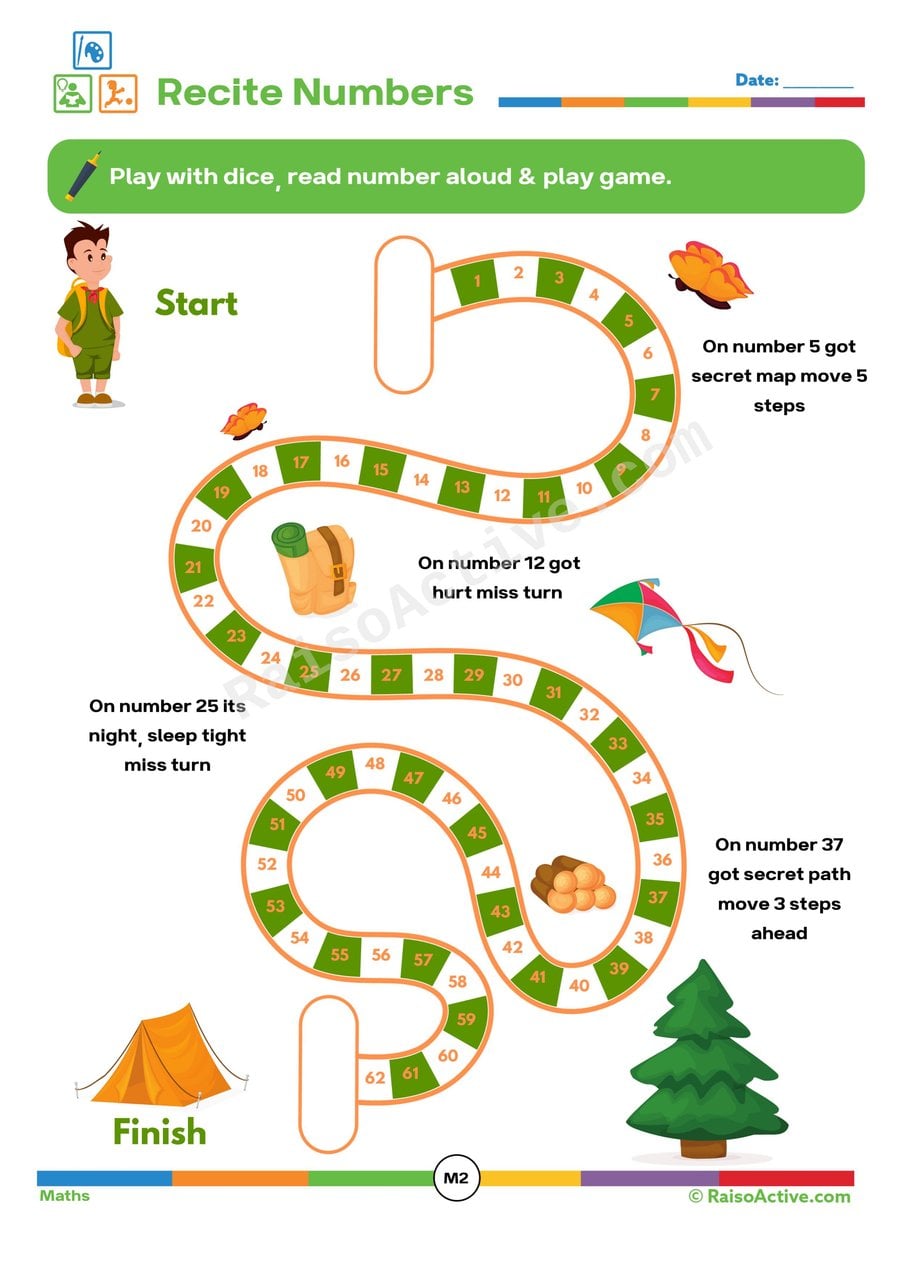
Recite Numbers Game Worksheet for Kids
Ages 4-6 · Pre-K–KindergartenAges 4-6 · Reception–Year 1Ages 4-6 · LKG–UKGAges 4-6
This game-based worksheet helps children ages 4-6 practice number recognition and following multi-step directions as they roll a die, move along a numbered path, and read each number aloud when they land on it. Turning number practice into a game increases motivation and repetition, both of which are key to building automatic number recognition.

Read and Match: Sentence Matching Worksheet for Preschoolers
Ages 4-5 · Pre-KAges 4-5 · ReceptionAges 4-5 · LKGAges 4-5
Reading a simple sentence and finding its matching picture teaches children ages 4-5 to connect written words directly to meaning, an essential comprehension skill that goes beyond simply decoding individual words. The cut-and-paste format also adds fine motor practice, requiring children to select the correct image from several options and place it precisely next to its sentence.
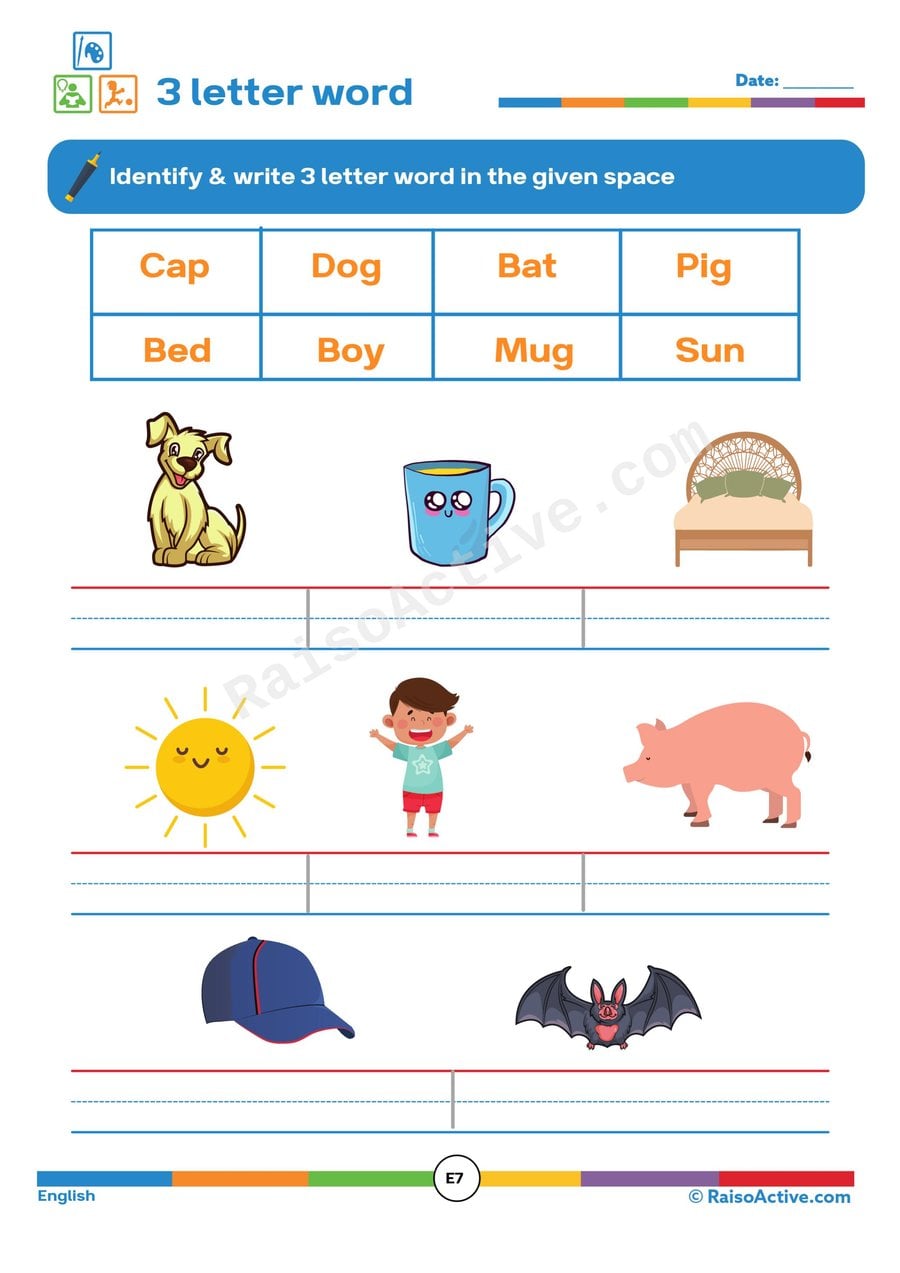
3-Letter Word Fun: Identify and Write! (Worksheet)
Ages 3-5 · Preschool–Pre-KAges 3-5 · Nursery–ReceptionAges 3-5 · Nursery–LKGAges 3-5
This worksheet strengthens CVC (consonant-vowel-consonant) word recognition by having children match a picture to its correct 3-letter word and then write that word themselves. For three- to five-year-olds, writing out a decoded word — not just reading it — cements the connection between letter sounds and spelling, an important step toward independent writing.

Draw & Color: Under, Over, and Above the Water Worksheet
Ages 3-5 · Preschool–Pre-KAges 3-5 · Nursery–ReceptionAges 3-5 · Nursery–LKGAges 3-5
This open-ended drawing worksheet asks children ages 3-5 to place creatures and objects under, above, and at water level, building early understanding of positional and spatial vocabulary within a real-world context. Drawing something for each of three distinct zones also encourages children to organize their ideas into categories before putting pencil to paper.
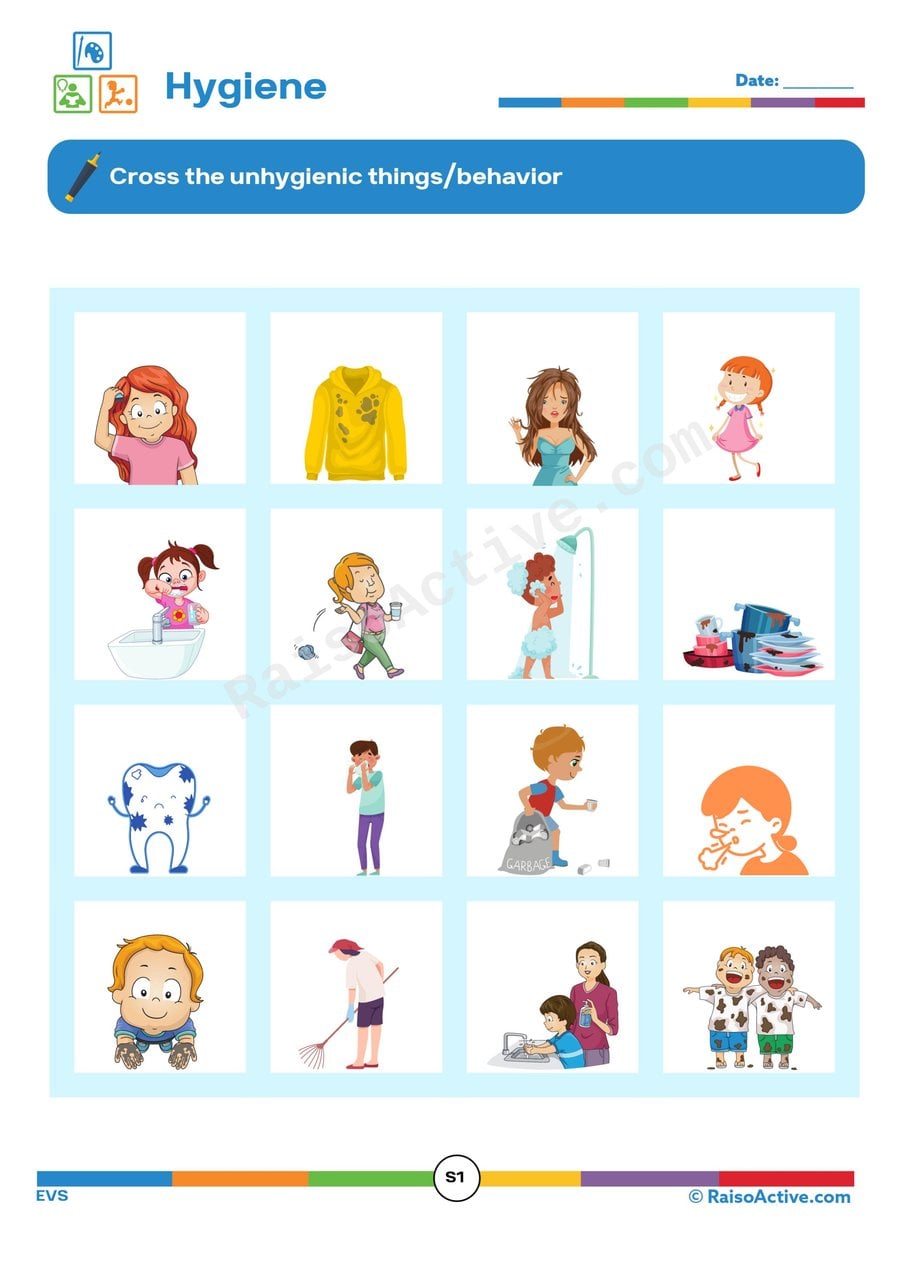
Hygiene Worksheet: Identify Unhygienic Behaviors
Ages 3-5 · Preschool–Pre-KAges 3-5 · Nursery–ReceptionAges 3-5 · Nursery–LKGAges 3-5
This worksheet asks children ages 3-5 to look at pictures of everyday scenes and cross out the behaviors that are unhygienic, building their ability to recognize the difference between healthy and unhealthy habits in a visual, concrete way. Identifying what's wrong in a picture, rather than just being told a rule, encourages children to reason about hygiene rather than simply memorize it.
Related worksheets

Number Path: Help the Boy Reach His House! (Numbers 41-50)
Ages 4-6 · Pre-K–KindergartenAges 4-6 · Reception–Year 1Ages 4-6 · LKG–UKGAges 4-6
This maze worksheet takes 4-6 year olds into two-digit number territory, asking them to recognize and sequence numbers 41 through 50 in order to trace a path — a step up in difficulty from single-digit counting since two-digit numbers are easy to reverse or confuse (41 versus 14). Tracing the connecting line also keeps pencil control and hand-eye coordination in play alongside the number work, and the payoff of guiding the boy home gives the counting task a clear, motivating goal.
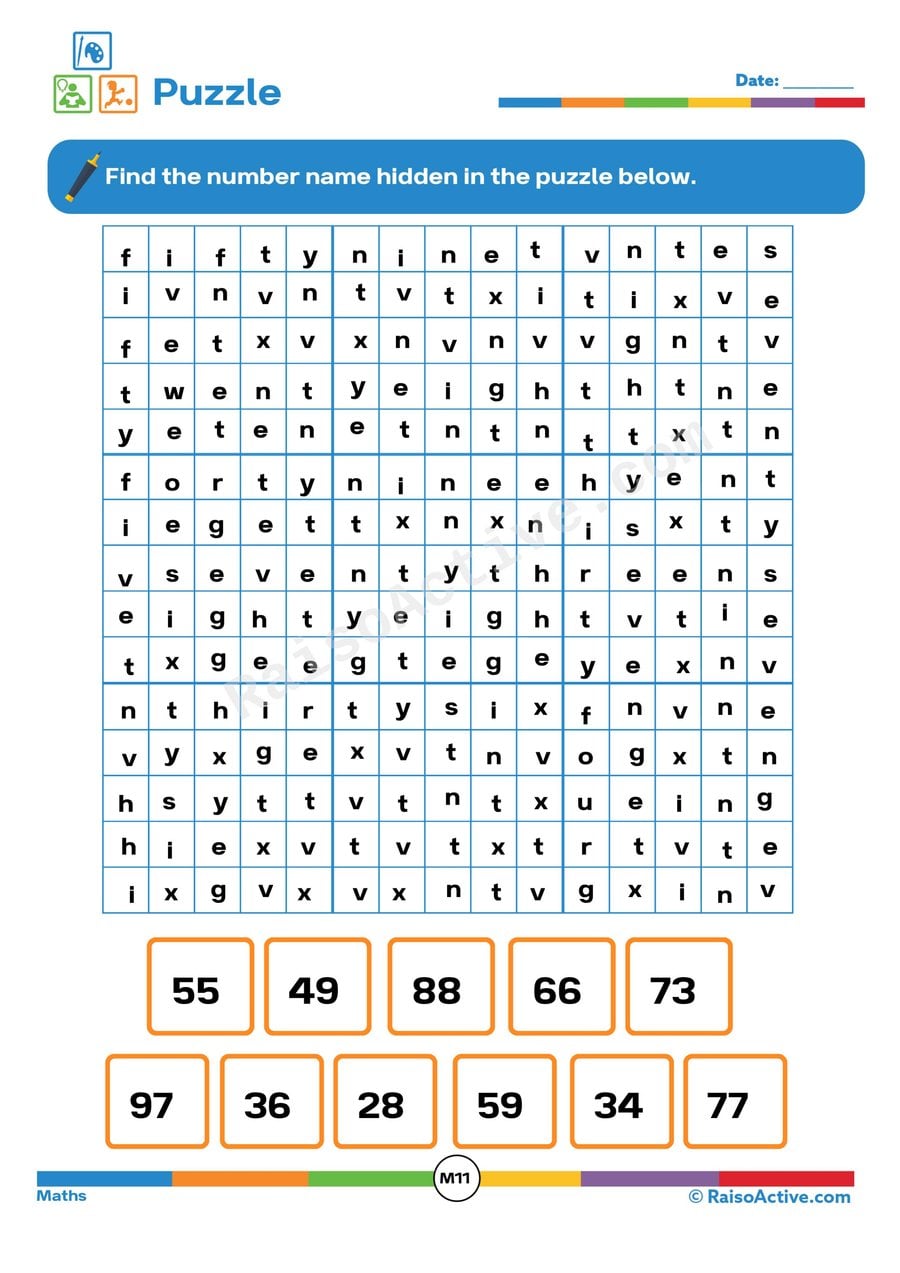
Number Name Word Search Worksheet for Kids
Ages 4-6 · Pre-K–KindergartenAges 4-6 · Reception–Year 1Ages 4-6 · LKG–UKGAges 4-6
Searching a grid of letters to find hidden number names, like 'seven' or 'twelve,' asks children ages 4-6 to recognize whole written words by sight, a skill that goes beyond sounding out letters one at a time. This word search format also builds visual scanning and sustained attention, since children must check rows, columns, and sometimes diagonals systematically rather than glancing randomly. Matching each found word back to its corresponding number afterward reinforces the link between a number's name, its written word form, and its numeral.

Tens and Ones Counting Worksheet for Preschoolers
Ages 4-6 · Pre-K–KindergartenAges 4-6 · Reception–Year 1Ages 4-6 · LKG–UKGAges 4-6
Counting grouped tens and ones blocks introduces children ages 4-6 to place value, the idea that a two-digit number is really made up of groups of ten plus some leftover ones. This concept is foundational for understanding larger numbers and for later work with addition and subtraction that involves regrouping.
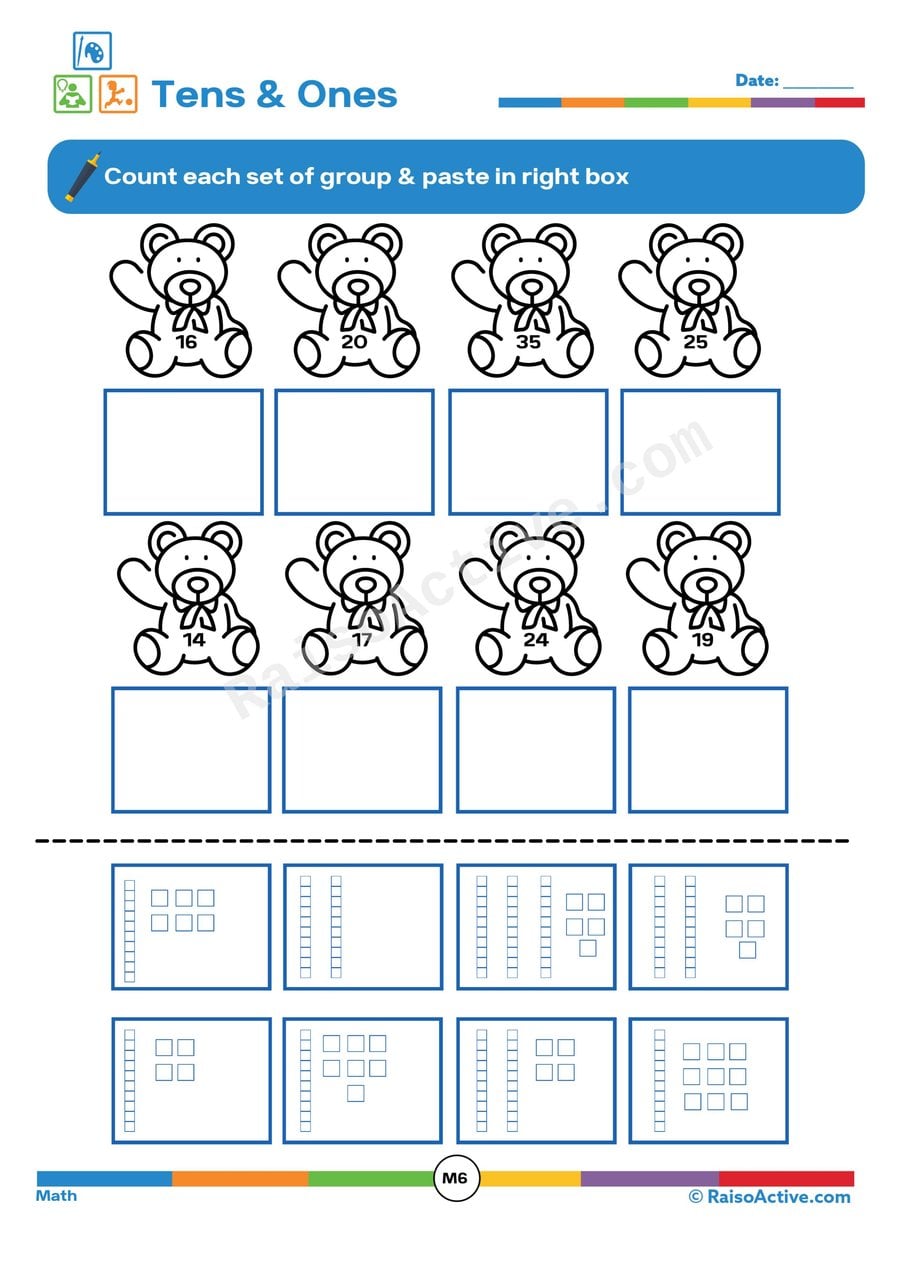
Count and Paste! Tens and Ones Worksheet
Ages 4-6 · Pre-K–KindergartenAges 4-6 · Reception–Year 1Ages 4-6 · LKG–UKGAges 4-6
Counting groups of teddy bears and then matching each total to its tens-and-ones representation teaches children ages 4-6 to connect a counted quantity with its place value breakdown, reinforcing that numbers can be represented in more than one way. Cutting and pasting the matching representation adds fine motor practice to the counting and place value work.
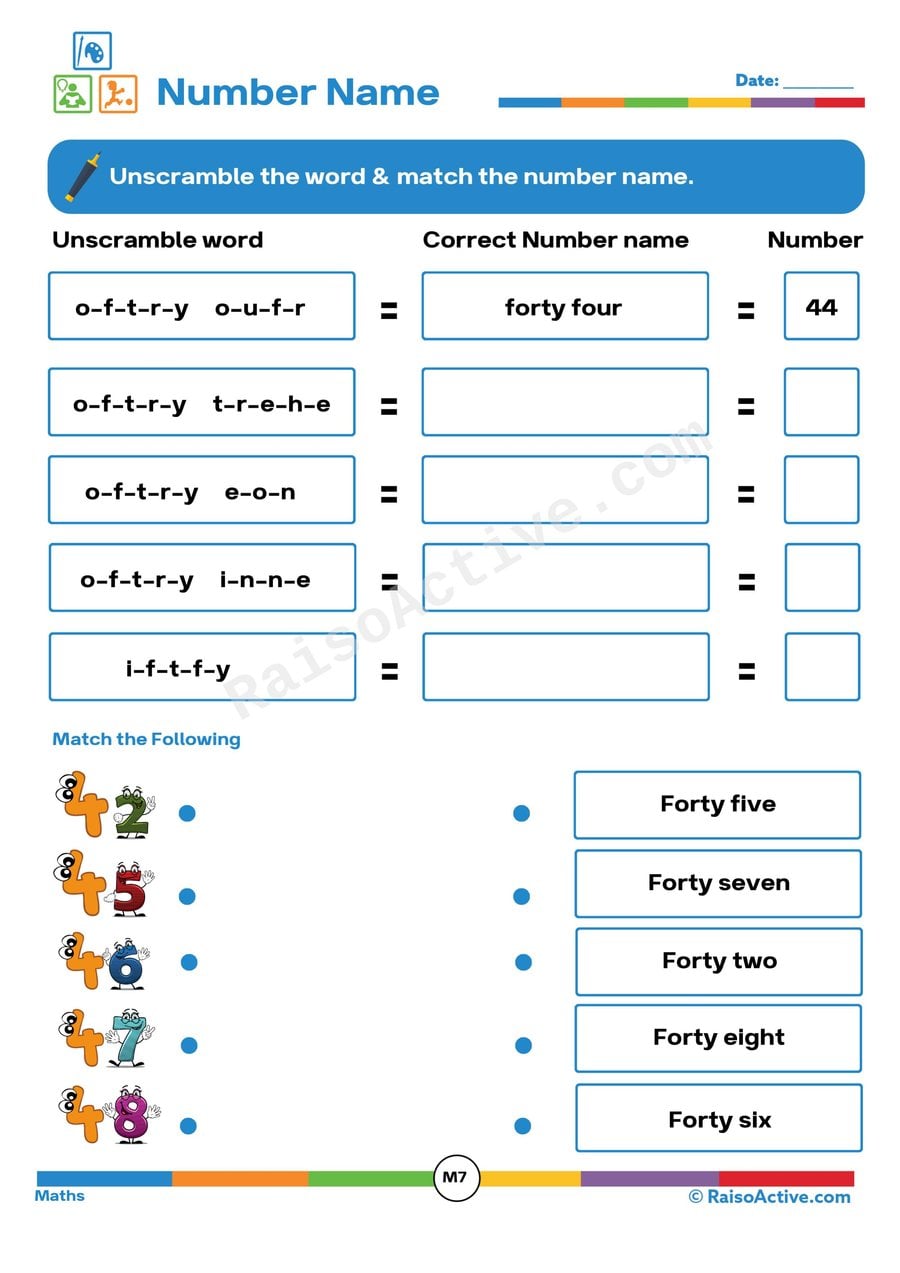
Number Name Matching Worksheet for Preschoolers
Ages 4-6 · Pre-K–KindergartenAges 4-6 · Reception–Year 1Ages 4-6 · LKG–UKGAges 4-6
This worksheet connects three related number skills at once: unscrambling a jumbled word to spell a number name correctly, writing that number name out, and then matching it to its numeral — a layered task that builds both early spelling and number recognition together. Because number-name spelling (like 'seven' or 'eight') doesn't always follow simple sound-out rules, this worksheet gives 4-6 year olds valuable repeated exposure to sight-word-style number vocabulary.

Number Names Matching Worksheet for Preschoolers
Ages 3-5 · Preschool–Pre-KAges 3-5 · Nursery–ReceptionAges 3-5 · Nursery–LKGAges 3-5
This worksheet helps children ages 3-5 connect written number words — like 'three' or 'seven' — to their matching numerals, an important step beyond simple numeral recognition toward full number literacy. Drawing a line from a number name to the numeral it stands for requires children to read or recall the word and hold it in mind while scanning for its match, which builds working memory alongside early reading and number skills.

Solar System Number Matching Worksheet for Preschoolers
Ages 4-6 · Pre-K–KindergartenAges 4-6 · Reception–Year 1Ages 4-6 · LKG–UKGAges 4-6
This worksheet combines number-word recognition with a color-by-key coloring task for children ages 4-6, asking them to match number names written on planets to their corresponding numerals before coloring each planet according to a color code. Matching written number words in a space-themed context adds novelty that keeps repeated number-word practice fresh, while the color-key step reinforces careful, sequential following of visual instructions. Together, these two tasks combine literacy and numeracy practice in one engaging page.

Place Value Beads: Count and Fill the Numbers Worksheet
Ages 3-5 · Preschool–Pre-KAges 3-5 · Nursery–ReceptionAges 3-5 · Nursery–LKGAges 3-5
Counting beads on an abacus-style picture and writing the tens and ones totals teaches children ages 3-5 place value through a visual, hands-on representation rather than abstract numerals alone. Solving the final abacus total afterward reinforces that a two-digit number is really the sum of its tens and ones parts.
Guides for this topic

Number Formation Rhymes 0–9 and How to Fix Reversals
Original number formation rhymes for 0–9, the correct stroke order for each digit, why 3, 5 and 7 get reversed most often, and multisensory fixes that work.

Best Worksheets for 3-Year-Olds: What Works and What to Avoid
What works on worksheets for 3-year-olds: short sessions, crayons, tracing lines, matching, cutting, a free weekly plan, and signs one is too advanced.
What's the Best Alternative to ABCmouse? A Complete Parent's Guide to Free and Affordable Educational Apps
ABCmouse runs ~Rs 4,000-5,000/year with US spellings and curriculum. Compare free & affordable Indian-friendly apps like Khan Academy Kids and DIKSHA.
Reviews
Every worksheet for ages 4–6, no watermark
Members download the full library of 1,000+ worksheets and every activity pack without watermarks or daily limits. One year costs ₹999 in India or $20 elsewhere.
See membership plansOr download any worksheet free with a watermark (5 a day).