Hygiene Worksheet: Identify Unhygienic Behaviors
This worksheet asks children ages 3-5 to look at pictures of everyday scenes and cross out the behaviors that are unhygienic, building their ability to recognize the difference between healthy and unhealthy habits in a visual, concrete way. Identifying what's wrong in a picture, rather than just being told a rule, encourages children to reason about hygiene rather than simply memorize it.
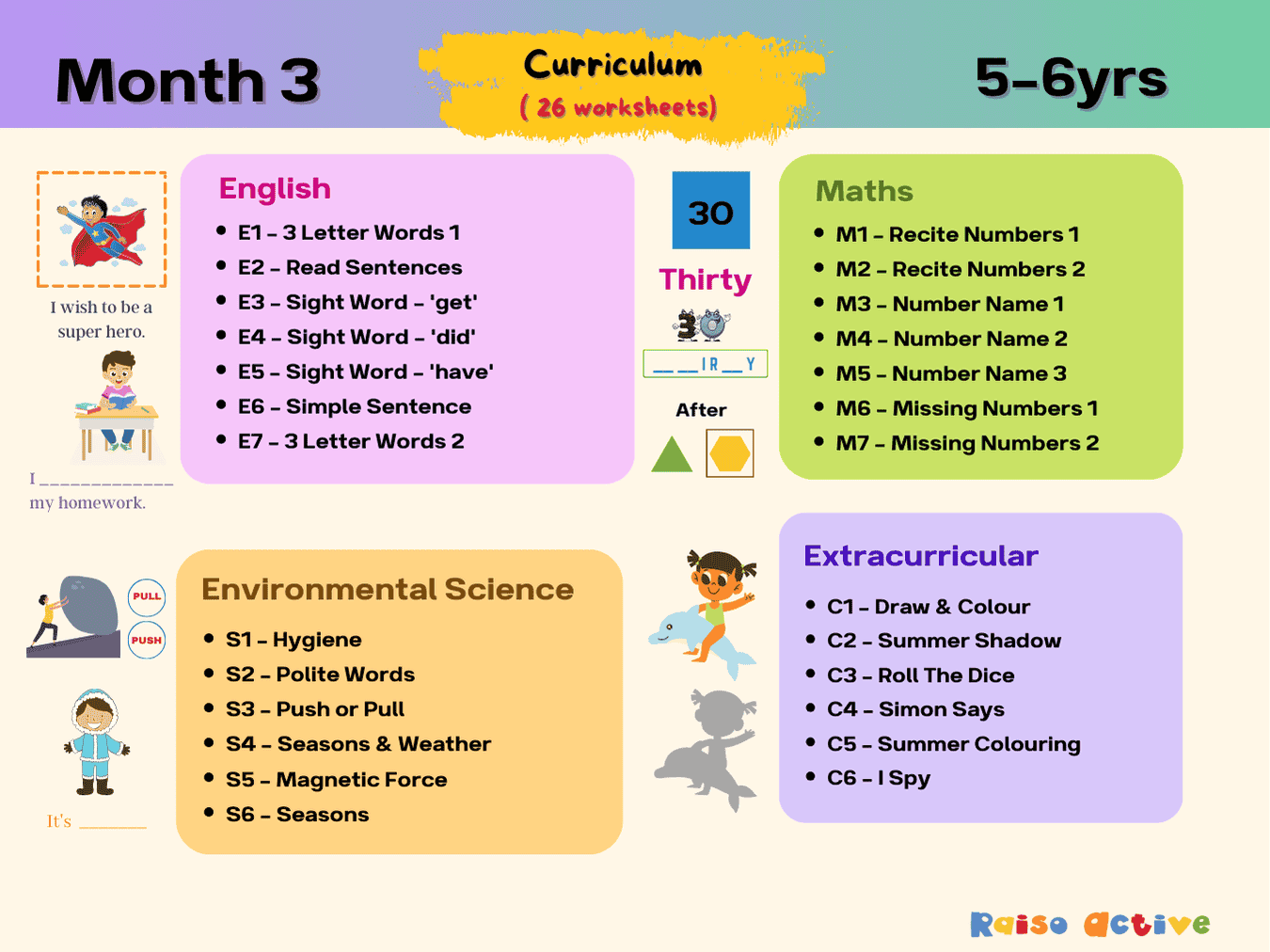
Part of the pack
Month 3: Learning & Development | Ages 5-6
This is page 18 of the pack. Ages 5-6 · KindergartenAges 5-6 · Year 1Ages 5-6 · UKGAges 5-6
Curriculum
- Health & Hygiene > Hygiene
How to use this worksheet
Look at each picture together and describe what's happening in the scene. Ask your child whether the behavior shown is a healthy habit or an unhygienic one, and why. Have them cross out the pictures or actions that show unhygienic behavior, like not washing hands or sharing a toothbrush. Once finished, go back through the page and talk about what the correct, hygienic version of each behavior would look like instead.
Materials needed
- Pencil
- Crayons
Extension activities
- 1Act out the correct version of each crossed-out behavior, like properly washing hands with soap for 20 seconds.
- 2Make a hygiene habits chart to track handwashing, toothbrushing, and bathing over a week.
- 3Draw a picture showing a child doing something hygienic, like covering a cough or washing fruit before eating.
- 4Read a story about germs or hygiene and talk about how the characters keep themselves healthy.
- 5Create a simple hygiene poster together to hang near the bathroom or kitchen sink.

Written by
Hemsweta Jain · Teacher Cheena
MBA and Early Childhood Educator, teaching since 2014 · Founder of RaisoActive, Mumbai
Every RaisoActive worksheet is designed and checked by the founder before publishing.
Published · Last reviewed
More from Month 3: Learning & Development | Ages 5-6

Summer Coloring Fun: Color the Summer-Related Objects!
Ages 3-5 · Preschool–Pre-KAges 3-5 · Nursery–ReceptionAges 3-5 · Nursery–LKGAges 3-5
This worksheet builds vocabulary and category recognition for children ages 3-5 as they color a collection of objects associated with summer, like sunglasses, ice cream, or a beach ball, reinforcing that certain items belong together under a seasonal theme. Coloring within outlined shapes also continues to build the fine motor control and hand strength children need for future writing.

Parent's Guide: Fun Activities for Reading, Forces, and Movement!
Ages 3-5 · Preschool–Pre-KAges 3-5 · Nursery–ReceptionAges 3-5 · Nursery–LKGAges 3-5
This multi-part guide walks parents and children ages 3-5 through several linked activities in one sitting — practicing 3-letter words, arranging simple sentences, discussing cleanliness habits, and exploring forces and movement with magnets — giving a broad snapshot of early literacy and science skills in a single session. Covering reading and science side by side in one guide shows how everyday routines can double as learning moments.

Golden Words Worksheet: Practice Using 'Excuse Me', 'Please', 'Thank You', and 'Sorry'
Ages 3-5 · Preschool–Pre-KAges 3-5 · Nursery–ReceptionAges 3-5 · Nursery–LKGAges 3-5
This worksheet teaches children ages 3-5 when and how to use four essential polite phrases — 'Excuse Me,' 'Please,' 'Thank You,' and 'Sorry' — by choosing the correct one to complete everyday social scenarios. Learning to match the right polite phrase to the right situation, rather than just memorizing the words, builds real social communication skills that children use constantly in daily interactions.
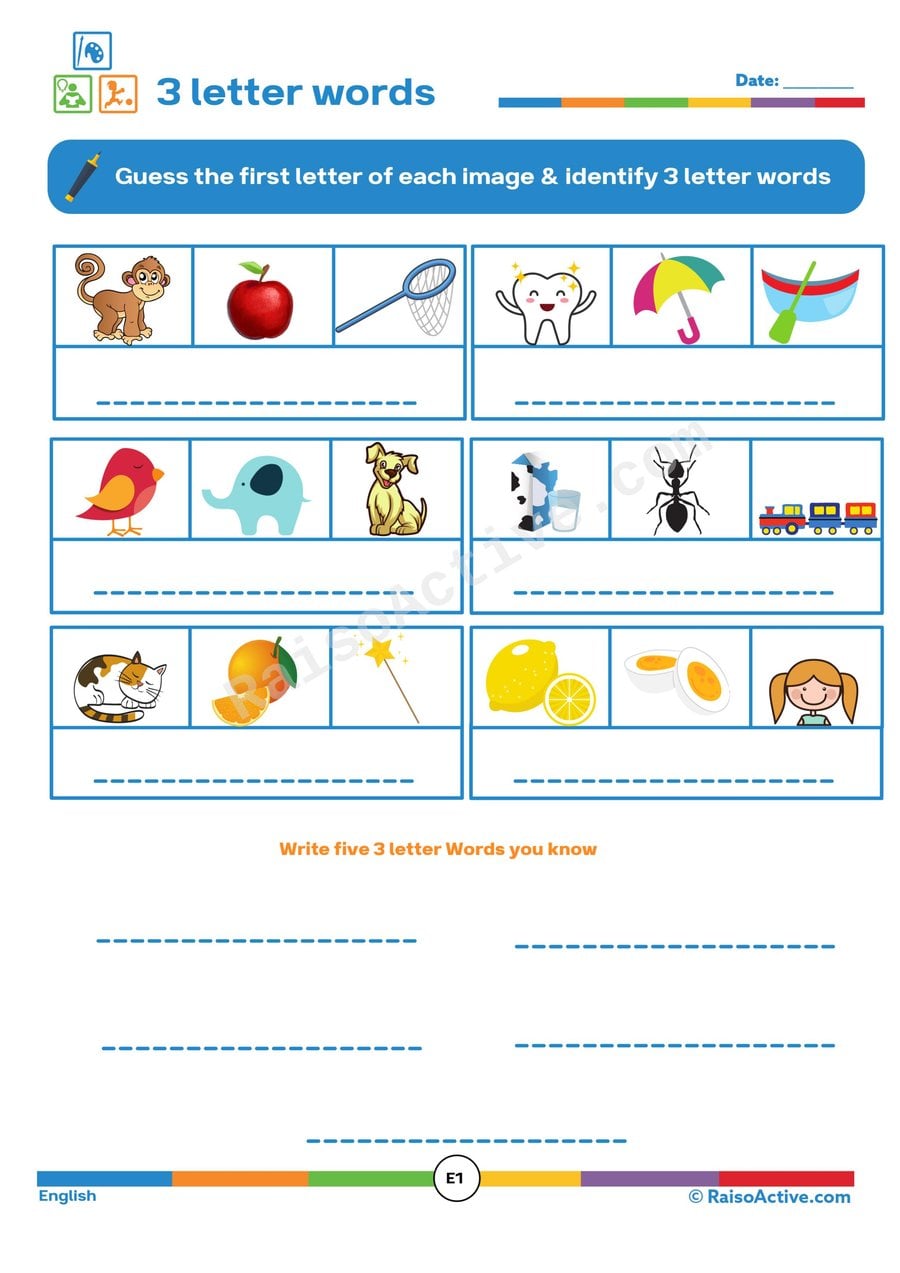
3-Letter Word Fun: Identify and Write! (Ages 3-5)
Ages 3-5 · Preschool–Pre-KAges 3-5 · Nursery–ReceptionAges 3-5 · Nursery–LKGAges 3-5
This worksheet asks children ages 3-5 to identify the beginning sound of a picture and use it to write a complete 3-letter word, moving them from single-letter sounds toward blending sounds into whole words — a key early step in phonics. The final task of writing five known 3-letter words independently also checks how much of this blending skill has transferred beyond the guided examples.

Number Names Worksheet: Write the Missing Letters!
Ages 4-6 · Pre-K–KindergartenAges 4-6 · Reception–Year 1Ages 4-6 · LKG–UKGAges 4-6
This worksheet builds early spelling and number-word recognition as children ages 4-6 look at a numeral and fill in the missing letters to complete its written name, such as turning 'f_ve' into 'five.' Connecting the numeral, the spoken word, and its written spelling all in one task strengthens both literacy and numeracy at the same time.

Seasons Cut and Paste Worksheet for Preschoolers
Ages 3-5 · Preschool–Pre-KAges 3-5 · Nursery–ReceptionAges 3-5 · Nursery–LKGAges 3-5
Children ages 3-5 build early science vocabulary and classification skills as they identify the four seasons and match seasonal pictures — like snowflakes, flowers, or sunhats — to the correct season circle. Understanding that weather and clothing change in predictable patterns throughout the year is a foundational science concept that also supports calendar and time awareness.

Missing Numbers Worksheet: Before, Between, and After
Ages 4-6 · Pre-K–KindergartenAges 4-6 · Reception–Year 1Ages 4-6 · LKG–UKGAges 4-6
This worksheet asks children ages 4-6 to fill in missing numbers that come before, between, or after given numbers in a sequence, building a deeper understanding of number order than simple counting alone. Recognizing what number is missing from a sequence requires children to mentally hold the number line and reason about relative position, a skill that supports later addition and subtraction.

Magnetic Force Worksheet: Test Objects with a Magnet!
Ages 4-6 · Pre-K–KindergartenAges 4-6 · Reception–Year 1Ages 4-6 · LKG–UKGAges 4-6
This hands-on science worksheet has children ages 4-6 test a range of everyday objects with a real magnet and record whether each one is magnetic or non-magnetic, building early scientific method skills like predicting, testing, and recording results. Discovering firsthand that magnetism depends on material (metal versus wood or plastic, for instance) rather than size or color is a genuine, memorable science concept at this age.
Related worksheets

Cleanliness Worksheet: Match Body Parts to Cleaning Tools!
Ages 3-5 · Preschool–Pre-KAges 3-5 · Nursery–ReceptionAges 3-5 · Nursery–LKGAges 3-5
This matching worksheet builds hygiene awareness by asking 3-5 year olds to connect specific body parts — teeth, hands, hair — to the correct cleaning tool for each one, like a toothbrush, soap, or shampoo. That pairing goes beyond simply naming hygiene items; it requires your child to reason about which tool actually does the job for which body part, which is the beginning of understanding personal care routines rather than just memorizing object names.

Cleanliness Worksheet: Tick the Items to Clean Our Body!
Ages 3-5 · Preschool–Pre-KAges 3-5 · Nursery–ReceptionAges 3-5 · Nursery–LKGAges 3-5
Ticking the items used to clean our bodies helps children ages 3-5 build hygiene vocabulary and practice classification, deciding which objects belong to a category based on their purpose rather than just their appearance. This early sorting skill also supports independence in self-care routines like washing and brushing.

Clean Hands Worksheet: Germs and Handwashing Experiment
Ages 4-6 · Pre-K–KindergartenAges 4-6 · Reception–Year 1Ages 4-6 · LKG–UKGAges 4-6
This worksheet teaches children ages 4-6 the science behind why handwashing matters through a simple, visual experiment demonstrating how germs (represented by something like glitter or oil) transfer between hands and spread easily, then how washing removes them. Seeing germs 'in action' makes an invisible concept concrete, helping children understand the real reason behind a daily hygiene habit rather than just following a rule.
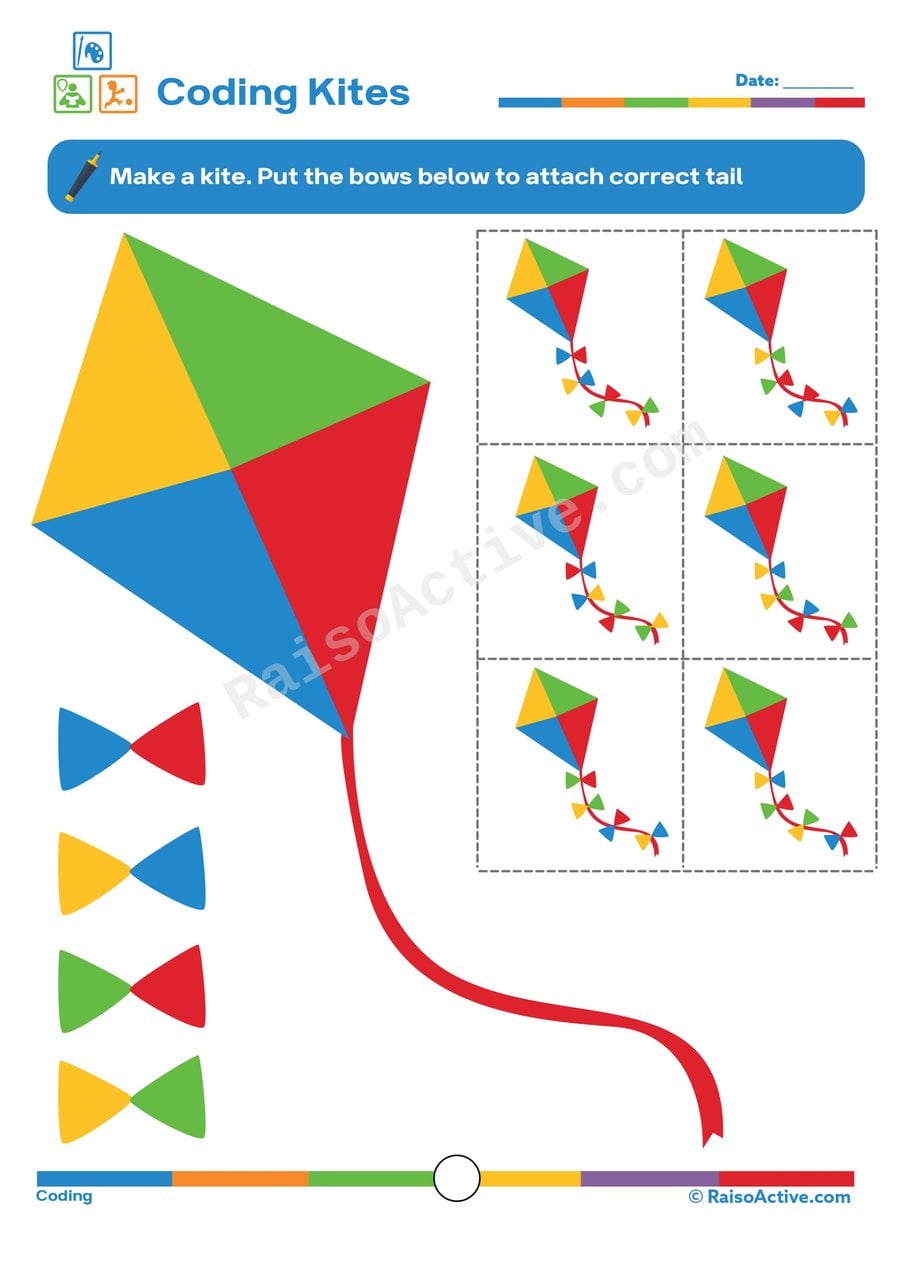
Coding Kites Worksheet: Match the Bows!
Ages 3-5 · Preschool–Pre-KAges 3-5 · Nursery–ReceptionAges 3-5 · Nursery–LKGAges 3-5
This activity sharpens visual observation in children ages 3-5 as they compare color sequences on each kite to a set of loose bows and find the exact match. Careful, systematic comparison — checking each color in order rather than glancing quickly — builds an attention-to-detail habit that transfers directly to early reading and number work.

States of Matter Worksheet: Exploring Solids, Liquids, and Gases!
Ages 4-6 · Pre-K–KindergartenAges 4-6 · Reception–Year 1Ages 4-6 · LKG–UKGAges 4-6
This worksheet introduces children ages 4-6 to the three states of matter — solid, liquid, and gas — by having them examine images and sort each one into its correct category. Learning to classify familiar objects (like ice, water, and steam) by their physical state builds early scientific reasoning, since children must look past an object's identity and focus on its underlying properties.

Logic Clue Puzzles Worksheet: Find Me
Ages 4-7 · Pre-K–Grade 1Ages 4-7 · Reception–Year 2Ages 4-7 · LKG–Class 1Ages 4-7
This worksheet helps children practice logical reasoning by matching descriptions to images.

Clothing Pattern Matching Worksheet for Preschoolers
Ages 3-5 · Preschool–Pre-KAges 3-5 · Nursery–ReceptionAges 3-5 · Nursery–LKGAges 3-5
By comparing clothing items and connecting each one to its pattern match, children ages 3-5 build visual discrimination skills, learning to notice fine differences in stripes, dots, or repeated shapes. This close-looking practice supports the same attention-to-detail children will later need to tell similar-looking letters and numbers apart.

Logic Grid Puzzle for Kids: Sort by Two Rules
Ages 4-7 · Pre-K–Grade 1Ages 4-7 · Reception–Year 2Ages 4-7 · LKG–Class 1Ages 4-7
Children sort eight numbered objects by two rules at once (big or small, striped or plain) and then use clues in a simple logic grid to work out which child has which pet. This builds classification and deductive reasoning.
Guides for this topic

Age-Appropriate Problem-Solving Activities: Building Critical Thinkers from the Ground Up
Discover fun, age-appropriate problem-solving activities for children ages 1-8. Build critical thinking, logic, and reasoning skills through play-based learning.
Critical Thinking Activities That Actually Work for Young Children: Building Tomorrow's Thinkers Today
Discover proven critical thinking activities for young children. Age-wise logic games, questioning techniques, and hands-on ideas to build thinking skills at home.

Preparing Your Child for a Rapidly Changing World: Essential Skills for Future Success
Discover the essential 21st century skills your child needs for future success. Practical tips on creativity, critical thinking, digital literacy & emotional intelligence for ages 1-8.
Reviews
Every worksheet for ages 3–5, no watermark
Members download the full library of 1,000+ worksheets and every activity pack without watermarks or daily limits. One year costs ₹999 in India or $20 elsewhere.
See membership plansOr download any worksheet free with a watermark (5 a day).