Parent's Guide: Fun Activities for Reading, Forces, and Movement!
This multi-part guide walks parents and children ages 3-5 through several linked activities in one sitting — practicing 3-letter words, arranging simple sentences, discussing cleanliness habits, and exploring forces and movement with magnets — giving a broad snapshot of early literacy and science skills in a single session. Covering reading and science side by side in one guide shows how everyday routines can double as learning moments.
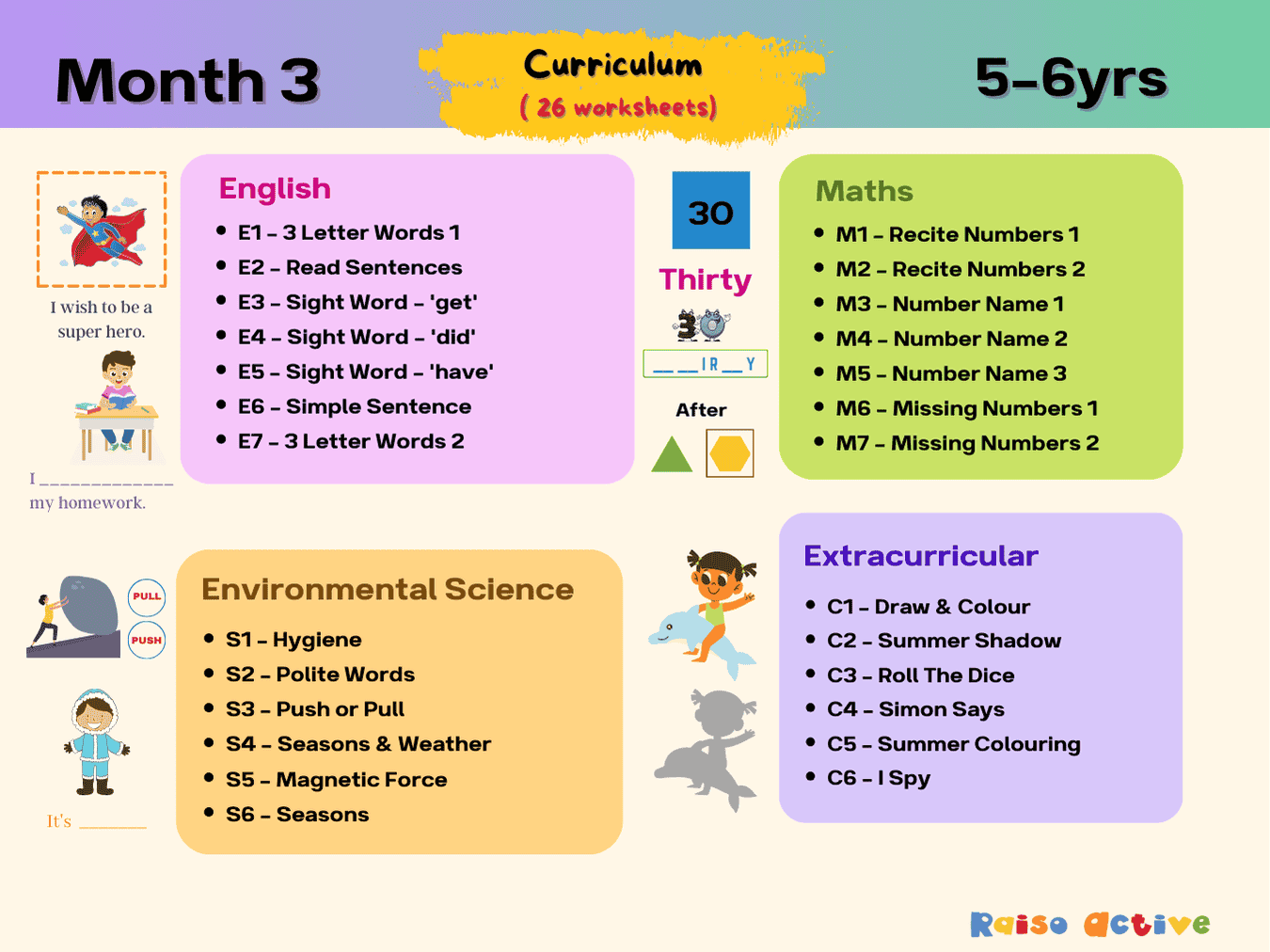
Part of the pack
Month 3: Learning & Development | Ages 5-6
This is page 2 of the pack. Ages 5-6 · KindergartenAges 5-6 · Year 1Ages 5-6 · UKGAges 5-6
Made for your child
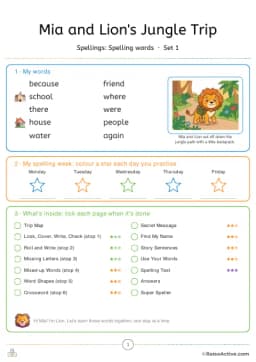
Spelling practice, made for your child
Their own spelling words turned into a pack: trace or look-cover-write-check, roll and write, a secret picture code, a word search, a crossword and a test, with their name in it.
Make a spelling packFree preview · free for members
Or start free: a word search with sight wordsCurriculum
- Phonics - Letter Sounds > Beginning Sounds
How to use this worksheet
Work through each section in order rather than all at once, since they cover different skills. For the 3-letter words, sound out each word together before your child writes it. For the sentence section, read the scrambled words aloud and help your child arrange them in the correct order. Talk through the cleanliness discussion using real examples from your child's day. Finish with the forces and movement section, using a real magnet to test which household objects it attracts and discussing what 'push' and 'pull' mean.
Materials needed
- Pencil
- Crayons
- Magnet
- Objects for Magnetism
Extension activities
- 1Turn the arranged sentences into a short story you tell together at bedtime.
- 2Make a simple chart tracking daily cleanliness habits, like handwashing or teeth brushing, with a sticker for each one completed.
- 3Test five household objects with a magnet and sort them into 'sticks' and 'doesn't stick' groups.
- 4Push and pull different toys across the floor and talk about which movement each action creates.
- 5Practice writing three new 3-letter words your child comes up with on their own.

Written by
Hemsweta Jain · Teacher Cheena
MBA and Early Childhood Educator, teaching since 2014 · Founder of RaisoActive, Mumbai
Every RaisoActive worksheet is designed and checked by the founder before publishing.
Published · Last reviewed
More from Month 3: Learning & Development | Ages 5-6

Seasons Cut and Paste Worksheet for Preschoolers
Ages 3-5 · Preschool–Pre-KAges 3-5 · Nursery–ReceptionAges 3-5 · Nursery–LKGAges 3-5
Children ages 3-5 build early science vocabulary and classification skills as they identify the four seasons and match seasonal pictures — like snowflakes, flowers, or sunhats — to the correct season circle. Understanding that weather and clothing change in predictable patterns throughout the year is a foundational science concept that also supports calendar and time awareness.
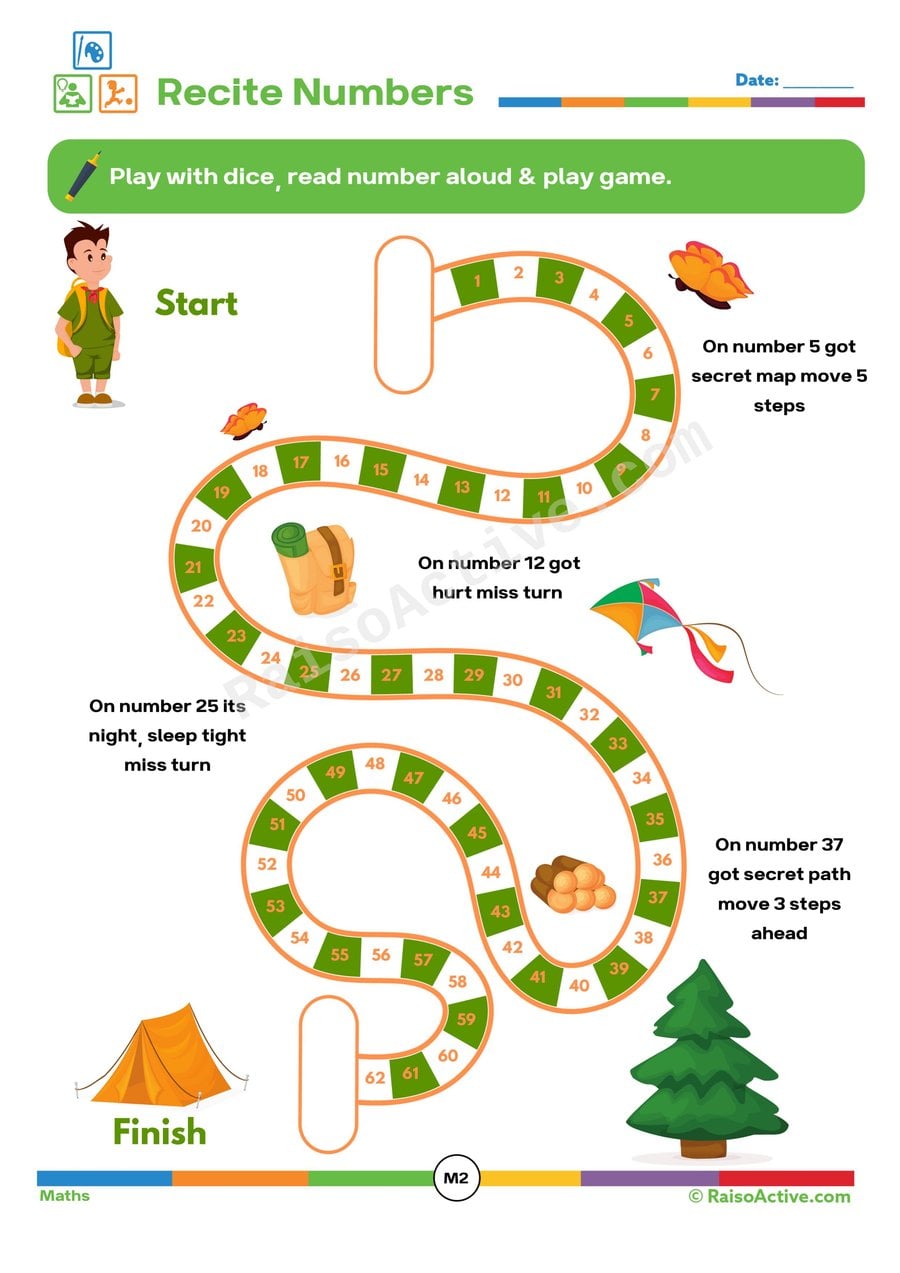
Recite Numbers Game Worksheet for Kids
Ages 4-6 · Pre-K–KindergartenAges 4-6 · Reception–Year 1Ages 4-6 · LKG–UKGAges 4-6
This game-based worksheet helps children ages 4-6 practice number recognition and following multi-step directions as they roll a die, move along a numbered path, and read each number aloud when they land on it. Turning number practice into a game increases motivation and repetition, both of which are key to building automatic number recognition.

Sight Word 'Did' Worksheet: Read, Trace, and Complete Sentences!
Ages 3-5 · Preschool–Pre-KAges 3-5 · Nursery–ReceptionAges 3-5 · Nursery–LKGAges 3-5
This worksheet strengthens sight-word recognition for children ages 3-5 through repeated exposure to the word 'did' — tracing it, writing it, completing sentences with it, and spelling it by cutting and pasting letters. Because 'did' is a past-tense helper word that doesn't sound out easily, this kind of varied repetition is exactly what builds the instant recognition needed for reading fluency.

Missing Numbers Worksheet: Before, Between, and After
Ages 4-6 · Pre-K–KindergartenAges 4-6 · Reception–Year 1Ages 4-6 · LKG–UKGAges 4-6
This worksheet asks children ages 4-6 to fill in missing numbers that come before, between, or after given numbers in a sequence, building a deeper understanding of number order than simple counting alone. Recognizing what number is missing from a sequence requires children to mentally hold the number line and reason about relative position, a skill that supports later addition and subtraction.

Summer Coloring Fun: Color the Summer-Related Objects!
Ages 3-5 · Preschool–Pre-KAges 3-5 · Nursery–ReceptionAges 3-5 · Nursery–LKGAges 3-5
This worksheet builds vocabulary and category recognition for children ages 3-5 as they color a collection of objects associated with summer, like sunglasses, ice cream, or a beach ball, reinforcing that certain items belong together under a seasonal theme. Coloring within outlined shapes also continues to build the fine motor control and hand strength children need for future writing.

Draw & Color: Under, Over, and Above the Water Worksheet
Ages 3-5 · Preschool–Pre-KAges 3-5 · Nursery–ReceptionAges 3-5 · Nursery–LKGAges 3-5
This open-ended drawing worksheet asks children ages 3-5 to place creatures and objects under, above, and at water level, building early understanding of positional and spatial vocabulary within a real-world context. Drawing something for each of three distinct zones also encourages children to organize their ideas into categories before putting pencil to paper.
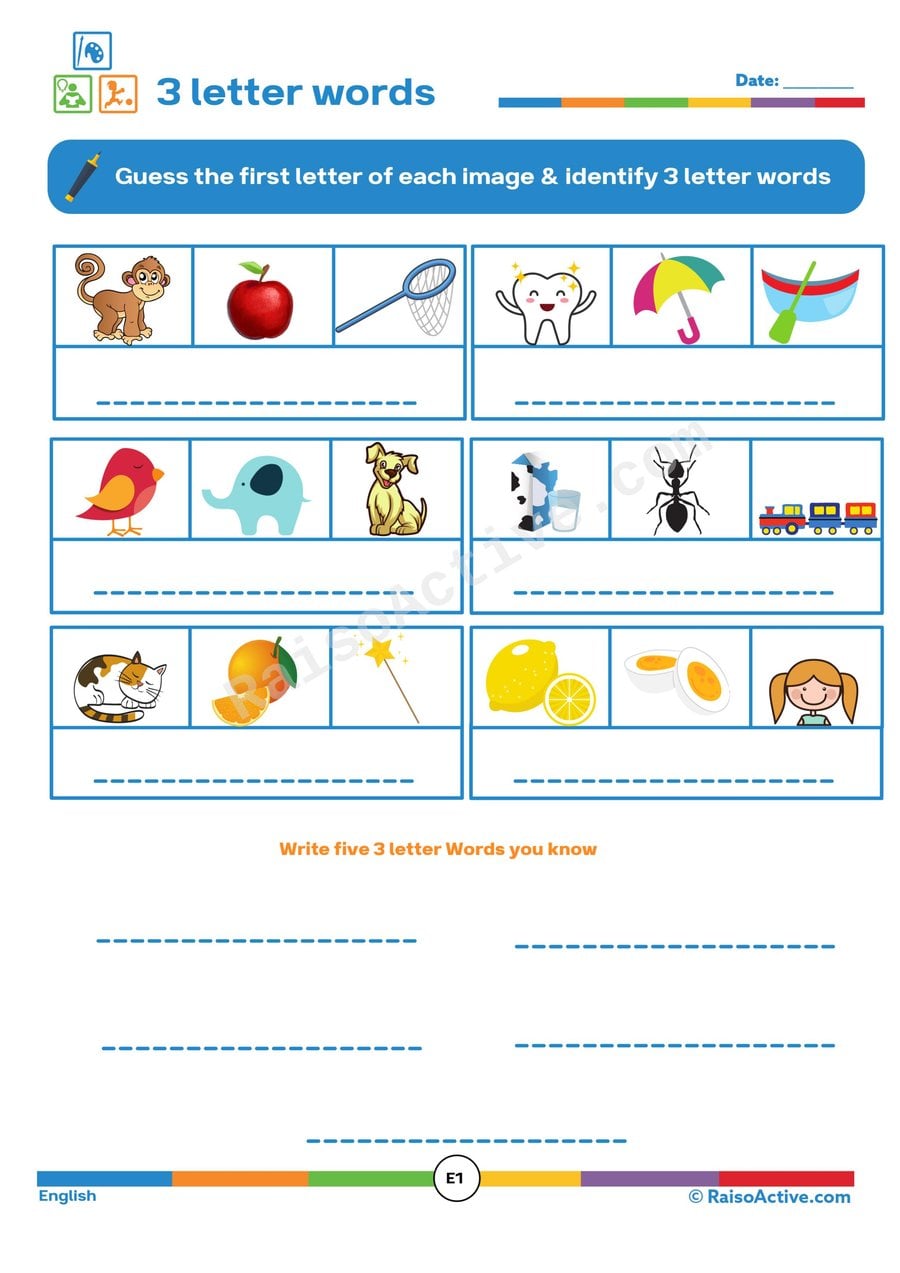
3-Letter Word Fun: Identify and Write! (Ages 3-5)
Ages 3-5 · Preschool–Pre-KAges 3-5 · Nursery–ReceptionAges 3-5 · Nursery–LKGAges 3-5
This worksheet asks children ages 3-5 to identify the beginning sound of a picture and use it to write a complete 3-letter word, moving them from single-letter sounds toward blending sounds into whole words — a key early step in phonics. The final task of writing five known 3-letter words independently also checks how much of this blending skill has transferred beyond the guided examples.
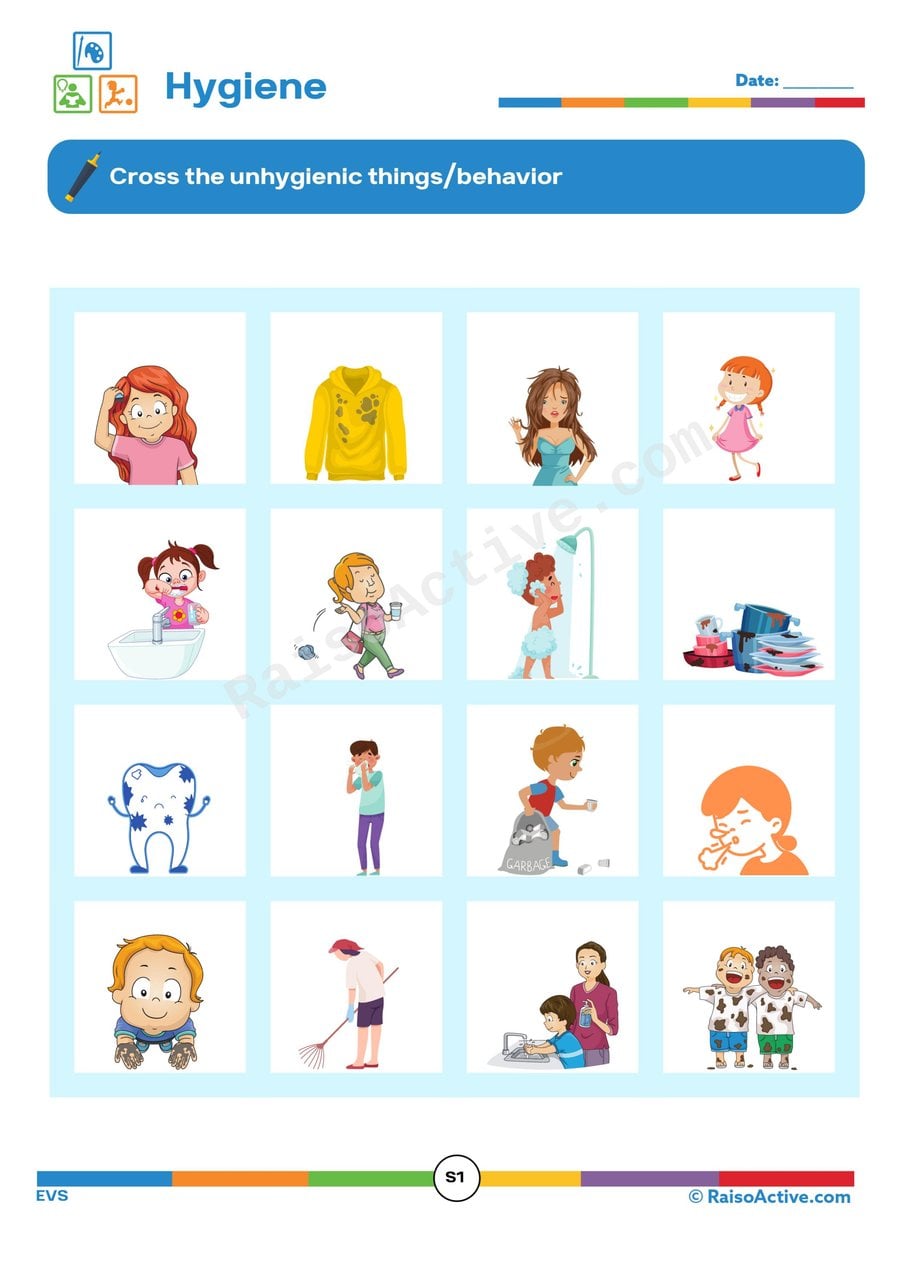
Hygiene Worksheet: Identify Unhygienic Behaviors
Ages 3-5 · Preschool–Pre-KAges 3-5 · Nursery–ReceptionAges 3-5 · Nursery–LKGAges 3-5
This worksheet asks children ages 3-5 to look at pictures of everyday scenes and cross out the behaviors that are unhygienic, building their ability to recognize the difference between healthy and unhealthy habits in a visual, concrete way. Identifying what's wrong in a picture, rather than just being told a rule, encourages children to reason about hygiene rather than simply memorize it.
Related worksheets

Parent's Guide: Fun Activities for Early Learners
Ages 3-5 · Preschool–Pre-KAges 3-5 · Nursery–ReceptionAges 3-5 · Nursery–LKGAges 3-5
This parent's guide offers a set of activities spanning literacy, sequencing, and early addition, giving caregivers several ready-to-use options for building foundational skills through everyday play. For ages 3-5, rotating between different skill areas, like rhyming games and simple math card games, keeps early learning varied and prevents any one skill from feeling repetitive or tedious.

Parent's Guide: Building Vocabulary and Spatial Awareness Activities for Kids
Ages 3-5 · Preschool–Pre-KAges 3-5 · Nursery–ReceptionAges 3-5 · Nursery–LKGAges 3-5
This parent's guide offers a set of hands-on activities for children ages 3-5 that build vocabulary through naming and describing objects, alongside spatial awareness through positional words like under, over, and beside. Doing both together strengthens the language children need to describe where things are, a skill that supports everyday communication and later reading comprehension.

Parent's Guide: Fun Revision Activities for Early Learners!
Ages 3-5 · Preschool–Pre-KAges 3-5 · Nursery–ReceptionAges 3-5 · Nursery–LKGAges 3-5
This revision guide pulls together several previously learned concepts — the butterfly life cycle, shadow drawing, simple coding logic, and art and craft skills — giving children ages 3-5 a chance to revisit and strengthen ideas rather than encounter them for the first time. Spaced repetition like this is proven to help young children retain concepts longer than a single exposure. Mixing very different skill types in one guide also keeps the review sessions varied and engaging rather than repetitive.

Parent's Guide: Fun Activities for Early Learners!
Ages 3-5 · Preschool–Pre-KAges 3-5 · Nursery–ReceptionAges 3-5 · Nursery–LKGAges 3-5
This parent's guide bundles several hands-on activities — letter matching, sorting, art, and simple crafts like paper cup animals — that build early literacy, fine motor skills, and creativity for children ages 3-5 through play rather than worksheets.

Parent's Guide: Sentence Framing and Early Literacy Activities
Ages 3-5 · Preschool–Pre-KAges 3-5 · Nursery–ReceptionAges 3-5 · Nursery–LKGAges 3-5
This parent's guide equips families of children ages 3-5 with a toolkit of hands-on activities — sentence framing, letter games, number and money recognition, and before/after sequencing with blocks — that build early literacy and numeracy together rather than in isolation. Framing simple sentences specifically helps children move from single words to connected speech, a critical bridge toward writing their own sentences later.

Parent's Guide: Fun Activities for Early Learning
Ages 3-5 · Preschool–Pre-KAges 3-5 · Nursery–ReceptionAges 3-5 · Nursery–LKGAges 3-5
This parent guide gathers hands-on activities around sentence building, creative art, and basic cooking skills, giving children practice with language, fine motor coordination, and following multi-step directions across very different, engaging contexts. Mixing sensory play like clay and painting with a simple cooking task keeps preschoolers motivated while quietly building vocabulary and sequencing skills.
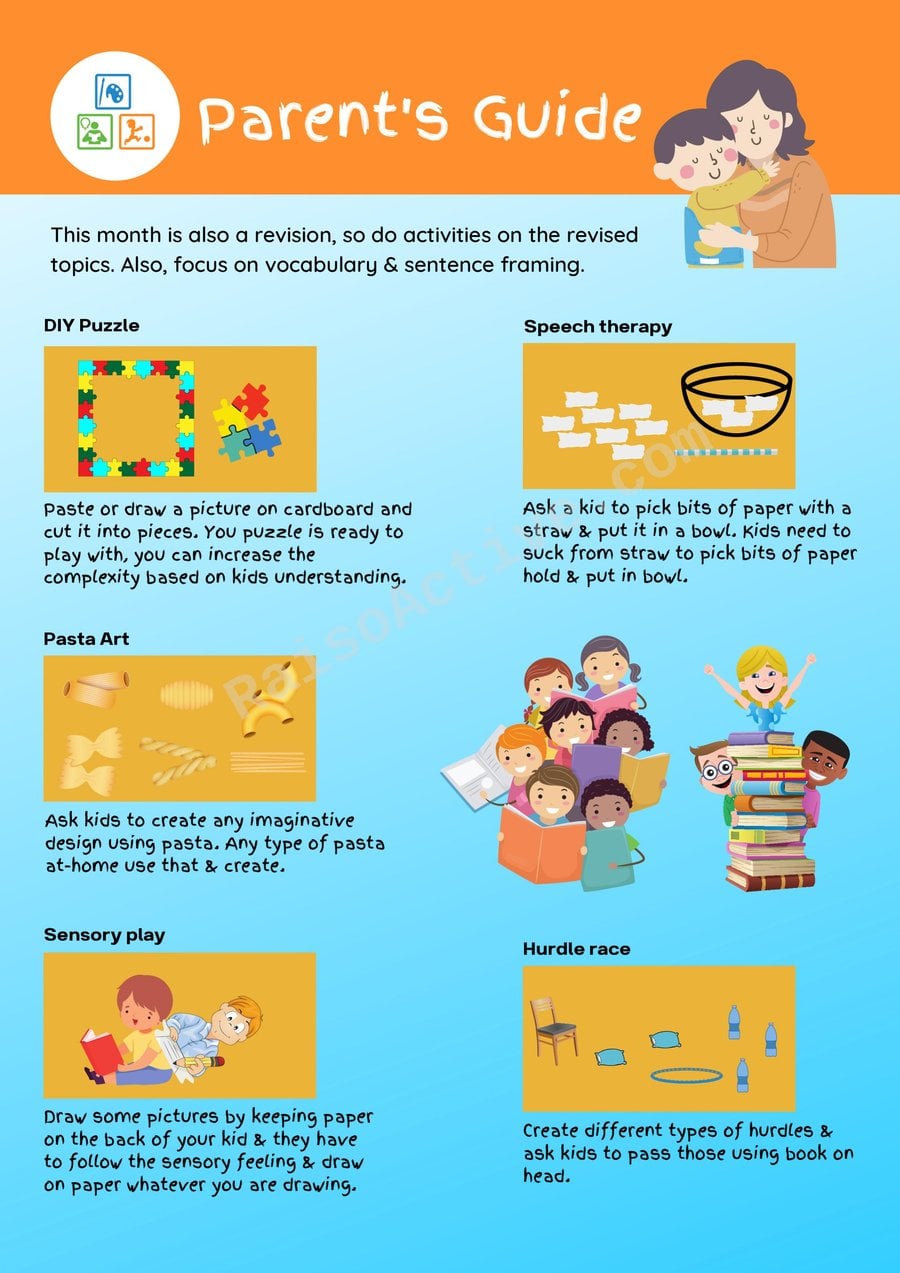
Parent's Guide: Fun Activities for Kids!
Ages 3-5 · Preschool–Pre-KAges 3-5 · Nursery–ReceptionAges 3-5 · Nursery–LKGAges 3-5
This parent's guide brings together a set of simple, no-prep activities that support early literacy, counting, and sequencing skills for children ages 3-5 outside of a single structured worksheet. Because the activities are designed to be adapted to your child's current interests and skill level, they build flexible thinking and real-world application of skills like counting and sequencing, rather than isolated worksheet practice.

Parent's Guide: Fun Activities for Early Learning!
Ages 3-5 · Preschool–Pre-KAges 3-5 · Nursery–ReceptionAges 3-5 · Nursery–LKGAges 3-5
This parent's guide compiles a set of short activities spanning early literacy, spatial reasoning, and problem-solving, giving caregivers ready-made ways to build foundational skills through everyday play. For ages 3-5, mixing activity types across one guide, like word games and puzzles, keeps a young child's attention while covering multiple developmental areas in a single session or across a week.
Guides for this topic

Documenting Learning Without Drowning in Data: A Practical Guide for Parents and Teachers
Learn practical ways to document your child's learning without overwhelm. Simple portfolios, observation tips, and printable trackers for ages 1-8.

Discovering Wonder: Nature-Based Learning Activities That Captivate Young Children
Explore nature-based learning activities for children ages 2–7 — leaf rubbings, bug hunts, nature journals, and seasonal Indian outdoor ideas that spark wonder.
How to Balance Free vs. Paid Educational Resources: A Parent's Strategic Guide to Smart Learning Investments
Learn how to strategically balance free and paid educational resources for your child. Save money while ensuring quality learning with this practical Indian parent guide.
Reviews
Every worksheet for ages 3–5, no watermark
Members download the full library of 1,000+ worksheets and every activity pack without watermarks or daily limits. One year costs ₹999 in India or $20 elsewhere.
See membership plansOr download any worksheet free with a watermark (5 a day).