Problem Solvers: Stop, Think, Choose, Try and Matching the Right Calm Tool
Children use four steps, Stop, Think, Choose and Try, to help Nia after a spill. They match calm tools to places (class, bed, field, shop) and brainstorm three ideas for a friend who wants a different game.
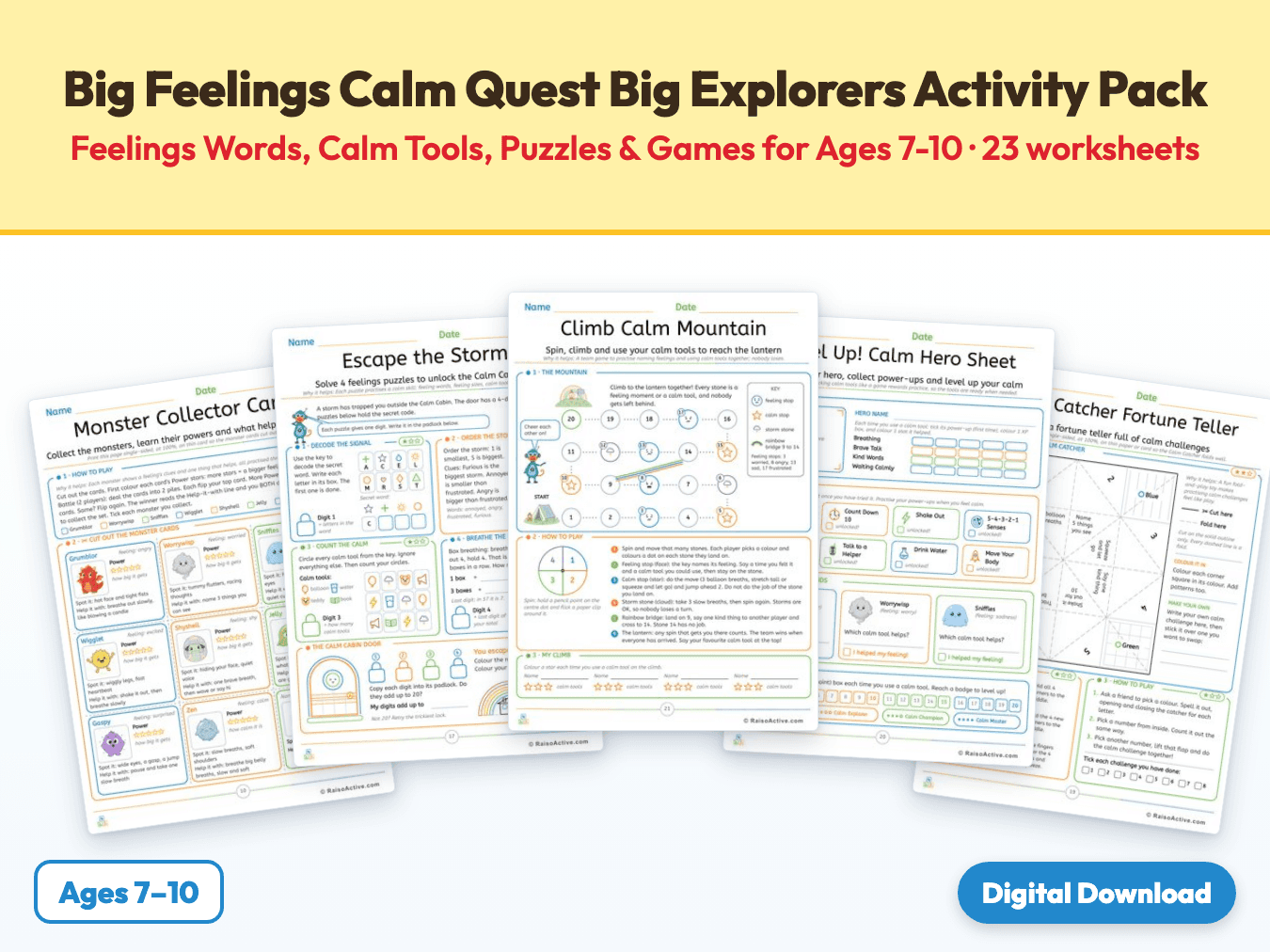
Part of the pack
Big Feelings Calm Quest Big Explorers Activity Pack: Feelings Words, Calm Tools, Puzzles & Games for Ages 7-10
This is page 14 of the pack. Ages 7-10 · Grade 2–Grade 3Ages 7-10 · Year 3–Year 4Ages 7-10 · Class 2–Class 3Ages 7-10
How to use this worksheet
Number the steps 1 to 4, write two 'Nia could...' ideas, draw lines from each place to the calm tool that fits, then draw three ideas in the bubbles and colour a star on the one you would try.
Materials needed
- Pencil
- Crayons
Extension activities
- 1Use the four steps on a real problem this week.
- 2Role-play the spill.

Written by
Hemsweta Jain · Teacher Cheena
MBA and Early Childhood Educator, teaching since 2014 · Founder of RaisoActive, Mumbai
Every RaisoActive worksheet is designed and checked by the founder before publishing.
Published · Last reviewed
More from Big Feelings Calm Quest Big Explorers Activity Pack: Feelings Words, Calm Tools, Puzzles & Games for Ages 7-10

Escape the Storm! A Feelings Escape Room Puzzle Worksheet
Ages 7-10 · Grade 2–Grade 3Ages 7-10 · Year 3–Year 4Ages 7-10 · Class 2–Class 3Ages 7-10
Children solve four mini puzzles (a picture code, ordering by size, counting calm tools and box breathing arithmetic) to get four digits, then check that the digits add up to 20.

Say It Kindly: Build I-Messages, Blame or Kind and Fix-It Cards
Ages 7-10 · Grade 2–Grade 3Ages 7-10 · Year 3–Year 4Ages 7-10 · Class 2–Class 3Ages 7-10
Children learn the I-message pattern 'I feel... when... I need...', sort blaming and kind sentences with B or K, match oops moments to repairs and think how a classmate might feel.

Level Up! Calm Hero Sheet: Hero Stats, Power-Ups and an XP Tracker
Ages 7-10 · Grade 2–Grade 3Ages 7-10 · Year 3–Year 4Ages 7-10 · Class 2–Class 3Ages 7-10
Children design a calm hero, colour stats for breathing, brave talk, kindness and patience, tick power-ups as they try them, pair three big-feeling friends with calm tools and fill a 20-box XP tracker.

Big Feelings Calm Quest Certificate: Calm Quest Champion
Ages 7-10 · Grade 2–Grade 3Ages 7-10 · Year 3–Year 4Ages 7-10 · Class 2–Class 3Ages 7-10
A certificate of achievement for children who explored big feelings and completed the Big Feelings Calm Quest pack. Tick the three levels completed.

Feelings Word Search and Secret Code: Find Ten Words and Crack the Calm Code
Ages 7-10 · Grade 2–Grade 3Ages 7-10 · Year 3–Year 4Ages 7-10 · Class 2–Class 3Ages 7-10
Children find ten feeling words (across, down and diagonal) in a grid, use a symbol key to decode a calm message, and write their own message in code.

How Big Is It? Feelings Thermometer and Matching the Size of the Reaction
Ages 7-10 · Grade 2–Grade 3Ages 7-10 · Year 3–Year 4Ages 7-10 · Class 2–Class 3Ages 7-10
Children rank five feelings from coolest to hottest, decide whether a problem is small, medium or big and match the size of the reaction, then think of a reaction that fits a small problem.

Big Feelings Calm Quest Answer Key for Grown-Ups
Ages 7-10 · Grade 2–Grade 3Ages 7-10 · Year 3–Year 4Ages 7-10 · Class 2–Class 3Ages 7-10
A page-by-page answer key for the Big Feelings Calm Quest pack, including the logic puzzle, escape room digits, word search positions and the calm code, with notes on open pages.

Calm Catcher Fortune Teller: Fold a Paper Fortune Teller of Calm Challenges
Ages 7-10 · Grade 2–Grade 3Ages 7-10 · Year 3–Year 4Ages 7-10 · Class 2–Class 3Ages 7-10
Children cut and fold a fortune teller (cootie catcher) whose eight flaps hold calm challenges: balloon breaths, name five things you see, stretch tall, squeeze and let go, say one kind thing and more.
Related worksheets
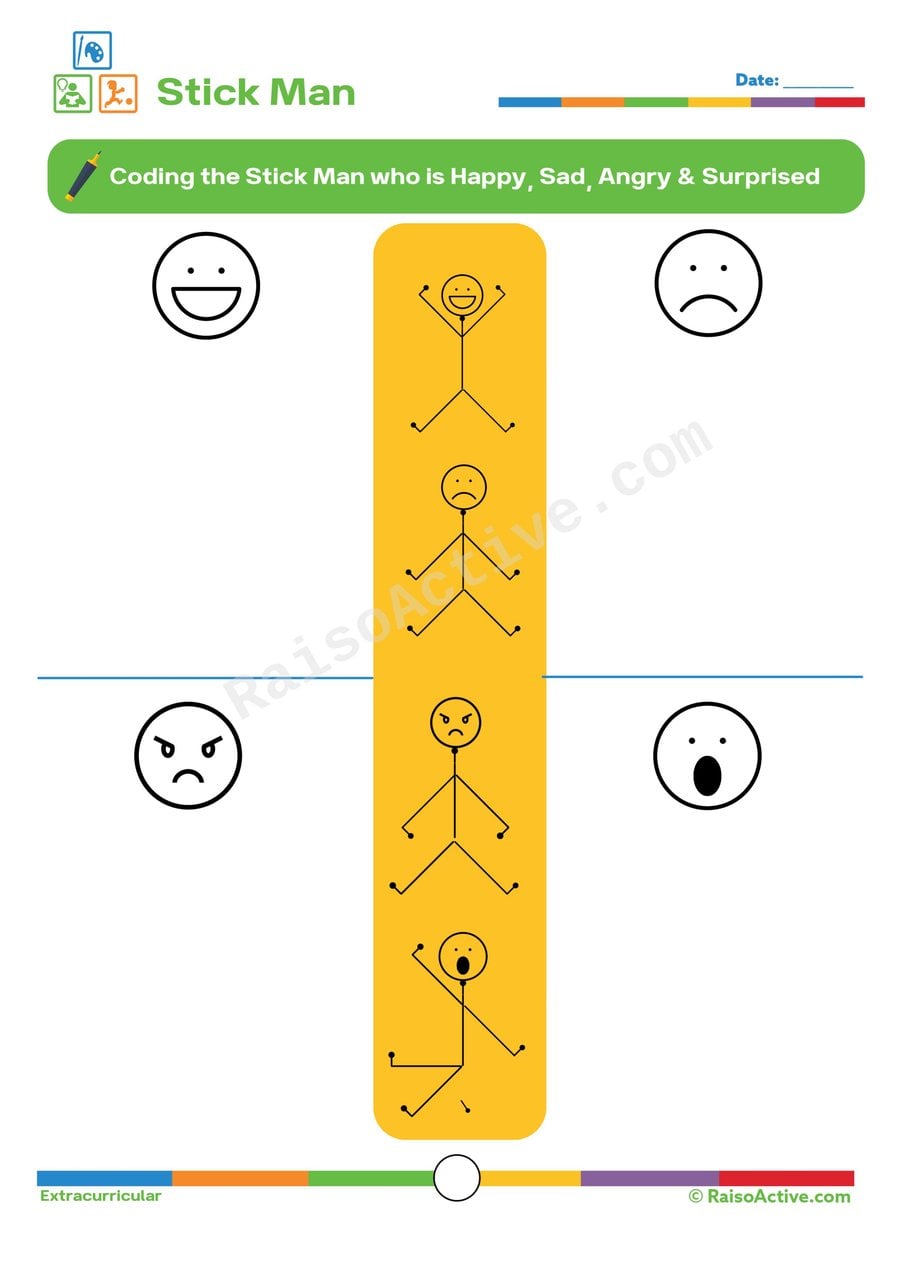
Stick Man Emotions Worksheet: Happy, Sad, Angry & Surprised!
Ages 3-5 · Preschool–Pre-KAges 3-5 · Nursery–ReceptionAges 3-5 · Nursery–LKGAges 3-5
Matching simple stick-figure faces to emotion words helps children ages 3-5 build an early emotional vocabulary, connecting facial cues like a curved mouth or raised eyebrows to specific feeling words. This kind of emotion recognition is a foundational social-emotional skill, helping children name what they and others are feeling instead of just reacting.

Big Feelings Fun Time Answer Key for Grown-Ups
Ages 4-6 · Pre-K–KindergartenAges 4-6 · Reception–Year 1Ages 4-6 · LKG–UKGAges 4-6
A page-by-page answer key for the Big Feelings Fun Time pack, including the maze route, game board squares, story order and notes on pages where answers vary.

Coding Worksheet for Kids: Arrow Codes and Robot Grid
Ages 4-7 · Pre-K–Grade 1Ages 4-7 · Reception–Year 2Ages 4-7 · LKG–Class 1Ages 4-7
Children read arrow codes to move a robot across a grid, write their own arrow code to take the bee to the flower, and spot the one wrong arrow in a code. These are first steps in coding, sequencing and debugging.

Kind Friends: Match Ways to Help a Friend with a Big Feeling
Ages 4-6 · Pre-K–KindergartenAges 4-6 · Reception–Year 1Ages 4-6 · LKG–UKGAges 4-6
Children think about how to help a friend who is sad, scared, angry or worried, colour kind hearts for things they did this week, and draw how they would help a new friend.

My Pocket Calm Book: A Mini Book of Six Calm Tools
Ages 4-6 · Pre-K–KindergartenAges 4-6 · Reception–Year 1Ages 4-6 · LKG–UKGAges 4-6
Children make a pocket-sized book with six calm tools: balloon breath, flower and candle, turtle pause, squeeze and let go, shake it out, and hug and talk. They tick 'I tried it!' as they practise.

Sequencing Worksheet for Kids: First, Next, Last
Ages 4-7 · Pre-K–Grade 1Ages 4-7 · Reception–Year 2Ages 4-7 · LKG–Class 1Ages 4-7
Children put three-step stories in order using first, next and last, then work backwards to find what came before a picture. This builds sequencing, time vocabulary and cause and effect thinking.

Balloon Pattern Matching Worksheet for Preschoolers
Ages 3-5 · Preschool–Pre-KAges 3-5 · Nursery–ReceptionAges 3-5 · Nursery–LKGAges 3-5
Children ages 3-5 build early pattern-recognition skills on this worksheet by studying a sequence of colored balloons and finding the matching set to complete it. Recognizing and continuing a repeating sequence is a foundational pre-math skill that later supports understanding of number patterns, skip counting, and simple algebraic thinking.

Feelings Detective for Kids: Clue Cards, Story Order and Draw a Proud Moment
Ages 4-6 · Pre-K–KindergartenAges 4-6 · Reception–Year 1Ages 4-6 · LKG–UKGAges 4-6
Children use body clues (fists, a wobbly tummy, standing tall) and what happened to work out the feeling, put three pictures in order and talk about a proud moment.
Guides for this topic

Age-Appropriate Problem-Solving Activities: Building Critical Thinkers from the Ground Up
Discover fun, age-appropriate problem-solving activities for children ages 1-8. Build critical thinking, logic, and reasoning skills through play-based learning.
Critical Thinking Activities That Actually Work for Young Children: Building Tomorrow's Thinkers Today
Discover proven critical thinking activities for young children. Age-wise logic games, questioning techniques, and hands-on ideas to build thinking skills at home.

Preparing Your Child for a Rapidly Changing World: Essential Skills for Future Success
Discover the essential 21st century skills your child needs for future success. Practical tips on creativity, critical thinking, digital literacy & emotional intelligence for ages 1-8.
Reviews
Every worksheet for ages 7–10, no watermark
Members download the full library of 1,000+ worksheets and every activity pack without watermarks or daily limits. One year costs ₹999 in India or $20 elsewhere.
See membership plansOr download any worksheet free with a watermark (5 a day).