Sight Word 'THE' Worksheet: Trace, Write, and Identify!
This worksheet builds automatic recognition of the sight word 'the,' one of the most frequently occurring words in English text, through repeated tracing, writing, and identification practice. For four- and five-year-olds, memorizing high-frequency sight words like 'the' by sight — rather than sounding them out each time — is essential for building reading fluency, since these words appear on nearly every page a child will read.
Part of the pack
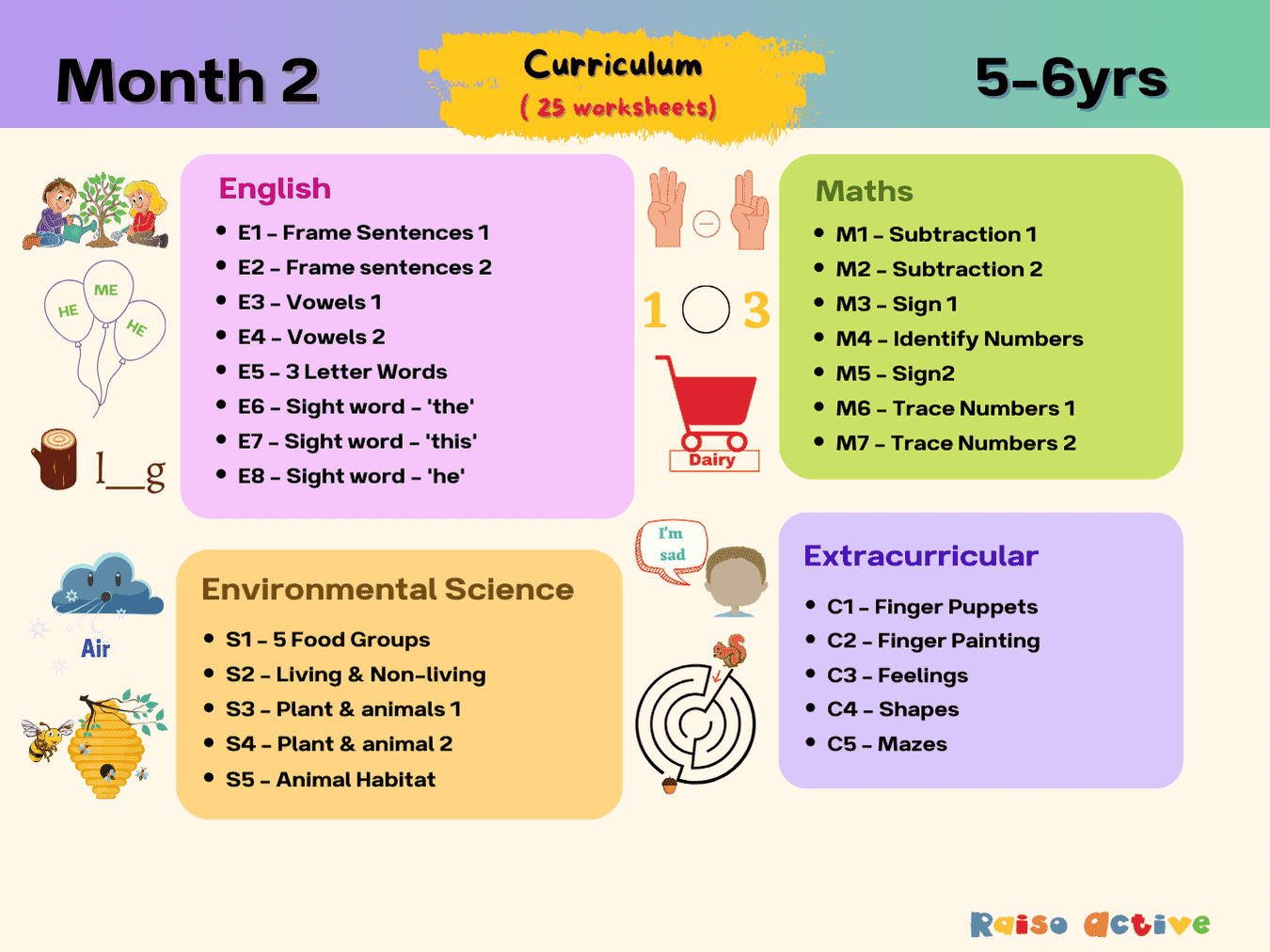
Month 2: Learning & Development | Ages 5-6
This is page 9 of the pack. Ages 5-6 · KindergartenAges 5-6 · Year 1Ages 5-6 · UKGAges 5-6
Made for your child
Spelling practice, made for your child
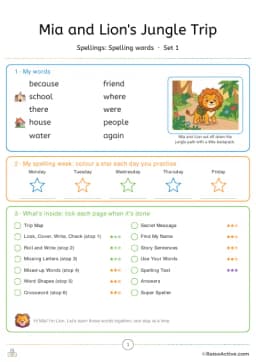
Their own spelling words turned into a pack: trace or look-cover-write-check, roll and write, a secret picture code, a word search, a crossword and a test, with their name in it.
Make a spelling packFree preview · free for members
Or start free: a word search with sight wordsCurriculum
- Fluency > Sight Words
How to use this worksheet
First, have your child trace the word 'the' along the dotted lines, saying the word aloud each time. Next, have them write the word independently on the practice lines provided. Then, look at the picture of clouds together and have your child color only the clouds that contain the word 'the.' Finally, help them read and complete a few simple sentences using the word 'the' in the blank spaces.
Materials needed
- Pencil
- Crayons
Extension activities
- 1Create simple sentences together that use the word 'the,' and have your child read them aloud.
- 2Go on a 'the' hunt through a favorite book or magazine, pointing out every time the word appears on a page.
- 3Make a flashcard for 'the' and add it to a small deck of sight words to review daily.
- 4Play a quick game where you say a sentence and your child claps every time they hear the word 'the.'
- 5Write 'the' in different colors or fonts to help your child recognize it in various forms.

Written by
Hemsweta Jain · Teacher Cheena
MBA and Early Childhood Educator, teaching since 2014 · Founder of RaisoActive, Mumbai
Every RaisoActive worksheet is designed and checked by the founder before publishing.
Published · Last reviewed
More from Month 2: Learning & Development | Ages 5-6

Trace and Write Numbers: Sixteen to Twenty Worksheet
Ages 4-5 · Pre-KAges 4-5 · ReceptionAges 4-5 · LKGAges 4-5
This worksheet helps children ages 4-5 practice tracing and writing the number words from sixteen to twenty, completing the teen and early twenty number-word range that builds toward full number fluency to 20. Repeated tracing of these longer words also continues to build the handwriting stamina needed for more complex writing tasks ahead.

Shape Counting Fun: Color and Count the Shapes Worksheet
Ages 3-5 · Preschool–Pre-KAges 3-5 · Nursery–ReceptionAges 3-5 · Nursery–LKGAges 3-5
Children ages 3-5 practice recognizing common shapes by sight, then apply early counting skills by tallying how many of each shape appear in the picture. Combining shape identification with counting strengthens both geometric awareness and number sense at the same time.

Vowel Fun! Find, Color, and Fill-in the Missing Vowels Worksheet
Ages 3-5 · Preschool–Pre-KAges 3-5 · Nursery–ReceptionAges 3-5 · Nursery–LKGAges 3-5
This worksheet gives children ages 3-5 focused practice identifying the five vowels, A, E, I, O, U, and recognizing which vowel sound completes a familiar picture word. Because vowels appear in nearly every word, this early, targeted practice builds a phonics foundation that supports reading many more words later.
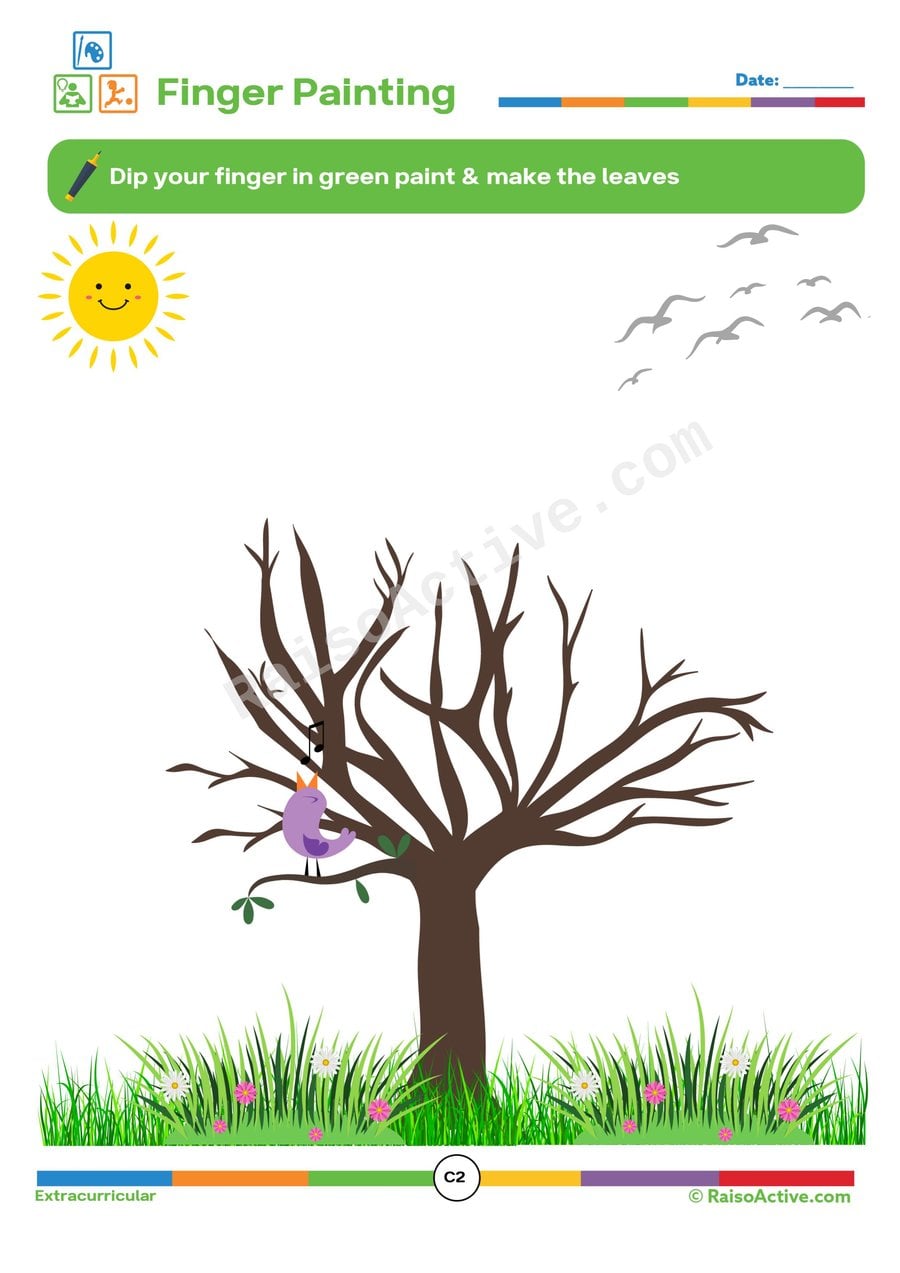
Finger Painting Fun: Make Leaves on the Tree!
Ages 3-5 · Preschool–Pre-KAges 3-5 · Nursery–ReceptionAges 3-5 · Nursery–LKGAges 3-5
This worksheet develops fine motor control and sensory creativity by having children use their fingertip, rather than a brush, to dab green paint onto tree branches to create leaves. For three- to five-year-olds, finger painting builds precise fingertip control in a low-pressure, playful way, and repeating the same dabbing motion across the page also reinforces the concept of filling a space with a repeated mark.

Animal Habitat Matching Worksheet for Preschoolers
Ages 3-5 · Preschool–Pre-KAges 3-5 · Nursery–ReceptionAges 3-5 · Nursery–LKGAges 3-5
This worksheet builds science vocabulary by having children match each animal to its natural habitat, such as a fish to the ocean or a lion to the savanna. For three- to five-year-olds, connecting an animal to where it lives introduces the idea that living things are suited to specific environments, an early step toward understanding ecosystems.

Sight Word 'HE' Worksheet: Trace, Color, and Practice!
Ages 3-5 · Preschool–Pre-KAges 3-5 · Nursery–ReceptionAges 3-5 · Nursery–LKGAges 3-5
This worksheet helps children ages 3-5 learn to recognize, write, and use the sight word 'HE' in simple sentences, giving repeated exposure to a short, high-frequency word that appears in nearly every early reader book. Practicing the word across six different formats, tracing, coloring, circling, writing, filling in, and cutting and pasting, builds recognition through many different types of practice in one sitting.

Animal Maze Adventure: Help the Animals Find Their Food!
Ages 3-5 · Preschool–Pre-KAges 3-5 · Nursery–ReceptionAges 3-5 · Nursery–LKGAges 3-5
This worksheet helps children ages 3-5 develop problem-solving skills and visual discrimination by guiding different animals through mazes to reach their favorite food, requiring them to scan ahead and choose the correct path before committing to a route. Matching each animal to a food that makes sense for it also builds early general knowledge about what different animals eat.
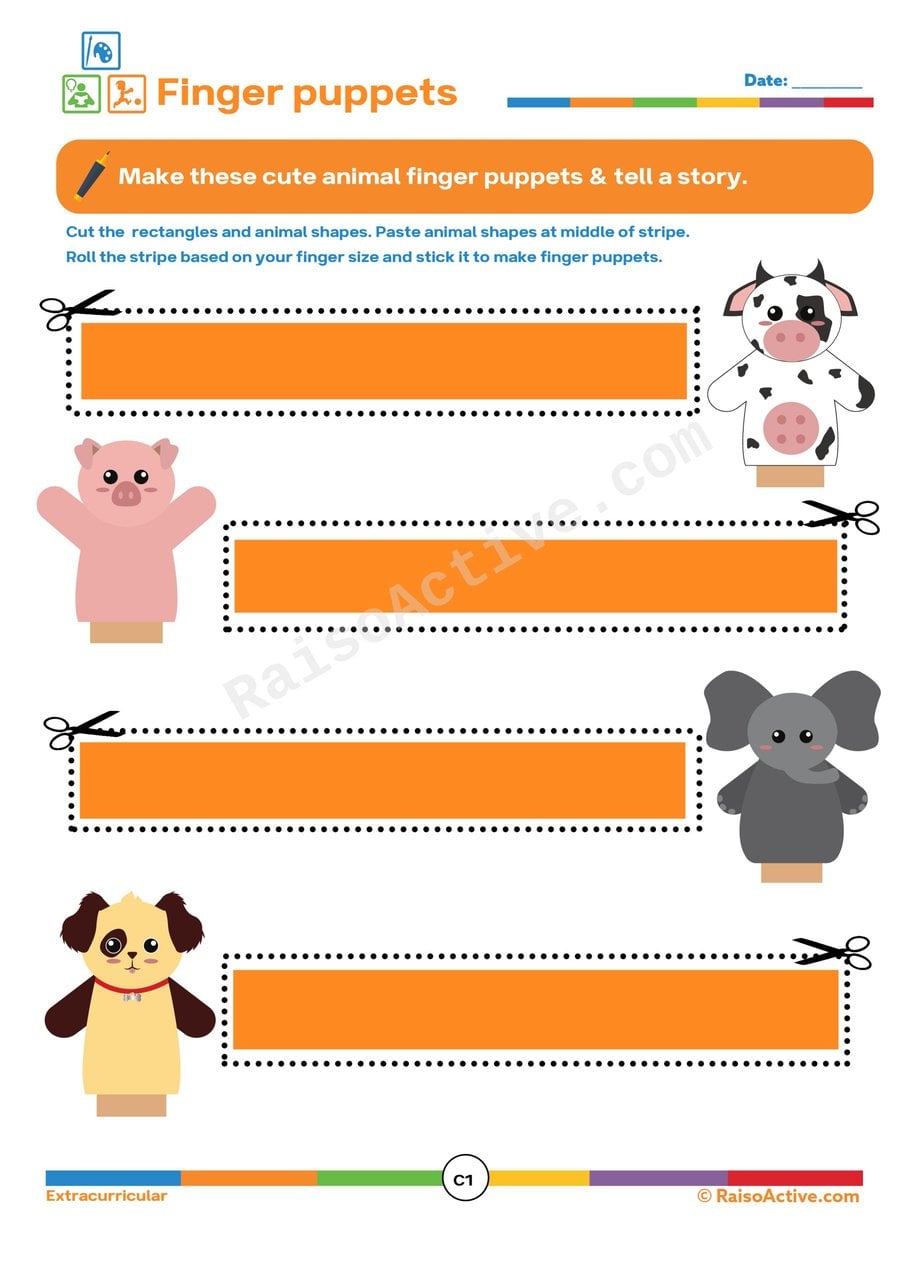
Make Finger Puppets! Fun Animal Craft Worksheet
Ages 3-5 · Preschool–Pre-KAges 3-5 · Nursery–ReceptionAges 3-5 · Nursery–LKGAges 3-5
This hands-on craft worksheet builds scissor control and fine motor precision in children ages 3-5 as they cut out animal shapes and rectangles, then roll and secure the rectangle into a puppet that fits their finger. The three-dimensional assembly step also introduces early spatial reasoning, since children must figure out how a flat shape becomes a wearable tube.
Related worksheets

Learn the Sight Word 'Had' | Fun Reading Worksheet for Preschoolers
Ages 4-5 · Pre-KAges 4-5 · ReceptionAges 4-5 · LKGAges 4-5
Children ages 4-5 build instant recognition of the sight word 'had', another high-frequency word that resists standard phonics decoding and must be memorized visually. This worksheet layers coloring, tracing, writing, grid-searching, and fill-in-the-blank practice, giving the word multiple forms of repeated exposure that solidify memory. Completing sentences with 'had' also shows children how the word is used naturally in storytelling, especially when talking about the past.

Sight Word 'For' Worksheet: Learn to Read and Write!
Ages 4-5 · Pre-KAges 4-5 · ReceptionAges 4-5 · LKGAges 4-5
The word 'for' appears constantly in early reading material but doesn't follow simple sound-it-out rules, so children ages 4-5 need repeated practice to recognize it instantly as a sight word. Working through tracing, a word search, and sentence completion in one sitting gives multiple angles of exposure, which research on early literacy shows helps cement tricky high-frequency words into memory.

Sight Word 'Did' Worksheet: Read, Trace, and Complete Sentences!
Ages 3-5 · Preschool–Pre-KAges 3-5 · Nursery–ReceptionAges 3-5 · Nursery–LKGAges 3-5
This worksheet strengthens sight-word recognition for children ages 3-5 through repeated exposure to the word 'did' — tracing it, writing it, completing sentences with it, and spelling it by cutting and pasting letters. Because 'did' is a past-tense helper word that doesn't sound out easily, this kind of varied repetition is exactly what builds the instant recognition needed for reading fluency.

Just Right! Sight Word 'Just' Worksheet for Preschoolers
Ages 4-5 · Pre-KAges 4-5 · ReceptionAges 4-5 · LKGAges 4-5
The word 'just' shows up frequently in everyday speech and early reading material, and this worksheet gives children ages 4-5 a full, multi-step encounter with it — coloring, searching, tracing, and using it inside complete sentences. Building sight word recognition through several different activities rather than one repeated drill helps the word transfer from short-term memory into automatic recall. Completing sentences using 'just' also gives children early practice applying a memorized word correctly in a meaningful context, not just recognizing it in isolation.
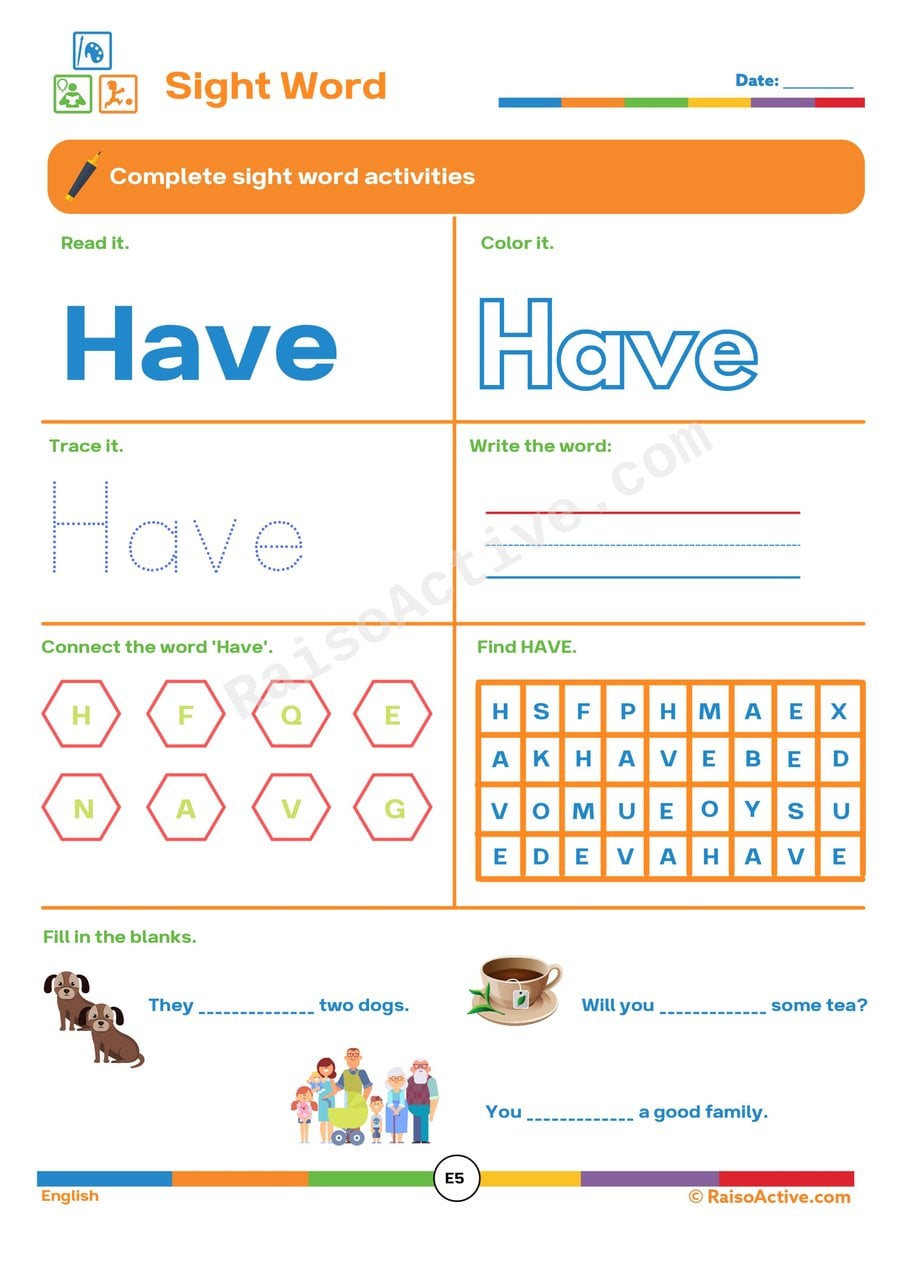
Sight Word 'Have' Worksheet for Preschoolers
Ages 3-5 · Preschool–Pre-KAges 3-5 · Nursery–ReceptionAges 3-5 · Nursery–LKGAges 3-5
This multi-step worksheet builds deep familiarity with the sight word 'have' for children ages 3-5 by having them read, color, trace, write, and search for the word in several different formats. Repeating the same word across varied tasks — rather than practicing it once — is exactly how high-frequency sight words become instantly recognizable to early readers.

Learn the Sight Word 'Has' - Fun Tracing and Matching Worksheet!
Ages 3-5 · Preschool–Pre-KAges 3-5 · Nursery–ReceptionAges 3-5 · Nursery–LKGAges 3-5
'Has' is a high-frequency verb that children ages 3-5 encounter constantly in early sentences describing possession, like 'the dog has a bone,' making it an important addition to their sight word vocabulary. This worksheet builds recognition of the word through coloring, tracing, word searching, and sentence completion, giving repeated exposure across formats that reinforces memory more effectively than a single repetition. Practicing 'has' inside complete sentences also helps children understand its grammatical role, connecting a subject to something it possesses.
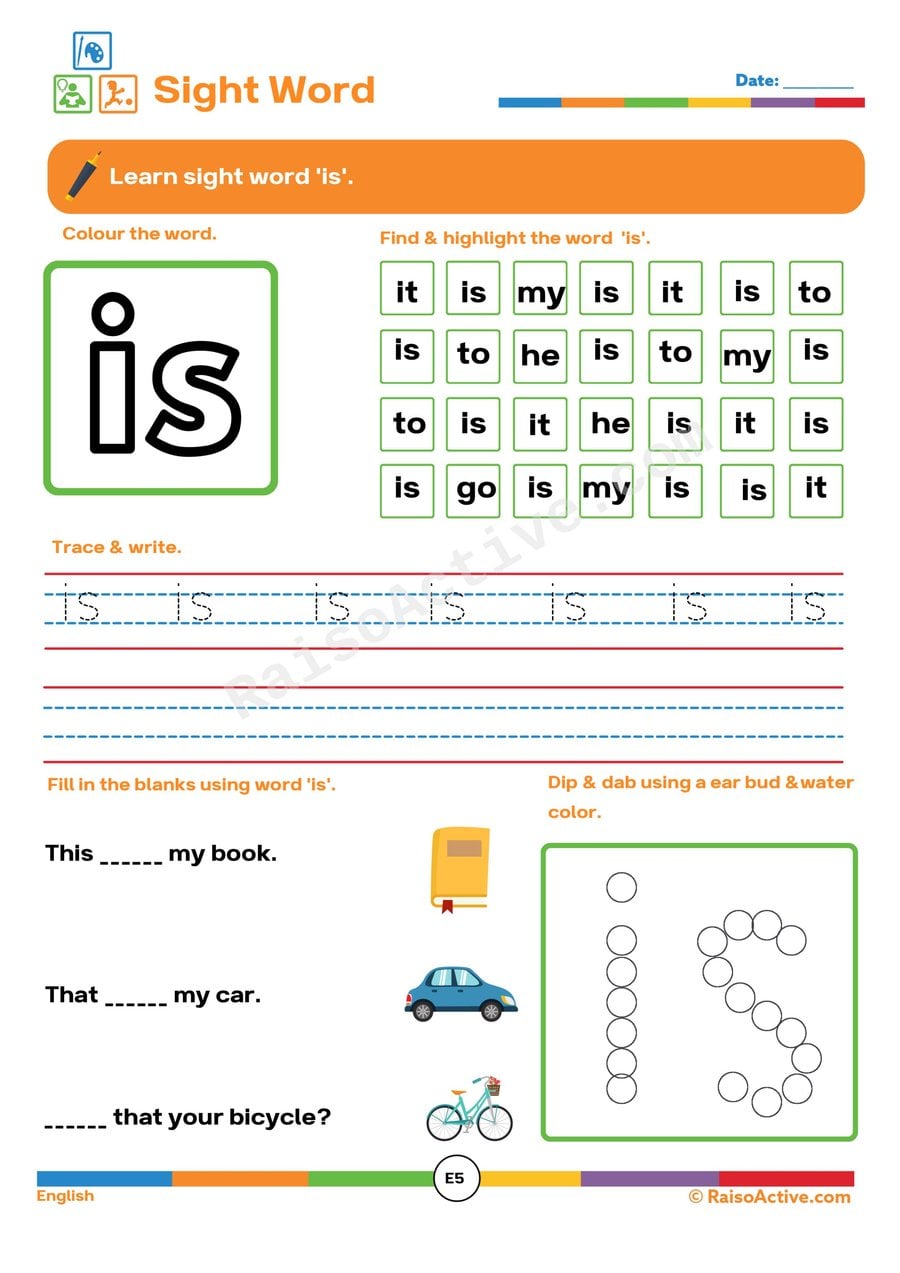
Sight Word 'is' Worksheet: Trace, Find, and Write!
Ages 3-5 · Preschool–Pre-KAges 3-5 · Nursery–ReceptionAges 3-5 · Nursery–LKGAges 3-5
Children ages 3-5 build instant recognition of the high-frequency sight word 'is', practicing it through coloring, tracing, searching, and writing for repeated exposure across multiple formats. As one of the earliest and most common words children encounter in print, quickly recognizing 'is' by sight significantly boosts early reading fluency. Completing fill-in-the-blank sentences also shows children how this small but essential word functions within everyday sentences.
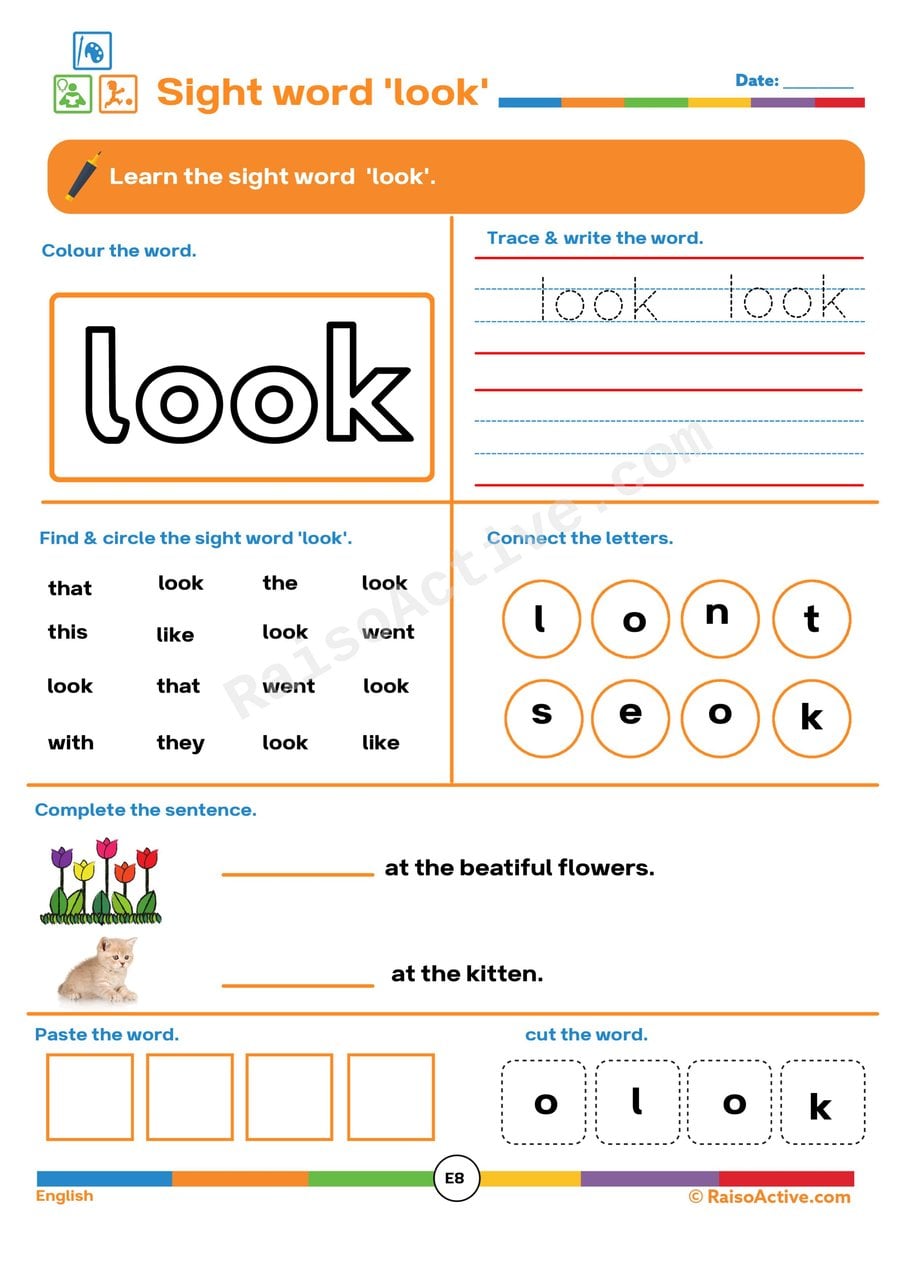
Look! Sight Word 'Look' Worksheet for Preschoolers
Ages 3-5 · Preschool–Pre-KAges 3-5 · Nursery–ReceptionAges 3-5 · Nursery–LKGAges 3-5
This worksheet builds automatic recognition of the sight word 'look' through six different activities — coloring, tracing, finding it in a list, spelling it by connecting letters, completing a sentence, and pasting it — which matters because sight words like 'look' don't sound out easily and have to be memorized by sight through repeated, varied exposure. Hitting the same word from six angles in one sitting is exactly the kind of repetition that turns a word from something your child sounds out slowly into one they recognize instantly.
Guides for this topic

Sight Words by Age: The First 50 Words and How to Teach Them Without Flashcard Fatigue
Which sight words to teach first and why, the heart-word method, a read-trace-write-find routine, games, and a by-age table of typical sight-word progress.
How to Teach CVC Blending: A Step-by-Step Method That Works in Two Weeks
A step-by-step method for teaching CVC blending, covering continuous sounds, word families, common errors, and a 14-day plan that most children finish reading CVC words.
Phase 2 Phonics at Home: Sound Order, Blending Games, Worksheets
Phase 2 phonics at home: the five sound sets in order, oral blending, tricky words, a two-week routine, common mistakes, and free worksheets.
Reviews
Every worksheet for ages 4–5, no watermark
Members download the full library of 1,000+ worksheets and every activity pack without watermarks or daily limits. One year costs ₹999 in India or $20 elsewhere.
See membership plansOr download any worksheet free with a watermark (5 a day).