Finger Painting Fun: Make Leaves on the Tree!
This worksheet develops fine motor control and sensory creativity by having children use their fingertip, rather than a brush, to dab green paint onto tree branches to create leaves. For three- to five-year-olds, finger painting builds precise fingertip control in a low-pressure, playful way, and repeating the same dabbing motion across the page also reinforces the concept of filling a space with a repeated mark.
Part of the pack
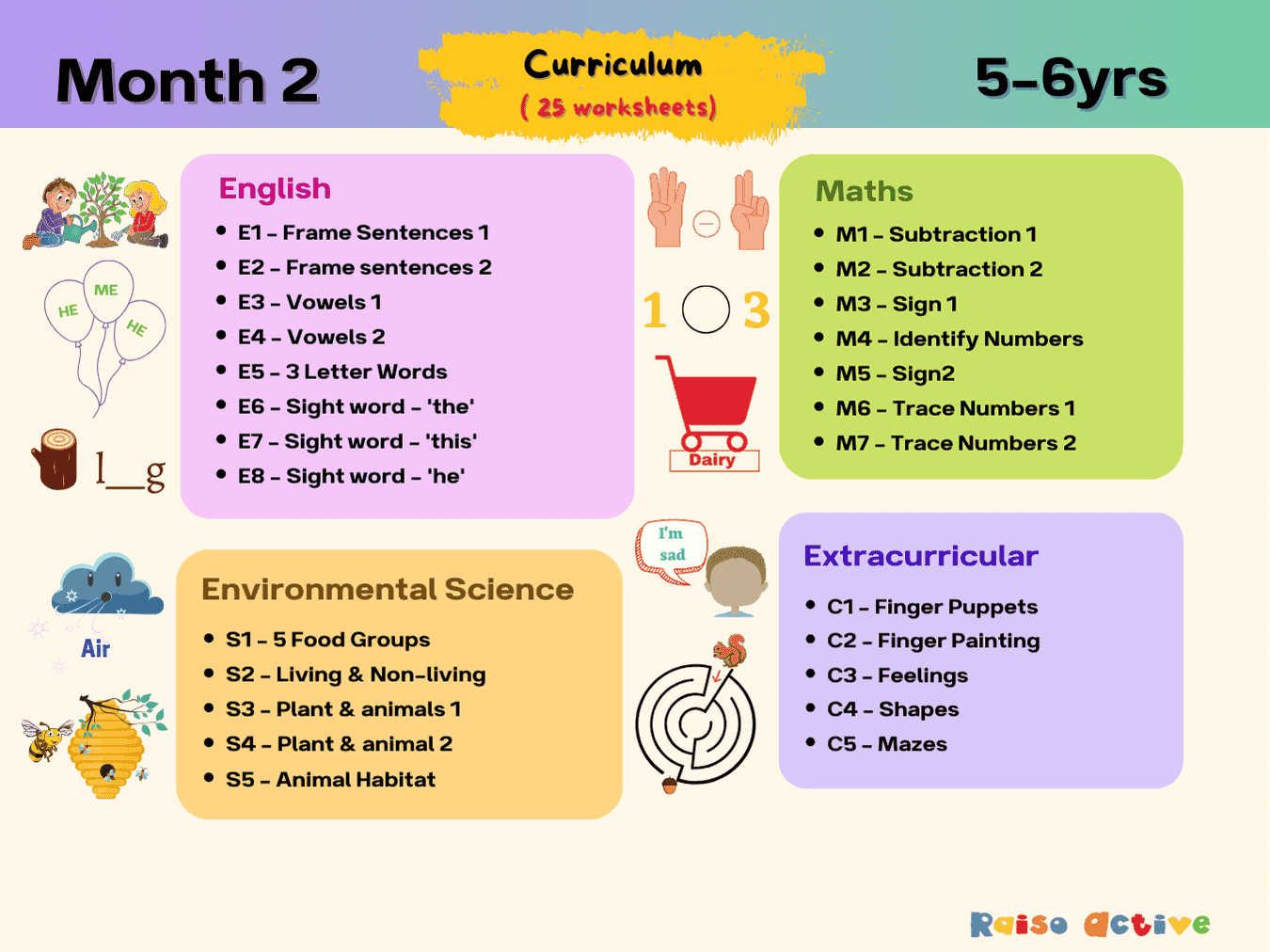
Month 2: Learning & Development | Ages 5-6
This is page 25 of the pack. Ages 5-6 · KindergartenAges 5-6 · Year 1Ages 5-6 · UKGAges 5-6
Made for your child
A whole activity pack made with their name
60 pages to spot, build, trace and write their own name, plus pages about their favourites, feelings and family. See a free preview with their name.
Make an All About Me packFree preview · free for members
Or start free: a name tracing sheet with their nameCurriculum
- Art & Craft > Arts & Crafts
How to use this worksheet
Set out a shallow dish of green paint and protect the work surface with a covering. Have your child dip just their fingertip into the paint. Show them the bare tree branches on the page and demonstrate dabbing a single fingerprint onto one branch to create a 'leaf.' Let them continue dabbing leaves across all the branches, using as many fingerprints as they like to fill the tree.
Materials needed
- Green paint
- Paper
- Finger
Extension activities
- 1Use different colors to paint other elements of the picture, like a sun, grass, or flowers.
- 2Create a background for the tree using other painting techniques, like a brush or a sponge.
- 3Try the same fingerprint-leaf technique using different colors to make a fall-themed tree.
- 4Press fingerprints onto a separate sheet to create other pictures, like a caterpillar or a bunch of grapes.
- 5Talk about how trees change with the seasons as you paint the leaves on.

Written by
Hemsweta Jain · Teacher Cheena
MBA and Early Childhood Educator, teaching since 2014 · Founder of RaisoActive, Mumbai
Every RaisoActive worksheet is designed and checked by the founder before publishing.
Published · Last reviewed
More from Month 2: Learning & Development | Ages 5-6

Trace and Write Numbers 11-15: Counting and Writing Worksheet
Ages 4-6 · Pre-K–KindergartenAges 4-6 · Reception–Year 1Ages 4-6 · LKG–UKGAges 4-6
This worksheet helps children ages 4-6 practice tracing and writing the number words from eleven to fifteen, moving beyond single-digit numbers into the trickier teen range where number names don't always follow an obvious pattern. Matching the number of dots on dice to the correct written number name also reinforces that these longer number words still represent a specific countable quantity.
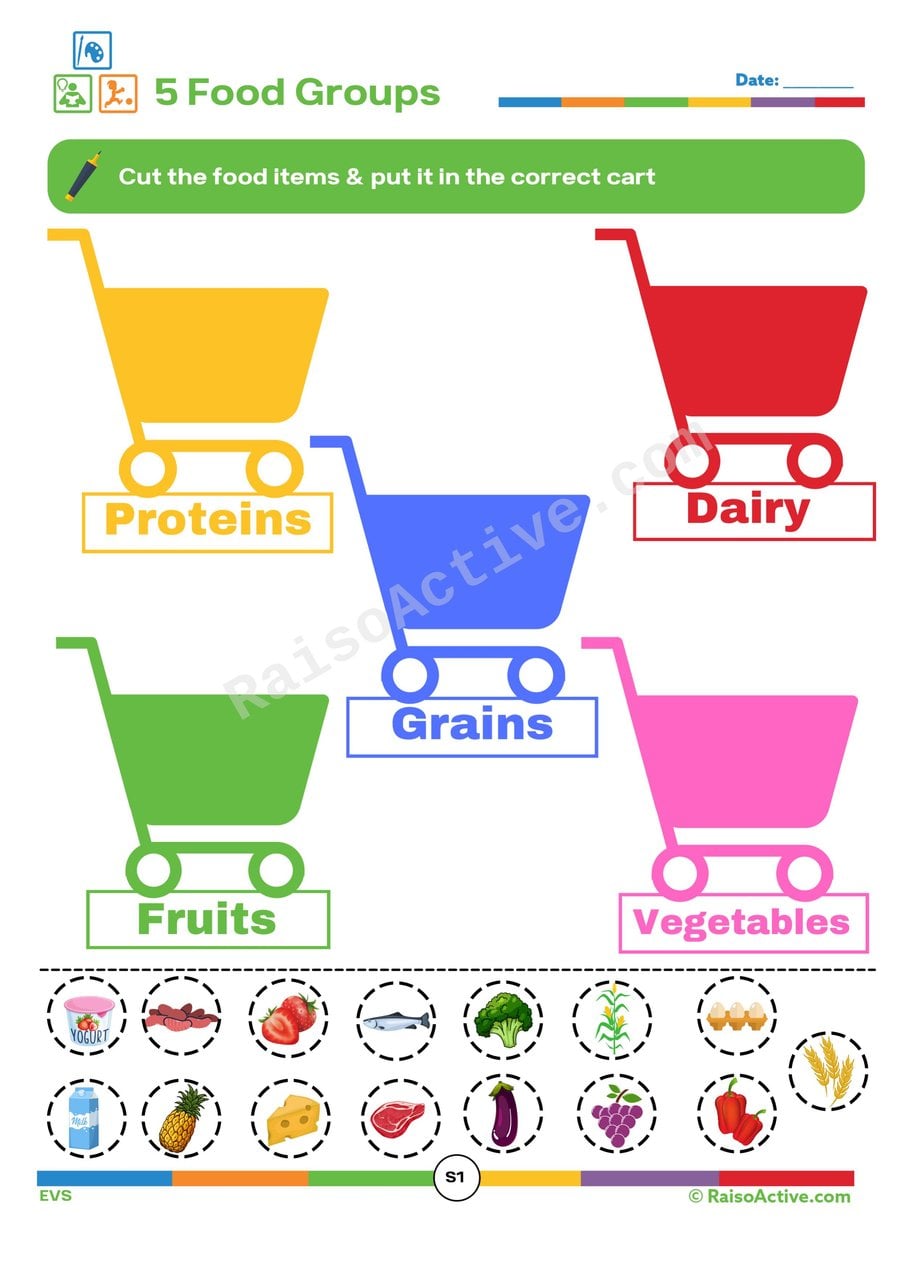
Food Groups Sorting Worksheet for Preschoolers
Ages 3-5 · Preschool–Pre-KAges 3-5 · Nursery–ReceptionAges 3-5 · Nursery–LKGAges 3-5
This worksheet helps children ages 3-5 learn about the different food groups and practice categorizing food items by cutting out pictures and pasting them into the correct group. Sorting foods this way builds early classification skills while also introducing the idea that different foods serve different purposes for the body, laying groundwork for healthy eating habits.
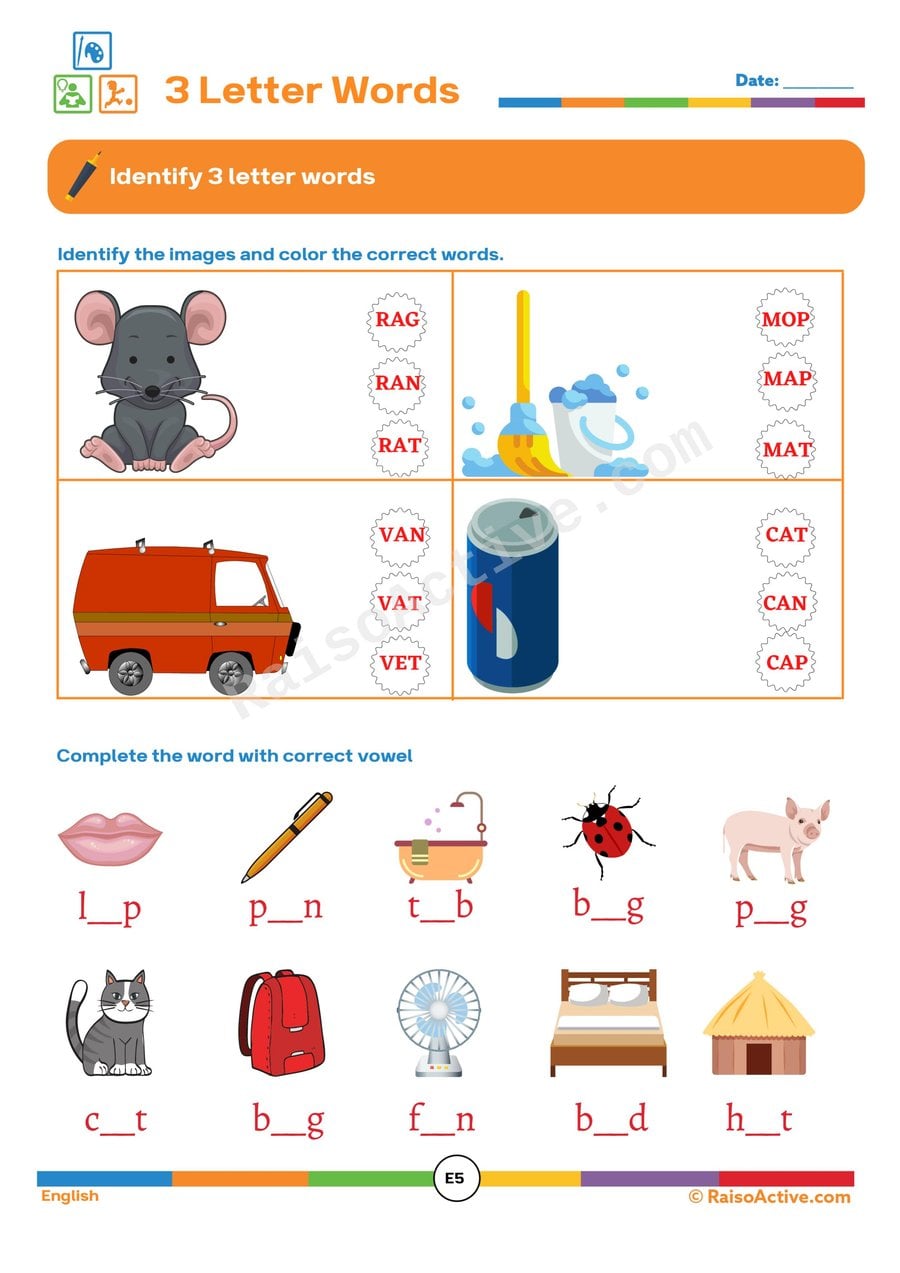
3 Letter Words Worksheet: Identify and Color!
Ages 3-5 · Preschool–Pre-KAges 3-5 · Nursery–ReceptionAges 3-5 · Nursery–LKGAges 3-5
This worksheet helps children ages 3-5 identify and recognize simple three-letter words by matching pictures to their written word and then completing each word by filling in a missing vowel. Working with short, consistent words like these builds the beginning reading skills that let children start decoding independently.

Frame Sentences Worksheet: Fill-in-the-Blanks with Pictures!
Ages 4-5 · Pre-KAges 4-5 · ReceptionAges 4-5 · LKGAges 4-5
Children ages 4-5 practice connecting spoken vocabulary to written words as they use picture clues to fill in missing words within a sentence frame. This builds early sentence construction and reinforces that a sentence needs the right word in the right place to make sense, a stepping stone toward independent writing.

Vowel Fun! Find, Color, and Fill-in the Missing Vowels Worksheet
Ages 3-5 · Preschool–Pre-KAges 3-5 · Nursery–ReceptionAges 3-5 · Nursery–LKGAges 3-5
This worksheet gives children ages 3-5 focused practice identifying the five vowels, A, E, I, O, U, and recognizing which vowel sound completes a familiar picture word. Because vowels appear in nearly every word, this early, targeted practice builds a phonics foundation that supports reading many more words later.

Counting and Comparing: Greater Than, Less Than, or Equal To Worksheet
Ages 4-6 · Pre-K–KindergartenAges 4-6 · Reception–Year 1Ages 4-6 · LKG–UKGAges 4-6
This worksheet builds on basic counting by asking children to compare two separate groups of pictures and decide whether one group has more, fewer, or the same number as the other, then represent that relationship with the correct symbol. For four- to six-year-olds, this task combines accurate counting with comparative reasoning, both of which are essential building blocks for later mathematical problem solving.
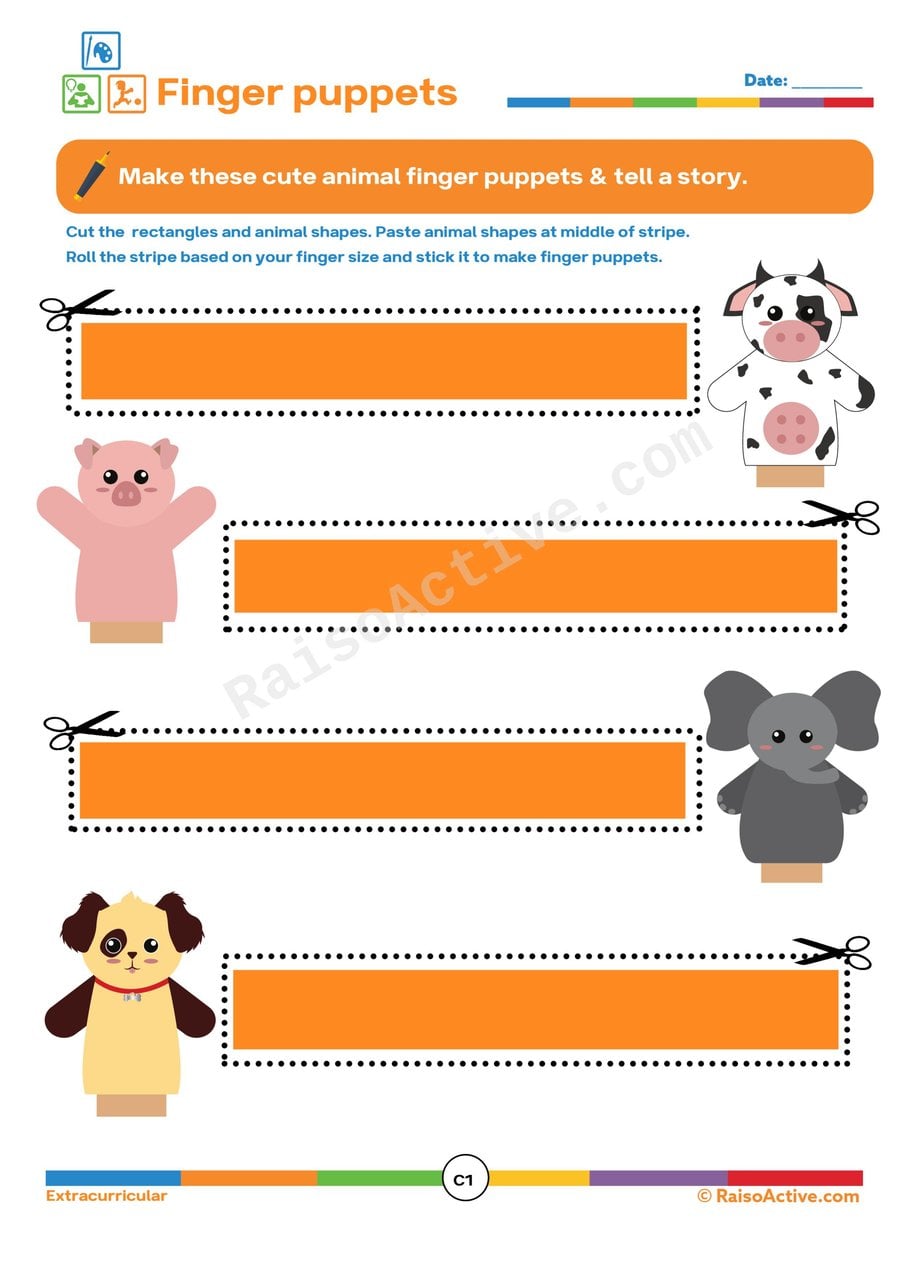
Make Finger Puppets! Fun Animal Craft Worksheet
Ages 3-5 · Preschool–Pre-KAges 3-5 · Nursery–ReceptionAges 3-5 · Nursery–LKGAges 3-5
This hands-on craft worksheet builds scissor control and fine motor precision in children ages 3-5 as they cut out animal shapes and rectangles, then roll and secure the rectangle into a puppet that fits their finger. The three-dimensional assembly step also introduces early spatial reasoning, since children must figure out how a flat shape becomes a wearable tube.

Trace and Write Numbers: Sixteen to Twenty Worksheet
Ages 4-5 · Pre-KAges 4-5 · ReceptionAges 4-5 · LKGAges 4-5
This worksheet helps children ages 4-5 practice tracing and writing the number words from sixteen to twenty, completing the teen and early twenty number-word range that builds toward full number fluency to 20. Repeated tracing of these longer words also continues to build the handwriting stamina needed for more complex writing tasks ahead.
Related worksheets
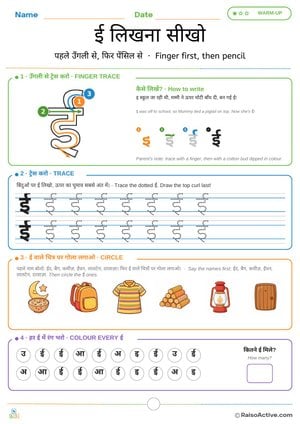
Hindi Letter ई (ee) Writing Practice: Finger and Pencil Tracing | ई लिखना सीखो
Ages 3-7 · Preschool–Grade 1Ages 3-7 · Nursery–Year 2Ages 3-7 · Nursery–Class 1Ages 3-7
Children learn the stroke order of ई. They trace it with a finger along numbered arrows, trace the dotted letters with a pencil, add the headline (शिरोरेखा) last, circle the pictures that start with ई and colour every ई in a row of mixed vowels.
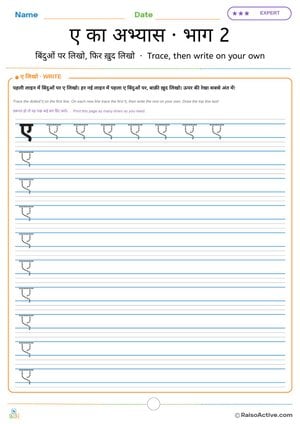
Hindi Letter ए (e) Practice 2: Trace, then Write on Your Own | ए का अभ्यास · भाग 2
Ages 5-7 · Kindergarten–Grade 1Ages 5-7 · Year 1–Year 2Ages 5-7 · UKG–Class 1Ages 5-7
An expert page for confident writers: trace the dotted ए on the first line, then on each new line trace the first ए and write the rest on your own, adding the top line last.
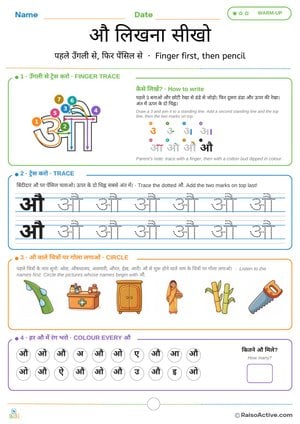
Learn to Write Hindi Letter औ (au) – Tracing Worksheet | औ लिखना सीखो
Ages 3-7 · Preschool–Grade 1Ages 3-7 · Nursery–Year 2Ages 3-7 · Nursery–Class 1Ages 3-7
Children learn to write औ step by step: a 3 joined to a standing line, a second standing line, the top line, and last the two marks on top. They trace with a finger first, then trace dotted rows with a pencil, circle the औ pictures and colour every औ in a grid.

Navratri Nine Colours Colouring Page: Colour the Garba Dancers
Ages 4-6 · Pre-K–KindergartenAges 4-6 · Reception–Year 1Ages 4-6 · LKG–UKGAges 4-6
Children learn the colour linked with each of the nine days of Navratri 2026 and practise colouring inside the lines.
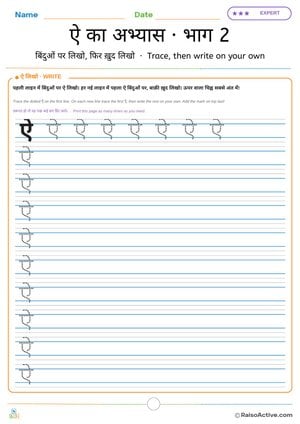
Hindi Letter ऐ (ai) Practice 2: Trace, then Write on Your Own | ऐ का अभ्यास · भाग 2
Ages 5-7 · Kindergarten–Grade 1Ages 5-7 · Year 1–Year 2Ages 5-7 · UKG–Class 1Ages 5-7
An expert page for confident writers: trace the dotted ऐ on the first line, then on each new line trace the first ऐ and write the rest on your own, adding the mark on top last.
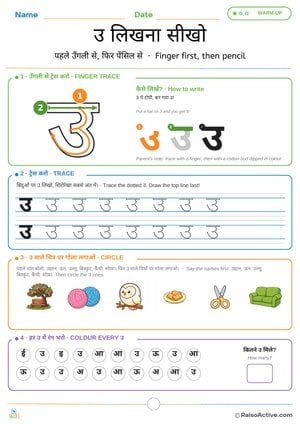
Hindi Letter उ (u) Writing Practice: Finger and Pencil Tracing | उ लिखना सीखो
Ages 3-7 · Preschool–Grade 1Ages 3-7 · Nursery–Year 2Ages 3-7 · Nursery–Class 1Ages 3-7
Children learn the stroke order of उ. They trace it with a finger along numbered arrows, trace the dotted letters with a pencil, add the headline (शिरोरेखा) last, circle the pictures that start with उ and colour every उ in a row of mixed vowels.
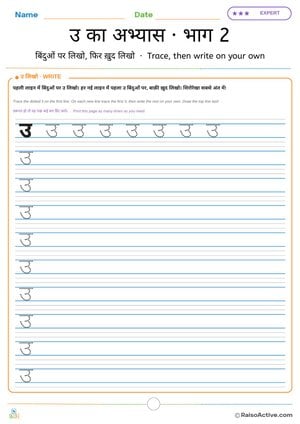
Hindi Letter उ Practice Part 2: Trace and Write on Your Own | उ का अभ्यास · भाग 2
Ages 3-7 · Preschool–Grade 1Ages 3-7 · Nursery–Year 2Ages 3-7 · Nursery–Class 1Ages 3-7
Children build writing fluency by tracing the dotted line उ on the first line and then writing the letter on their own, line after line, as the dotted help fades. The headline (शिरोरेखा) is drawn last, as in Hindi handwriting.
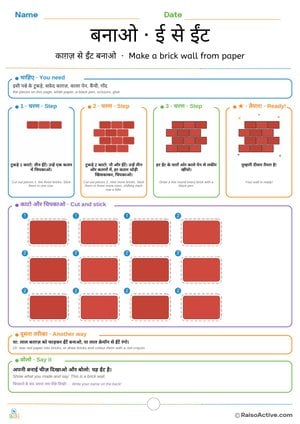
Make a Paper Brick Wall: Hindi Letter ई Craft | बनाओ · ई से ईंट
Ages 3-7 · Preschool–Grade 1Ages 3-7 · Nursery–Year 2Ages 3-7 · Nursery–Class 1Ages 3-7
Children cut out the pieces, put them together following three step pictures and make a paper brick wall. Saying the word ईंट as they make it links the sound ई to something they built themselves.
Guides for this topic

Number Formation Rhymes 0–9 and How to Fix Reversals
Original number formation rhymes for 0–9, the correct stroke order for each digit, why 3, 5 and 7 get reversed most often, and multisensory fixes that work.

Pre-Writing Strokes in Order: From Standing Lines to Loops (With Printable Patterns)
The developmental order of pre-writing strokes, from vertical lines to loops, and why practicing them in sequence makes letter formation much easier to learn.

Kindergarten Readiness Checklist: 25 Skills to Practice Before the First Day
A kindergarten readiness checklist of 25 literacy, math, motor, self-regulation and self-help skills, with an 8-week summer plan and notes on when not to worry.
Reviews
Every worksheet for ages 3–5, no watermark
Members download the full library of 1,000+ worksheets and every activity pack without watermarks or daily limits. One year costs ₹999 in India or $20 elsewhere.
See membership plansOr download any worksheet free with a watermark (5 a day).