Make Finger Puppets! Fun Animal Craft Worksheet
This hands-on craft worksheet builds scissor control and fine motor precision in children ages 3-5 as they cut out animal shapes and rectangles, then roll and secure the rectangle into a puppet that fits their finger. The three-dimensional assembly step also introduces early spatial reasoning, since children must figure out how a flat shape becomes a wearable tube.
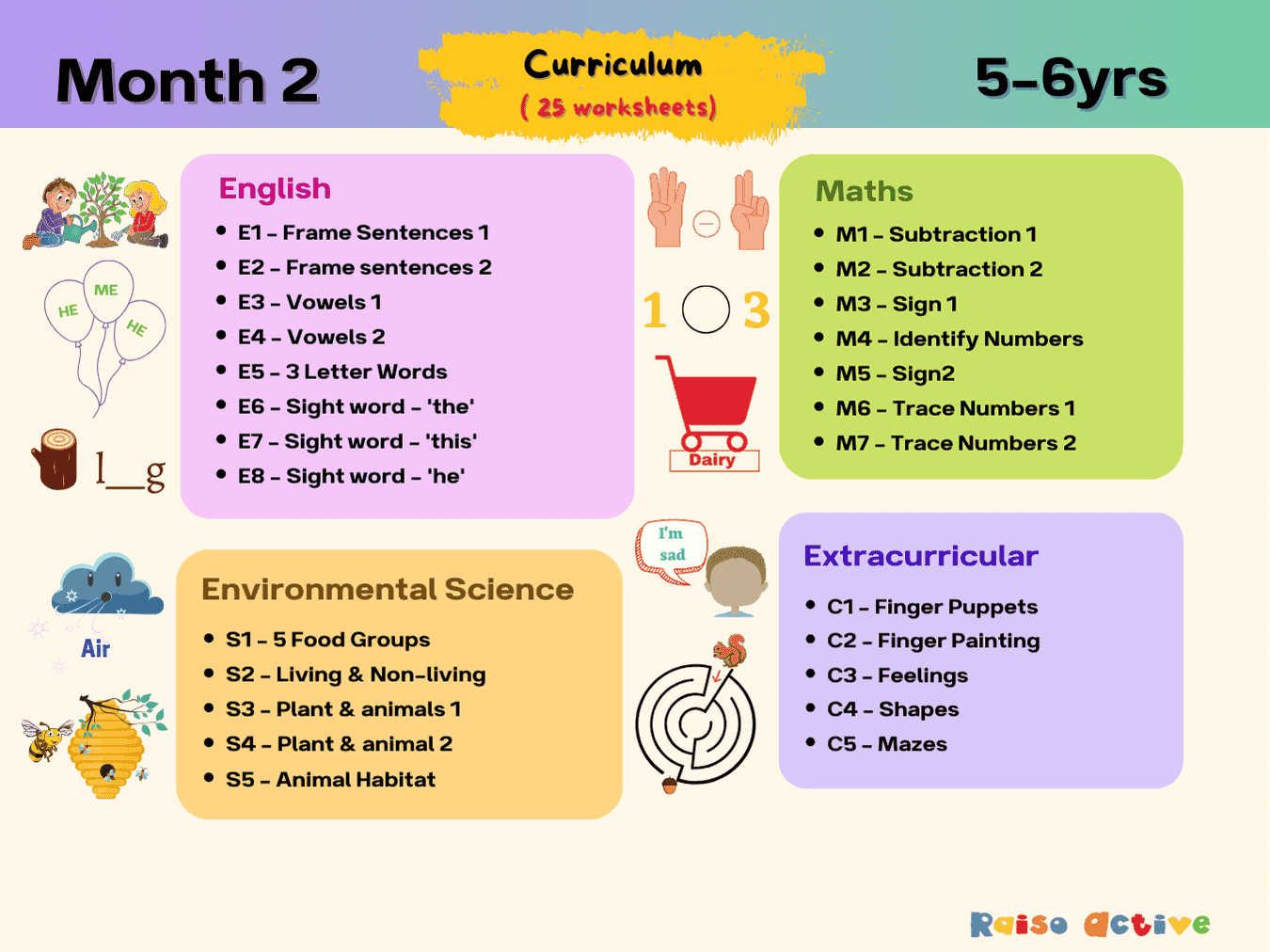
Part of the pack
Month 2: Learning & Development | Ages 5-6
This is page 24 of the pack. Ages 5-6 · KindergartenAges 5-6 · Year 1Ages 5-6 · UKGAges 5-6
Curriculum
- Art & Craft > Arts & Crafts
How to use this worksheet
Help your child cut out the animal shapes along with the orange rectangles, guiding their scissor hand if needed for the curved edges. Have them glue or paste each animal shape onto the middle of an orange rectangle, checking that the animal is facing the right way up. Next, help them roll the rectangle around their finger until it forms a snug tube and secure the overlapping edge with glue or tape. Repeat with the remaining animals until your child has a full set of finger puppets, then let them wiggle their fingers to bring each animal to life.
Materials needed
- Scissors
- Glue or Tape
- Crayons or Markers (optional)
Extension activities
- 1Put on a puppet show together, giving each animal a name and a silly voice.
- 2Draw one extra animal from scratch and turn it into another finger puppet.
- 3Make up and tell a short story where all the puppet animals meet each other.
- 4Practice animal sounds and movements for each puppet character before the show.

Written by
Hemsweta Jain · Teacher Cheena
MBA and Early Childhood Educator, teaching since 2014 · Founder of RaisoActive, Mumbai
Every RaisoActive worksheet is designed and checked by the founder before publishing.
Published · Last reviewed
More from Month 2: Learning & Development | Ages 5-6

Subtraction Fun: Counting Fingers Worksheet for Kids
Ages 4-5 · Pre-KAges 4-5 · ReceptionAges 4-5 · LKGAges 4-5
Children ages 4-5 use their own fingers as a built-in counting tool to practice subtraction, connecting an abstract number sentence to something they can physically see and touch. This bridges the gap between counting objects and solving take-away problems with numbers alone.

Sight Word 'This' Worksheet: Trace, Write, and Identify!
Ages 3-5 · Preschool–Pre-KAges 3-5 · Nursery–ReceptionAges 3-5 · Nursery–LKGAges 3-5
This worksheet helps children ages 3-5 learn to recognize, write, and use the sight word 'this' in sentences, building automatic recognition of a word that appears constantly in early reading but doesn't sound out easily. Cutting and pasting letters to spell the word adds a hands-on layer that reinforces letter order alongside whole-word recognition.

Alligator Comparison Worksheet: Greater Than, Less Than, and Equal To!
Ages 4-6 · Pre-K–KindergartenAges 4-6 · Reception–Year 1Ages 4-6 · LKG–UKGAges 4-6
This worksheet teaches children ages 4-6 to compare two numbers using the 'hungry alligator' mnemonic, where the alligator's mouth always opens toward the larger number. Understanding greater than, less than, and equal to is an essential building block for later place value, ordering, and basic algebra concepts.

Plant or Animal? A Fun Sorting Worksheet for Kids!
Ages 3-5 · Preschool–Pre-KAges 3-5 · Nursery–ReceptionAges 3-5 · Nursery–LKGAges 3-5
Children ages 3-5 practice distinguishing plants from animals by identifying key characteristics like movement and growth, an early biology classification skill that builds their ability to organize the natural world into categories. Labeling each picture with 'A' or 'P' also reinforces letter recognition alongside the science content.

Subtraction Fun: Count and Subtract with Hands and Objects!
Ages 4-6 · Pre-K–KindergartenAges 4-6 · Reception–Year 1Ages 4-6 · LKG–UKGAges 4-6
This worksheet introduces basic subtraction by having children count a starting group of objects and then 'take away' a smaller amount indicated by the minus sign, connecting the abstract concept of subtraction to something they can see and count. For four- to six-year-olds, visualizing subtraction as physically removing objects from a group — rather than just manipulating numbers — makes the concept concrete before they move to solving subtraction problems with numbers alone.

Frame Sentences Worksheet: Fill-in-the-Blanks with Pictures!
Ages 4-5 · Pre-KAges 4-5 · ReceptionAges 4-5 · LKGAges 4-5
Children ages 4-5 practice connecting spoken vocabulary to written words as they use picture clues to fill in missing words within a sentence frame. This builds early sentence construction and reinforces that a sentence needs the right word in the right place to make sense, a stepping stone toward independent writing.

Sight Word 'THE' Worksheet: Trace, Write, and Identify!
Ages 4-5 · Pre-KAges 4-5 · ReceptionAges 4-5 · LKGAges 4-5
This worksheet builds automatic recognition of the sight word 'the,' one of the most frequently occurring words in English text, through repeated tracing, writing, and identification practice. For four- and five-year-olds, memorizing high-frequency sight words like 'the' by sight — rather than sounding them out each time — is essential for building reading fluency, since these words appear on nearly every page a child will read.

Frame Sentences Worksheet: Read and Tick the Correct Sentence!
Ages 4-6 · Pre-K–KindergartenAges 4-6 · Reception–Year 1Ages 4-6 · LKG–UKGAges 4-6
This worksheet strengthens early grammar awareness in children ages 4-6 by having them compare two or more versions of a sentence and judge which one is written correctly. Spotting the difference between a correct and incorrect sentence builds the same skimming and comparing skills that support later spelling and editing work.
Related worksheets

Ladybug Cut and Paste Worksheet for Preschoolers
Ages 3-5 · Preschool–Pre-KAges 3-5 · Nursery–ReceptionAges 3-5 · Nursery–LKGAges 3-5
Cutting out and assembling separate ladybug pieces into one recognizable insect builds scissor control on small, rounded shapes and reinforces the idea of constructing a whole picture from parts, similar to other animal-assembly crafts. The ladybug theme also gives a simple, concrete opening to talk about insect features like spots and wings.

Colorful Bird Cut and Paste Worksheet for Preschoolers
Ages 3-5 · Preschool–Pre-KAges 3-5 · Nursery–ReceptionAges 3-5 · Nursery–LKGAges 3-5
Assembling a colorful bird from separate cut-out shapes teaches children to build a recognizable image from individual parts — body, wings, beak, tail — which strengthens both scissor control and the visual-spatial planning needed to see how pieces relate to a whole picture. The bright color theme also gives a natural opportunity to build color-naming vocabulary as each piece goes on.

Paste the Animals: Aerial and Aquatic Animals Worksheet
Ages 3-5 · Preschool–Pre-KAges 3-5 · Nursery–ReceptionAges 3-5 · Nursery–LKGAges 3-5
Sorting animals into 'aerial' and 'aquatic' groups introduces slightly more advanced classification vocabulary than a simple farm-versus-wild sort, asking children to think about how an animal moves and where it lives — in the air or in water — rather than just what it looks like. This kind of habitat-based categorization at ages 3-5 builds early science thinking alongside the scissor and gluing practice.

Cut and Paste a Fun Fish Worksheet for Preschoolers
Ages 3-5 · Preschool–Pre-KAges 3-5 · Nursery–ReceptionAges 3-5 · Nursery–LKGAges 3-5
Building a fish from separate cut-out shapes glued onto a large circle base gives children practice constructing a picture within a defined boundary, teaching them to fit and arrange pieces inside a fixed space rather than a blank page. This kind of bounded assembly at ages 3-5 builds spatial planning alongside the usual scissor and gluing practice.
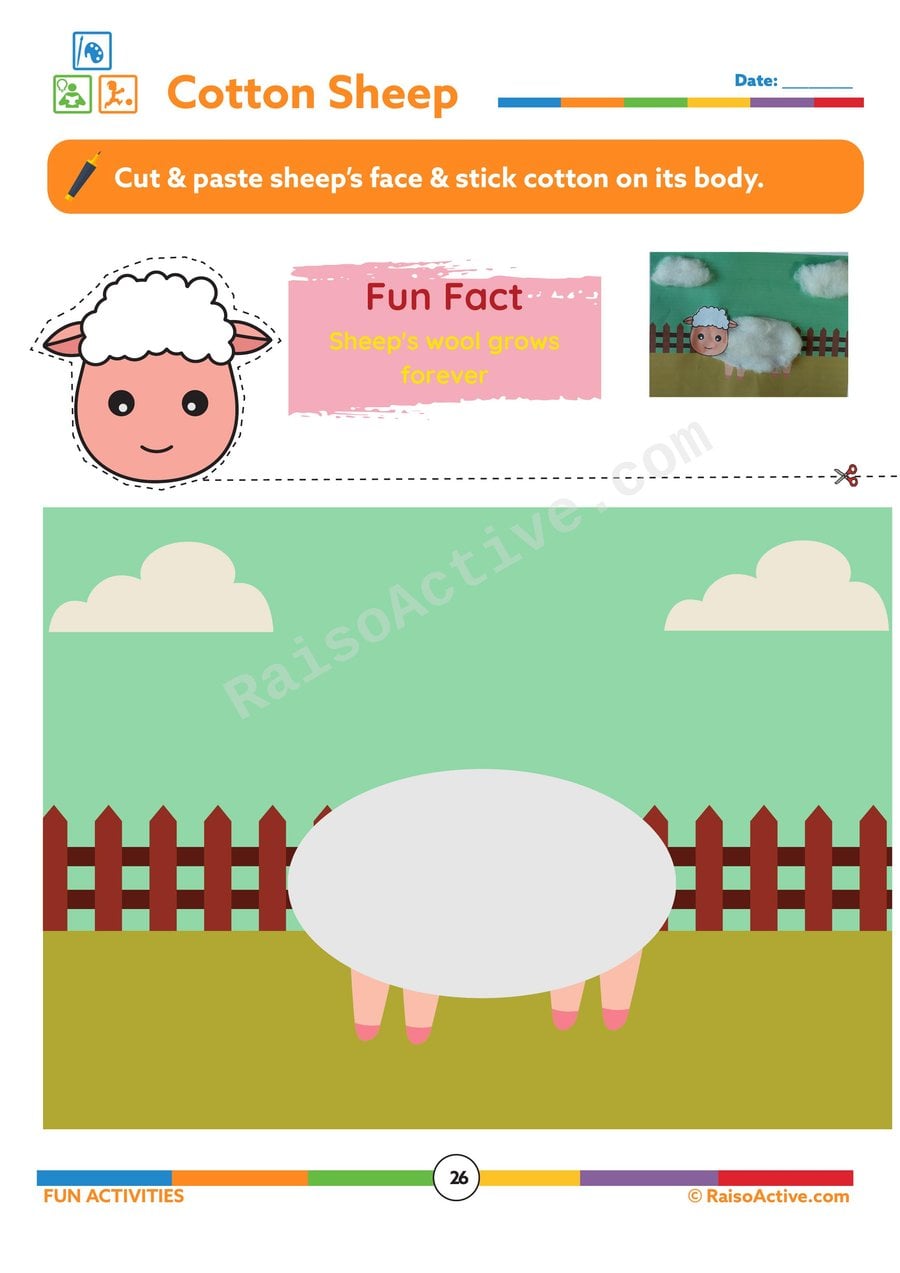
Cotton Sheep Craft Worksheet for Preschoolers
Ages 3-5 · Preschool–Pre-KAges 3-5 · Nursery–ReceptionAges 3-5 · Nursery–LKGAges 3-5
Cutting out the sheep's face and body and then pressing on individual cotton balls to build up its wool gives children a satisfying sensory contrast — the crisp, controlled cut of paper versus the soft, pinch-and-place texture of cotton — while practicing pincer grip strength needed for holding a pencil. The sheep theme also opens up simple, concrete conversation about where wool comes from.

Farm and Wild Animals Cut and Paste Worksheet for Preschoolers
Ages 3-5 · Preschool–Pre-KAges 3-5 · Nursery–ReceptionAges 3-5 · Nursery–LKGAges 3-5
Sorting each cut-out animal into 'Farm' or 'Wild' teaches an early classification skill — grouping items by a shared category rather than just by appearance — which is foundational to later science and math thinking. At ages 3-5, deciding where an animal belongs also builds vocabulary and general knowledge about where different animals actually live, alongside the scissor and gluing practice.
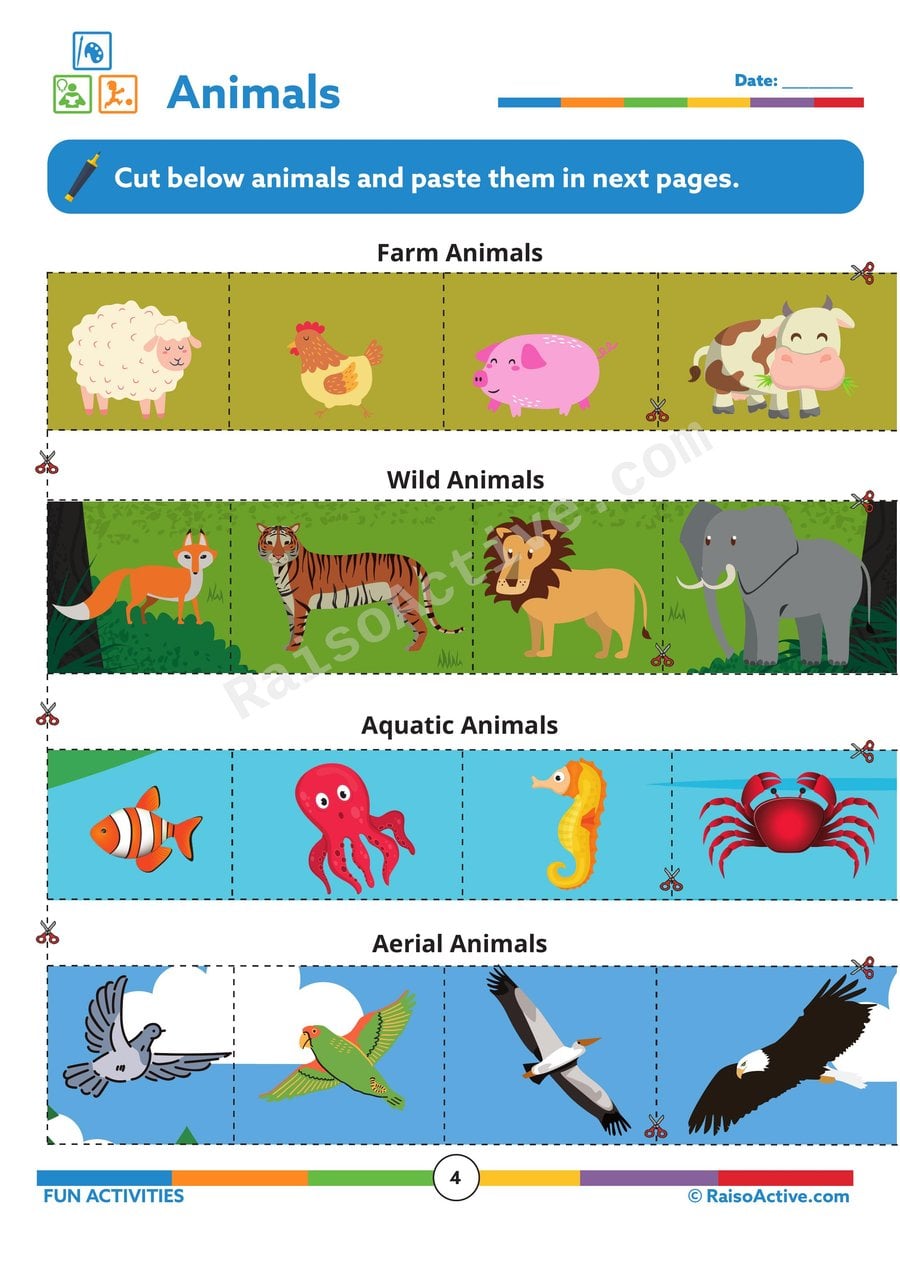
Animal Cut and Paste Worksheet for Preschoolers
Ages 3-5 · Preschool–Pre-KAges 3-5 · Nursery–ReceptionAges 3-5 · Nursery–LKGAges 3-5
Cutting out animal shapes or parts and gluing them into place builds scissor control and gluing precision in children ages 3-5, while sorting or placing animals correctly, such as onto a matching habitat or body outline, reinforces basic animal knowledge and classification. This combination of a physical craft skill and a simple thinking task makes the activity more than just cutting practice alone.

Giraffe Cut and Paste Worksheet for Preschoolers
Ages 3-5 · Preschool–Pre-KAges 3-5 · Nursery–ReceptionAges 3-5 · Nursery–LKGAges 3-5
Assembling a giraffe from separate cut-out parts and gluing them onto a background gives children practice with proportion and placement — a giraffe's long neck and small head need to be positioned correctly relative to its body — which is a slightly more advanced spatial task than assembling rounder, simpler animals. This craft at ages 3-5 builds scissor control alongside basic animal knowledge.
Guides for this topic

Number Formation Rhymes 0–9 and How to Fix Reversals
Original number formation rhymes for 0–9, the correct stroke order for each digit, why 3, 5 and 7 get reversed most often, and multisensory fixes that work.

Pre-Writing Strokes in Order: From Standing Lines to Loops (With Printable Patterns)
The developmental order of pre-writing strokes, from vertical lines to loops, and why practicing them in sequence makes letter formation much easier to learn.

Kindergarten Readiness Checklist: 25 Skills to Practice Before the First Day
A kindergarten readiness checklist of 25 literacy, math, motor, self-regulation and self-help skills, with an 8-week summer plan and notes on when not to worry.
Reviews
Every worksheet for ages 3–5, no watermark
Members download the full library of 1,000+ worksheets and every activity pack without watermarks or daily limits. One year costs ₹999 in India or $20 elsewhere.
See membership plansOr download any worksheet free with a watermark (5 a day).