Shape Counting Fun: Color and Count the Shapes Worksheet
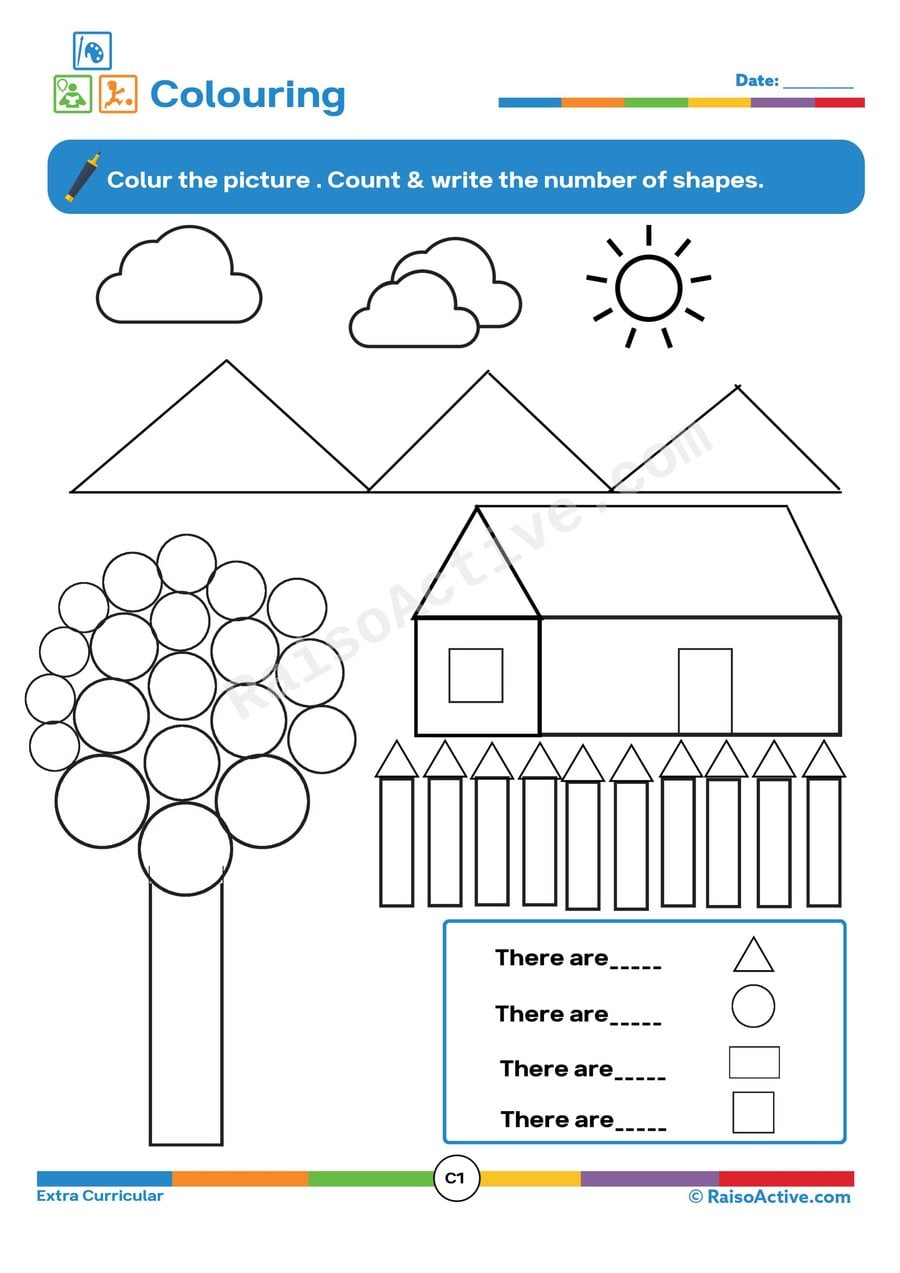
Children ages 3-5 practice recognizing common shapes by sight, then apply early counting skills by tallying how many of each shape appear in the picture. Combining shape identification with counting strengthens both geometric awareness and number sense at the same time.
Part of the pack
Month 2: Learning & Development | Ages 5-6
This is page 27 of the pack. Ages 5-6 · KindergartenAges 5-6 · Year 1Ages 5-6 · UKGAges 5-6
Made for your child
Counting to 10, made for your child
A maths pack with your child's name in it: pictures that explain, practice at three levels, puzzles and story sums about them. Print a new set whenever they finish.
Make a maths packFree preview · free for members
Curriculum
- 2D Shapes > Shapes & Sorting
How to use this worksheet
Look at the picture together and name each shape you see — circles, squares, triangles, and so on. Have your child color each shape, using a different color for each shape type if they'd like. Once the coloring is done, ask them to count how many of each shape appear on the page and write that number in the box provided next to each shape.
Materials needed
- Pencil
- Crayons
Extension activities
- 1Send your child on a shape hunt around the house, counting how many circles, squares, and triangles they can find.
- 2Build shapes out of craft sticks or straws and count how many sides each one has.
- 3Make a shape collage using cut-out construction paper shapes glued onto a large sheet.
- 4Use blocks or shape tiles to build a small structure and count how many of each shape you used.

Written by
Hemsweta Jain · Teacher Cheena
MBA and Early Childhood Educator, teaching since 2014 · Founder of RaisoActive, Mumbai
Every RaisoActive worksheet is designed and checked by the founder before publishing.
Published · Last reviewed
More from Month 2: Learning & Development | Ages 5-6

Plant or Animal? A Fun Sorting Worksheet for Kids!
Ages 3-5 · Preschool–Pre-KAges 3-5 · Nursery–ReceptionAges 3-5 · Nursery–LKGAges 3-5
Children ages 3-5 practice distinguishing plants from animals by identifying key characteristics like movement and growth, an early biology classification skill that builds their ability to organize the natural world into categories. Labeling each picture with 'A' or 'P' also reinforces letter recognition alongside the science content.

Parent's Guide: Fun Activities for Early Learning
Ages 3-5 · Preschool–Pre-KAges 3-5 · Nursery–ReceptionAges 3-5 · Nursery–LKGAges 3-5
This parent guide bundles four hands-on activities covering sentence building, subtraction, number comparison, and food sorting, designed for children ages 3-5 to practice early literacy and numeracy through tactile, real-world materials like natural loose parts and playdough. Rotating between language and math tasks in one sitting helps children see connections between counting, comparing, and describing the world around them, rather than treating each subject in isolation.

Subtraction Fun: Counting Fingers Worksheet for Kids
Ages 4-5 · Pre-KAges 4-5 · ReceptionAges 4-5 · LKGAges 4-5
Children ages 4-5 use their own fingers as a built-in counting tool to practice subtraction, connecting an abstract number sentence to something they can physically see and touch. This bridges the gap between counting objects and solving take-away problems with numbers alone.

Frame Sentences Worksheet: Fill-in-the-Blanks with Pictures!
Ages 4-5 · Pre-KAges 4-5 · ReceptionAges 4-5 · LKGAges 4-5
Children ages 4-5 practice connecting spoken vocabulary to written words as they use picture clues to fill in missing words within a sentence frame. This builds early sentence construction and reinforces that a sentence needs the right word in the right place to make sense, a stepping stone toward independent writing.
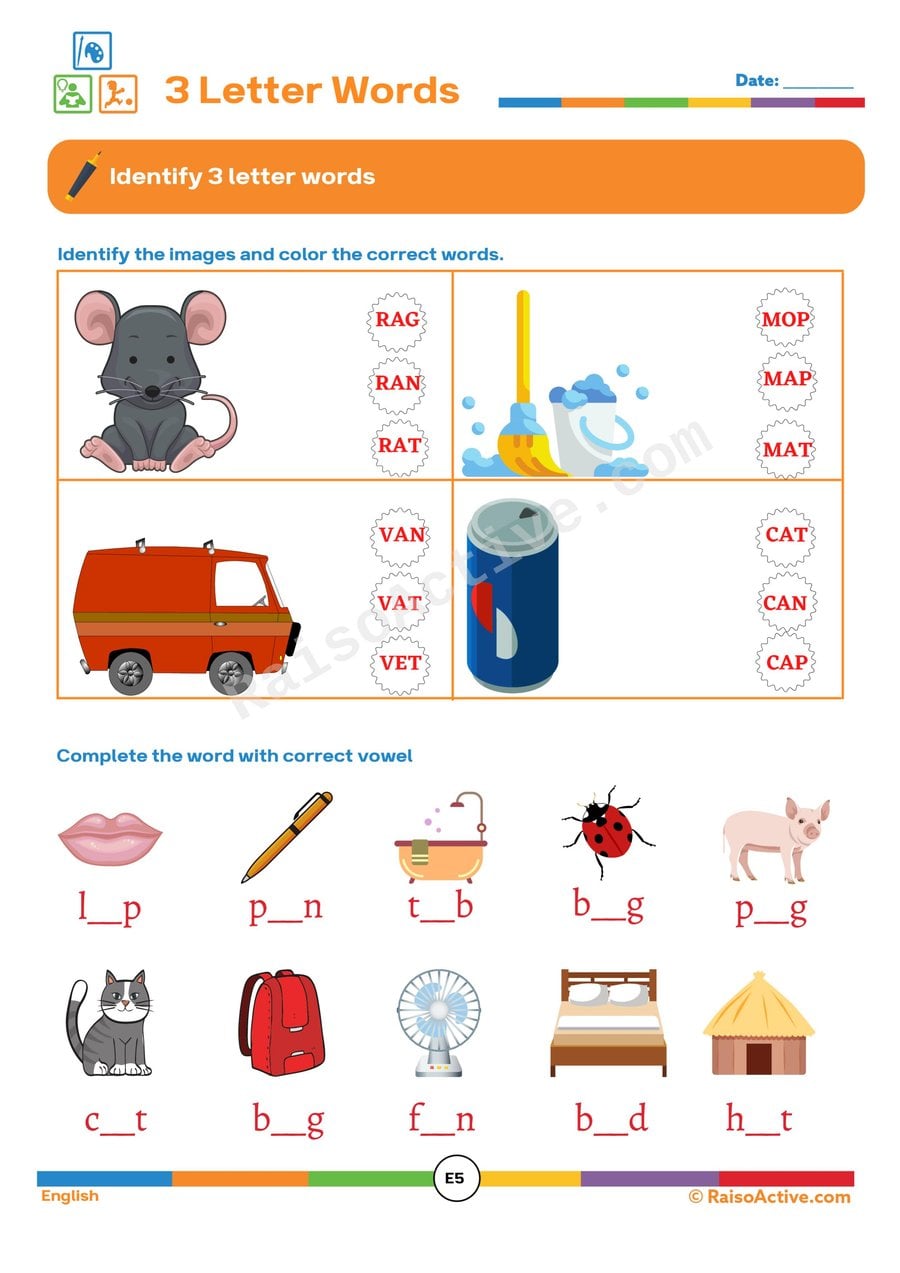
3 Letter Words Worksheet: Identify and Color!
Ages 3-5 · Preschool–Pre-KAges 3-5 · Nursery–ReceptionAges 3-5 · Nursery–LKGAges 3-5
This worksheet helps children ages 3-5 identify and recognize simple three-letter words by matching pictures to their written word and then completing each word by filling in a missing vowel. Working with short, consistent words like these builds the beginning reading skills that let children start decoding independently.

Alligator Comparison Worksheet: Greater Than, Less Than, and Equal To!
Ages 4-6 · Pre-K–KindergartenAges 4-6 · Reception–Year 1Ages 4-6 · LKG–UKGAges 4-6
This worksheet teaches children ages 4-6 to compare two numbers using the 'hungry alligator' mnemonic, where the alligator's mouth always opens toward the larger number. Understanding greater than, less than, and equal to is an essential building block for later place value, ordering, and basic algebra concepts.
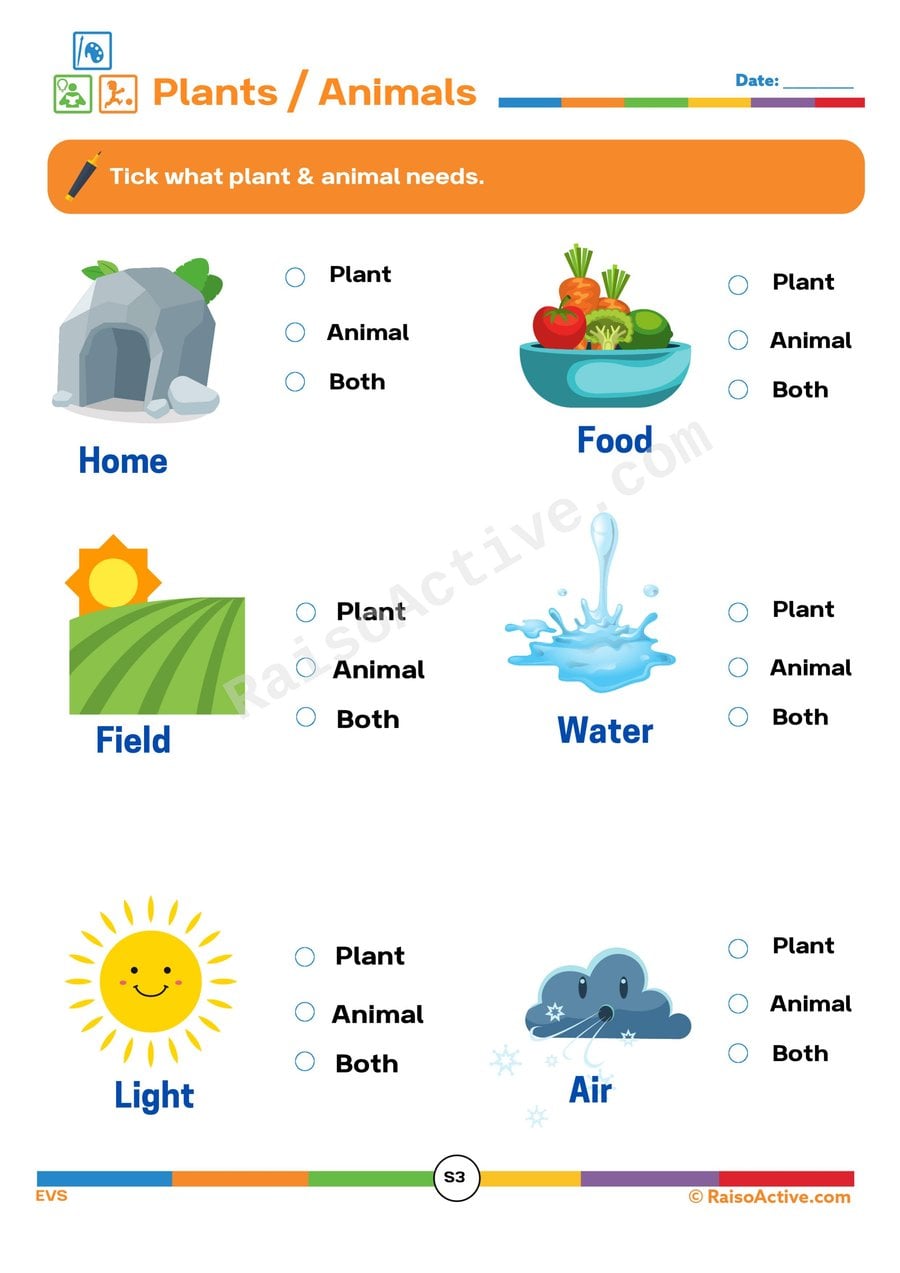
Plants and Animals Needs Worksheet for Kids
Ages 3-5 · Preschool–Pre-KAges 3-5 · Nursery–ReceptionAges 3-5 · Nursery–LKGAges 3-5
This worksheet introduces the basic science concept that living things — both plants and animals — share fundamental needs like food, water, air, and shelter to survive and grow. For three- to five-year-olds, sorting pictures by which need they represent builds early categorization skills while planting the foundation for later biology lessons about what makes something alive.

Sight Word 'HE' Worksheet: Trace, Color, and Practice!
Ages 3-5 · Preschool–Pre-KAges 3-5 · Nursery–ReceptionAges 3-5 · Nursery–LKGAges 3-5
This worksheet helps children ages 3-5 learn to recognize, write, and use the sight word 'HE' in simple sentences, giving repeated exposure to a short, high-frequency word that appears in nearly every early reader book. Practicing the word across six different formats, tracing, coloring, circling, writing, filling in, and cutting and pasting, builds recognition through many different types of practice in one sitting.
Related worksheets
Shape Counting Fun: Count and Color the Shapes!
Ages 3-5 · Preschool–Pre-KAges 3-5 · Nursery–ReceptionAges 3-5 · Nursery–LKGAges 3-5
Preschoolers ages 3-5 combine shape recognition with counting practice by identifying different shapes within a larger picture, coloring them, and then counting how many of each shape appear. This dual task strengthens both geometry vocabulary and one-to-one correspondence as children tally shape totals. Coloring the picture first also builds sustained fine motor control before the counting portion begins.

Connect the Dots: Hidden Shape Worksheet for Kids
Ages 3-5 · Preschool–Pre-KAges 3-5 · Nursery–ReceptionAges 3-5 · Nursery–LKGAges 3-5
Children ages 3-5 practice counting in sequence and fine motor line control as they connect numbered dots in order to reveal a hidden shape, combining numeracy with hand-eye coordination in one satisfying activity. The surprise of a shape emerging only once every dot is connected correctly also motivates children to stay careful and accurate rather than rushing through the numbers.
Shape Matching Worksheet for Preschoolers
Ages 3-5 · Preschool–Pre-KAges 3-5 · Nursery–ReceptionAges 3-5 · Nursery–LKGAges 3-5
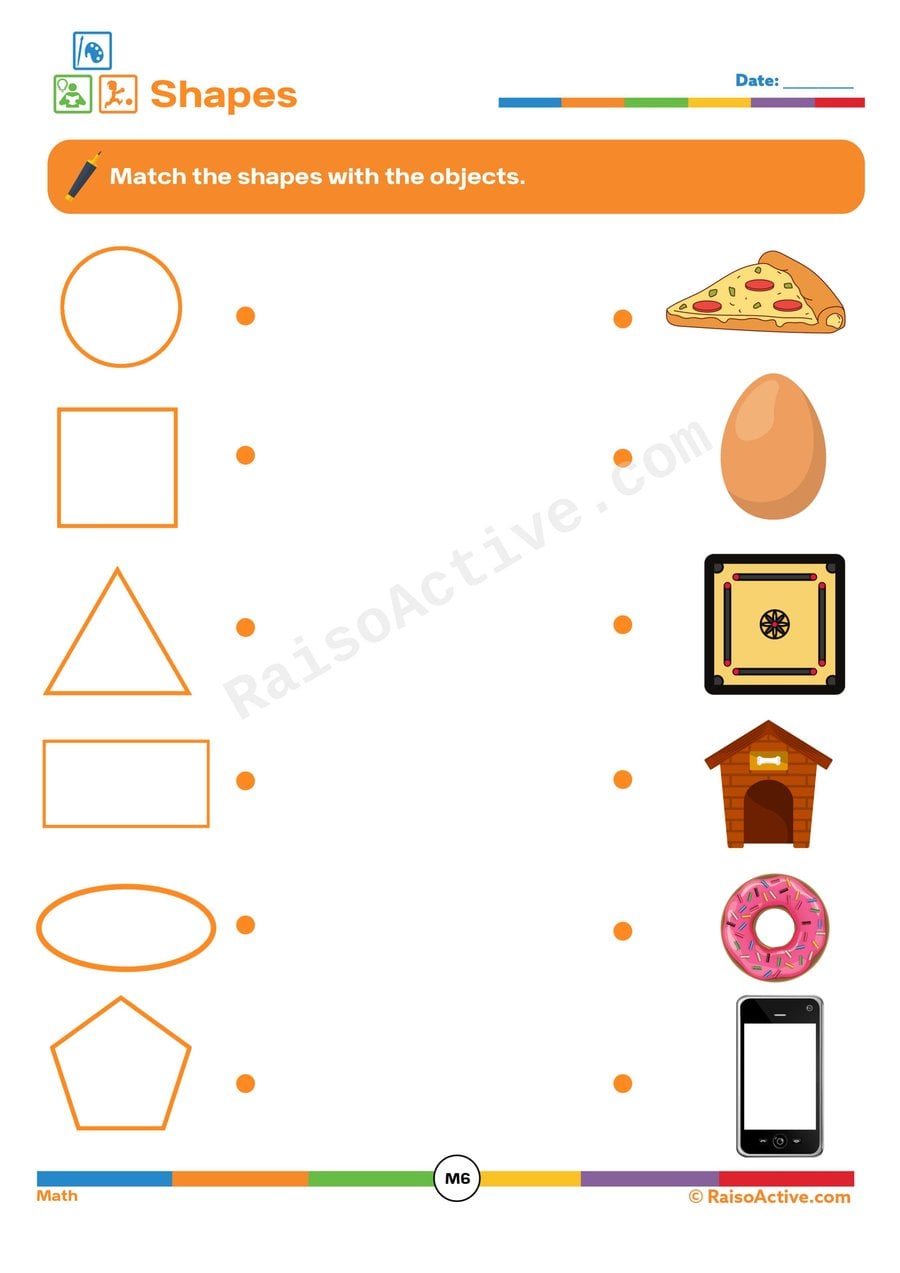
This worksheet strengthens shape recognition for children ages 3-5 by asking them to connect abstract shape outlines to the real-world objects that share that same shape. Recognizing that a shape like a circle or rectangle can apply to very different objects, such as a clock and a door, helps children generalize shape concepts beyond a single example. Drawing the connecting line between matched pairs also reinforces visual tracking and pencil control.

Color the Shapes! A Fun Coloring Worksheet for Kids
Ages 3-5 · Preschool–Pre-KAges 3-5 · Nursery–ReceptionAges 3-5 · Nursery–LKGAges 3-5
This worksheet strengthens children ages 3-5 in both shape recognition and color matching by having them reproduce a colored key onto a black-and-white picture made of shapes. Matching a printed example rather than choosing colors freely also builds a new skill: following a visual reference precisely, which is different from — and complements — open-ended coloring.
Circle Shapes Worksheet: Trace, Color, and Draw!
Ages 3-5 · Preschool–Pre-KAges 3-5 · Nursery–ReceptionAges 3-5 · Nursery–LKGAges 3-5
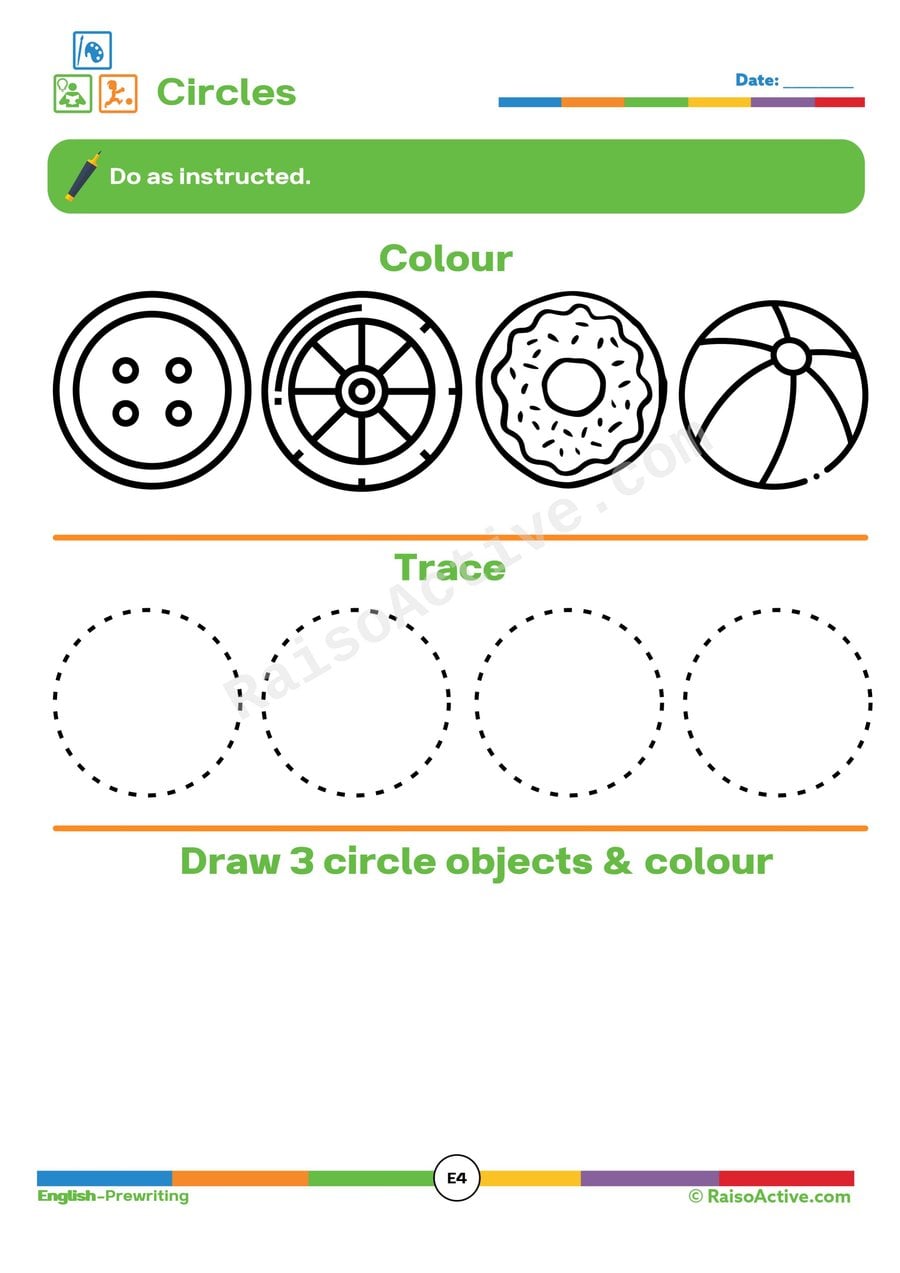
This worksheet builds shape recognition and drawing skills as children ages 3-5 trace dotted circles, color pictures of circular objects, and then draw three circle-shaped objects entirely on their own. Moving from tracing to independent drawing tracks a real developmental progression — first following a guide, then applying the shape from memory — which builds true shape mastery rather than just copying.

Dino Shapes: Cut and Paste Worksheet for Preschoolers
Ages 3-5 · Preschool–Pre-KAges 3-5 · Nursery–ReceptionAges 3-5 · Nursery–LKGAges 3-5
Preschoolers ages 3-5 practice recognizing and counting triangles while cutting them out and pasting them onto a dinosaur outline to complete the picture. This combines shape identification with precise cutting and gluing, building fine motor control alongside early geometry skills. Counting the triangles before cutting also reinforces one-to-one correspondence in a playful, purposeful context.
Shape Sorting Worksheet: Cut and Paste Fun!
Ages 3-5 · Preschool–Pre-KAges 3-5 · Nursery–ReceptionAges 3-5 · Nursery–LKGAges 3-5
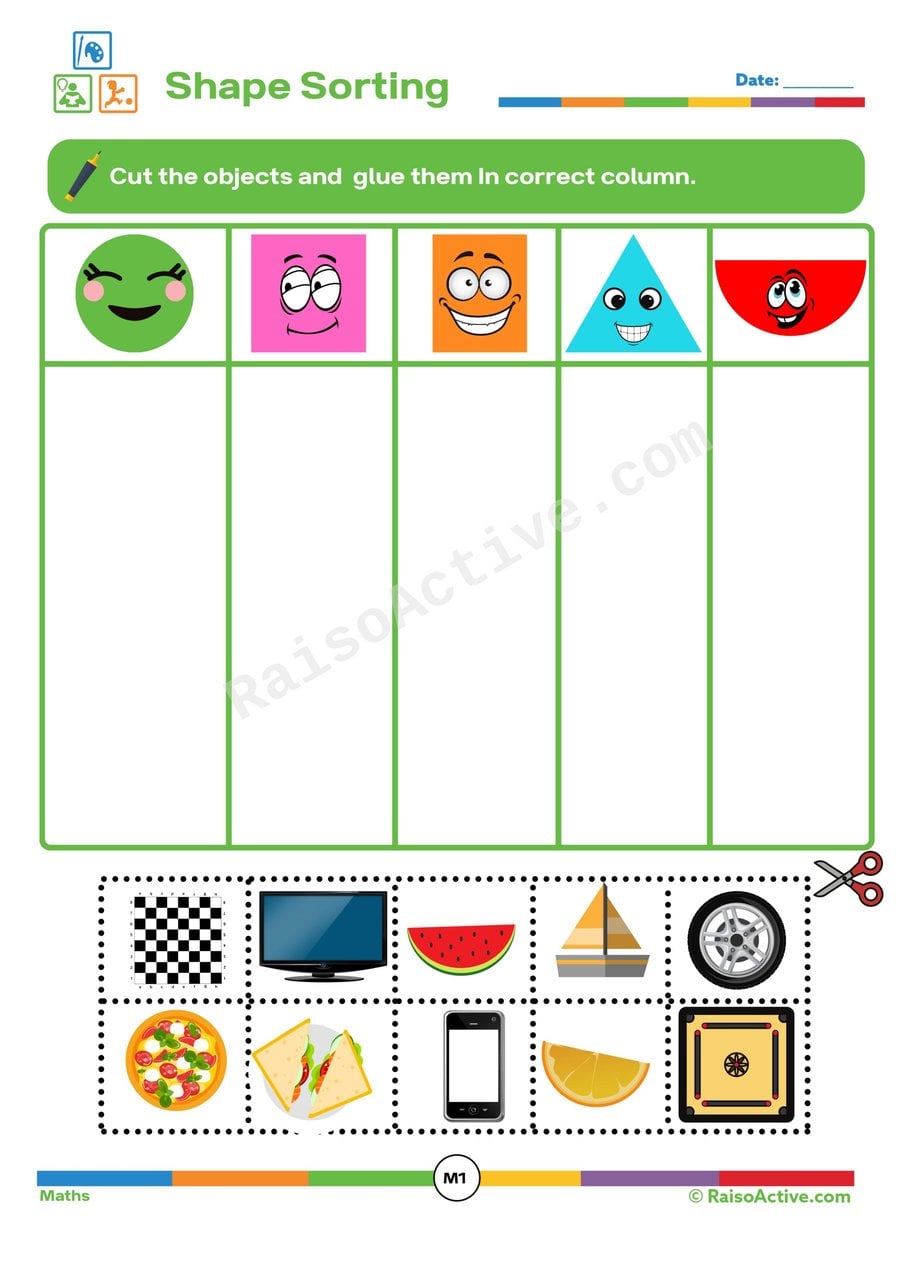
This cut-and-paste activity asks 3-5 year olds to do more than just name a shape — they have to look at a jumble of circles, squares, and triangles, decide which column each one belongs to, and physically place it there. That sorting step is what builds real shape classification, not just shape labeling, since your child must compare each new piece against the ones already in the column. Cutting the shapes out along their curves and corners is also genuine scissor practice, since curved cuts (circles) are notably harder for small hands than straight ones (triangles, squares).

2D Shapes Worksheet for Preschoolers: Identifying Shapes and Properties
Ages 4-6 · Pre-K–KindergartenAges 4-6 · Reception–Year 1Ages 4-6 · LKG–UKGAges 4-6
This worksheet pushes 4-6 year olds past simply naming shapes into analyzing their properties — counting sides and corners for circles, triangles, squares, rectangles, pentagons, and hexagons, and using those properties to answer more complex questions about which shapes combine to form others. That combination-and-composition piece (asking what shapes make up a bigger shape, or identifying a shaded portion) is genuine early geometric reasoning, well beyond simple shape recognition.
Guides for this topic

Number Formation Rhymes 0–9 and How to Fix Reversals
Original number formation rhymes for 0–9, the correct stroke order for each digit, why 3, 5 and 7 get reversed most often, and multisensory fixes that work.

Best Worksheets for 3-Year-Olds: What Works and What to Avoid
What works on worksheets for 3-year-olds: short sessions, crayons, tracing lines, matching, cutting, a free weekly plan, and signs one is too advanced.
Fostering Creativity in Structured Learning: The Perfect Balance for Young Minds
Learn how to blend creativity with structured learning for children ages 1-8. Practical strategies, activities, and printable worksheets for parents and teachers.
Reviews
Every worksheet for ages 3–5, no watermark
Members download the full library of 1,000+ worksheets and every activity pack without watermarks or daily limits. One year costs ₹999 in India or $20 elsewhere.
See membership plansOr download any worksheet free with a watermark (5 a day).