Number Identification Worksheet: Highlight Numbers 61-70
Finding and highlighting the numbers 61 through 70 in sequence within a larger number grid builds visual scanning skills alongside number recognition, since children must search among many similar-looking two-digit numbers to find the correct one in order. For ages four to six, working confidently in this higher number range extends counting fluency well beyond the more commonly practiced numbers up to 20 or 50.
Part of the pack
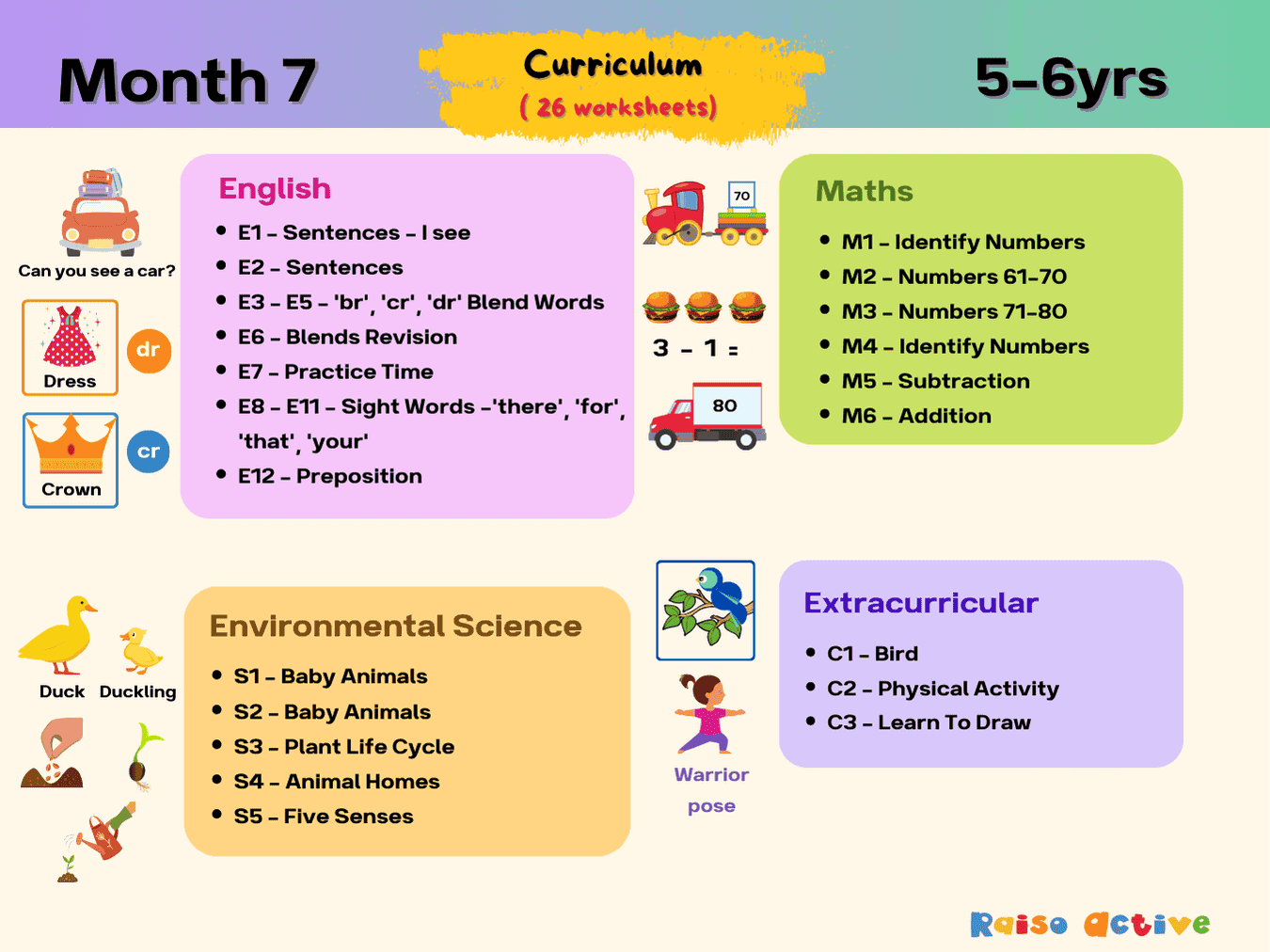
Month 7: Holistic Kindergarten Curriculum | Ages 5-6
This is page 16 of the pack. Ages 5-6 · KindergartenAges 5-6 · Year 1Ages 5-6 · UKGAges 5-6
Made for your child
Counting to 10, made for your child
A maths pack with your child's name in it: pictures that explain, practice at three levels, puzzles and story sums about them. Print a new set whenever they finish.
Make a maths packFree preview · free for members
Curriculum
- Number Sense > Number Sequencing
How to use this worksheet
Look at the number grid together and help your child locate the number 61 first, pointing out how it's surrounded by other similar two-digit numbers. Have them highlight 61, then search for 62 next, continuing in order through 70. Encourage your child to scan systematically, row by row, rather than jumping around the grid randomly, so they don't lose track of which numbers they've already found. Once all ten numbers are highlighted, have your child recite the full sequence aloud from 61 to 70.
Materials needed
- Pencil
- Highlighter or colored pencil
Extension activities
- 1Have your child write the numbers 61 through 70 on a separate sheet of paper for handwriting practice.
- 2Create a number line with the numbers 61-70 and have your child point to each number as you call it out.
- 3Practice counting aloud from 61 to 70, and then continue past 70 to see how far they can go.
- 4Play a number-search game using a newspaper or magazine page, circling any two-digit numbers your child recognizes.

Written by
Hemsweta Jain · Teacher Cheena
MBA and Early Childhood Educator, teaching since 2014 · Founder of RaisoActive, Mumbai
Every RaisoActive worksheet is designed and checked by the founder before publishing.
Published · Last reviewed
More from Month 7: Holistic Kindergarten Curriculum | Ages 5-6

Trace and Write Simple Sentences Worksheet for Preschoolers
Ages 4-5 · Pre-KAges 4-5 · ReceptionAges 4-5 · LKGAges 4-5
Tracing and then writing simple sentences independently helps children ages 4-5 move beyond single-word and letter practice into connected writing, learning that words are separated by spaces and sentences follow a left-to-right flow. This step is an important bridge between early handwriting skills and functional written communication.
Easter Egg Addition Worksheet for Preschoolers
Ages 4-5 · Pre-KAges 4-5 · ReceptionAges 4-5 · LKGAges 4-5
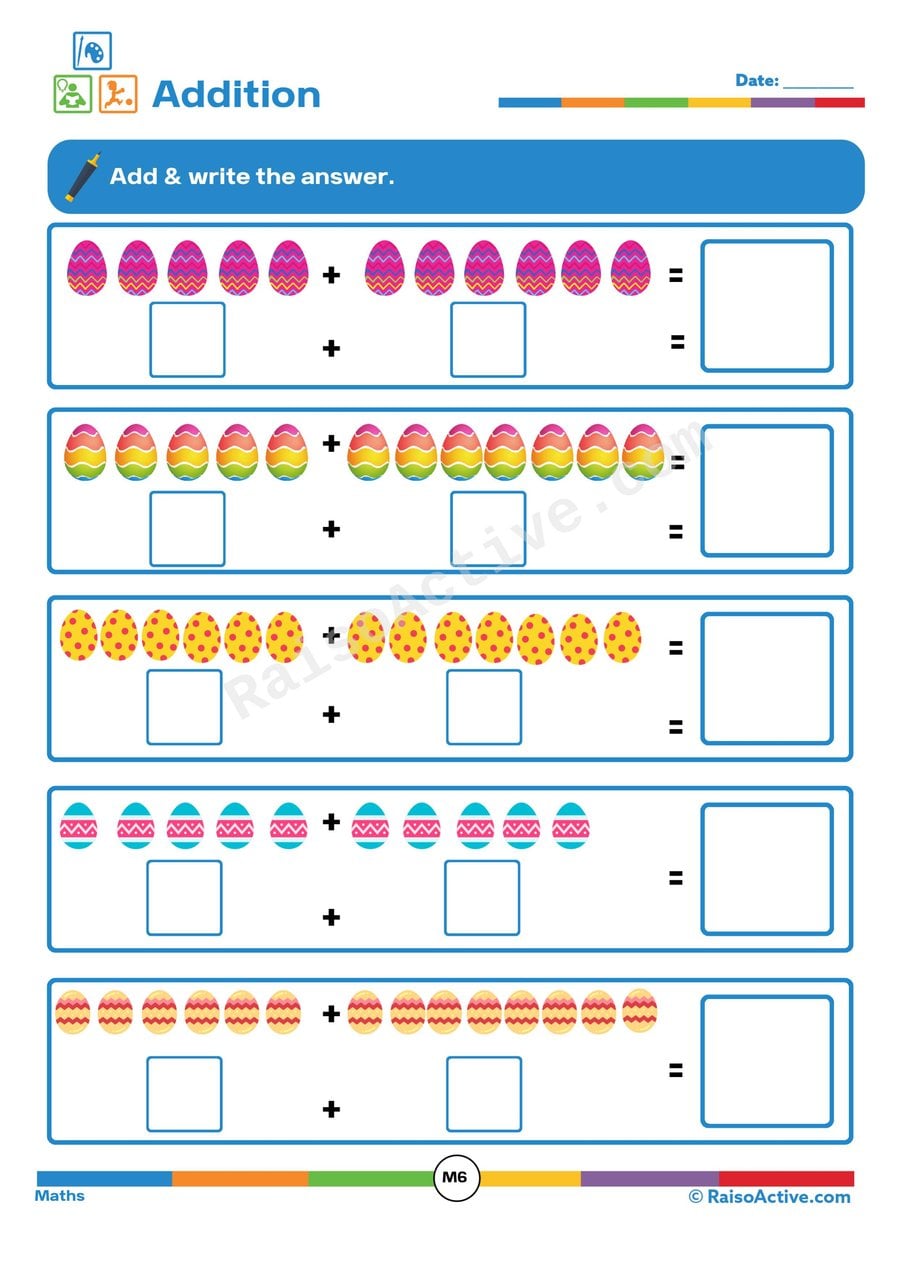
Counting groups of Easter eggs and combining them builds early addition sense for children ages 4-5, showing that putting two smaller groups together creates one larger total. Because the eggs are grouped visually rather than shown as bare numerals, children practice one-to-one counting alongside the abstract addition symbol, connecting the concrete and written forms of the same idea.

Animal Homes and Babies: A Parent's Guide Worksheet
Ages 3-5 · Preschool–Pre-KAges 3-5 · Nursery–ReceptionAges 3-5 · Nursery–LKGAges 3-5
This parent's guide combines learning about where animals live and what their babies are called with an observation puzzle and number-identification practice, weaving science vocabulary together with counting and attention-to-detail skills. For ages three to five, connecting an animal to both its home, like a 'den' or 'nest', and its baby's name, like a 'cub' or 'chick', builds a richer, more memorable set of animal facts than either detail alone.

Make Your Own Paper Bird Worksheet for Preschoolers
Ages 3-5 · Preschool–Pre-KAges 3-5 · Nursery–ReceptionAges 3-5 · Nursery–LKGAges 3-5
Cutting out shapes and assembling them into a paper bird helps children ages 3-5 build fine motor control and hand-eye coordination, since aligning several small pieces accurately requires more precision than a single cut-and-paste task. Following a reference image to guide assembly also strengthens visual sequencing and the ability to translate a picture instruction into a physical, step-by-step action.

Sentence Matching Worksheet: Read and Match the Sentences!
Ages 4-6 · Pre-K–KindergartenAges 4-6 · Reception–Year 1Ages 4-6 · LKG–UKGAges 4-6
Reading a short sentence and pasting it beneath its matching picture builds reading comprehension for children ages 4-6, requiring them to understand the full meaning of a sentence rather than recognizing isolated words. This task also reinforces fine motor precision as children position and glue a small strip of text accurately within a defined space.

Christmas Blend Words Coloring Worksheet for Preschoolers
Ages 4-5 · Pre-KAges 4-5 · ReceptionAges 4-5 · LKGAges 4-5
Coloring words by their beginning blend sound on a Christmas tree turns phonics practice into a festive, motivating activity for children ages 4-5, reinforcing that blends like 'br,' 'cl,' or 'sn' keep their combined sound even though they're made of two consonants. Because each color represents a different blend, children must listen carefully to each word before choosing a crayon, strengthening auditory discrimination alongside seasonal fun.
Physical Activity Dice Game: Yoga Poses for Kids!
Ages 3-5 · Preschool–Pre-KAges 3-5 · Nursery–ReceptionAges 3-5 · Nursery–LKGAges 3-5
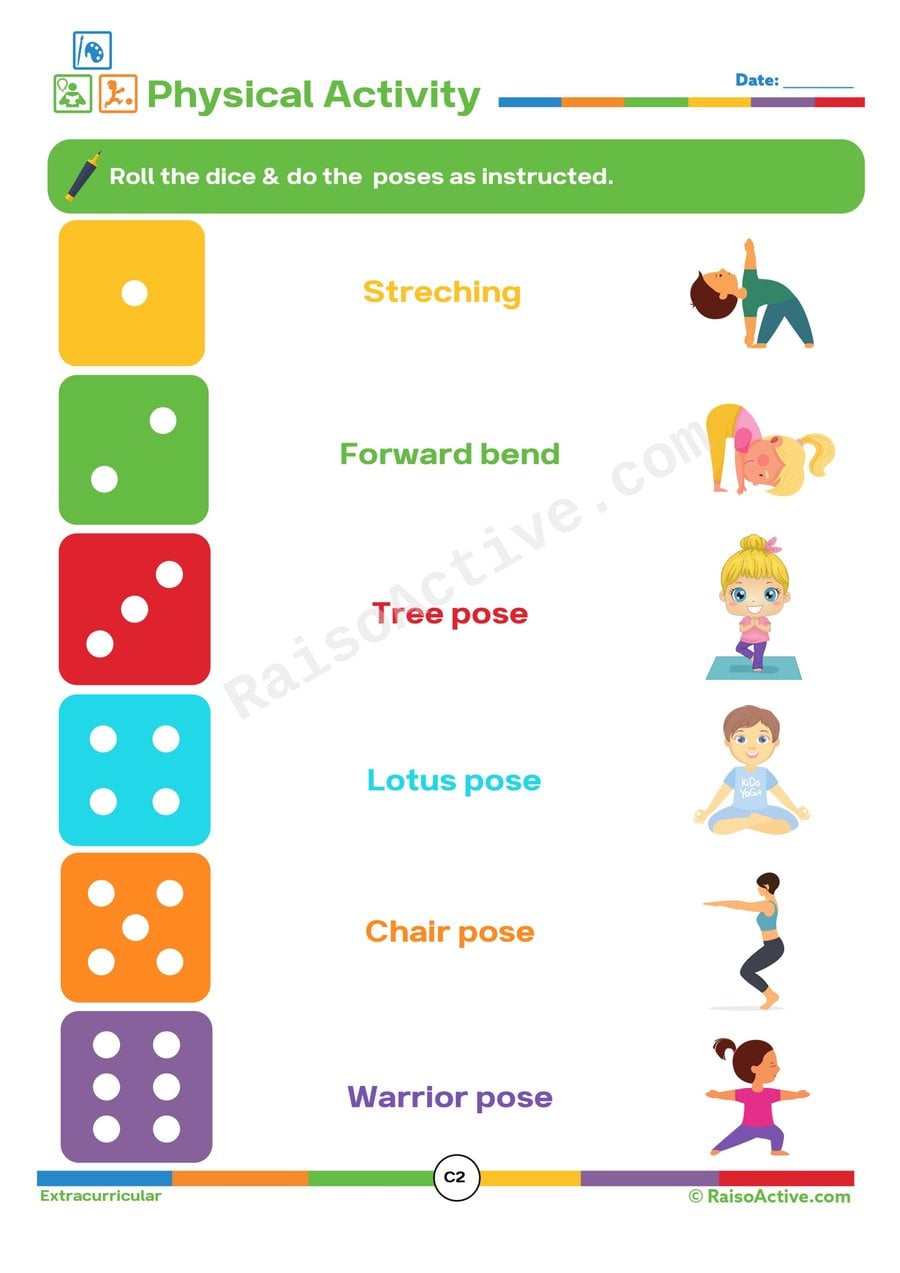
Rolling a dice and matching the number to a yoga pose introduces children ages 3-5 to basic gross motor movement and body control in a playful, game-based format, while also reinforcing number recognition through the dice roll itself. Practicing simple yoga poses like this builds balance, body awareness, and an early habit of calm, mindful movement.
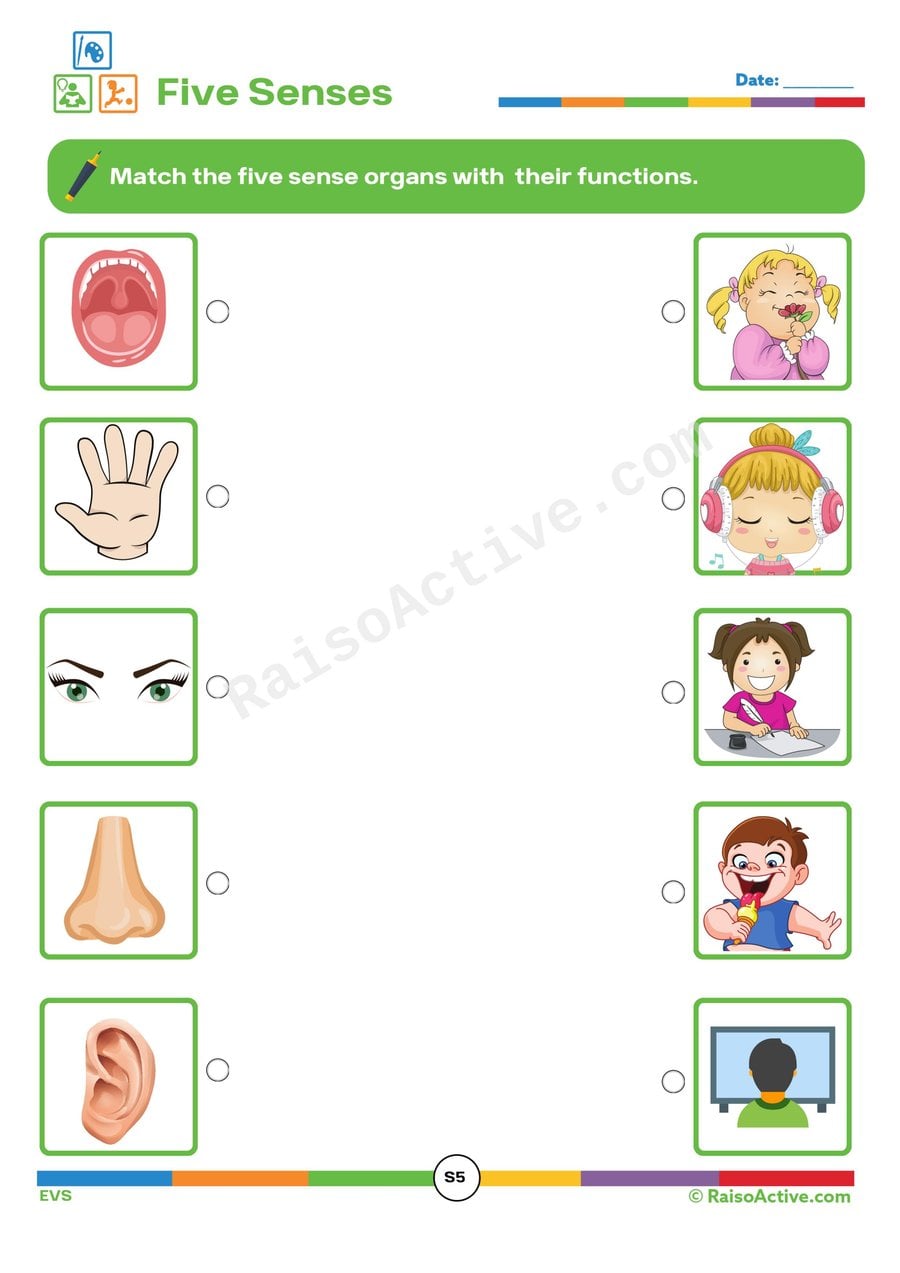
Five Senses Matching Worksheet for Preschoolers
Ages 3-5 · Preschool–Pre-KAges 3-5 · Nursery–ReceptionAges 3-5 · Nursery–LKGAges 3-5
Matching each sense organ, eyes, nose, ears, hands, mouth, to its correct function teaches children the basic science of how their bodies gather information about the world, an early concept in human biology. For ages three to five, connecting a body part to a specific job, eyes for seeing, nose for smelling, also builds descriptive vocabulary they can use to talk about their everyday experiences.
Related worksheets

Numeracy Match: Counting and Number Recognition Worksheet
Ages 4-6 · Pre-K–KindergartenAges 4-6 · Reception–Year 1Ages 4-6 · LKG–UKGAges 4-6
Children ages 4-6 strengthen number recognition by matching written numerals to their corresponding word names or quantities, reinforcing that numbers can be represented in more than one way. This kind of numeral-to-word matching deepens number sense beyond simple counting, helping children see the relationship between symbol, word, and quantity. Coloring in their birth date personalizes the practice and connects it to something meaningful in their own life.

Count and Match: Number Names Worksheet for Preschoolers
Ages 3-5 · Preschool–Pre-KAges 3-5 · Nursery–ReceptionAges 3-5 · Nursery–LKGAges 3-5
Children ages 3-5 practice counting groups of objects and then matching that quantity to both its written numeral and its spelled-out number word, connecting three different representations of the same amount. This triple connection between objects, numerals, and number names builds a deeper, more flexible sense of number than counting alone.
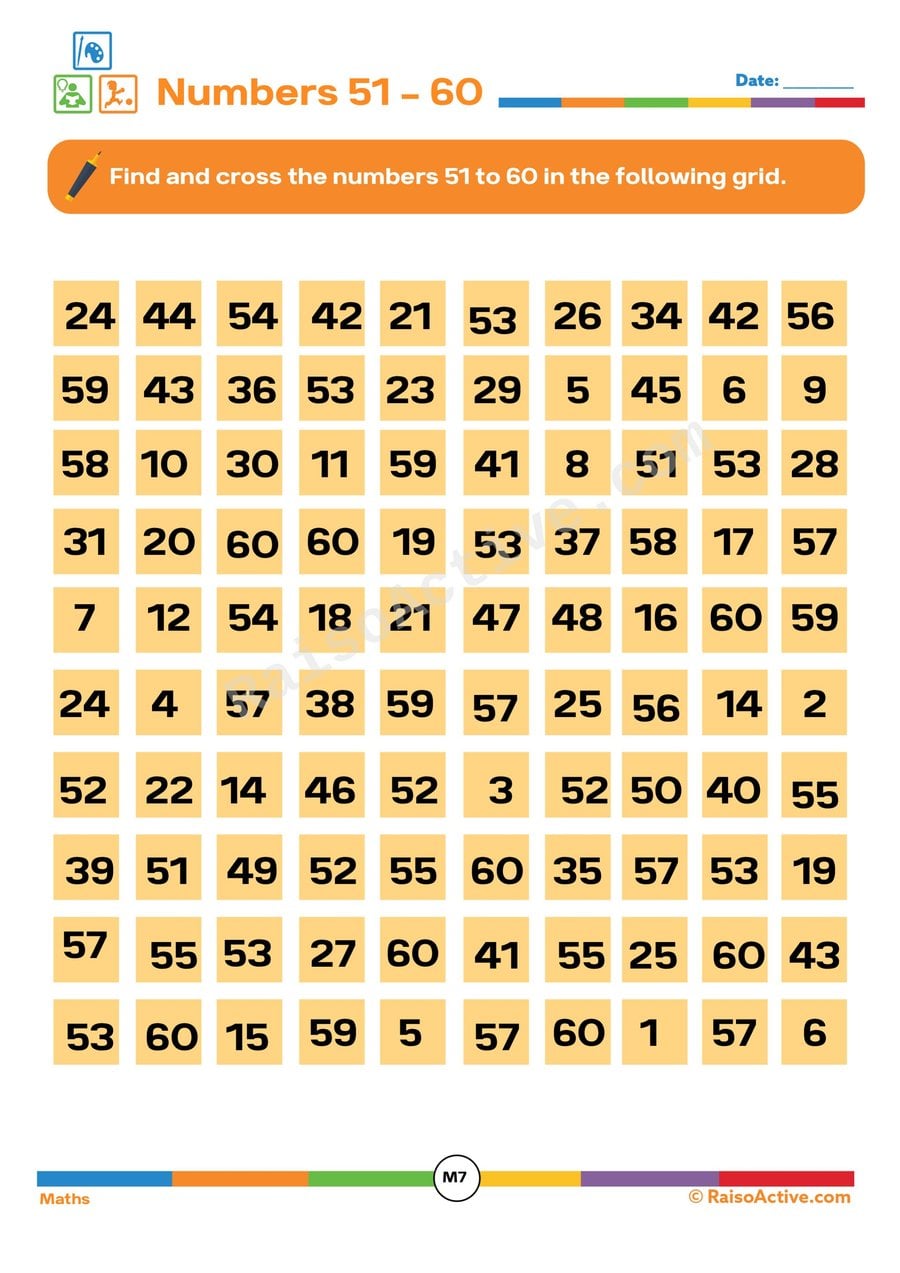
Find and Cross Numbers 51-60 Worksheet
Ages 4-5 · Pre-KAges 4-5 · ReceptionAges 4-5 · LKGAges 4-5
Hunting through a grid of numbers to find and cross out 51 through 60 trains children ages 4-5 to recognize specific two-digit numerals quickly among visually similar distractors, a scanning skill that supports both math fluency and reading readiness. This activity demands sustained visual attention, since the target numbers are scattered randomly rather than in order, unlike a simple sequencing task. It's also a fun, game-like way to reinforce number recognition without it feeling repetitive.

Cut and Paste Number Matching Worksheet: Numbers 31-40
Ages 4-6 · Pre-K–KindergartenAges 4-6 · Reception–Year 1Ages 4-6 · LKG–UKGAges 4-6
Matching number words like thirty-one through forty to their correct numerals teaches children ages 4-6 to recognize larger two-digit numbers by both their written word form and their numeral form, extending number recognition well beyond the more familiar numbers under twenty. Cutting and pasting the matching numeral also reinforces careful visual comparison, since numbers in this range can look similar to one another.

Identify Numbers Worksheet: Matching Numbers and Words
Ages 4-6 · Pre-K–KindergartenAges 4-6 · Reception–Year 1Ages 4-6 · LKG–UKGAges 4-6
This worksheet builds number-word recognition by having children match written number names, like 'seven,' to their corresponding numeral, 7. For four- to six-year-olds, learning to read number words alongside numerals adds an important layer to early numeracy, since numbers appear in both written-word and symbol form in books, signs, and everyday life.

Sorting Numbers Worksheet: Match the Number to the Picture!
Ages 3-5 · Preschool–Pre-KAges 3-5 · Nursery–ReceptionAges 3-5 · Nursery–LKGAges 3-5
Counting objects in a picture and then pasting that picture next to its matching numeral helps children ages 3-5 connect a written number symbol to an actual quantity, which is the heart of true number sense rather than just numeral naming. Cutting out the picture pieces beforehand also builds scissor control, giving this worksheet a fine motor component alongside the counting practice. The puzzle-piece format adds a satisfying, hands-on element that keeps repetitive counting practice engaging.

Hidden Numbers Worksheet: Find and Complete the Table!
Ages 3-5 · Preschool–Pre-KAges 3-5 · Nursery–ReceptionAges 3-5 · Nursery–LKGAges 3-5
Searching a busy picture for hidden numbers trains visual scanning and sustained attention in children ages 3-5, since numbers may be tucked into small or unexpected spots within the artwork. Completing the table with the missing numbers afterward reinforces the counting sequence and numeral recognition, requiring children to recall which numbers they've already found and figure out which ones are still missing. Together, the search-and-complete format turns basic number practice into an engaging seek-and-find challenge.

Navratri Picture Sudoku and Story Sequencing: Think It Through
Ages 4-6 · Pre-K–KindergartenAges 4-6 · Reception–Year 1Ages 4-6 · LKG–UKGAges 4-6
Children use logic to complete a 4x4 picture sudoku where each row and column has each picture once, and put four story pictures in order.
Guides for this topic

Number Formation Rhymes 0–9 and How to Fix Reversals
Original number formation rhymes for 0–9, the correct stroke order for each digit, why 3, 5 and 7 get reversed most often, and multisensory fixes that work.

Age-Appropriate Problem-Solving Activities: Building Critical Thinkers from the Ground Up
Discover fun, age-appropriate problem-solving activities for children ages 1-8. Build critical thinking, logic, and reasoning skills through play-based learning.
Critical Thinking Activities That Actually Work for Young Children: Building Tomorrow's Thinkers Today
Discover proven critical thinking activities for young children. Age-wise logic games, questioning techniques, and hands-on ideas to build thinking skills at home.
Reviews
Every worksheet for ages 4–6, no watermark
Members download the full library of 1,000+ worksheets and every activity pack without watermarks or daily limits. One year costs ₹999 in India or $20 elsewhere.
See membership plansOr download any worksheet free with a watermark (5 a day).