Lantern Light Lab: Navratri Garba Pot Light Experiment
Children make holes in a paper cup, shine a torch through it and see one spot of light for each hole. They predict and record what happens as they move further from the wall, and explain the results and why a real garba pot needs holes.
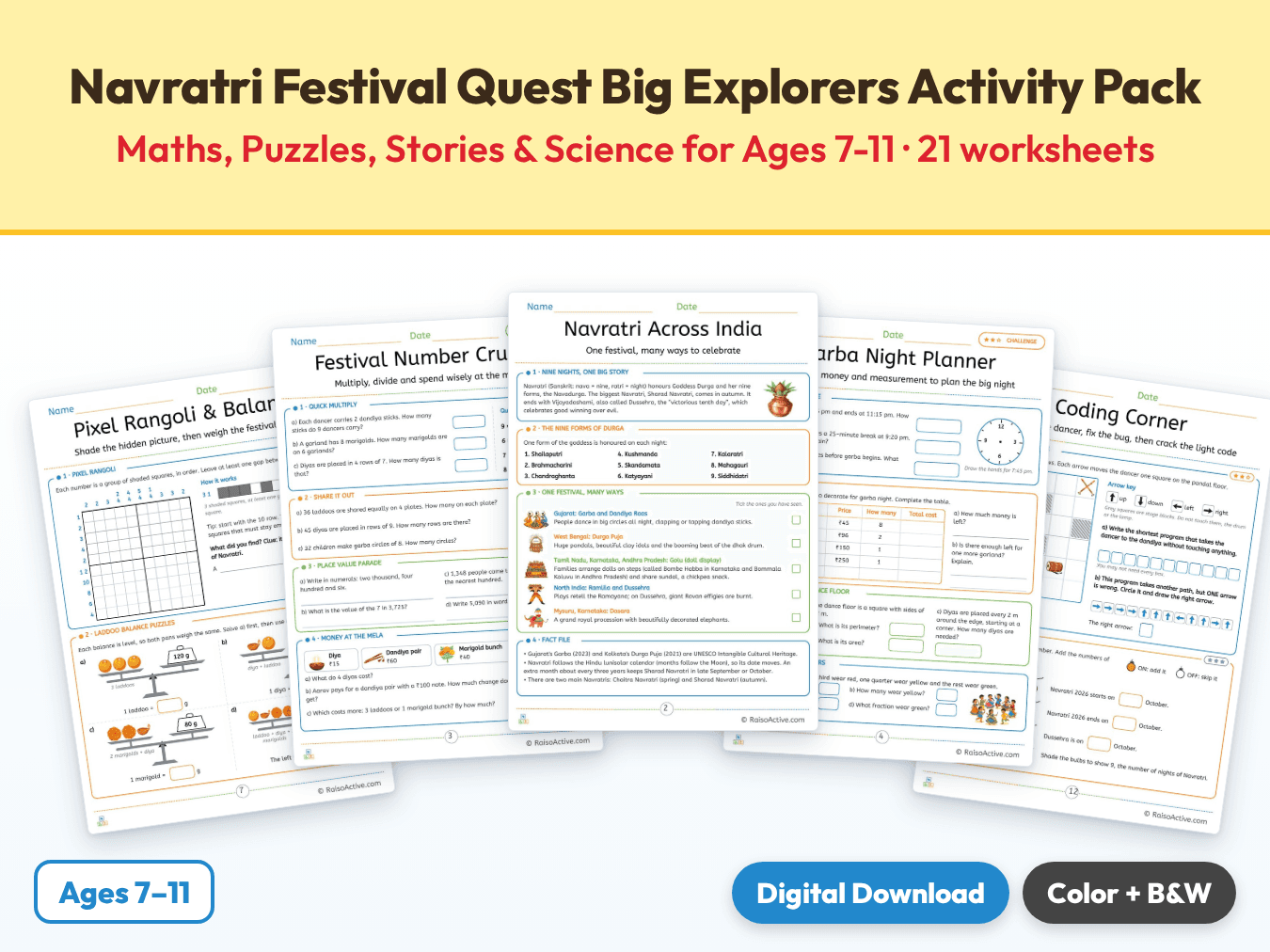
Part of the pack
Navratri Festival Quest Big Explorers Activity Pack: Maths, Puzzles, Stories & Science for Ages 7-11
This is page 16 of the pack. Ages 7-11 · Grade 2–Grade 3Ages 7-11 · Year 3–Year 4Ages 7-11 · Class 2–Class 3Ages 7-11
How to use this worksheet
A grown-up pokes the holes. Follow the five steps in a dark room, then fill in the prediction and results table and answer the scientist questions.
Materials needed
- Paper cup
- Sharp pencil (for a grown-up to make the holes)
- Small torch or phone torch
- Ruler
- Pencil
Extension activities
- 1Try cups with bigger and smaller holes and compare the dots.
- 2Look at a real garba pot or lantern and talk about how its pattern is made.

Written by
Hemsweta Jain · Teacher Cheena
MBA and Early Childhood Educator, teaching since 2014 · Founder of RaisoActive, Mumbai
Every RaisoActive worksheet is designed and checked by the founder before publishing.
Published · Last reviewed
More from Navratri Festival Quest Big Explorers Activity Pack: Maths, Puzzles, Stories & Science for Ages 7-11
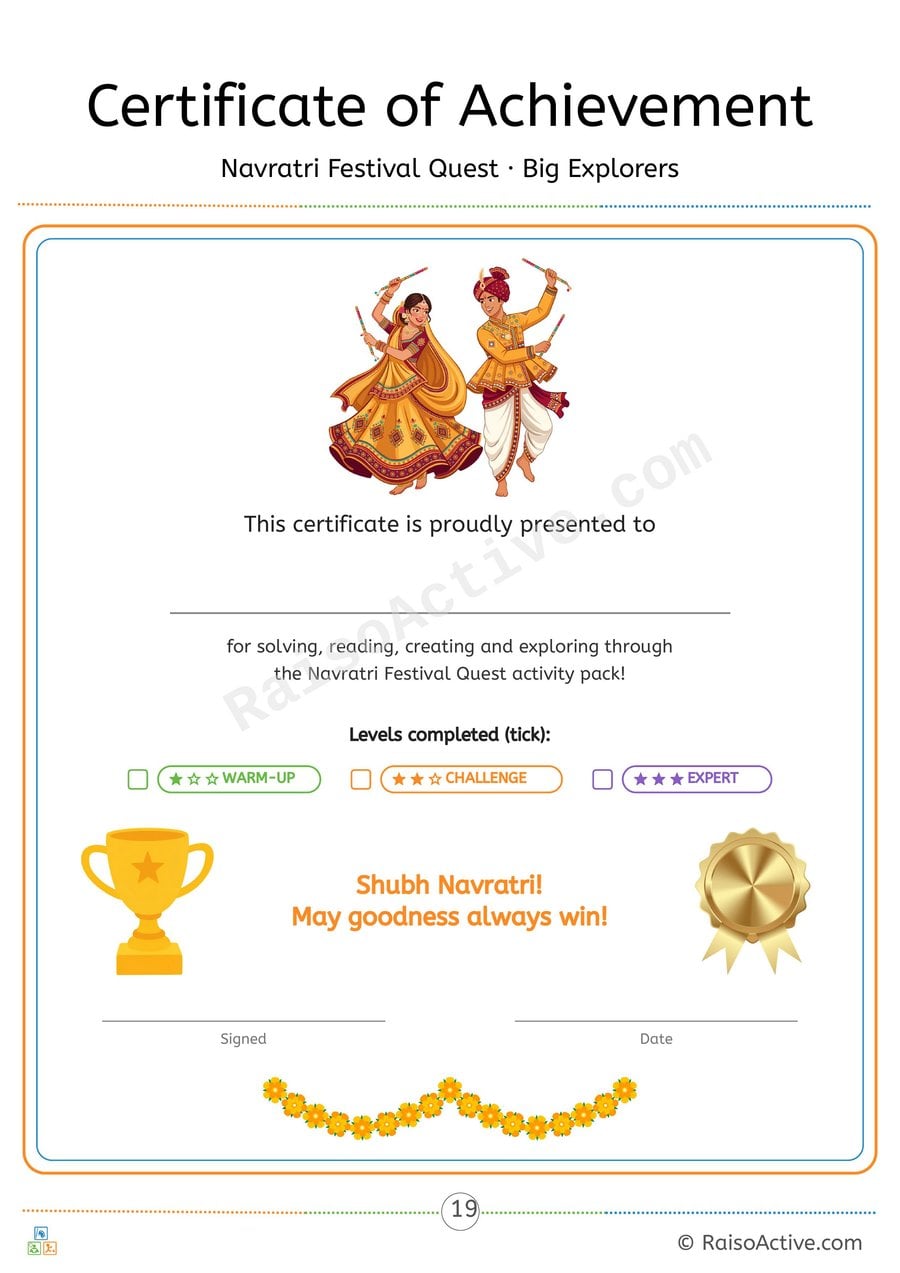
Navratri Festival Quest Certificate of Achievement
Ages 7-11 · Grade 2–Grade 3Ages 7-11 · Year 3–Year 4Ages 7-11 · Class 2–Class 3Ages 7-11
Children celebrate finishing the Navratri Festival Quest pack and record which levels they completed.
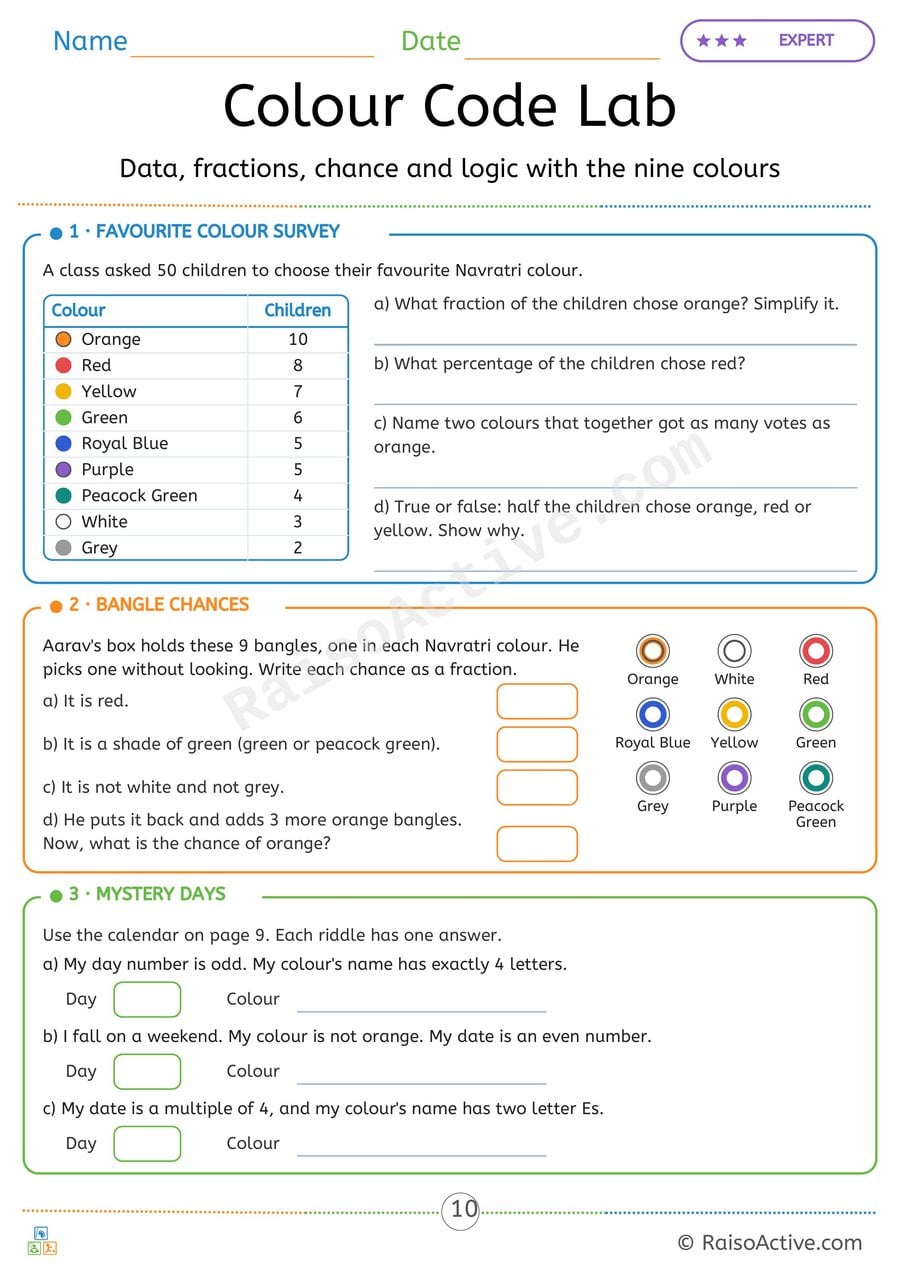
Colour Code Lab: Navratri Fractions, Percentages and Probability
Ages 7-11 · Grade 2–Grade 3Ages 7-11 · Year 3–Year 4Ages 7-11 · Class 2–Class 3Ages 7-11
Children read a survey of 50 children's favourite Navratri colours and write fractions and percentages, write the chance of picking each kind of bangle as a fraction, and solve three riddles using the colour calendar on page 9.
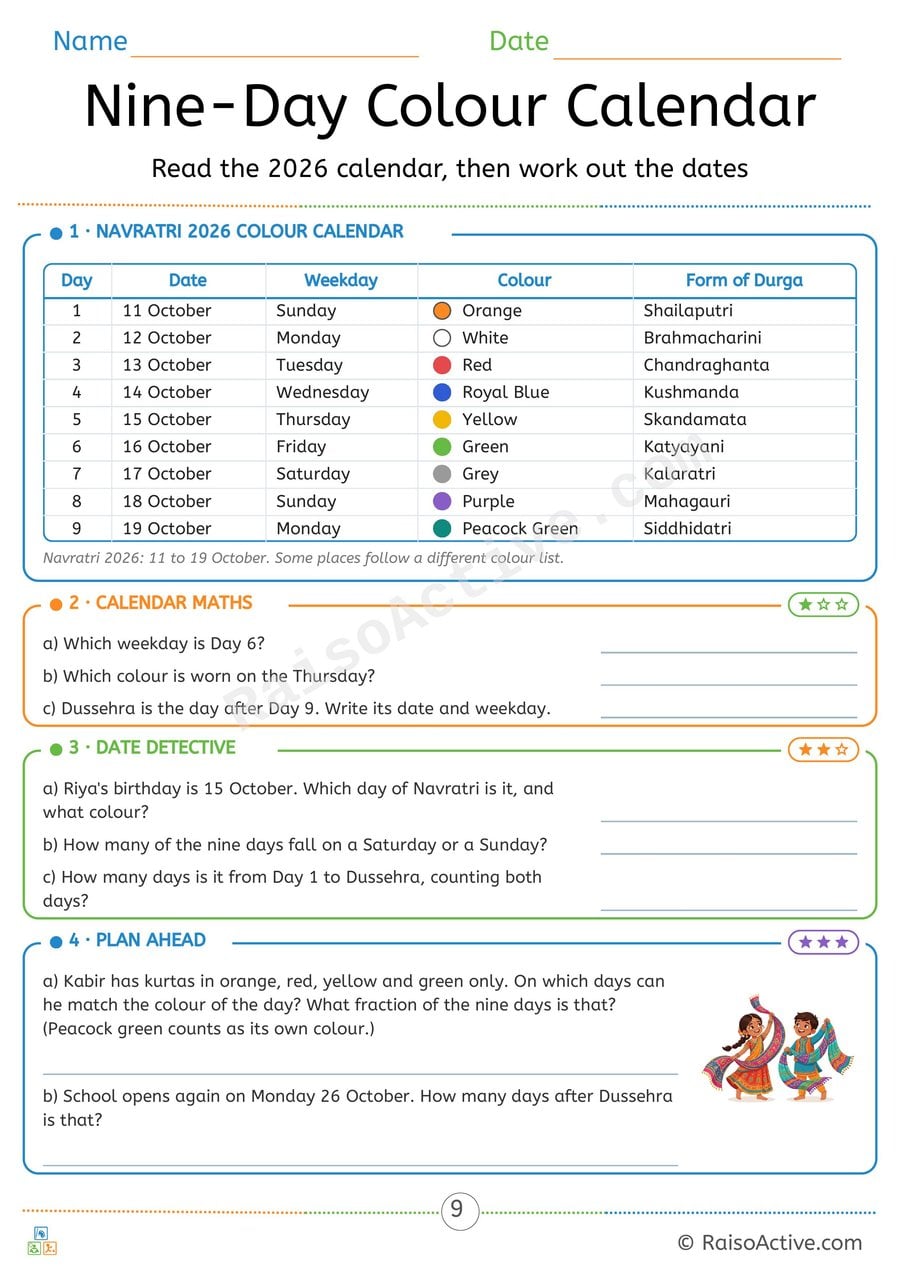
Navratri 2026 Colour Calendar: Dates, Days and Colours Maths
Ages 7-11 · Grade 2–Grade 3Ages 7-11 · Year 3–Year 4Ages 7-11 · Class 2–Class 3Ages 7-11
Children read a table of the nine days of Navratri 2026 with dates, weekdays, colours and forms of Durga, then answer calendar questions, count days including both ends, and use fractions to plan which colours they can wear.
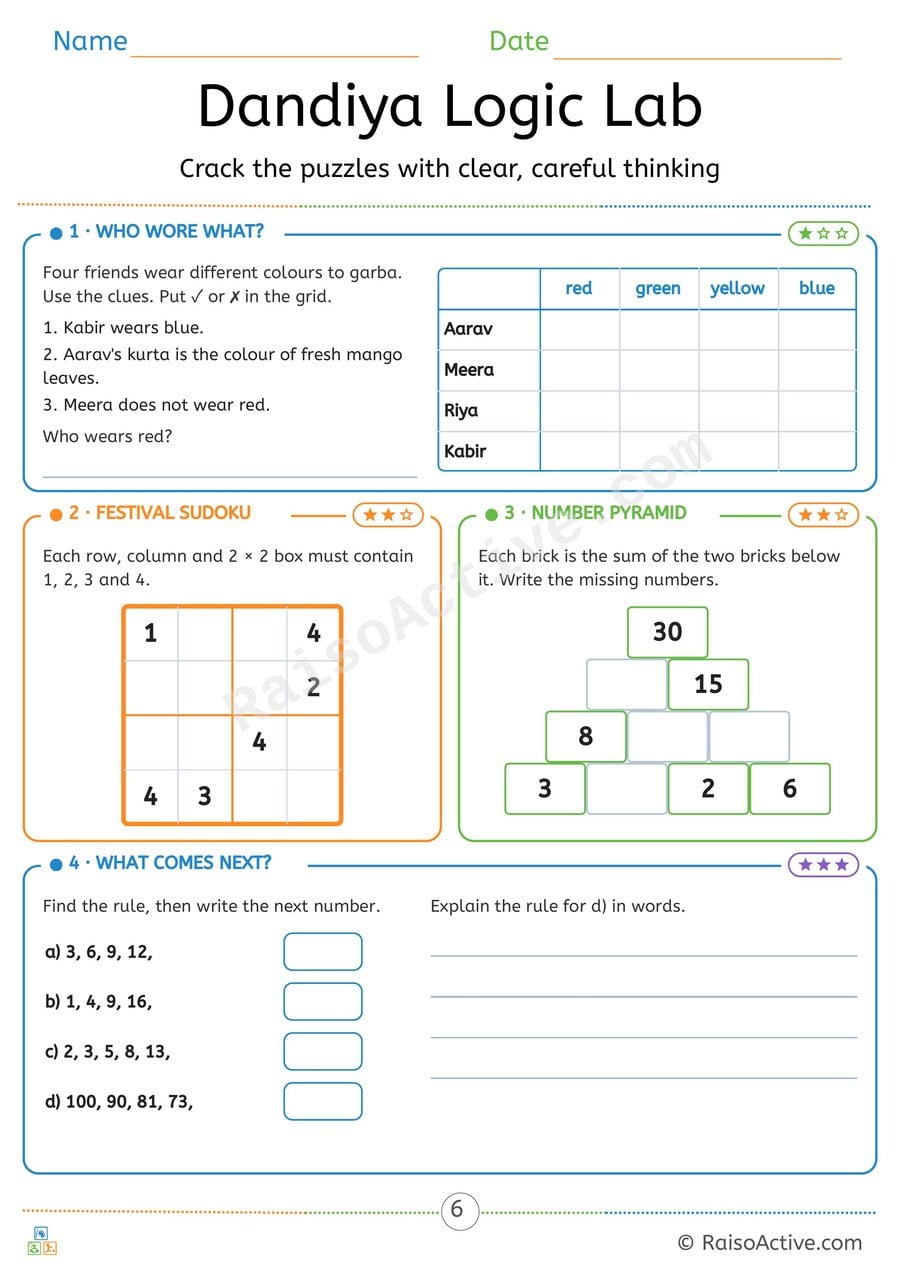
Dandiya Logic Lab: Navratri Logic Grid, Sudoku and Number Pyramid
Ages 7-11 · Grade 2–Grade 3Ages 7-11 · Year 3–Year 4Ages 7-11 · Class 2–Class 3Ages 7-11
Children use clues to fill a logic grid about four friends' garba colours, solve a 4x4 sudoku, complete a number pyramid where each brick is the sum of the two below, and find the rules for four number sequences, including square numbers and the Fibonacci pattern.
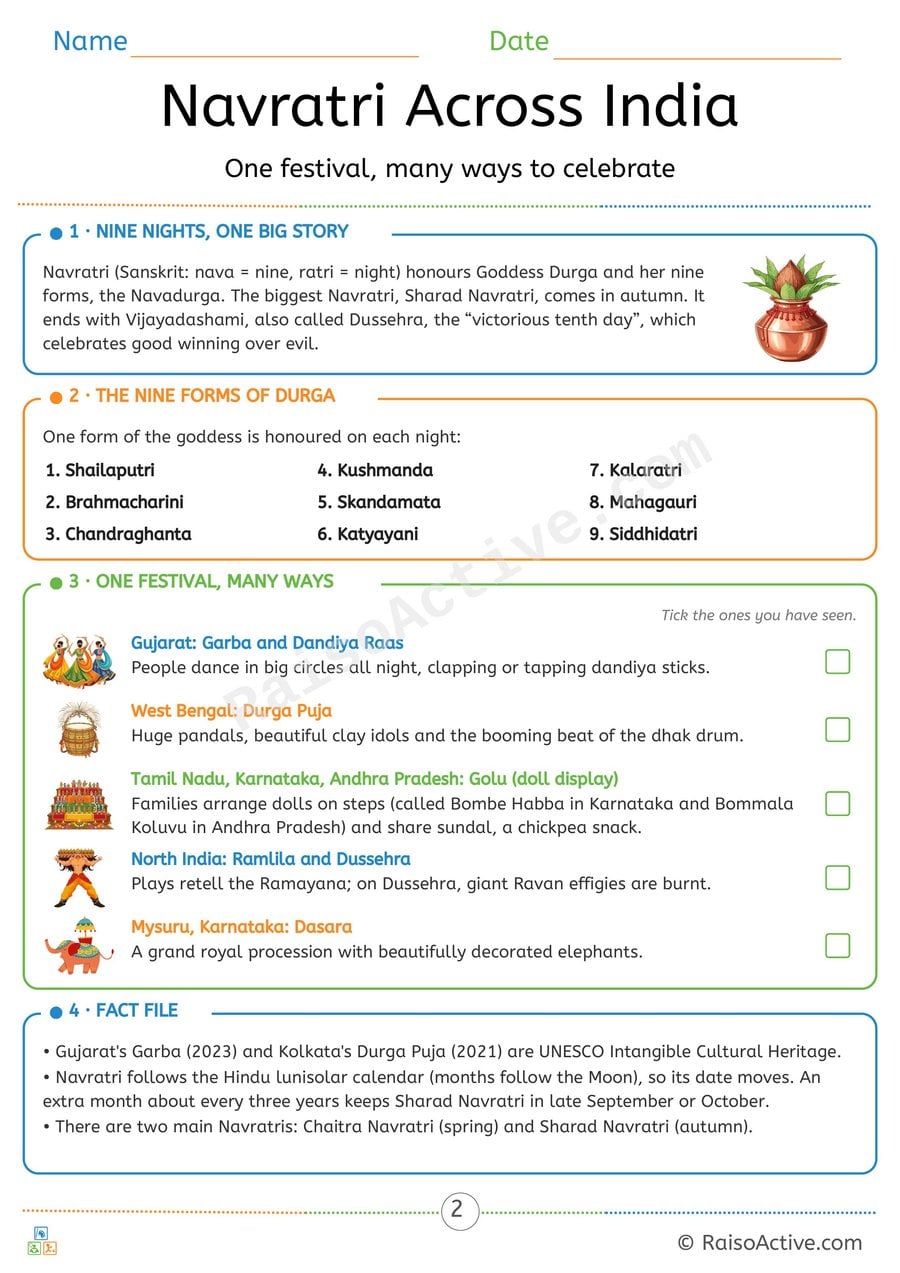
Navratri Across India: How Different States Celebrate
Ages 7-11 · Grade 2–Grade 3Ages 7-11 · Year 3–Year 4Ages 7-11 · Class 2–Class 3Ages 7-11
Children learn what Navratri means (nava = nine, ratri = night), that Sharad Navratri ends with Vijayadashami (Dussehra), and the names of the nine forms of Durga. They read how the festival is celebrated in Gujarat, West Bengal, South India, North India and Mysuru, and a short fact file about UNESCO heritage and the lunisolar calendar.
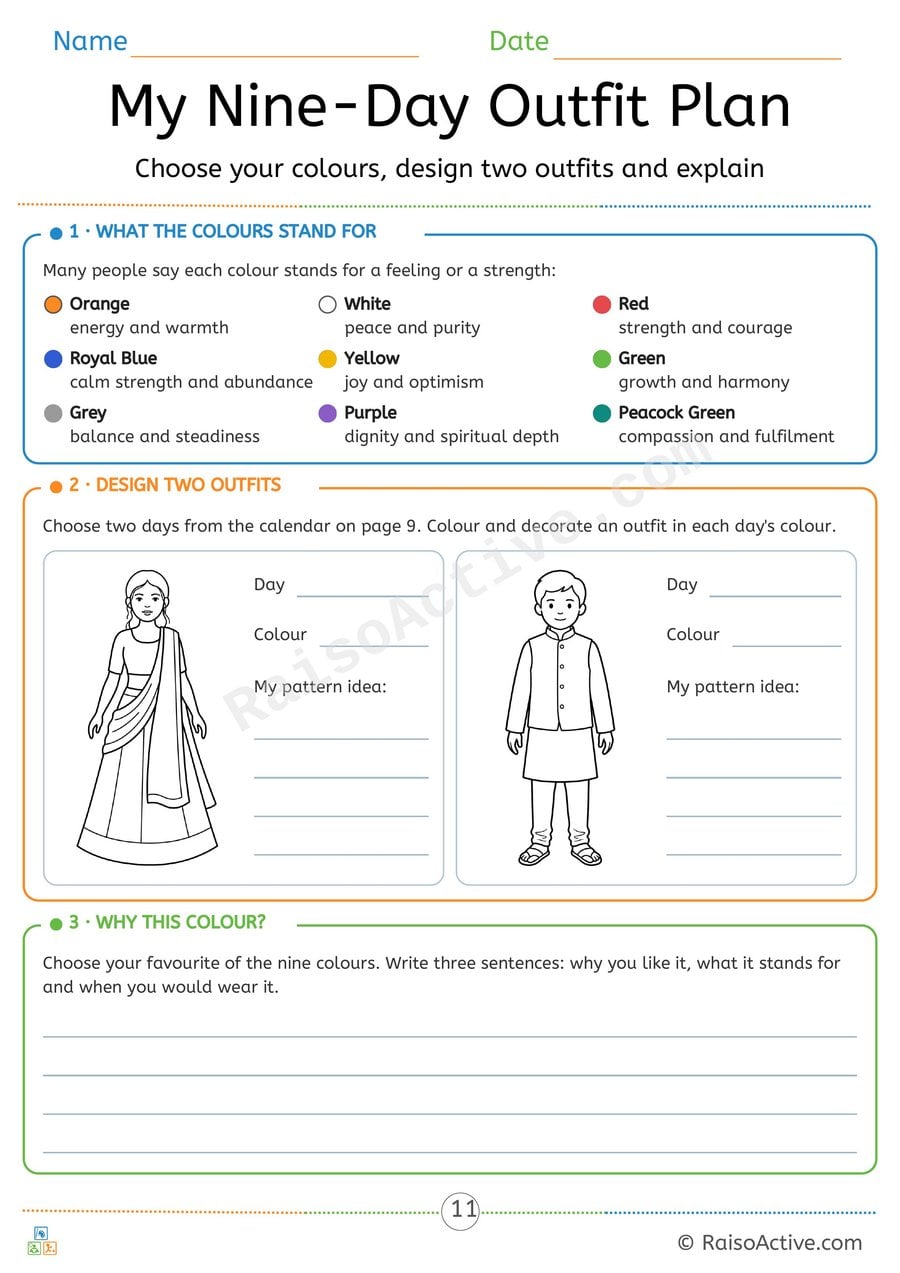
My Nine-Day Outfit Plan: Navratri Colours Design and Writing
Ages 7-11 · Grade 2–Grade 3Ages 7-11 · Year 3–Year 4Ages 7-11 · Class 2–Class 3Ages 7-11
Children read what each of the nine colours is often said to stand for, choose two days from the calendar, colour and pattern a lehenga-style outfit and a kurta outfit in those colours, and write three sentences explaining their favourite colour.
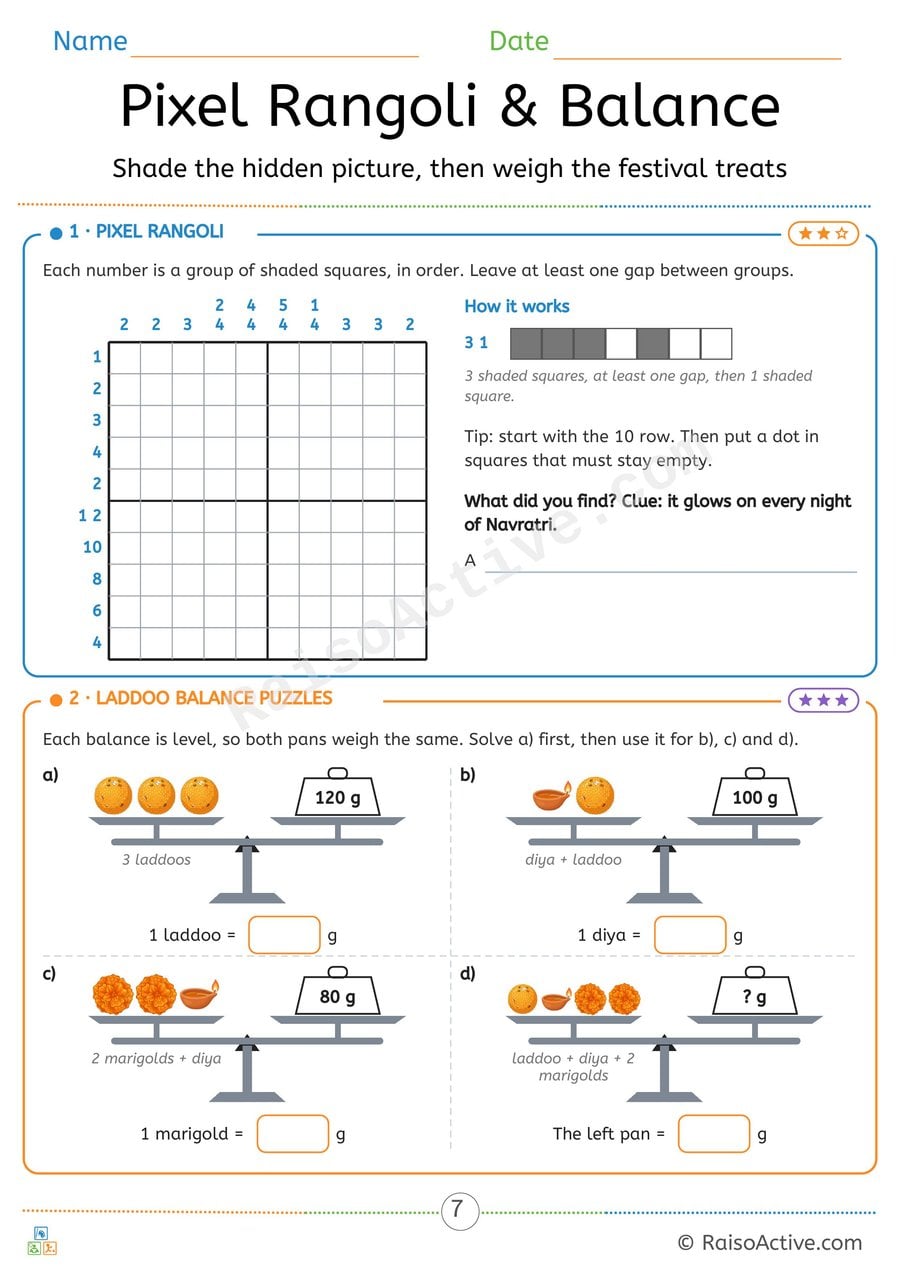
Pixel Rangoli and Laddoo Balance Puzzles for Navratri
Ages 7-11 · Grade 2–Grade 3Ages 7-11 · Year 3–Year 4Ages 7-11 · Class 2–Class 3Ages 7-11
Children use row and column clues to shade a 10 x 10 grid and reveal a hidden festival picture, then solve four balance puzzles in grams, using each answer to work out the next: a first step into algebra.
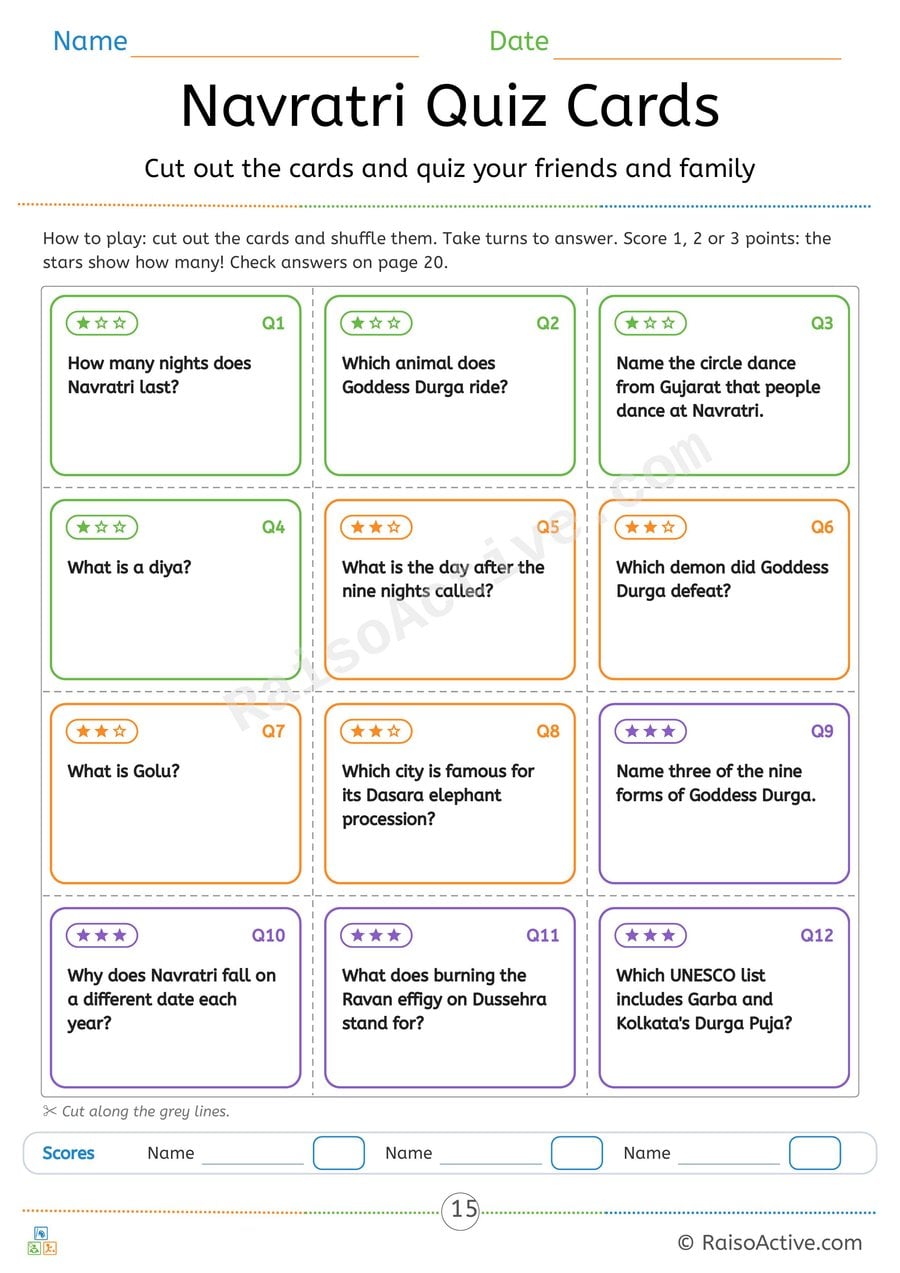
Navratri Quiz Cards: 12 Cut-Out Festival Questions
Ages 7-11 · Grade 2–Grade 3Ages 7-11 · Year 3–Year 4Ages 7-11 · Class 2–Class 3Ages 7-11
Children recall facts about Navratri, Durga, Golu, Dussehra and the UNESCO heritage list, from one-star questions to three-star questions that need explaining.
Related worksheets
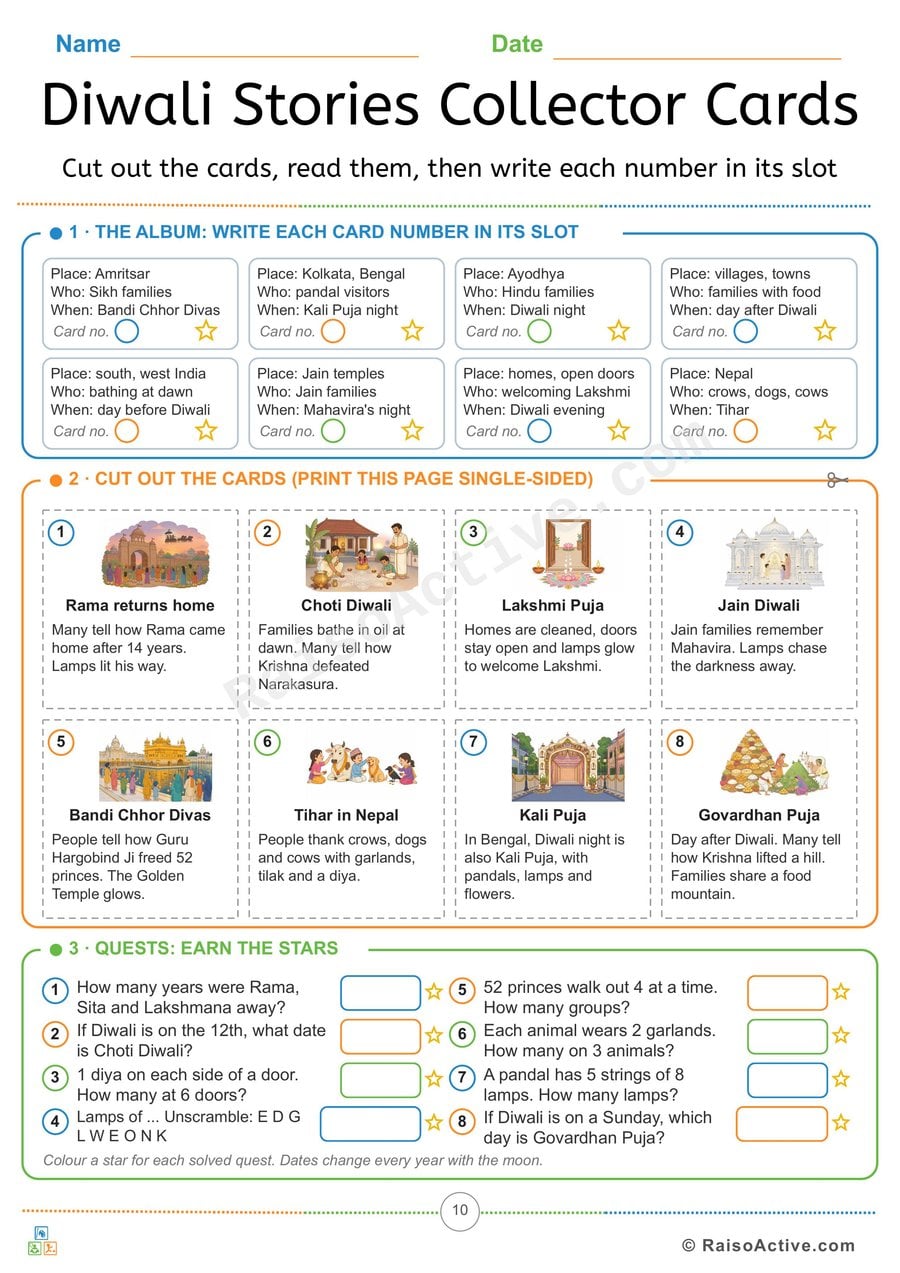
Diwali Stories Collector Cards: Cut-Out Cards and Quest Puzzles
Ages 7-10 · Grade 2–Grade 3Ages 7-10 · Year 3–Year 4Ages 7-10 · Class 2–Class 3Ages 7-10
Children cut out eight cards that tell where and how families celebrate, including Rama's return, Lakshmi Puja, Jain Diwali, Bandi Chhor Divas, Tihar in Nepal, Kali Puja and Govardhan Puja, then match them to an album and solve eight quests.
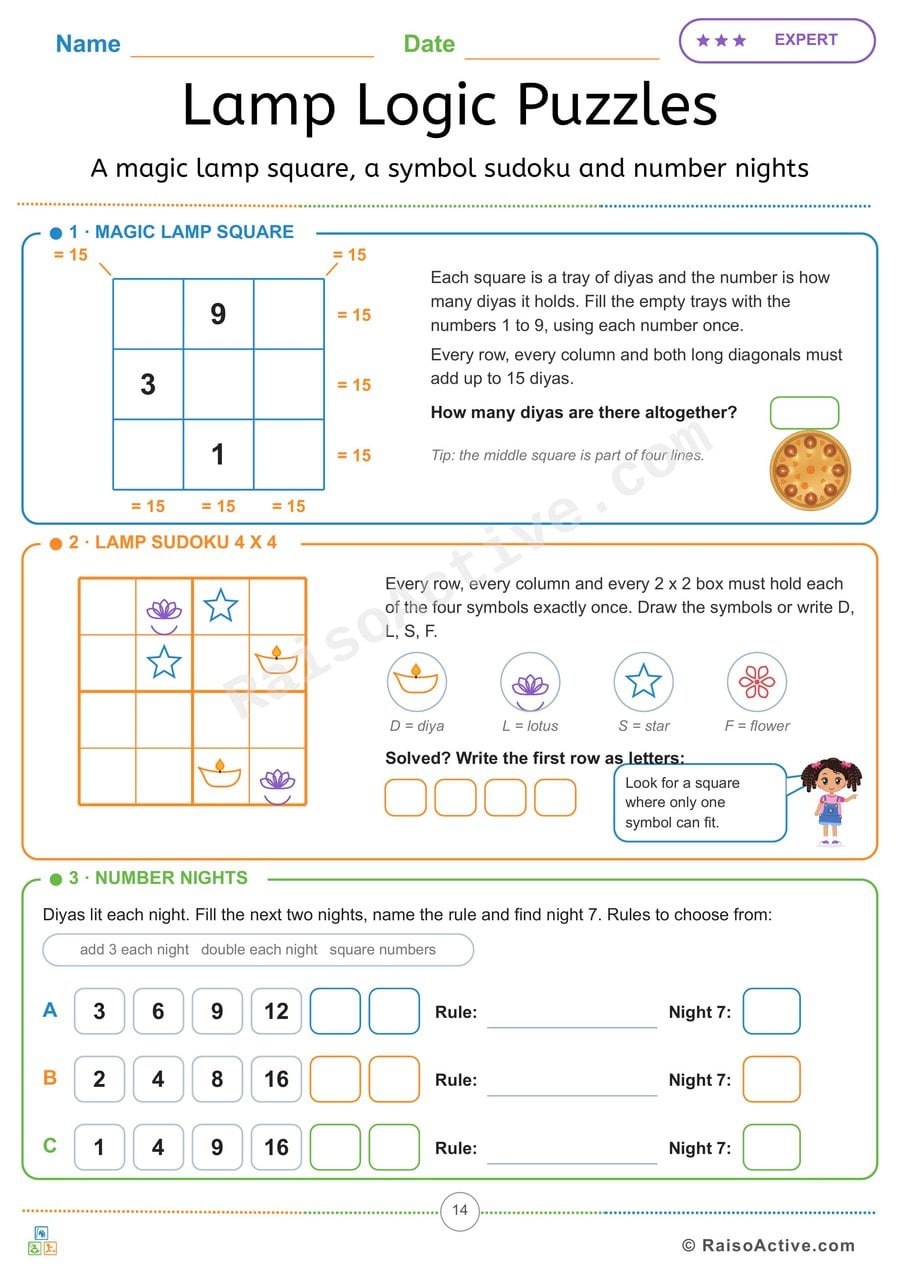
Lamp Logic Puzzles: Magic Square, Sudoku and Number Patterns
Ages 7-10 · Grade 2–Grade 3Ages 7-10 · Year 3–Year 4Ages 7-10 · Class 2–Class 3Ages 7-10
Children fill a magic square so every line adds to 15, solve a 4 by 4 symbol sudoku with diyas, lotuses, stars and flowers, and find the rule and night 7 for three number patterns.
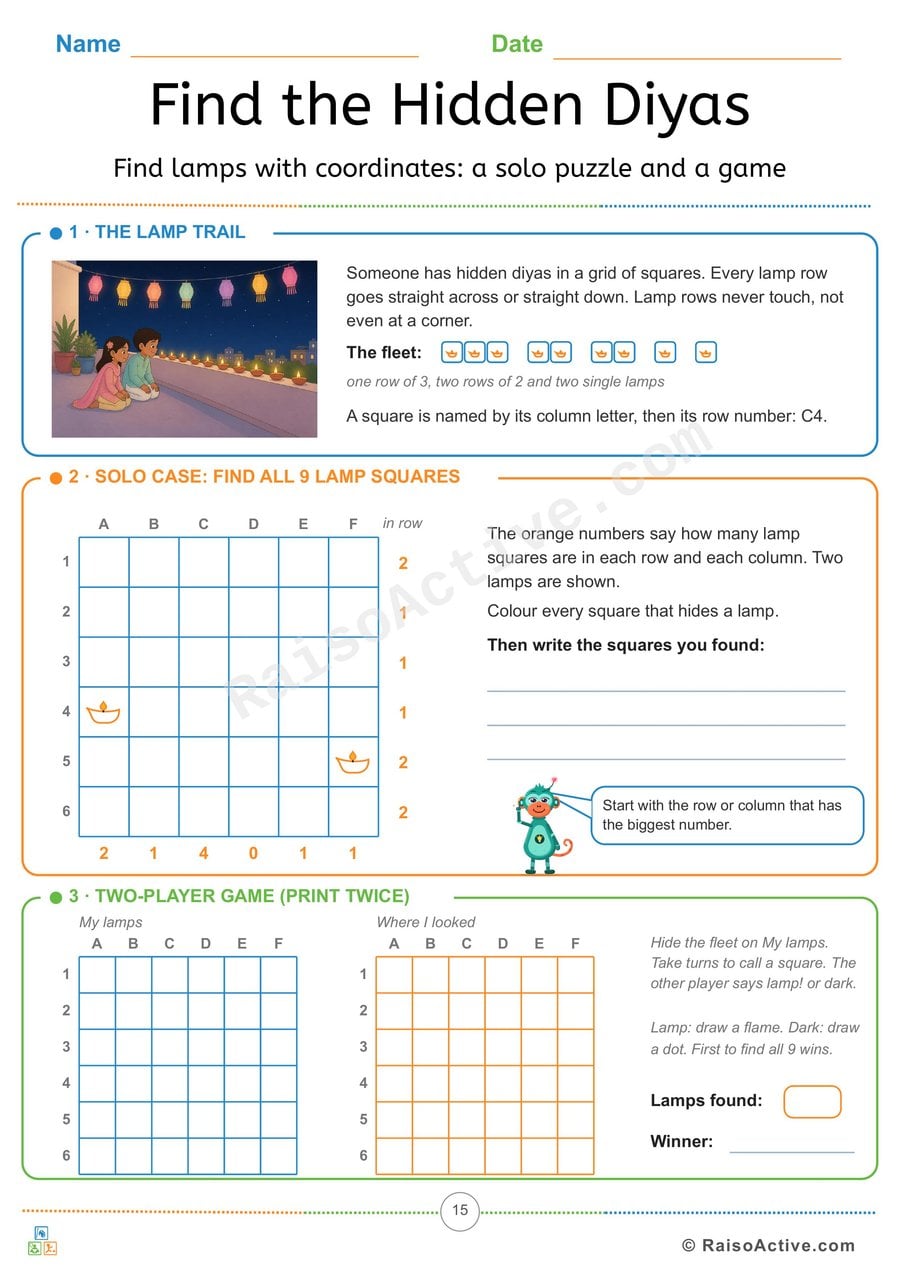
Find the Hidden Diyas: Coordinates Puzzle and Two-Player Game
Ages 7-10 · Grade 2–Grade 3Ages 7-10 · Year 3–Year 4Ages 7-10 · Class 2–Class 3Ages 7-10
Children use row and column clues to find nine hidden lamp squares in a grid, write them with coordinates such as C4, and then play a two-player game to find each other's hidden fleet.
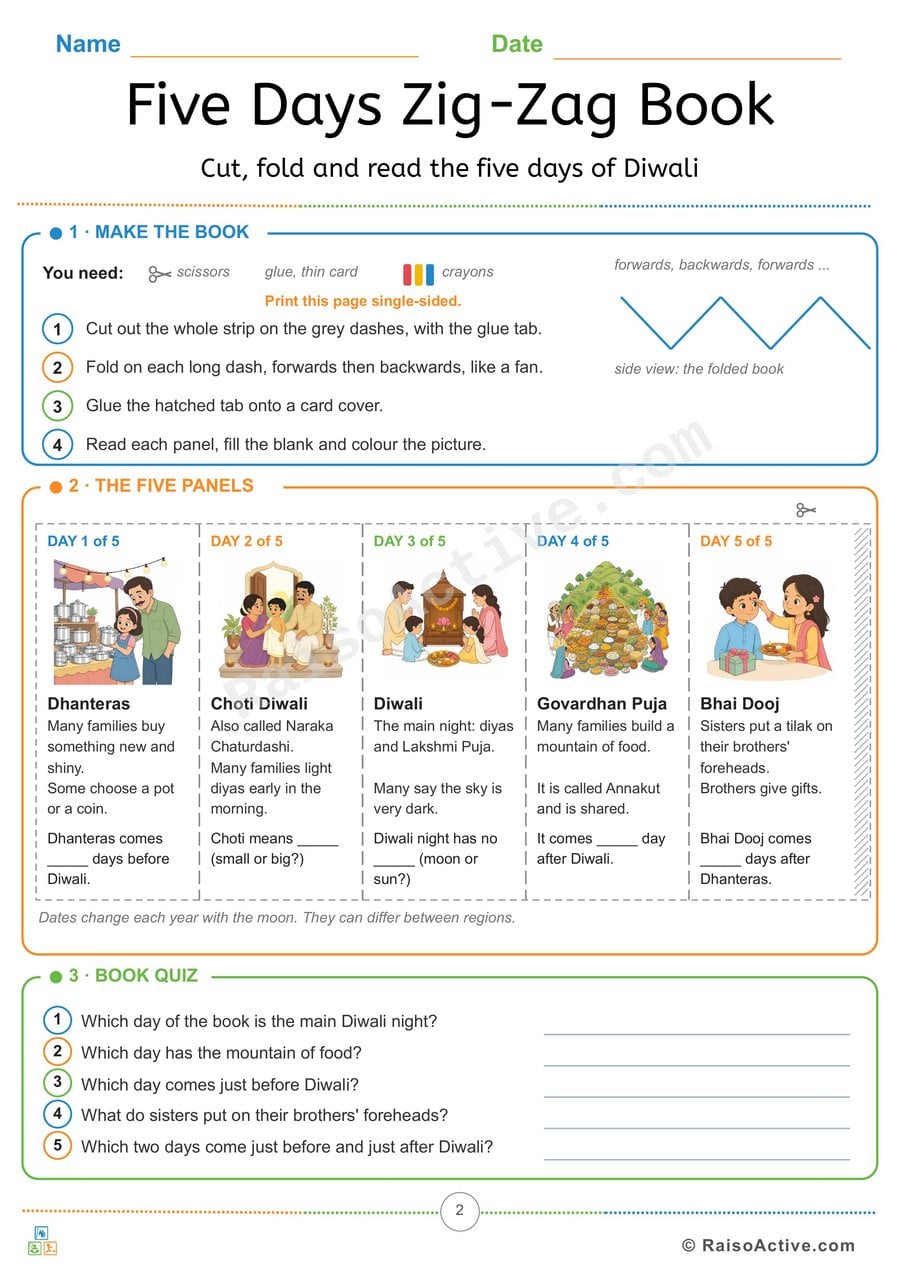
Five Days of Diwali Zig-Zag Book: Cut, Fold, Read and Quiz
Ages 7-10 · Grade 2–Grade 3Ages 7-10 · Year 3–Year 4Ages 7-10 · Class 2–Class 3Ages 7-10
Children cut and fold a zig-zag book about Dhanteras, Choti Diwali, Diwali, Govardhan Puja and Bhai Dooj, fill in the blanks about each day and answer a five-question quiz.

Breathe Lab: Box and Lazy-8 Breathing and a Heartbeat Experiment
Ages 7-10 · Grade 2–Grade 3Ages 7-10 · Year 3–Year 4Ages 7-10 · Class 2–Class 3Ages 7-10
Children trace box and lazy-8 breathing shapes, then run a simple experiment: predict, count pulse beats for 15 seconds, multiply by 4 and compare resting, after star jumps and after slow breathing. They fill in a bar chart.

Diwali Picture Bingo: Four Boards and Call Cards to Cut Out
Ages 4-6 · Pre-K–KindergartenAges 4-6 · Reception–Year 1Ages 4-6 · LKG–UKGAges 4-6
Children match picture call cards to their bingo board, covering diyas, lanterns, sweets, garlands, rangolis, gift boxes and fireworks. They practise looking closely, taking turns and waiting, and win by covering three in a row.
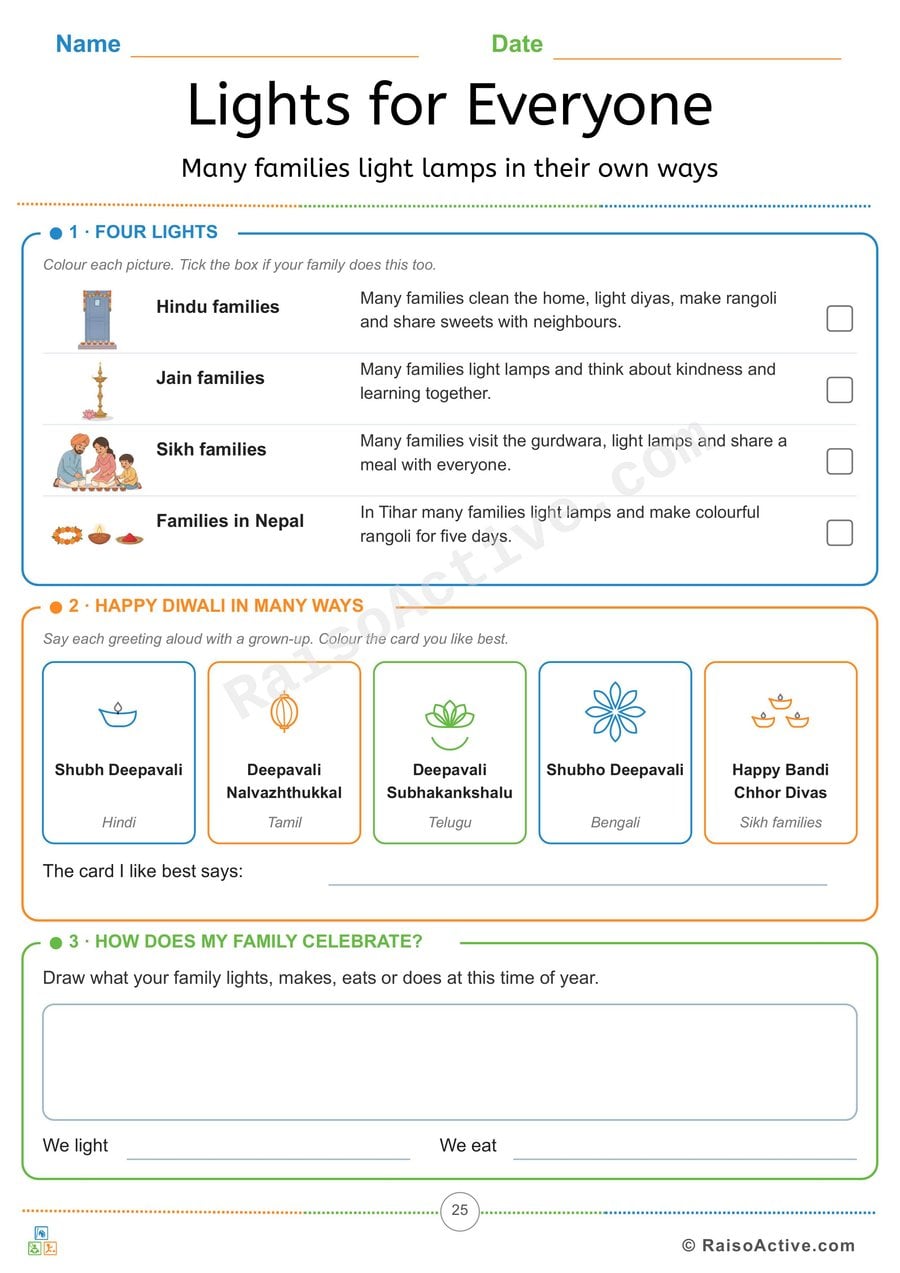
Lights for Everyone: How Families Celebrate Diwali in Different Ways
Ages 4-6 · Pre-K–KindergartenAges 4-6 · Reception–Year 1Ages 4-6 · LKG–UKGAges 4-6
Children learn that many families light lamps in their own ways: Hindu, Jain and Sikh families and families in Nepal. They read festival greetings in Hindi, Tamil, Telugu and Bengali, plus the Sikh Bandi Chhor Divas greeting, and draw how their own family celebrates.

Diwali Night Seek-and-Find: Colour the Street and Spot 8 Things
Ages 4-6 · Pre-K–KindergartenAges 4-6 · Reception–Year 1Ages 4-6 · LKG–UKGAges 4-6
Children colour a big line-art Diwali street with lanterns, garlands, diyas and rangoli, then find eight pictured things in the scene: a cat, sweets, a rangoli, a garland, a lantern, a star, a plant pot and diyas. They tick each one and count the paper lanterns hanging over the street.
Guides for this topic

Age-Appropriate Problem-Solving Activities: Building Critical Thinkers from the Ground Up
Discover fun, age-appropriate problem-solving activities for children ages 1-8. Build critical thinking, logic, and reasoning skills through play-based learning.

Fostering Creativity in Structured Learning: The Perfect Balance for Young Minds
Learn how to blend creativity with structured learning for children ages 1-8. Practical strategies, activities, and printable worksheets for parents and teachers.
Critical Thinking Activities That Actually Work for Young Children: Building Tomorrow's Thinkers Today
Discover proven critical thinking activities for young children. Age-wise logic games, questioning techniques, and hands-on ideas to build thinking skills at home.
Reviews
Every worksheet for ages 7–11, no watermark
Members download the full library of 1,000+ worksheets and every activity pack without watermarks or daily limits. One year costs ₹999 in India or $20 elsewhere.
See membership plansOr download any worksheet free with a watermark (5 a day).