Shape Pattern Worksheet for Preschoolers
This worksheet asks children ages 3-5 to study a repeating sequence of shapes and continue the pattern by drawing the shape that logically comes next in each row. Extending a pattern rather than just identifying one requires a bit more reasoning than simple recognition, since children must hold the rule in mind and apply it to produce a new correct answer rather than choosing from options.

Part of the pack
Month 10: Learning & Development | Ages Up to 4
This is page 15 of the pack. Ages 2-4 · PreschoolAges 2-4 · NurseryAges 2-4

Made for your child
Counting to 10, made for your child
A maths pack with your child's name in it: pictures that explain, practice at three levels, puzzles and story sums about them. Print a new set whenever they finish.
Make a maths packFree preview · free for members
Curriculum
- Patterns > Patterns
How to use this worksheet
Look at one row of shapes at a time and name each shape aloud together, paying attention to the order in which they repeat. Ask your child what shape should logically come next, then have them draw that shape in the empty space in the table. Check each answer together before moving to the next row, since an early mistake in identifying the pattern will throw off the rest of that row.
Materials needed
- Pencil
- Crayons
Extension activities
- 1Create your own shape patterns on paper using different combinations and have your child extend them.
- 2Use the cut-out shapes from another worksheet or craft box to physically build and extend a pattern.
- 3Make a pattern using household objects, like alternating spoons and forks, and ask your child to continue it.
- 4Draw a pattern using colors instead of shapes and see if your child can apply the same reasoning.

Written by
Hemsweta Jain · Teacher Cheena
MBA and Early Childhood Educator, teaching since 2014 · Founder of RaisoActive, Mumbai
Every RaisoActive worksheet is designed and checked by the founder before publishing.
Published · Last reviewed
More from Month 10: Learning & Development | Ages Up to 4

Dinosaur's Missing Numbers Worksheet: Cut and Paste Fun!
Ages 4-6 · Pre-K–KindergartenAges 4-6 · Reception–Year 1Ages 4-6 · LKG–UKGAges 4-6
Children ages 4-6 practice number recognition and sequencing in a playful dinosaur theme, identifying which numbers are missing from a sequence and pasting them into the correct spots on a row of eggs. The dinosaur and egg imagery adds motivation and narrative context to what's otherwise a straightforward but important numeracy task — recognizing numerals and understanding their fixed order.

Alphabet Adventures: Complete the Vocabulary Table!
Ages 4-6 · Pre-K–KindergartenAges 4-6 · Reception–Year 1Ages 4-6 · LKG–UKGAges 4-6
This worksheet helps children ages 4-6 strengthen letter-picture-word associations by filling in missing letters, finding matching pictures for each letter, and pasting them into a vocabulary table. Combining letter recall, picture matching, and gluing into one multi-step task pushes children beyond simple letter recognition into actively building and organizing vocabulary, an important step toward independent reading and writing.

Count and Match: Numbers Worksheet for Preschoolers
Ages 3-5 · Preschool–Pre-KAges 3-5 · Nursery–ReceptionAges 3-5 · Nursery–LKGAges 3-5
This worksheet builds number recognition and one-to-one counting in children ages 3-5 by having them count sets of objects and then identify or match the correct numeral. Counting stationery items and circling the matching number reinforces that a numeral represents an exact quantity, not just a symbol to memorize. Matching fruits to candy quantities on a second section adds variety and repeated practice with different object types.
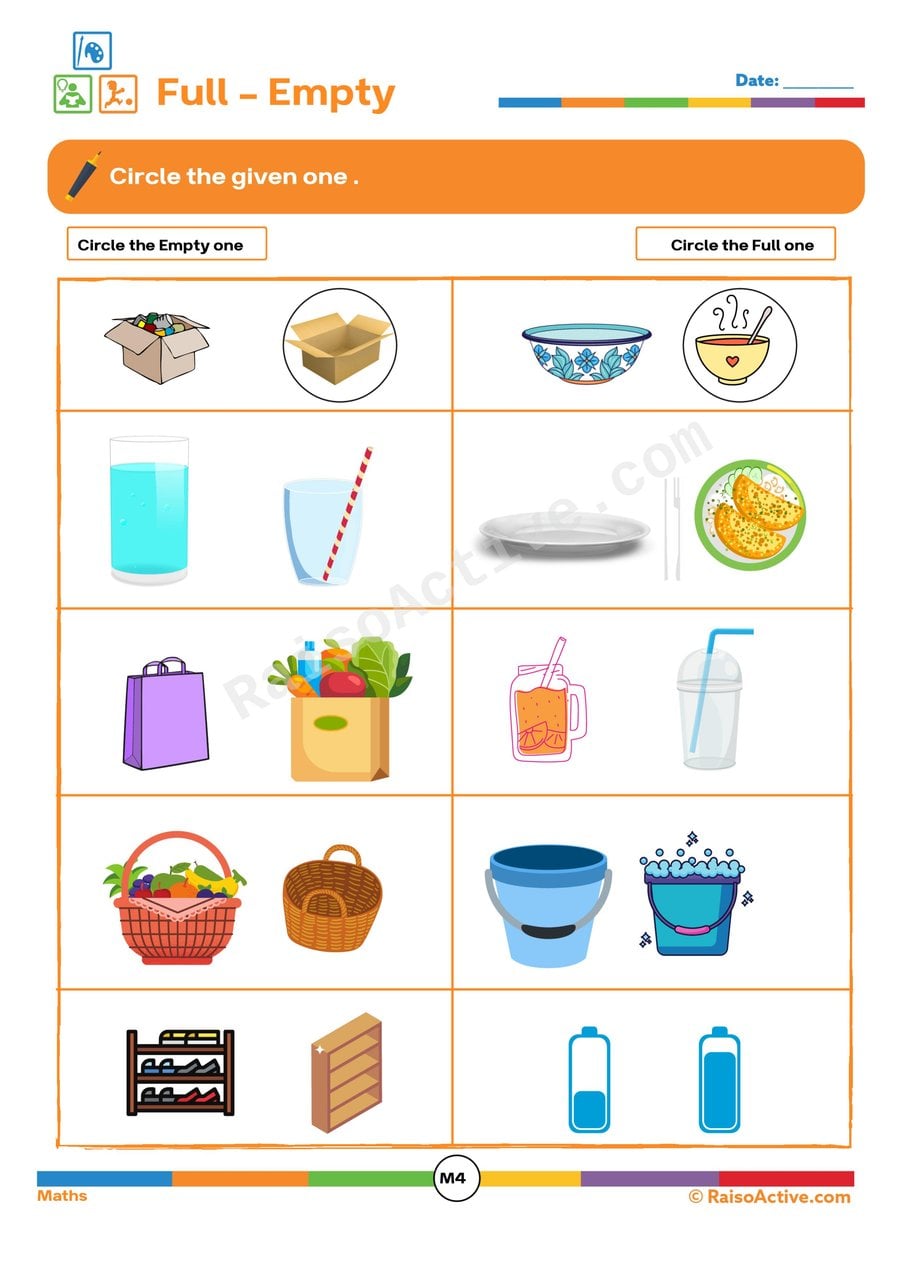
Full and Empty Worksheet for Preschoolers
Ages 3-5 · Preschool–Pre-KAges 3-5 · Nursery–ReceptionAges 3-5 · Nursery–LKGAges 3-5
This sorting worksheet introduces children ages 3-5 to the comparative concepts of 'full' and 'empty,' an early measurement idea that lays groundwork for later understanding of quantity and volume. By examining containers and objects at different fill levels, children practice careful visual observation rather than relying on counting alone. Learning to describe amounts in everyday language like full and empty also supports vocabulary development children will use constantly in daily life.

Big and Small Sorting Worksheet for Preschoolers
Ages 3-5 · Preschool–Pre-KAges 3-5 · Nursery–ReceptionAges 3-5 · Nursery–LKGAges 3-5
This worksheet helps children ages 3-5 build early comparative reasoning by identifying and sorting objects as big or small, then physically arranging cut-out pictures to show that understanding. Comparing size is one of the first ways young children learn to describe and organize the world around them, laying groundwork for later measurement and comparison skills in math.

Before and After Numbers Worksheet: Counting Bananas!
Ages 4-5 · Pre-KAges 4-5 · ReceptionAges 4-5 · LKGAges 4-5
Figuring out which number comes immediately before and after a given number strengthens children ages 4-5's understanding of number order and the counting sequence, a concept that's more abstract than simply counting objects one by one. Coloring a matching number of bananas for each answer adds a concrete, visual check, letting children confirm their number sense by physically representing the quantity. This worksheet bridges rote number-sequence memorization with real quantity understanding.
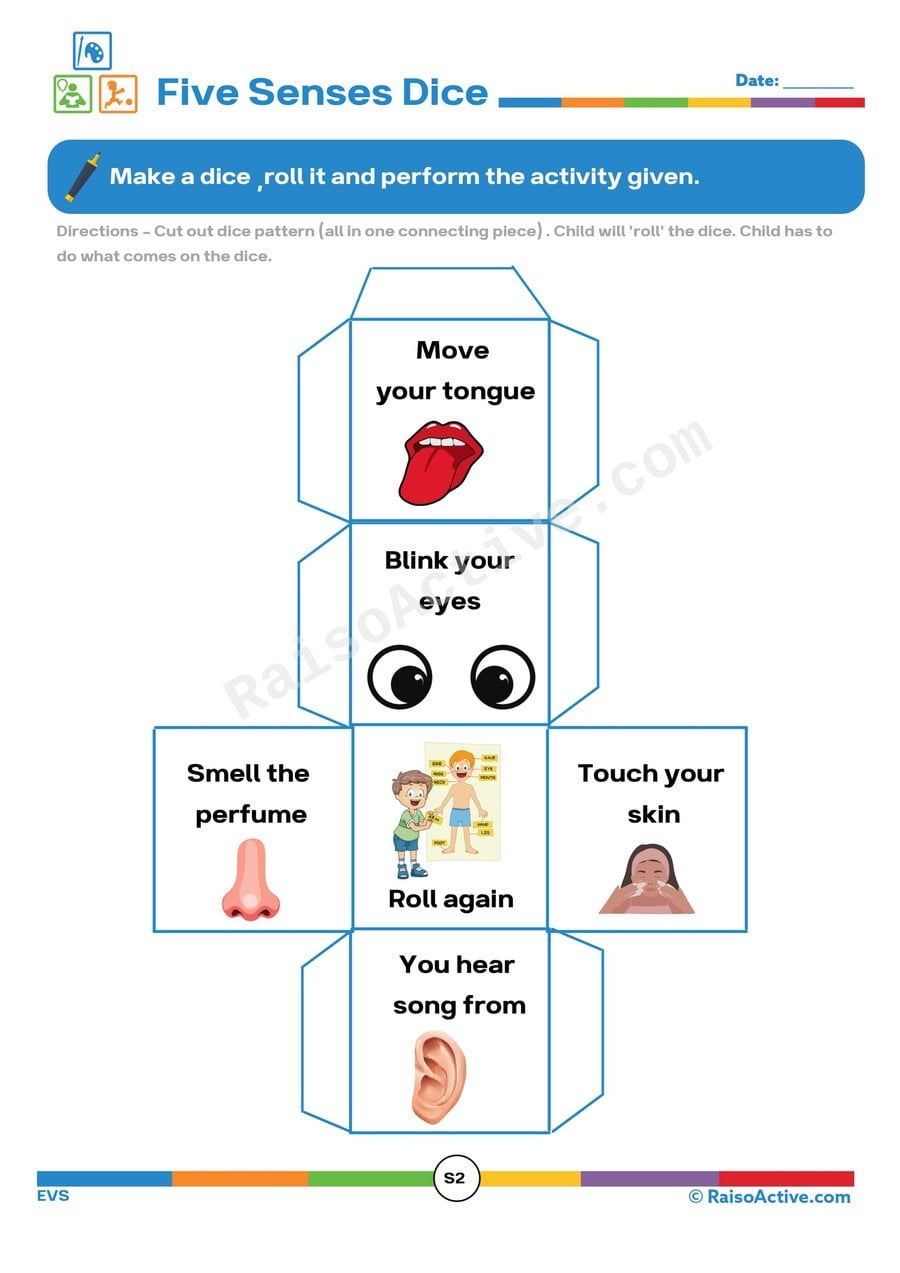
Five Senses Dice Activity: Roll and Explore!
Ages 3-5 · Preschool–Pre-KAges 3-5 · Nursery–ReceptionAges 3-5 · Nursery–LKGAges 3-5
Rolling a homemade dice to trigger sensory activities teaches children ages 3-5 to identify and use each of the five senses — sight, hearing, touch, taste, and smell — through direct hands-on exploration rather than only reading or discussing them. Building and assembling the dice itself also adds a light fine motor and spatial task before the sensory learning even begins.

Scarecrow Cut and Paste Worksheet for Preschoolers
Ages 3-5 · Preschool–Pre-KAges 3-5 · Nursery–ReceptionAges 3-5 · Nursery–LKGAges 3-5
This scarecrow-building activity gives children ages 3-5 focused practice in cutting and gluing basic shapes — circles, triangles, rectangles — into place to assemble a recognizable figure. Matching each shape to its correct spot on the scarecrow outline also reinforces spatial reasoning, since children must judge size and orientation before pasting. Naming the shapes aloud as they work connects the craft to early geometry vocabulary rather than treating it as pure art time.
Related worksheets

Shape Pattern Worksheet for Preschoolers: Color the Correct Pattern!
Ages 3-5 · Preschool–Pre-KAges 3-5 · Nursery–ReceptionAges 3-5 · Nursery–LKGAges 3-5
This worksheet asks children to study a repeating shape pattern and identify which shape logically comes next, then color the correct answer choice, combining pattern recognition with a decision-making step rather than simply continuing the pattern by hand. For ages three to five, recognizing shape patterns builds the same underlying logical reasoning skill used later in number patterns and early algebra.
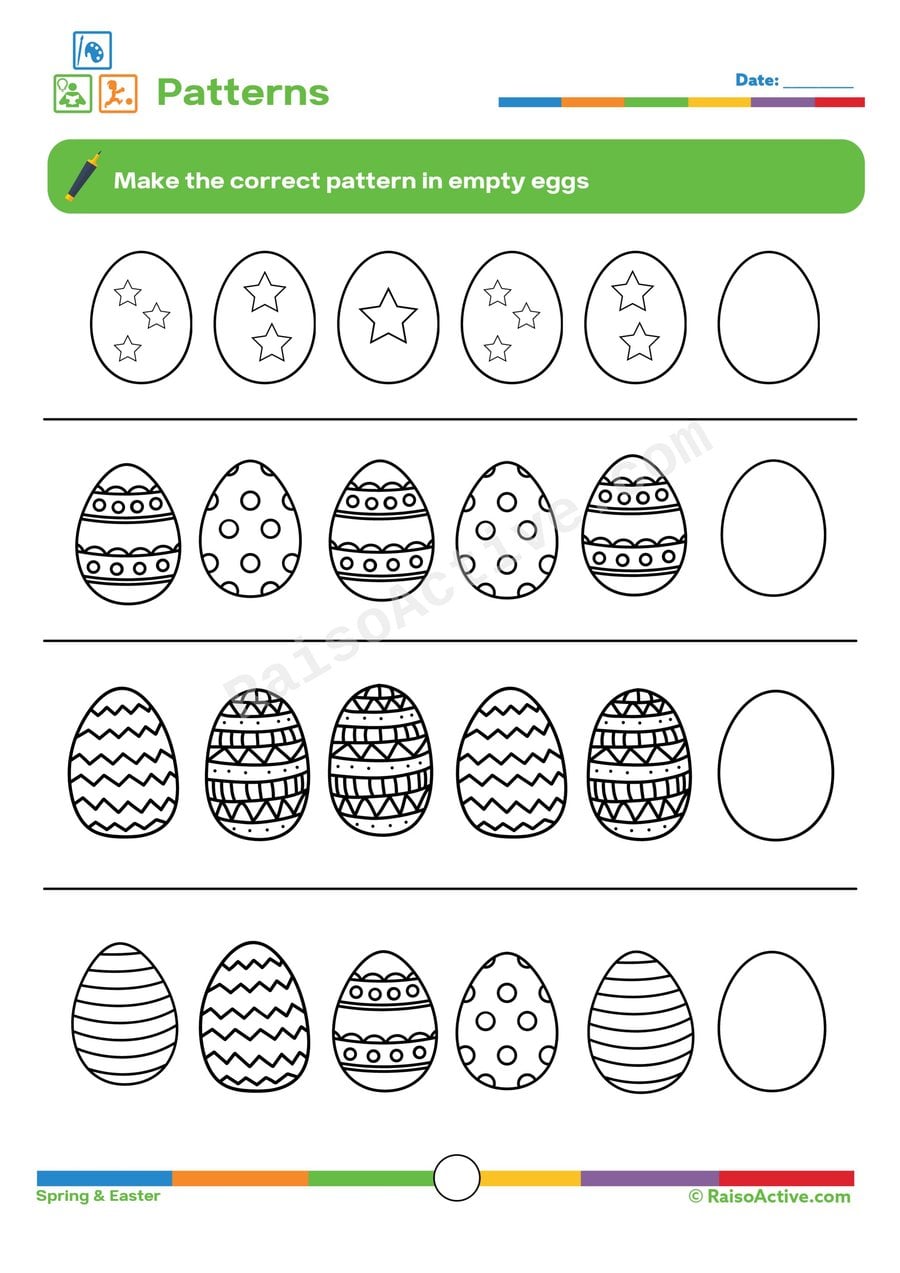
Easter Egg Patterns Worksheet for Preschoolers
Ages 3-5 · Preschool–Pre-KAges 3-5 · Nursery–ReceptionAges 3-5 · Nursery–LKGAges 3-5
This worksheet asks children ages 3-5 to study a sequence of patterned Easter eggs and figure out what design should come next, then draw it into the empty egg themselves. Predicting and completing a pattern, rather than just matching an existing one, pushes children a step further into the kind of what-comes-next reasoning that underlies early math and logic.
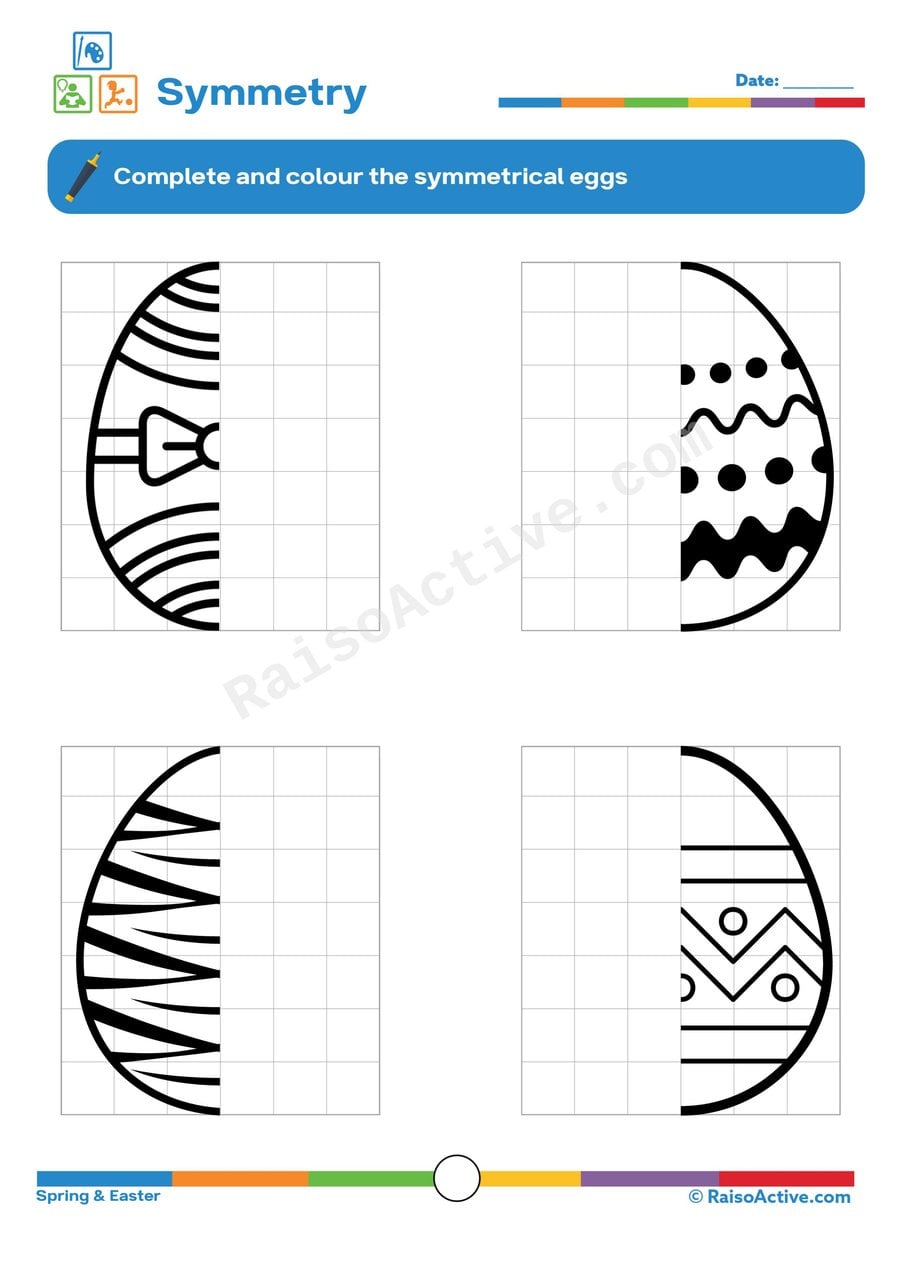
Symmetry Eggs Worksheet for Preschoolers
Ages 4-6 · Pre-K–KindergartenAges 4-6 · Reception–Year 1Ages 4-6 · LKG–UKGAges 4-6
This worksheet introduces children ages 4-6 to the concept of symmetry by having them complete the missing mirrored half of an egg design. Drawing a matching reflection requires children to closely observe shape, size, and placement on one side and reproduce it accurately on the other — an early geometry skill that also sharpens visual attention to detail.

Clothing Pattern Matching Worksheet for Preschoolers
Ages 3-5 · Preschool–Pre-KAges 3-5 · Nursery–ReceptionAges 3-5 · Nursery–LKGAges 3-5
By comparing clothing items and connecting each one to its pattern match, children ages 3-5 build visual discrimination skills, learning to notice fine differences in stripes, dots, or repeated shapes. This close-looking practice supports the same attention-to-detail children will later need to tell similar-looking letters and numbers apart.
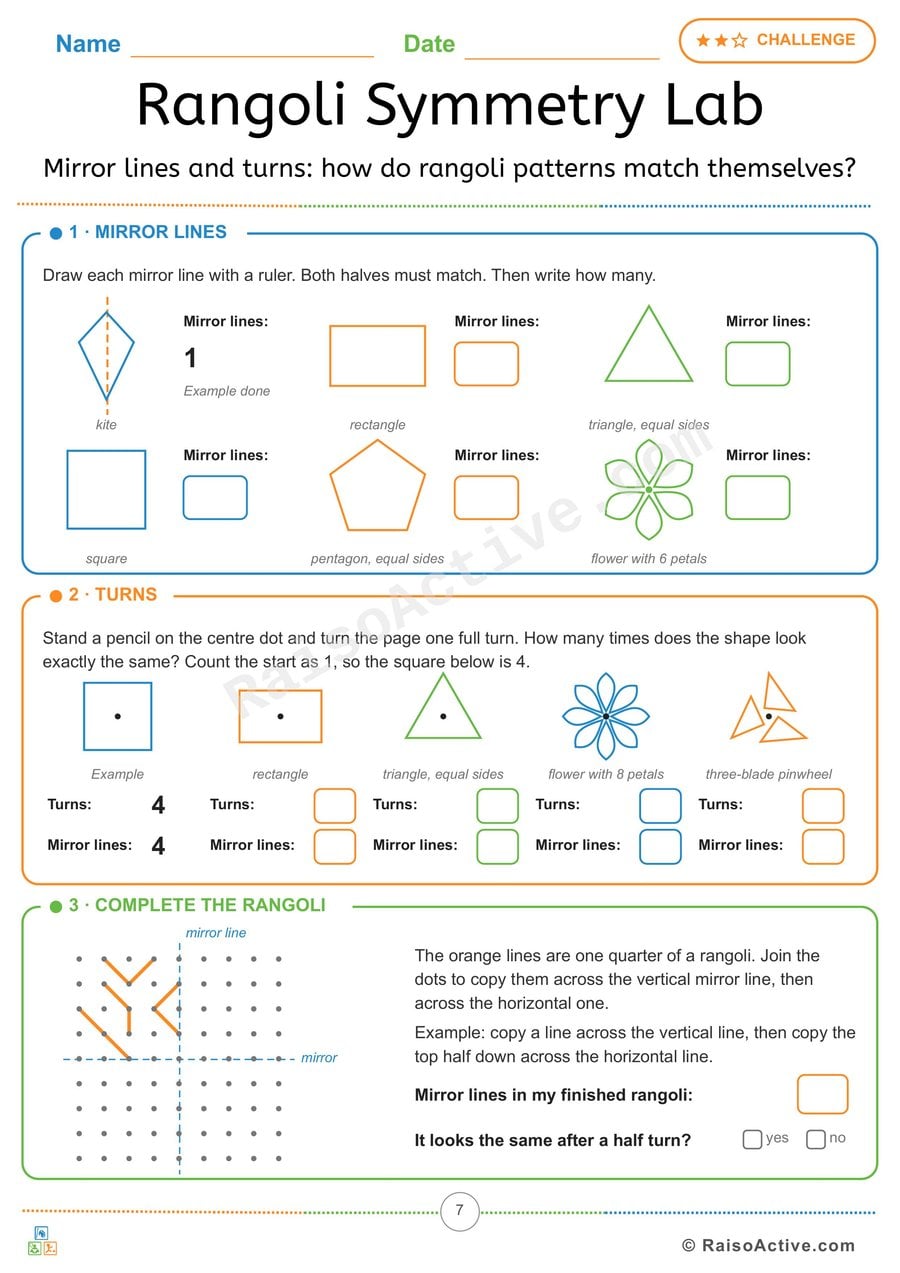
Rangoli Symmetry Lab: Mirror Lines and Rotations Worksheet
Ages 7-10 · Grade 2–Grade 3Ages 7-10 · Year 3–Year 4Ages 7-10 · Class 2–Class 3Ages 7-10
Children draw mirror lines on shapes and count them, count how many turns make a shape look the same, and complete a rangoli across a vertical and a horizontal mirror line.

Navratri Mix and Pattern: Mixing Colours and Bead Patterns
Ages 4-6 · Pre-K–KindergartenAges 4-6 · Reception–Year 1Ages 4-6 · LKG–UKGAges 4-6
Children learn which two colours mix to make green, orange, purple and grey, continue colour patterns on beads and read a simple chart to answer questions.
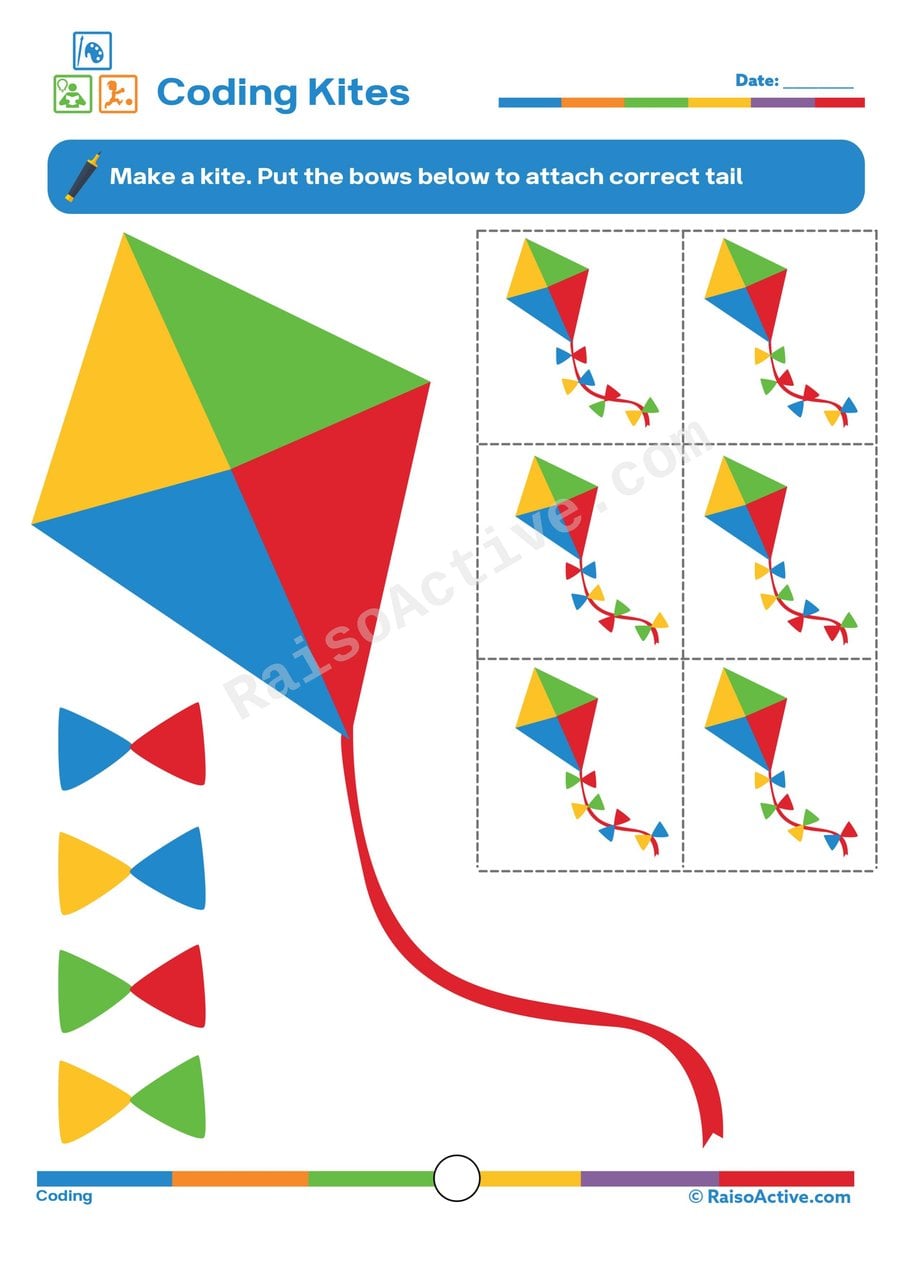
Coding Kites Worksheet: Match the Bows!
Ages 3-5 · Preschool–Pre-KAges 3-5 · Nursery–ReceptionAges 3-5 · Nursery–LKGAges 3-5
By matching each colorful bow to the kite sharing its color pattern, children ages 3-5 practice visual pattern recognition — an early form of the same logical sequencing used in beginner coding concepts. Cutting, matching, and gluing the correct bow also reinforces color-word vocabulary and precise hand-eye coordination.
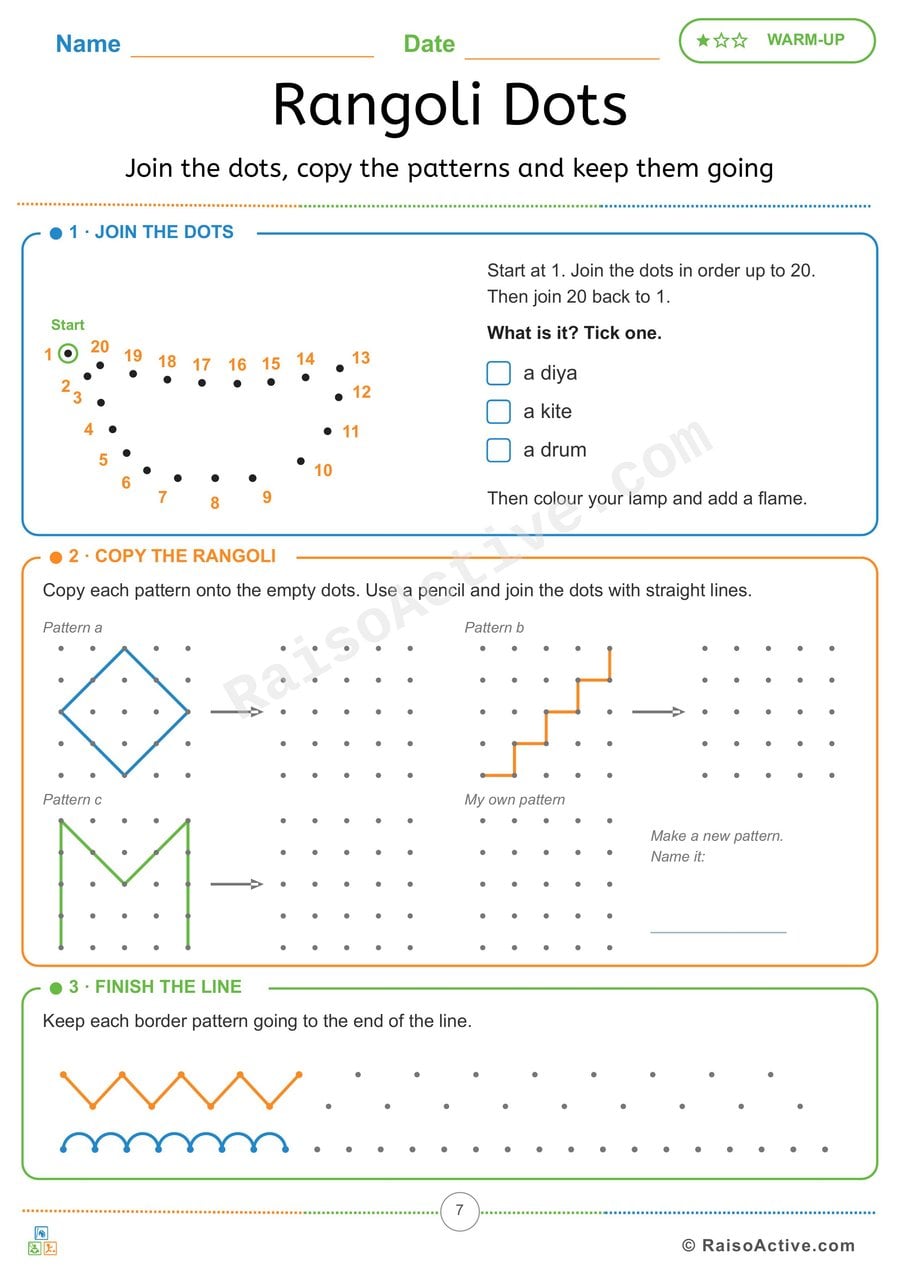
Rangoli Dot Pictures: Join the Dots, Copy Patterns and Finish the Line
Ages 4-6 · Pre-K–KindergartenAges 4-6 · Reception–Year 1Ages 4-6 · LKG–UKGAges 4-6
Children join numbered dots from 1 to 20 to reveal a diya, copy three dot-grid patterns with straight lines, and keep two border patterns going. It builds number order, pencil control and pattern sense.
Guides for this topic

Pre-Writing Strokes in Order: From Standing Lines to Loops (With Printable Patterns)
The developmental order of pre-writing strokes, from vertical lines to loops, and why practicing them in sequence makes letter formation much easier to learn.

Age-Appropriate Problem-Solving Activities: Building Critical Thinkers from the Ground Up
Discover fun, age-appropriate problem-solving activities for children ages 1-8. Build critical thinking, logic, and reasoning skills through play-based learning.

Fostering Creativity in Structured Learning: The Perfect Balance for Young Minds
Learn how to blend creativity with structured learning for children ages 1-8. Practical strategies, activities, and printable worksheets for parents and teachers.
Reviews
Every worksheet for ages 3–5, no watermark
Members download the full library of 1,000+ worksheets and every activity pack without watermarks or daily limits. One year costs ₹999 in India or $20 elsewhere.
See membership plansOr download any worksheet free with a watermark (5 a day).