Count and Match: Numbers Worksheet for Preschoolers
This worksheet builds number recognition and one-to-one counting in children ages 3-5 by having them count sets of objects and then identify or match the correct numeral. Counting stationery items and circling the matching number reinforces that a numeral represents an exact quantity, not just a symbol to memorize. Matching fruits to candy quantities on a second section adds variety and repeated practice with different object types.

Part of the pack
Month 10: Learning & Development | Ages Up to 4
This is page 12 of the pack. Ages 2-4 · PreschoolAges 2-4 · NurseryAges 2-4

Made for your child
Counting to 10, made for your child
A maths pack with your child's name in it: pictures that explain, practice at three levels, puzzles and story sums about them. Print a new set whenever they finish.
Make a maths packFree preview · free for members
Curriculum
- Number Sense > Counting 1-20
How to use this worksheet
Look at the first row of stationery items together and count them aloud one by one, pointing to each item as you say its number. Ask your child to circle the numeral at the end of the row that matches the total they counted. Move on to the fruit section, where your child counts the fruits on the table and finds the matching group of candies with the same number, drawing a line or circling the match. Continue through each row, always counting aloud before choosing an answer.
Materials needed
- Pencil
- Crayons
Extension activities
- 1Have the child draw their own sets of objects and write the corresponding number.
- 2Use real objects to practice counting and matching.
- 3Set out small snacks in groups and ask your child to count and label each group with a number card.
- 4Play a 'clap the number' game where you clap a number of times and your child holds up that many fingers.
- 5Create a simple number-to-object matching game using stickers.

Written by
Hemsweta Jain · Teacher Cheena
MBA and Early Childhood Educator, teaching since 2014 · Founder of RaisoActive, Mumbai
Every RaisoActive worksheet is designed and checked by the founder before publishing.
Published · Last reviewed
More from Month 10: Learning & Development | Ages Up to 4

Alphabet Adventures: Complete the Vocabulary Table!
Ages 4-6 · Pre-K–KindergartenAges 4-6 · Reception–Year 1Ages 4-6 · LKG–UKGAges 4-6
This worksheet helps children ages 4-6 strengthen letter-picture-word associations by filling in missing letters, finding matching pictures for each letter, and pasting them into a vocabulary table. Combining letter recall, picture matching, and gluing into one multi-step task pushes children beyond simple letter recognition into actively building and organizing vocabulary, an important step toward independent reading and writing.

Speak Sentences: A Fun Sentence Building Worksheet!
Ages 4-6 · Pre-K–KindergartenAges 4-6 · Reception–Year 1Ages 4-6 · LKG–UKGAges 4-6
Reading a single word on each stair step and turning it into a full spoken sentence helps children ages 4-6 practice expanding a vocabulary word into a grammatically complete thought, an important bridge between word recognition and sentence-level language. The staircase, climb-to-the-top format adds a sense of progress and motivation, encouraging children to keep going even when a particular word is tricky to build a sentence around. This oral sentence-building practice also lays groundwork for later independent sentence writing.
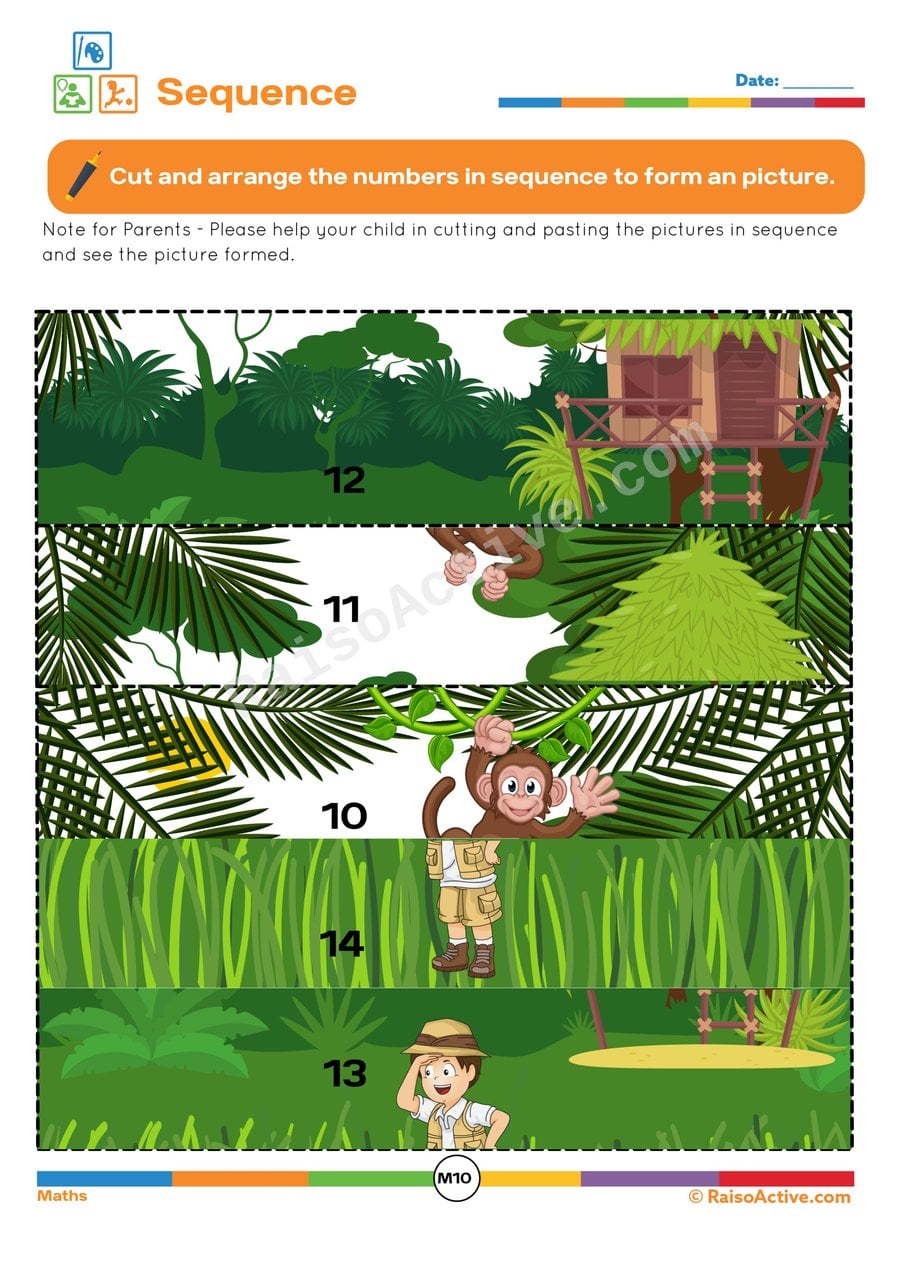
Jungle Adventure Sequence Worksheet for Kids
Ages 3-5 · Preschool–Pre-KAges 3-5 · Nursery–ReceptionAges 3-5 · Nursery–LKGAges 3-5
This cut-and-paste sequencing activity has children ages 3-5 arrange picture strips numbered 10 through 14 in the correct order to reveal a hidden jungle scene, linking number sequencing directly to a satisfying visual reward. Because the reveal only works if every strip is placed correctly, children get immediate, built-in feedback on whether their sequencing is accurate. Practicing numbers in the 10-14 range also pushes counting skills just beyond the more commonly rehearsed 1-10 range.
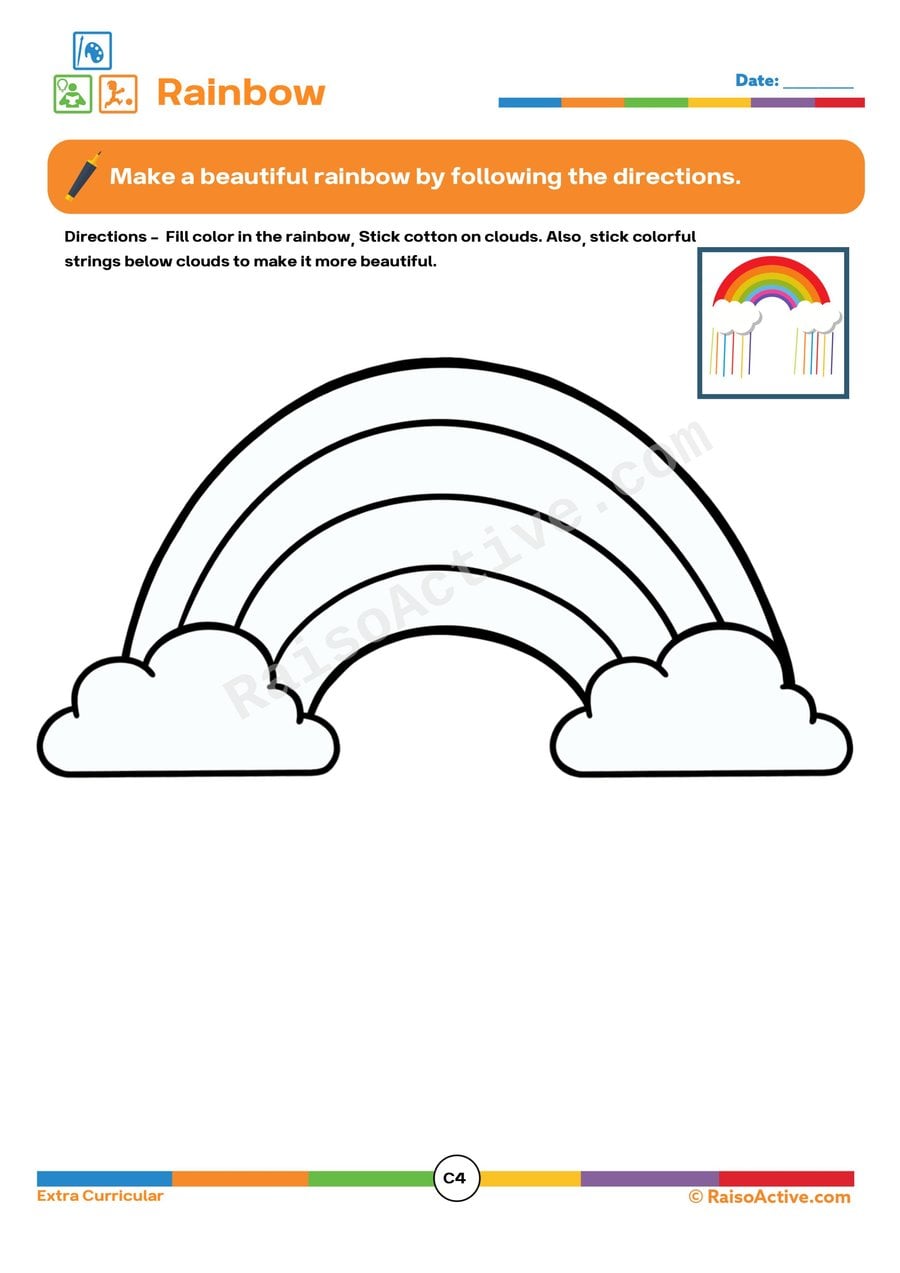
Rainbow Coloring Worksheet for Preschoolers
Ages 3-5 · Preschool–Pre-KAges 3-5 · Nursery–ReceptionAges 3-5 · Nursery–LKGAges 3-5
This multi-sensory worksheet helps children ages 3-5 practice color recognition and sequencing by coloring a rainbow in its correct color order, while also introducing texture through a cotton-ball cloud and string activity. Matching colors to a printed example teaches children to compare and follow a visual model precisely, an important pre-reading skill of left-to-right, top-to-bottom scanning. Adding cotton and string engages a different set of fine motor movements than coloring alone, like pinching and placing.

Sorting Numbers Worksheet: Match the Number to the Picture!
Ages 3-5 · Preschool–Pre-KAges 3-5 · Nursery–ReceptionAges 3-5 · Nursery–LKGAges 3-5
Counting objects in a picture and then pasting that picture next to its matching numeral helps children ages 3-5 connect a written number symbol to an actual quantity, which is the heart of true number sense rather than just numeral naming. Cutting out the picture pieces beforehand also builds scissor control, giving this worksheet a fine motor component alongside the counting practice. The puzzle-piece format adds a satisfying, hands-on element that keeps repetitive counting practice engaging.

Big and Small Sorting Worksheet for Preschoolers
Ages 3-5 · Preschool–Pre-KAges 3-5 · Nursery–ReceptionAges 3-5 · Nursery–LKGAges 3-5
This worksheet helps children ages 3-5 build early comparative reasoning by identifying and sorting objects as big or small, then physically arranging cut-out pictures to show that understanding. Comparing size is one of the first ways young children learn to describe and organize the world around them, laying groundwork for later measurement and comparison skills in math.
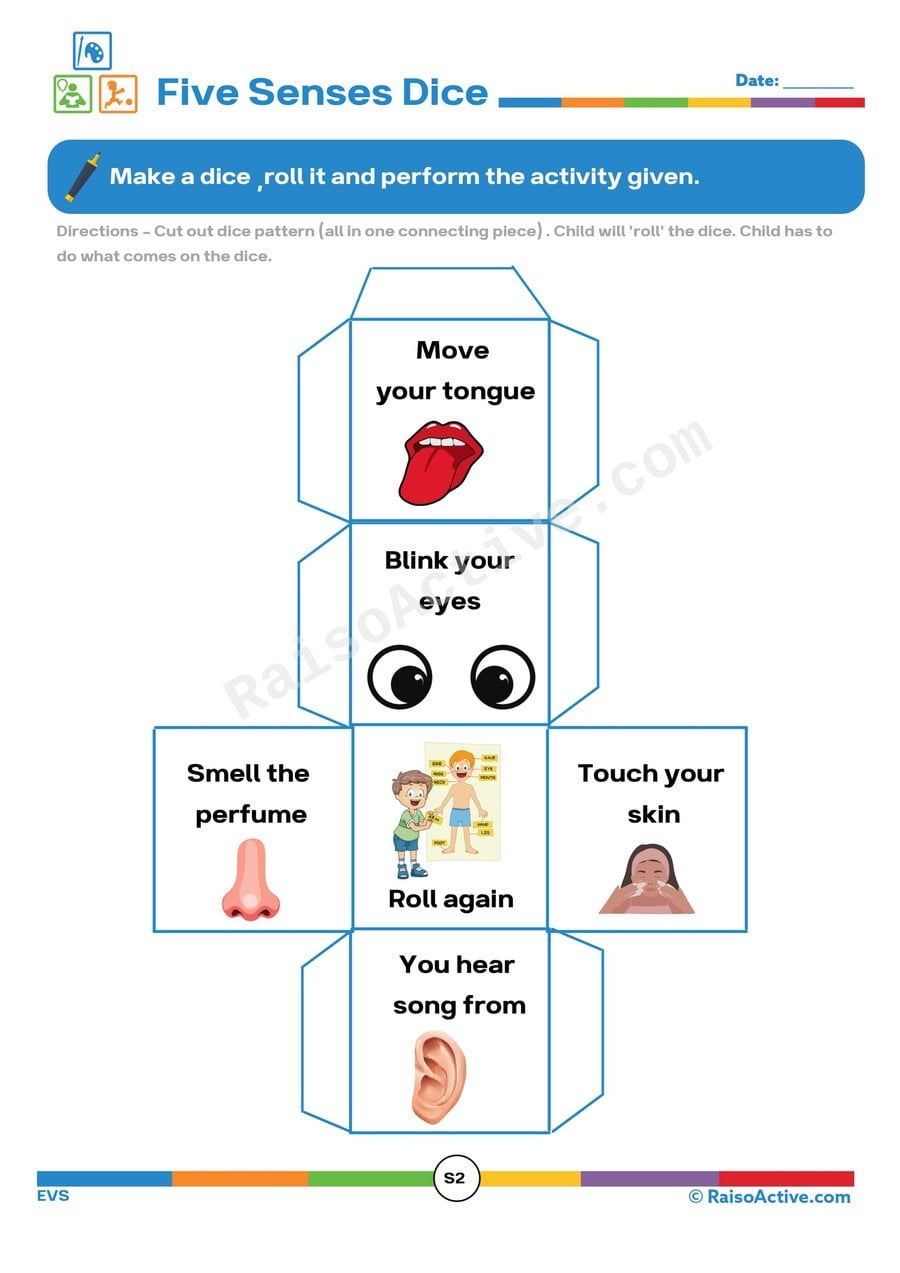
Five Senses Dice Activity: Roll and Explore!
Ages 3-5 · Preschool–Pre-KAges 3-5 · Nursery–ReceptionAges 3-5 · Nursery–LKGAges 3-5
Rolling a homemade dice to trigger sensory activities teaches children ages 3-5 to identify and use each of the five senses — sight, hearing, touch, taste, and smell — through direct hands-on exploration rather than only reading or discussing them. Building and assembling the dice itself also adds a light fine motor and spatial task before the sensory learning even begins.
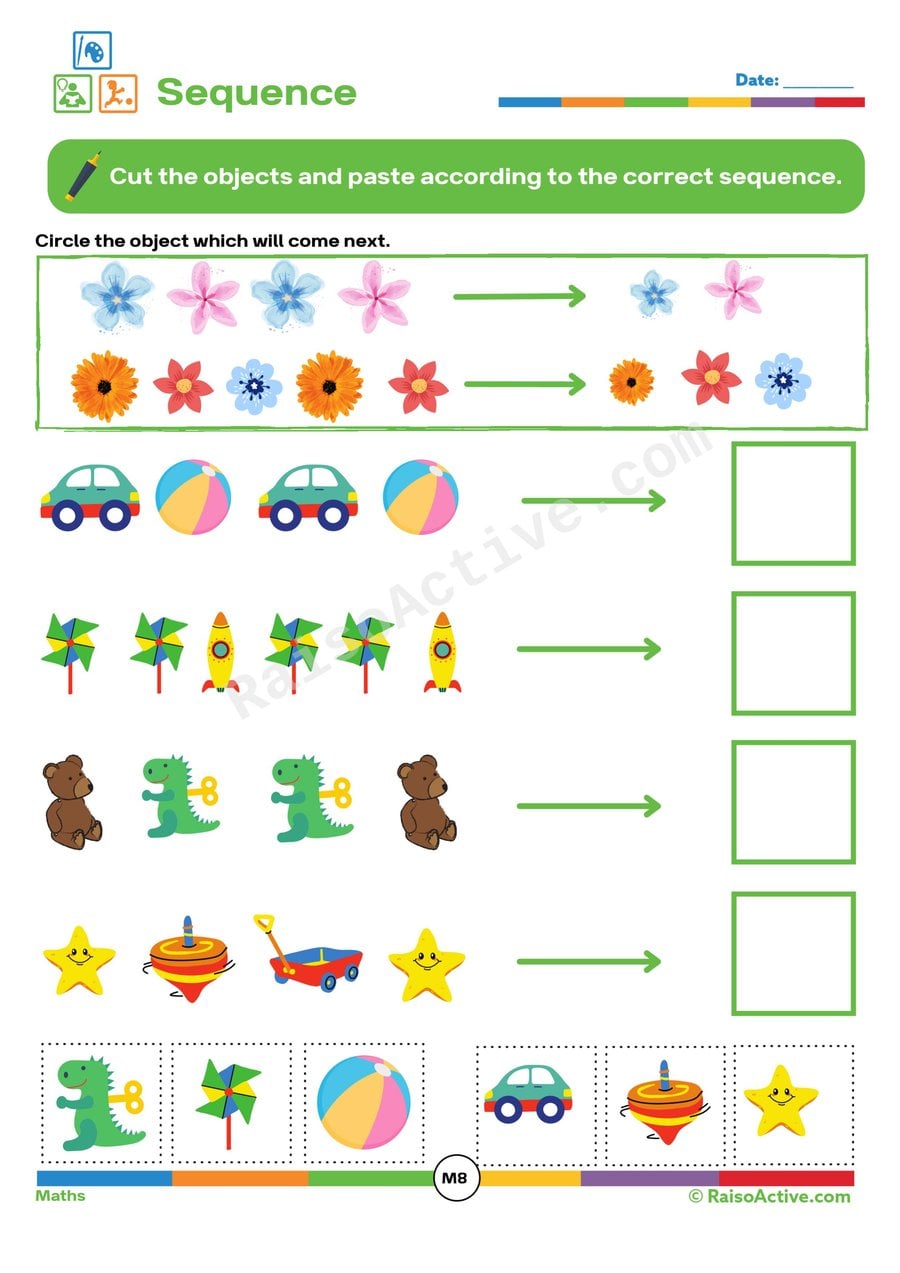
Sequence Worksheet: What Comes Next?
Ages 3-5 · Preschool–Pre-KAges 3-5 · Nursery–ReceptionAges 3-5 · Nursery–LKGAges 3-5
Children ages 3-5 build pattern recognition and predictive reasoning as they study a sequence of objects, figure out the underlying rule, and determine which object comes next. Recognizing and extending patterns is a foundational pre-math skill that later supports understanding of number patterns, skip counting, and algebraic thinking, making this simple activity more mathematically important than it might first appear.
Related worksheets
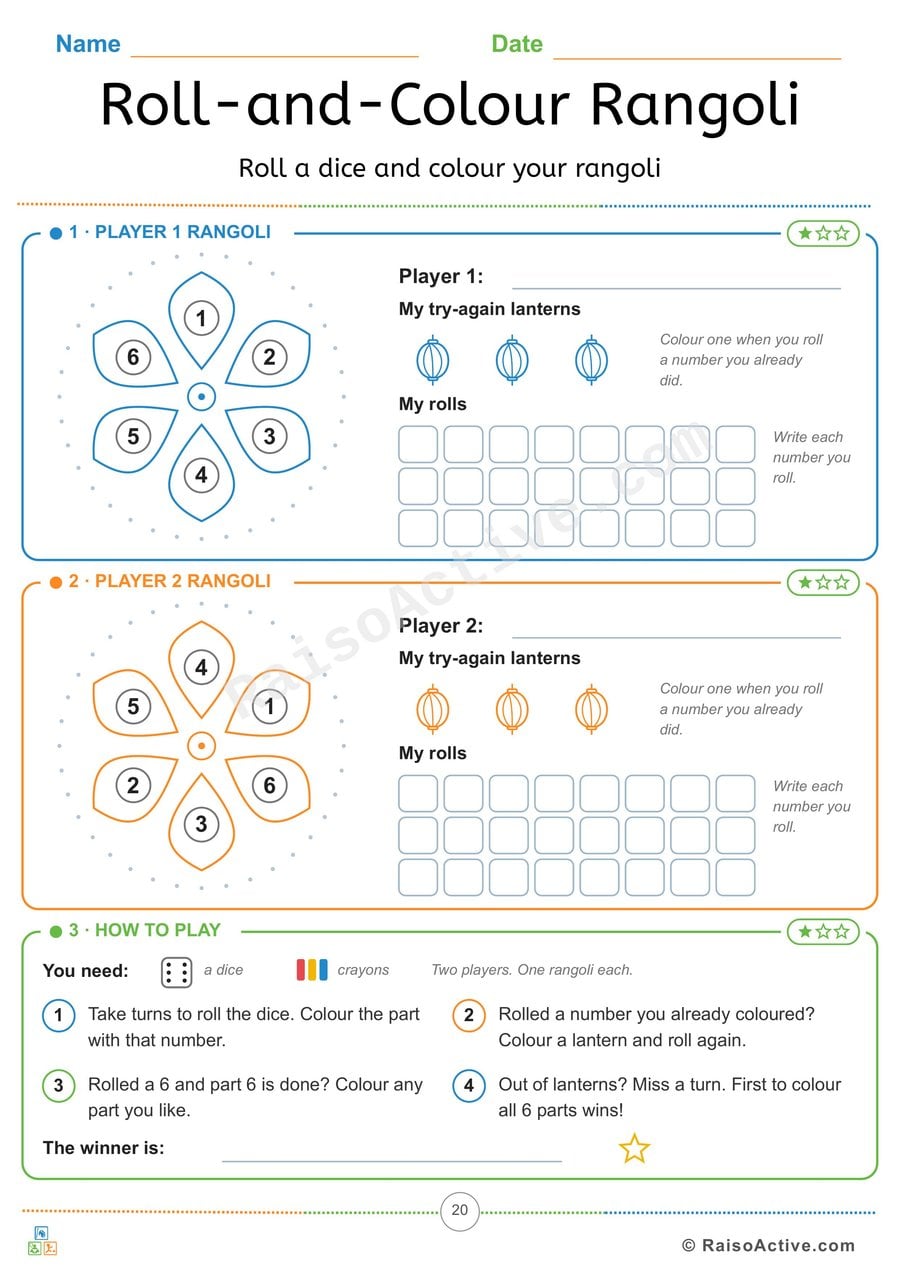
Roll-and-Colour Rangoli: Two-Player Dice Game
Ages 4-6 · Pre-K–KindergartenAges 4-6 · Reception–Year 1Ages 4-6 · LKG–UKGAges 4-6
Two players take turns rolling a dice and colouring the rangoli part with that number. They practise number recognition, turn-taking and handling a try-again rule, and write each roll in a record box.
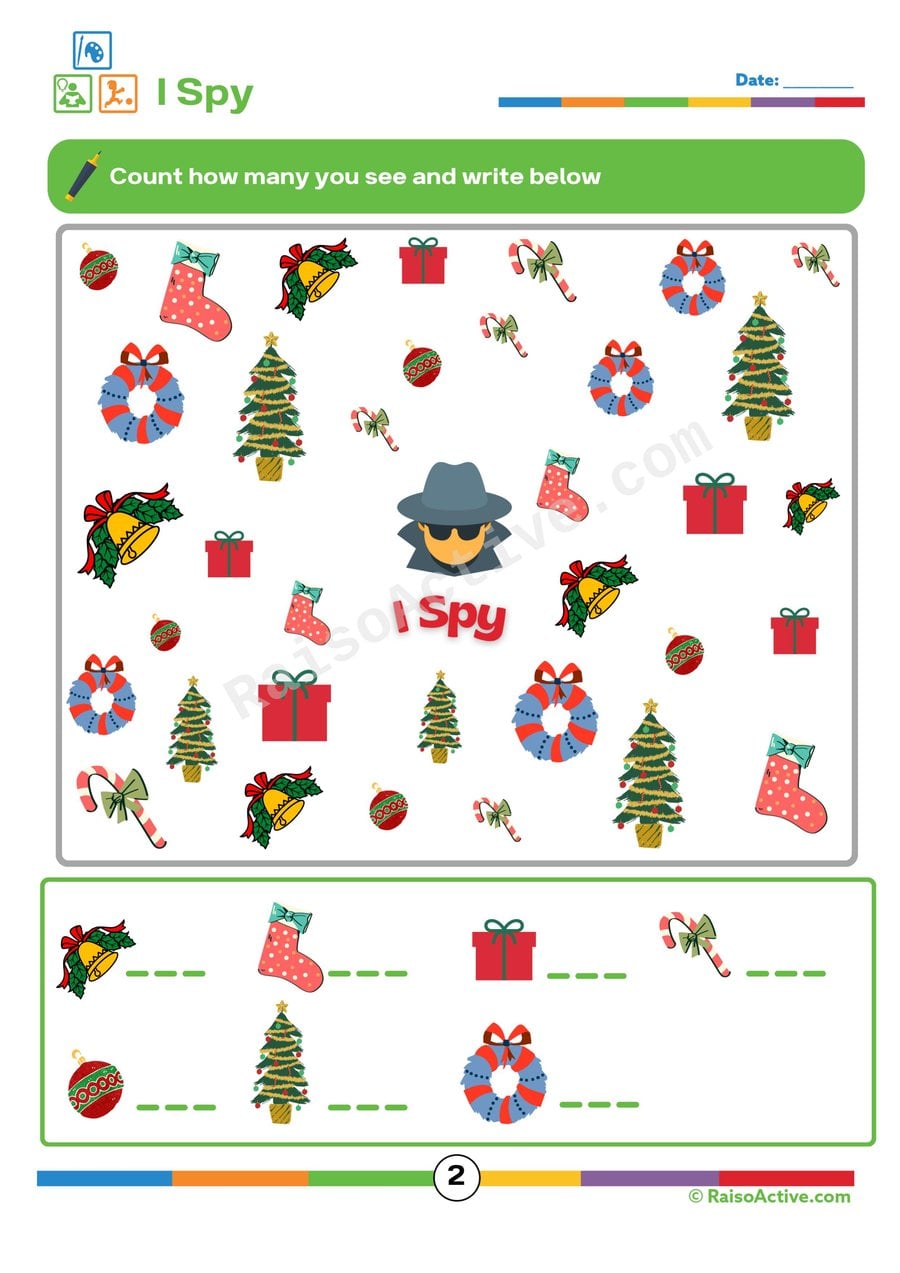
I Spy Christmas Worksheet: Count and Write!
Ages 3-5 · Preschool–Pre-KAges 3-5 · Nursery–ReceptionAges 3-5 · Nursery–LKGAges 3-5
This worksheet strengthens counting accuracy and number writing in children ages 3-5 as they search a busy Christmas scene for specific items and record how many they find. The 'I Spy' search format adds a visual scanning challenge on top of basic counting, since children must first locate every instance of an item scattered across the picture before counting it.

Harvests & New Years: One Harvest, Many Names Across India
Ages 4-8 · Pre-K–Grade 2Ages 4-8 · Reception–Year 3Ages 4-8 · LKG–Class 2Ages 4-8
Children learn that the same winter harvest is celebrated with different names across India, and that many states have their own New Year festival.

Dussehra and First Letters: Vidyarambham Tracing and Letter Hunt
Ages 4-6 · Pre-K–KindergartenAges 4-6 · Reception–Year 1Ages 4-6 · LKG–UKGAges 4-6
Children learn about Vidyarambham, when little children write their first letters in rice on Vijayadashami, and about Dussehra, when Rama won against Ravana. They trace letters, sort things we use to learn, count to 10 and match letters to beginning sounds.

Symmetry Worksheet for Kids: Mirror Halves and Shadow Match
Ages 4-7 · Pre-K–Grade 1Ages 4-7 · Reception–Year 2Ages 4-7 · LKG–Class 1Ages 4-7
Children complete the other half of a butterfly and a house on a dot grid so both sides match like a mirror, then draw lines to match eight pictures to their shadows. This builds spatial reasoning and visual discrimination.

Balloon Pattern Matching Worksheet for Preschoolers
Ages 3-5 · Preschool–Pre-KAges 3-5 · Nursery–ReceptionAges 3-5 · Nursery–LKGAges 3-5
Children ages 3-5 build early pattern-recognition skills on this worksheet by studying a sequence of colored balloons and finding the matching set to complete it. Recognizing and continuing a repeating sequence is a foundational pre-math skill that later supports understanding of number patterns, skip counting, and simple algebraic thinking.
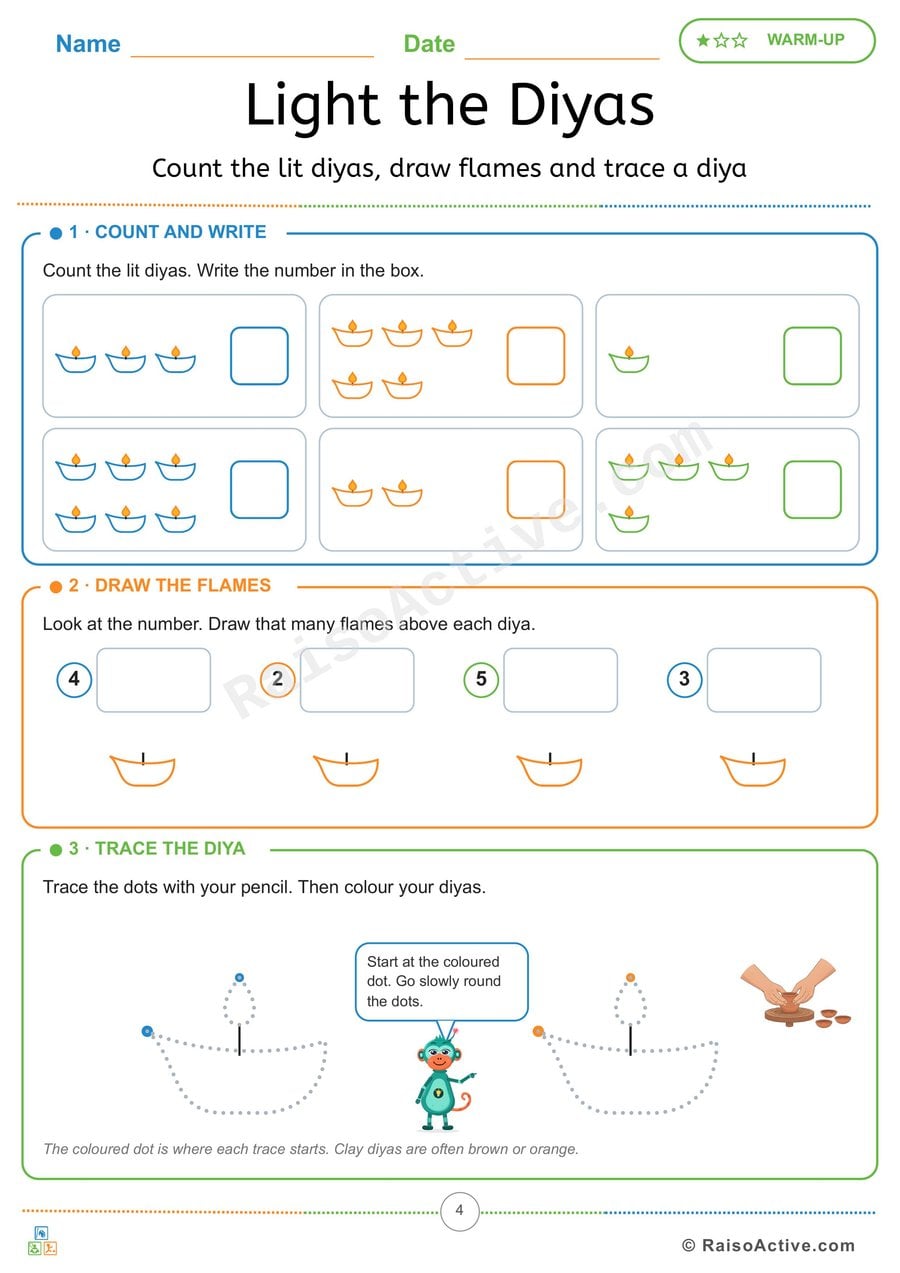
Diwali Diya Counting, Flame Drawing and Tracing Worksheet
Ages 4-6 · Pre-K–KindergartenAges 4-6 · Reception–Year 1Ages 4-6 · LKG–UKGAges 4-6
Children count groups of up to six lit diyas and write the number, then draw the matching number of flames above each lamp. They finish by tracing the dotted outline of a diya with a steady pencil.

Busy Bazaar Seek-and-Find: Find 12 Things in the Diwali Market
Ages 7-10 · Grade 2–Grade 3Ages 7-10 · Year 3–Year 4Ages 7-10 · Class 2–Class 3Ages 7-10
Children search a big line-art Diwali market for twelve things, such as a dog, a bicycle, a bunch of balloons, trays of sweets and a potter at his wheel. They tick each find, answer two counting bonuses about marigold baskets and garlands, then colour the whole market.
Guides for this topic

Number Formation Rhymes 0–9 and How to Fix Reversals
Original number formation rhymes for 0–9, the correct stroke order for each digit, why 3, 5 and 7 get reversed most often, and multisensory fixes that work.

Best Worksheets for 3-Year-Olds: What Works and What to Avoid
What works on worksheets for 3-year-olds: short sessions, crayons, tracing lines, matching, cutting, a free weekly plan, and signs one is too advanced.
Christmas and Winter Activities That Combine Fun and Learning: Creating Magical Educational Experiences
Discover Christmas and winter activities that combine festive fun with real learning. Crafts, counting, literacy, and printable worksheets for ages 2 to 8 — perfect for home and school.
Reviews
Every worksheet for ages 3–5, no watermark
Members download the full library of 1,000+ worksheets and every activity pack without watermarks or daily limits. One year costs ₹999 in India or $20 elsewhere.
See membership plansOr download any worksheet free with a watermark (5 a day).