Jungle Adventure Sequence Worksheet for Kids
This cut-and-paste sequencing activity has children ages 3-5 arrange picture strips numbered 10 through 14 in the correct order to reveal a hidden jungle scene, linking number sequencing directly to a satisfying visual reward. Because the reveal only works if every strip is placed correctly, children get immediate, built-in feedback on whether their sequencing is accurate. Practicing numbers in the 10-14 range also pushes counting skills just beyond the more commonly rehearsed 1-10 range.

Part of the pack
Month 10: Learning & Development | Ages Up to 4
This is page 16 of the pack. Ages 2-4 · PreschoolAges 2-4 · NurseryAges 2-4
Curriculum
- Cognitive - Problem Solving > Sequencing Events
How to use this worksheet
Cut out each numbered picture strip along the lines, keeping them in a loose pile so your child has to actively sequence them rather than just gluing them in the order they were cut. Ask your child to find the strip numbered 10 first and set it in place, then look for 11, 12, 13, and 14 in turn. Glue each strip down only once its position is confirmed, checking that the picture lines up correctly across the strips. When finished, reveal and discuss the completed jungle scene together.
Materials needed
- Scissors
- Glue
- Pencil
Extension activities
- 1Create your own numbered sequencing strips using a photo cut into pieces.
- 2Practice counting forward and backward from 10 to 14 using fingers or counters.
- 3Look for the numbers 10 through 14 on a number line or hundred chart at home.
- 4Make jungle animal sounds or act out jungle animals as a fun break during the activity.
- 5Draw an extra jungle animal and add it to the completed scene.

Written by
Hemsweta Jain · Teacher Cheena
MBA and Early Childhood Educator, teaching since 2014 · Founder of RaisoActive, Mumbai
Every RaisoActive worksheet is designed and checked by the founder before publishing.
Published · Last reviewed
More from Month 10: Learning & Development | Ages Up to 4

Alphabet Adventures: Complete the Vocabulary Table!
Ages 4-6 · Pre-K–KindergartenAges 4-6 · Reception–Year 1Ages 4-6 · LKG–UKGAges 4-6
This worksheet helps children ages 4-6 strengthen letter-picture-word associations by filling in missing letters, finding matching pictures for each letter, and pasting them into a vocabulary table. Combining letter recall, picture matching, and gluing into one multi-step task pushes children beyond simple letter recognition into actively building and organizing vocabulary, an important step toward independent reading and writing.

Before and After Numbers Worksheet: Counting Bananas!
Ages 4-5 · Pre-KAges 4-5 · ReceptionAges 4-5 · LKGAges 4-5
Figuring out which number comes immediately before and after a given number strengthens children ages 4-5's understanding of number order and the counting sequence, a concept that's more abstract than simply counting objects one by one. Coloring a matching number of bananas for each answer adds a concrete, visual check, letting children confirm their number sense by physically representing the quantity. This worksheet bridges rote number-sequence memorization with real quantity understanding.
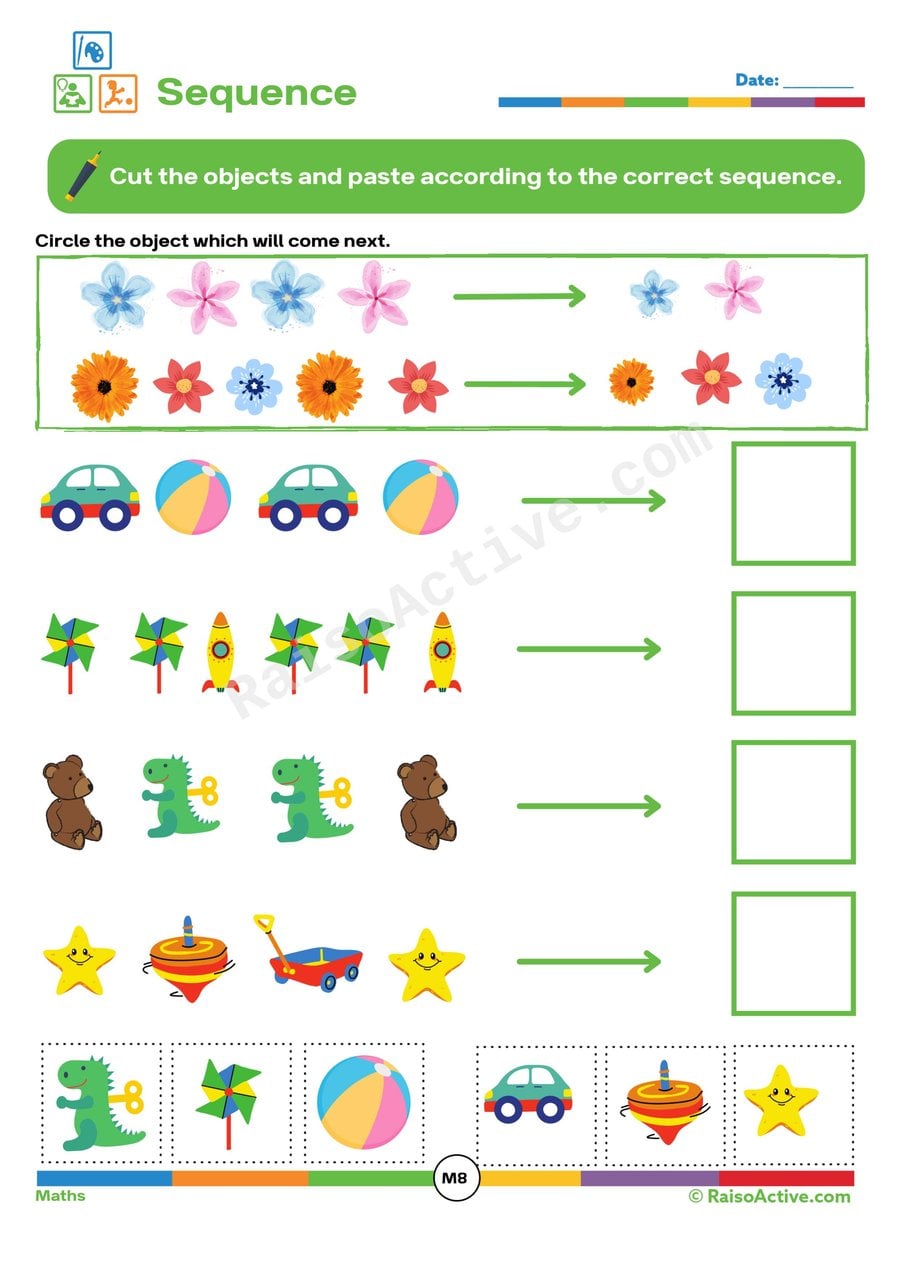
Sequence Worksheet: What Comes Next?
Ages 3-5 · Preschool–Pre-KAges 3-5 · Nursery–ReceptionAges 3-5 · Nursery–LKGAges 3-5
Children ages 3-5 build pattern recognition and predictive reasoning as they study a sequence of objects, figure out the underlying rule, and determine which object comes next. Recognizing and extending patterns is a foundational pre-math skill that later supports understanding of number patterns, skip counting, and algebraic thinking, making this simple activity more mathematically important than it might first appear.

Match the Pictures: Letter Matching Worksheet for Preschoolers
Ages 3-5 · Preschool–Pre-KAges 3-5 · Nursery–ReceptionAges 3-5 · Nursery–LKGAges 3-5
Connecting pictures to their matching letters helps children ages 3-5 build the foundation of phonics, learning that a printed letter represents the beginning sound of a spoken word. Circling the animals that specifically start with the letter B adds a second layer of practice, requiring children to apply that letter-sound knowledge rather than just matching shapes. This two-step approach moves children from simple visual matching toward true letter-sound recognition, a critical pre-reading skill.

Animal's World: Count and Identify Animals Worksheet for Kids
Ages 3-5 · Preschool–Pre-KAges 3-5 · Nursery–ReceptionAges 3-5 · Nursery–LKGAges 3-5
Counting the total number of animals in a picture builds one-to-one correspondence and number-writing practice for children ages 3-5, while circling the food each animal eats adds an early science layer about animal diets and habitats. Combining a counting task with an animal-knowledge task in one worksheet keeps children engaged across two different types of thinking, numerical and factual, within a single page. This variety helps maintain focus better than a single repetitive task might at this age.

Tall and Short Worksheet for Preschoolers: Identifying Sizes
Ages 3-5 · Preschool–Pre-KAges 3-5 · Nursery–ReceptionAges 3-5 · Nursery–LKGAges 3-5
This worksheet builds children ages 3-5's understanding of relative height by having them identify which of two objects is tall and which is short across several picture sets. Comparing height is one of the earliest forms of measurement reasoning children encounter, and practicing it with varied, unrelated objects helps the concept generalize beyond just the specific pictures shown.

Speak Sentences: A Fun Sentence Building Worksheet!
Ages 4-6 · Pre-K–KindergartenAges 4-6 · Reception–Year 1Ages 4-6 · LKG–UKGAges 4-6
Reading a single word on each stair step and turning it into a full spoken sentence helps children ages 4-6 practice expanding a vocabulary word into a grammatically complete thought, an important bridge between word recognition and sentence-level language. The staircase, climb-to-the-top format adds a sense of progress and motivation, encouraging children to keep going even when a particular word is tricky to build a sentence around. This oral sentence-building practice also lays groundwork for later independent sentence writing.

Food Bingo Worksheet: Identify Healthy and Unhealthy Foods!
Ages 3-5 · Preschool–Pre-KAges 3-5 · Nursery–ReceptionAges 3-5 · Nursery–LKGAges 3-5
This bingo-style activity helps children ages 3-5 practice distinguishing healthy foods from unhealthy ones by physically placing tokens on matching pictures, turning nutrition education into an active game rather than a lecture. Scanning the board for matches also reinforces visual search skills similar to those used in matching and memory games. Because bingo requires a full row to win, children stay motivated to keep scanning and comparing even after finding a few matches.
Related worksheets

Earlier and Later: Flower Bloom Sequencing Worksheet for Preschoolers
Ages 3-5 · Preschool–Pre-KAges 3-5 · Nursery–ReceptionAges 3-5 · Nursery–LKGAges 3-5
Sequencing events in order is an early scientific and narrative reasoning skill, and this worksheet uses the life cycle of a flower to give children ages 3-5 concrete practice with the concepts of 'earlier' and 'later.' By matching earlier-stage images to their later-stage counterparts, children start to understand cause and change over time, a concept that underlies both storytelling and basic science observation. Drawing the next stage of the flower's bloom afterward adds a predictive element, asking children to apply the pattern they've just observed.

Rainbow Sequence Cut and Paste Worksheet for Preschoolers
Ages 4-6 · Pre-K–KindergartenAges 4-6 · Reception–Year 1Ages 4-6 · LKG–UKGAges 4-6
Children ages 4-6 practice numerical sequencing by arranging rainbow picture pieces in the correct numbered order, while also building fine motor control through cutting and gluing. Combining sequencing with a cut-and-paste format makes an abstract ordering skill into a tactile, visual task.

After School Routine Worksheet: Sequencing Activities
Ages 3-5 · Preschool–Pre-KAges 3-5 · Nursery–ReceptionAges 3-5 · Nursery–LKGAges 3-5
Children ages 3-5 practice ordering a set of pictures to match the real sequence of their own after-school routine, building early sequencing skills that also support memory, planning, and the language of time, like 'first,' 'next,' and 'last.' Reflecting on their own daily routine makes this sequencing practice personally meaningful rather than abstract.
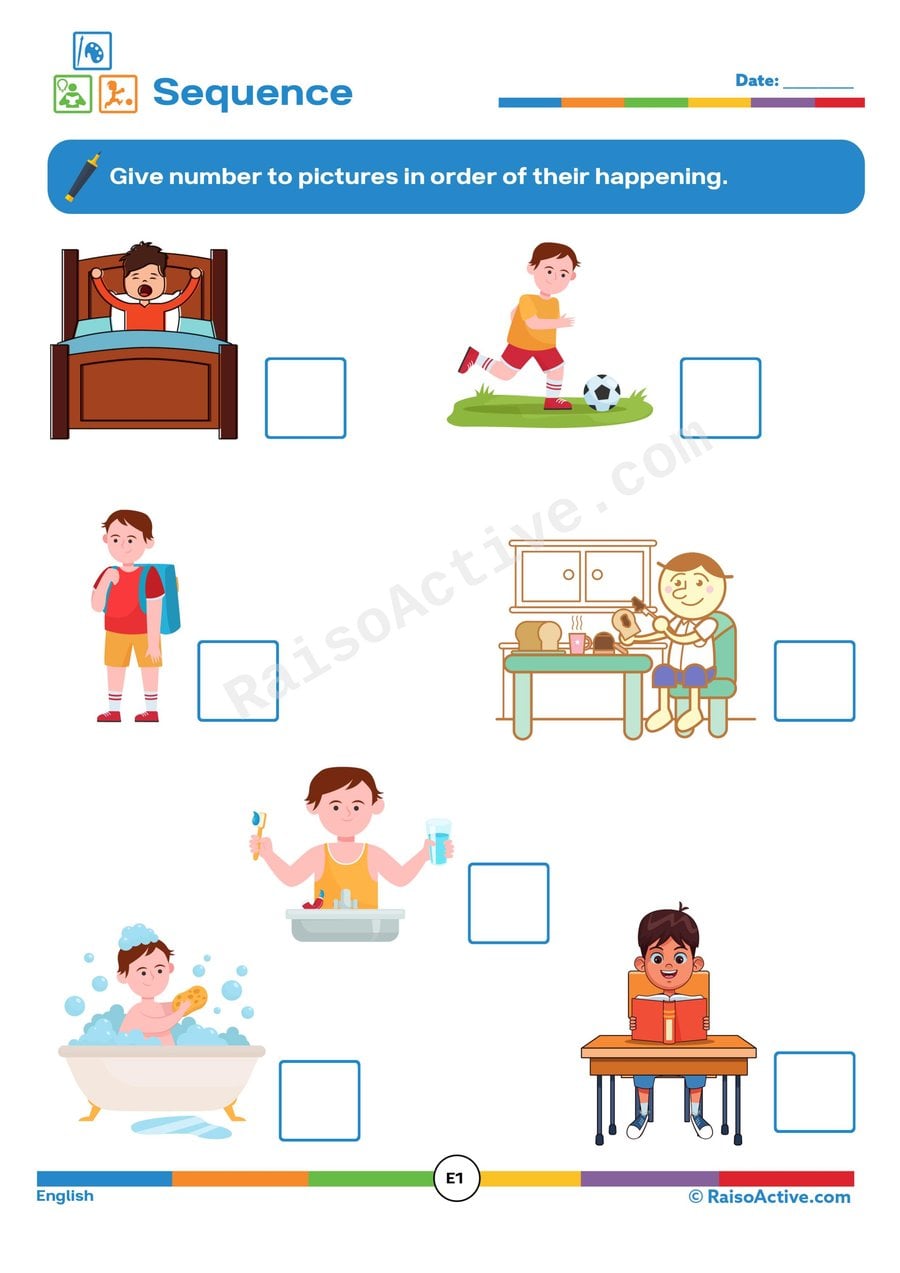
Daily Routine Sequencing Worksheet for Kids
Ages 3-5 · Preschool–Pre-KAges 3-5 · Nursery–ReceptionAges 3-5 · Nursery–LKGAges 3-5
Numbering pictures of daily activities in the order they happen teaches children ages 3-5 to reason about time and cause and effect, an early form of logical sequencing that also supports narrative skills used in storytelling. Recognizing routine events like waking up, eating breakfast, and going to bed helps children connect the worksheet to their own daily experience.

Post Sequence Worksheet: Ordering Steps for Sending a Letter!
Ages 3-5 · Preschool–Pre-KAges 3-5 · Nursery–ReceptionAges 3-5 · Nursery–LKGAges 3-5
Ordering the steps of sending a letter teaches children to recognize that everyday processes happen in a logical sequence with a clear beginning, middle, and end, a skill that underlies both reading comprehension and later writing organization. For ages 3-5, sequencing also strengthens working memory, since children must hold several images in mind at once while deciding which comes first.
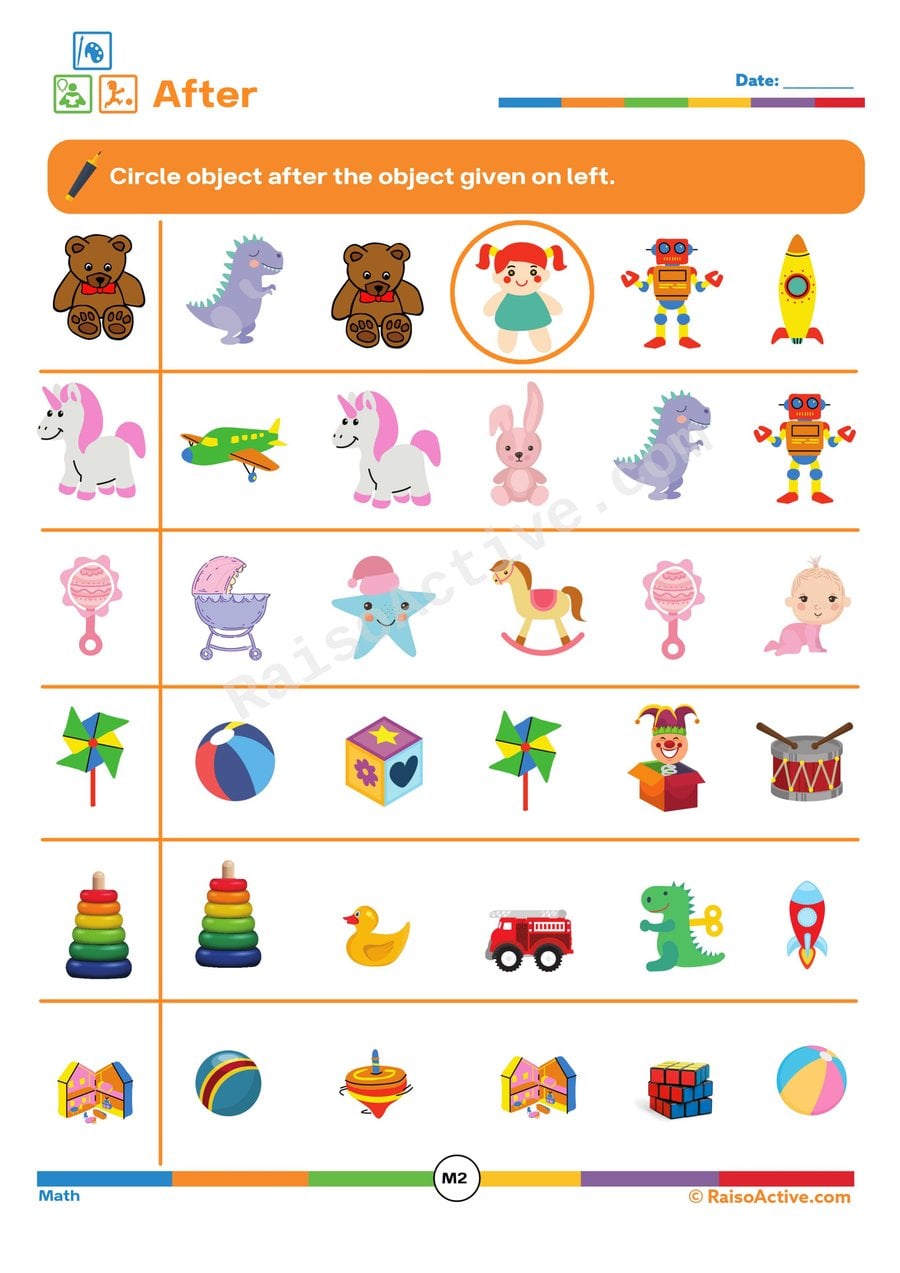
Object Sequencing Worksheet: What Comes After?
Ages 3-5 · Preschool–Pre-KAges 3-5 · Nursery–ReceptionAges 3-5 · Nursery–LKGAges 3-5
Preschoolers ages 3-5 build sequencing and pattern-recognition skills by identifying what object logically comes next after a given item. Predicting what comes next requires observing a pattern or relationship and applying that logic forward, an early form of the reasoning used in later math and science. Circling the correct answer among several options also sharpens careful visual comparison and decision-making.

Before and After Worksheet for Kids: Sequencing Activities
Ages 3-5 · Preschool–Pre-KAges 3-5 · Nursery–ReceptionAges 3-5 · Nursery–LKGAges 3-5
This worksheet helps children ages 3-5 practice sequencing by identifying which picture logically comes before and which comes after a given event. Understanding cause-and-effect order is an early comprehension skill that supports retelling stories and understanding daily routines. Combining a tick-the-answer section with a cut-and-paste section gives repeated practice with the same concept in two different formats.

Sequence the Pictures: Ordering Activities Worksheet for Kids
Ages 3-5 · Preschool–Pre-KAges 3-5 · Nursery–ReceptionAges 3-5 · Nursery–LKGAges 3-5
This worksheet builds logical sequencing skills for 3-5 year olds by having them study a set of three pictures showing an event unfolding and decide which order makes sense — planting a seed before it grows, for example, rather than after. Writing the numbers 1, 2, and 3 under each picture forces your child to commit to a specific reasoning about cause and effect, which is a meaningfully different task than simply describing what's happening in each picture.
Guides for this topic

Age-Appropriate Problem-Solving Activities: Building Critical Thinkers from the Ground Up
Discover fun, age-appropriate problem-solving activities for children ages 1-8. Build critical thinking, logic, and reasoning skills through play-based learning.
Critical Thinking Activities That Actually Work for Young Children: Building Tomorrow's Thinkers Today
Discover proven critical thinking activities for young children. Age-wise logic games, questioning techniques, and hands-on ideas to build thinking skills at home.

Preparing Your Child for a Rapidly Changing World: Essential Skills for Future Success
Discover the essential 21st century skills your child needs for future success. Practical tips on creativity, critical thinking, digital literacy & emotional intelligence for ages 1-8.
Reviews
Every worksheet for ages 3–5, no watermark
Members download the full library of 1,000+ worksheets and every activity pack without watermarks or daily limits. One year costs ₹999 in India or $20 elsewhere.
See membership plansOr download any worksheet free with a watermark (5 a day).