Big and Small Sorting Worksheet for Preschoolers
This worksheet helps children ages 3-5 build early comparative reasoning by identifying and sorting objects as big or small, then physically arranging cut-out pictures to show that understanding. Comparing size is one of the first ways young children learn to describe and organize the world around them, laying groundwork for later measurement and comparison skills in math.

Part of the pack
Month 10: Learning & Development | Ages Up to 4
This is page 8 of the pack. Ages 2-4 · PreschoolAges 2-4 · NurseryAges 2-4
Made for your child
Counting to 10, made for your child
A maths pack with your child's name in it: pictures that explain, practice at three levels, puzzles and story sums about them. Print a new set whenever they finish.
Make a maths packFree preview · free for members
Curriculum
- Number Sense > Comparing Numbers
How to use this worksheet
Look at the pictures together and talk about which ones are big and which are small before your child starts cutting. Have your child cut out the pictures and paste them in the correct order or grouping based on their size, checking each placement together as they go. Finish by having your child color the letter 'S' for the small objects and the letter 'B' for the big objects, saying each word aloud as they color.
Materials needed
- Scissors
- Glue
- Pencils
- Crayons
Extension activities
- 1Find big and small versions of the same object around the house, like a big spoon and a small spoon.
- 2Draw your own pair of big and small pictures of the same object, like a big dog and a small dog.
- 3Play a game of 'I Spy' focusing only on size, taking turns spotting something big or something small.
- 4Sort a pile of toys into 'big' and 'small' groups and count how many are in each pile.

Written by
Hemsweta Jain · Teacher Cheena
MBA and Early Childhood Educator, teaching since 2014 · Founder of RaisoActive, Mumbai
Every RaisoActive worksheet is designed and checked by the founder before publishing.
Published · Last reviewed
More from Month 10: Learning & Development | Ages Up to 4

Sorting Numbers Worksheet: Match the Number to the Picture!
Ages 3-5 · Preschool–Pre-KAges 3-5 · Nursery–ReceptionAges 3-5 · Nursery–LKGAges 3-5
Counting objects in a picture and then pasting that picture next to its matching numeral helps children ages 3-5 connect a written number symbol to an actual quantity, which is the heart of true number sense rather than just numeral naming. Cutting out the picture pieces beforehand also builds scissor control, giving this worksheet a fine motor component alongside the counting practice. The puzzle-piece format adds a satisfying, hands-on element that keeps repetitive counting practice engaging.

Parent's Guide: Fun Activities for Early Learners!
Ages 3-5 · Preschool–Pre-KAges 3-5 · Nursery–ReceptionAges 3-5 · Nursery–LKGAges 3-5
This parent's guide bundles several short, hands-on activities that build counting, shape recognition, fine motor control, and instruction-following in children ages 3-5. Rather than a single worksheet, it offers a menu of quick learning moments parents can use throughout the day, which suits the short attention spans typical of this age group. Rotating through different skill areas in one sitting also helps parents see which concepts their child grasps easily and which need more practice.

Hidden Numbers Worksheet: Find and Complete the Table!
Ages 3-5 · Preschool–Pre-KAges 3-5 · Nursery–ReceptionAges 3-5 · Nursery–LKGAges 3-5
Searching a busy picture for hidden numbers trains visual scanning and sustained attention in children ages 3-5, since numbers may be tucked into small or unexpected spots within the artwork. Completing the table with the missing numbers afterward reinforces the counting sequence and numeral recognition, requiring children to recall which numbers they've already found and figure out which ones are still missing. Together, the search-and-complete format turns basic number practice into an engaging seek-and-find challenge.

Before and After Numbers Worksheet: Counting Bananas!
Ages 4-5 · Pre-KAges 4-5 · ReceptionAges 4-5 · LKGAges 4-5
Figuring out which number comes immediately before and after a given number strengthens children ages 4-5's understanding of number order and the counting sequence, a concept that's more abstract than simply counting objects one by one. Coloring a matching number of bananas for each answer adds a concrete, visual check, letting children confirm their number sense by physically representing the quantity. This worksheet bridges rote number-sequence memorization with real quantity understanding.
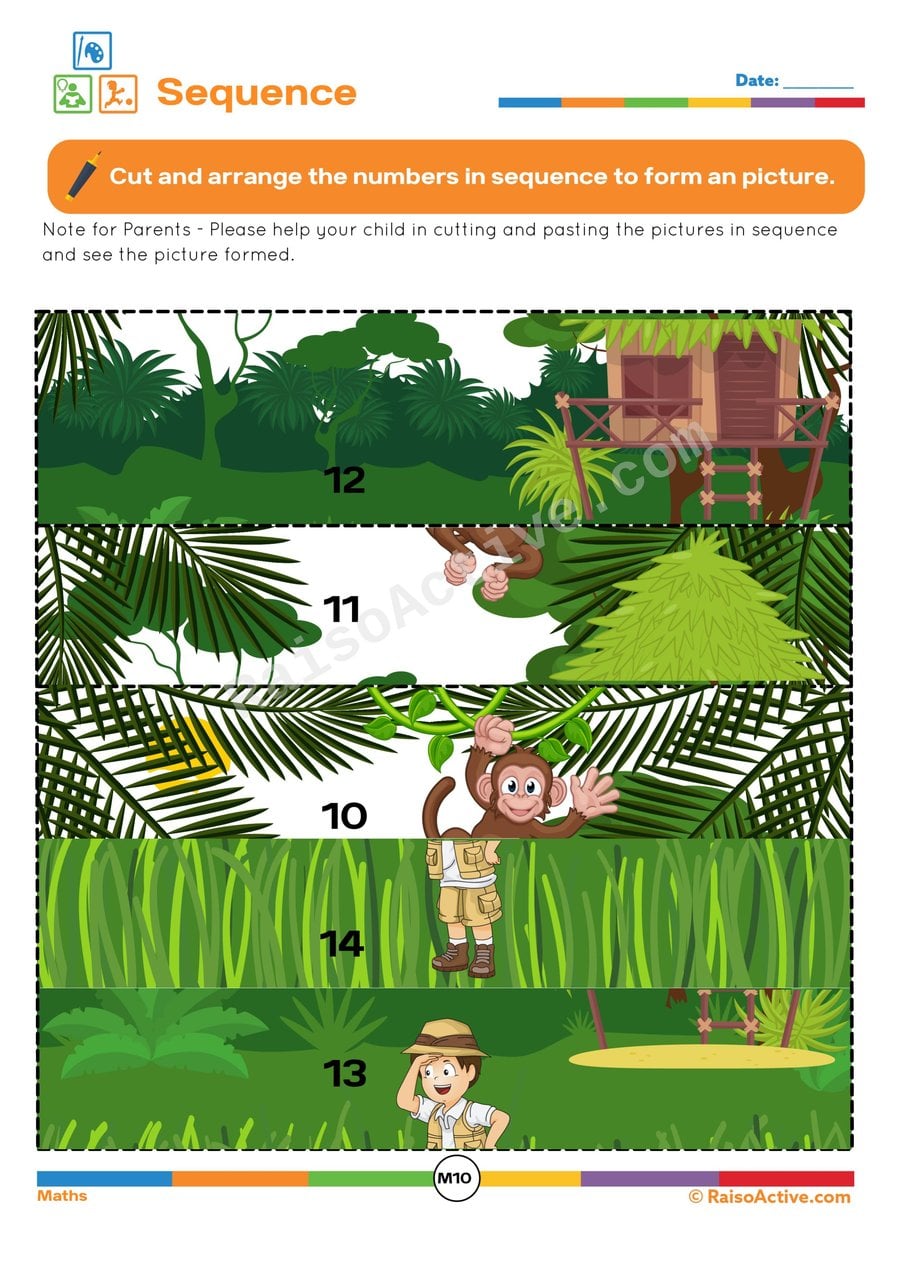
Jungle Adventure Sequence Worksheet for Kids
Ages 3-5 · Preschool–Pre-KAges 3-5 · Nursery–ReceptionAges 3-5 · Nursery–LKGAges 3-5
This cut-and-paste sequencing activity has children ages 3-5 arrange picture strips numbered 10 through 14 in the correct order to reveal a hidden jungle scene, linking number sequencing directly to a satisfying visual reward. Because the reveal only works if every strip is placed correctly, children get immediate, built-in feedback on whether their sequencing is accurate. Practicing numbers in the 10-14 range also pushes counting skills just beyond the more commonly rehearsed 1-10 range.

Scarecrow Cut and Paste Worksheet for Preschoolers
Ages 3-5 · Preschool–Pre-KAges 3-5 · Nursery–ReceptionAges 3-5 · Nursery–LKGAges 3-5
This scarecrow-building activity gives children ages 3-5 focused practice in cutting and gluing basic shapes — circles, triangles, rectangles — into place to assemble a recognizable figure. Matching each shape to its correct spot on the scarecrow outline also reinforces spatial reasoning, since children must judge size and orientation before pasting. Naming the shapes aloud as they work connects the craft to early geometry vocabulary rather than treating it as pure art time.

Match the Pictures: Letter Matching Worksheet for Preschoolers
Ages 3-5 · Preschool–Pre-KAges 3-5 · Nursery–ReceptionAges 3-5 · Nursery–LKGAges 3-5
Connecting pictures to their matching letters helps children ages 3-5 build the foundation of phonics, learning that a printed letter represents the beginning sound of a spoken word. Circling the animals that specifically start with the letter B adds a second layer of practice, requiring children to apply that letter-sound knowledge rather than just matching shapes. This two-step approach moves children from simple visual matching toward true letter-sound recognition, a critical pre-reading skill.

Speak Sentences: A Fun Sentence Building Worksheet!
Ages 4-6 · Pre-K–KindergartenAges 4-6 · Reception–Year 1Ages 4-6 · LKG–UKGAges 4-6
Reading a single word on each stair step and turning it into a full spoken sentence helps children ages 4-6 practice expanding a vocabulary word into a grammatically complete thought, an important bridge between word recognition and sentence-level language. The staircase, climb-to-the-top format adds a sense of progress and motivation, encouraging children to keep going even when a particular word is tricky to build a sentence around. This oral sentence-building practice also lays groundwork for later independent sentence writing.
Related worksheets

Tall and Short Worksheet: Comparing Sizes for Preschoolers
Ages 3-5 · Preschool–Pre-KAges 3-5 · Nursery–ReceptionAges 3-5 · Nursery–LKGAges 3-5
Comparing objects and circling the tallest and shortest one in each row teaches children ages 3-5 comparative size vocabulary, an early math skill that goes beyond simply describing single objects as big or small. This worksheet requires children to look across an entire row and rank items relative to one another, which builds visual comparison skills that later support measurement concepts like longer, shorter, and equal. Using varied pictures for each comparison also keeps children engaged while practicing the same underlying skill repeatedly.

Big and Small Objects: Coloring Worksheet for Preschoolers
Ages 3-5 · Preschool–Pre-KAges 3-5 · Nursery–ReceptionAges 3-5 · Nursery–LKGAges 3-5
This coloring worksheet helps children ages 3-5 practice comparative size reasoning by identifying and coloring the larger object within each paired set of pictures. Making a size judgment before coloring means the coloring itself becomes a way to record and confirm the child's reasoning, rather than being purely decorative. Repeated practice comparing 'big' and 'small' objects supports later measurement and comparison skills in early math.
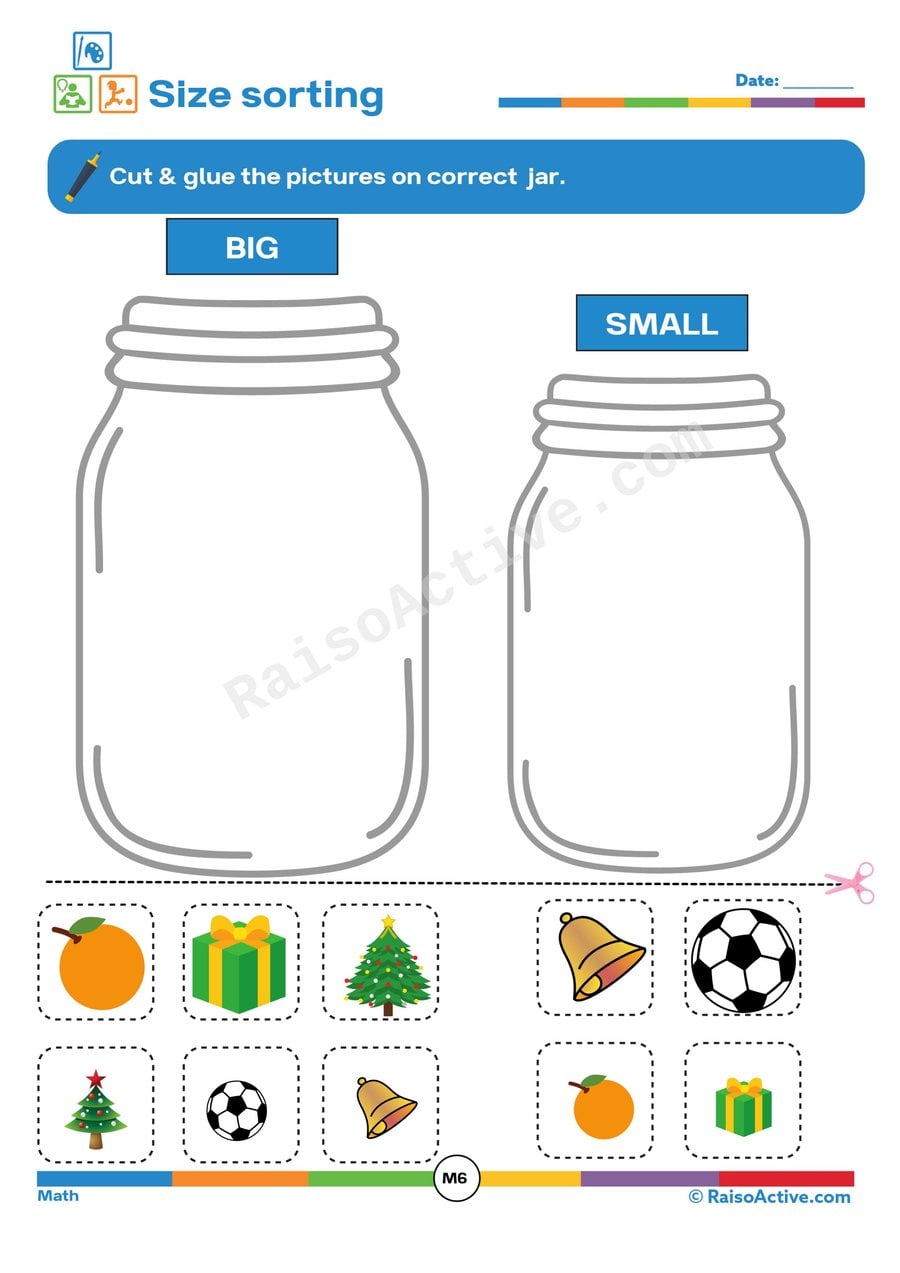
Size Sorting Worksheet: Big vs. Small!
Ages 3-5 · Preschool–Pre-KAges 3-5 · Nursery–ReceptionAges 3-5 · Nursery–LKGAges 3-5
Deciding whether a cut-out picture is big or small and gluing it into the correct jar builds comparative reasoning for children ages 3-5, an early step toward understanding relative size before moving into formal measurement.

Big or Small? Size Sorting Worksheet for Preschoolers
Ages 3-5 · Preschool–Pre-KAges 3-5 · Nursery–ReceptionAges 3-5 · Nursery–LKGAges 3-5
Sorting pictures into 'big' and 'small' categories teaches children ages 3-5 an early comparative concept, requiring them to judge relative size rather than an object's absolute measurement. Cutting and gluing each picture into its correct column also reinforces this classification decision physically, making an abstract comparison concrete and visible.
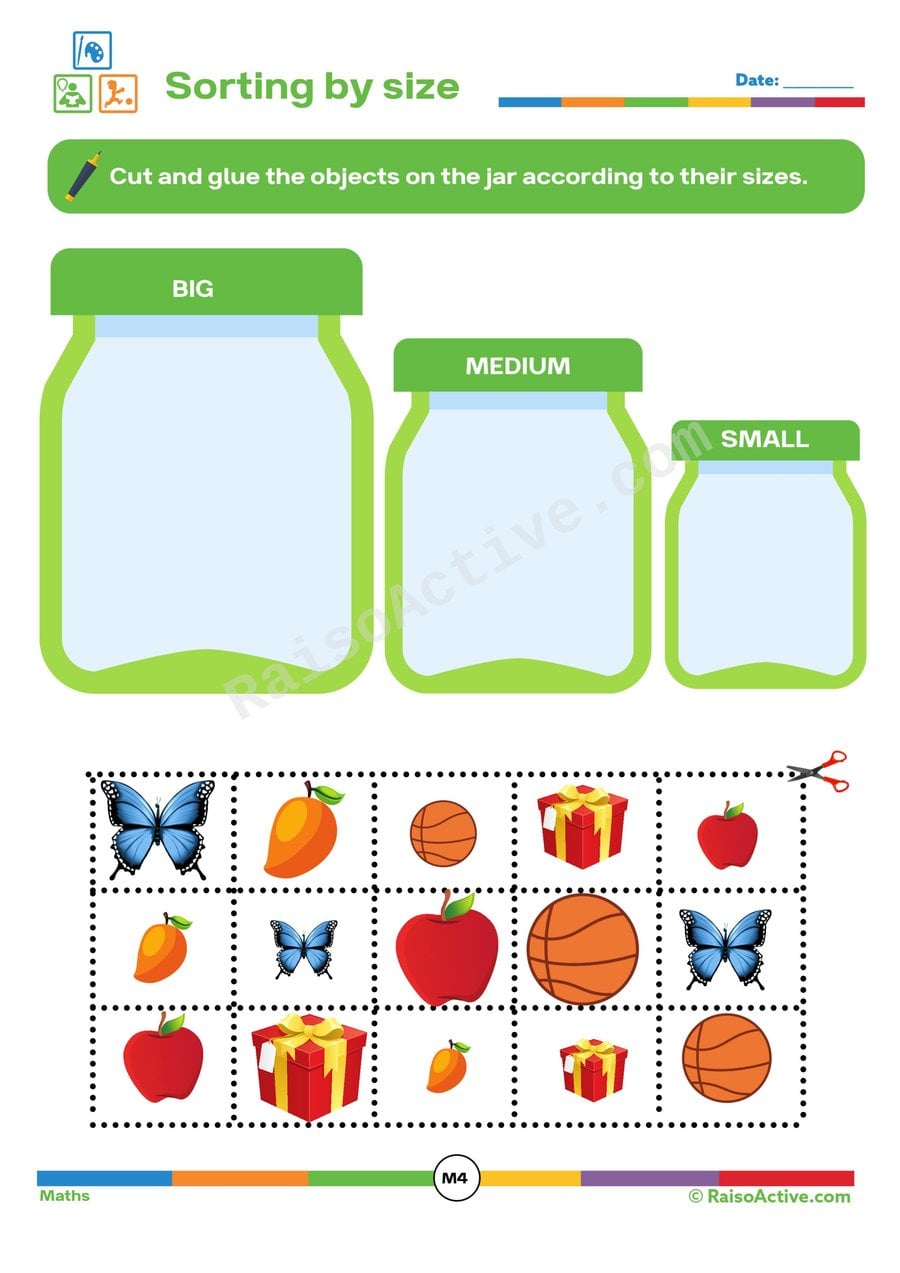
Sorting by Size: Cut and Paste Worksheet
Ages 3-5 · Preschool–Pre-KAges 3-5 · Nursery–ReceptionAges 3-5 · Nursery–LKGAges 3-5
This cut-and-paste worksheet asks 3-5 year olds to compare objects by size — big, medium, and small — and sort them into the correct jar, which is a genuinely tricky comparison since 'medium' only makes sense relative to the other two sizes rather than as an absolute category. Working through this sorting builds early comparative reasoning alongside the fine motor practice of cutting and gluing small pieces accurately.

Long, Tall, and Short: Comparing Objects Worksheet for Kids
Ages 3-5 · Preschool–Pre-KAges 3-5 · Nursery–ReceptionAges 3-5 · Nursery–LKGAges 3-5
Children ages 3-5 build comparative reasoning by identifying which of two or three objects is long, tall, or short. Understanding relative size — that an object is only 'tall' compared to something else — is an early measurement skill that lays the groundwork for later concepts like more/less and eventually numeric comparison.

Big and Small Fish Counting Worksheet for Preschoolers
Ages 3-5 · Preschool–Pre-KAges 3-5 · Nursery–ReceptionAges 3-5 · Nursery–LKGAges 3-5
This counting worksheet gives children ages 3-5 practice with one-to-one correspondence — touching and counting each fish exactly once — while also comparing two groups by size. Splitting the fish into 'big' and 'small' groups before counting adds a light classification step that sharpens observation skills alongside basic numeracy. Recording each total as a written numeral also connects counting aloud to number formation.

Coding Worksheet for Kids: Arrow Codes and Robot Grid
Ages 4-7 · Pre-K–Grade 1Ages 4-7 · Reception–Year 2Ages 4-7 · LKG–Class 1Ages 4-7
Children read arrow codes to move a robot across a grid, write their own arrow code to take the bee to the flower, and spot the one wrong arrow in a code. These are first steps in coding, sequencing and debugging.
Guides for this topic

Age-Appropriate Problem-Solving Activities: Building Critical Thinkers from the Ground Up
Discover fun, age-appropriate problem-solving activities for children ages 1-8. Build critical thinking, logic, and reasoning skills through play-based learning.
Critical Thinking Activities That Actually Work for Young Children: Building Tomorrow's Thinkers Today
Discover proven critical thinking activities for young children. Age-wise logic games, questioning techniques, and hands-on ideas to build thinking skills at home.

Preparing Your Child for a Rapidly Changing World: Essential Skills for Future Success
Discover the essential 21st century skills your child needs for future success. Practical tips on creativity, critical thinking, digital literacy & emotional intelligence for ages 1-8.
Reviews
Every worksheet for ages 3–5, no watermark
Members download the full library of 1,000+ worksheets and every activity pack without watermarks or daily limits. One year costs ₹999 in India or $20 elsewhere.
See membership plansOr download any worksheet free with a watermark (5 a day).