Wild Animals Sudoku Worksheet for Kids
Solving a picture sudoku with wild animals introduces children ages 4-6 to early logical reasoning, since each animal can only appear once in every row, column, and small grid, requiring careful process of elimination. This puzzle format builds problem-solving stamina and visual discrimination in a format that feels like play rather than a typical worksheet.
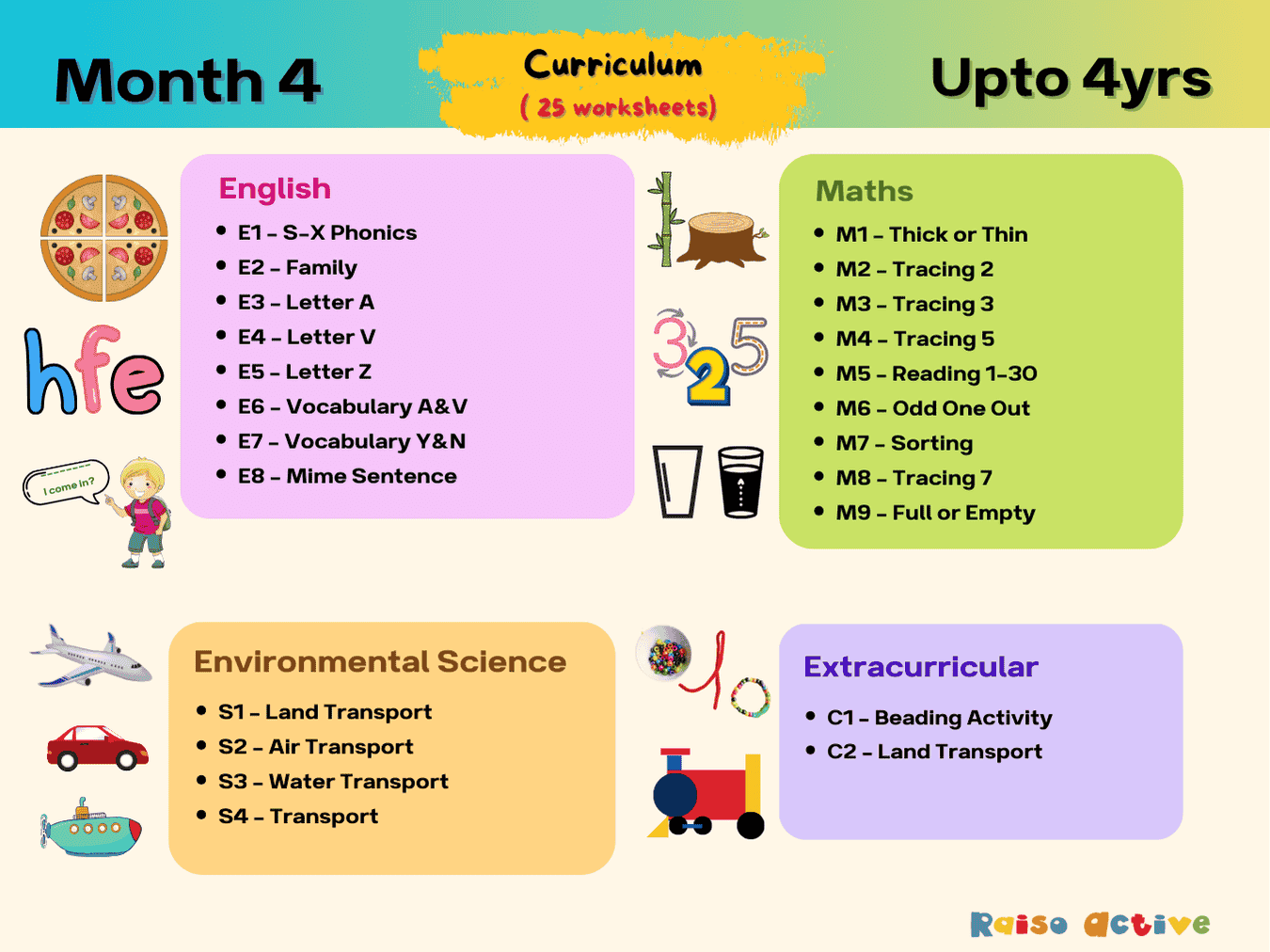
Part of the pack
Month 4: Learning & Development | Ages Up to 4
This is page 29 of the pack. Ages 2-4 · PreschoolAges 2-4 · NurseryAges 2-4
Curriculum
- Cognitive - Problem Solving > Sudoku Puzzles
How to use this worksheet
Look at the grid together and point out which animals are already placed in each row and column. Ask your child to figure out which animal is missing from an empty square by checking what's already used in its row, column, and small box. Have them draw or write the correct animal in that square, then repeat the process for each remaining empty space.
Materials needed
- Pencil
- Eraser
Extension activities
- 1Create your own simple four-by-four picture sudoku using stickers or drawn animals.
- 2Play with physical animal cards, physically covering used spots to visualize the puzzle rules.
- 3Talk about the habitat of each wild animal featured in the sudoku.
- 4Try a slightly larger sudoku grid once your child masters this size.
- 5Time how long it takes to solve the puzzle and try to beat your own record together.

Written by
Hemsweta Jain · Teacher Cheena
MBA and Early Childhood Educator, teaching since 2014 · Founder of RaisoActive, Mumbai
Every RaisoActive worksheet is designed and checked by the founder before publishing.
Published · Last reviewed
More from Month 4: Learning & Development | Ages Up to 4

Farm Animal Fun: Cut and Paste Worksheet for Preschoolers
Ages 3-5 · Preschool–Pre-KAges 3-5 · Nursery–ReceptionAges 3-5 · Nursery–LKGAges 3-5
Coloring, cutting, and pasting farm animals onto a scene teaches children ages 3-5 farm animal vocabulary while giving substantial fine motor practice through careful cutting along lines. Building the completed farm scene also lets children practice spatial placement, deciding where each animal fits within the picture.

Number Writing Worksheet: Trace, Write, Count, and Paste Numbers!
Ages 3-5 · Preschool–Pre-KAges 3-5 · Nursery–ReceptionAges 3-5 · Nursery–LKGAges 3-5
This multi-step worksheet strengthens number formation, counting, and one-to-one correspondence all in one activity, as children ages 3-5 trace and write numerals, then count a group of objects and paste the matching quantity in a box. Combining writing with hands-on counting and cutting helps children connect the written symbol to the actual amount it represents, a key milestone in early numeracy.
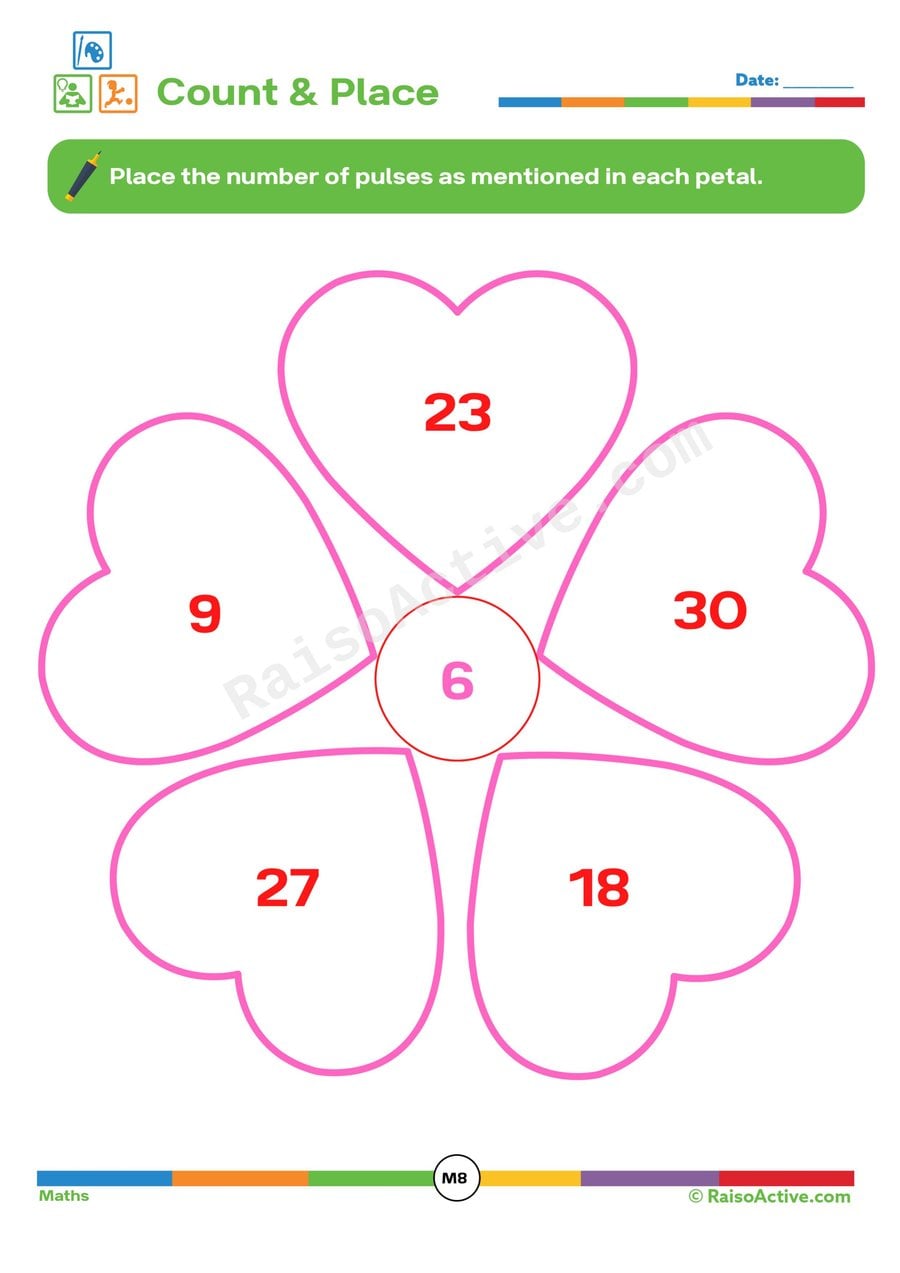
Count and Place: Heart Petals Worksheet
Ages 4-5 · Pre-KAges 4-5 · ReceptionAges 4-5 · LKGAges 4-5
Counting the marks in each heart-shaped petal and writing the matching number builds one-to-one correspondence for children ages 4-5, ensuring they touch or point to each mark exactly once as they count. This petal-by-petal counting also strengthens number formation practice as children write each total by hand.
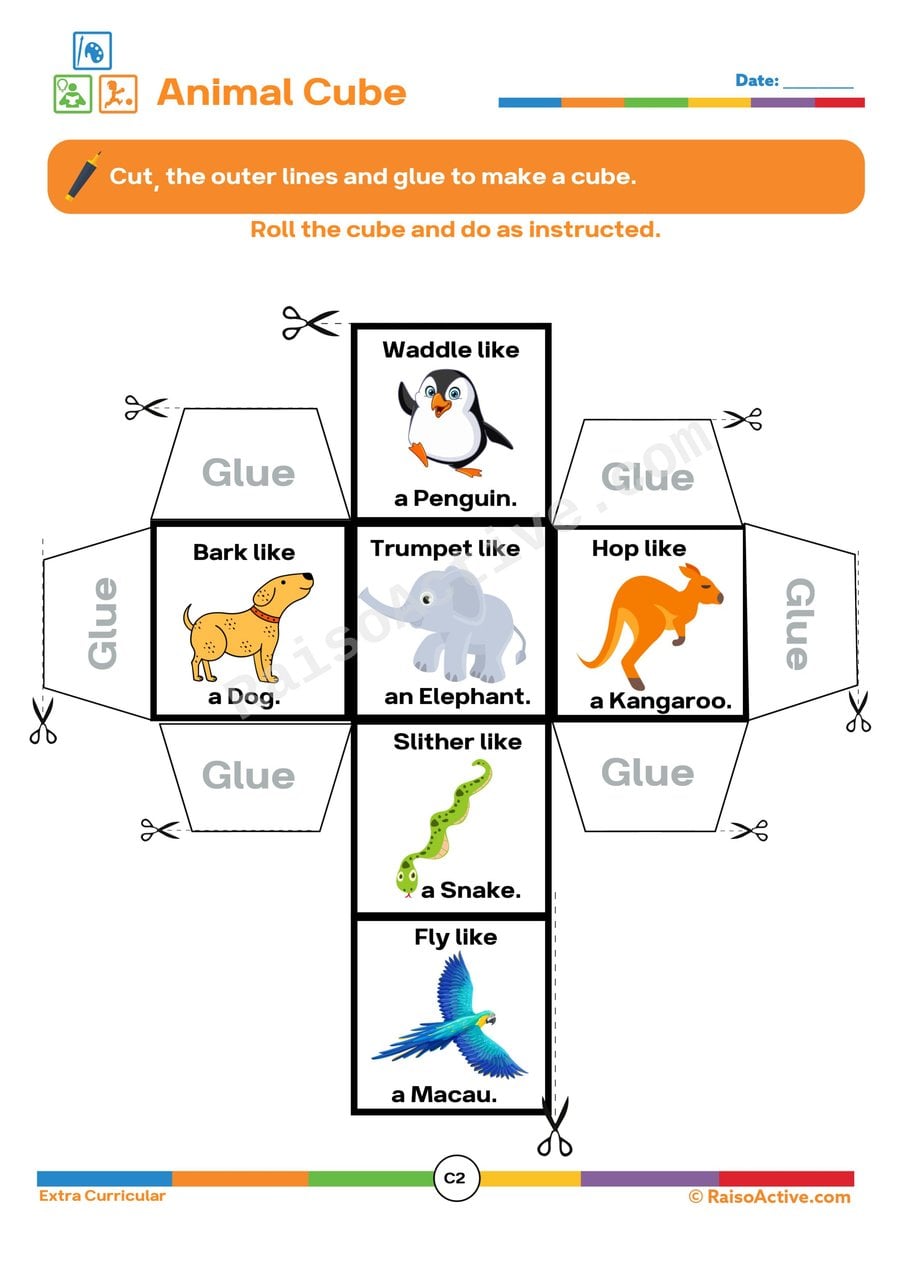
Animal Cube: Cut, Glue, and Learn!
Ages 3-5 · Preschool–Pre-KAges 3-5 · Nursery–ReceptionAges 3-5 · Nursery–LKGAges 3-5
Children ages 3-5 practice following a multi-step assembly sequence as they cut out a net, fold it, and glue the tabs to build a 3D cube featuring different animals, then use it as a game piece to review animal names and sounds. Assembling a flat shape into a 3D object also introduces early spatial reasoning about how 2D shapes fold into 3D forms.

Trace and Write the Number 0 Worksheet for Preschoolers
Ages 3-5 · Preschool–Pre-KAges 3-5 · Nursery–ReceptionAges 3-5 · Nursery–LKGAges 3-5
This worksheet gives children ages 3-5 focused practice forming the number 0, building the fine motor control and pencil grip needed for handwriting while reinforcing that 0 represents 'none' or an empty group. Tracing the curved stroke repeatedly also helps children internalize the shape through muscle memory, which supports faster, more confident number writing later.

Pattern Power! What Comes Next? Worksheet for Preschoolers
Ages 3-5 · Preschool–Pre-KAges 3-5 · Nursery–ReceptionAges 3-5 · Nursery–LKGAges 3-5
This worksheet builds pattern recognition, an early algebraic thinking skill, as children ages 3-5 study a repeating sequence of shapes, letters, or numbers and figure out what belongs next. Spotting what repeats and predicting what comes after it trains logical reasoning and attention to detail that later transfers directly to math sequences and number patterns.

Animal Food Matching Worksheet for Preschoolers
Ages 3-5 · Preschool–Pre-KAges 3-5 · Nursery–ReceptionAges 3-5 · Nursery–LKGAges 3-5
This worksheet teaches children ages 3-5 which foods different animals eat by matching each animal to its correct food, building early classification skills and expanding their vocabulary around animals and diets. Learning that a rabbit eats carrots while a bird eats worms also introduces the idea that living things have different needs, a first step toward basic life-science thinking.

Domestic Animals Worksheet for Preschoolers: Circle the Animals!
Ages 3-5 · Preschool–Pre-KAges 3-5 · Nursery–ReceptionAges 3-5 · Nursery–LKGAges 3-5
Circling only the domestic animals among a mixed group teaches children ages 3-5 to apply a category rule to unfamiliar examples, an early reasoning skill that goes beyond simply naming animals they recognize. This visual discrimination task also builds vocabulary as children practice identifying each animal before deciding whether it belongs.
Related worksheets
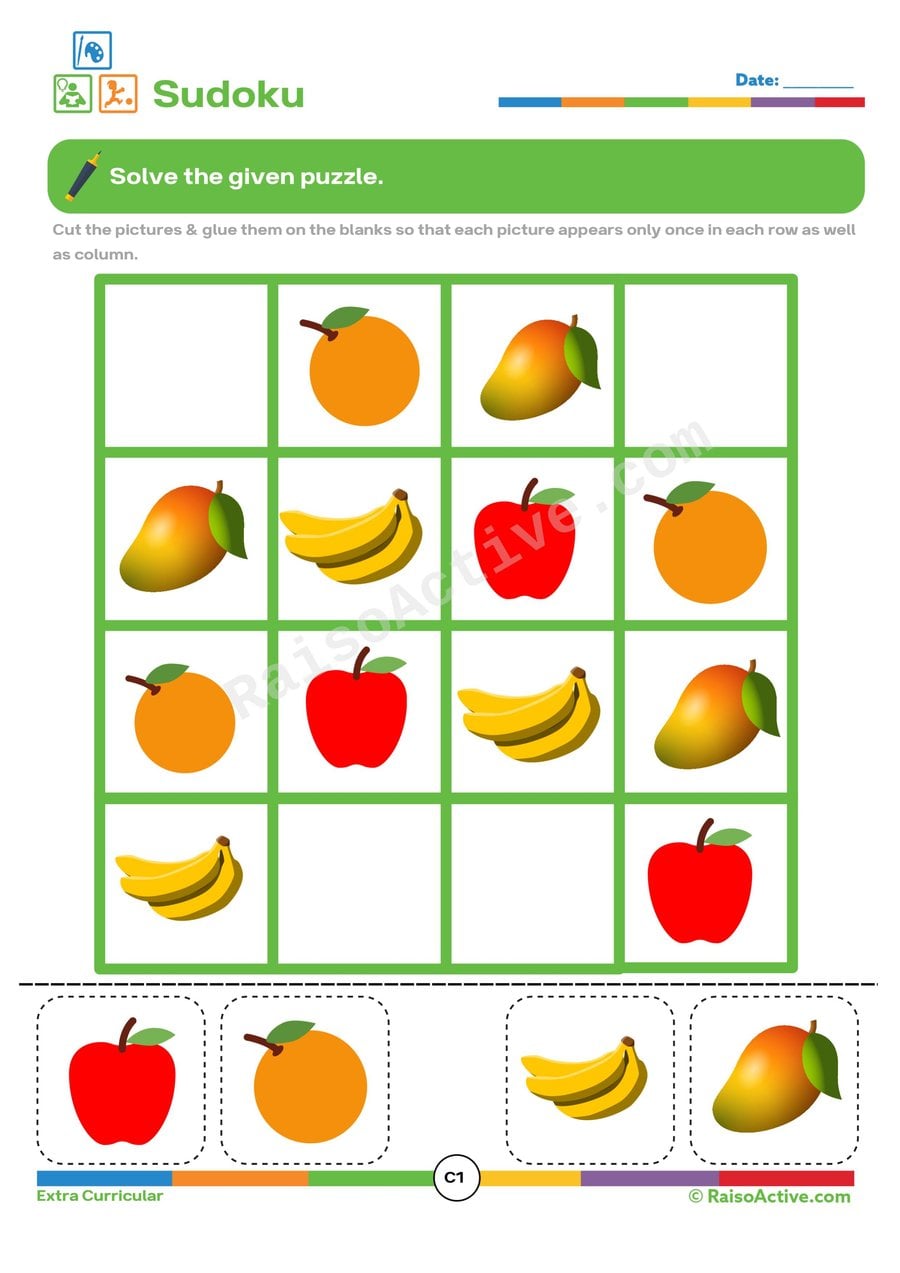
Fruit Sudoku Puzzle Worksheet for Kids
Ages 4-6 · Pre-K–KindergartenAges 4-6 · Reception–Year 1Ages 4-6 · LKG–UKGAges 4-6
Completing a fruit-themed Sudoku grid builds early logical reasoning for children ages 4-6, requiring them to track which fruits are already placed in a row or column and deduce which one is missing — a foundational problem-solving skill.
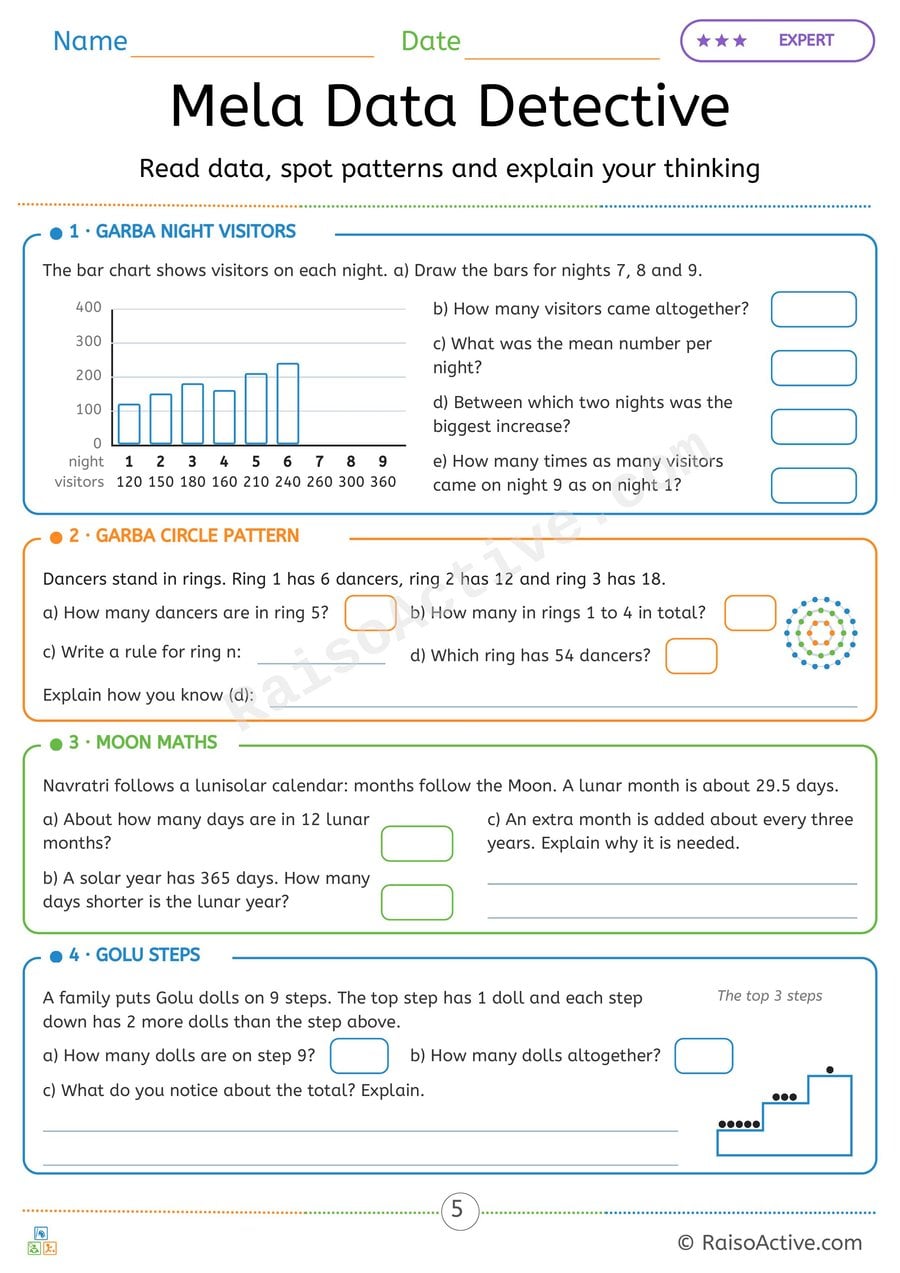
Mela Data Detective: Navratri Bar Chart, Patterns and Moon Maths
Ages 7-11 · Grade 2–Grade 3Ages 7-11 · Year 3–Year 4Ages 7-11 · Class 2–Class 3Ages 7-11
Children complete a bar chart of nine nights of visitors, find the total, the mean and the biggest increase, find and explain the rule for a growing pattern of dancers, compare a lunar year with a solar year, and add the dolls on nine Golu steps to discover a square number.

Clothing Pattern Matching Worksheet for Preschoolers
Ages 3-5 · Preschool–Pre-KAges 3-5 · Nursery–ReceptionAges 3-5 · Nursery–LKGAges 3-5
By comparing clothing items and connecting each one to its pattern match, children ages 3-5 build visual discrimination skills, learning to notice fine differences in stripes, dots, or repeated shapes. This close-looking practice supports the same attention-to-detail children will later need to tell similar-looking letters and numbers apart.
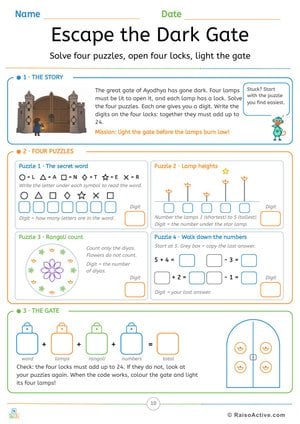
Escape the Dark Gate: Diwali Puzzle Challenge for Big Explorers
Ages 7-10 · Grade 2–Grade 3Ages 7-10 · Year 3–Year 4Ages 7-10 · Class 2–Class 3Ages 7-10
Children solve four puzzles: a secret word, lamp heights, a rangoli count and a number walk. Each gives one digit, and the four digits must add to 24 to open the gate of Ayodhya.

Inside My Brain: Guard Dog and Wise Owl Hand-Brain Activity
Ages 7-10 · Grade 2–Grade 3Ages 7-10 · Year 3–Year 4Ages 7-10 · Class 2–Class 3Ages 7-10
Children meet two story helpers: the guard dog, who keeps us safe fast, and the wise owl, who thinks and chooses. They make a hand model, sort eight thoughts and choose calm tools that help the owl come back.

Elephant Shapes: Fun Sorting Worksheet for Preschoolers!
Ages 3-5 · Preschool–Pre-KAges 3-5 · Nursery–ReceptionAges 3-5 · Nursery–LKGAges 3-5
This playful sorting worksheet has children ages 3-5 use an elephant's 'trunk' (their own hand reaching through a cut circle) to pick and sort shapes, building both shape recognition and simple classification skills. Physically selecting and grouping shapes by type, rather than just naming them on sight, helps solidify the concept that shapes can share a category even when their size or color differs.
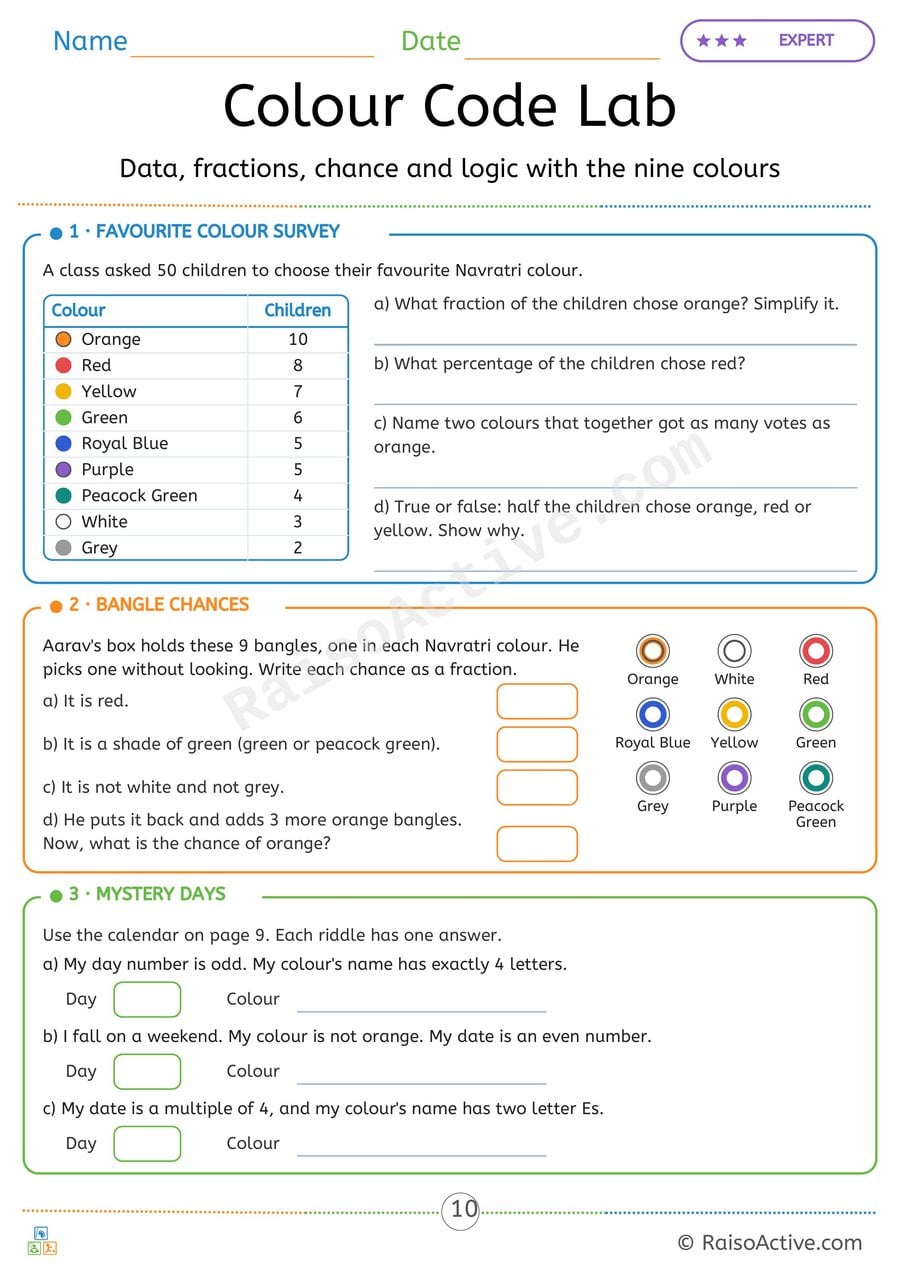
Colour Code Lab: Navratri Fractions, Percentages and Probability
Ages 7-11 · Grade 2–Grade 3Ages 7-11 · Year 3–Year 4Ages 7-11 · Class 2–Class 3Ages 7-11
Children read a survey of 50 children's favourite Navratri colours and write fractions and percentages, write the chance of picking each kind of bangle as a fraction, and solve three riddles using the colour calendar on page 9.

Easter Egg Color by Hints Worksheet for Preschoolers
Ages 3-5 · Preschool–Pre-KAges 3-5 · Nursery–ReceptionAges 3-5 · Nursery–LKGAges 3-5
This worksheet has children ages 3-5 listen to or read simple written hints describing shapes and colors, then apply that information correctly while coloring each Easter egg, building early reading comprehension and the ability to follow multi-step verbal instructions. Because the hints must be followed precisely rather than colored freely, children also practice patience and careful attention to detail.
Guides for this topic

Age-Appropriate Problem-Solving Activities: Building Critical Thinkers from the Ground Up
Discover fun, age-appropriate problem-solving activities for children ages 1-8. Build critical thinking, logic, and reasoning skills through play-based learning.

Fostering Creativity in Structured Learning: The Perfect Balance for Young Minds
Learn how to blend creativity with structured learning for children ages 1-8. Practical strategies, activities, and printable worksheets for parents and teachers.
Critical Thinking Activities That Actually Work for Young Children: Building Tomorrow's Thinkers Today
Discover proven critical thinking activities for young children. Age-wise logic games, questioning techniques, and hands-on ideas to build thinking skills at home.
Reviews
Every worksheet for ages 4–6, no watermark
Members download the full library of 1,000+ worksheets and every activity pack without watermarks or daily limits. One year costs ₹999 in India or $20 elsewhere.
See membership plansOr download any worksheet free with a watermark (5 a day).