Before Number Worksheet: Practice Number Sequencing!
Practicing 'what comes before' a given number strengthens number sequencing for children ages 4-6, requiring them to think backward through the counting sequence rather than only forward, which is how most early counting practice happens. This backward thinking builds flexibility with numbers that supports later subtraction and number-line reasoning.
Part of the pack
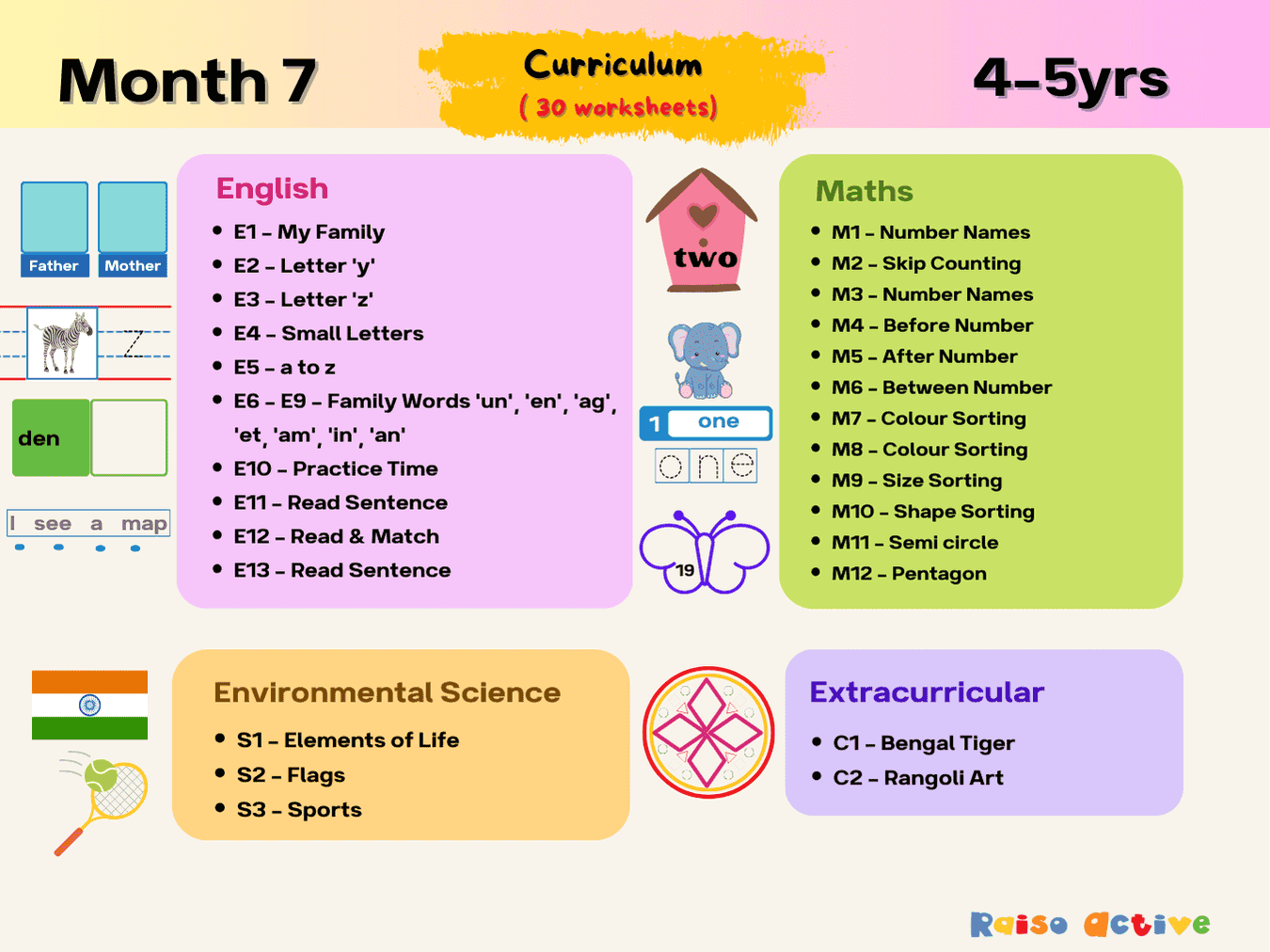
Month 7: Preschool Skills Through Play | Ages 4-5
This is page 20 of the pack. Ages 4-5 · Pre-KAges 4-5 · ReceptionAges 4-5 · LKGAges 4-5
Made for your child
Counting to 10, made for your child
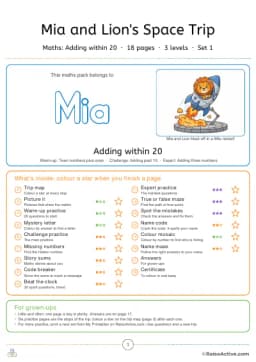
A maths pack with your child's name in it: pictures that explain, practice at three levels, puzzles and story sums about them. Print a new set whenever they finish.
Make a maths packFree preview · free for members
Curriculum
- Number Sense > Number Sequencing
How to use this worksheet
Look at the first number shown in the book picture together and read it aloud. Ask your child what number comes right before it when counting, encouraging them to count up slowly from one if needed to check their answer. Have them write that 'before' number in the empty space provided. Repeat this look-think-write process for each remaining number on the page, checking the finished answers together at the end.
Materials needed
- Pencil
- Eraser
Extension activities
- 1Create your own simple number sequence and ask your child to identify the number that comes before a chosen one.
- 2Use building blocks or counters lined up in order and ask your child to remove the one that comes before a given number's block.
- 3Practice counting backward together from ten to one as a related skill-building activity.
- 4Play a quick number line game, hopping backward one space to find the number that comes before.
- 5Use a printed number line at home and cover one number at a time for your child to identify what comes before it.

Written by
Hemsweta Jain · Teacher Cheena
MBA and Early Childhood Educator, teaching since 2014 · Founder of RaisoActive, Mumbai
Every RaisoActive worksheet is designed and checked by the founder before publishing.
Published · Last reviewed
More from Month 7: Preschool Skills Through Play | Ages 4-5

Color Sorting Fun: Cut and Paste Worksheet for Preschoolers
Ages 3-5 · Preschool–Pre-KAges 3-5 · Nursery–ReceptionAges 3-5 · Nursery–LKGAges 3-5
This cut-and-paste activity builds color recognition alongside fine motor control, as children use scissors to cut out pictures and glue them into matching color categories. For ages 3-5, sorting by a single attribute like color is an early classification skill that lays the groundwork for later math concepts like grouping and comparing.

Skip Counting by 10 Worksheet: Fill in the Blanks!
Ages 4-5 · Pre-KAges 4-5 · ReceptionAges 4-5 · LKGAges 4-5
This worksheet builds skip counting fluency by 10s, a foundational skill that helps children recognize number patterns and prepares them for place value concepts and faster counting strategies later on. For ages 4-5, seeing numbers grouped in tens on signs reinforces both sequencing and the visual structure of our base-ten number system.

Family Words Cut and Paste Worksheet for Early Readers
Ages 4-6 · Pre-K–KindergartenAges 4-6 · Reception–Year 1Ages 4-6 · LKG–UKGAges 4-6
Reading a simple CVC word and matching it to its picture teaches children ages 4-6 to blend individual sounds into a whole word and then connect that word to its meaning, a core decoding skill for early readers. Because CVC words follow a consistent consonant-vowel-consonant pattern, practicing them builds a reliable phonics foundation that transfers to reading many other simple words.
Sports Matching Worksheet for Preschoolers
Ages 3-5 · Preschool–Pre-KAges 3-5 · Nursery–ReceptionAges 3-5 · Nursery–LKGAges 3-5
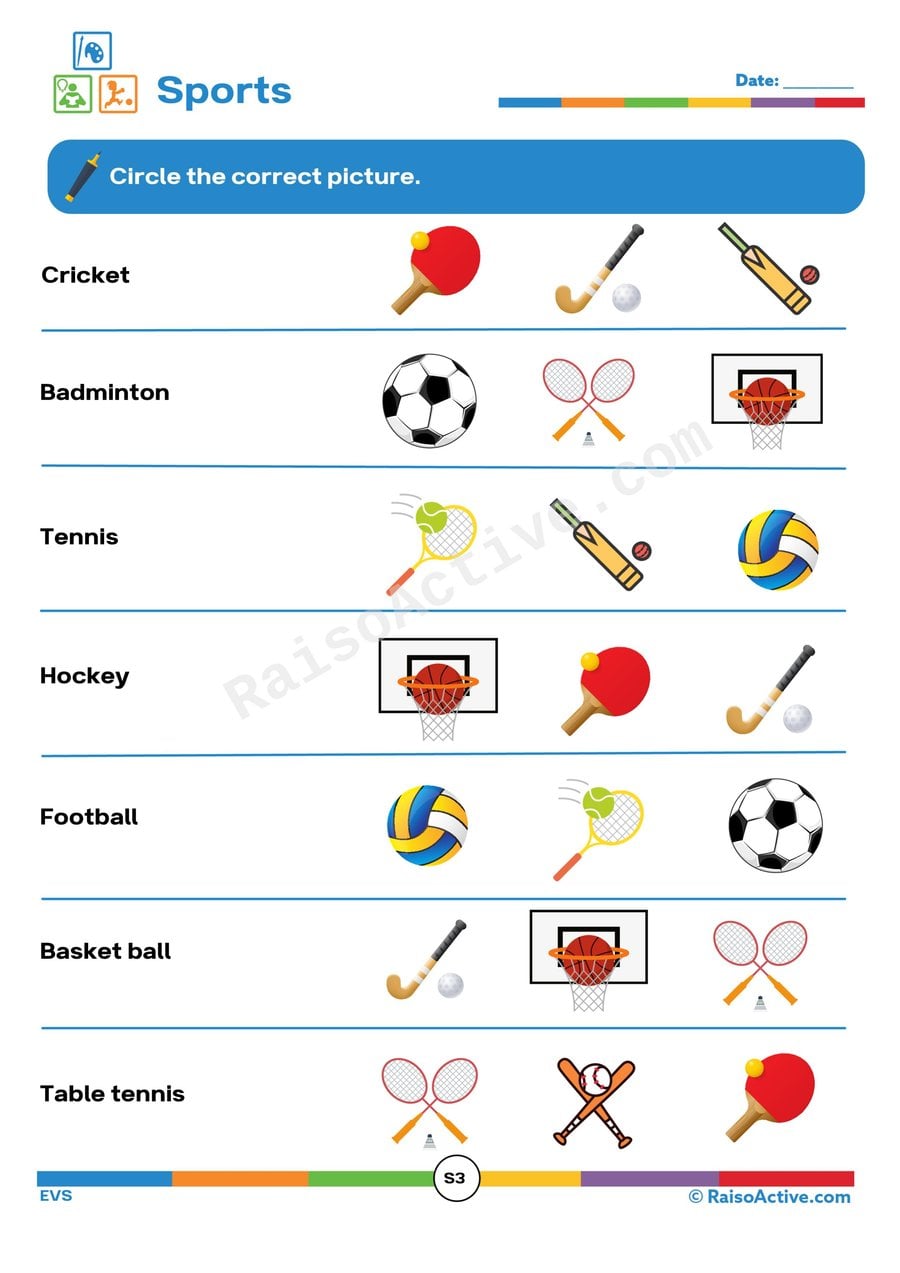
Matching a sport's written name to its picture builds vocabulary and early reading recognition for children ages 3-5, connecting specific words like 'soccer' or 'swimming' to real, familiar activities. Because sports involve distinct equipment and movements, this task also sharpens visual discrimination, since children must notice small differences between similar-looking pictures to find the correct match.

Shape Sorting Fun: Cut and Glue Worksheet for Preschoolers
Ages 3-5 · Preschool–Pre-KAges 3-5 · Nursery–ReceptionAges 3-5 · Nursery–LKGAges 3-5
Sorting cut-out shapes into matching rows builds shape recognition for children ages 3-5, requiring them to visually compare each piece's sides and corners before placing it correctly. This early geometry practice, paired with the fine motor demands of cutting and gluing, strengthens both cognitive classification skills and hand control at the same time.
After Number Worksheet: Butterfly Fun!
Ages 4-6 · Pre-K–KindergartenAges 4-6 · Reception–Year 1Ages 4-6 · LKG–UKGAges 4-6
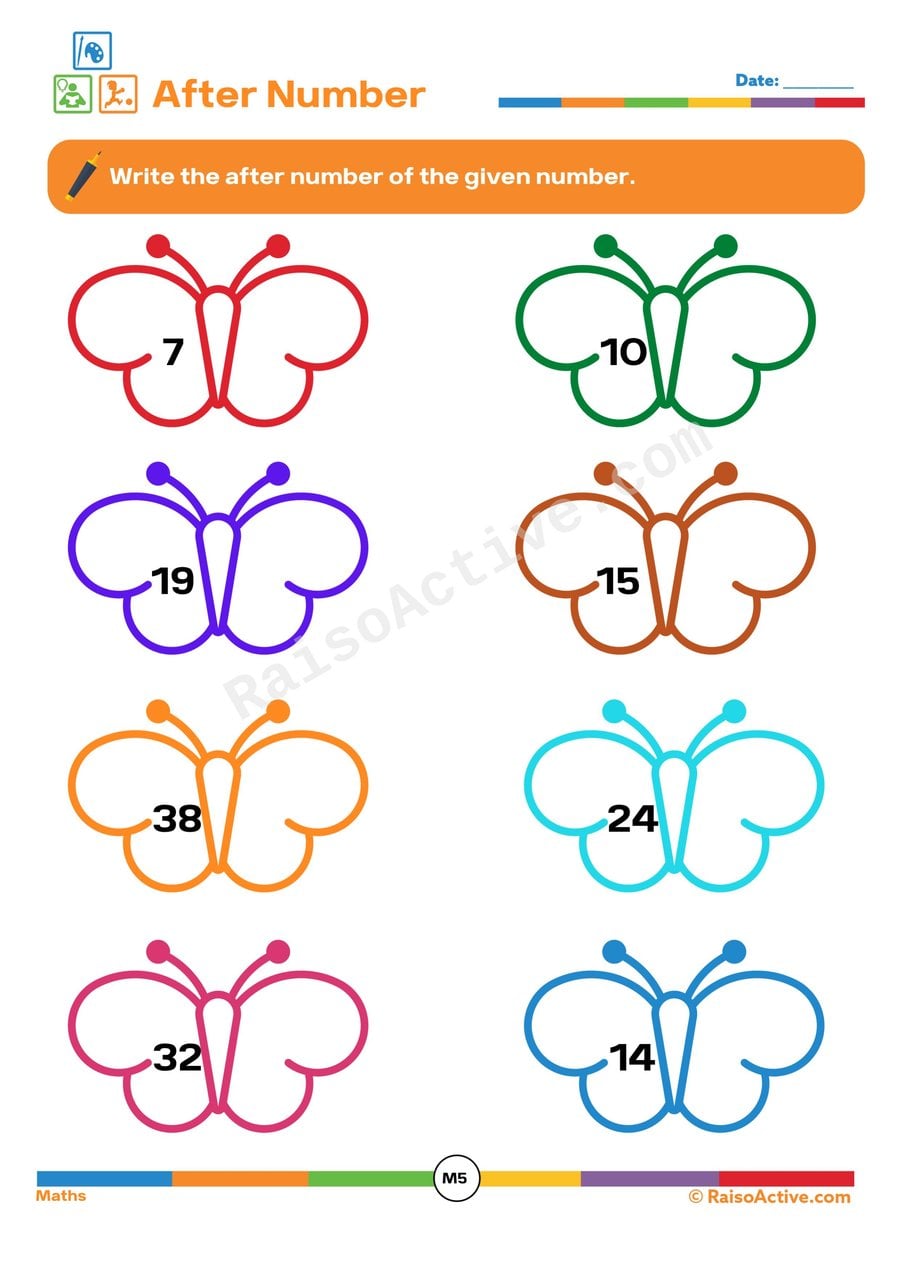
This worksheet targets a specific early-numeracy milestone: understanding that every number has a number that comes immediately after it in sequence. For ages 4-6, practicing 'what comes next' strengthens the mental number line children rely on for later addition, since knowing that 7 comes after 6 is the foundation of counting on.

Alphabet Maze: Help the Alligator Find the Zoo! (a to z Worksheet)
Ages 3-5 · Preschool–Pre-KAges 3-5 · Nursery–ReceptionAges 3-5 · Nursery–LKGAges 3-5
Guiding a character through a maze from A to Z asks children to recall the full alphabet in order while also navigating a physical path, combining letter sequencing with the visual planning and fine motor control needed for any maze activity. For ages three to five, tracing the entire alphabet in one continuous task is a bigger sequencing challenge than shorter letter drills, building real stamina in letter-order recall.

Number Names Worksheet: Count, Write, and Match Numbers!
Ages 4-6 · Pre-K–KindergartenAges 4-6 · Reception–Year 1Ages 4-6 · LKG–UKGAges 4-6
Counting, writing, and matching numbers to their written names helps children ages 4-6 connect three related but distinct number skills — quantity recognition, numeral writing, and word reading — into one integrated understanding. Building fluency across all three forms means a child can recognize '5,' 'five,' and a group of five objects as the same idea no matter how it's presented.
Related worksheets

Sequencing Numbers Train Worksheet for Preschoolers
Ages 4-5 · Pre-KAges 4-5 · ReceptionAges 4-5 · LKGAges 4-5
This train-themed worksheet asks children ages 4-5 to fill in missing numbers within a given sequence, which builds a much deeper number sense than simply counting from one — they must recognize what number comes before or after a given value anywhere in the run. Practicing sequencing this way strengthens working memory and prepares children for later mental math skills like skip counting and addition. The train-car format also keeps the abstract task of ordering numbers visually organized and engaging.

Before and After Numbers Worksheet: Counting Bananas!
Ages 4-5 · Pre-KAges 4-5 · ReceptionAges 4-5 · LKGAges 4-5
Figuring out which number comes immediately before and after a given number strengthens children ages 4-5's understanding of number order and the counting sequence, a concept that's more abstract than simply counting objects one by one. Coloring a matching number of bananas for each answer adds a concrete, visual check, letting children confirm their number sense by physically representing the quantity. This worksheet bridges rote number-sequence memorization with real quantity understanding.

Number Path Adventure: Write Numbers 1-20 Worksheet
Ages 4-6 · Pre-K–KindergartenAges 4-6 · Reception–Year 1Ages 4-6 · LKG–UKGAges 4-6
Children ages 4-6 practice writing numerals in correct sequence as they fill in missing numbers along a path of stepping stones from 1 to 20. This strengthens number-order memory and numeral formation together, both needed before a child can count on reliably or recognize number patterns like the teens. Following a winding path also adds a light visual-tracking challenge that keeps attention on the correct next stone.
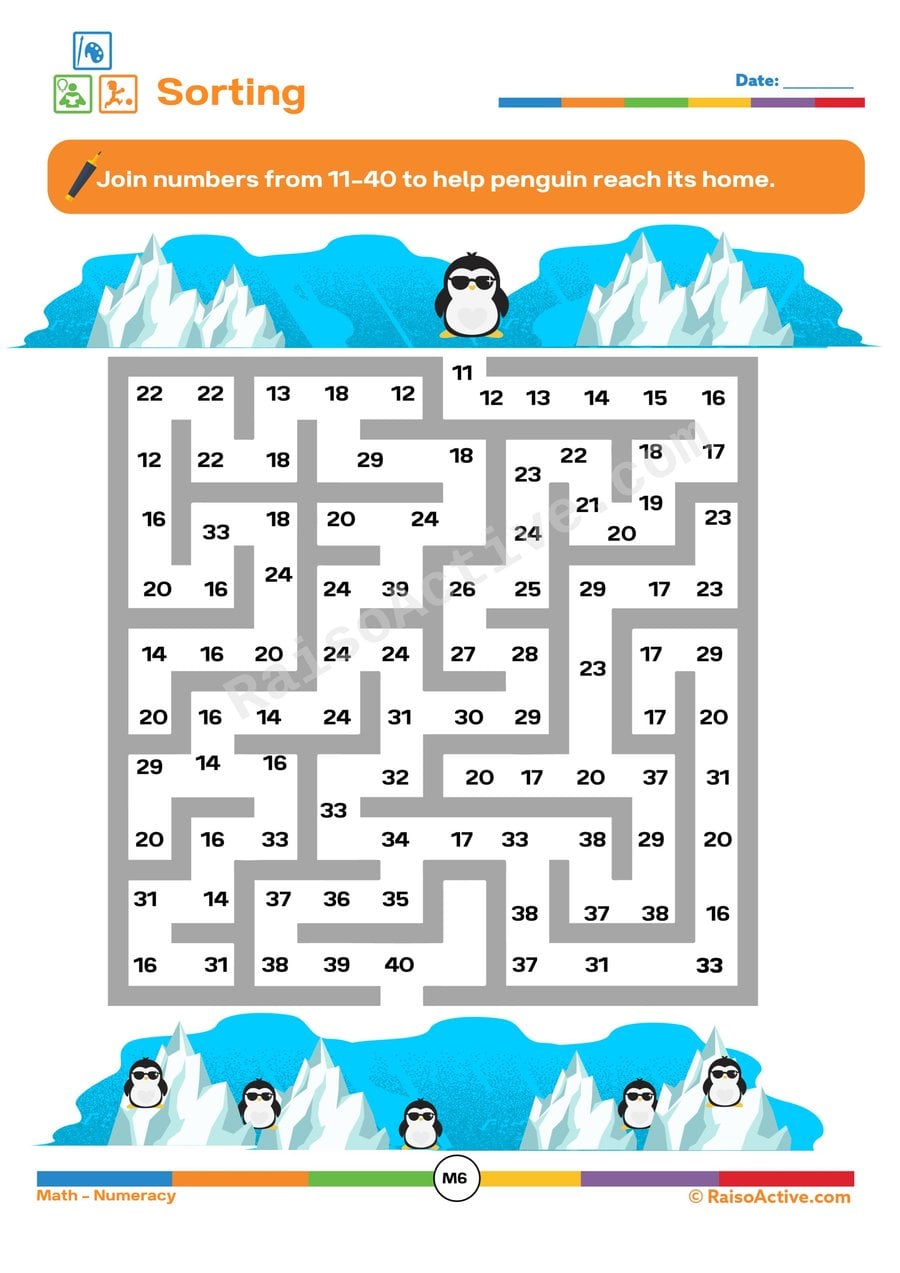
Penguin's Path: A Fun Sorting Worksheet for Kids!
Ages 4-6 · Pre-K–KindergartenAges 4-6 · Reception–Year 1Ages 4-6 · LKG–UKGAges 4-6
This maze worksheet has 4-6 year olds trace a path through numbers 11 to 40, building both number sequencing across a wider range and the fine motor control needed to draw a connected line dot to dot. Because the range spans several decades, your child gets real practice with the trickiest part of early counting — the transitions between decades (19 to 20, 29 to 30) — while the penguin's journey gives the task a clear, motivating goal.

Number Sequencing Worksheet: Practice Counting and Ordering Numbers!
Ages 4-5 · Pre-KAges 4-5 · ReceptionAges 4-5 · LKGAges 4-5
This worksheet gives children ages 4-5 focused practice writing numerals in order by filling in the missing numbers within several different counting sequences. Unlike simple counting aloud, writing each numeral by hand forces children to connect the spoken number word to its correct written symbol, reinforcing both number recognition and early handwriting control.

Descending Order Fruits Worksheet for Preschoolers
Ages 4-5 · Pre-KAges 4-5 · ReceptionAges 4-5 · LKGAges 4-5
Arranging fruits labeled with numbers from largest to smallest builds descending order recognition for children ages 4-5, reinforcing number comparison skills that complement the more commonly practiced ascending order.
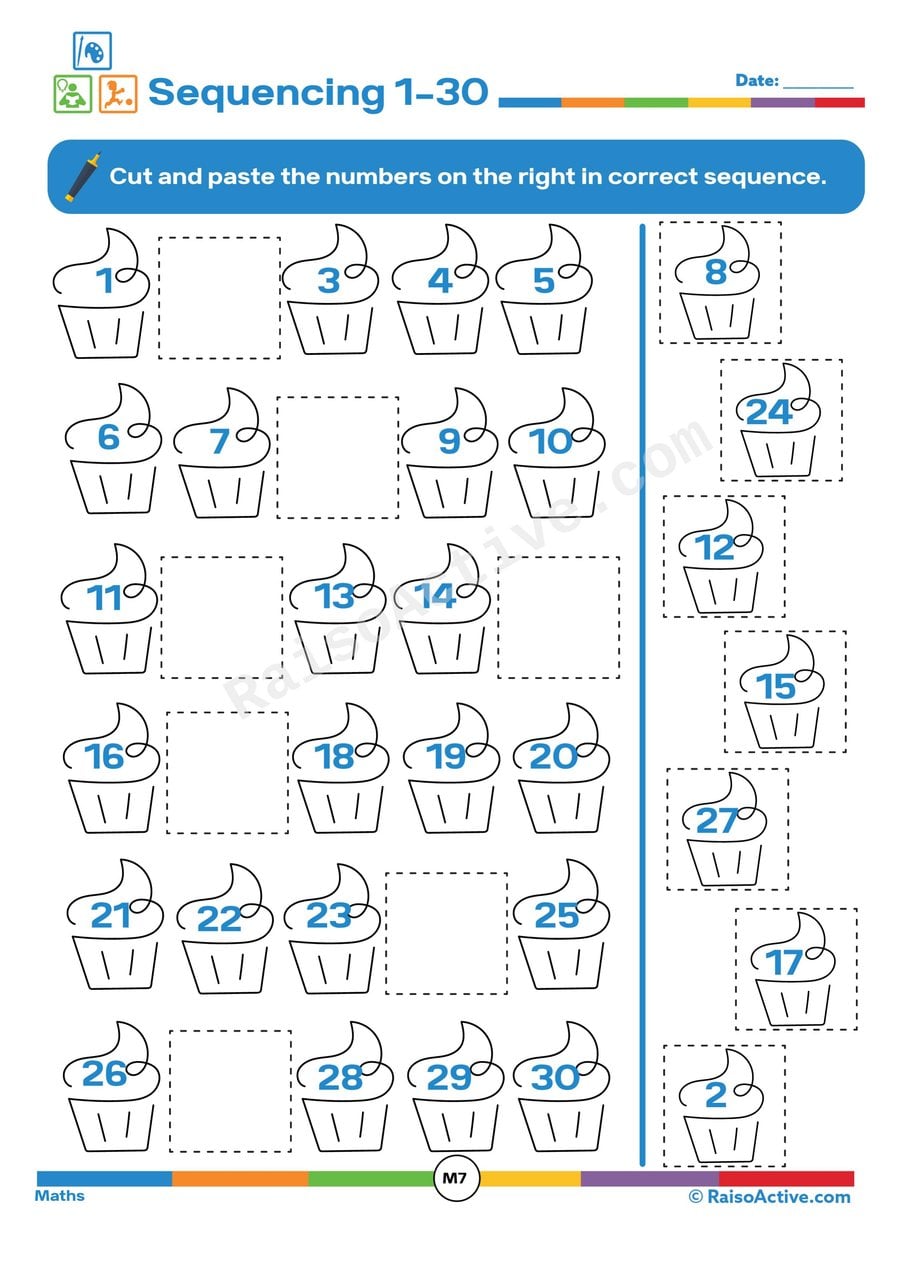
Cupcake Number Sequencing Worksheet 1-30
Ages 4-6 · Pre-K–KindergartenAges 4-6 · Reception–Year 1Ages 4-6 · LKG–UKGAges 4-6
Children ages 4-6 practice number sequencing from 1 to 30 by cutting out numeral pieces and pasting them onto cupcakes in ascending order, reinforcing both number recognition and the logic of 'what comes next' in the counting sequence. This bridges the gap between counting by rote and truly understanding number order, an essential step before children can skip-count or do simple addition.

Space Adventure: Reading Numbers 1-40 Worksheet for Kids
Ages 4-5 · Pre-KAges 4-5 · ReceptionAges 4-5 · LKGAges 4-5
This worksheet strengthens number recognition across a wider range, 1 to 40, by having children read numbers that are partially hidden and identify them without a visual count to rely on. For ages 4-5, recognizing two-digit numbers by sight, rather than only counting objects, marks an important step toward more advanced number sense and eventual mental math.
Guides for this topic

Number Formation Rhymes 0–9 and How to Fix Reversals
Original number formation rhymes for 0–9, the correct stroke order for each digit, why 3, 5 and 7 get reversed most often, and multisensory fixes that work.

Documenting Learning Without Drowning in Data: A Practical Guide for Parents and Teachers
Learn practical ways to document your child's learning without overwhelm. Simple portfolios, observation tips, and printable trackers for ages 1-8.

How to Help Your Child with Letter Reversals: A Complete Guide for Parents and Teachers
Letter reversals are normal until age 7-8. Learn the best multisensory strategies, anchor letter tricks, and activities to help children write b, d, p, and q correctly.
Reviews
Every worksheet for ages 4–6, no watermark
Members download the full library of 1,000+ worksheets and every activity pack without watermarks or daily limits. One year costs ₹999 in India or $20 elsewhere.
See membership plansOr download any worksheet free with a watermark (5 a day).