Future Tense Fun: Fill-in-the-Blanks Worksheet for Kids
This worksheet introduces children ages 4-6 to the future tense, having them choose and write the correct verb form to complete sentences about things that 'will' happen. Understanding that verbs change to reflect when an action takes place — past, present, or future — is a foundational grammar concept that helps children communicate more precisely as their sentences grow longer and more complex.
Part of the pack
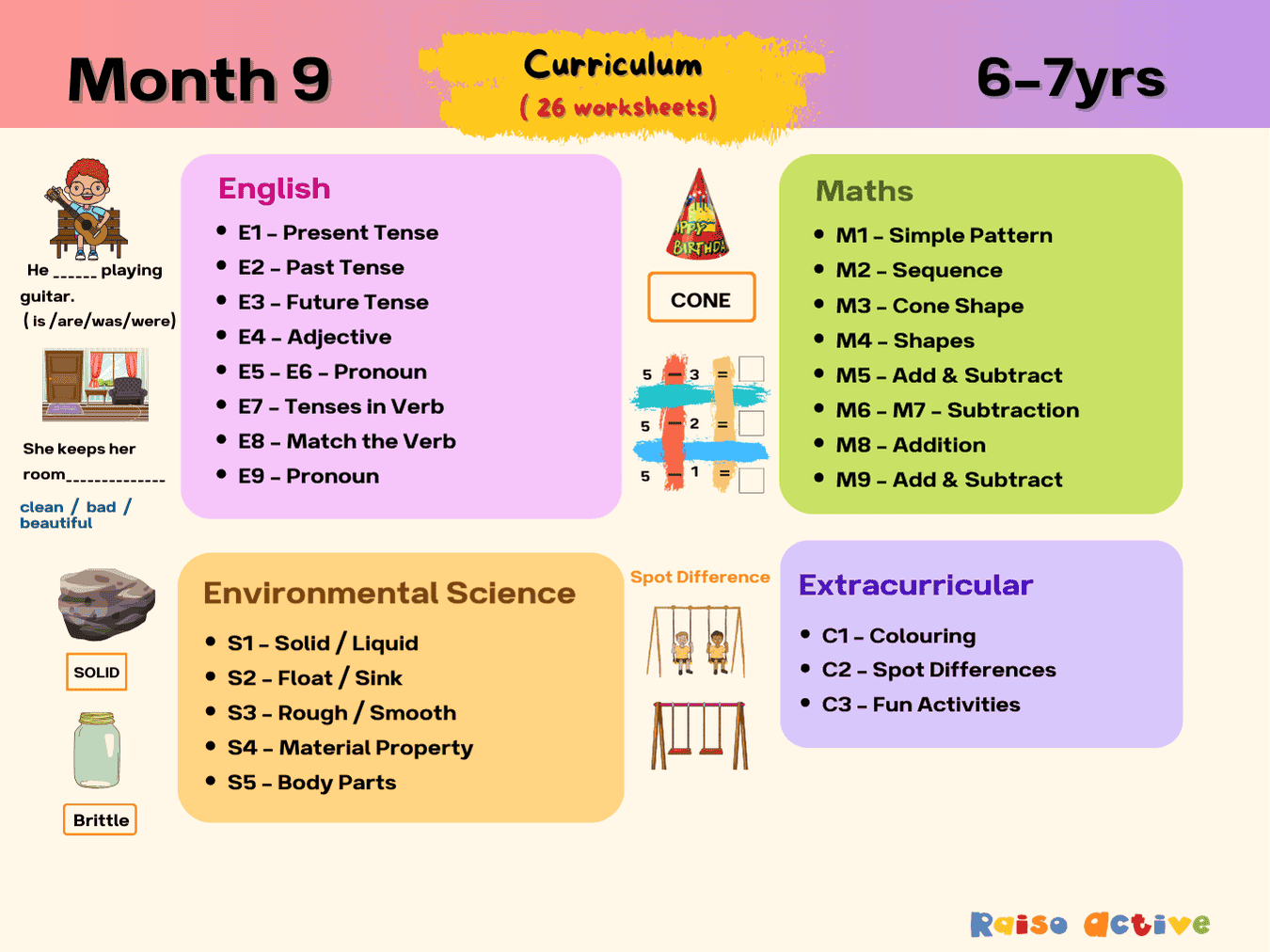
Month 9: Multi-Subject Early Learning | Ages 6-7
This is page 6 of the pack. Ages 6-7 · Grade 1Ages 6-7 · Year 2Ages 6-7 · Class 1Ages 6-7
Made for your child
A whole activity pack made with their name
60 pages to spot, build, trace and write their own name, plus pages about their favourites, feelings and family. See a free preview with their name.
Make an All About Me packFree preview · free for members
Or start free: a name tracing sheet with their nameCurriculum
- Grammar > Verb Tenses
How to use this worksheet
Read each sentence together first without filling anything in, and talk about whether the action is happening now or will happen later. Have your child choose the correct verb option to complete each sentence, writing it into the blank. Once the blanks are filled, go back and have your child circle the future tense words, like 'will', to reinforce the pattern.
Materials needed
- Pencil
Extension activities
- 1Create new sentences together about things your family will do this weekend, using future tense verbs.
- 2Draw a picture illustrating one of the completed future-tense sentences.
- 3Play a 'what will you do' game, taking turns predicting simple future actions using the word 'will'.
- 4Compare a present tense sentence and its future tense version side by side, like 'I play' versus 'I will play'.

Written by
Hemsweta Jain · Teacher Cheena
MBA and Early Childhood Educator, teaching since 2014 · Founder of RaisoActive, Mumbai
Every RaisoActive worksheet is designed and checked by the founder before publishing.
Published · Last reviewed
More from Month 9: Multi-Subject Early Learning | Ages 6-7
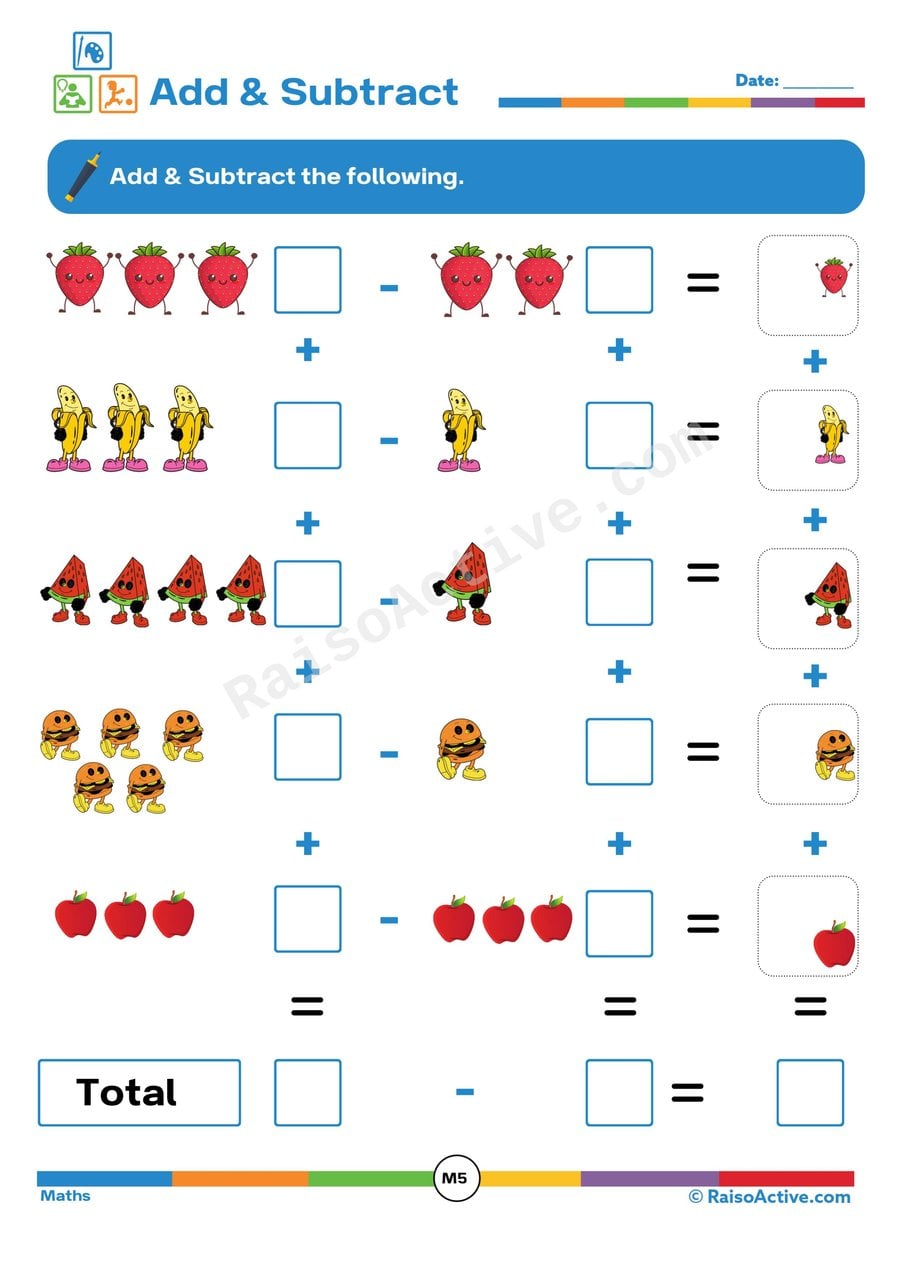
Fun Add & Subtract Worksheet for Preschoolers!
Ages 4-6 · Pre-K–KindergartenAges 4-6 · Reception–Year 1Ages 4-6 · LKG–UKGAges 4-6
This worksheet introduces children ages 4-6 to the basics of addition and subtraction by having them count pictured objects, record the quantities, and then combine or take away groups to find a total. Working with visual objects rather than abstract numbers alone helps children build a concrete understanding of what addition and subtraction actually mean before they're expected to solve equations using numbers only.

Rough vs. Smooth Worksheet: Sorting and Counting Objects
Ages 3-5 · Preschool–Pre-KAges 3-5 · Nursery–ReceptionAges 3-5 · Nursery–LKGAges 3-5
Rough and smooth are texture words a 3-5 year old usually understands through touch long before they can reliably identify them just by looking at a picture, so this worksheet bridges that gap by pairing the visual sorting task with counting practice. Counting how many rough versus smooth objects appear afterward layers basic data skills — 'which group has more?' — on top of the classification.

Spot the Differences! Fun Picture Puzzle Worksheet for Kids
Ages 3-5 · Preschool–Pre-KAges 3-5 · Nursery–ReceptionAges 3-5 · Nursery–LKGAges 3-5
This spot-the-differences puzzle sharpens visual discrimination in children ages 3-5 by requiring them to compare two nearly identical pictures and notice small changes in detail, color, or position. Scanning systematically for differences also builds sustained visual attention and patience, both important pre-academic skills that support later tasks like proofreading and careful reading.
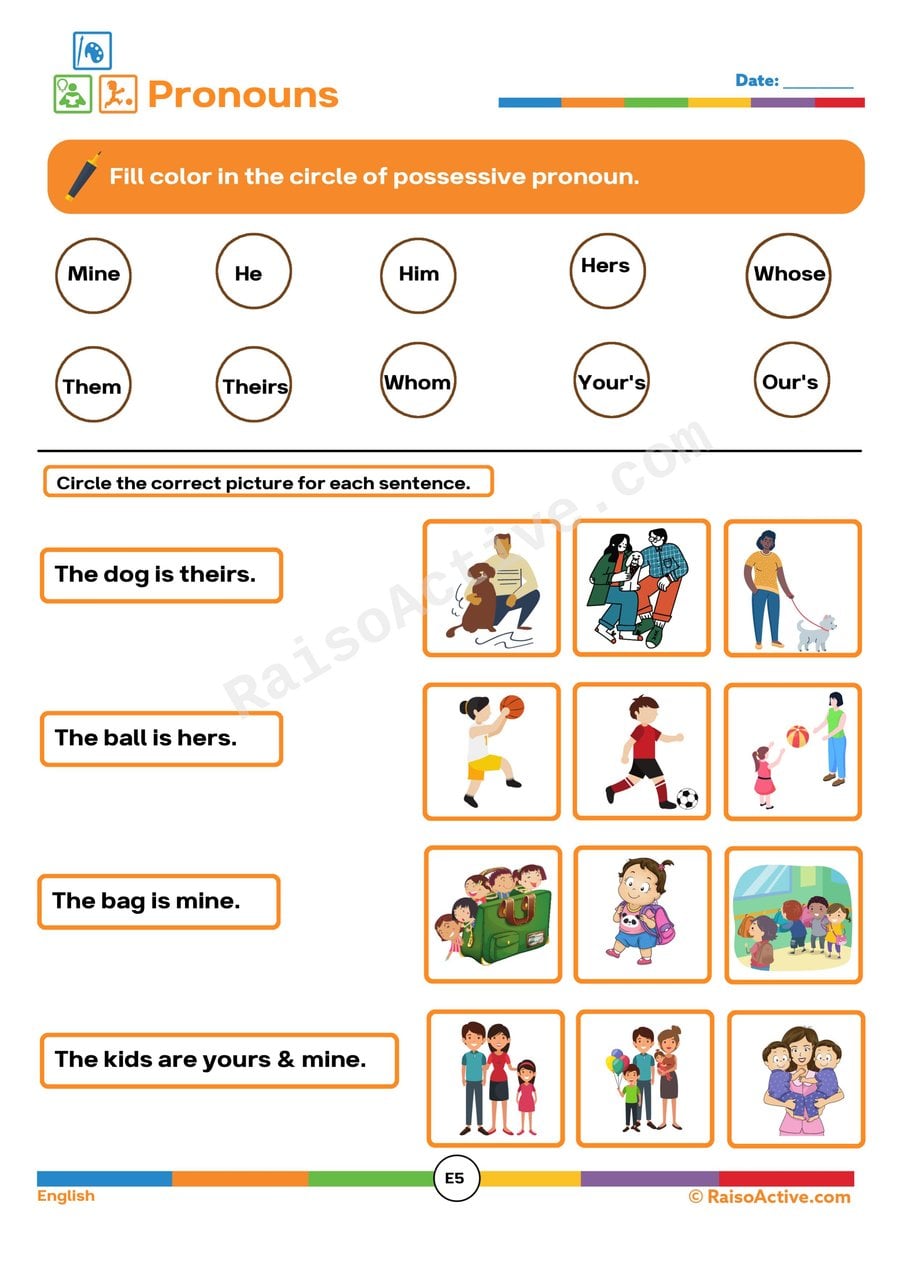
Possessive Pronouns Worksheet: Circle and Match!
Ages 3-5 · Preschool–Pre-KAges 3-5 · Nursery–ReceptionAges 3-5 · Nursery–LKGAges 3-5
Possessive pronouns like 'mine,' 'hers,' and 'theirs' are an abstract grammar concept for children ages 3-5, since they require understanding that a single word can stand in for a whole phrase about ownership — 'that ball is hers' instead of 'that ball belongs to her.' This worksheet builds early grammar awareness by having children match possessive pronouns to sentences and pictures, giving them concrete visual context for what could otherwise be a confusing abstract idea. Early, low-pressure exposure to pronouns like this supports both oral language development and the sentence-building skills needed for writing later on.
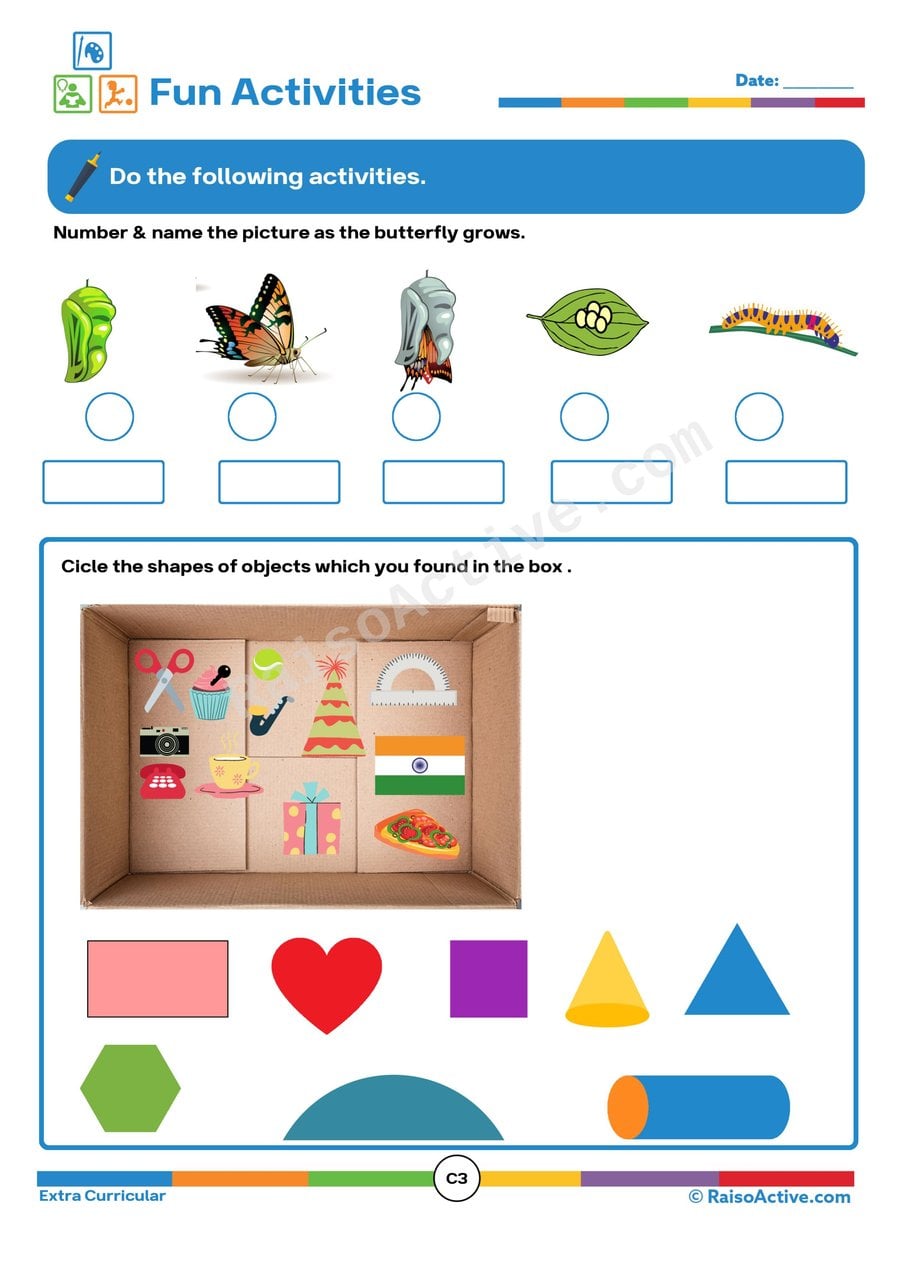
Butterfly Life Cycle Worksheet for Kids
Ages 3-5 · Preschool–Pre-KAges 3-5 · Nursery–ReceptionAges 3-5 · Nursery–LKGAges 3-5
This worksheet introduces children ages 3-5 to the four stages of a butterfly's life cycle — egg, caterpillar, chrysalis, and butterfly — by having them number the pictures in the correct sequence. Understanding a life cycle as an ordered sequence of changes is an early but genuine science skill, building the sequencing and cause-and-effect thinking children need for later scientific reasoning.

Simple Pattern Worksheet for Preschoolers: Fill in the Sequence!
Ages 3-5 · Preschool–Pre-KAges 3-5 · Nursery–ReceptionAges 3-5 · Nursery–LKGAges 3-5
Recognizing and continuing a pattern is one of the earliest building blocks of mathematical and logical thinking for children ages 3-5, since it requires noticing a repeating rule and predicting what comes next based on that rule. This worksheet uses both shapes and numbers to build pattern awareness, asking children to fill in missing elements in a sequence and then match related number sequences together. Pattern recognition like this underpins later skills in math, reading, and even everyday problem-solving, since spotting repeating structures is a skill that transfers well beyond this one worksheet.

Cut and Paste Body Parts Worksheet for Preschoolers
Ages 4-6 · Pre-K–KindergartenAges 4-6 · Reception–Year 1Ages 4-6 · LKG–UKGAges 4-6
This worksheet helps children ages 4-6 learn to name and correctly place major body parts by cutting them out and pasting each one onto the right location on a body outline. Physically assembling a body diagram builds body awareness and vocabulary at the same time, while the cutting and gluing sharpens fine motor precision that supports later handwriting.

Tenses in Verbs Worksheet: Tick & Write the Correct Option!
Ages 4-6 · Pre-K–KindergartenAges 4-6 · Reception–Year 1Ages 4-6 · LKG–UKGAges 4-6
This worksheet has children ages 4-6 practice identifying whether a sentence describes a past, present, or future action, ticking the correct verb tense option and then writing it into the sentence. Distinguishing between tenses is a core grammar skill that helps children eventually narrate their own experiences accurately, whether describing something that already happened or something they plan to do.
Related worksheets

Tense Time! Identifying Past, Present, and Future Tense Worksheet
Ages 5-7 · Kindergarten–Grade 1Ages 5-7 · Year 1–Year 2Ages 5-7 · UKG–Class 1Ages 5-7
This worksheet asks 5-7 year olds to read a full sentence and identify which tense it's written in — past, present, or future — based on the verb form and clue words used, which is a meaningfully harder skill than simply writing verbs in different tenses since it requires recognizing the grammar pattern rather than producing it. This kind of tense-identification practice is exactly what supports stronger reading comprehension and writing later, since understanding when something happens is core to following any story.

Tenses Worksheet: Identifying Past, Present, and Future Verbs
Ages 4-6 · Pre-K–KindergartenAges 4-6 · Reception–Year 1Ages 4-6 · LKG–UKGAges 4-6
Identifying whether an underlined verb describes something that already happened, is happening now, or will happen later introduces children ages 4-6 to verb tense, an important step toward constructing grammatically correct sentences of their own.

Tense Time! A Worksheet on Past, Present, and Future Verbs
Ages 4-6 · Pre-K–KindergartenAges 4-6 · Reception–Year 1Ages 4-6 · LKG–UKGAges 4-6
This worksheet has 4-6 year olds take a given verb and write it correctly in past, present, and future tense boxes, which is a more demanding task than simply identifying tense since it requires actually producing the correct verb form each time — including the common '-ed' ending pattern for regular verbs. Practicing this transformation across multiple verbs builds the flexible understanding that the same action word changes shape depending on when it happens.
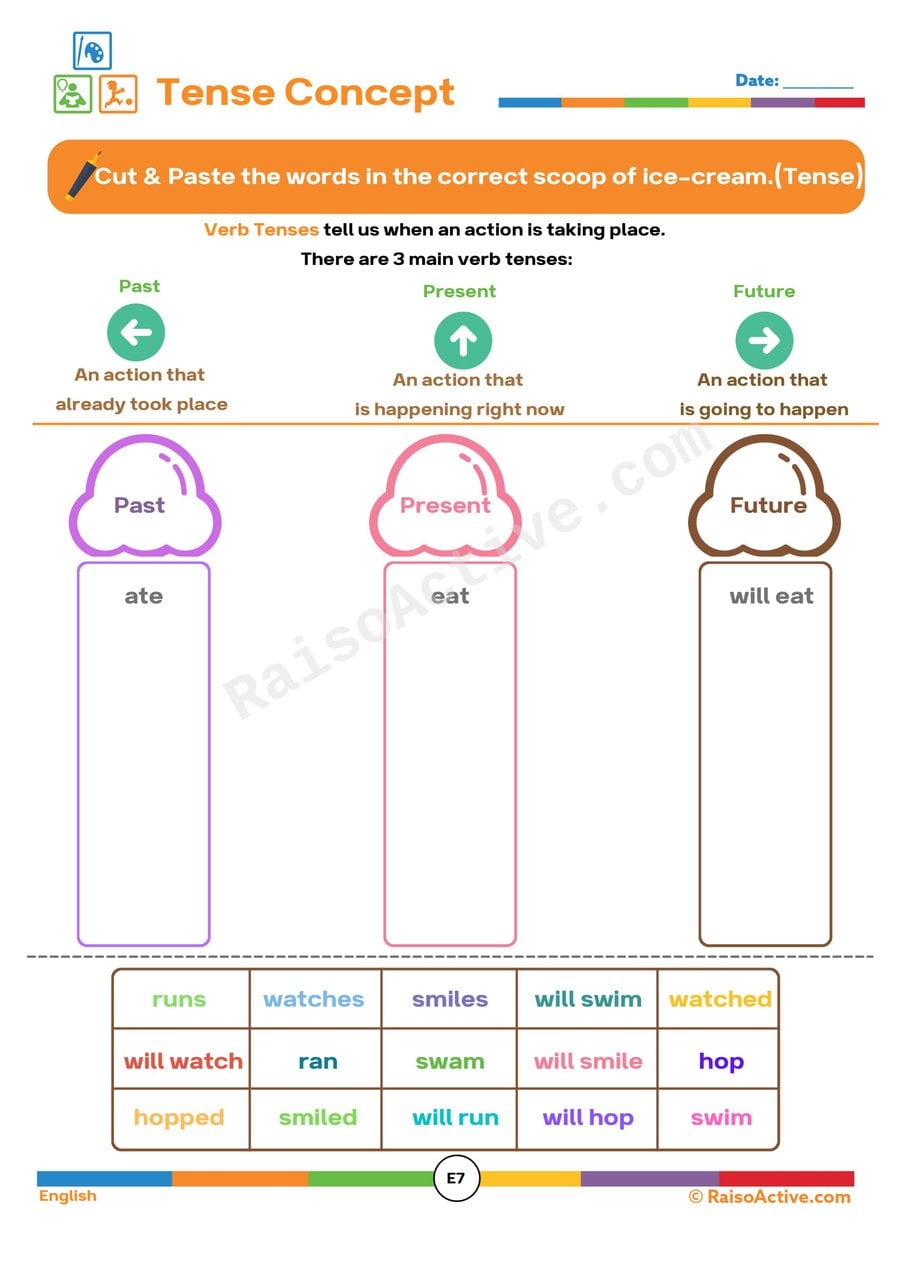
Tense Time! Cut and Paste the Verbs Worksheet
Ages 4-6 · Pre-K–KindergartenAges 4-6 · Reception–Year 1Ages 4-6 · LKG–UKGAges 4-6
Sorting verbs into past, present, and future ice cream scoops teaches 4-6 year olds that verbs physically change form to show when something happens — a foundational grammar concept that often trips kids up because English tense endings are inconsistent (walked, but went, not goed). Because your child has to read each word, decide its tense, and then correctly cut and place it, the worksheet demands genuine comprehension rather than pattern-matching by ending alone, especially where irregular verbs are involved.
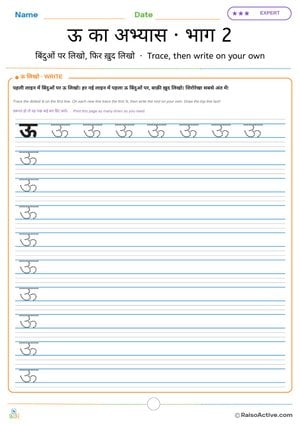
Hindi Letter ऊ Practice Part 2: Trace and Write on Your Own | ऊ का अभ्यास · भाग 2
Ages 3-7 · Preschool–Grade 1Ages 3-7 · Nursery–Year 2Ages 3-7 · Nursery–Class 1Ages 3-7
Children build writing fluency by tracing the dotted line ऊ on the first line and then writing the letter on their own, line after line, as the dotted help fades. The headline (शिरोरेखा) is drawn last, as in Hindi handwriting.
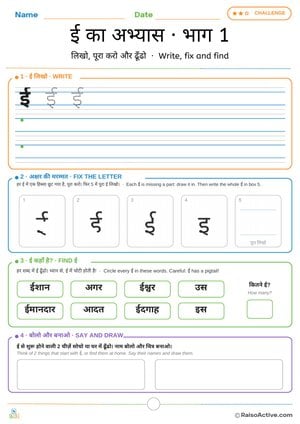
Hindi Letter ई Practice Part 1: Write, Fix and Find | ई का अभ्यास · भाग 1
Ages 3-7 · Preschool–Grade 1Ages 3-7 · Nursery–Year 2Ages 3-7 · Nursery–Class 1Ages 3-7
Children write ई on guide lines, complete four partly drawn letters, circle ई in eight words (while avoiding its look-alike इ), count how many they found, then think of two more words at home that start with ई and draw them.
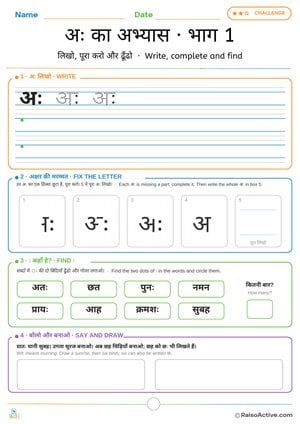
Hindi Visarga अः (ah) Practice 1: Write, Fix the Letter and Find | अः का अभ्यास · भाग 1
Ages 4-7 · Pre-K–Grade 1Ages 4-7 · Reception–Year 2Ages 4-7 · LKG–Class 1Ages 4-7
A challenge page: write अः between the lines, complete four letters each missing a part and write the whole अः in box 5, find the two dots ः in words such as अतः, पुनः, प्रायः and क्रमशः, and draw a sunrise with six birds (छः can also be written छह).
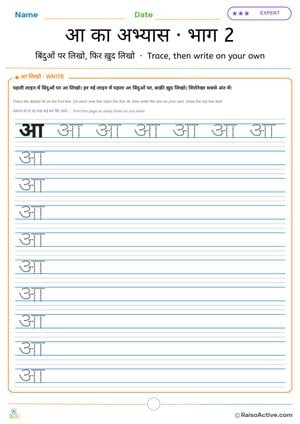
Hindi Letter आ Practice Part 2: Trace and Write on Your Own | आ का अभ्यास · भाग 2
Ages 3-7 · Preschool–Grade 1Ages 3-7 · Nursery–Year 2Ages 3-7 · Nursery–Class 1Ages 3-7
Children build writing fluency by tracing the dotted line आ on the first line and then writing the letter on their own, line after line, as the dotted help fades. The headline (शिरोरेखा) is drawn last, as in Hindi handwriting.
Guides for this topic

Documenting Learning Without Drowning in Data: A Practical Guide for Parents and Teachers
Learn practical ways to document your child's learning without overwhelm. Simple portfolios, observation tips, and printable trackers for ages 1-8.

How to Help Your Child with Letter Reversals: A Complete Guide for Parents and Teachers
Letter reversals are normal until age 7-8. Learn the best multisensory strategies, anchor letter tricks, and activities to help children write b, d, p, and q correctly.

Activities That Help with Pencil Grip Development: A Complete Guide for Parents and Teachers
Discover fun, research-backed activities to develop pencil grip in young children. Age-wise exercises, play ideas, and expert tips for parents and teachers.
Reviews
Every worksheet for ages 4–6, no watermark
Members download the full library of 1,000+ worksheets and every activity pack without watermarks or daily limits. One year costs ₹999 in India or $20 elsewhere.
See membership plansOr download any worksheet free with a watermark (5 a day).