Tense Time! A Worksheet on Past, Present, and Future Verbs
This worksheet has 4-6 year olds take a given verb and write it correctly in past, present, and future tense boxes, which is a more demanding task than simply identifying tense since it requires actually producing the correct verb form each time — including the common '-ed' ending pattern for regular verbs. Practicing this transformation across multiple verbs builds the flexible understanding that the same action word changes shape depending on when it happens.
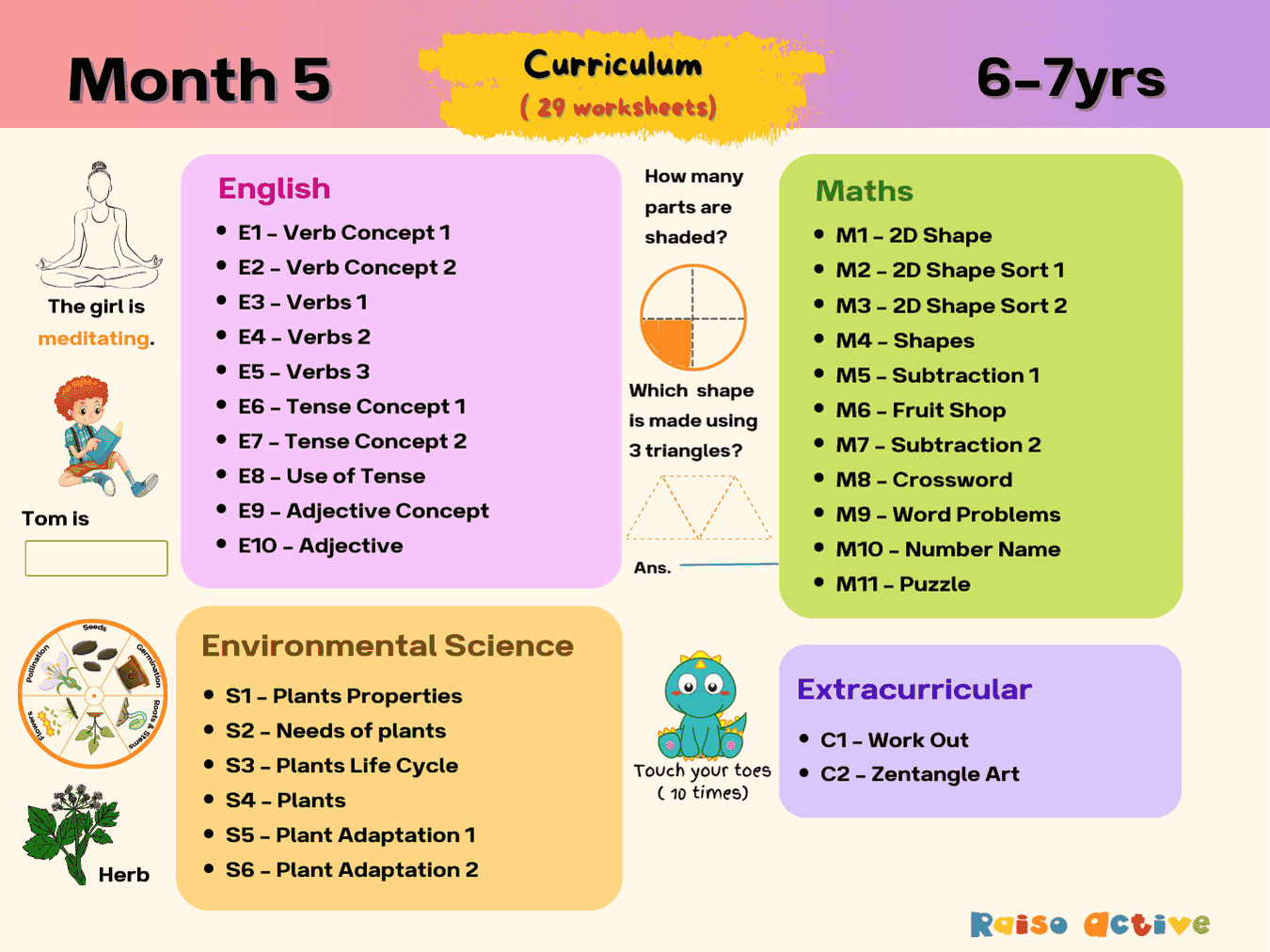
Part of the pack
Month 5: Essential English, Math, Science | Ages 6-7
This is page 11 of the pack. Ages 6-7 · Grade 1Ages 6-7 · Year 2Ages 6-7 · Class 1Ages 6-7
Made for your child
A whole activity pack made with their name
60 pages to spot, build, trace and write their own name, plus pages about their favourites, feelings and family. See a free preview with their name.
Make an All About Me packFree preview · free for members
Or start free: a name tracing sheet with their nameCurriculum
- Grammar > Verb Tenses
How to use this worksheet
Look at the first given verb together, like 'cook,' and talk about what it would look like in each tense. Ask your child to write the past tense form in its box first — 'cooked' — sounding out the added ending as they write. Move to the present and future tense boxes the same way, writing 'cooks' or 'is cooking' and 'will cook' as appropriate. Repeat this process for each verb on the worksheet, reading all three forms aloud together once each row is complete.
Materials needed
- Pencil
- Eraser
Extension activities
- 1Have your child create full sentences using the verbs in each of the three tenses they wrote.
- 2Act out a single verb three different ways to match its past, present, and future forms.
- 3Play a quick verbal game where you say a verb and your child has to give all three tense forms.
- 4Talk through your child's actual day using verbs in past, present, and future tense.
- 5Sort a mixed pile of verb cards into three piles by tense.

Written by
Hemsweta Jain · Teacher Cheena
MBA and Early Childhood Educator, teaching since 2014 · Founder of RaisoActive, Mumbai
Every RaisoActive worksheet is designed and checked by the founder before publishing.
Published · Last reviewed
More from Month 5: Essential English, Math, Science | Ages 6-7

Adjective Adventure: Matching Sentences Worksheet for Kids
Ages 4-6 · Pre-K–KindergartenAges 4-6 · Reception–Year 1Ages 4-6 · LKG–UKGAges 4-6
This worksheet teaches 4-6 year olds that adjectives are the words that describe nouns, asking them to fill in a missing adjective in a sentence and then physically mark the noun and adjective separately by underlining and circling. That separation step — telling apart which word names a thing and which word describes it — is a genuinely useful grammar distinction that most children haven't consciously noticed before, even though they use adjectives constantly in speech.

Action Verbs Worksheet: Identify and Color Verbs in the Picture
Ages 3-5 · Preschool–Pre-KAges 3-5 · Nursery–ReceptionAges 3-5 · Nursery–LKGAges 3-5
This worksheet asks 3-5 year olds to look closely at a busy picture and decide which action verbs are actually happening in it versus which ones aren't shown at all, using a color code (green for present, red for absent) to record their answer. That distinction — is this action really happening in the picture, or just a word I know? — pushes your child to observe carefully rather than simply recognize verb vocabulary in isolation.

Subtraction Fun: Cross Out and Count the Cupcakes!
Ages 4-5 · Pre-KAges 4-5 · ReceptionAges 4-5 · LKGAges 4-5
This worksheet introduces subtraction to 4-5 year olds through a very concrete take-away model: your child crosses out one cupcake from a group and counts what remains, which makes the abstract idea of 'subtracting' visible and immediate rather than something happening only inside a number sentence. Because the crossing-out step comes before the counting step, this worksheet keeps the connection between the physical action and the resulting number crystal clear.

Subtraction Fun: Counting and Subtracting Worksheet for Kids
Ages 3-5 · Preschool–Pre-KAges 3-5 · Nursery–ReceptionAges 3-5 · Nursery–LKGAges 3-5
This worksheet gives 3-5 year olds direct practice subtracting the smaller number from the larger one, using accompanying pictures to make each subtraction problem visible and countable rather than purely abstract. Working through picture-supported subtraction repeatedly at this age builds the number sense needed before children can subtract using numerals alone, without a picture to lean on.

Crossword Math Worksheet: Fill in the Missing Numbers!
Ages 4-6 · Pre-K–KindergartenAges 4-6 · Reception–Year 1Ages 4-6 · LKG–UKGAges 4-6
This crossword-style worksheet has 4-6 year olds solve a series of subtraction equations to fill in missing numbers, then cross-check their answers by matching them across and down within the grid — a built-in accuracy check that regular subtraction worksheets don't offer. Because an answer has to be correct in both directions to complete the crossword properly, this format naturally encourages your child to double-check their subtraction rather than move on after a single attempt.

Shape Sorting Fun: Matching Shapes by Properties Worksheet
Ages 4-5 · Pre-KAges 4-5 · ReceptionAges 4-5 · LKGAges 4-5
This worksheet has 4-5 year olds match written shape descriptions — number of sides, number of corners — to the correct shapes, then count how many of each shape appear in an accompanying picture. Reasoning from a property description back to the shape itself is a step up from simple naming, since it requires your child to hold the definition in mind and scan for a match, and the counting task afterward adds a quantity check to the geometry practice.
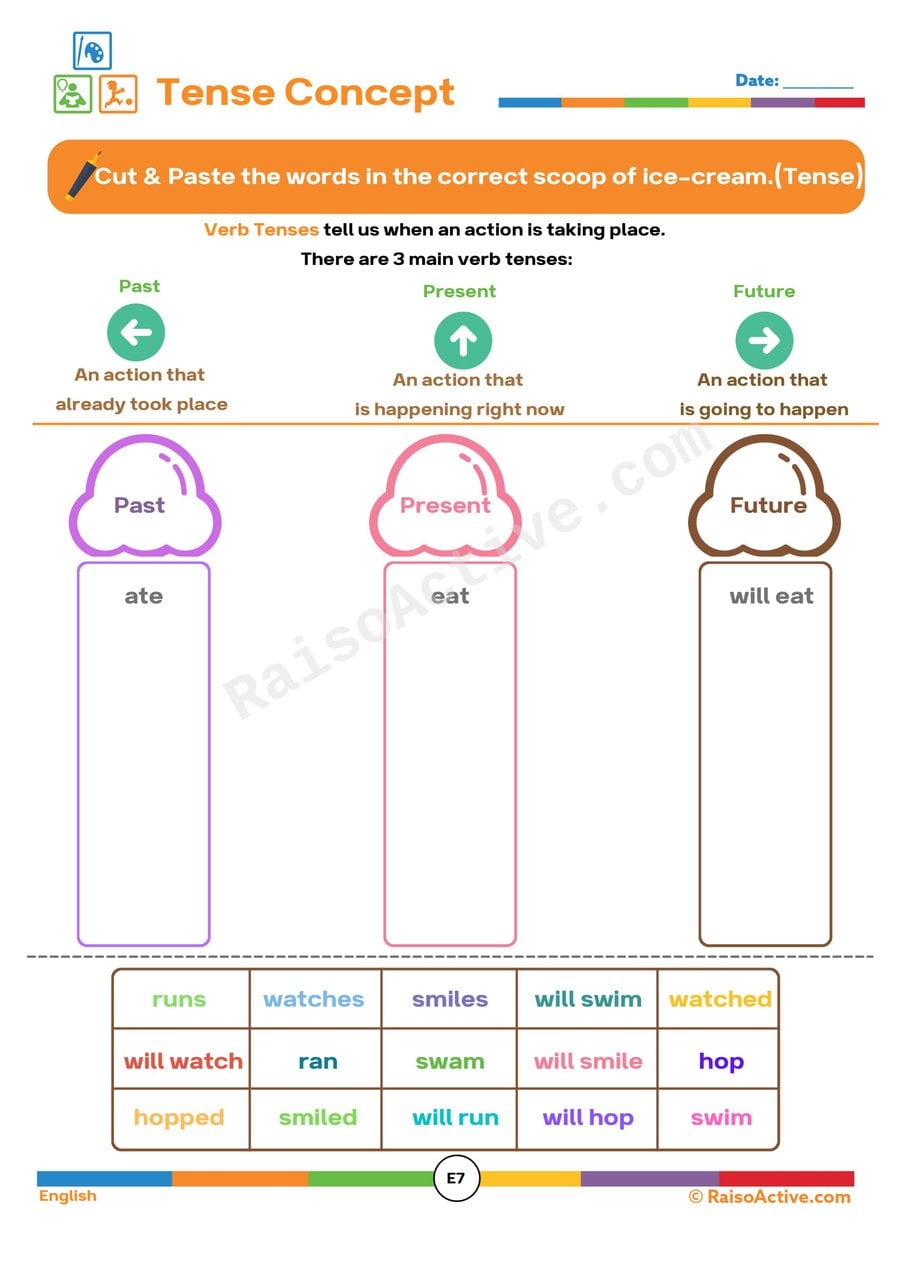
Tense Time! Cut and Paste the Verbs Worksheet
Ages 4-6 · Pre-K–KindergartenAges 4-6 · Reception–Year 1Ages 4-6 · LKG–UKGAges 4-6
Sorting verbs into past, present, and future ice cream scoops teaches 4-6 year olds that verbs physically change form to show when something happens — a foundational grammar concept that often trips kids up because English tense endings are inconsistent (walked, but went, not goed). Because your child has to read each word, decide its tense, and then correctly cut and place it, the worksheet demands genuine comprehension rather than pattern-matching by ending alone, especially where irregular verbs are involved.
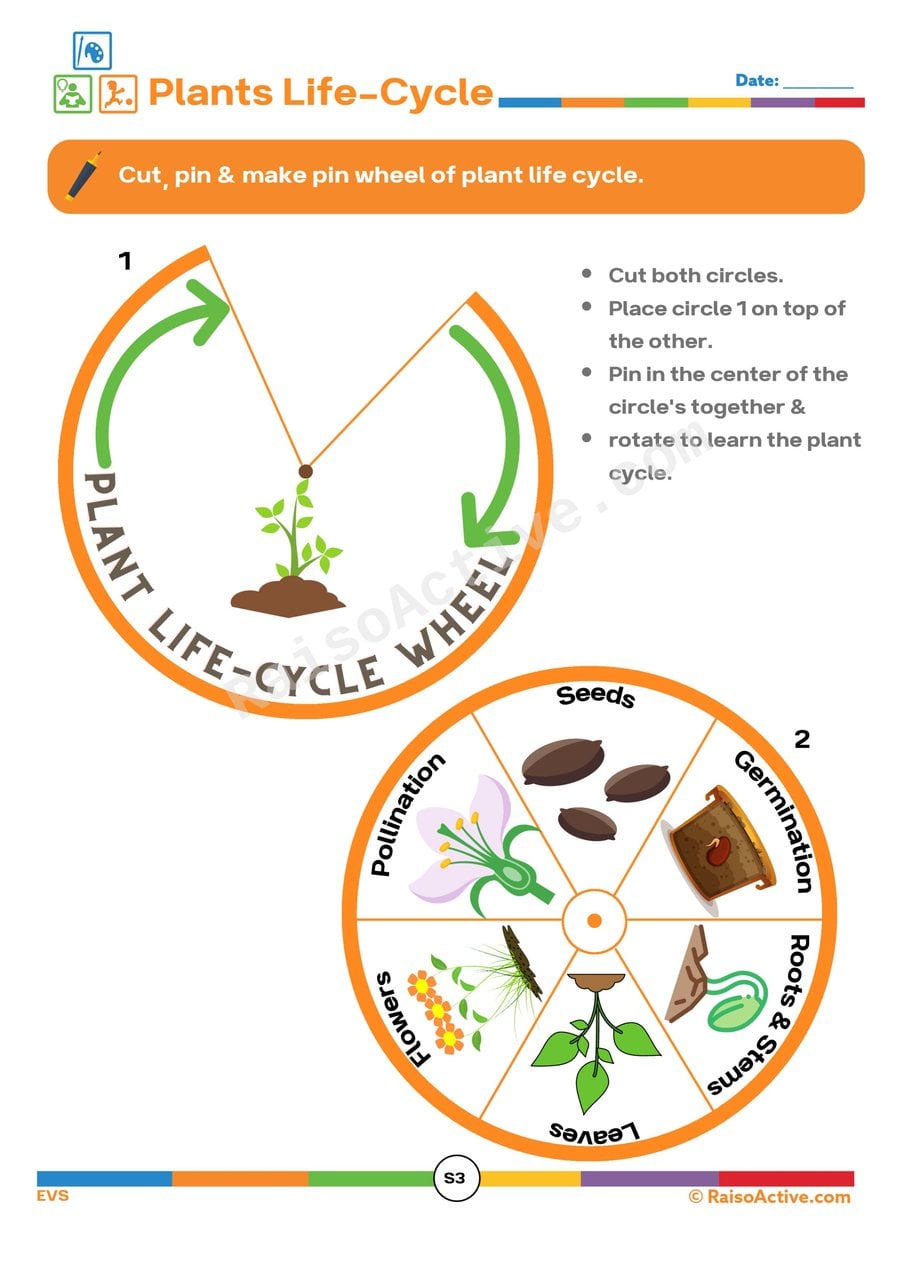
Plant Life Cycle Wheel: Cut, Pin & Learn!
Ages 4-6 · Pre-K–KindergartenAges 4-6 · Reception–Year 1Ages 4-6 · LKG–UKGAges 4-6
Building a spinning wheel that shows a plant's life cycle helps children ages 4-6 understand that growth happens in a repeating sequence of stages — seed, sprout, growing plant, flower — rather than as a single instant event. This hands-on 3D craft turns an abstract scientific process into something children can physically rotate and observe, which suits how young learners grasp sequence and cause-and-effect best. Assembling the two-circle wheel with a paper fastener also builds fine motor precision beyond typical flat cut-and-paste tasks.
Related worksheets

Tenses in Verbs Worksheet: Tick & Write the Correct Option!
Ages 4-6 · Pre-K–KindergartenAges 4-6 · Reception–Year 1Ages 4-6 · LKG–UKGAges 4-6
This worksheet has children ages 4-6 practice identifying whether a sentence describes a past, present, or future action, ticking the correct verb tense option and then writing it into the sentence. Distinguishing between tenses is a core grammar skill that helps children eventually narrate their own experiences accurately, whether describing something that already happened or something they plan to do.

Tenses Worksheet: Identifying Past, Present, and Future Verbs
Ages 4-6 · Pre-K–KindergartenAges 4-6 · Reception–Year 1Ages 4-6 · LKG–UKGAges 4-6
Identifying whether an underlined verb describes something that already happened, is happening now, or will happen later introduces children ages 4-6 to verb tense, an important step toward constructing grammatically correct sentences of their own.

Present Tense Worksheet: Fill in the Blanks and Identify Sentences!
Ages 4-6 · Pre-K–KindergartenAges 4-6 · Reception–Year 1Ages 4-6 · LKG–UKGAges 4-6
This worksheet gives children ages 4-6 focused practice with present tense verbs, both producing them correctly in fill-in-the-blank sentences and recognizing them when identifying whether a given sentence is written in the present tense. Distinguishing tense is an important grammar milestone that helps children communicate clearly about what is happening right now versus what already happened, a distinction they're actively sorting out in their own speech at this age.
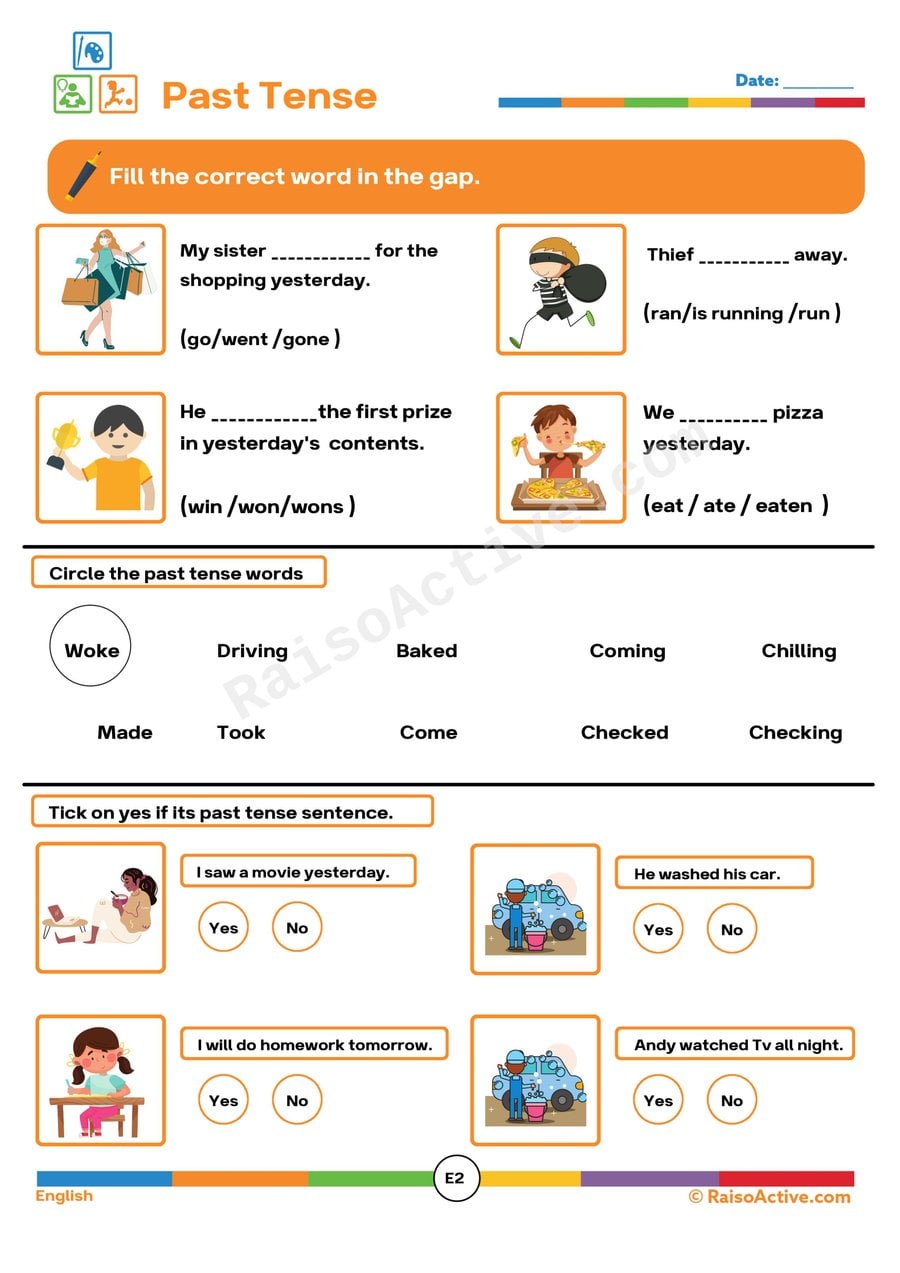
Past Tense Verbs Worksheet for Kids
Ages 4-6 · Pre-K–KindergartenAges 4-6 · Reception–Year 1Ages 4-6 · LKG–UKGAges 4-6
Understanding that verbs change form to show when an action happened is an important grammar concept for children ages 4-6, and this worksheet gives them focused practice recognizing and using past tense verbs in context. Filling in blanks with the correct past tense form, circling past tense words, and judging whether a sentence is already in the past tense all approach the same grammar skill from different angles, which helps solidify the pattern. This kind of grammar awareness supports both clearer spoken language and more accurate writing as children begin composing their own sentences.

Future Tense Fun: Fill-in-the-Blanks Worksheet for Kids
Ages 4-6 · Pre-K–KindergartenAges 4-6 · Reception–Year 1Ages 4-6 · LKG–UKGAges 4-6
This worksheet introduces children ages 4-6 to the future tense, having them choose and write the correct verb form to complete sentences about things that 'will' happen. Understanding that verbs change to reflect when an action takes place — past, present, or future — is a foundational grammar concept that helps children communicate more precisely as their sentences grow longer and more complex.

Festival Fun: Name the Festivals Worksheet for Kids
Ages 4-8 · Pre-K–Grade 2Ages 4-8 · Reception–Year 3Ages 4-8 · LKG–Class 2Ages 4-8
Children look at nine festival pictures and write the right name under each, from Diwali and Navratri to Lohri, Pongal and Paryushan Parv.

I Spy Letters and Numbers Worksheet: Find, Match, and Write!
Ages 4-5 · Pre-KAges 4-5 · ReceptionAges 4-5 · LKGAges 4-5
This worksheet blends letter and number recognition for children ages 4-5, asking them to spot a hidden letter within a picture, find its matching number, and then write both symbols down, combining visual search with early literacy and numeracy in a single activity. Working with letters and numbers side by side reinforces that both are symbols that carry specific meaning and can be found, matched, and recorded.
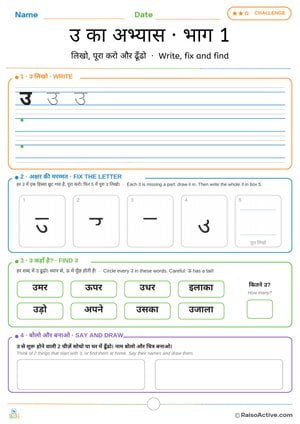
Hindi Letter उ Practice Part 1: Write, Fix and Find | उ का अभ्यास · भाग 1
Ages 3-7 · Preschool–Grade 1Ages 3-7 · Nursery–Year 2Ages 3-7 · Nursery–Class 1Ages 3-7
Children write उ on guide lines, complete four partly drawn letters, circle उ in eight words (while avoiding its look-alike ऊ), count how many they found, then think of two more words at home that start with उ and draw them.
Guides for this topic

Documenting Learning Without Drowning in Data: A Practical Guide for Parents and Teachers
Learn practical ways to document your child's learning without overwhelm. Simple portfolios, observation tips, and printable trackers for ages 1-8.

How to Help Your Child with Letter Reversals: A Complete Guide for Parents and Teachers
Letter reversals are normal until age 7-8. Learn the best multisensory strategies, anchor letter tricks, and activities to help children write b, d, p, and q correctly.

Activities That Help with Pencil Grip Development: A Complete Guide for Parents and Teachers
Discover fun, research-backed activities to develop pencil grip in young children. Age-wise exercises, play ideas, and expert tips for parents and teachers.
Reviews
Every worksheet for ages 4–6, no watermark
Members download the full library of 1,000+ worksheets and every activity pack without watermarks or daily limits. One year costs ₹999 in India or $20 elsewhere.
See membership plansOr download any worksheet free with a watermark (5 a day).