Crossword Math Worksheet: Fill in the Missing Numbers!
This crossword-style worksheet has 4-6 year olds solve a series of subtraction equations to fill in missing numbers, then cross-check their answers by matching them across and down within the grid — a built-in accuracy check that regular subtraction worksheets don't offer. Because an answer has to be correct in both directions to complete the crossword properly, this format naturally encourages your child to double-check their subtraction rather than move on after a single attempt.
Part of the pack
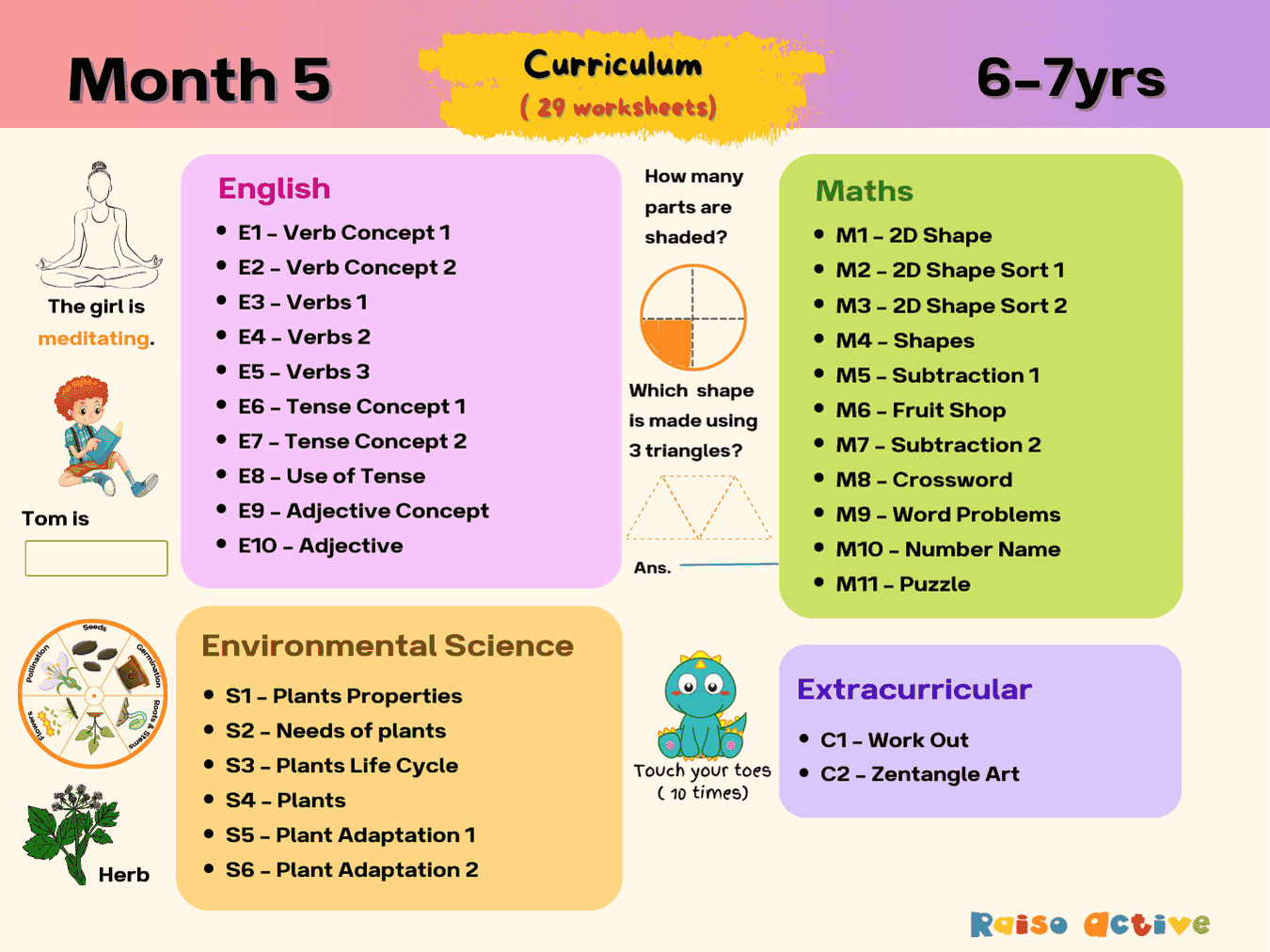
Month 5: Essential English, Math, Science | Ages 6-7
This is page 21 of the pack. Ages 6-7 · Grade 1Ages 6-7 · Year 2Ages 6-7 · Class 1Ages 6-7
Made for your child
Taking away within 10, made for your child
A maths pack with your child's name in it: pictures that explain, practice at three levels, puzzles and story sums about them. Print a new set whenever they finish.
Make a maths packFree preview · free for members
Curriculum
- Subtraction > Subtraction Basics
How to use this worksheet
Look at the first equation together and have your child work out the missing number using counting, fingers, or mental math. Have them write that number into its spot in the crossword grid. Move through each remaining equation the same way, filling in the grid piece by piece. Once the grid is complete, check together that the numbers match correctly both across and down, revisiting any equation that doesn't line up.
Materials needed
- Pencil
- Eraser
Extension activities
- 1Create your own simple addition or subtraction problems using a similar crossword grid format.
- 2Use manipulatives like blocks or counters to double-check any answers your child is unsure about.
- 3Time how long it takes to complete a row of equations, then try to beat that time on a fresh set.
- 4Turn the completed crossword numbers into a simple counting sequence and read them aloud.
- 5Make a matching version using addition facts instead of subtraction.

Written by
Hemsweta Jain · Teacher Cheena
MBA and Early Childhood Educator, teaching since 2014 · Founder of RaisoActive, Mumbai
Every RaisoActive worksheet is designed and checked by the founder before publishing.
Published · Last reviewed
More from Month 5: Essential English, Math, Science | Ages 6-7
Fruit Shop Counting Worksheet for Kids
Ages 3-5 · Preschool–Pre-KAges 3-5 · Nursery–ReceptionAges 3-5 · Nursery–LKGAges 3-5
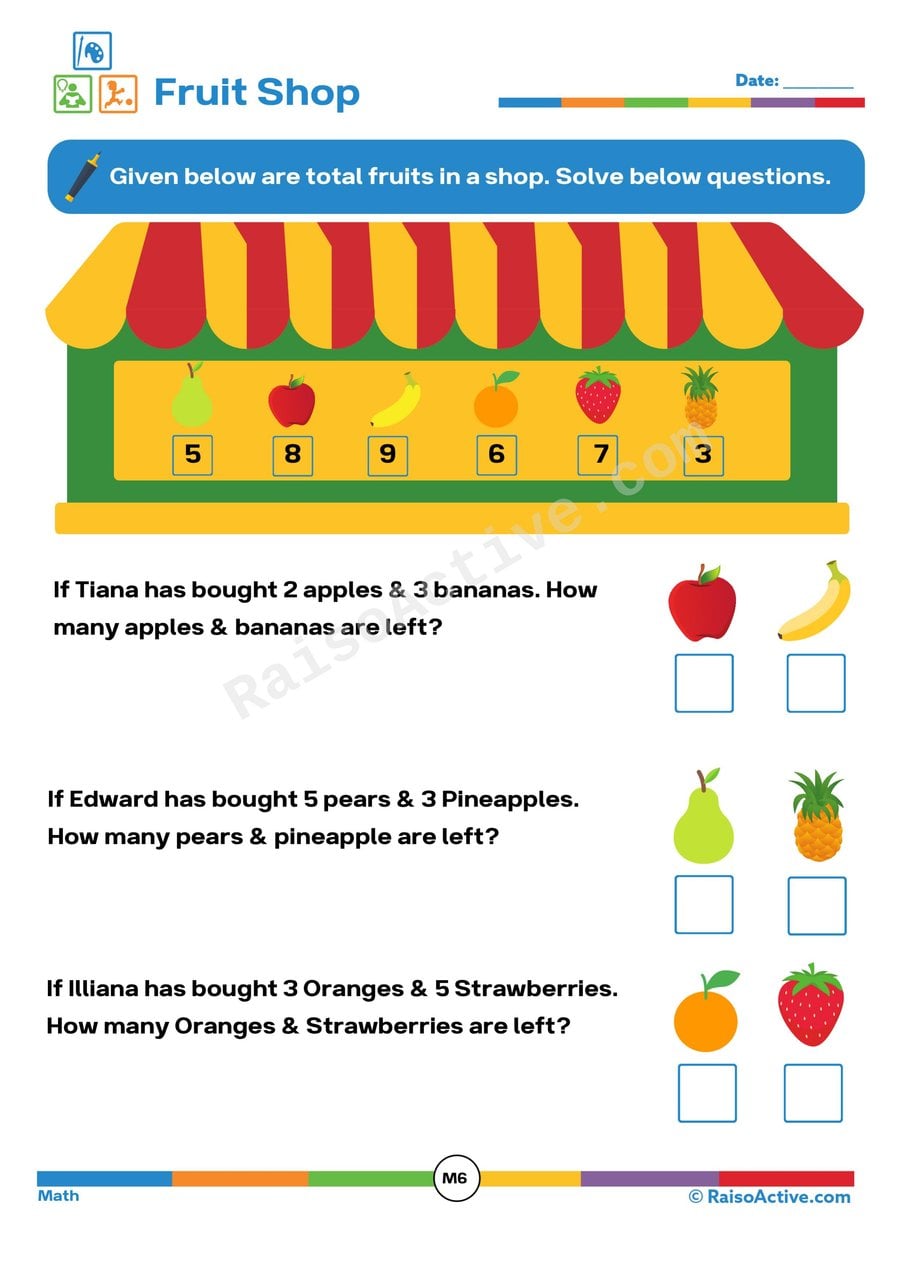
This worksheet applies subtraction to a real-world shopping scenario for 3-5 year olds, asking them to count a total number of fruits, read a short word problem about fruits being bought, and then subtract to find how many remain — combining reading comprehension with the counting and subtraction skills practiced elsewhere. Framing the math inside a relatable 'fruit shop' story helps your child see subtraction as something that happens in everyday situations, not just on a worksheet.
Number Name Word Search Worksheet for Kids
Ages 4-6 · Pre-K–KindergartenAges 4-6 · Reception–Year 1Ages 4-6 · LKG–UKGAges 4-6
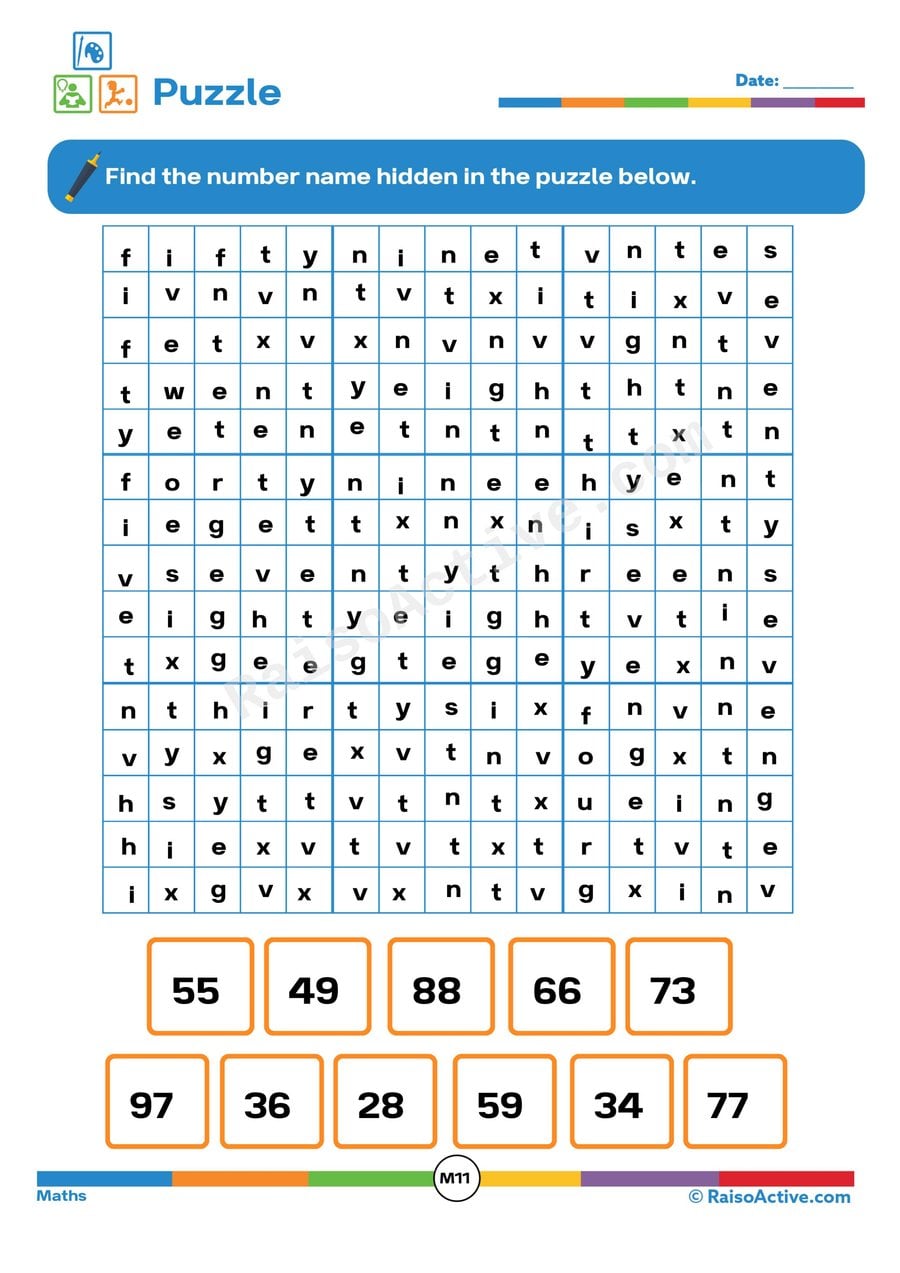
Searching a grid of letters to find hidden number names, like 'seven' or 'twelve,' asks children ages 4-6 to recognize whole written words by sight, a skill that goes beyond sounding out letters one at a time. This word search format also builds visual scanning and sustained attention, since children must check rows, columns, and sometimes diagonals systematically rather than glancing randomly. Matching each found word back to its corresponding number afterward reinforces the link between a number's name, its written word form, and its numeral.
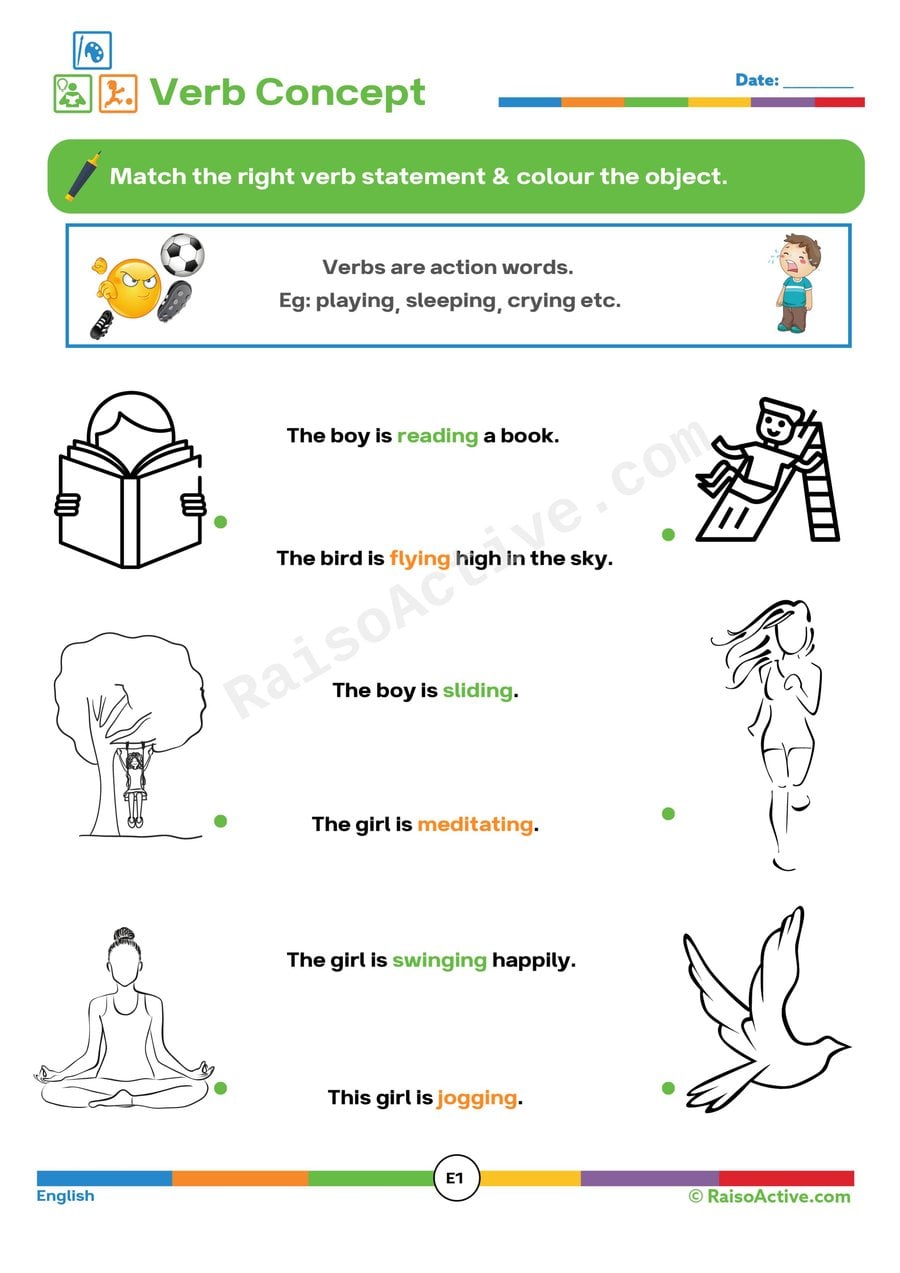
Action Verbs Worksheet: Match and Color!
Ages 4-6 · Pre-K–KindergartenAges 4-6 · Reception–Year 1Ages 4-6 · LKG–UKGAges 4-6
This worksheet has 4-6 year olds read a short sentence, pick out the action word inside it, and match that sentence to the picture showing the action happening — a skill that bridges early reading with grammar. Identifying the verb specifically (rather than just understanding the sentence generally) is a more advanced task than simple picture-word matching, since children have to isolate one word's job within a whole sentence. Coloring the matched picture afterward gives an easy, low-pressure way to confirm the match was correct.

2D Shape Sort Worksheet for Preschoolers: Matching Shapes!
Ages 3-5 · Preschool–Pre-KAges 3-5 · Nursery–ReceptionAges 3-5 · Nursery–LKGAges 3-5
This worksheet connects a shape's visual form to its written name, asking 3-5 year olds to match circles, squares, triangles, and rectangles on one side of the page to their names on the other. That word-to-shape link builds early reading vocabulary alongside geometry, since shape names are often a child's first exposure to reading multi-letter words that describe something they can see and touch. The follow-up questions at the bottom add a light counting or identification check to confirm the matching was done with real understanding.

Subtraction Fun: Counting and Subtracting Worksheet for Kids
Ages 3-5 · Preschool–Pre-KAges 3-5 · Nursery–ReceptionAges 3-5 · Nursery–LKGAges 3-5
This worksheet gives 3-5 year olds direct practice subtracting the smaller number from the larger one, using accompanying pictures to make each subtraction problem visible and countable rather than purely abstract. Working through picture-supported subtraction repeatedly at this age builds the number sense needed before children can subtract using numerals alone, without a picture to lean on.

Adjective Adventure: Cut and Paste Worksheet for Early Readers
Ages 4-6 · Pre-K–KindergartenAges 4-6 · Reception–Year 1Ages 4-6 · LKG–UKGAges 4-6
This cut-and-paste worksheet has 4-6 year olds fill in the blanks of a short story using adjectives, then reread the finished story to see how those descriptive words change and enrich the meaning — a more advanced application of adjective knowledge than isolated sentence work, since it shows how word choice affects a whole narrative. Choosing which cut-out adjective fits best in context also builds reading comprehension alongside vocabulary.
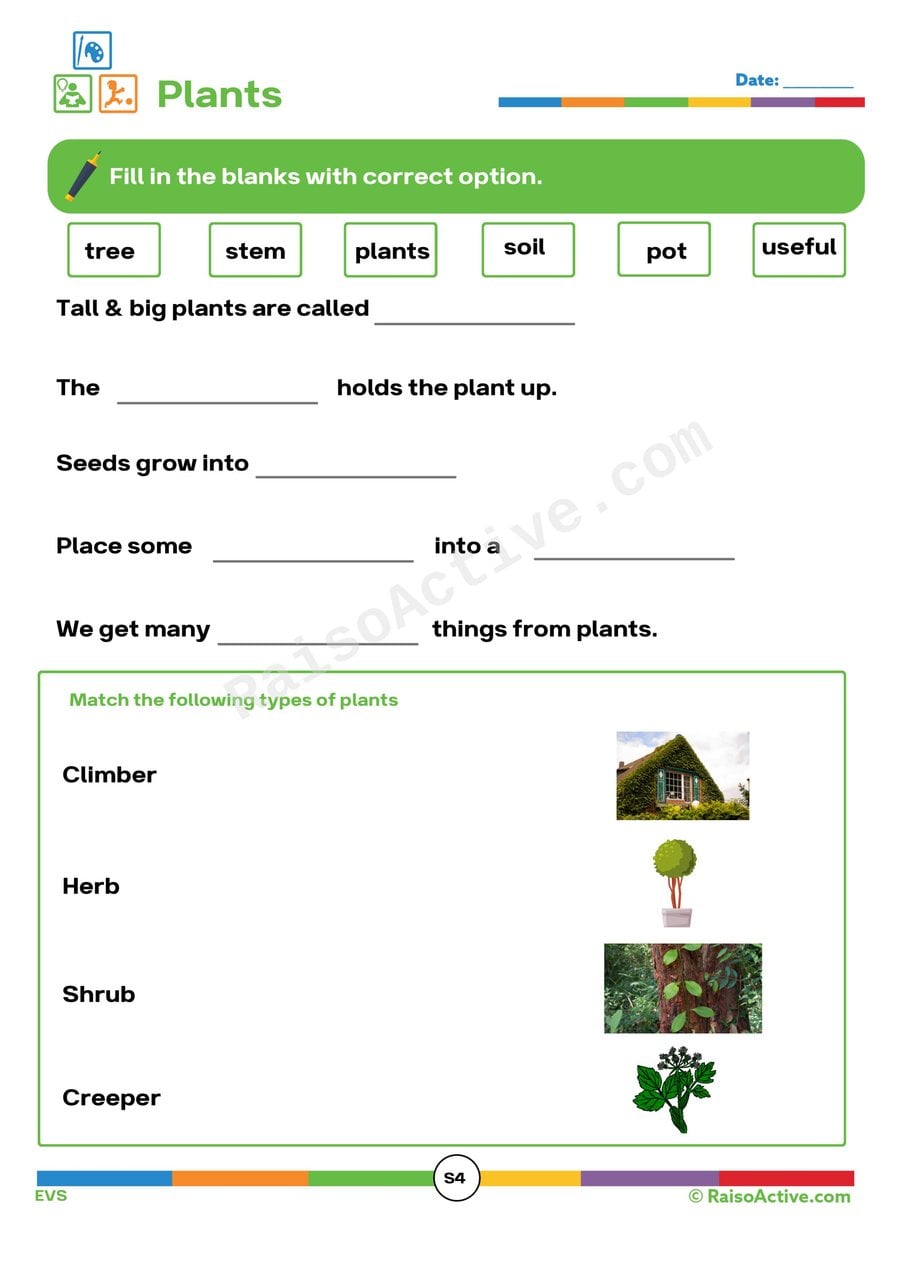
Plant Parts Worksheet for Preschoolers
Ages 4-6 · Pre-K–KindergartenAges 4-6 · Reception–Year 1Ages 4-6 · LKG–UKGAges 4-6
This worksheet introduces 4-6 year olds to plant anatomy — roots, stem, leaves, and flower — and asks them to connect each part's name to its function, while a separate matching section links different plant types to their pictures. Learning that plants have parts with specific jobs (roots drink water, leaves make food from sunlight) is an early building block of life science, and naming these parts gives your child vocabulary they'll keep reusing throughout school science lessons.
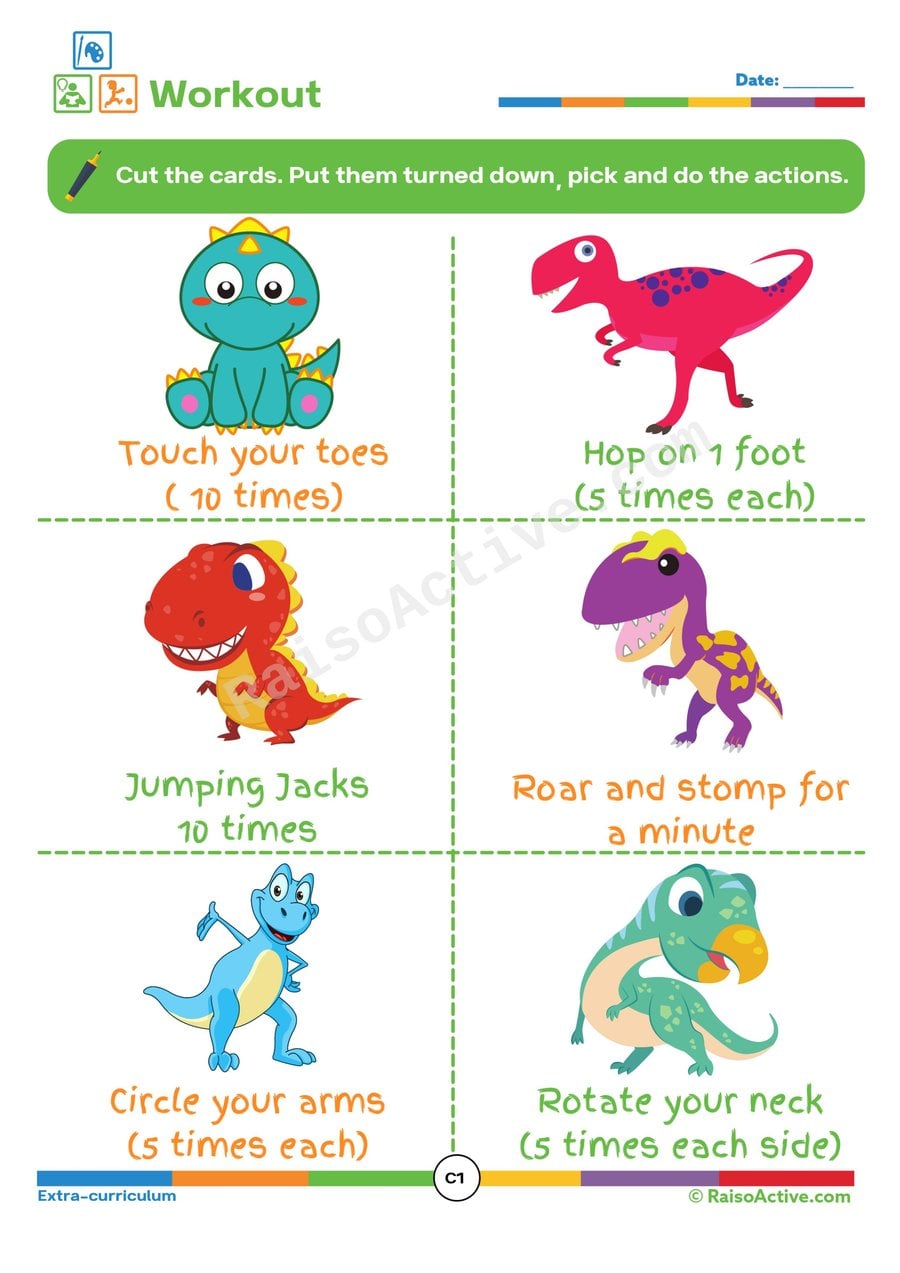
Dino Workout: Fun Exercise Worksheet for Kids!
Ages 3-5 · Preschool–Pre-KAges 3-5 · Nursery–ReceptionAges 3-5 · Nursery–LKGAges 3-5
This dinosaur-themed activity gets 3-5 year olds moving, which is exactly what this age group needs for developing gross motor skills, body awareness, and balance — abilities that don't come from sitting at a table. Following each exercise card as instructed also builds the ability to interpret a picture prompt and translate it into a physical action, a form of following directions that's harder than it sounds for young children still developing self-regulation.
Related worksheets

Subtraction Worksheet: Find the Row with Matching Answers!
Ages 4-6 · Pre-K–KindergartenAges 4-6 · Reception–Year 1Ages 4-6 · LKG–UKGAges 4-6
This worksheet pushes subtraction practice a step further for children ages 4-6 by having them solve several subtraction problems and then compare the answers across different rows to find matches, adding a layer of number-sense reasoning on top of basic calculation. Recognizing that two different subtraction problems can produce the same answer helps children understand that numbers can be reached in more than one way, which is an important early step toward flexible mathematical thinking. This kind of comparison task also builds attention to detail, since a child has to solve every problem accurately before the matching rows can be found.
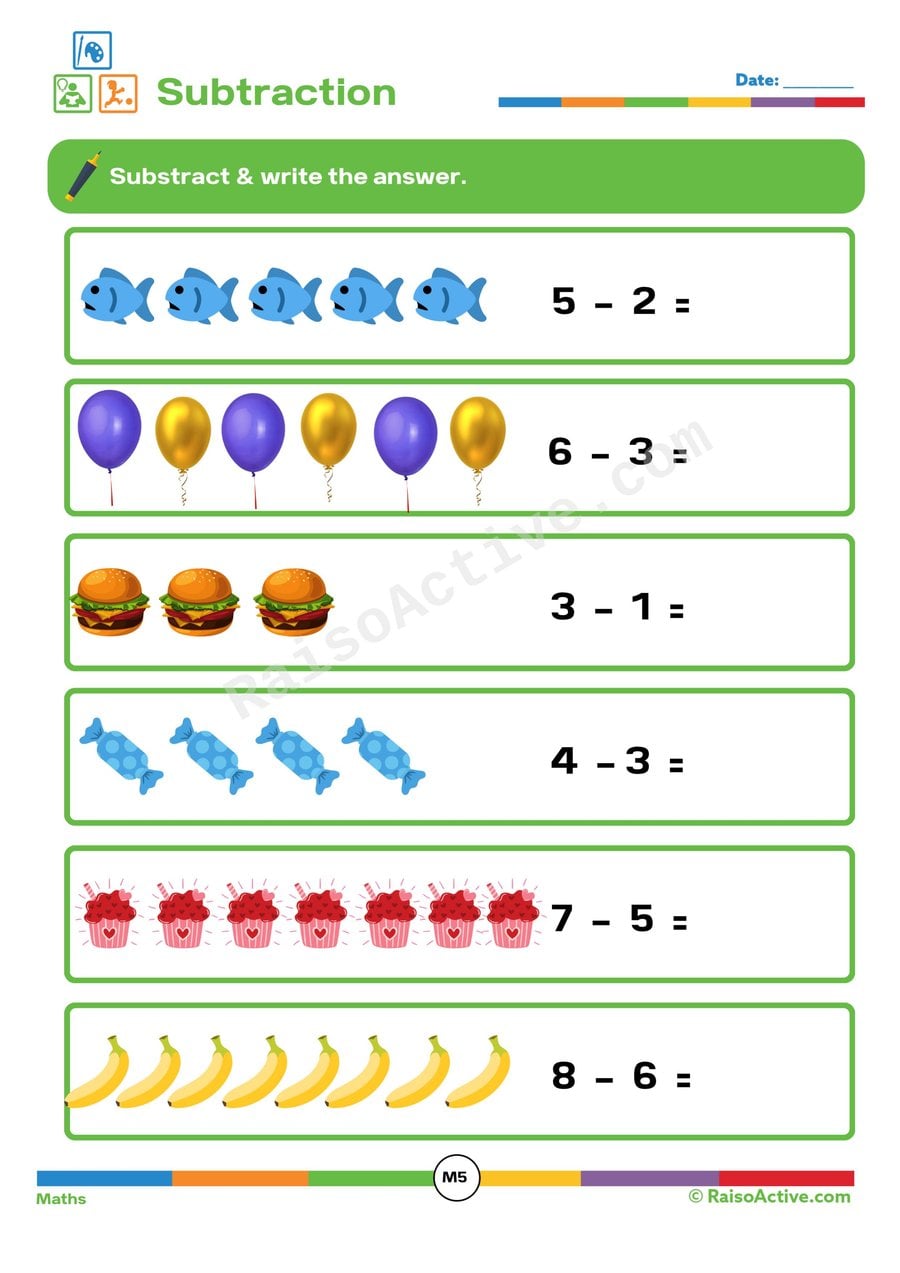
Subtraction Worksheet: Count and Subtract!
Ages 4-5 · Pre-KAges 4-5 · ReceptionAges 4-5 · LKGAges 4-5
This worksheet gives children ages 4-5 hands-on practice with subtraction as 'taking away' from a visible group, helping them understand that a number decreases when items are removed rather than treating subtraction as an abstract symbol on paper. Counting the starting group and then physically crossing out or covering objects before writing the difference builds the concrete number sense that later supports mental subtraction.
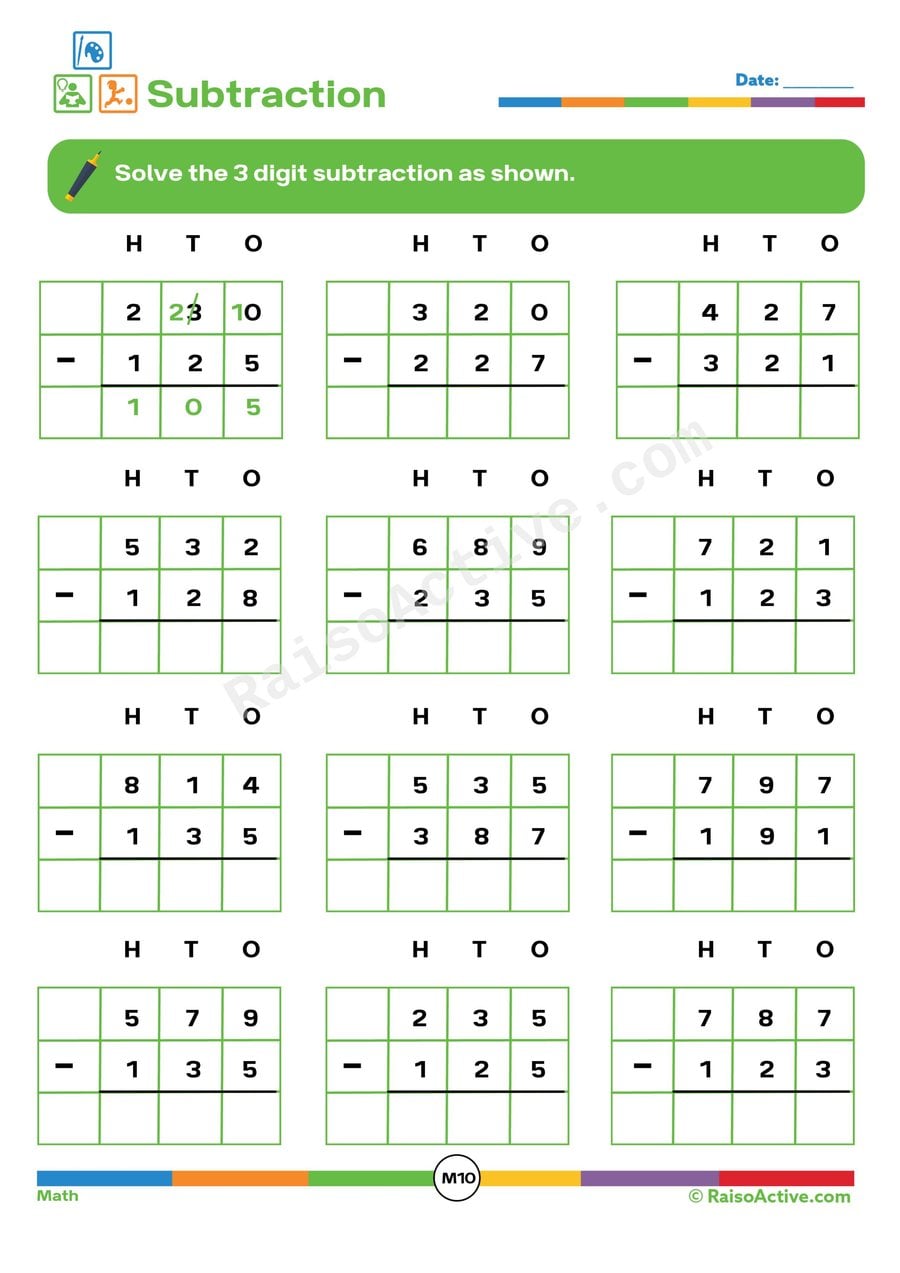
3-Digit Subtraction Worksheet for Kids
Ages 5-7 · Kindergarten–Grade 1Ages 5-7 · Year 1–Year 2Ages 5-7 · UKG–Class 1Ages 5-7
Subtracting three-digit numbers introduces children to borrowing, or regrouping, across place value columns, a more demanding skill than simple subtraction since it requires understanding that a ten can be 'broken' into ones when a column doesn't have enough to subtract from. For ages five to seven, this worksheet builds the procedural foundation for confident multi-digit subtraction going forward.

Subtraction Worksheet: Count and Subtract with Fun Objects!
Ages 4-6 · Pre-K–KindergartenAges 4-6 · Reception–Year 1Ages 4-6 · LKG–UKGAges 4-6
This worksheet grounds subtraction in something 4-6 year olds can actually see and count — a group of objects being taken away — rather than starting with abstract numerals and symbols. Because your child has to count the starting group, physically account for the number being subtracted, and then count what's left, this builds real number sense about what subtraction means, not just a memorized fact.
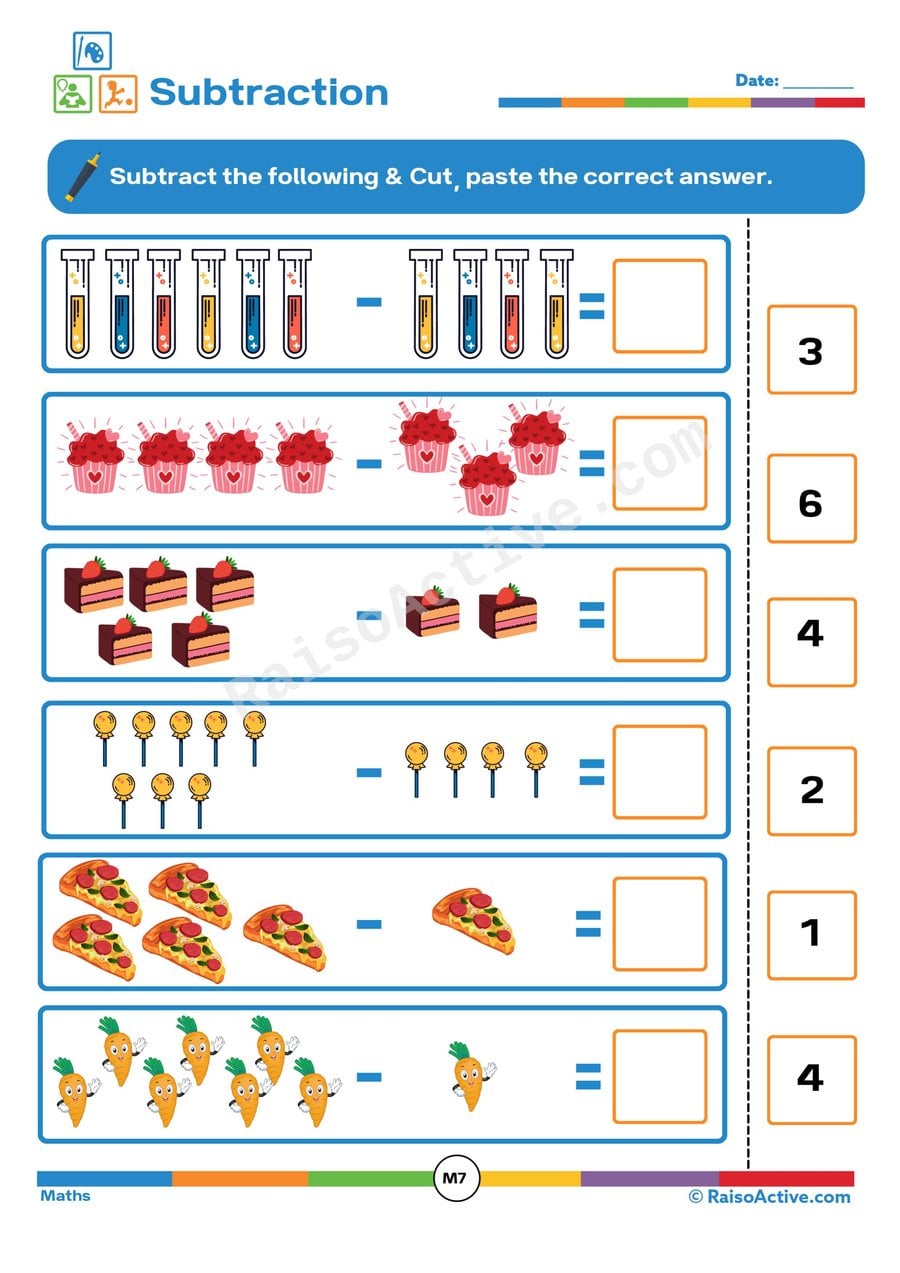
Subtraction Fun: Cut and Paste the Answers!
Ages 4-6 · Pre-K–KindergartenAges 4-6 · Reception–Year 1Ages 4-6 · LKG–UKGAges 4-6
This worksheet grounds subtraction in something concrete for children ages 4-6 by having them count visual object groups, subtract, and then physically select and paste the correct numeral answer from a set of choices. Counting objects before subtracting keeps the math anchored in real quantities rather than abstract numerals alone, which is exactly the kind of support young learners need before they're ready for purely symbolic subtraction. The cut-and-paste answer selection also adds a layer of verification, since your child has to search through several numeral options to find the one that truly matches their calculated answer.
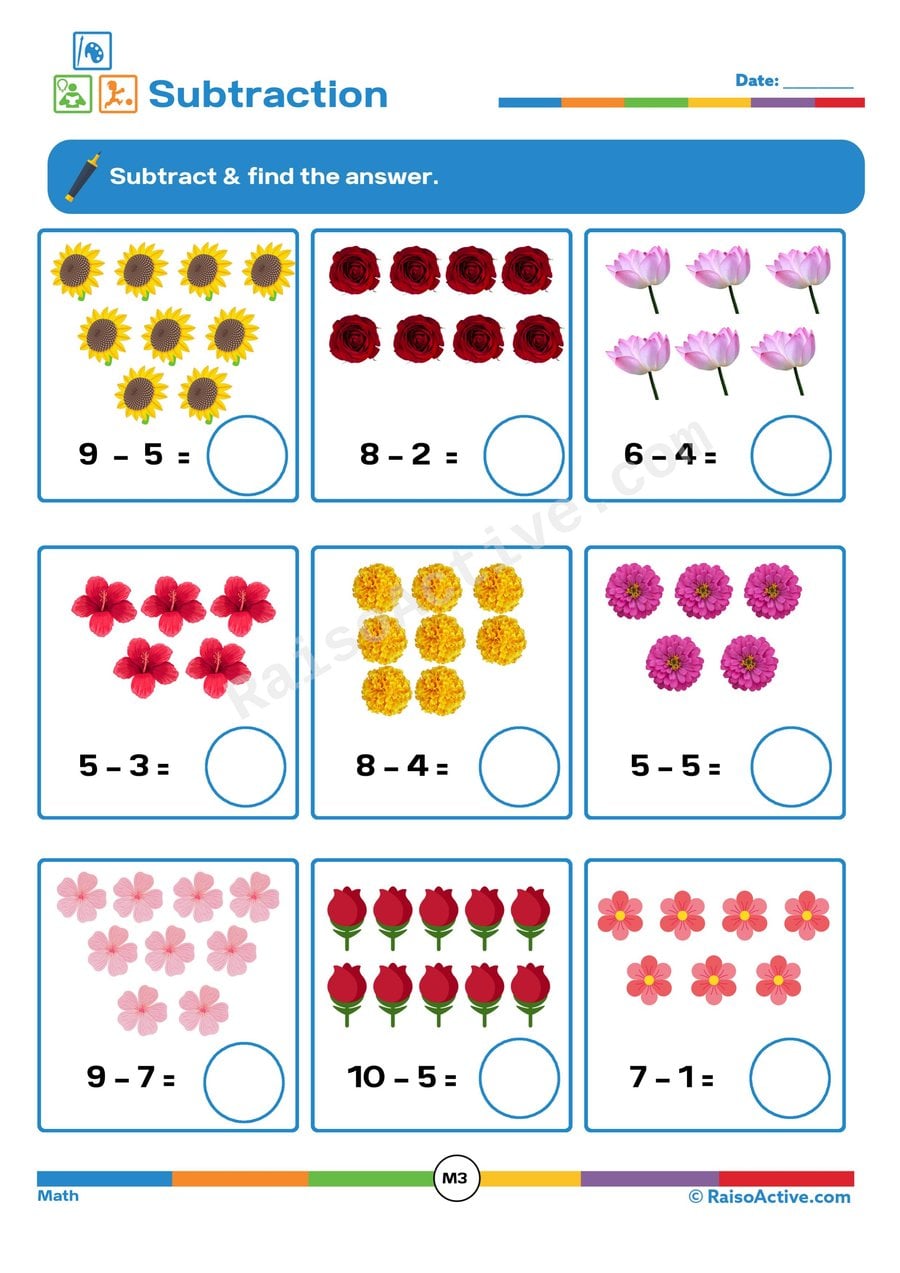
Flower Power Subtraction Worksheet for Kids
Ages 4-6 · Pre-K–KindergartenAges 4-6 · Reception–Year 1Ages 4-6 · LKG–UKGAges 4-6
This worksheet gives children ages 4-6 hands-on subtraction practice using a flower-themed counting context, asking them to count pictured objects, subtract a given amount, and write the difference in a circle. The visual, countable format helps make subtraction concrete rather than abstract, reinforcing that 'taking away' reduces a group's total in a way children can see and verify by recounting.

Subtraction Fun: Count and Subtract with Hands and Objects!
Ages 4-6 · Pre-K–KindergartenAges 4-6 · Reception–Year 1Ages 4-6 · LKG–UKGAges 4-6
This worksheet introduces basic subtraction by having children count a starting group of objects and then 'take away' a smaller amount indicated by the minus sign, connecting the abstract concept of subtraction to something they can see and count. For four- to six-year-olds, visualizing subtraction as physically removing objects from a group — rather than just manipulating numbers — makes the concept concrete before they move to solving subtraction problems with numbers alone.

Subtraction Worksheet: Counting and Subtracting for Preschoolers
Ages 4-5 · Pre-KAges 4-5 · ReceptionAges 4-5 · LKGAges 4-5
This worksheet introduces children ages 4-5 to the concept of subtraction as 'taking away' by having them count a group of objects, cross out the number indicated, and write how many remain. Building this concrete, visual understanding of subtraction before introducing abstract number sentences helps children grasp what the minus sign actually means rather than just memorizing a procedure.
Guides for this topic

Number Formation Rhymes 0–9 and How to Fix Reversals
Original number formation rhymes for 0–9, the correct stroke order for each digit, why 3, 5 and 7 get reversed most often, and multisensory fixes that work.

Age-Appropriate Problem-Solving Activities: Building Critical Thinkers from the Ground Up
Discover fun, age-appropriate problem-solving activities for children ages 1-8. Build critical thinking, logic, and reasoning skills through play-based learning.
Critical Thinking Activities That Actually Work for Young Children: Building Tomorrow's Thinkers Today
Discover proven critical thinking activities for young children. Age-wise logic games, questioning techniques, and hands-on ideas to build thinking skills at home.
Reviews
Every worksheet for ages 4–6, no watermark
Members download the full library of 1,000+ worksheets and every activity pack without watermarks or daily limits. One year costs ₹999 in India or $20 elsewhere.
See membership plansOr download any worksheet free with a watermark (5 a day).