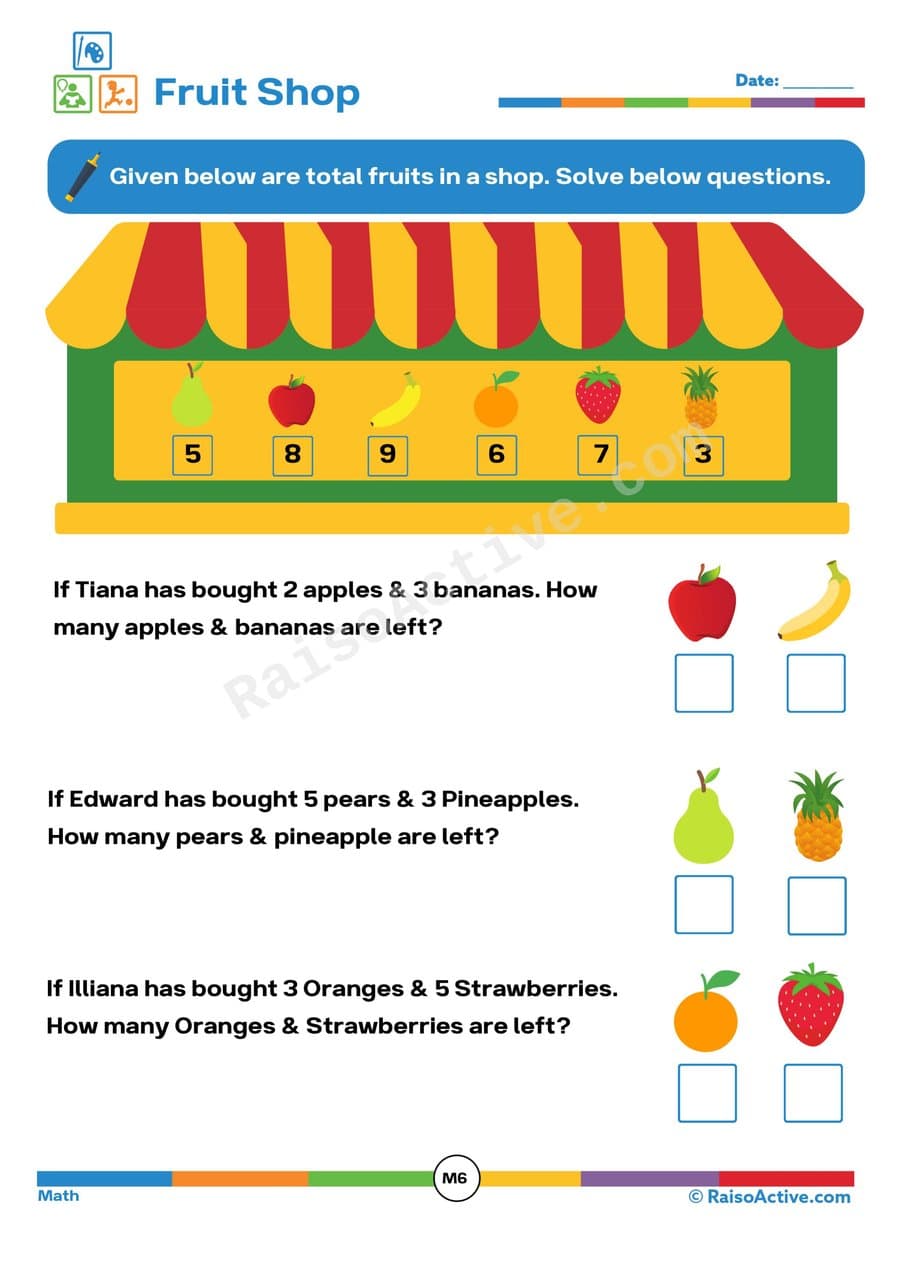
Fruit Shop Counting Worksheet for Kids
This worksheet applies subtraction to a real-world shopping scenario for 3-5 year olds, asking them to count a total number of fruits, read a short word problem about fruits being bought, and then subtract to find how many remain — combining reading comprehension with the counting and subtraction skills practiced elsewhere. Framing the math inside a relatable 'fruit shop' story helps your child see subtraction as something that happens in everyday situations, not just on a worksheet.
Part of the pack
Month 5: Essential English, Math, Science | Ages 6-7Curriculum
How to use this worksheet
Have your child count the total number of one type of fruit shown on the page, saying the count out loud. Read the question aloud together, making sure your child understands how many fruits are described as 'bought' in the story. Have them subtract that number from the total, using fingers or drawings if helpful, and write the answer in the box. Move to the next fruit and question, repeating the counting, reading, and subtracting steps.
Materials needed
- Pencil
- Eraser
Extension activities
- •Have your child draw their own fruit shop scene and make up new word problems to go with it.
- •Use real fruit from the kitchen to act out buying and subtracting in a pretend shop.
- •Set up a simple pretend fruit shop at home, with your child as the shopkeeper handling 'purchases.'
- •Create more shopping-themed word problems using other items around the house.
- •Play a counting game where you 'buy' a few items and your child figures out how many are left in the pile.
Tips for parents and teachers
Encourage your child to use manipulatives, like small toys or counters, to physically represent the fruit shop scenario, especially if translating the word problem into a subtraction operation feels tricky. Read each question slowly and check that your child understands the story before they attempt the math. This real-world framing is a great opportunity to point out subtraction happening naturally during actual grocery trips or snack time.

Written by
Hemsweta Jain · Teacher Cheena
MBA and Early Childhood Educator, teaching since 2014 · Founder of RaisoActive, Mumbai
Every RaisoActive worksheet is designed and checked by the founder before publishing.
Published · Last reviewed
Related worksheets

Word Problem Fun: Solving Burger and Bird Problems!
Solving addition and subtraction word problems featuring burgers and birds gives children ages 4-6 practice applying arithmetic to playful, concrete scenarios, strengthening the link between story context and the correct math operation.

Word Problems Worksheet: Solving for Addition and Subtraction
This worksheet builds the ability to translate real-world scenarios into number sentences, teaching children ages 4-6 to spot clue words like 'gave away' or 'found more' that signal whether to add or subtract. It also practices reading comprehension applied to math, a key step as children move from rote counting toward applied reasoning.

Word Problems Worksheet: Solving Addition and Subtraction
Solving a mix of addition and subtraction word problems trains children ages 4-6 to decide which operation a story calls for, based on whether it describes combining groups or taking something away, a key reasoning skill before formal equation writing.

Word Problems Worksheet: Addition Practice for Kids
Children ages 4-6 practice applying addition to real-life scenarios by reading short word problems and figuring out what numbers to add together, a skill that bridges basic number facts with reading comprehension and problem-solving. Solving word problems teaches children to translate language into math, a step beyond simply adding numbers already given.

Word Problem Fun: Balloon and Mango Math Worksheet for Kids
Solving addition word problems featuring balloons and mangoes teaches children ages 4-6 to translate a short story into a number sentence, practicing both reading comprehension and basic addition in a playful, visual context.

Froggy Fun: Word Problems Worksheet for Early Learners
This worksheet introduces basic addition word problems using a frog theme, teaching children to translate a short story into a math equation they can solve. For four- to six-year-olds, this is a critical bridge skill — moving from simply adding numbers on a page to understanding what a real-world situation like '3 frogs on a lily pad, 2 more hop on' is actually asking them to find.

Trace the Numbers 1-9 Worksheet for Preschoolers
Tracing the numerals 1 through 9 gives children ages 3-5 repeated, guided practice with the specific pencil strokes each number requires, building the fine motor control and muscle memory needed for independent number writing. Because tracing follows a fixed, correct path, it also reinforces accurate numeral recognition, helping children tell visually similar digits apart.
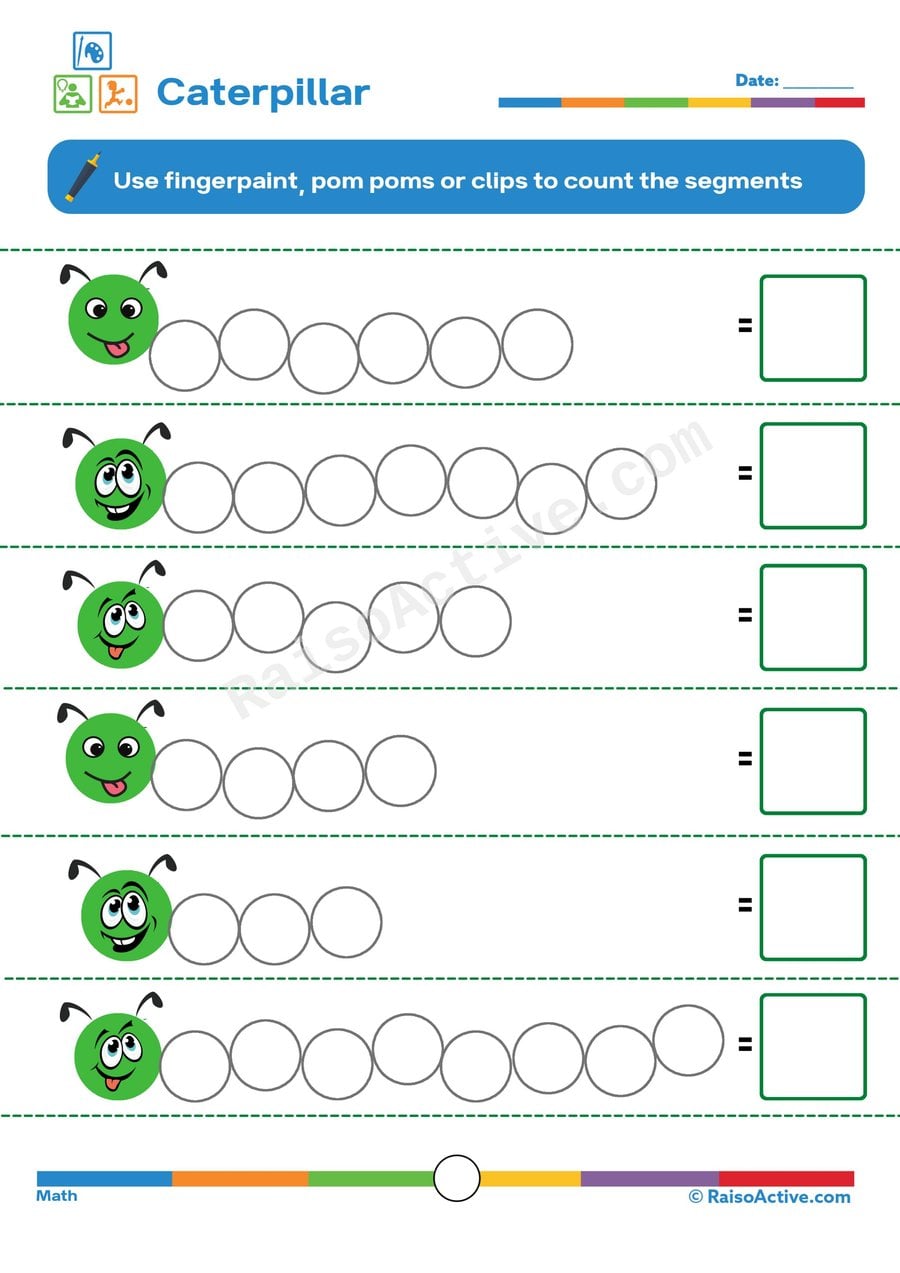
Caterpillar Counting Worksheet for Preschoolers
Counting the segments of each caterpillar teaches children ages 3-5 one-to-one correspondence — touching or marking each segment exactly once while saying a number — which is the core skill underlying accurate counting. Writing the final total in a box also connects the physical act of counting to its written numeral, reinforcing early number-writing practice.
Guides for this topic
Number Formation Rhymes 0–9 and How to Fix Reversals
Original number formation rhymes for 0–9, the correct stroke order for each digit, why 3, 5 and 7 get reversed most often, and multisensory fixes that work.
Christmas and Winter Activities That Combine Fun and Learning: Creating Magical Educational Experiences
Discover Christmas and winter activities that combine festive fun with real learning. Crafts, counting, literacy, and printable worksheets for ages 2 to 8 — perfect for home and school.
Age-Appropriate Halloween Learning Activities: Balancing Spooks and Skills for Young Learners
Discover fun, age-appropriate Halloween learning activities for young children. Spooky crafts, counting games, literacy ideas, and printable worksheets for ages 2 to 8.
Reviews
Every worksheet for ages 3–5, no watermark
Members download the full library of 1,000+ worksheets and every activity pack without watermarks or daily limits. One year costs ₹1,000 in India or $20 elsewhere.
See membership plansOr download any worksheet free with a watermark (5 a day).