Action Word Coloring Worksheet for Preschoolers
This worksheet trains 3-5 year olds to follow a written instruction precisely — color only the teddy bears paired with specific action words, and leave the rest blank. That precision is the real skill being built: your child has to read or recognize each action word before deciding whether to color, rather than coloring everything in sight. It's an early, low-stakes way to connect written verbs to their meaning while also practicing careful, purposeful coloring instead of open-ended scribbling.
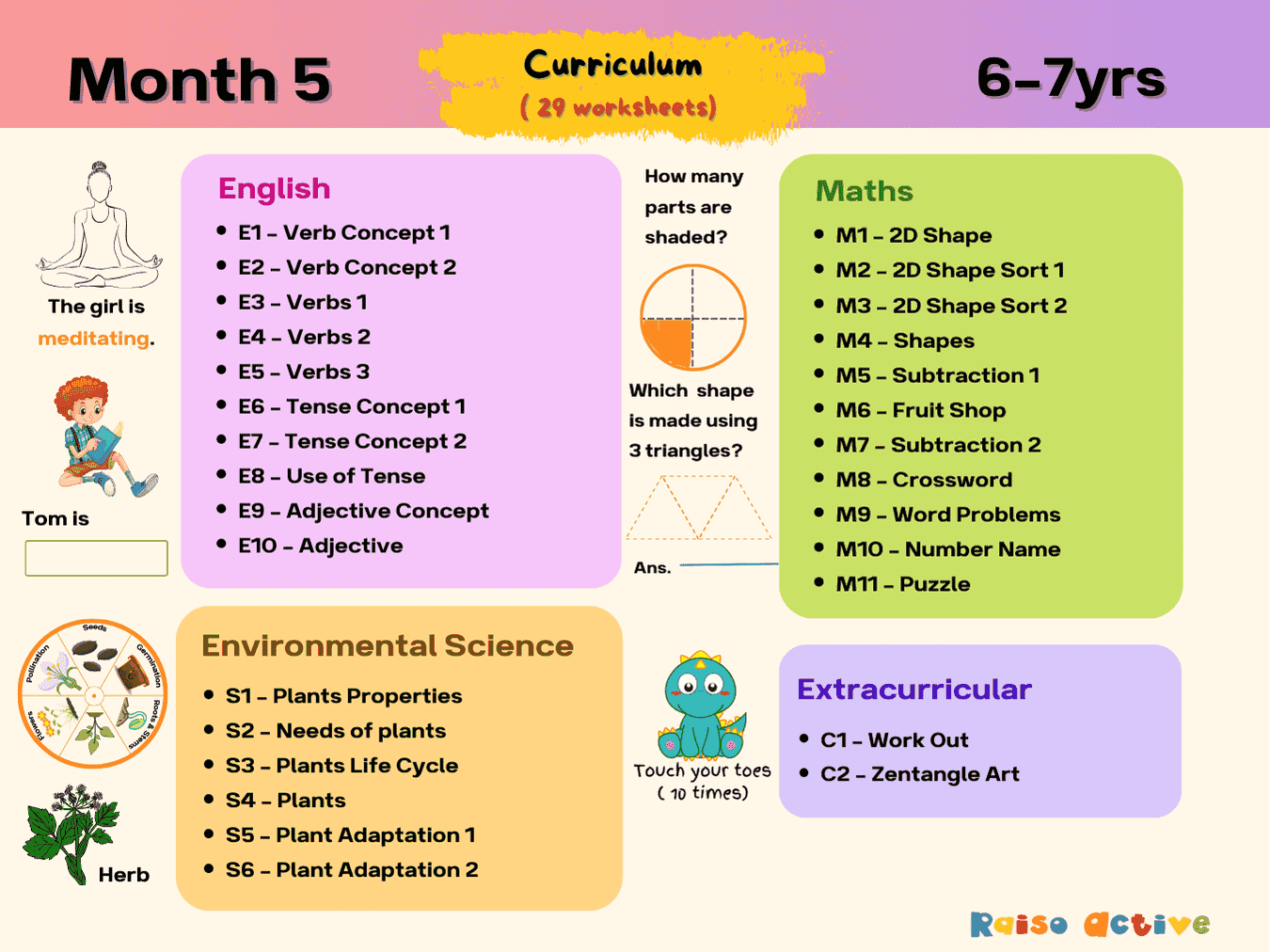
Part of the pack
Month 5: Essential English, Math, Science | Ages 6-7
This is page 6 of the pack. Ages 6-7 · Grade 1Ages 6-7 · Year 2Ages 6-7 · Class 1Ages 6-7
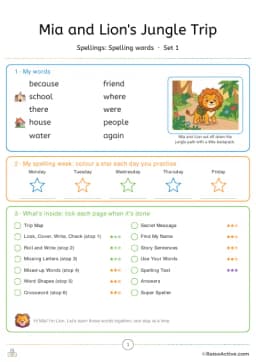
Made for your child
Spelling practice, made for your child
Their own spelling words turned into a pack: trace or look-cover-write-check, roll and write, a secret picture code, a word search, a crossword and a test, with their name in it.
Make a spelling packFree preview · free for members
Or start free: a word search with sight wordsCurriculum
- Grammar > Action Verbs
How to use this worksheet
Read the action word under the first teddy bear aloud together — for example, 'walk.' Ask your child whether that word matches an instruction they were given to color or skip. If it's a match, let them color that bear in; if not, have them leave it blank and move to the next one. Work down the row of bears this way, checking after each one that the coloring decision matches the word underneath.
Materials needed
- Crayons or colored pencils
- Pencil
Extension activities
- 1Have your child physically act out each action word from the worksheet — walk, run, jump, hop.
- 2Look through a favorite book together and find action words on the page.
- 3Turn it into a game: call out an action word and have your child do the action as fast as they can.
- 4Ask your child to think of one more action word not on the worksheet and act it out for you to guess.
- 5Play musical freeze dance where you shout an action word and your child performs it until the music stops.

Written by
Hemsweta Jain · Teacher Cheena
MBA and Early Childhood Educator, teaching since 2014 · Founder of RaisoActive, Mumbai
Every RaisoActive worksheet is designed and checked by the founder before publishing.
Published · Last reviewed
More from Month 5: Essential English, Math, Science | Ages 6-7
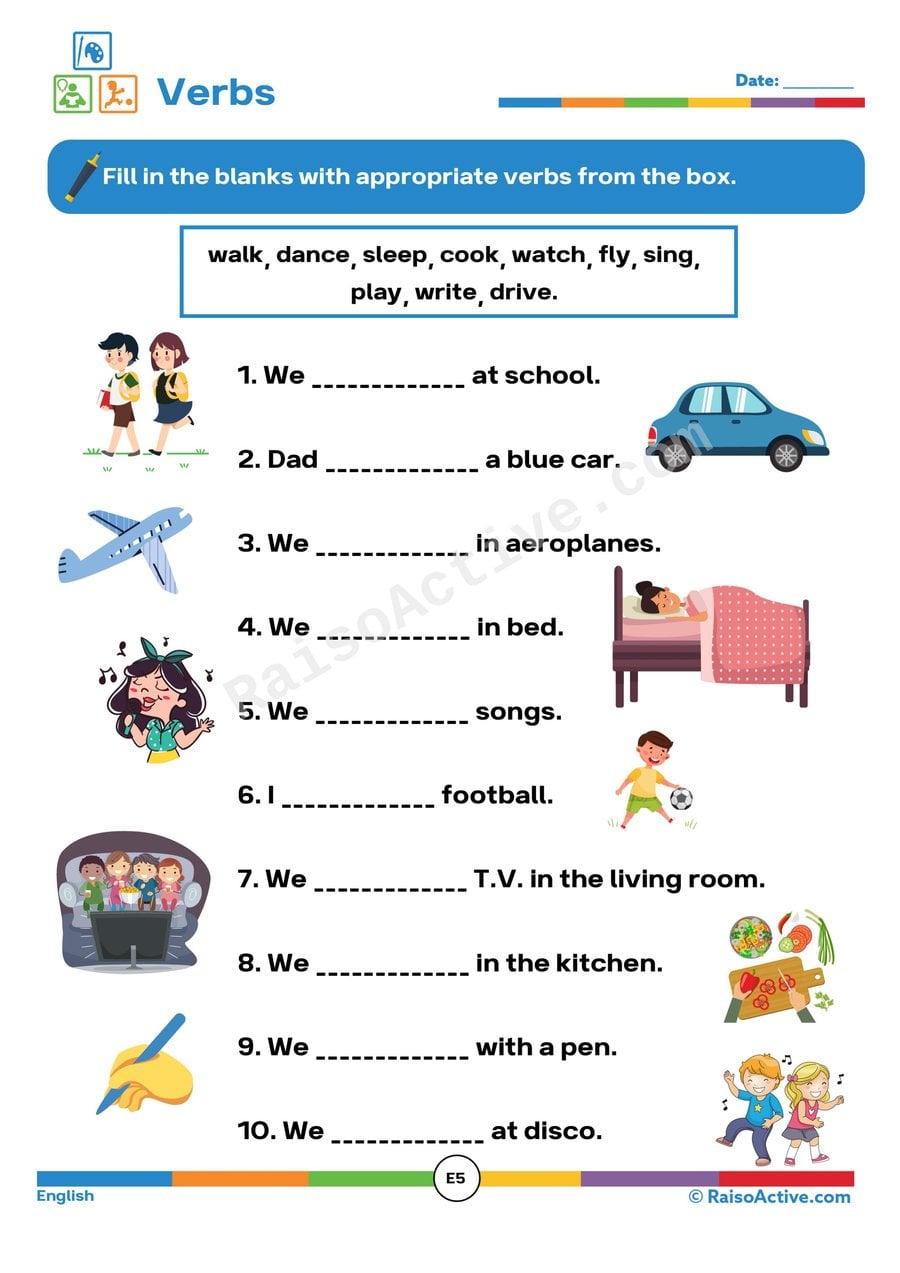
Action Verbs Worksheet: Fill in the Blanks!
Ages 4-6 · Pre-K–KindergartenAges 4-6 · Reception–Year 1Ages 4-6 · LKG–UKGAges 4-6
This worksheet moves 4-6 year olds a step beyond matching verbs to pictures — now they have to read a full sentence, understand its meaning, choose the correct verb from a word box, and write it into the blank themselves. That combination of reading comprehension, vocabulary selection, and handwriting makes this noticeably more demanding than earlier action-word worksheets, and it's exactly the kind of sentence-completion task children will meet again in early elementary grammar lessons.
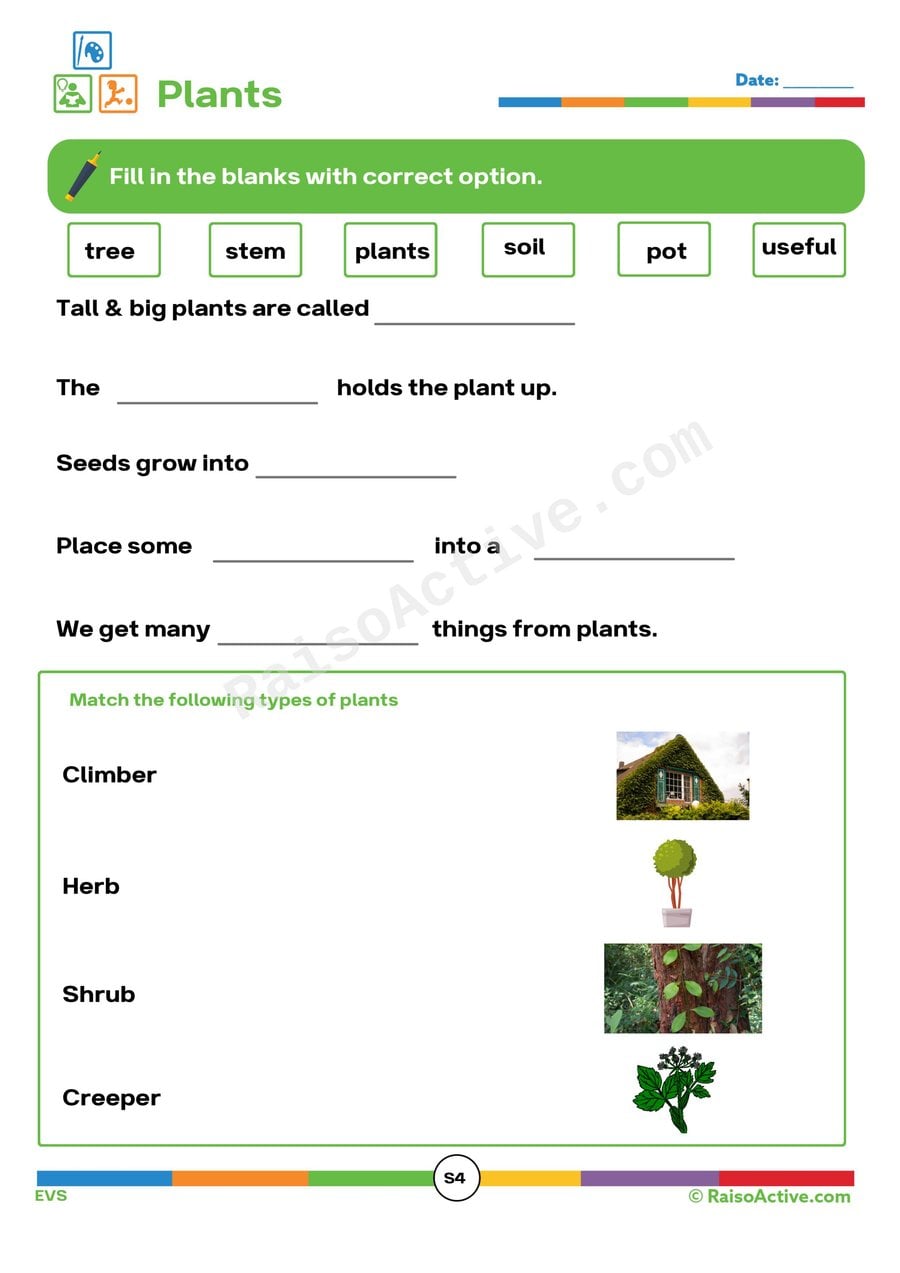
Plant Parts Worksheet for Preschoolers
Ages 4-6 · Pre-K–KindergartenAges 4-6 · Reception–Year 1Ages 4-6 · LKG–UKGAges 4-6
This worksheet introduces 4-6 year olds to plant anatomy — roots, stem, leaves, and flower — and asks them to connect each part's name to its function, while a separate matching section links different plant types to their pictures. Learning that plants have parts with specific jobs (roots drink water, leaves make food from sunlight) is an early building block of life science, and naming these parts gives your child vocabulary they'll keep reusing throughout school science lessons.

Plant Properties Worksheet for Preschoolers: Learn About Plants!
Ages 4-6 · Pre-K–KindergartenAges 4-6 · Reception–Year 1Ages 4-6 · LKG–UKGAges 4-6
Filling in the blanks about what plants need to survive and labeling their parts gives children ages 4-6 a more structured science lesson than a simple coloring page, requiring them to recall specific facts rather than just recognize pictures. This worksheet combines factual recall — like knowing plants need sunlight, water, and air — with visual labeling of plant anatomy, reinforcing the same content in two different formats. Understanding what plants need to grow also builds a foundation for later lessons on ecosystems, food chains, and basic biology.
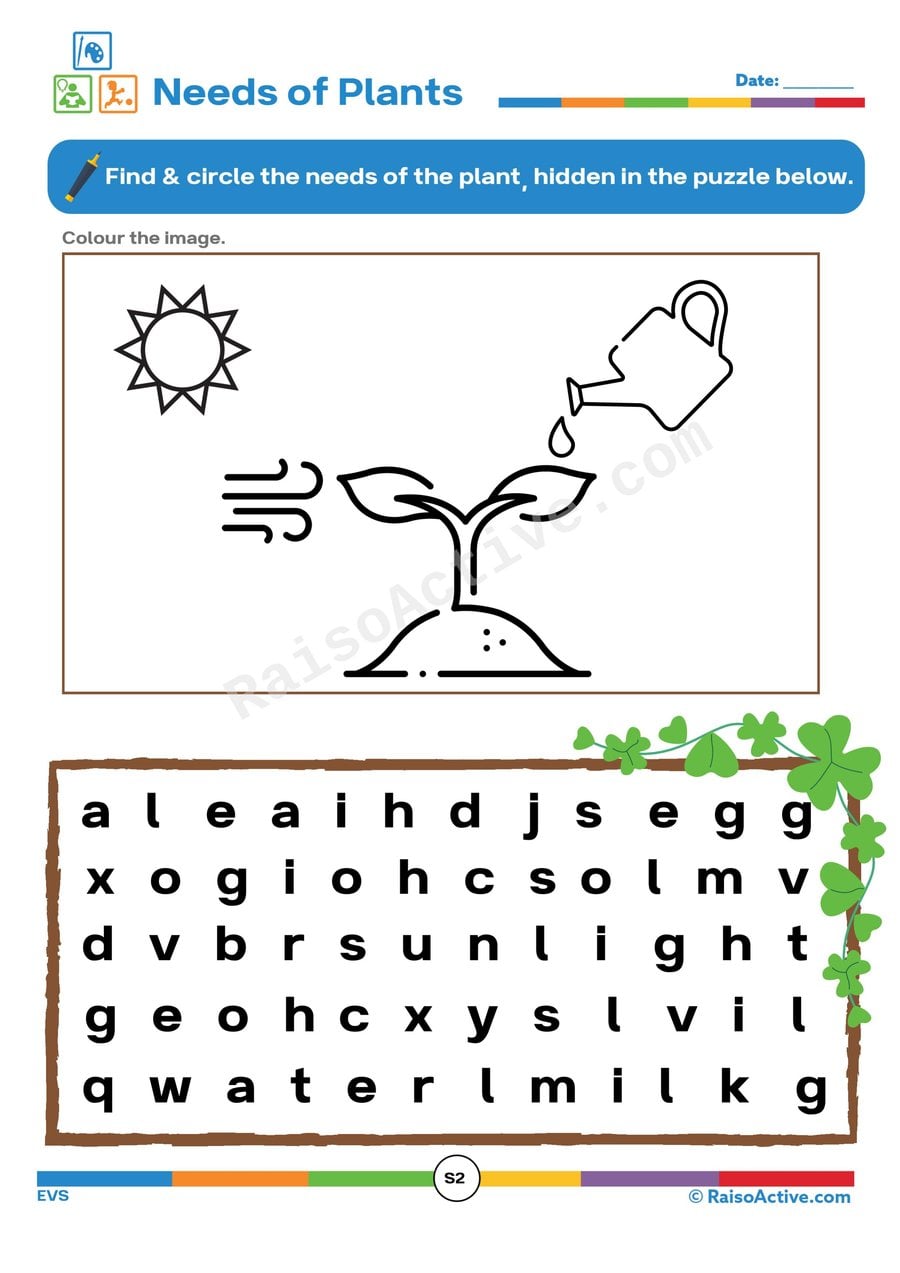
Plant Needs Word Search Worksheet for Kids
Ages 3-5 · Preschool–Pre-KAges 3-5 · Nursery–ReceptionAges 3-5 · Nursery–LKGAges 3-5
This word search introduces 3-5 year olds to the specific things plants need to survive — sunlight, water, soil, air — while building early reading skills through visual word scanning and letter recognition. Hunting for whole words hidden in a grid of letters is a genuinely different reading task than sounding out an isolated word, since your child has to recognize a word's overall letter pattern among distracting surrounding letters.

Crossword Math Worksheet: Fill in the Missing Numbers!
Ages 4-6 · Pre-K–KindergartenAges 4-6 · Reception–Year 1Ages 4-6 · LKG–UKGAges 4-6
This crossword-style worksheet has 4-6 year olds solve a series of subtraction equations to fill in missing numbers, then cross-check their answers by matching them across and down within the grid — a built-in accuracy check that regular subtraction worksheets don't offer. Because an answer has to be correct in both directions to complete the crossword properly, this format naturally encourages your child to double-check their subtraction rather than move on after a single attempt.

Subtraction Fun: Cross Out and Count the Cupcakes!
Ages 4-5 · Pre-KAges 4-5 · ReceptionAges 4-5 · LKGAges 4-5
This worksheet introduces subtraction to 4-5 year olds through a very concrete take-away model: your child crosses out one cupcake from a group and counts what remains, which makes the abstract idea of 'subtracting' visible and immediate rather than something happening only inside a number sentence. Because the crossing-out step comes before the counting step, this worksheet keeps the connection between the physical action and the resulting number crystal clear.
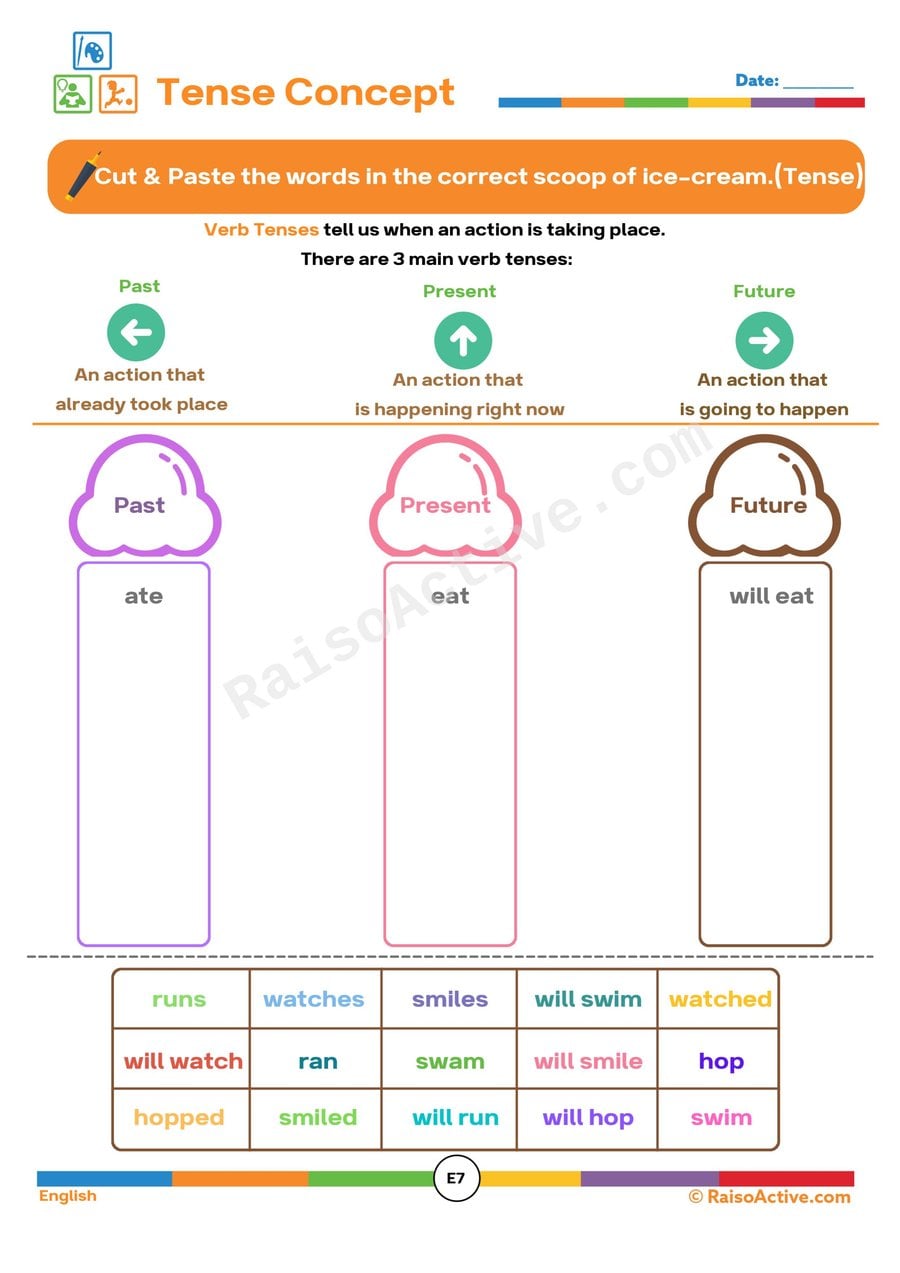
Tense Time! Cut and Paste the Verbs Worksheet
Ages 4-6 · Pre-K–KindergartenAges 4-6 · Reception–Year 1Ages 4-6 · LKG–UKGAges 4-6
Sorting verbs into past, present, and future ice cream scoops teaches 4-6 year olds that verbs physically change form to show when something happens — a foundational grammar concept that often trips kids up because English tense endings are inconsistent (walked, but went, not goed). Because your child has to read each word, decide its tense, and then correctly cut and place it, the worksheet demands genuine comprehension rather than pattern-matching by ending alone, especially where irregular verbs are involved.

Tense Time! A Worksheet on Past, Present, and Future Verbs
Ages 4-6 · Pre-K–KindergartenAges 4-6 · Reception–Year 1Ages 4-6 · LKG–UKGAges 4-6
This worksheet has 4-6 year olds take a given verb and write it correctly in past, present, and future tense boxes, which is a more demanding task than simply identifying tense since it requires actually producing the correct verb form each time — including the common '-ed' ending pattern for regular verbs. Practicing this transformation across multiple verbs builds the flexible understanding that the same action word changes shape depending on when it happens.
Related worksheets

Match the Verb: Action Verbs Worksheet for Preschoolers
Ages 3-5 · Preschool–Pre-KAges 3-5 · Nursery–ReceptionAges 3-5 · Nursery–LKGAges 3-5
Action verbs are some of the first 'doing words' children learn to recognize in print, and this worksheet asks children ages 3-5 to spot the verb within a simple sentence and connect it to a picture showing that action. Circling the verb first trains children to identify the part of a sentence that describes an action, an early grammar skill, while matching it to a picture reinforces comprehension of the word's meaning. This combination builds both reading and vocabulary skills using content — running, jumping, eating — that's naturally engaging to young children.
Colour the अ Things: Hindi Letter अ Colouring Page | रंग भरो · अ
Ages 3-7 · Preschool–Grade 1Ages 3-7 · Nursery–Year 2Ages 3-7 · Nursery–Class 1Ages 3-7
Children listen for the first sound of each picture name and decide whether it starts with अ. They colour the अ pictures, cross out the others and colour the big letter.

Merry Christmas Coloring Worksheet for Preschoolers
Ages 3-5 · Preschool–Pre-KAges 3-5 · Nursery–ReceptionAges 3-5 · Nursery–LKGAges 3-5
Filling in Christmas-themed pictures with crayons or colored pencils helps children ages 3-5 refine their pencil grip and hand control while practicing the concept of staying within a defined boundary. Because the pictures include multiple familiar holiday objects, this worksheet also gives children a chance to build vocabulary by naming each item as they color it. Repeated coloring practice at this age steadily improves the wrist and finger strength needed for later writing tasks.
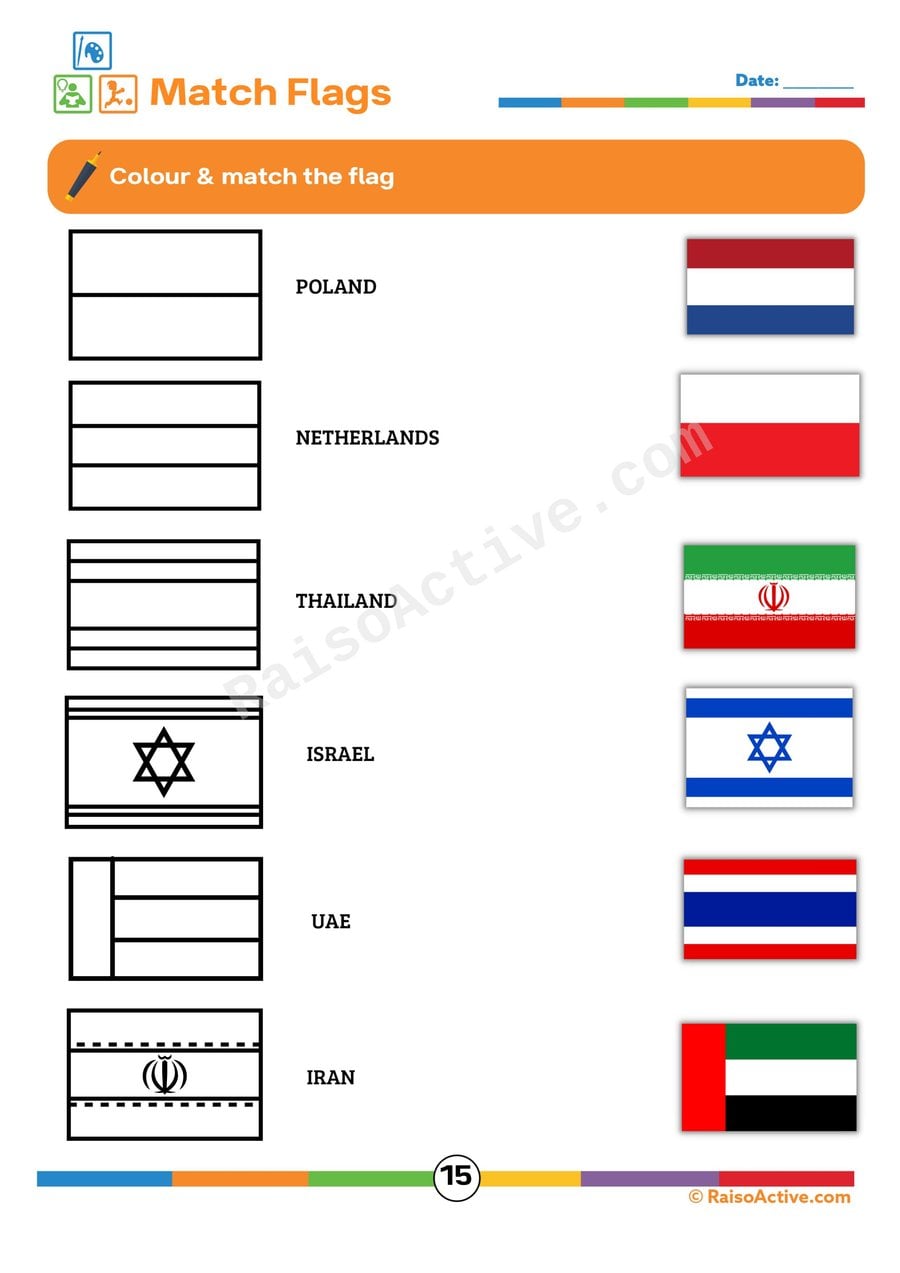
Match the Flags Worksheet: Color and Learn!
Ages 3-5 · Preschool–Pre-KAges 3-5 · Nursery–ReceptionAges 3-5 · Nursery–LKGAges 3-5
This worksheet asks children ages 3-5 to color a set of country flags and then match each one to its printed name, combining fine motor coloring practice with early visual-word association. Matching a colored flag to text also builds pre-reading skills, since children learn to recognize whole words as symbols tied to a picture even before they can sound them out.

Phonics Level 2 Certificate of Achievement: Super Reader
Ages 4-7 · Pre-K–Grade 1Ages 4-7 · Reception–Year 2Ages 4-7 · LKG–Class 1Ages 4-7
Children celebrate reading and spelling words with blends and digraphs, and tick what they can read: CVC words, blends and digraphs.
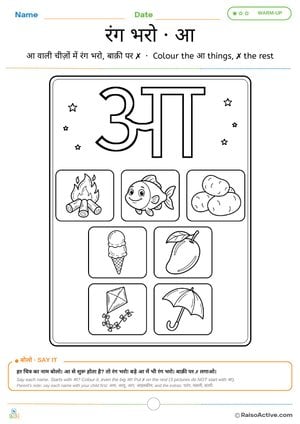
Colour the आ Things: Hindi Letter आ Colouring Page | रंग भरो · आ
Ages 3-7 · Preschool–Grade 1Ages 3-7 · Nursery–Year 2Ages 3-7 · Nursery–Class 1Ages 3-7
Children listen for the first sound of each picture name and decide whether it starts with आ. They colour the आ pictures, cross out the others and colour the big letter.

Dinosaur Friendship Bands Worksheet: Cut, Color, and Create!
Ages 3-5 · Preschool–Pre-KAges 3-5 · Nursery–ReceptionAges 3-5 · Nursery–LKGAges 3-5
This worksheet combines scissor practice with creative design as children ages 3-5 cut out dinosaur-themed friendship bands and color them before wearing or gifting them. Cutting along the dotted lines builds the hand strength and control needed for later writing, while choosing colors and patterns for each dinosaur circle nurtures early creative decision-making.

Phonics Level 3 Long Vowels Certificate of Achievement
Ages 5-7 · Kindergarten–Grade 1Ages 5-7 · Year 1–Year 2Ages 5-7 · UKG–Class 1Ages 5-7
Children celebrate finishing Phonics Level 3 and look back at the five long vowel sounds they can now read: long a, e, i, o and u.
Guides for this topic

Best Worksheets for 3-Year-Olds: What Works and What to Avoid
What works on worksheets for 3-year-olds: short sessions, crayons, tracing lines, matching, cutting, a free weekly plan, and signs one is too advanced.
Documenting Learning Without Drowning in Data: A Practical Guide for Parents and Teachers
Learn practical ways to document your child's learning without overwhelm. Simple portfolios, observation tips, and printable trackers for ages 1-8.
Fostering Creativity in Structured Learning: The Perfect Balance for Young Minds
Learn how to blend creativity with structured learning for children ages 1-8. Practical strategies, activities, and printable worksheets for parents and teachers.
Reviews
Every worksheet for ages 3–5, no watermark
Members download the full library of 1,000+ worksheets and every activity pack without watermarks or daily limits. One year costs ₹999 in India or $20 elsewhere.
See membership plansOr download any worksheet free with a watermark (5 a day).