Plant Properties Worksheet for Preschoolers: Learn About Plants!
Filling in the blanks about what plants need to survive and labeling their parts gives children ages 4-6 a more structured science lesson than a simple coloring page, requiring them to recall specific facts rather than just recognize pictures. This worksheet combines factual recall — like knowing plants need sunlight, water, and air — with visual labeling of plant anatomy, reinforcing the same content in two different formats. Understanding what plants need to grow also builds a foundation for later lessons on ecosystems, food chains, and basic biology.
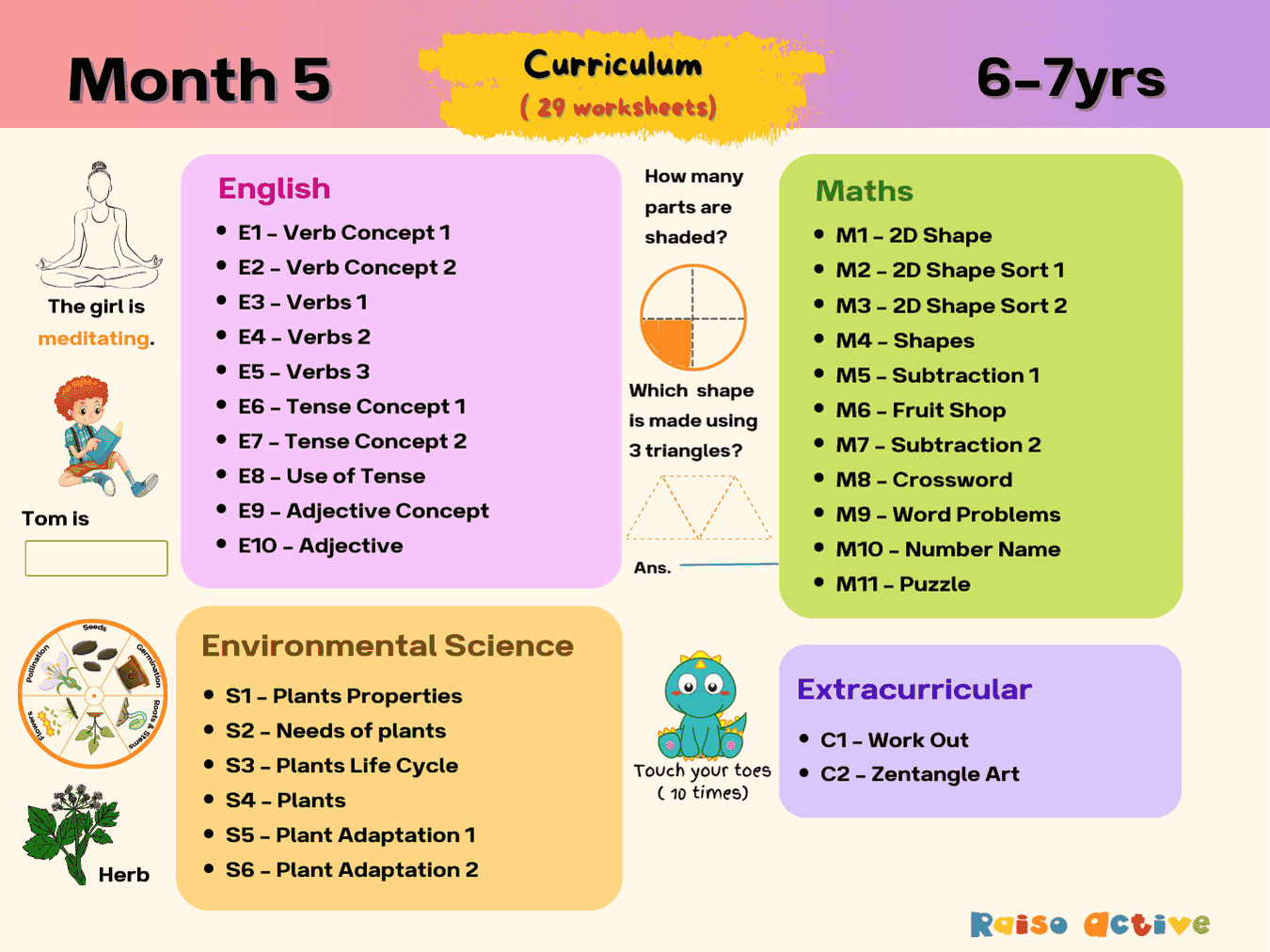
Part of the pack
Month 5: Essential English, Math, Science | Ages 6-7
This is page 25 of the pack. Ages 6-7 · Grade 1Ages 6-7 · Year 2Ages 6-7 · Class 1Ages 6-7
Curriculum
- Living Things - Plants > Plant Science
How to use this worksheet
Read the fill-in-the-blank sentences aloud together first, discussing what a plant needs to survive before your child chooses the correct word from the options given. Have them write or circle their chosen answer for each blank, checking that the completed sentence makes sense when read back. Move to the labeling section, where your child uses the arrows pointing to different parts of a plant to write or match the correct part name. Review the whole page together once finished, reading the completed sentences and labels aloud.
Materials needed
- Pencil
- Crayons
Extension activities
- 1Plant a seed in a cup with your child and observe together what it needs to grow over the following weeks.
- 2Draw and label your own plant, including its roots, stem, leaves, and flower.
- 3Go outside and examine a real plant, pointing out its parts and discussing what it needs to survive.
- 4Create a simple poster listing everything a plant needs, like sunlight, water, and soil.
- 5Read a short book about how plants grow and compare it to what your child learned on the worksheet.

Written by
Hemsweta Jain · Teacher Cheena
MBA and Early Childhood Educator, teaching since 2014 · Founder of RaisoActive, Mumbai
Every RaisoActive worksheet is designed and checked by the founder before publishing.
Published · Last reviewed
More from Month 5: Essential English, Math, Science | Ages 6-7

Action Verbs Worksheet: Cut and Paste the Correct Verb!
Ages 3-5 · Preschool–Pre-KAges 3-5 · Nursery–ReceptionAges 3-5 · Nursery–LKGAges 3-5
This cut-and-paste worksheet asks young children to look at a picture of an action, choose the matching verb from a set of cutouts at the bottom of the page, and glue it into the blank — practicing verb-to-image matching alongside genuine scissor and glue control. Because the verbs aren't pre-placed, your child has to actively decide which word fits each picture rather than simply confirming an existing pairing, which makes the vocabulary work more demanding than a standard matching worksheet.
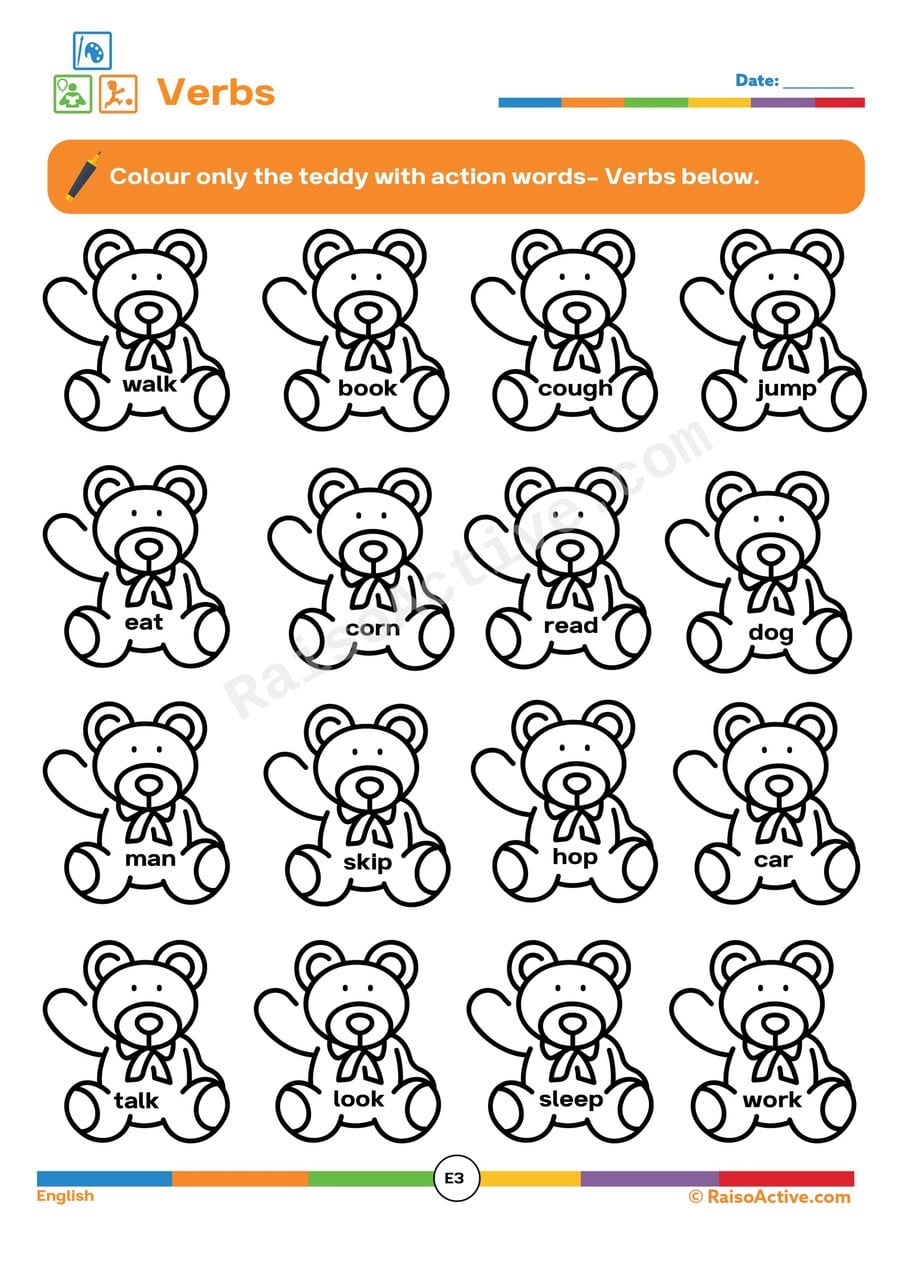
Action Word Coloring Worksheet for Preschoolers
Ages 3-5 · Preschool–Pre-KAges 3-5 · Nursery–ReceptionAges 3-5 · Nursery–LKGAges 3-5
This worksheet trains 3-5 year olds to follow a written instruction precisely — color only the teddy bears paired with specific action words, and leave the rest blank. That precision is the real skill being built: your child has to read or recognize each action word before deciding whether to color, rather than coloring everything in sight. It's an early, low-stakes way to connect written verbs to their meaning while also practicing careful, purposeful coloring instead of open-ended scribbling.
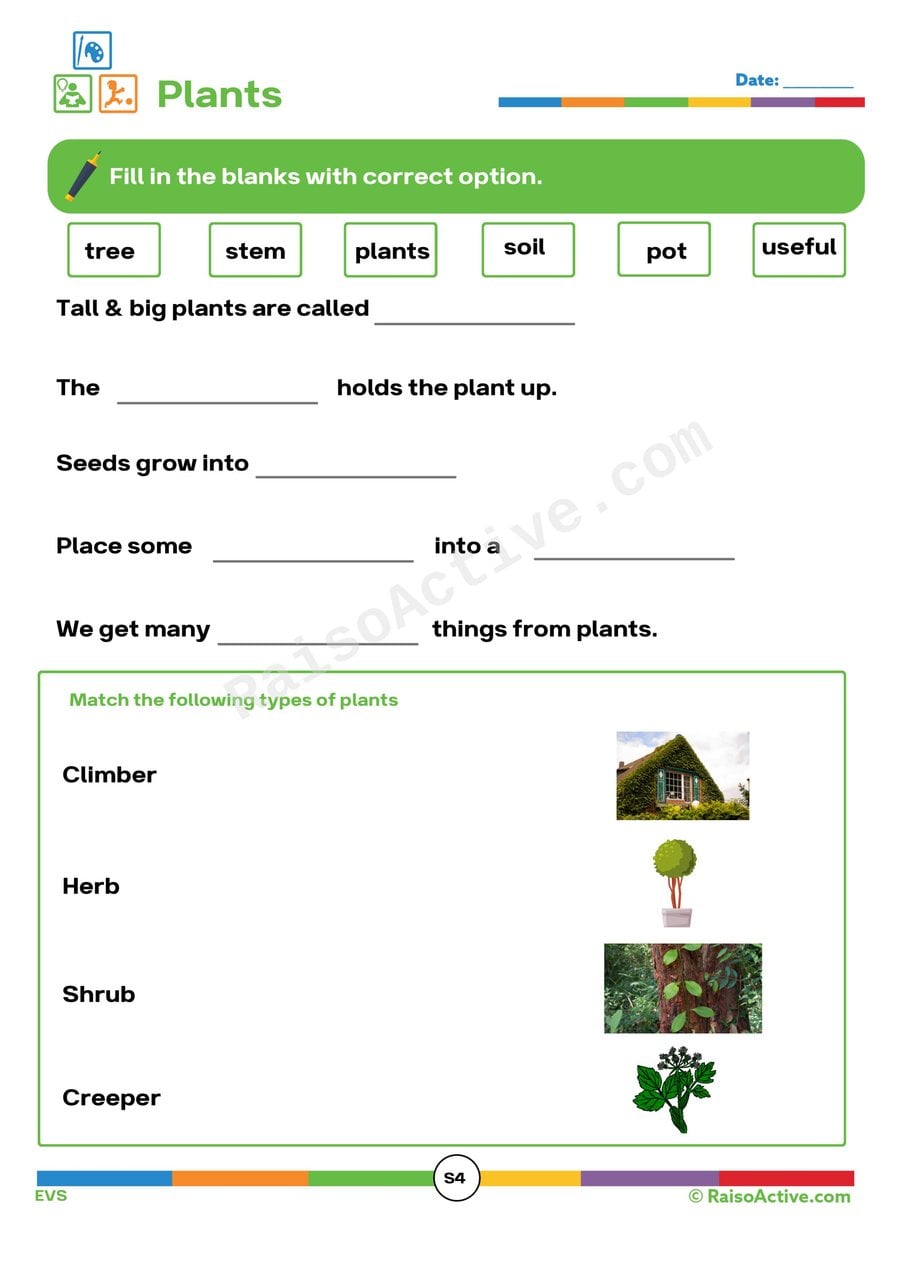
Plant Parts Worksheet for Preschoolers
Ages 4-6 · Pre-K–KindergartenAges 4-6 · Reception–Year 1Ages 4-6 · LKG–UKGAges 4-6
This worksheet introduces 4-6 year olds to plant anatomy — roots, stem, leaves, and flower — and asks them to connect each part's name to its function, while a separate matching section links different plant types to their pictures. Learning that plants have parts with specific jobs (roots drink water, leaves make food from sunlight) is an early building block of life science, and naming these parts gives your child vocabulary they'll keep reusing throughout school science lessons.
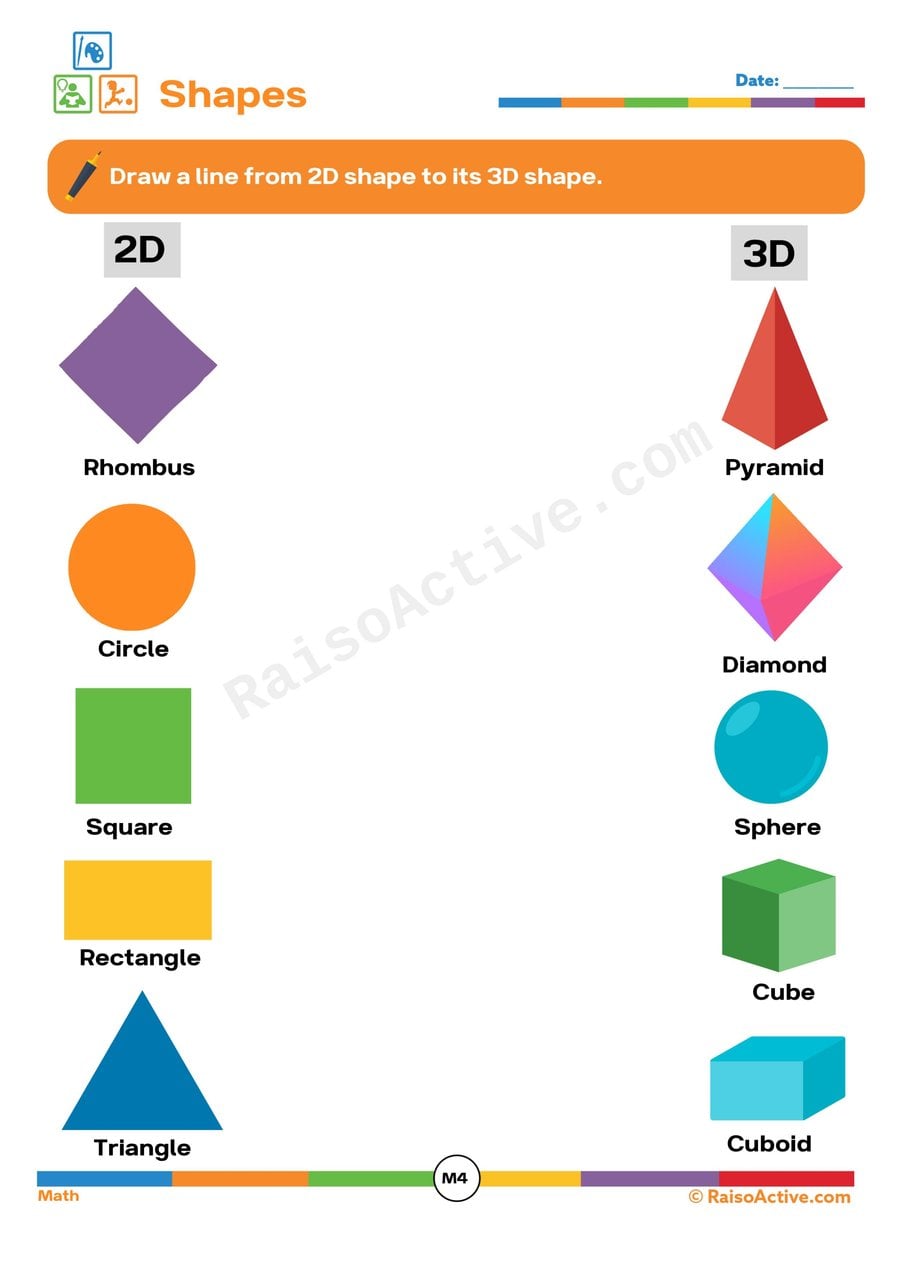
Shape Match: 2D to 3D Shapes Worksheet
Ages 4-6 · Pre-K–KindergartenAges 4-6 · Reception–Year 1Ages 4-6 · LKG–UKGAges 4-6
This worksheet introduces 4-6 year olds to the relationship between flat 2D shapes and solid 3D shapes — connecting a circle to a sphere, a square to a cube — which is an important spatial reasoning leap, since a 3D shape's flat 'face' is what actually corresponds to its related 2D shape. Making this connection explicit helps children understand that the shapes they've been learning aren't just flat pictures but also describe the surfaces of real, solid objects around them.
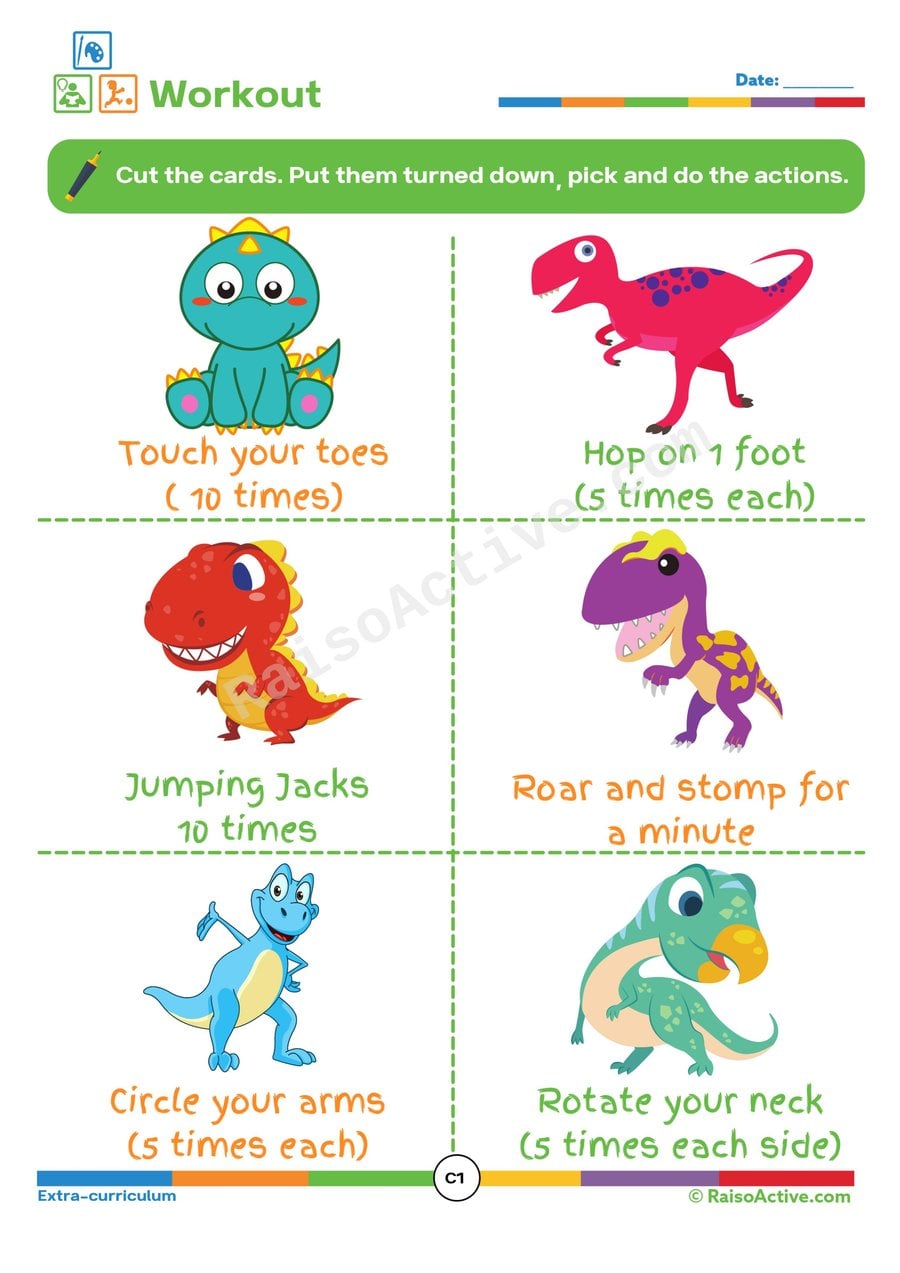
Dino Workout: Fun Exercise Worksheet for Kids!
Ages 3-5 · Preschool–Pre-KAges 3-5 · Nursery–ReceptionAges 3-5 · Nursery–LKGAges 3-5
This dinosaur-themed activity gets 3-5 year olds moving, which is exactly what this age group needs for developing gross motor skills, body awareness, and balance — abilities that don't come from sitting at a table. Following each exercise card as instructed also builds the ability to interpret a picture prompt and translate it into a physical action, a form of following directions that's harder than it sounds for young children still developing self-regulation.

Parent's Guide: Fun Activities for Verbs, Subtraction, and More!
Ages 3-5 · Preschool–Pre-KAges 3-5 · Nursery–ReceptionAges 3-5 · Nursery–LKGAges 3-5
This parent guide pulls together several early-learning threads — verbs, subtraction, plant life cycles, and 2D shapes — into a single set of hands-on activity suggestions designed for 3-5 year olds, giving you ready-made ways to reinforce classroom or worksheet learning at home without needing to plan lessons yourself. Rather than a single skill, this guide's value is in showing how the same everyday objects (flashcards, fruit, seeds, toys) can support several different concepts across a week of casual, low-pressure practice.

Adjective Adventure: Matching Sentences Worksheet for Kids
Ages 4-6 · Pre-K–KindergartenAges 4-6 · Reception–Year 1Ages 4-6 · LKG–UKGAges 4-6
This worksheet teaches 4-6 year olds that adjectives are the words that describe nouns, asking them to fill in a missing adjective in a sentence and then physically mark the noun and adjective separately by underlining and circling. That separation step — telling apart which word names a thing and which word describes it — is a genuinely useful grammar distinction that most children haven't consciously noticed before, even though they use adjectives constantly in speech.

2D Shapes Worksheet for Preschoolers: Identifying Shapes and Properties
Ages 4-6 · Pre-K–KindergartenAges 4-6 · Reception–Year 1Ages 4-6 · LKG–UKGAges 4-6
This worksheet pushes 4-6 year olds past simply naming shapes into analyzing their properties — counting sides and corners for circles, triangles, squares, rectangles, pentagons, and hexagons, and using those properties to answer more complex questions about which shapes combine to form others. That combination-and-composition piece (asking what shapes make up a bigger shape, or identifying a shaded portion) is genuine early geometric reasoning, well beyond simple shape recognition.
Related worksheets

Parts of a Plant Cut and Paste Worksheet for Kids
Ages 3-5 · Preschool–Pre-KAges 3-5 · Nursery–ReceptionAges 3-5 · Nursery–LKGAges 3-5
This cut-and-paste worksheet teaches children ages 3-5 the names and locations of the main parts of a plant — roots, stem, leaves, flower, and fruit — by having them match labels to the correct spot on a plant diagram. Learning to label a diagram, rather than just naming parts verbally, is an early step toward the kind of labeled-illustration work children will do throughout their science education.

Spring Sudoku Worksheet: Cut and Paste Puzzle for Kids
Ages 4-6 · Pre-K–KindergartenAges 4-6 · Reception–Year 1Ages 4-6 · LKG–UKGAges 4-6
Placing cut-out pictures into a sudoku-style grid so that no image repeats in any row, column, or box teaches children ages 4-6 early logical reasoning and systematic thinking, since they must check multiple directions before deciding where each piece belongs. Cutting out the small picture squares beforehand also builds scissor control and hand-eye coordination. Together, this combines a pre-math logic puzzle with fine motor practice in a single spring-themed activity.

Butterfly Life Cycle Cut and Paste Worksheet for Preschoolers
Ages 4-6 · Pre-K–KindergartenAges 4-6 · Reception–Year 1Ages 4-6 · LKG–UKGAges 4-6
Children ages 4-6 build on earlier metamorphosis learning by assembling a butterfly life cycle circle book, practicing sequencing and fine motor precision as they cut and glue circular pieces. The rotating circle book format reinforces that metamorphosis is a repeating cycle, helping children move beyond a simple straight-line understanding of egg to butterfly.

Lock and Key Matching Worksheet for Preschoolers
Ages 3-5 · Preschool–Pre-KAges 3-5 · Nursery–ReceptionAges 3-5 · Nursery–LKGAges 3-5
Matching each key to the lock sharing the same letter helps children ages 3-5 practice letter recognition in a playful, puzzle-like context rather than rote drilling. Because each key must be checked against several similar-looking locks before finding the right match, this worksheet also builds visual scanning and careful comparison skills that support problem-solving.

Sequencing Worksheet for Kids: First, Next, Last
Ages 4-7 · Pre-K–Grade 1Ages 4-7 · Reception–Year 2Ages 4-7 · LKG–Class 1Ages 4-7
Children put three-step stories in order using first, next and last, then work backwards to find what came before a picture. This builds sequencing, time vocabulary and cause and effect thinking.

Lifecycle Circle Book: Cut & Paste Activity for Preschoolers
Ages 3-5 · Preschool–Pre-KAges 3-5 · Nursery–ReceptionAges 3-5 · Nursery–LKGAges 3-5
Building this circle book helps children ages 3-5 understand that a plant's life cycle is a repeating loop rather than a straight line — a seed grows into a sprout, then a mature plant, which produces seeds of its own to start the cycle again. Cutting out and assembling the circles in order also develops scissor control and hand-eye coordination. Framing the plant's growth as a 'book' gives children a tangible object they can flip through to retell the sequence in their own words.

Balloon Pattern Matching Worksheet for Preschoolers
Ages 3-5 · Preschool–Pre-KAges 3-5 · Nursery–ReceptionAges 3-5 · Nursery–LKGAges 3-5
Children ages 3-5 build early pattern-recognition skills on this worksheet by studying a sequence of colored balloons and finding the matching set to complete it. Recognizing and continuing a repeating sequence is a foundational pre-math skill that later supports understanding of number patterns, skip counting, and simple algebraic thinking.
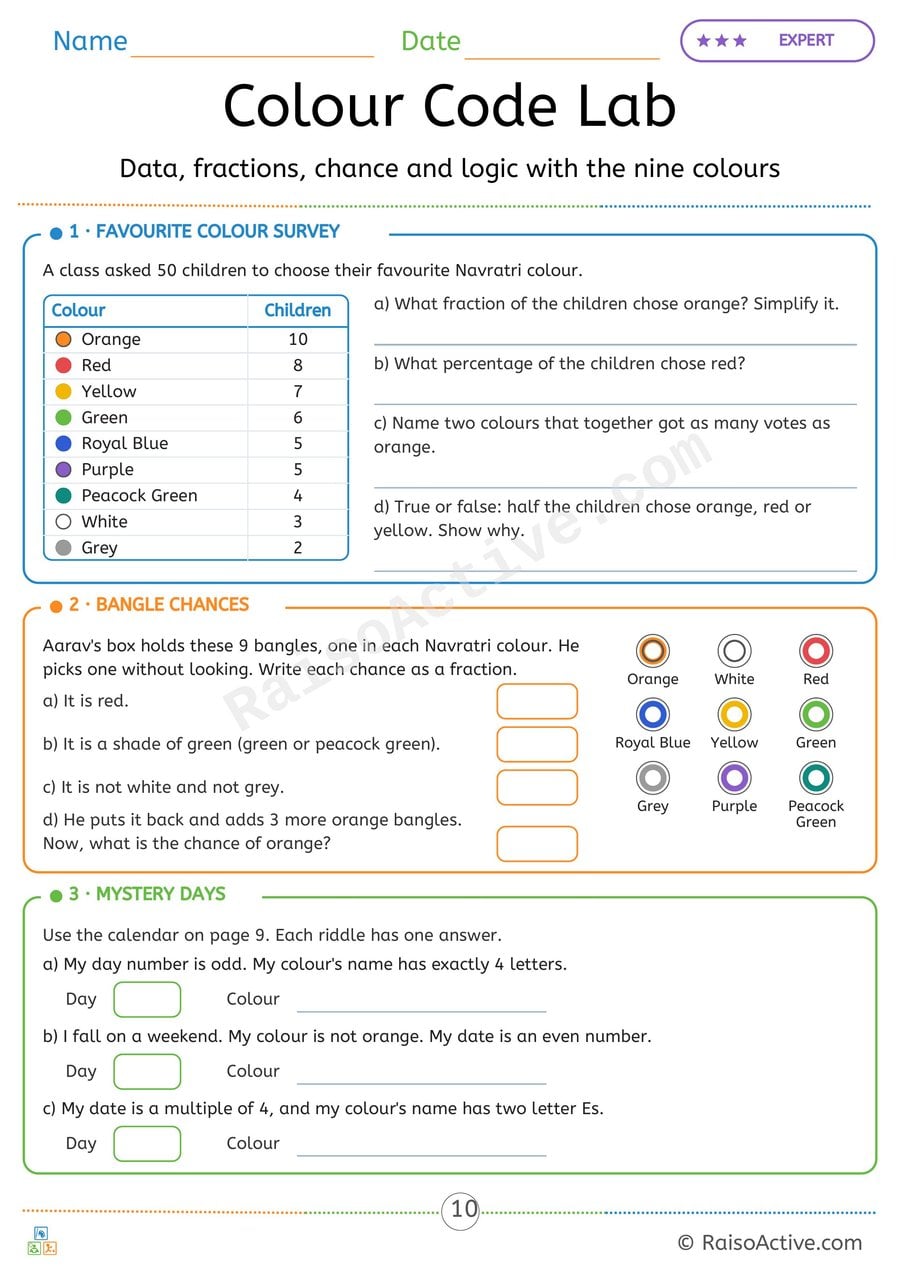
Colour Code Lab: Navratri Fractions, Percentages and Probability
Ages 7-11 · Grade 2–Grade 3Ages 7-11 · Year 3–Year 4Ages 7-11 · Class 2–Class 3Ages 7-11
Children read a survey of 50 children's favourite Navratri colours and write fractions and percentages, write the chance of picking each kind of bangle as a fraction, and solve three riddles using the colour calendar on page 9.
Guides for this topic

Age-Appropriate Problem-Solving Activities: Building Critical Thinkers from the Ground Up
Discover fun, age-appropriate problem-solving activities for children ages 1-8. Build critical thinking, logic, and reasoning skills through play-based learning.
Critical Thinking Activities That Actually Work for Young Children: Building Tomorrow's Thinkers Today
Discover proven critical thinking activities for young children. Age-wise logic games, questioning techniques, and hands-on ideas to build thinking skills at home.

Preparing Your Child for a Rapidly Changing World: Essential Skills for Future Success
Discover the essential 21st century skills your child needs for future success. Practical tips on creativity, critical thinking, digital literacy & emotional intelligence for ages 1-8.
Reviews
Every worksheet for ages 4–6, no watermark
Members download the full library of 1,000+ worksheets and every activity pack without watermarks or daily limits. One year costs ₹999 in India or $20 elsewhere.
See membership plansOr download any worksheet free with a watermark (5 a day).