Plant Life Cycle Wheel: Cut, Pin & Learn!
Building a spinning wheel that shows a plant's life cycle helps children ages 4-6 understand that growth happens in a repeating sequence of stages — seed, sprout, growing plant, flower — rather than as a single instant event. This hands-on 3D craft turns an abstract scientific process into something children can physically rotate and observe, which suits how young learners grasp sequence and cause-and-effect best. Assembling the two-circle wheel with a paper fastener also builds fine motor precision beyond typical flat cut-and-paste tasks.
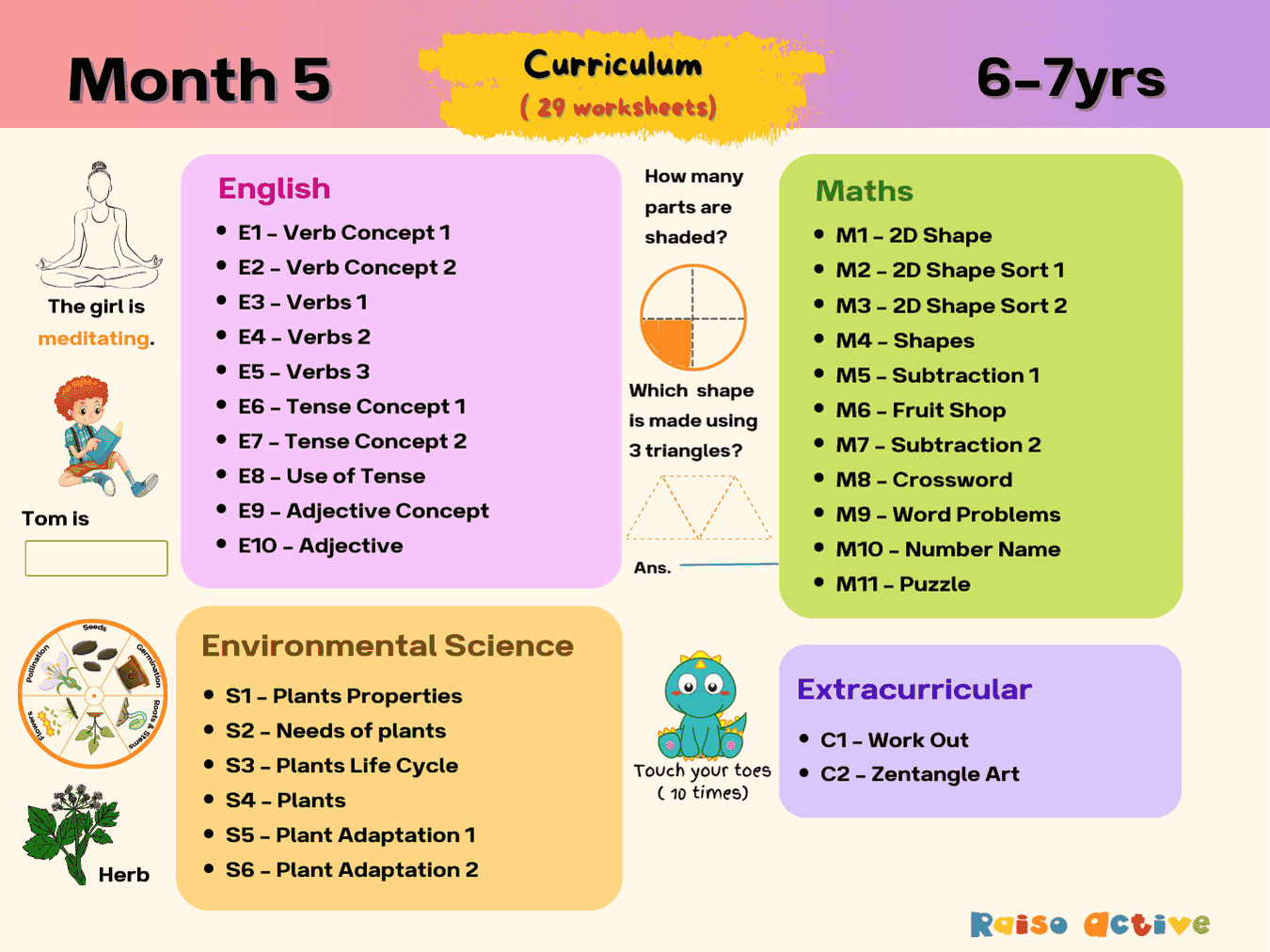
Part of the pack
Month 5: Essential English, Math, Science | Ages 6-7
This is page 27 of the pack. Ages 6-7 · Grade 1Ages 6-7 · Year 2Ages 6-7 · Class 1Ages 6-7
Curriculum
- Living Things - Plants > Plant Science
How to use this worksheet
Have your child cut out both circles along their outer edges, offering help with the curved cutting if needed. Show them how to place the smaller top circle over the larger bottom circle, aligning the small window cutout with the pictures underneath. Help your child push a paper fastener or brad through the center point of both circles to join them securely. Once assembled, let your child rotate the top circle slowly, describing each stage of the plant life cycle as it appears in the window.
Materials needed
- Scissors
- Pin or brad
- Pencil (optional)
Extension activities
- 1Plant a real seed in a cup and check on it regularly, comparing its stages to the wheel.
- 2Draw your own simple plant life cycle as a straight sequence of pictures rather than a wheel.
- 3Act out the plant life cycle as a movement game — curl up small as a seed, then slowly 'grow' into a tall flower.
- 4Read a picture book about how plants grow from seed to flower.
- 5Make a second life-cycle wheel for a different plant, like a sunflower or an apple tree, and compare the stages.

Written by
Hemsweta Jain · Teacher Cheena
MBA and Early Childhood Educator, teaching since 2014 · Founder of RaisoActive, Mumbai
Every RaisoActive worksheet is designed and checked by the founder before publishing.
Published · Last reviewed
More from Month 5: Essential English, Math, Science | Ages 6-7
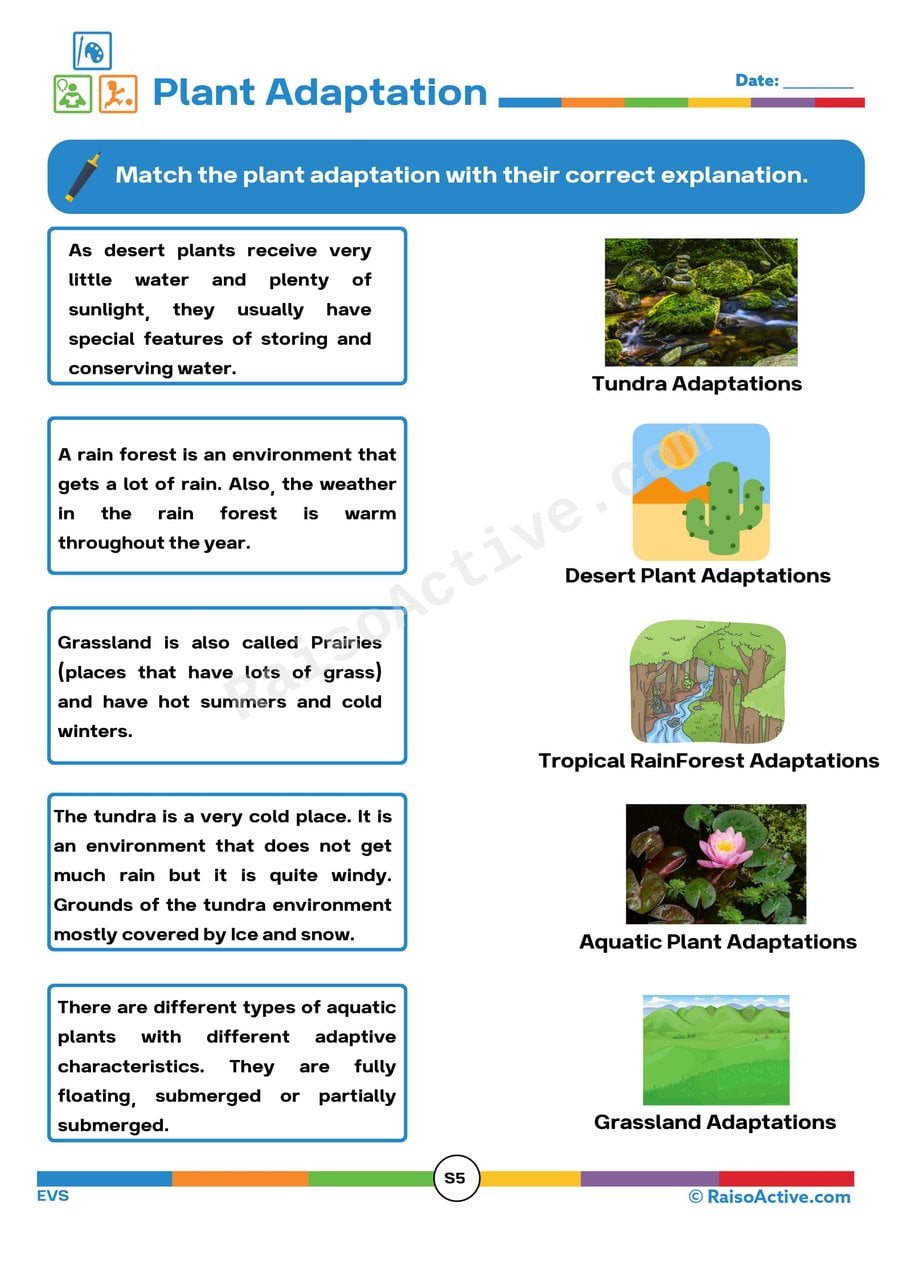
Plant Adaptation Matching Worksheet for Kids
Ages 4-6 · Pre-K–KindergartenAges 4-6 · Reception–Year 1Ages 4-6 · LKG–UKGAges 4-6
This worksheet has 4-6 year olds match written descriptions of plant adaptations to the correct pictures, building on the idea that plants develop specific features — thick leaves, deep roots, bright flowers — to help them survive in their particular environment. Matching a description to an image requires your child to connect an abstract idea (why does this feature help?) to a concrete picture, which is a genuine step up from simple plant-part identification.

Plant Adaptation Worksheet for Kids: Matching Examples
Ages 4-6 · Pre-K–KindergartenAges 4-6 · Reception–Year 1Ages 4-6 · LKG–UKGAges 4-6
This worksheet introduces 4-6 year olds to plant adaptations — the specific features that help plants survive in their environment, like thick leaves that store water or thorns that deter animals — by having them match real plant examples to the correct type of adaptation and then write it in. This is a genuinely abstract science concept for this age group, since it requires connecting a visible feature to an invisible purpose (why does a cactus have thick, waxy skin?), making it more conceptually demanding than simple plant-part labeling.

Action Verbs Worksheet: Identify and Color Verbs in the Picture
Ages 3-5 · Preschool–Pre-KAges 3-5 · Nursery–ReceptionAges 3-5 · Nursery–LKGAges 3-5
This worksheet asks 3-5 year olds to look closely at a busy picture and decide which action verbs are actually happening in it versus which ones aren't shown at all, using a color code (green for present, red for absent) to record their answer. That distinction — is this action really happening in the picture, or just a word I know? — pushes your child to observe carefully rather than simply recognize verb vocabulary in isolation.
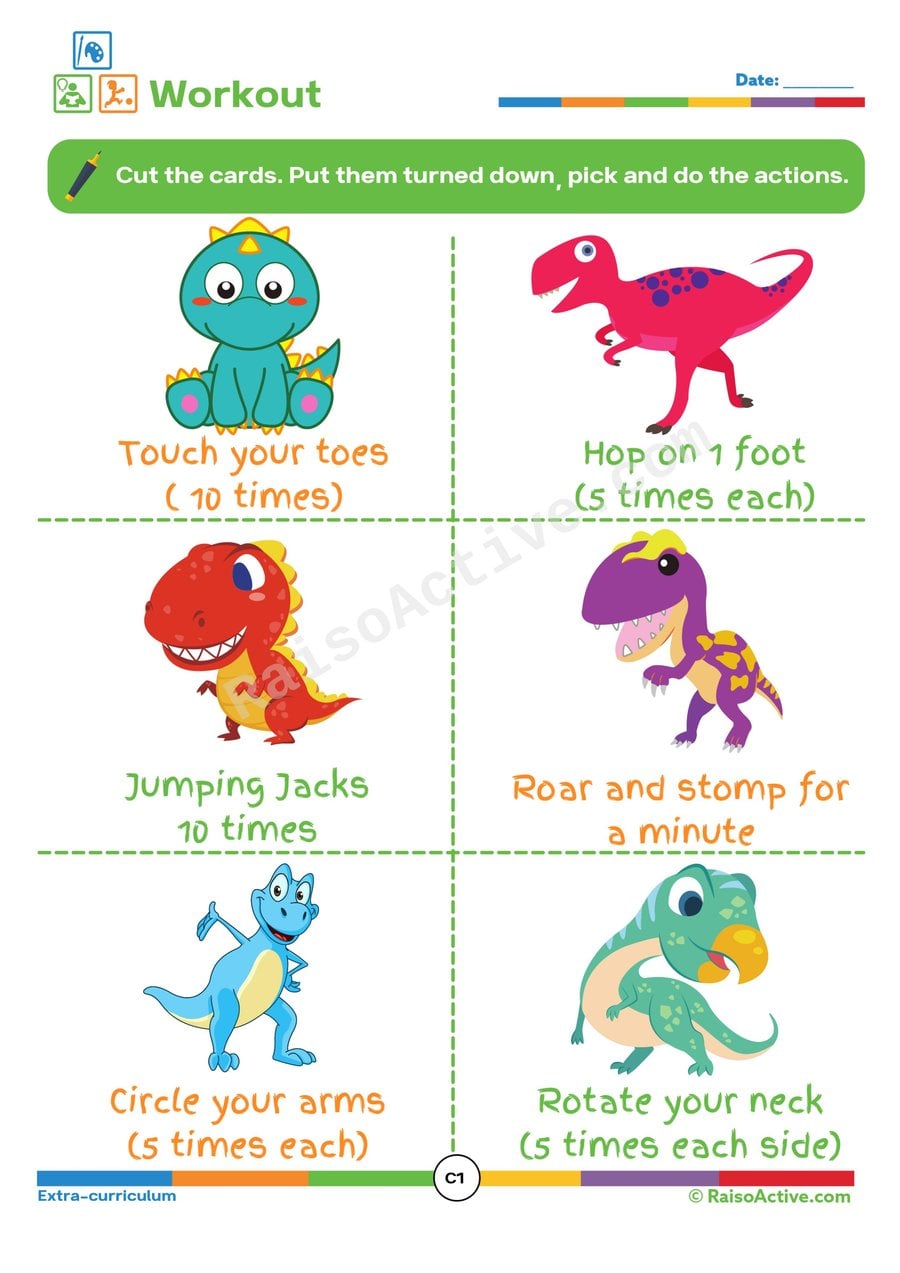
Dino Workout: Fun Exercise Worksheet for Kids!
Ages 3-5 · Preschool–Pre-KAges 3-5 · Nursery–ReceptionAges 3-5 · Nursery–LKGAges 3-5
This dinosaur-themed activity gets 3-5 year olds moving, which is exactly what this age group needs for developing gross motor skills, body awareness, and balance — abilities that don't come from sitting at a table. Following each exercise card as instructed also builds the ability to interpret a picture prompt and translate it into a physical action, a form of following directions that's harder than it sounds for young children still developing self-regulation.

Tense Time! Identifying Past, Present, and Future Tense Worksheet
Ages 5-7 · Kindergarten–Grade 1Ages 5-7 · Year 1–Year 2Ages 5-7 · UKG–Class 1Ages 5-7
This worksheet asks 5-7 year olds to read a full sentence and identify which tense it's written in — past, present, or future — based on the verb form and clue words used, which is a meaningfully harder skill than simply writing verbs in different tenses since it requires recognizing the grammar pattern rather than producing it. This kind of tense-identification practice is exactly what supports stronger reading comprehension and writing later, since understanding when something happens is core to following any story.
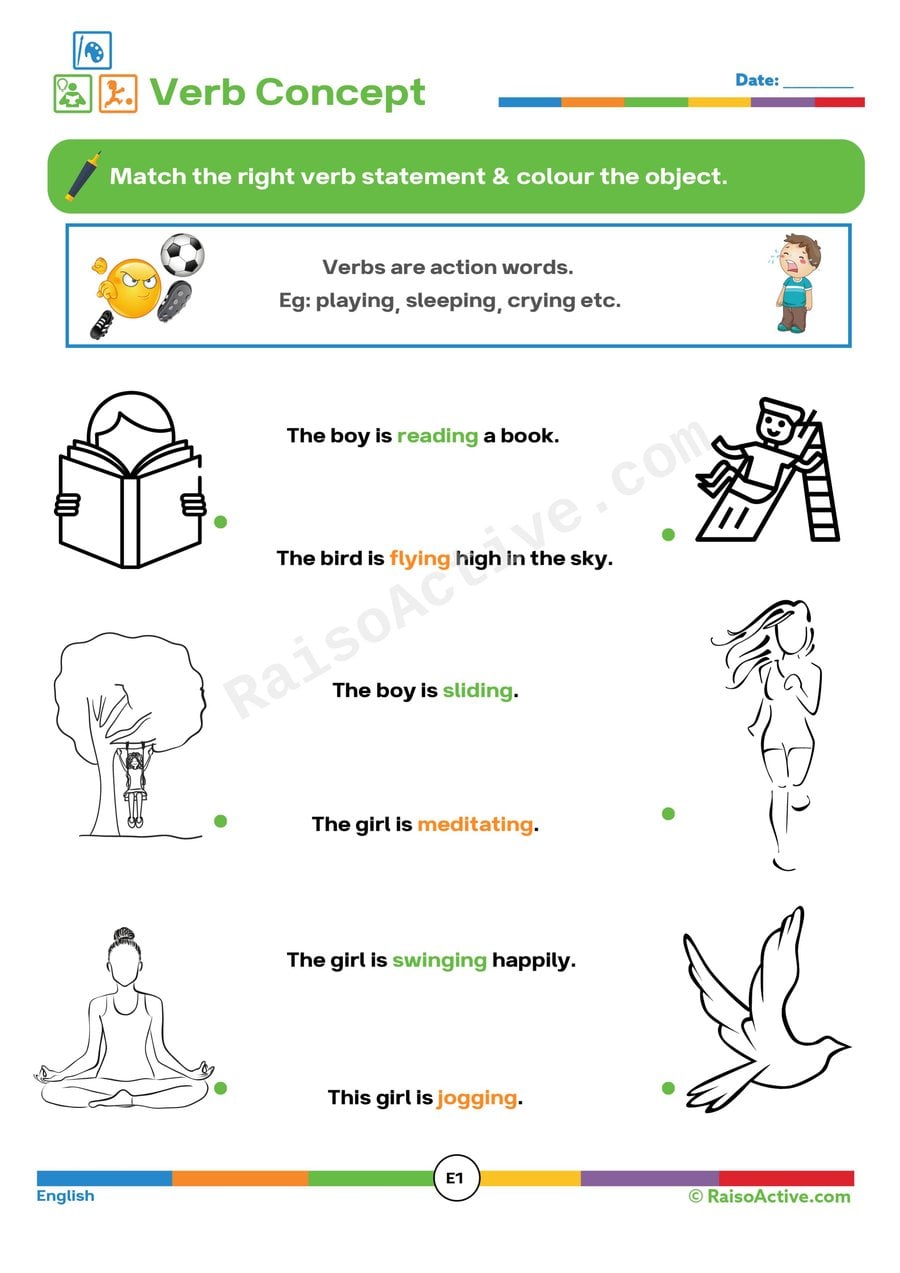
Action Verbs Worksheet: Match and Color!
Ages 4-6 · Pre-K–KindergartenAges 4-6 · Reception–Year 1Ages 4-6 · LKG–UKGAges 4-6
This worksheet has 4-6 year olds read a short sentence, pick out the action word inside it, and match that sentence to the picture showing the action happening — a skill that bridges early reading with grammar. Identifying the verb specifically (rather than just understanding the sentence generally) is a more advanced task than simple picture-word matching, since children have to isolate one word's job within a whole sentence. Coloring the matched picture afterward gives an easy, low-pressure way to confirm the match was correct.

Crossword Math Worksheet: Fill in the Missing Numbers!
Ages 4-6 · Pre-K–KindergartenAges 4-6 · Reception–Year 1Ages 4-6 · LKG–UKGAges 4-6
This crossword-style worksheet has 4-6 year olds solve a series of subtraction equations to fill in missing numbers, then cross-check their answers by matching them across and down within the grid — a built-in accuracy check that regular subtraction worksheets don't offer. Because an answer has to be correct in both directions to complete the crossword properly, this format naturally encourages your child to double-check their subtraction rather than move on after a single attempt.

Tense Time! A Worksheet on Past, Present, and Future Verbs
Ages 4-6 · Pre-K–KindergartenAges 4-6 · Reception–Year 1Ages 4-6 · LKG–UKGAges 4-6
This worksheet has 4-6 year olds take a given verb and write it correctly in past, present, and future tense boxes, which is a more demanding task than simply identifying tense since it requires actually producing the correct verb form each time — including the common '-ed' ending pattern for regular verbs. Practicing this transformation across multiple verbs builds the flexible understanding that the same action word changes shape depending on when it happens.
Related worksheets

Plant Life Cycle Worksheet: Cut and Paste the Stages!
Ages 3-5 · Preschool–Pre-KAges 3-5 · Nursery–ReceptionAges 3-5 · Nursery–LKGAges 3-5
This worksheet helps children ages 3-5 learn the different stages of a plant's life cycle, from seed to sprout to full-grown plant, by coloring each stage and then cutting and pasting the pictures in the correct sequential order. Sequencing the stages builds early scientific reasoning about growth and change over time, a concept children can also observe in themselves.
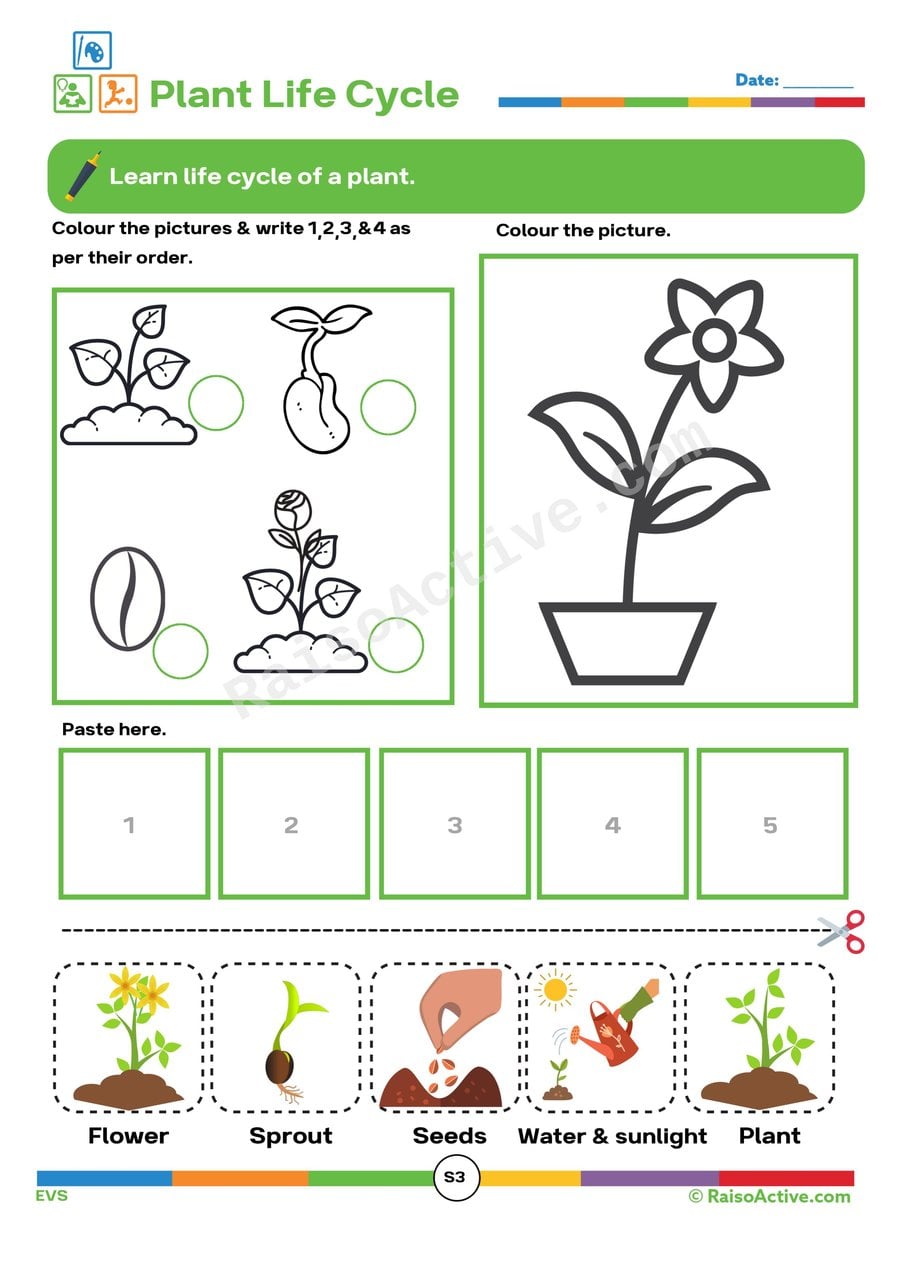
Plant Life Cycle Worksheet: Learn and Color!
Ages 3-5 · Preschool–Pre-KAges 3-5 · Nursery–ReceptionAges 3-5 · Nursery–LKGAges 3-5
Sequencing the stages of a plant's life cycle — from seed to sprout to full-grown flower — introduces children ages 3-5 to the science concept that living things grow and change in a predictable order over time. Numbering the stages before coloring also builds early sequencing and observation skills, since children must look closely at each picture to judge which comes before the next.

Lifecycle Circle Book: Cut & Paste Activity for Preschoolers
Ages 3-5 · Preschool–Pre-KAges 3-5 · Nursery–ReceptionAges 3-5 · Nursery–LKGAges 3-5
Building this circle book helps children ages 3-5 understand that a plant's life cycle is a repeating loop rather than a straight line — a seed grows into a sprout, then a mature plant, which produces seeds of its own to start the cycle again. Cutting out and assembling the circles in order also develops scissor control and hand-eye coordination. Framing the plant's growth as a 'book' gives children a tangible object they can flip through to retell the sequence in their own words.

Plant Life Cycle Worksheet: Cut and Paste the Stages!
Ages 4-6 · Pre-K–KindergartenAges 4-6 · Reception–Year 1Ages 4-6 · LKG–UKGAges 4-6
Children ages 4-6 learn the sequential stages of a plant's life cycle — from seed to sprout to full-grown flower — by cutting out and correctly ordering picture cards. Understanding that living things grow through a fixed, predictable sequence is an early science concept that also reinforces sequencing and ordering skills useful well beyond biology.

Coding Shapes Worksheet for Preschoolers: Cut and Paste Patterns
Ages 3-5 · Preschool–Pre-KAges 3-5 · Nursery–ReceptionAges 3-5 · Nursery–LKGAges 3-5
This cut-and-paste activity has children ages 3-5 recreate shape sequences shown in sample boxes, combining shape recognition with the same ordered, step-by-step thinking used in beginner coding concepts. Cutting out individual shapes and arranging them in the correct sequence also builds fine motor precision and spatial planning.
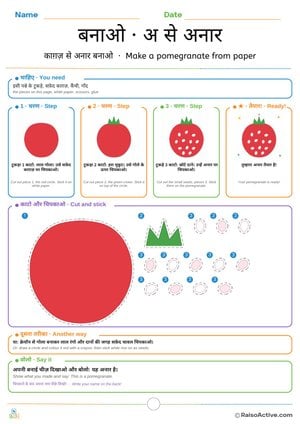
Make a Paper Pomegranate: Hindi Letter अ Craft | बनाओ · अ से अनार
Ages 3-7 · Preschool–Grade 1Ages 3-7 · Nursery–Year 2Ages 3-7 · Nursery–Class 1Ages 3-7
Children cut out the pieces, put them together following three step pictures and make a paper pomegranate. Saying the word अनार as they make it links the sound अ to something they built themselves.
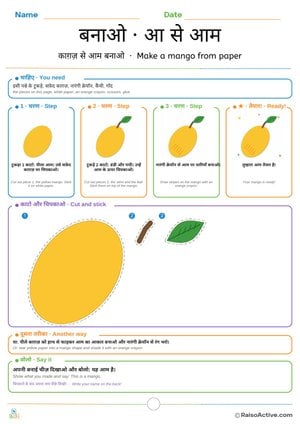
Make a Paper Mango: Hindi Letter आ Craft | बनाओ · आ से आम
Ages 3-7 · Preschool–Grade 1Ages 3-7 · Nursery–Year 2Ages 3-7 · Nursery–Class 1Ages 3-7
Children cut out the pieces, put them together following three step pictures and make a paper mango. Saying the word आम as they make it links the sound आ to something they built themselves.
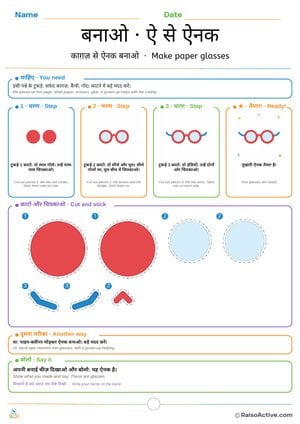
Make Paper Glasses: Hindi Letter ऐ (ai) Cut and Stick Craft | बनाओ · ऐ से ऐनक
Ages 4-7 · Pre-K–Grade 1Ages 4-7 · Reception–Year 2Ages 4-7 · LKG–Class 1Ages 4-7
Children cut out the numbered pieces and stick them in order to make a pair of glasses with two red rims, two lenses and two arms, then show it and say a full sentence about it. It links the letter ऐ with a real picture word, ऐनक, and practises scissor control and following steps.
Guides for this topic

Discovering Wonder: Nature-Based Learning Activities That Captivate Young Children
Explore nature-based learning activities for children ages 2–7 — leaf rubbings, bug hunts, nature journals, and seasonal Indian outdoor ideas that spark wonder.

Christmas and Winter Activities That Combine Fun and Learning: Creating Magical Educational Experiences
Discover Christmas and winter activities that combine festive fun with real learning. Crafts, counting, literacy, and printable worksheets for ages 2 to 8 — perfect for home and school.
Age-Appropriate Halloween Learning Activities: Balancing Spooks and Skills for Young Learners
Discover fun, age-appropriate Halloween learning activities for young children. Spooky crafts, counting games, literacy ideas, and printable worksheets for ages 2 to 8.
Reviews
Every worksheet for ages 4–6, no watermark
Members download the full library of 1,000+ worksheets and every activity pack without watermarks or daily limits. One year costs ₹999 in India or $20 elsewhere.
See membership plansOr download any worksheet free with a watermark (5 a day).