Action Verbs Worksheet: Match and Color!
This worksheet has 4-6 year olds read a short sentence, pick out the action word inside it, and match that sentence to the picture showing the action happening — a skill that bridges early reading with grammar. Identifying the verb specifically (rather than just understanding the sentence generally) is a more advanced task than simple picture-word matching, since children have to isolate one word's job within a whole sentence. Coloring the matched picture afterward gives an easy, low-pressure way to confirm the match was correct.
Part of the pack
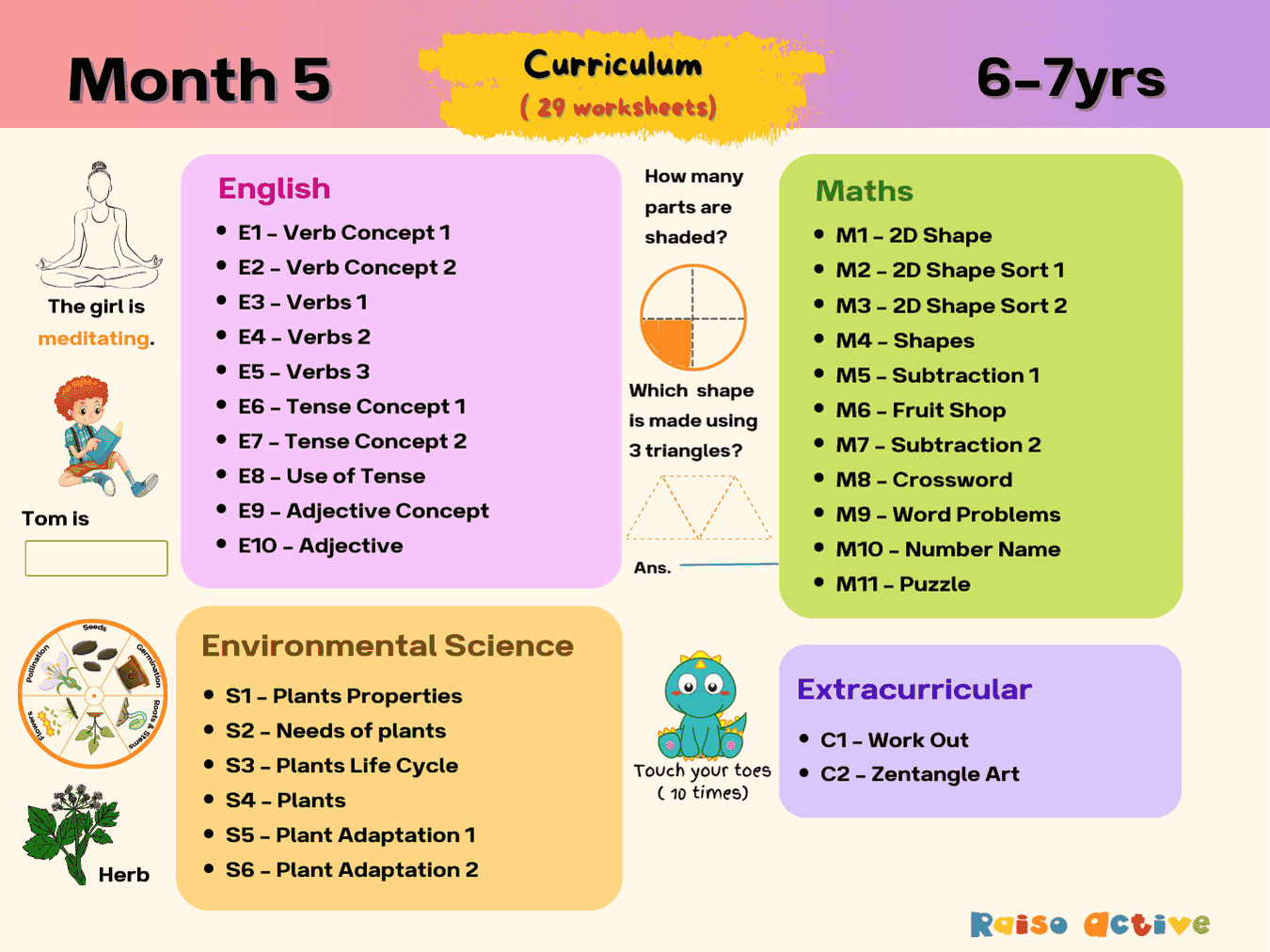
Month 5: Essential English, Math, Science | Ages 6-7
This is page 4 of the pack. Ages 6-7 · Grade 1Ages 6-7 · Year 2Ages 6-7 · Class 1Ages 6-7
Made for your child
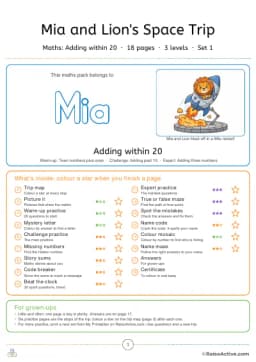
Numbers to 20, made for your child
A maths pack with your child's name in it: pictures that explain, practice at three levels, puzzles and story sums about them. Print a new set whenever they finish.
Make a maths packFree preview · free for members
Curriculum
- Grammar > Action Verbs
How to use this worksheet
Read the first sentence aloud together, or have your child try reading it if they're ready. Ask them to point to the action word in the sentence — the word that tells what someone is doing. Have them draw a line or match the sentence to the picture that shows that action taking place. Once matched, let them color the picture, then move to the next sentence and repeat the process.
Materials needed
- Pencil
- Crayons
Extension activities
- 1Play charades using only the verbs from the worksheet, taking turns acting them out for each other.
- 2Go on a 'verb hunt' through a picture book, pointing out action words on each page.
- 3Ask your child to make up their own sentence using one of the action words from the worksheet.
- 4Pick a 'verb of the day' and challenge your child to use it in conversation throughout the day.
- 5Play a quick game where you say an action and your child has to do it, then name the verb.

Written by
Hemsweta Jain · Teacher Cheena
MBA and Early Childhood Educator, teaching since 2014 · Founder of RaisoActive, Mumbai
Every RaisoActive worksheet is designed and checked by the founder before publishing.
Published · Last reviewed
More from Month 5: Essential English, Math, Science | Ages 6-7

Number Names Worksheet: Matching and Writing Numbers
Ages 4-6 · Pre-K–KindergartenAges 4-6 · Reception–Year 1Ages 4-6 · LKG–UKGAges 4-6
This worksheet strengthens the connection between a written number name and its numeral for 4-6 year olds — first by circling the numeral that matches a given name, then by writing the number name out themselves, which adds a spelling and handwriting layer on top of simple recognition. Because number-name spelling doesn't always follow easy sound-out rules, this repeated practice with both reading and writing the words builds genuine sight-word familiarity with number vocabulary.
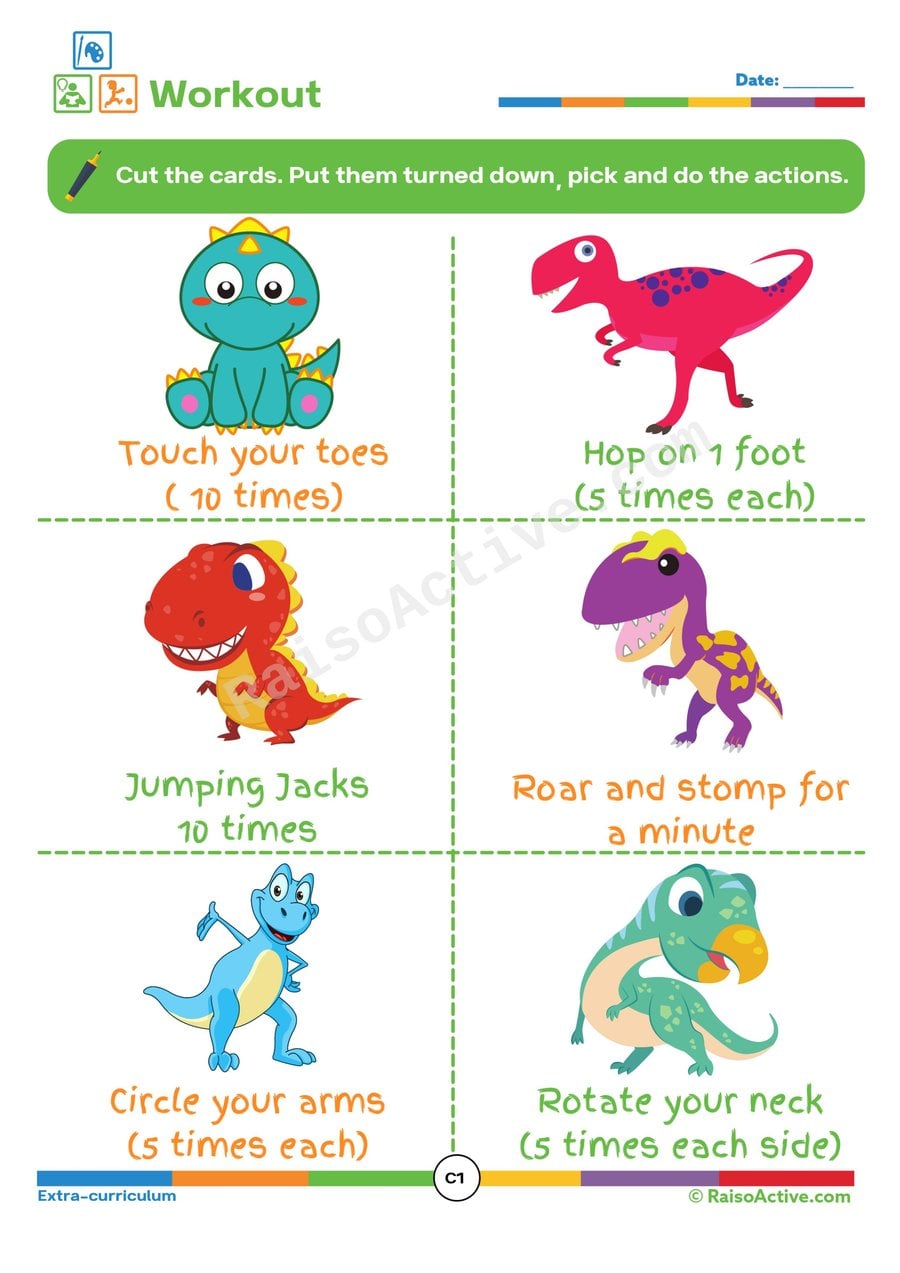
Dino Workout: Fun Exercise Worksheet for Kids!
Ages 3-5 · Preschool–Pre-KAges 3-5 · Nursery–ReceptionAges 3-5 · Nursery–LKGAges 3-5
This dinosaur-themed activity gets 3-5 year olds moving, which is exactly what this age group needs for developing gross motor skills, body awareness, and balance — abilities that don't come from sitting at a table. Following each exercise card as instructed also builds the ability to interpret a picture prompt and translate it into a physical action, a form of following directions that's harder than it sounds for young children still developing self-regulation.

Action Verbs Worksheet: Identify and Color Verbs in the Picture
Ages 3-5 · Preschool–Pre-KAges 3-5 · Nursery–ReceptionAges 3-5 · Nursery–LKGAges 3-5
This worksheet asks 3-5 year olds to look closely at a busy picture and decide which action verbs are actually happening in it versus which ones aren't shown at all, using a color code (green for present, red for absent) to record their answer. That distinction — is this action really happening in the picture, or just a word I know? — pushes your child to observe carefully rather than simply recognize verb vocabulary in isolation.

Plant Adaptation Worksheet for Kids: Matching Examples
Ages 4-6 · Pre-K–KindergartenAges 4-6 · Reception–Year 1Ages 4-6 · LKG–UKGAges 4-6
This worksheet introduces 4-6 year olds to plant adaptations — the specific features that help plants survive in their environment, like thick leaves that store water or thorns that deter animals — by having them match real plant examples to the correct type of adaptation and then write it in. This is a genuinely abstract science concept for this age group, since it requires connecting a visible feature to an invisible purpose (why does a cactus have thick, waxy skin?), making it more conceptually demanding than simple plant-part labeling.
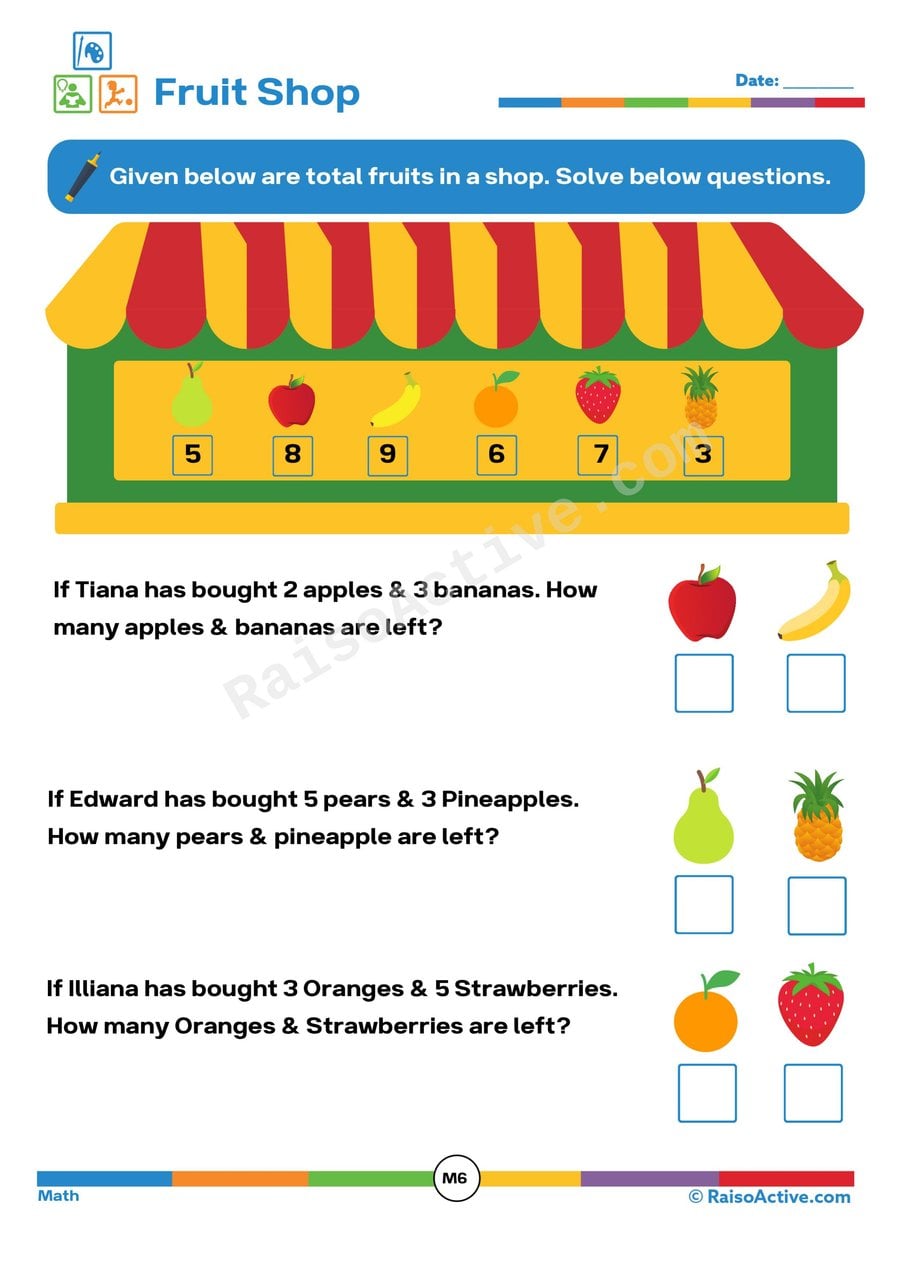
Fruit Shop Counting Worksheet for Kids
Ages 3-5 · Preschool–Pre-KAges 3-5 · Nursery–ReceptionAges 3-5 · Nursery–LKGAges 3-5
This worksheet applies subtraction to a real-world shopping scenario for 3-5 year olds, asking them to count a total number of fruits, read a short word problem about fruits being bought, and then subtract to find how many remain — combining reading comprehension with the counting and subtraction skills practiced elsewhere. Framing the math inside a relatable 'fruit shop' story helps your child see subtraction as something that happens in everyday situations, not just on a worksheet.

Plant Properties Worksheet for Preschoolers: Learn About Plants!
Ages 4-6 · Pre-K–KindergartenAges 4-6 · Reception–Year 1Ages 4-6 · LKG–UKGAges 4-6
Filling in the blanks about what plants need to survive and labeling their parts gives children ages 4-6 a more structured science lesson than a simple coloring page, requiring them to recall specific facts rather than just recognize pictures. This worksheet combines factual recall — like knowing plants need sunlight, water, and air — with visual labeling of plant anatomy, reinforcing the same content in two different formats. Understanding what plants need to grow also builds a foundation for later lessons on ecosystems, food chains, and basic biology.
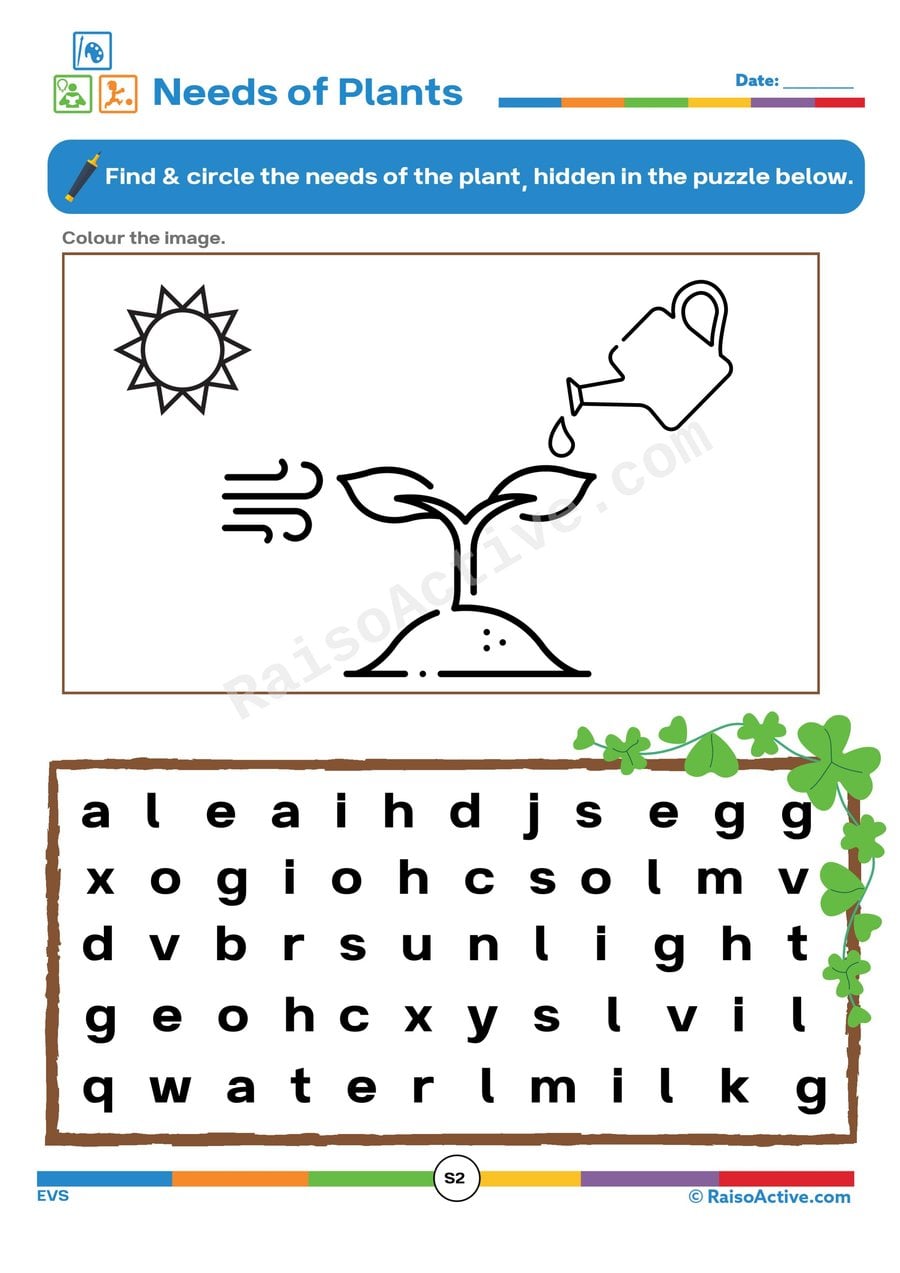
Plant Needs Word Search Worksheet for Kids
Ages 3-5 · Preschool–Pre-KAges 3-5 · Nursery–ReceptionAges 3-5 · Nursery–LKGAges 3-5
This word search introduces 3-5 year olds to the specific things plants need to survive — sunlight, water, soil, air — while building early reading skills through visual word scanning and letter recognition. Hunting for whole words hidden in a grid of letters is a genuinely different reading task than sounding out an isolated word, since your child has to recognize a word's overall letter pattern among distracting surrounding letters.
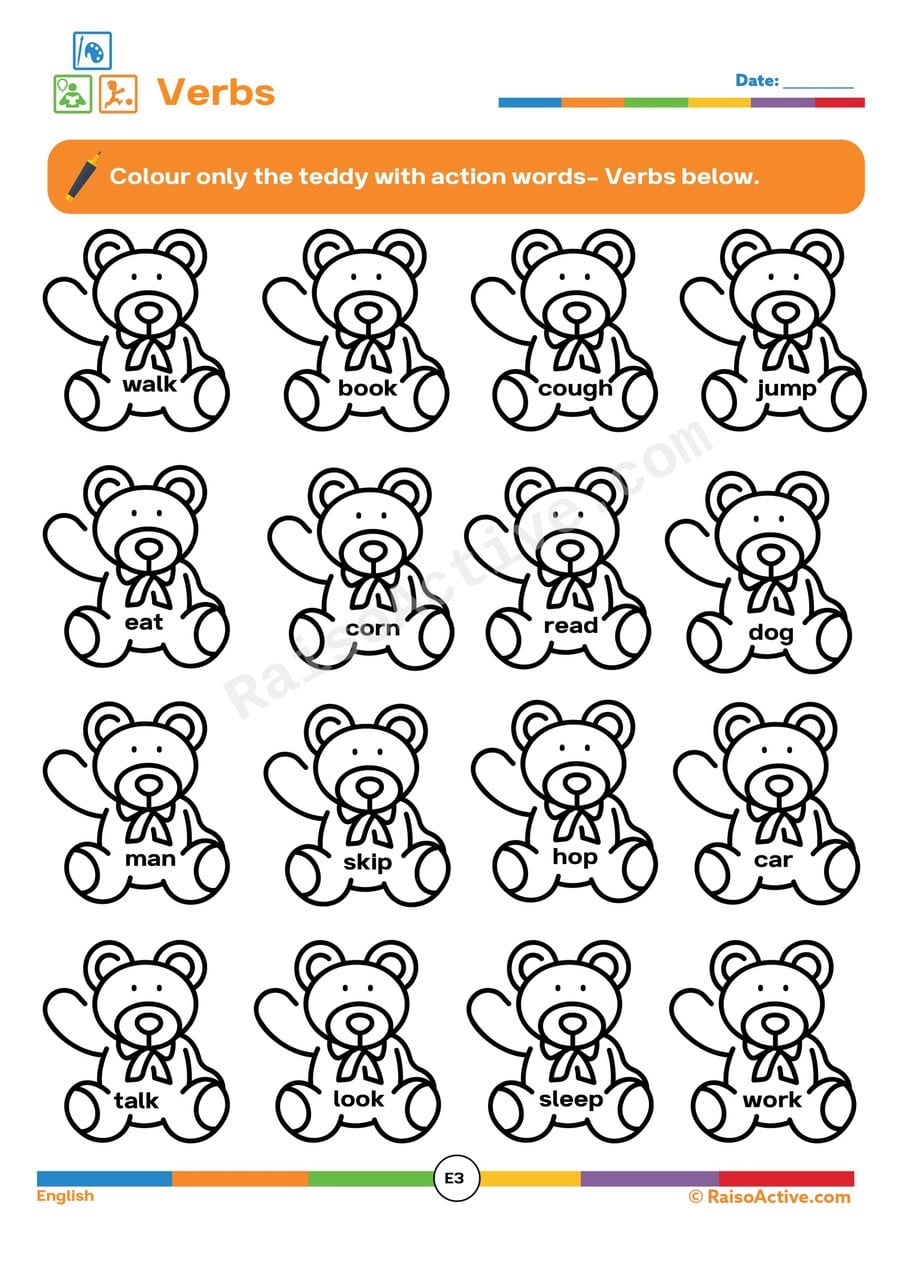
Action Word Coloring Worksheet for Preschoolers
Ages 3-5 · Preschool–Pre-KAges 3-5 · Nursery–ReceptionAges 3-5 · Nursery–LKGAges 3-5
This worksheet trains 3-5 year olds to follow a written instruction precisely — color only the teddy bears paired with specific action words, and leave the rest blank. That precision is the real skill being built: your child has to read or recognize each action word before deciding whether to color, rather than coloring everything in sight. It's an early, low-stakes way to connect written verbs to their meaning while also practicing careful, purposeful coloring instead of open-ended scribbling.
Related worksheets

Match the Verb: Action Verbs Worksheet for Preschoolers
Ages 3-5 · Preschool–Pre-KAges 3-5 · Nursery–ReceptionAges 3-5 · Nursery–LKGAges 3-5
Action verbs are some of the first 'doing words' children learn to recognize in print, and this worksheet asks children ages 3-5 to spot the verb within a simple sentence and connect it to a picture showing that action. Circling the verb first trains children to identify the part of a sentence that describes an action, an early grammar skill, while matching it to a picture reinforces comprehension of the word's meaning. This combination builds both reading and vocabulary skills using content — running, jumping, eating — that's naturally engaging to young children.

Christmas Shadow Match Worksheet for Preschoolers
Ages 3-5 · Preschool–Pre-KAges 3-5 · Nursery–ReceptionAges 3-5 · Nursery–LKGAges 3-5
Matching each Christmas object to its correct black silhouette trains children ages 3-5 in visual discrimination — noticing outline, proportion, and shape rather than color or detail. This kind of shadow-matching also builds the same shape-analysis skills children later use for letter recognition, since it requires holding one image in mind while comparing it against several similar-looking options.

Symmetry Fun Worksheet for Kids: Complete and Color!
Ages 3-5 · Preschool–Pre-KAges 3-5 · Nursery–ReceptionAges 3-5 · Nursery–LKGAges 3-5
This symmetry worksheet challenges children ages 3-5 to study a half-drawn Christmas picture and draw the missing mirror-image half, introducing the early geometry concept that two sides of a shape can match exactly. Completing and then coloring the picture also builds visual comparison skills, since children must check their drawn half against the original before filling it in with color.

Navratri Colour Hunt: Colour Words, Matching and Bangles
Ages 4-6 · Pre-K–KindergartenAges 4-6 · Reception–Year 1Ages 4-6 · LKG–UKGAges 4-6
Children read colour words, colour bangles to match, count how many of each colour, match everyday things to their colours and find colours around the home.

Navratri Rangoli Colour by Number and Symmetry Diya
Ages 4-6 · Pre-K–KindergartenAges 4-6 · Reception–Year 1Ages 4-6 · LKG–UKGAges 4-6
Children match numbers to colours using a key, colour a rangoli pattern carefully and draw the other half of a shape so both sides match.

Navratri Nine Colours Colouring Page: Colour the Garba Dancers
Ages 4-6 · Pre-K–KindergartenAges 4-6 · Reception–Year 1Ages 4-6 · LKG–UKGAges 4-6
Children learn the colour linked with each of the nine days of Navratri 2026 and practise colouring inside the lines.

Coloring Worksheet: Identify and Color the Symbols!
Ages 3-5 · Preschool–Pre-KAges 3-5 · Nursery–ReceptionAges 3-5 · Nursery–LKGAges 3-5
This worksheet introduces children ages 3-5 to national symbols by having them color each one and then match or write its name from a list of options. Beyond fine motor coloring practice, naming each symbol builds early cultural knowledge and category-matching skills, since children must connect a picture to the correct word rather than color at random.
Colour the अ Things: Hindi Letter अ Colouring Page | रंग भरो · अ
Ages 3-7 · Preschool–Grade 1Ages 3-7 · Nursery–Year 2Ages 3-7 · Nursery–Class 1Ages 3-7
Children listen for the first sound of each picture name and decide whether it starts with अ. They colour the अ pictures, cross out the others and colour the big letter.
Guides for this topic

Best Worksheets for 3-Year-Olds: What Works and What to Avoid
What works on worksheets for 3-year-olds: short sessions, crayons, tracing lines, matching, cutting, a free weekly plan, and signs one is too advanced.
Fostering Creativity in Structured Learning: The Perfect Balance for Young Minds
Learn how to blend creativity with structured learning for children ages 1-8. Practical strategies, activities, and printable worksheets for parents and teachers.
Christmas and Winter Activities That Combine Fun and Learning: Creating Magical Educational Experiences
Discover Christmas and winter activities that combine festive fun with real learning. Crafts, counting, literacy, and printable worksheets for ages 2 to 8 — perfect for home and school.
Reviews
Every worksheet for ages 4–6, no watermark
Members download the full library of 1,000+ worksheets and every activity pack without watermarks or daily limits. One year costs ₹999 in India or $20 elsewhere.
See membership plansOr download any worksheet free with a watermark (5 a day).