Plant Adaptation Matching Worksheet for Kids
This worksheet has 4-6 year olds match written descriptions of plant adaptations to the correct pictures, building on the idea that plants develop specific features — thick leaves, deep roots, bright flowers — to help them survive in their particular environment. Matching a description to an image requires your child to connect an abstract idea (why does this feature help?) to a concrete picture, which is a genuine step up from simple plant-part identification.
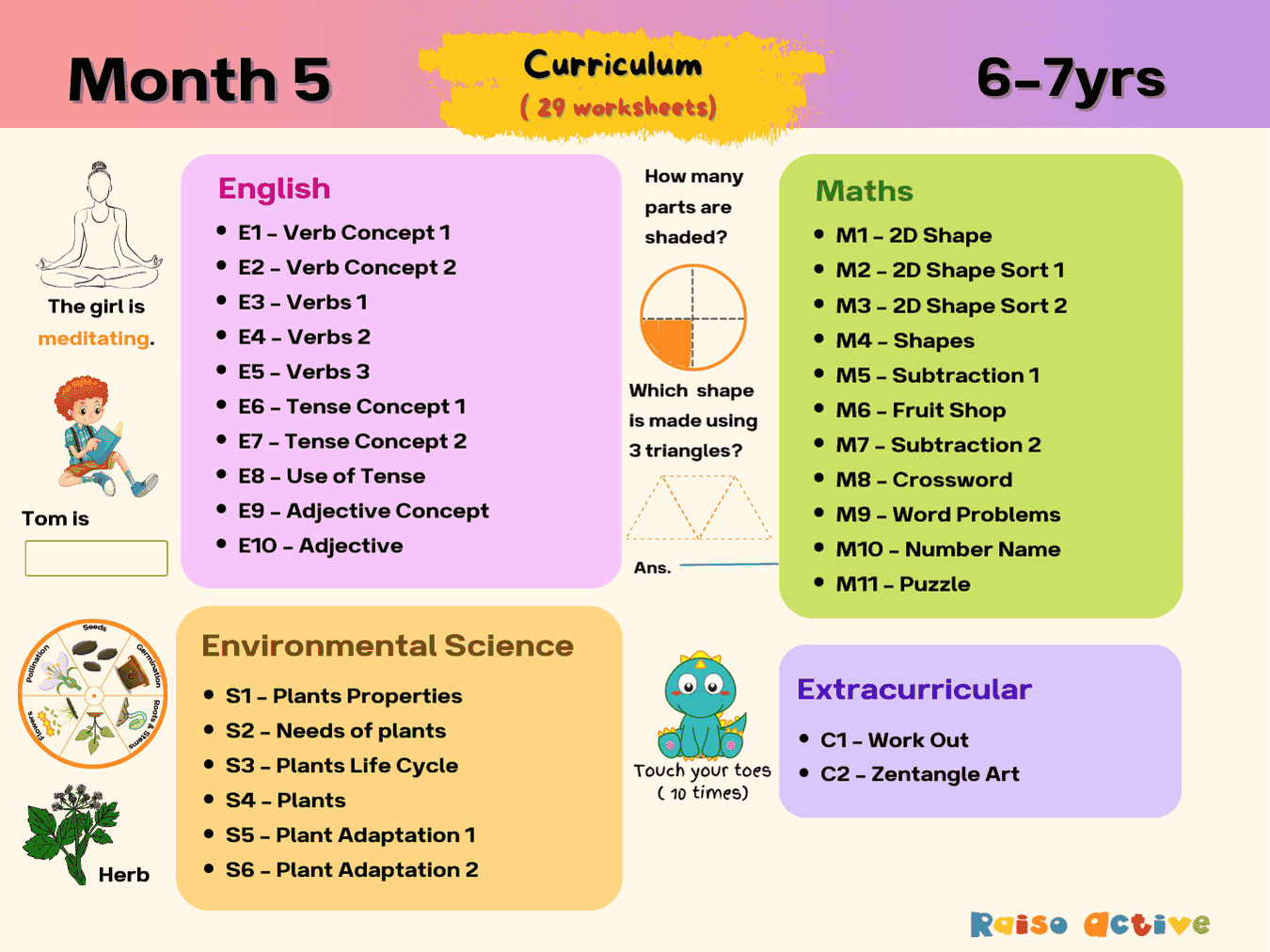
Part of the pack
Month 5: Essential English, Math, Science | Ages 6-7
This is page 29 of the pack. Ages 6-7 · Grade 1Ages 6-7 · Year 2Ages 6-7 · Class 1Ages 6-7
Made for your child
Numbers to 20, made for your child
A maths pack with your child's name in it: pictures that explain, practice at three levels, puzzles and story sums about them. Print a new set whenever they finish.
Make a maths packFree preview · free for members
Curriculum
- Living Things - Plants > Plant Science
How to use this worksheet
Read the first adaptation description aloud together, like a plant with thick, waxy leaves that store water. Ask your child what kind of environment might need that adaptation — a very dry place, for instance. Have them look at the picture choices and pick the one that matches the description, drawing a line to connect them. Repeat for each remaining description, discussing the 'why' behind each adaptation before confirming the match.
Materials needed
- Pencil
- Eraser
Extension activities
- 1Draw your child's favorite plant along with the environment it lives in.
- 2Look up a few real examples of plant adaptations together, like cacti or water lilies.
- 3Compare how a desert plant and a rainforest plant might look different because of where they live.
- 4Make a simple chart pairing plant features with the environment challenge they solve.
- 5Talk about how people also adapt to different environments, like wearing warm clothes in winter.

Written by
Hemsweta Jain · Teacher Cheena
MBA and Early Childhood Educator, teaching since 2014 · Founder of RaisoActive, Mumbai
Every RaisoActive worksheet is designed and checked by the founder before publishing.
Published · Last reviewed
More from Month 5: Essential English, Math, Science | Ages 6-7

Tense Time! Identifying Past, Present, and Future Tense Worksheet
Ages 5-7 · Kindergarten–Grade 1Ages 5-7 · Year 1–Year 2Ages 5-7 · UKG–Class 1Ages 5-7
This worksheet asks 5-7 year olds to read a full sentence and identify which tense it's written in — past, present, or future — based on the verb form and clue words used, which is a meaningfully harder skill than simply writing verbs in different tenses since it requires recognizing the grammar pattern rather than producing it. This kind of tense-identification practice is exactly what supports stronger reading comprehension and writing later, since understanding when something happens is core to following any story.

Number Names Worksheet: Matching and Writing Numbers
Ages 4-6 · Pre-K–KindergartenAges 4-6 · Reception–Year 1Ages 4-6 · LKG–UKGAges 4-6
This worksheet strengthens the connection between a written number name and its numeral for 4-6 year olds — first by circling the numeral that matches a given name, then by writing the number name out themselves, which adds a spelling and handwriting layer on top of simple recognition. Because number-name spelling doesn't always follow easy sound-out rules, this repeated practice with both reading and writing the words builds genuine sight-word familiarity with number vocabulary.

Parent's Guide: Fun Activities for Verbs, Subtraction, and More!
Ages 3-5 · Preschool–Pre-KAges 3-5 · Nursery–ReceptionAges 3-5 · Nursery–LKGAges 3-5
This parent guide pulls together several early-learning threads — verbs, subtraction, plant life cycles, and 2D shapes — into a single set of hands-on activity suggestions designed for 3-5 year olds, giving you ready-made ways to reinforce classroom or worksheet learning at home without needing to plan lessons yourself. Rather than a single skill, this guide's value is in showing how the same everyday objects (flashcards, fruit, seeds, toys) can support several different concepts across a week of casual, low-pressure practice.

Crossword Math Worksheet: Fill in the Missing Numbers!
Ages 4-6 · Pre-K–KindergartenAges 4-6 · Reception–Year 1Ages 4-6 · LKG–UKGAges 4-6
This crossword-style worksheet has 4-6 year olds solve a series of subtraction equations to fill in missing numbers, then cross-check their answers by matching them across and down within the grid — a built-in accuracy check that regular subtraction worksheets don't offer. Because an answer has to be correct in both directions to complete the crossword properly, this format naturally encourages your child to double-check their subtraction rather than move on after a single attempt.

Plant Adaptation Worksheet for Kids: Matching Examples
Ages 4-6 · Pre-K–KindergartenAges 4-6 · Reception–Year 1Ages 4-6 · LKG–UKGAges 4-6
This worksheet introduces 4-6 year olds to plant adaptations — the specific features that help plants survive in their environment, like thick leaves that store water or thorns that deter animals — by having them match real plant examples to the correct type of adaptation and then write it in. This is a genuinely abstract science concept for this age group, since it requires connecting a visible feature to an invisible purpose (why does a cactus have thick, waxy skin?), making it more conceptually demanding than simple plant-part labeling.
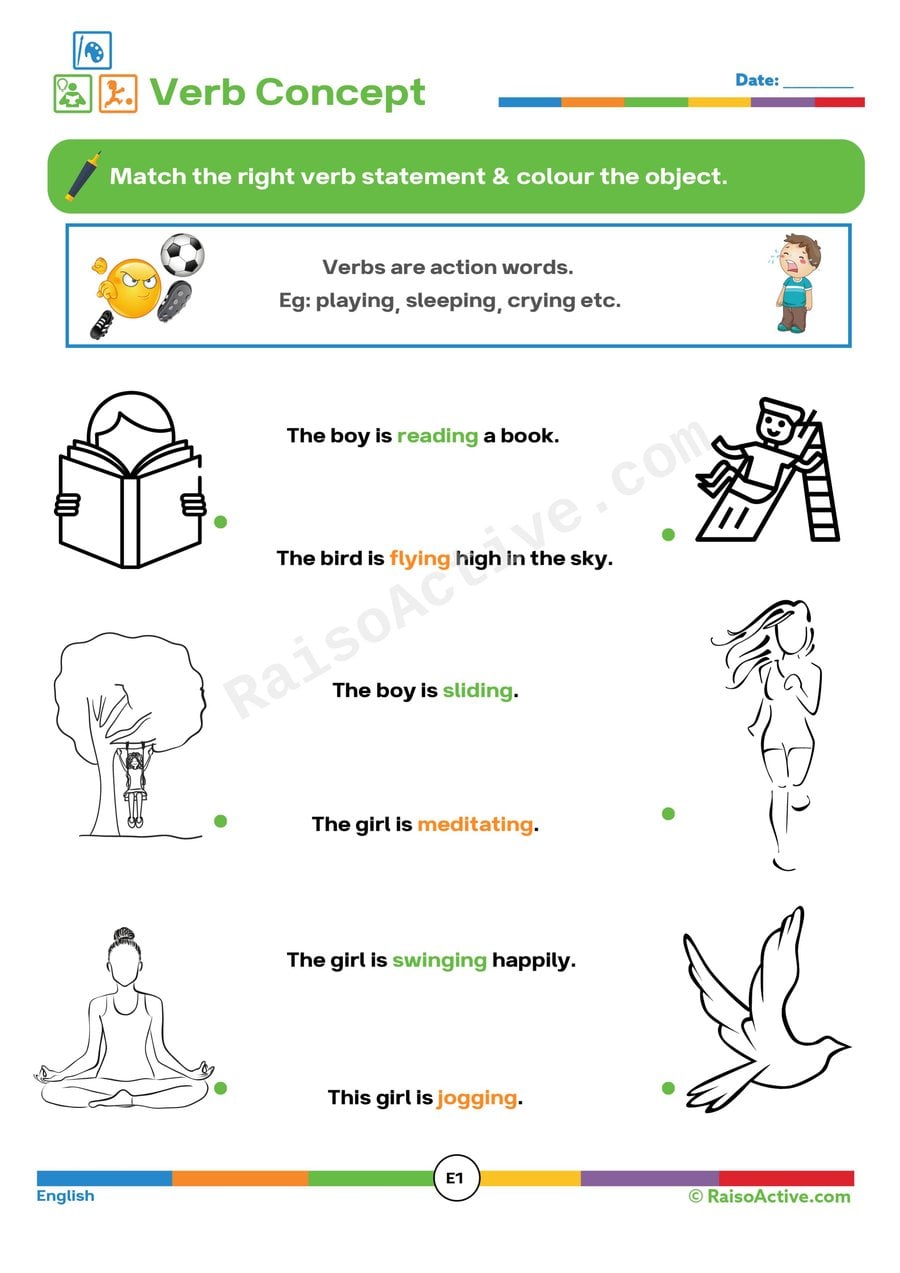
Action Verbs Worksheet: Match and Color!
Ages 4-6 · Pre-K–KindergartenAges 4-6 · Reception–Year 1Ages 4-6 · LKG–UKGAges 4-6
This worksheet has 4-6 year olds read a short sentence, pick out the action word inside it, and match that sentence to the picture showing the action happening — a skill that bridges early reading with grammar. Identifying the verb specifically (rather than just understanding the sentence generally) is a more advanced task than simple picture-word matching, since children have to isolate one word's job within a whole sentence. Coloring the matched picture afterward gives an easy, low-pressure way to confirm the match was correct.
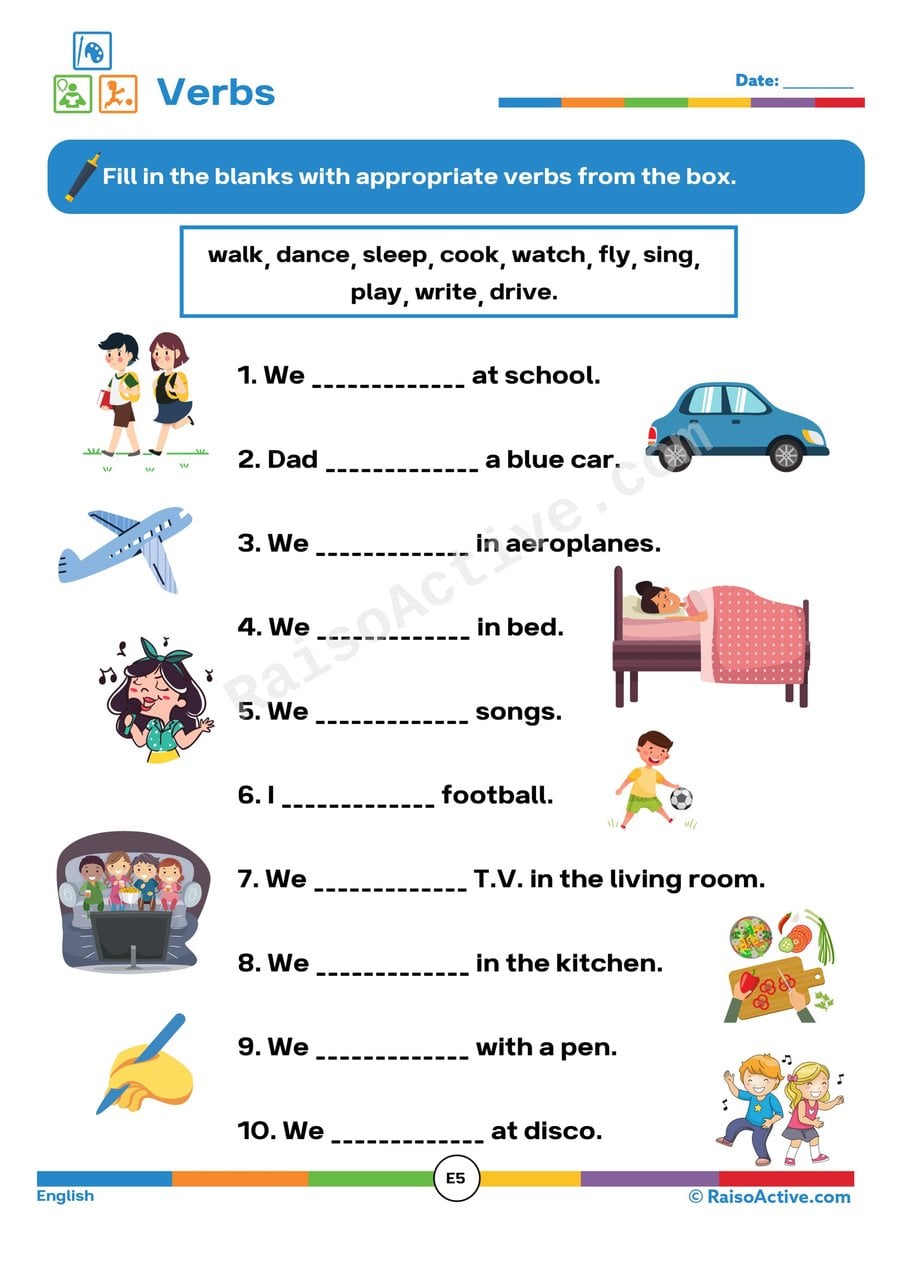
Action Verbs Worksheet: Fill in the Blanks!
Ages 4-6 · Pre-K–KindergartenAges 4-6 · Reception–Year 1Ages 4-6 · LKG–UKGAges 4-6
This worksheet moves 4-6 year olds a step beyond matching verbs to pictures — now they have to read a full sentence, understand its meaning, choose the correct verb from a word box, and write it into the blank themselves. That combination of reading comprehension, vocabulary selection, and handwriting makes this noticeably more demanding than earlier action-word worksheets, and it's exactly the kind of sentence-completion task children will meet again in early elementary grammar lessons.
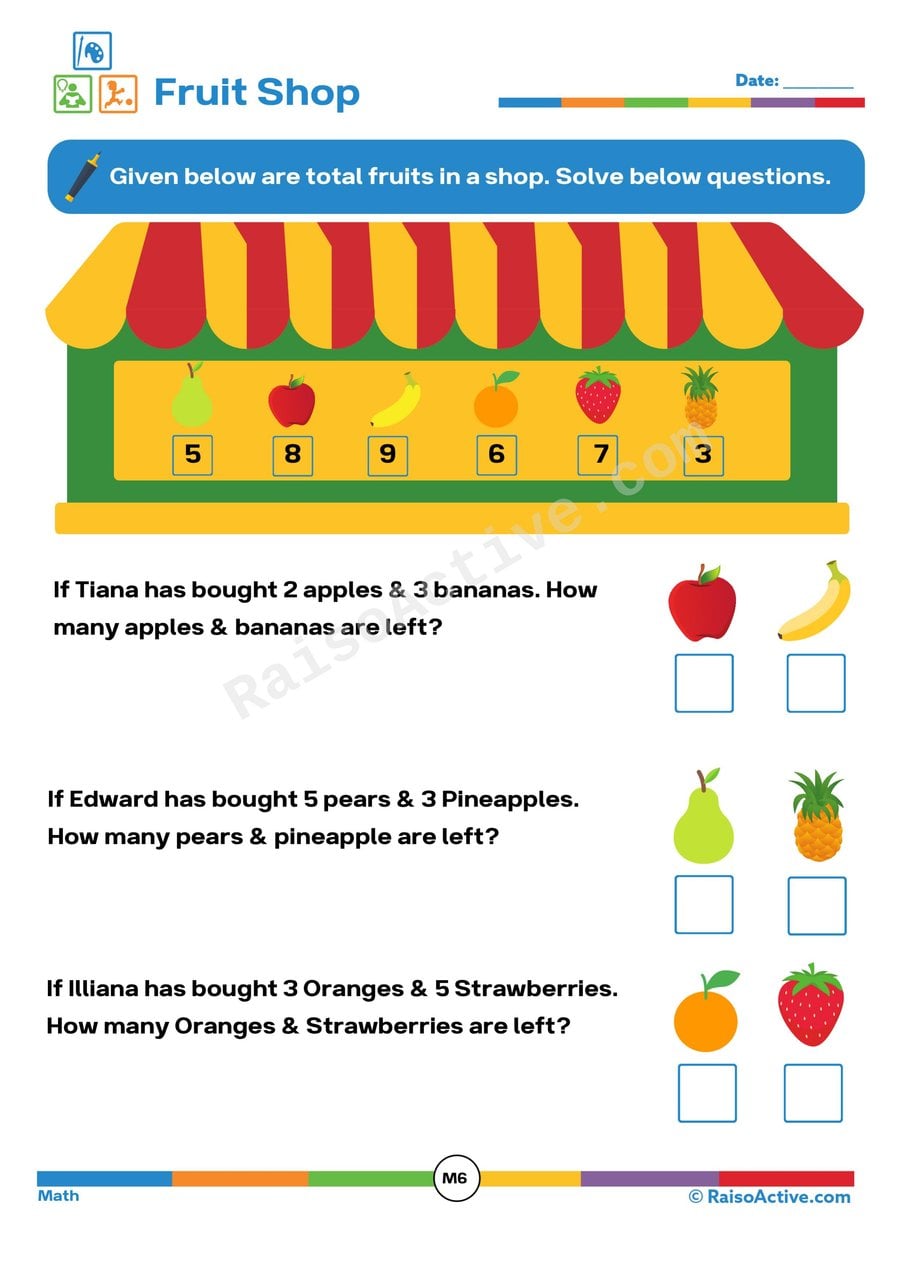
Fruit Shop Counting Worksheet for Kids
Ages 3-5 · Preschool–Pre-KAges 3-5 · Nursery–ReceptionAges 3-5 · Nursery–LKGAges 3-5
This worksheet applies subtraction to a real-world shopping scenario for 3-5 year olds, asking them to count a total number of fruits, read a short word problem about fruits being bought, and then subtract to find how many remain — combining reading comprehension with the counting and subtraction skills practiced elsewhere. Framing the math inside a relatable 'fruit shop' story helps your child see subtraction as something that happens in everyday situations, not just on a worksheet.
Related worksheets

Navratri Picture Sudoku and Story Sequencing: Think It Through
Ages 4-6 · Pre-K–KindergartenAges 4-6 · Reception–Year 1Ages 4-6 · LKG–UKGAges 4-6
Children use logic to complete a 4x4 picture sudoku where each row and column has each picture once, and put four story pictures in order.
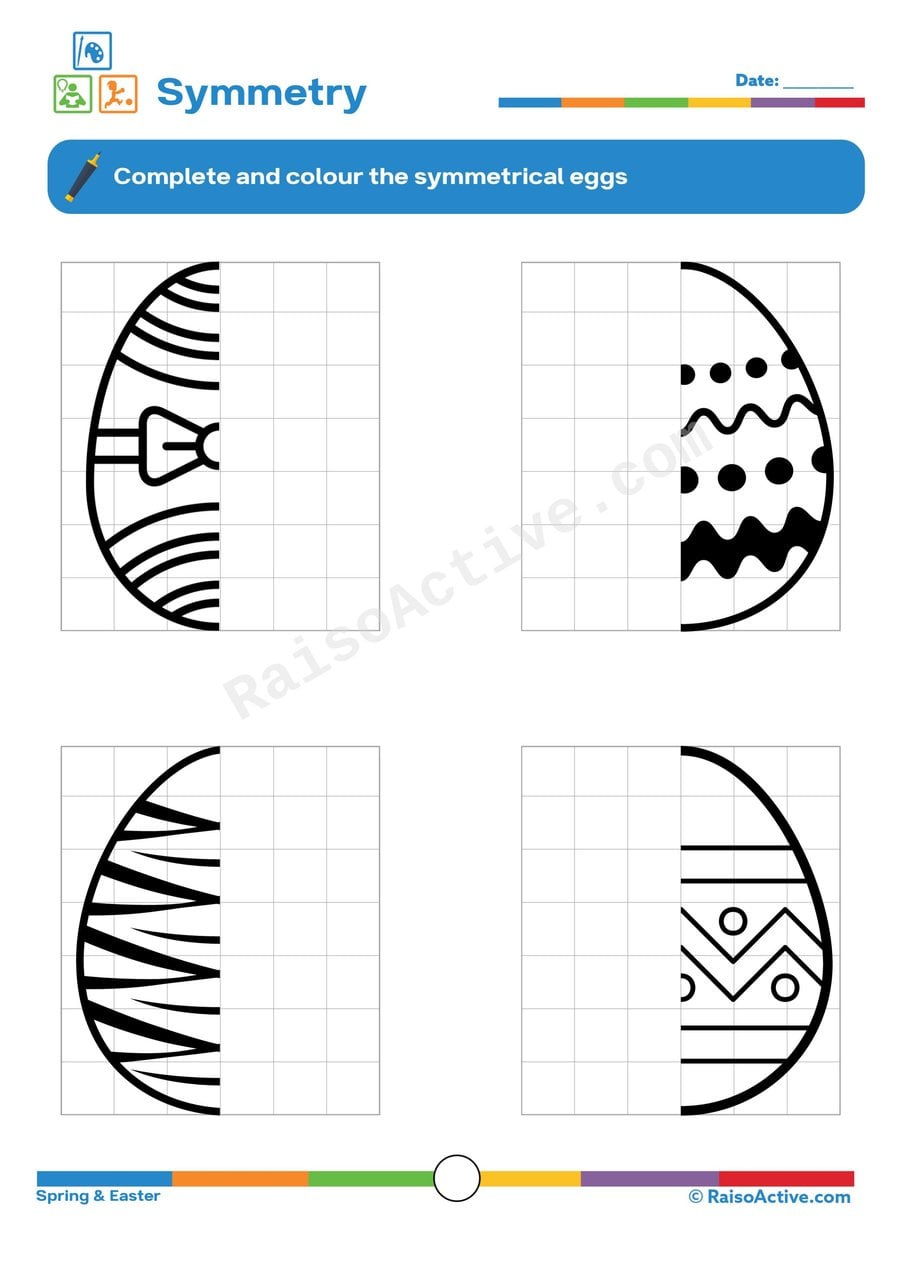
Symmetry Eggs Worksheet for Preschoolers
Ages 4-6 · Pre-K–KindergartenAges 4-6 · Reception–Year 1Ages 4-6 · LKG–UKGAges 4-6
This worksheet introduces children ages 4-6 to the concept of symmetry by having them complete the missing mirrored half of an egg design. Drawing a matching reflection requires children to closely observe shape, size, and placement on one side and reproduce it accurately on the other — an early geometry skill that also sharpens visual attention to detail.
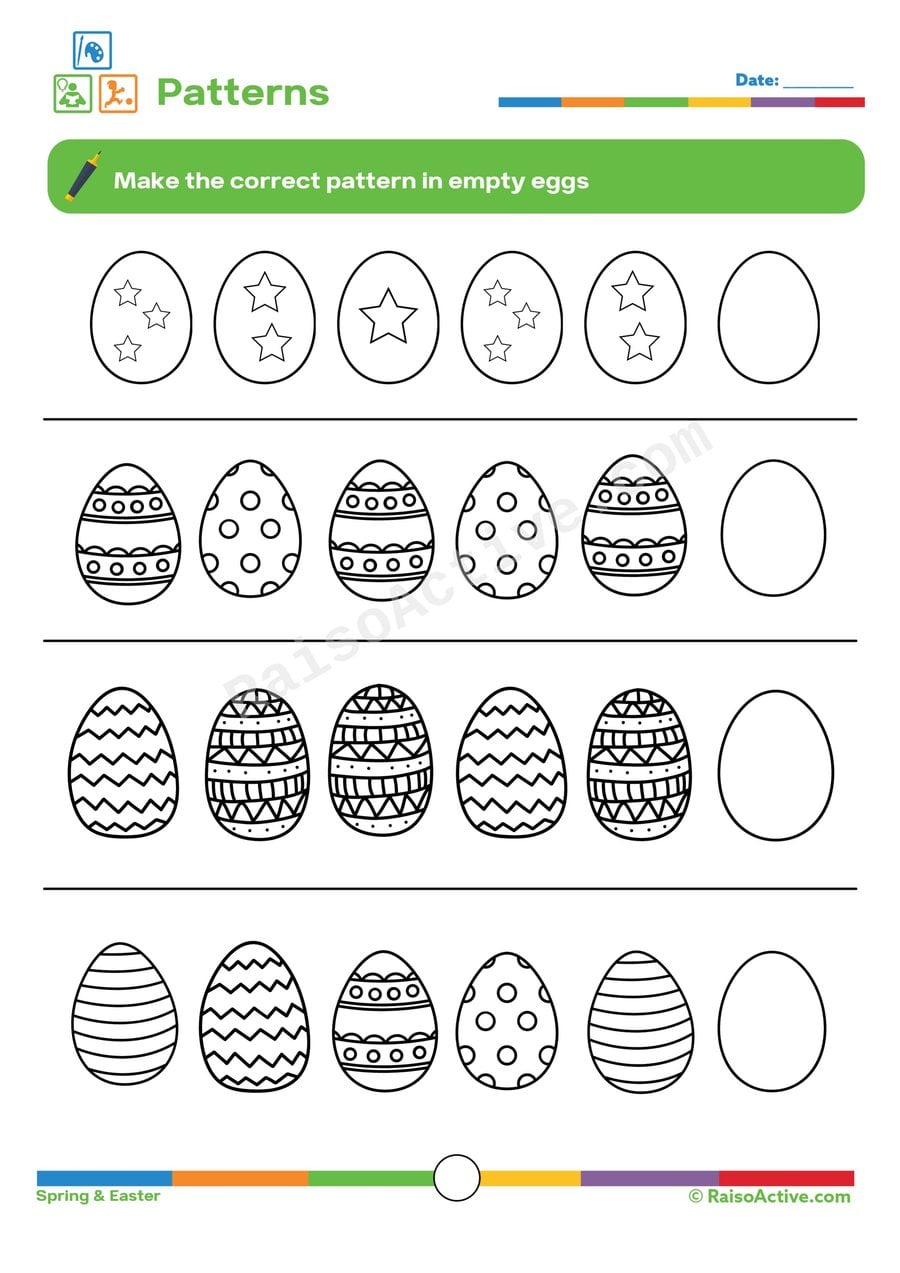
Easter Egg Patterns Worksheet for Preschoolers
Ages 3-5 · Preschool–Pre-KAges 3-5 · Nursery–ReceptionAges 3-5 · Nursery–LKGAges 3-5
This worksheet asks children ages 3-5 to study a sequence of patterned Easter eggs and figure out what design should come next, then draw it into the empty egg themselves. Predicting and completing a pattern, rather than just matching an existing one, pushes children a step further into the kind of what-comes-next reasoning that underlies early math and logic.

Soap & Pepper Science Experiment Worksheet for Preschoolers
Ages 3-5 · Preschool–Pre-KAges 3-5 · Nursery–ReceptionAges 3-5 · Nursery–LKGAges 3-5
This simple experiment introduces children ages 3-5 to the basic science of surface tension and how soap breaks it, using pepper flakes sprinkled on water as a visual demonstration. Watching the pepper scatter away the instant soap touches the water gives children a concrete, memorable example of cause and effect, an early building block for scientific thinking.

States of Matter Worksheet: Exploring Solids, Liquids, and Gases!
Ages 4-6 · Pre-K–KindergartenAges 4-6 · Reception–Year 1Ages 4-6 · LKG–UKGAges 4-6
This worksheet introduces children ages 4-6 to the three states of matter — solid, liquid, and gas — by having them examine images and sort each one into its correct category. Learning to classify familiar objects (like ice, water, and steam) by their physical state builds early scientific reasoning, since children must look past an object's identity and focus on its underlying properties.
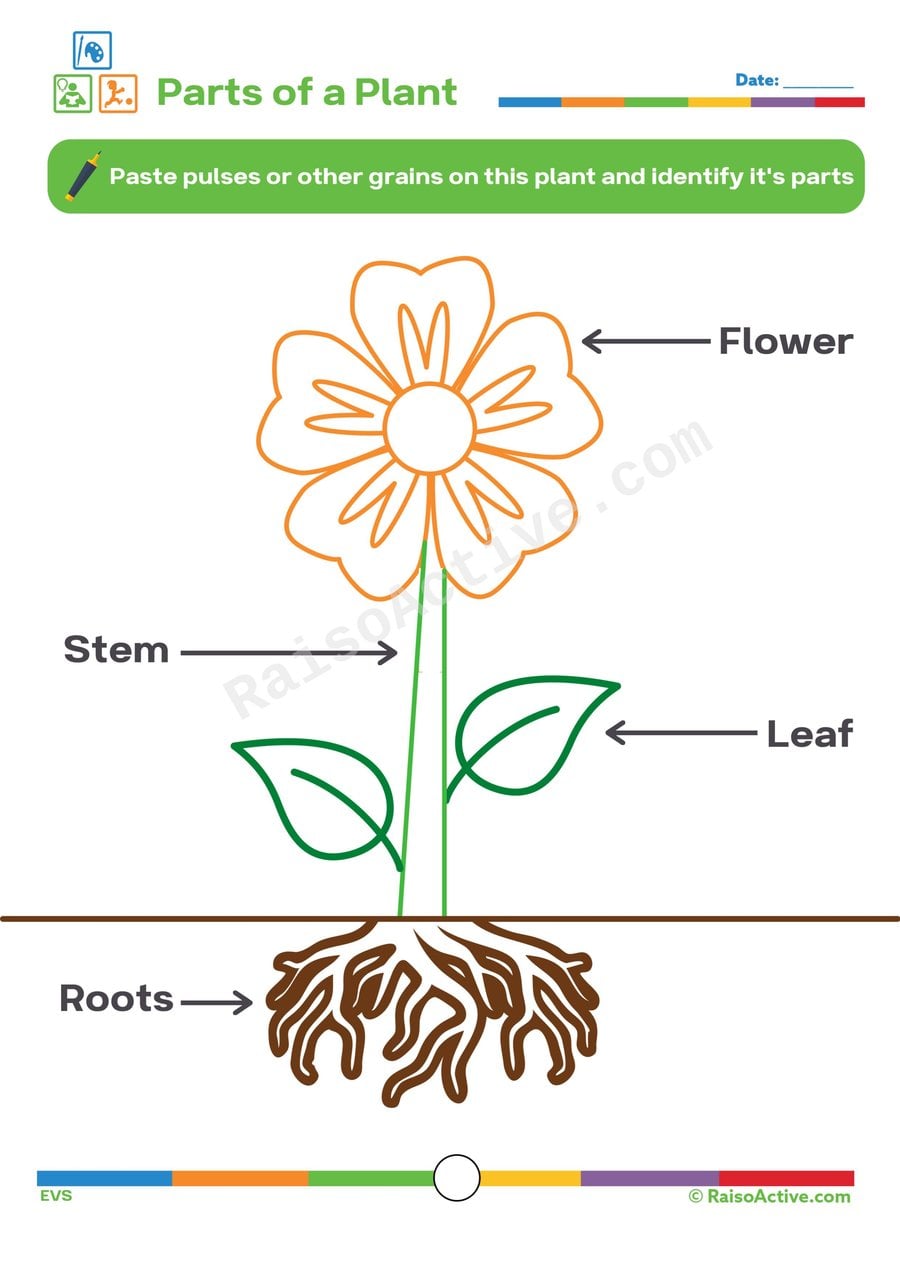
Parts of a Plant Worksheet: Identify and Label!
Ages 3-5 · Preschool–Pre-KAges 3-5 · Nursery–ReceptionAges 3-5 · Nursery–LKGAges 3-5
This activity teaches children ages 3-5 the basic parts of a plant — flower, stem, leaf, and roots — by having them label a diagram and add texture using real pulses or grains glued onto the plant shape. Combining a tactile material with each labeled part helps young children retain the vocabulary better than labeling alone, since touch and sight reinforce the same information.

Elephant Shapes: Fun Sorting Worksheet for Preschoolers!
Ages 3-5 · Preschool–Pre-KAges 3-5 · Nursery–ReceptionAges 3-5 · Nursery–LKGAges 3-5
This playful sorting worksheet has children ages 3-5 use an elephant's 'trunk' (their own hand reaching through a cut circle) to pick and sort shapes, building both shape recognition and simple classification skills. Physically selecting and grouping shapes by type, rather than just naming them on sight, helps solidify the concept that shapes can share a category even when their size or color differs.
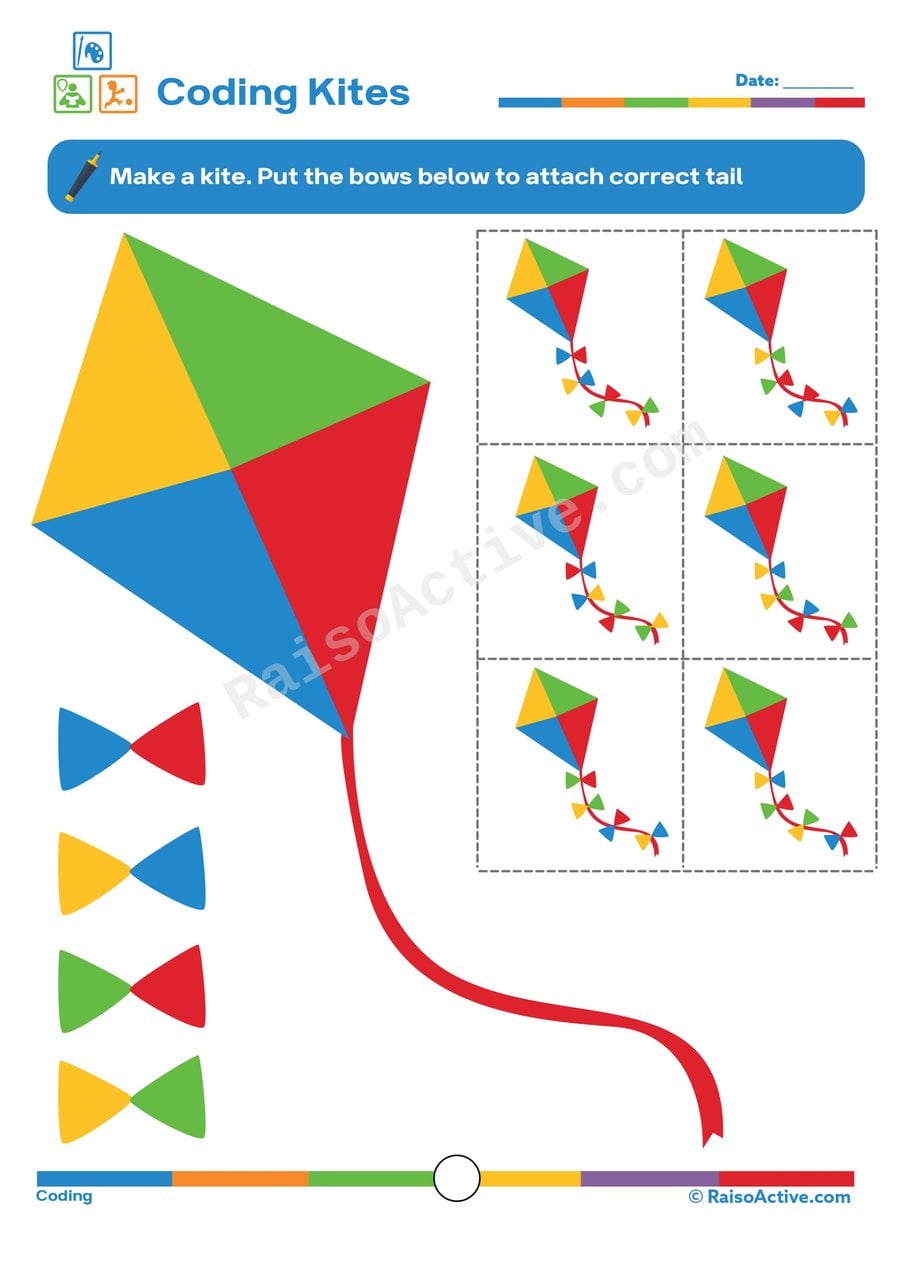
Coding Kites Worksheet: Match the Bows!
Ages 3-5 · Preschool–Pre-KAges 3-5 · Nursery–ReceptionAges 3-5 · Nursery–LKGAges 3-5
This activity sharpens visual observation in children ages 3-5 as they compare color sequences on each kite to a set of loose bows and find the exact match. Careful, systematic comparison — checking each color in order rather than glancing quickly — builds an attention-to-detail habit that transfers directly to early reading and number work.
Guides for this topic

Best Worksheets for 3-Year-Olds: What Works and What to Avoid
What works on worksheets for 3-year-olds: short sessions, crayons, tracing lines, matching, cutting, a free weekly plan, and signs one is too advanced.

Age-Appropriate Problem-Solving Activities: Building Critical Thinkers from the Ground Up
Discover fun, age-appropriate problem-solving activities for children ages 1-8. Build critical thinking, logic, and reasoning skills through play-based learning.
Critical Thinking Activities That Actually Work for Young Children: Building Tomorrow's Thinkers Today
Discover proven critical thinking activities for young children. Age-wise logic games, questioning techniques, and hands-on ideas to build thinking skills at home.
Reviews
Every worksheet for ages 4–6, no watermark
Members download the full library of 1,000+ worksheets and every activity pack without watermarks or daily limits. One year costs ₹999 in India or $20 elsewhere.
See membership plansOr download any worksheet free with a watermark (5 a day).