Lifecycle Circle Book: Cut & Paste Activity for Preschoolers
Building this circle book helps children ages 3-5 understand that a plant's life cycle is a repeating loop rather than a straight line — a seed grows into a sprout, then a mature plant, which produces seeds of its own to start the cycle again. Cutting out and assembling the circles in order also develops scissor control and hand-eye coordination. Framing the plant's growth as a 'book' gives children a tangible object they can flip through to retell the sequence in their own words.
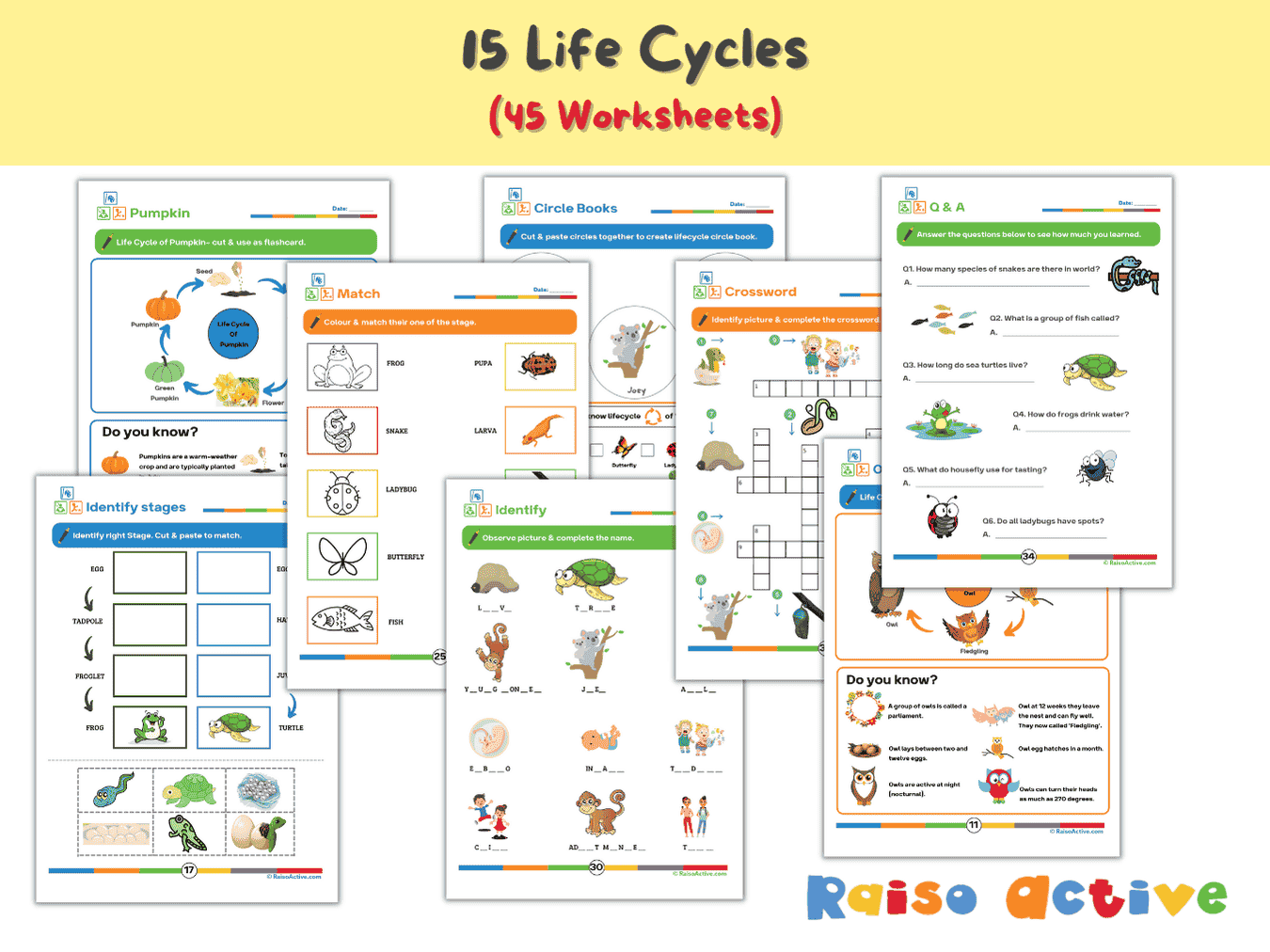
Part of the pack
Lifecycles Activity Book & Flashcards for Preschool & Early Elementary
This is page 39 of the pack. Ages 3-8 · Preschool–Grade 2Ages 3-8 · Nursery–Year 3Ages 3-8 · Nursery–Class 2Ages 3-8
Curriculum
- Living Things - Plants > Plant Life Cycles
How to use this worksheet
Cut out each circle along its outline, helping your child if the curves are tricky for small scissors. Lay the circles in a row and talk through what's happening at each stage: seed, sprout, growing plant, and flowering or seed-producing plant. Paste or fasten the circles together in order, either stacking them into a flip book or gluing them onto a strip of paper. Once assembled, have your child point to each circle and explain what happens next in the cycle.
Materials needed
- Scissors
- Glue
- Crayons
Extension activities
- 1Plant a real seed in a cup of soil and check on it daily to compare its growth to the circle book.
- 2Color each circle to match the real colors of a growing plant, from brown seed to green sprout to colorful flower.
- 3Retell the plant life cycle out loud without looking at the book, using it afterward to check accuracy.
- 4Make a second circle book for a different plant, like a sunflower or bean, and compare the two cycles.
- 5Sing a simple 'seed to plant' song while pointing to each stage in the finished book.

Written by
Hemsweta Jain · Teacher Cheena
MBA and Early Childhood Educator, teaching since 2014 · Founder of RaisoActive, Mumbai
Every RaisoActive worksheet is designed and checked by the founder before publishing.
Published · Last reviewed
More from Lifecycles Activity Book & Flashcards for Preschool & Early Elementary

Lifecycle Circle Book: Cut & Paste Activity for Early Learners
Ages 3-5 · Preschool–Pre-KAges 3-5 · Nursery–ReceptionAges 3-5 · Nursery–LKGAges 3-5
Children ages 3-5 explore the stages of human growth — baby, child, teenager, and adult — by building a hands-on circular lifecycle book. Applying the same 'lifecycle' concept they may know from animals to people themselves helps children make a meaningful, personal connection to the idea of growing and changing over time.

Lifecycle Circle Book: Cut & Paste Activity for Young Learners
Ages 3-5 · Preschool–Pre-KAges 3-5 · Nursery–ReceptionAges 3-5 · Nursery–LKGAges 3-5
This activity has children ages 3-5 cut out circular pages and assemble them into a small 'circle book' that flips through different animals' life cycles, combining fine motor cutting and gluing with the concept that a book can hold information in sequence. Matching each animal to its correct life stage across several circles also reinforces the idea that different animals go through different growth patterns.
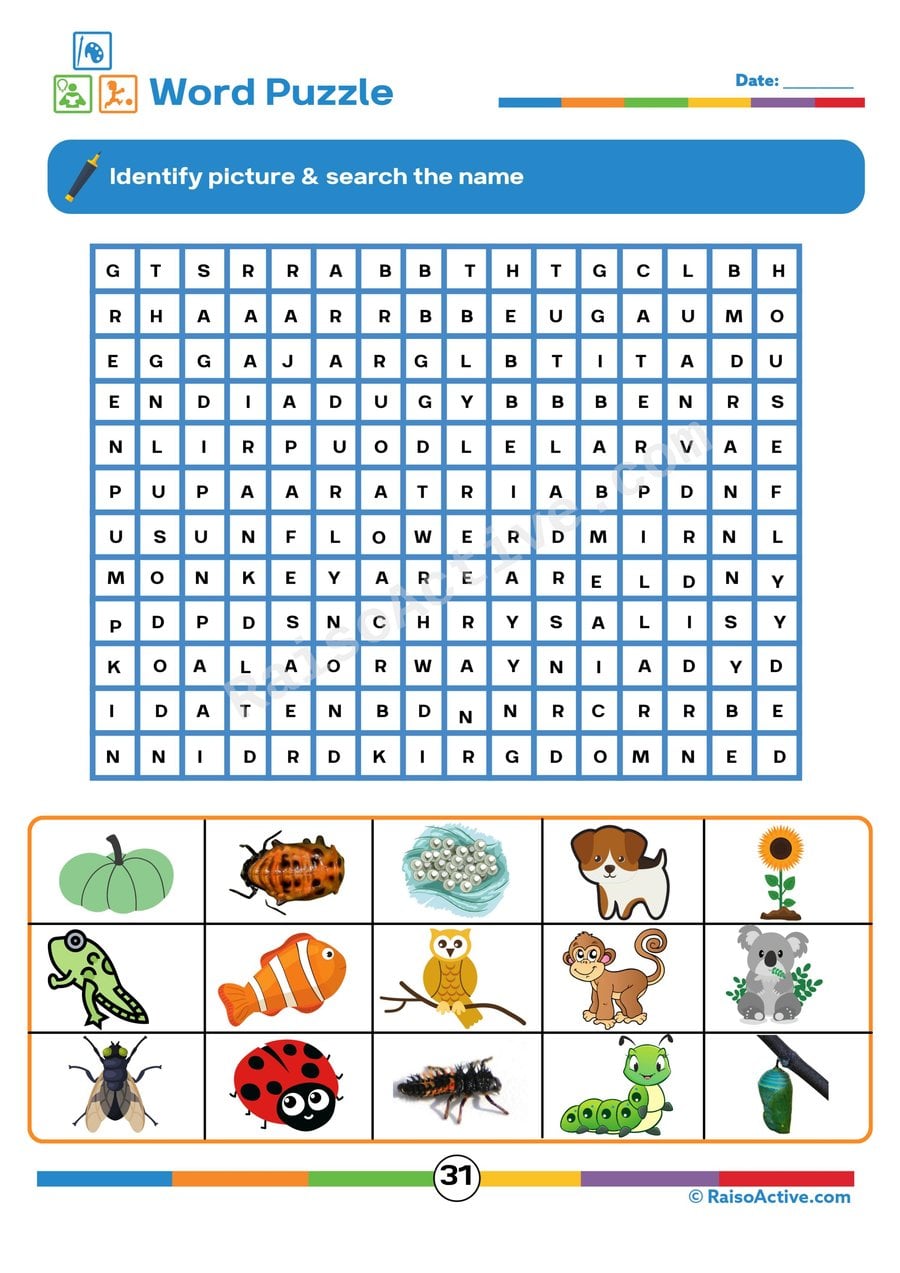
Word Search Worksheet: Find the Hidden Words!
Ages 5-7 · Kindergarten–Grade 1Ages 5-7 · Year 1–Year 2Ages 5-7 · UKG–Class 1Ages 5-7
Searching this life cycle-themed word grid strengthens children's letter-by-letter visual scanning and spelling recognition, both essential pre-reading skills for ages 5-7. As they hunt for words tied to animal growth stages — such as egg, larva, or adult — children reinforce life cycle vocabulary while training their eyes to track left-to-right and top-to-bottom across a busy grid. This dual focus on reading mechanics and science content makes the puzzle more valuable than a generic word search.

Life Cycle Stages Worksheet: Identify and Sequence!
Ages 4-6 · Pre-K–KindergartenAges 4-6 · Reception–Year 1Ages 4-6 · LKG–UKGAges 4-6
This worksheet asks children ages 4-6 to identify what life-cycle stage is shown in each individual picture and then number a whole set of pictures into the correct growth sequence, moving beyond simple matching into independent ordering and logical reasoning. Because the worksheet likely mixes several different animals' or plants' stages, it also asks children to recognize what type of life cycle a picture belongs to before sequencing it.

Sunflower Life Cycle Flashcard Worksheet for Kids
Ages 3-5 · Preschool–Pre-KAges 3-5 · Nursery–ReceptionAges 3-5 · Nursery–LKGAges 3-5
Seeing a sunflower's life cycle laid out as stages — seed, sprout, growing stem, full bloom — introduces a 3-5 year old to the idea of sequence and change over time, a concept that shows up again in stories, science, and even daily routines. It's also many children's first encounter with the idea that a plant is alive and changing, not just a static thing.

Housefly Life Cycle Flashcards Worksheet for Kids
Ages 3-5 · Preschool–Pre-KAges 3-5 · Nursery–ReceptionAges 3-5 · Nursery–LKGAges 3-5
These flashcards teach children ages 3-5 the four stages of a housefly's life cycle, egg, larva, pupa, and adult fly, giving them a concrete, sequential science concept using an insect they likely encounter often in daily life. Learning that a familiar insect goes through such distinct changes also builds curiosity and reduces the instinct to simply dismiss it.
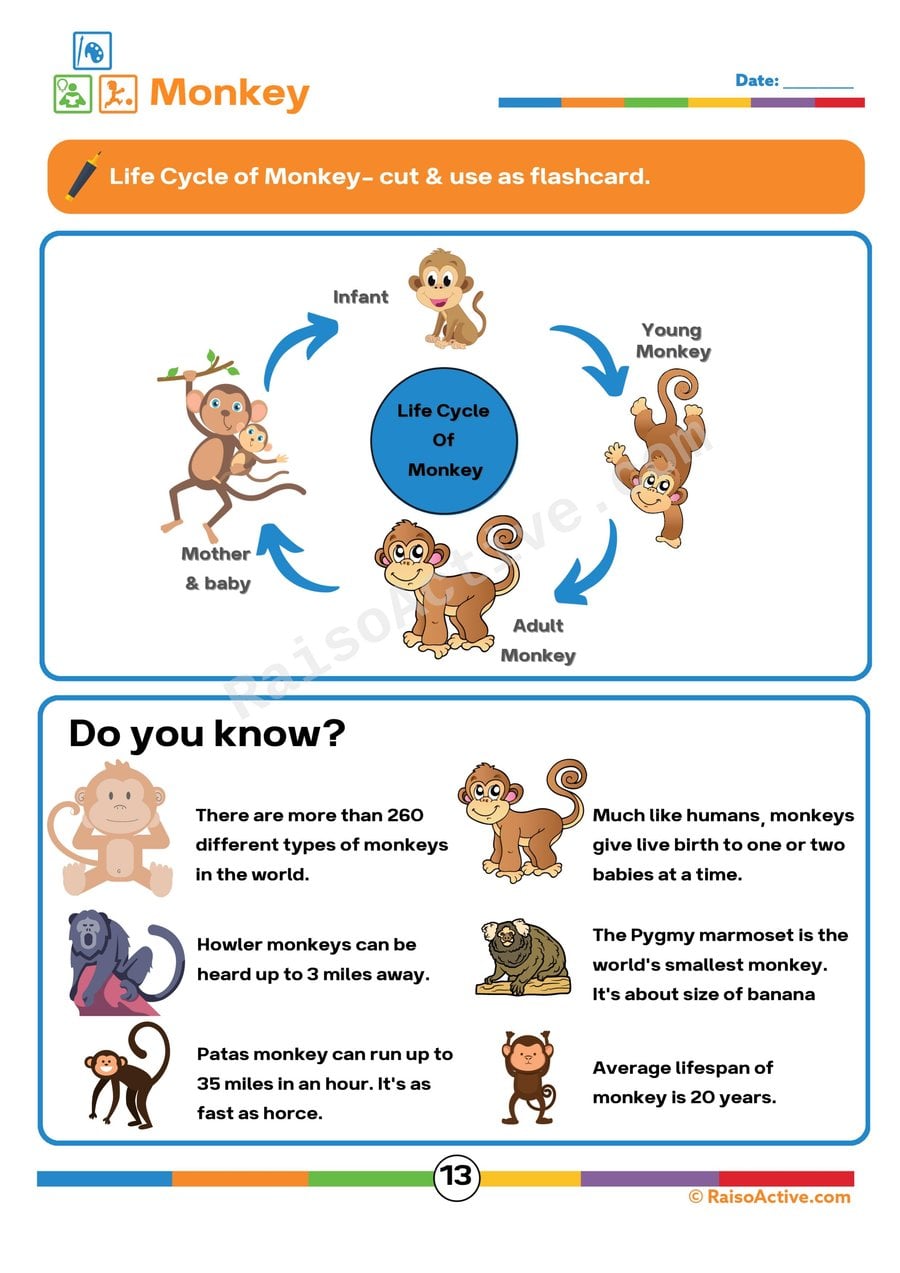
Monkey Life Cycle Worksheet for Preschoolers
Ages 3-5 · Preschool–Pre-KAges 3-5 · Nursery–ReceptionAges 3-5 · Nursery–LKGAges 3-5
This flashcard worksheet introduces children ages 3-5 to the stages of a monkey's life cycle, from infant to juvenile to adult, building early science vocabulary and sequencing skills. Learning that animals other than insects and birds also go through distinct growth stages helps children generalize the concept of a 'life cycle' across the animal kingdom.

Turtle Life Cycle Flashcard Worksheet for Preschoolers
Ages 3-5 · Preschool–Pre-KAges 3-5 · Nursery–ReceptionAges 3-5 · Nursery–LKGAges 3-5
This flashcard set introduces children ages 3-5 to the stages of a turtle's life, egg, hatchling, and adult, helping them understand that turtles start life very small and vulnerable before growing into their familiar shelled adult form. Discussing where turtles lay their eggs and how hatchlings behave also builds early awareness of animal habitats and instincts.
Related worksheets

Plant Life Cycle Worksheet: Cut and Paste the Stages!
Ages 4-6 · Pre-K–KindergartenAges 4-6 · Reception–Year 1Ages 4-6 · LKG–UKGAges 4-6
Children ages 4-6 learn the sequential stages of a plant's life cycle — from seed to sprout to full-grown flower — by cutting out and correctly ordering picture cards. Understanding that living things grow through a fixed, predictable sequence is an early science concept that also reinforces sequencing and ordering skills useful well beyond biology.
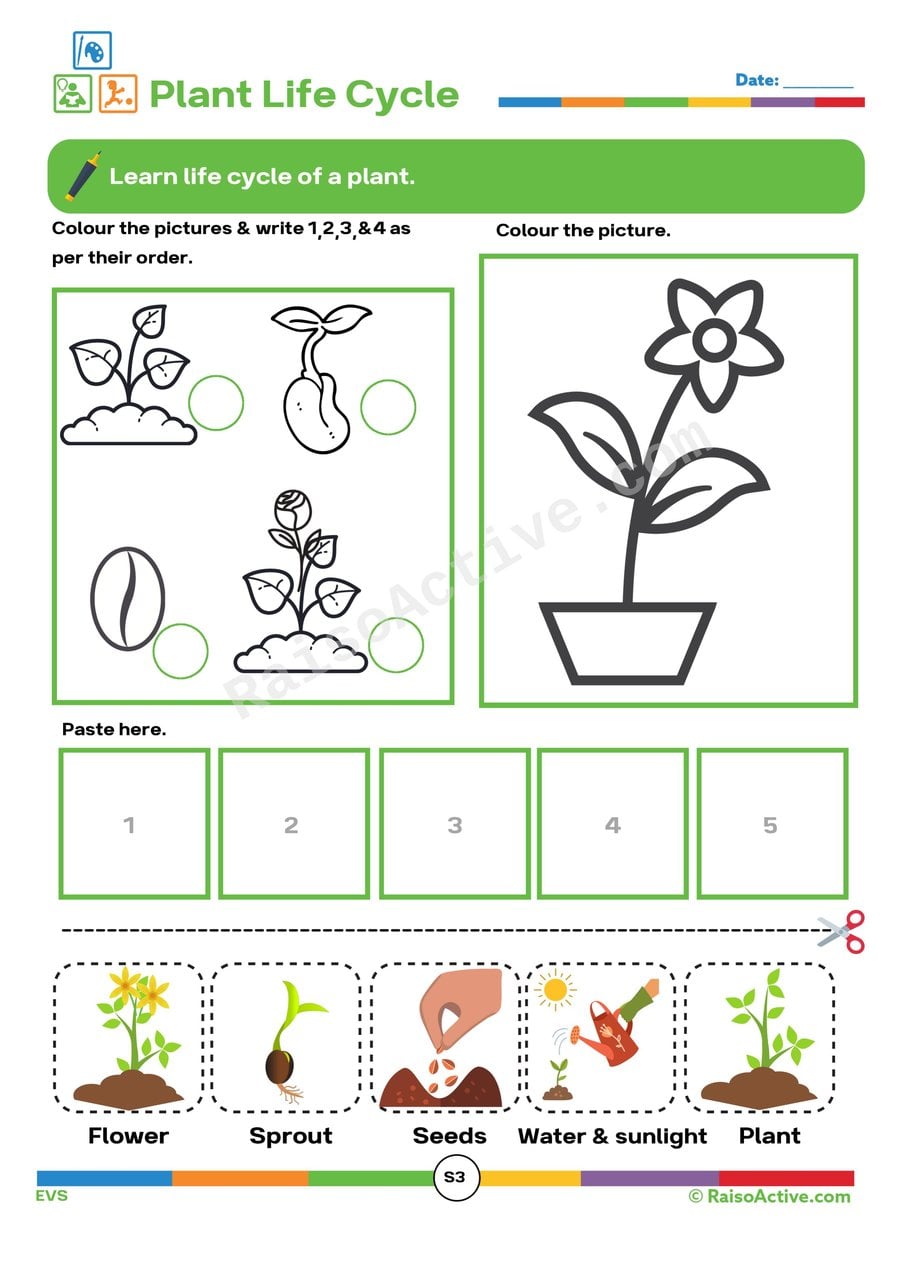
Plant Life Cycle Worksheet: Learn and Color!
Ages 3-5 · Preschool–Pre-KAges 3-5 · Nursery–ReceptionAges 3-5 · Nursery–LKGAges 3-5
Sequencing the stages of a plant's life cycle — from seed to sprout to full-grown flower — introduces children ages 3-5 to the science concept that living things grow and change in a predictable order over time. Numbering the stages before coloring also builds early sequencing and observation skills, since children must look closely at each picture to judge which comes before the next.

Plant Life Cycle Worksheet: Cut and Paste the Stages!
Ages 3-5 · Preschool–Pre-KAges 3-5 · Nursery–ReceptionAges 3-5 · Nursery–LKGAges 3-5
This worksheet helps children ages 3-5 learn the different stages of a plant's life cycle, from seed to sprout to full-grown plant, by coloring each stage and then cutting and pasting the pictures in the correct sequential order. Sequencing the stages builds early scientific reasoning about growth and change over time, a concept children can also observe in themselves.
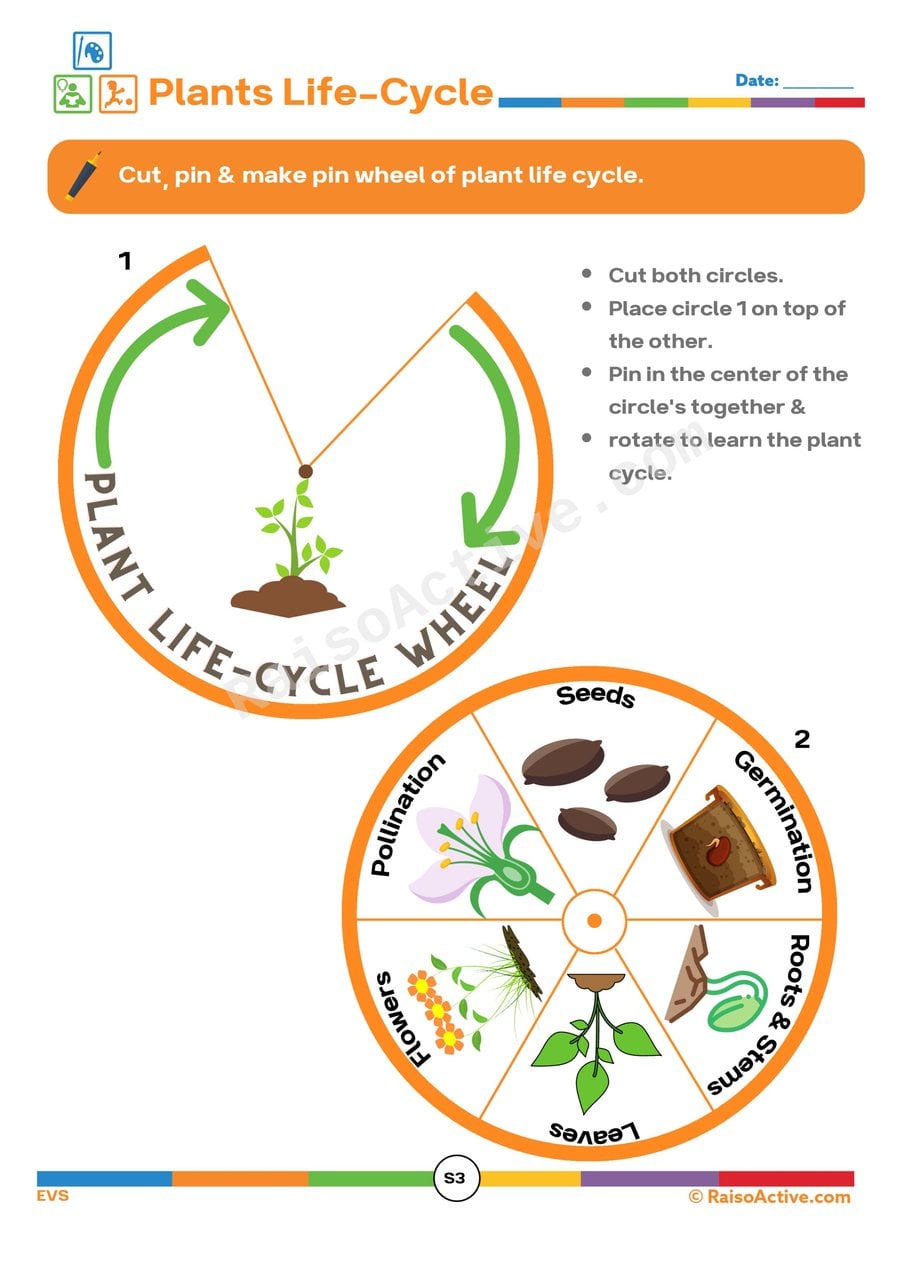
Plant Life Cycle Wheel: Cut, Pin & Learn!
Ages 4-6 · Pre-K–KindergartenAges 4-6 · Reception–Year 1Ages 4-6 · LKG–UKGAges 4-6
Building a spinning wheel that shows a plant's life cycle helps children ages 4-6 understand that growth happens in a repeating sequence of stages — seed, sprout, growing plant, flower — rather than as a single instant event. This hands-on 3D craft turns an abstract scientific process into something children can physically rotate and observe, which suits how young learners grasp sequence and cause-and-effect best. Assembling the two-circle wheel with a paper fastener also builds fine motor precision beyond typical flat cut-and-paste tasks.
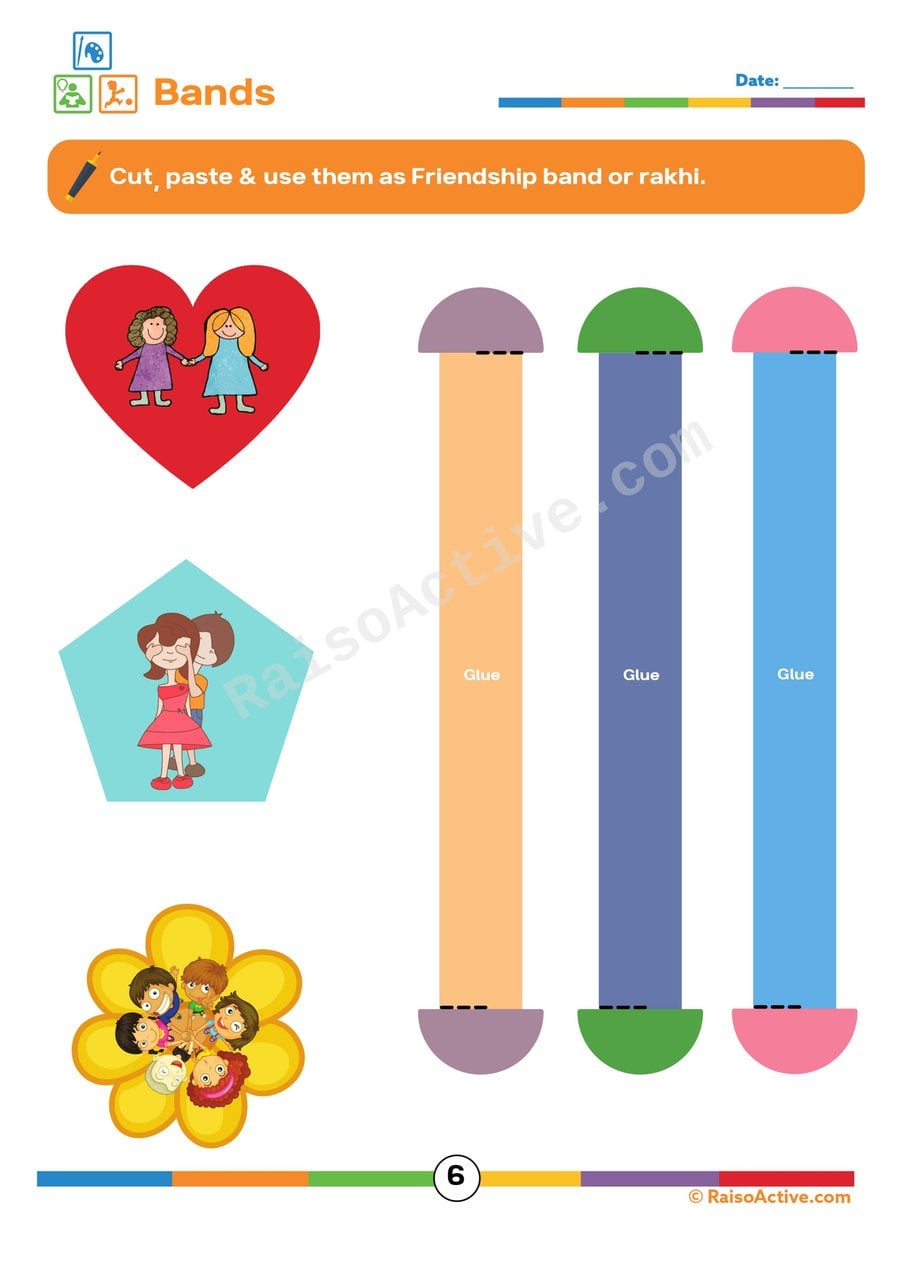
Friendship Band Craft: Cut, Paste, and Create!
Ages 3-5 · Preschool–Pre-KAges 3-5 · Nursery–ReceptionAges 3-5 · Nursery–LKGAges 3-5
This worksheet gives children ages 3-5 additional practice with scissor control and sequential assembly as they cut, join, and decorate their own friendship band or rakhi. Repeating a craft with a new set of shapes reinforces the multi-step process of cutting, arranging, and gluing until it becomes a comfortable, repeatable routine.
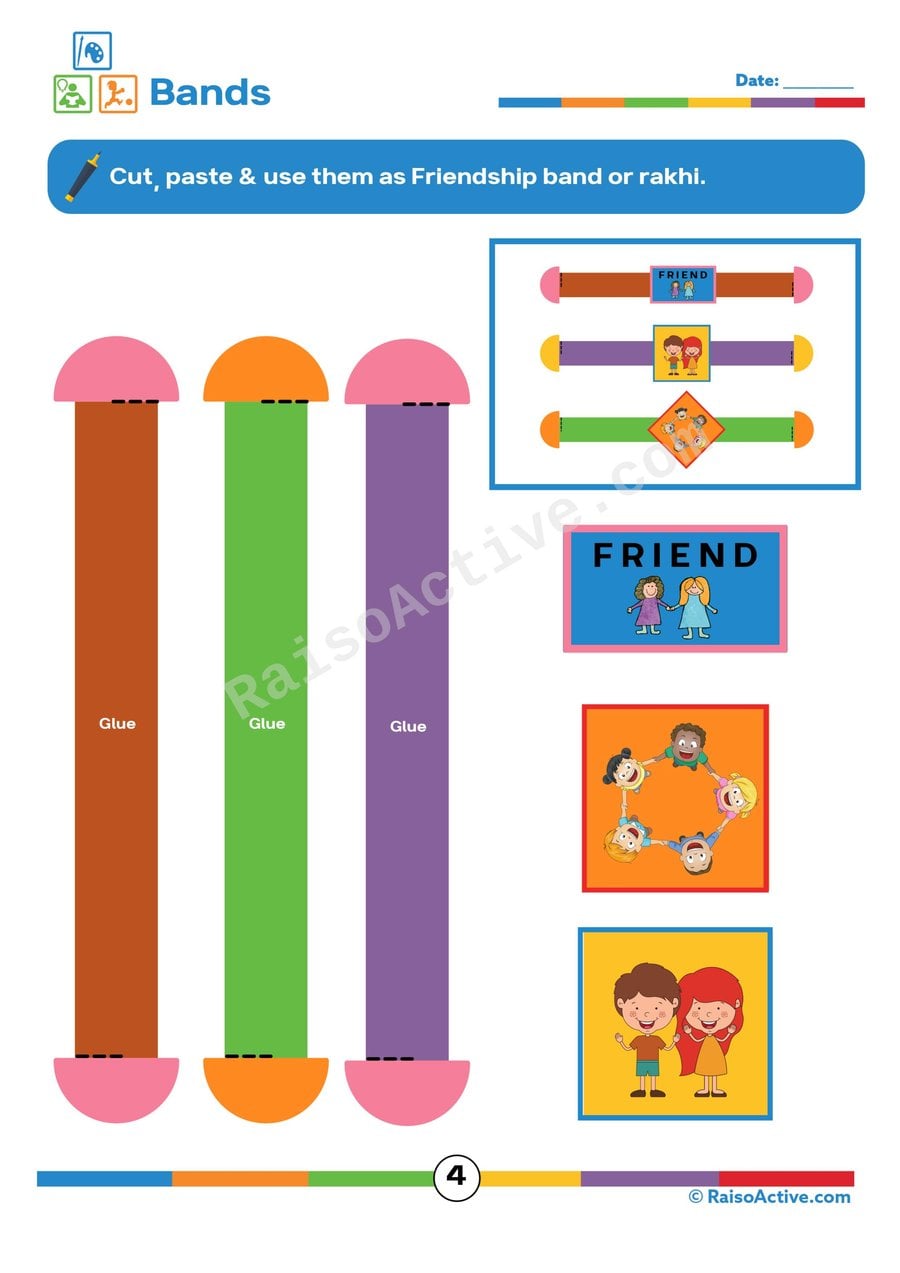
Friendship Band Craft: Cut, Paste, and Create!
Ages 3-5 · Preschool–Pre-KAges 3-5 · Nursery–ReceptionAges 3-5 · Nursery–LKGAges 3-5
Children ages 3-5 practice precise scissor cuts and glue control as they assemble their own wearable friendship band from printed templates. Forming the loop and securing the ends also builds an early understanding of shape and structure, turning a flat strip into a wearable circle, while decorating the band encourages open-ended creative choices.

Honeycomb Pattern Matching Worksheet for Preschoolers
Ages 4-7 · Pre-K–Grade 1Ages 4-7 · Reception–Year 2Ages 4-7 · LKG–Class 1Ages 4-7
This worksheet helps children practice pattern recognition and matching skills by cutting out hexagon shapes and matching them to complete a honeycomb.
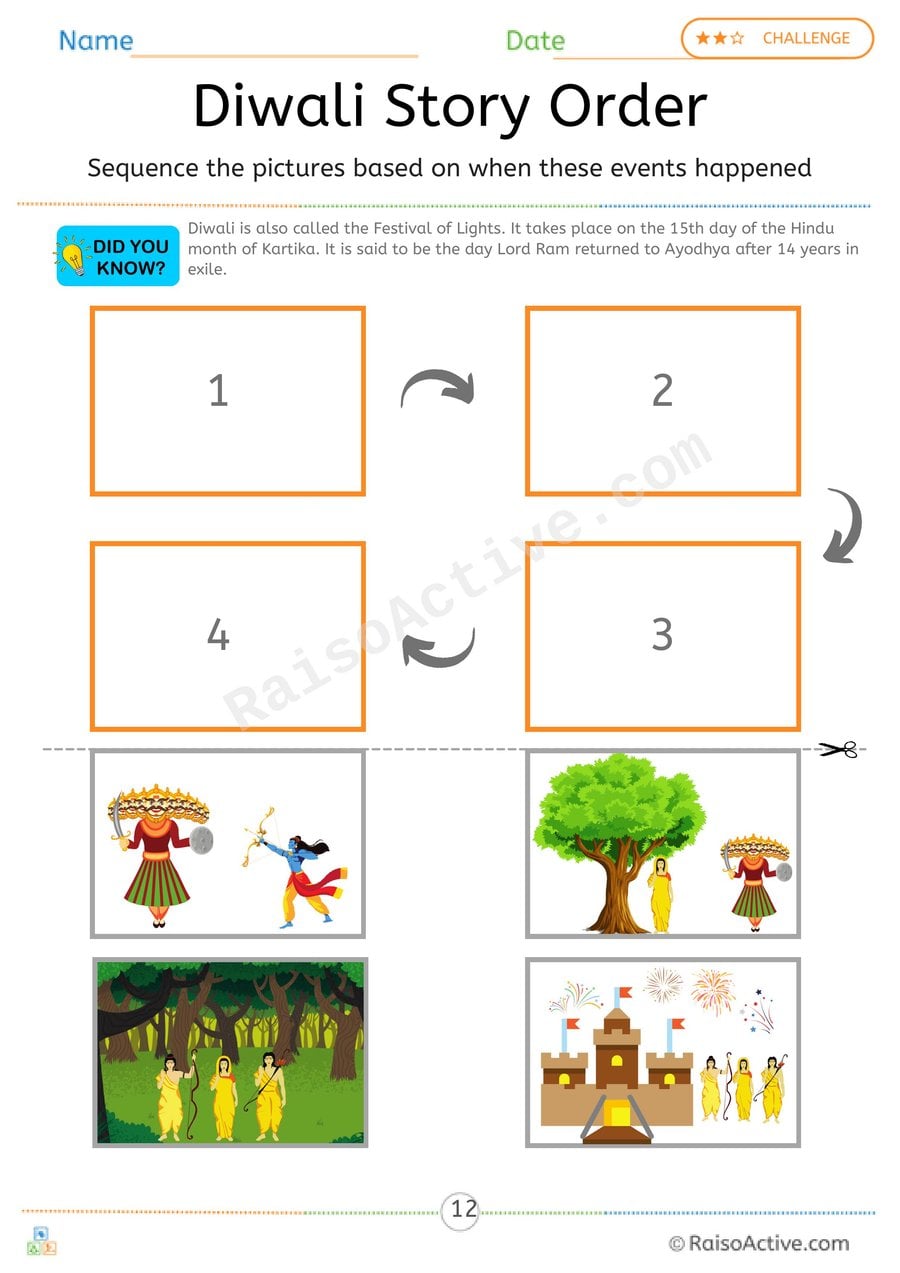
Diwali Sequencing Worksheet for Kids
Ages 4-8 · Pre-K–Grade 2Ages 4-8 · Reception–Year 3Ages 4-8 · LKG–Class 2Ages 4-8
Children learn that Diwali, the Festival of Lights, marks Lord Ram's return to Ayodhya, and put four pictures of the story in the right order.
Guides for this topic

Coding Activities for Preschoolers: Building Tomorrow's Thinkers Today
Discover 15+ unplugged and screen-based coding activities for preschoolers that build sequencing, logic, and problem-solving skills through play. NEP 2020 aligned.

Christmas and Winter Activities That Combine Fun and Learning: Creating Magical Educational Experiences
Discover Christmas and winter activities that combine festive fun with real learning. Crafts, counting, literacy, and printable worksheets for ages 2 to 8 — perfect for home and school.
Age-Appropriate Halloween Learning Activities: Balancing Spooks and Skills for Young Learners
Discover fun, age-appropriate Halloween learning activities for young children. Spooky crafts, counting games, literacy ideas, and printable worksheets for ages 2 to 8.
Reviews
Every worksheet for ages 3–5, no watermark
Members download the full library of 1,000+ worksheets and every activity pack without watermarks or daily limits. One year costs ₹999 in India or $20 elsewhere.
See membership plansOr download any worksheet free with a watermark (5 a day).