Turtle Life Cycle Flashcard Worksheet for Preschoolers
This flashcard set introduces children ages 3-5 to the stages of a turtle's life, egg, hatchling, and adult, helping them understand that turtles start life very small and vulnerable before growing into their familiar shelled adult form. Discussing where turtles lay their eggs and how hatchlings behave also builds early awareness of animal habitats and instincts.
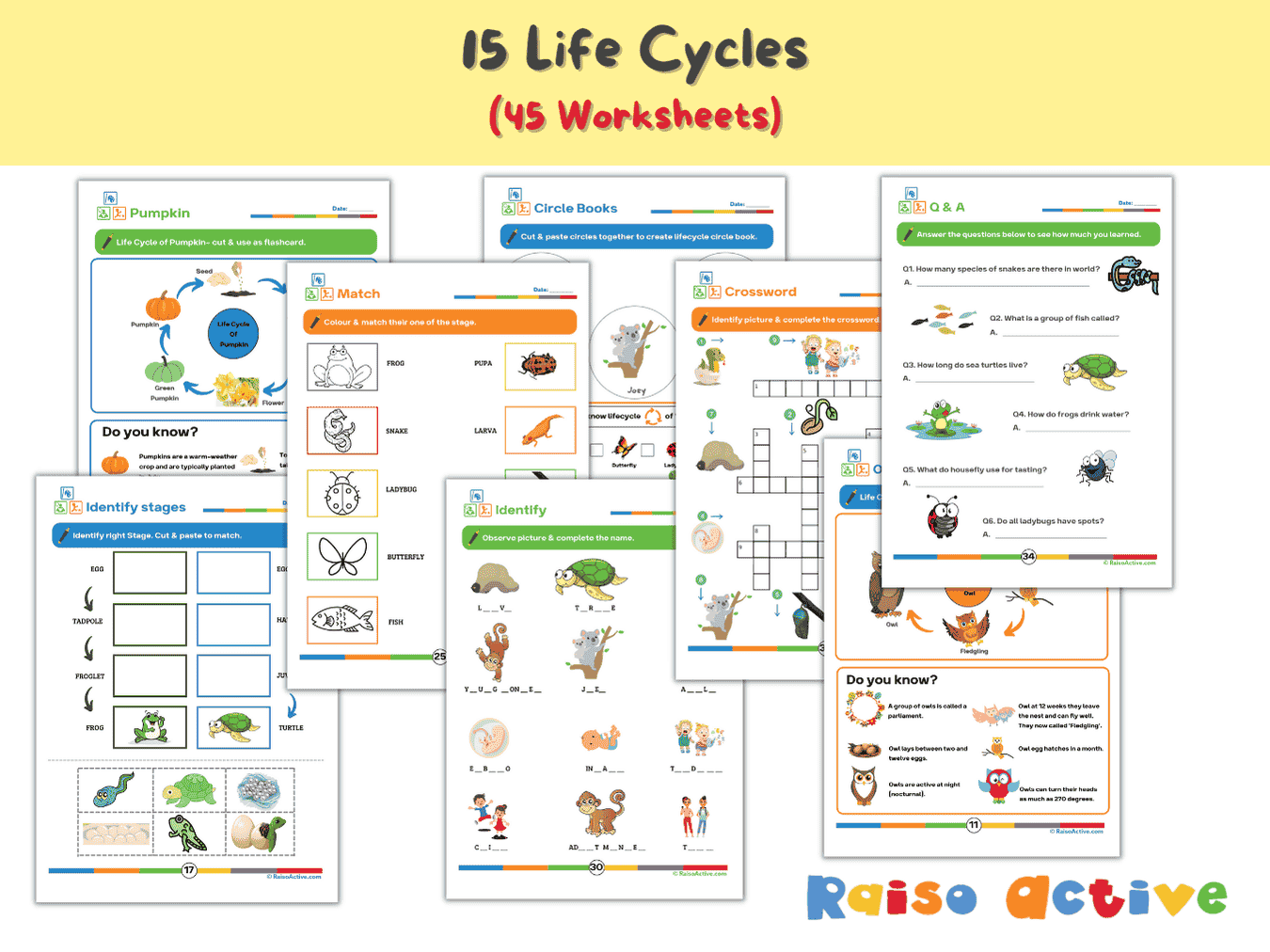
Part of the pack
Lifecycles Activity Book & Flashcards for Preschool & Early Elementary
This is page 8 of the pack. Ages 3-8 · Preschool–Grade 2Ages 3-8 · Nursery–Year 3Ages 3-8 · Nursery–Class 2Ages 3-8
Made for your child
A whole activity pack made with their name
60 pages to spot, build, trace and write their own name, plus pages about their favourites, feelings and family. See a free preview with their name.
Make an All About Me packFree preview · free for members
Or start free: a name tracing sheet with their nameCurriculum
- Living Things - Animals > Animal Life Cycles
How to use this worksheet
Cut out the flashcards and look at each stage together, naming what's shown and describing how the turtle changes in size and shell pattern. Talk about where the eggs are laid and what a baby turtle, or hatchling, looks like compared to an adult. Arrange the cards in growing order from egg to adult turtle. Mix them up and challenge your child to reorder them correctly on their own.
Materials needed
- Scissors
- Optional: Crayons or colored pencils
Extension activities
- 1Draw your own turtle life cycle showing the egg, hatchling, and adult stages.
- 2Research different types of turtles and where they live.
- 3Watch a video of baby sea turtles making their way to the ocean.
- 4Make a turtle craft using a painted rock or paper bowl for the shell.
- 5Compare turtle shells to other protective coverings animals have.

Written by
Hemsweta Jain · Teacher Cheena
MBA and Early Childhood Educator, teaching since 2014 · Founder of RaisoActive, Mumbai
Every RaisoActive worksheet is designed and checked by the founder before publishing.
Published · Last reviewed
More from Lifecycles Activity Book & Flashcards for Preschool & Early Elementary
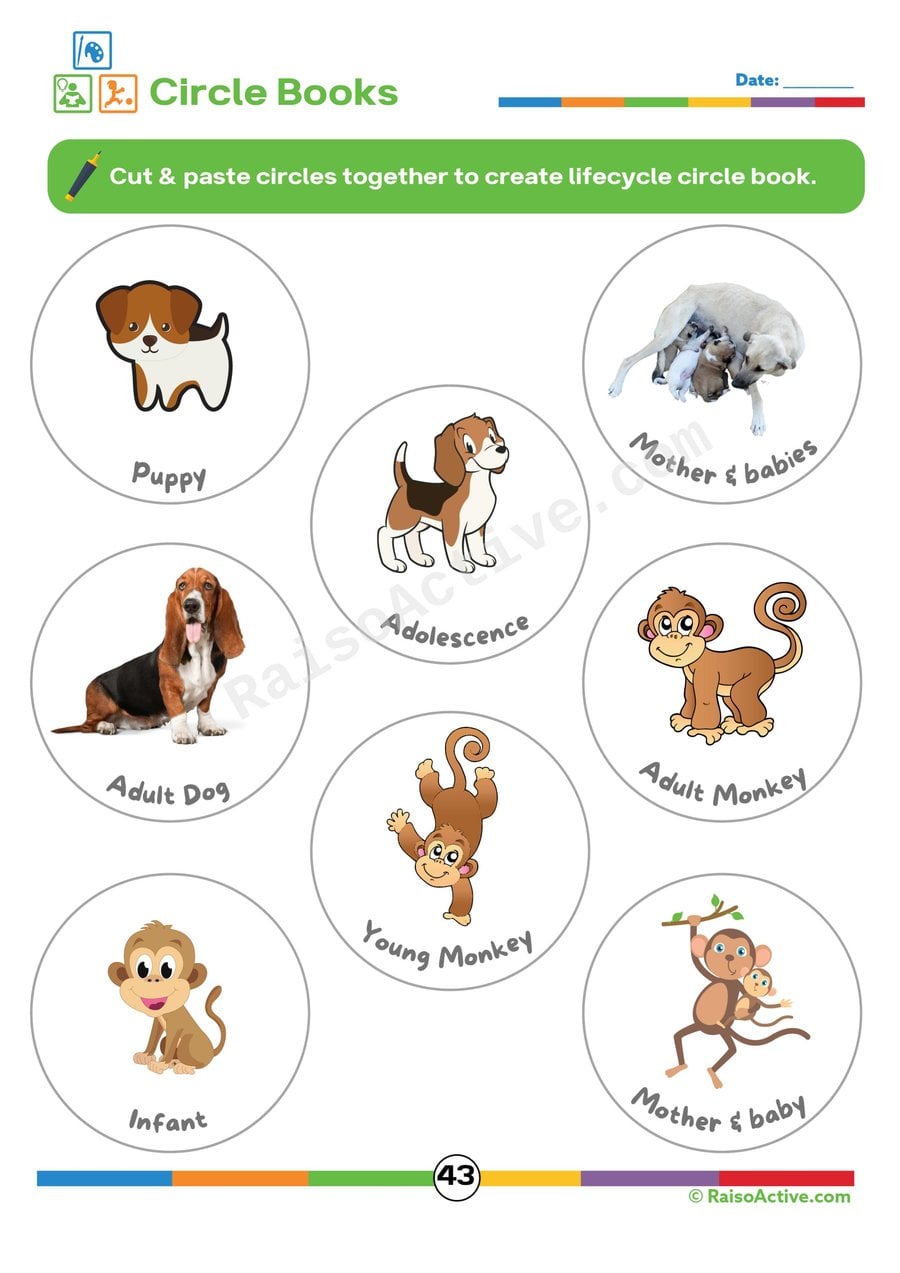
Lifecycle Circle Book: Cut and Paste Fun!
Ages 3-5 · Preschool–Pre-KAges 3-5 · Nursery–ReceptionAges 3-5 · Nursery–LKGAges 3-5
This worksheet gives children ages 3-5 more practice assembling a rotating lifecycle circle book, reinforcing the skills of sequencing, cutting, and gluing built in earlier lifecycle activities. Repeating this hands-on format with new content helps the process itself — cut, sequence, glue, review — become a familiar and confident routine.

Life Cycle Crossword Puzzle for Kids: Identify and Complete!
Ages 4-6 · Pre-K–KindergartenAges 4-6 · Reception–Year 1Ages 4-6 · LKG–UKGAges 4-6
This crossword challenges children ages 4-6 to connect a picture clue to its written word, strengthening both vocabulary recall and early spelling of life cycle terms like egg, caterpillar, or tadpole. Fitting letters into the numbered crossword boxes also builds letter-space awareness, helping children understand that each box holds exactly one letter. Together these skills bridge picture recognition and independent word writing, a key step for pre-readers moving toward reading fluency.

Sunflower Life Cycle Flashcard Worksheet for Kids
Ages 3-5 · Preschool–Pre-KAges 3-5 · Nursery–ReceptionAges 3-5 · Nursery–LKGAges 3-5
Seeing a sunflower's life cycle laid out as stages — seed, sprout, growing stem, full bloom — introduces a 3-5 year old to the idea of sequence and change over time, a concept that shows up again in stories, science, and even daily routines. It's also many children's first encounter with the idea that a plant is alive and changing, not just a static thing.

Frog Life Cycle Cut and Paste Worksheet for Preschoolers
Ages 3-5 · Preschool–Pre-KAges 3-5 · Nursery–ReceptionAges 3-5 · Nursery–LKGAges 3-5
Children ages 3-5 learn the four stages of a frog's life cycle — egg, tadpole, froglet, and adult frog — while practicing sequencing and precise pasting skills. This worksheet is especially useful for illustrating dramatic physical change, since a tadpole looks almost nothing like an adult frog, which helps children grasp that growth can transform an animal significantly.

Chicken Life Cycle Flashcards: Learn About Chickens!
Ages 3-5 · Preschool–Pre-KAges 3-5 · Nursery–ReceptionAges 3-5 · Nursery–LKGAges 3-5
Working with flashcards that show a chicken's life stages, from egg to chick to adult chicken, teaches children ages 3-5 the concept of a life cycle using an animal that's familiar and easy to relate to through farms, storybooks, and everyday life. Cutting out and physically arranging the cards in order builds fine motor skills alongside sequencing and early scientific reasoning about growth and change. Because chickens are a common early-learning animal, this worksheet also reinforces vocabulary your child may already be building through other farm or animal-themed lessons.

Identify Bird Life Cycle Stages Worksheet for Preschoolers
Ages 4-6 · Pre-K–KindergartenAges 4-6 · Reception–Year 1Ages 4-6 · LKG–UKGAges 4-6
Children ages 4-6 practice identifying and sequencing the stages of a bird's life — egg, hatchling, chick, and adult bird — while strengthening the scissor control and precision placement needed for cut-and-paste tasks. This worksheet also reinforces one-to-one matching between an image and its labeled box, an early classification skill.

Butterfly Life Cycle Cut and Paste Worksheet for Preschoolers
Ages 4-6 · Pre-K–KindergartenAges 4-6 · Reception–Year 1Ages 4-6 · LKG–UKGAges 4-6
Children ages 4-6 build on earlier metamorphosis learning by assembling a butterfly life cycle circle book, practicing sequencing and fine motor precision as they cut and glue circular pieces. The rotating circle book format reinforces that metamorphosis is a repeating cycle, helping children move beyond a simple straight-line understanding of egg to butterfly.

Complete the Words: Identify the Animals Worksheet for Preschoolers
Ages 3-5 · Preschool–Pre-KAges 3-5 · Nursery–ReceptionAges 3-5 · Nursery–LKGAges 3-5
This worksheet helps children ages 3-5 practice early letter recognition and spelling by filling in missing letters to complete animal names using picture clues. Working from a picture to a partially completed word builds phonics skills gradually, since children only need to identify one or two missing sounds rather than spelling an entire word from scratch.
Related worksheets
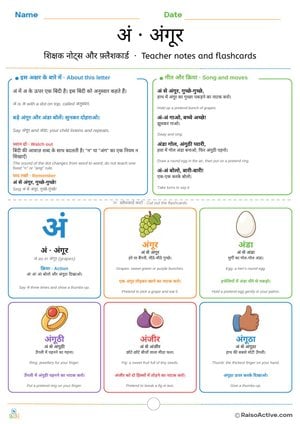
Hindi Letter अं (am) Teacher Notes and Flashcards | अं शिक्षक नोट्स और फ़्लैशकार्ड
Ages 3-7 · Preschool–Grade 1Ages 3-7 · Nursery–Year 2Ages 3-7 · Nursery–Class 1Ages 3-7
Teacher notes and six cut-out flashcards for अं (am) with the words अंगूर, अंडा, अंगूठी, अंजीर and अंगूठा. Each card has a sentence and a small action, and the page ends with a short song to sing and move to.
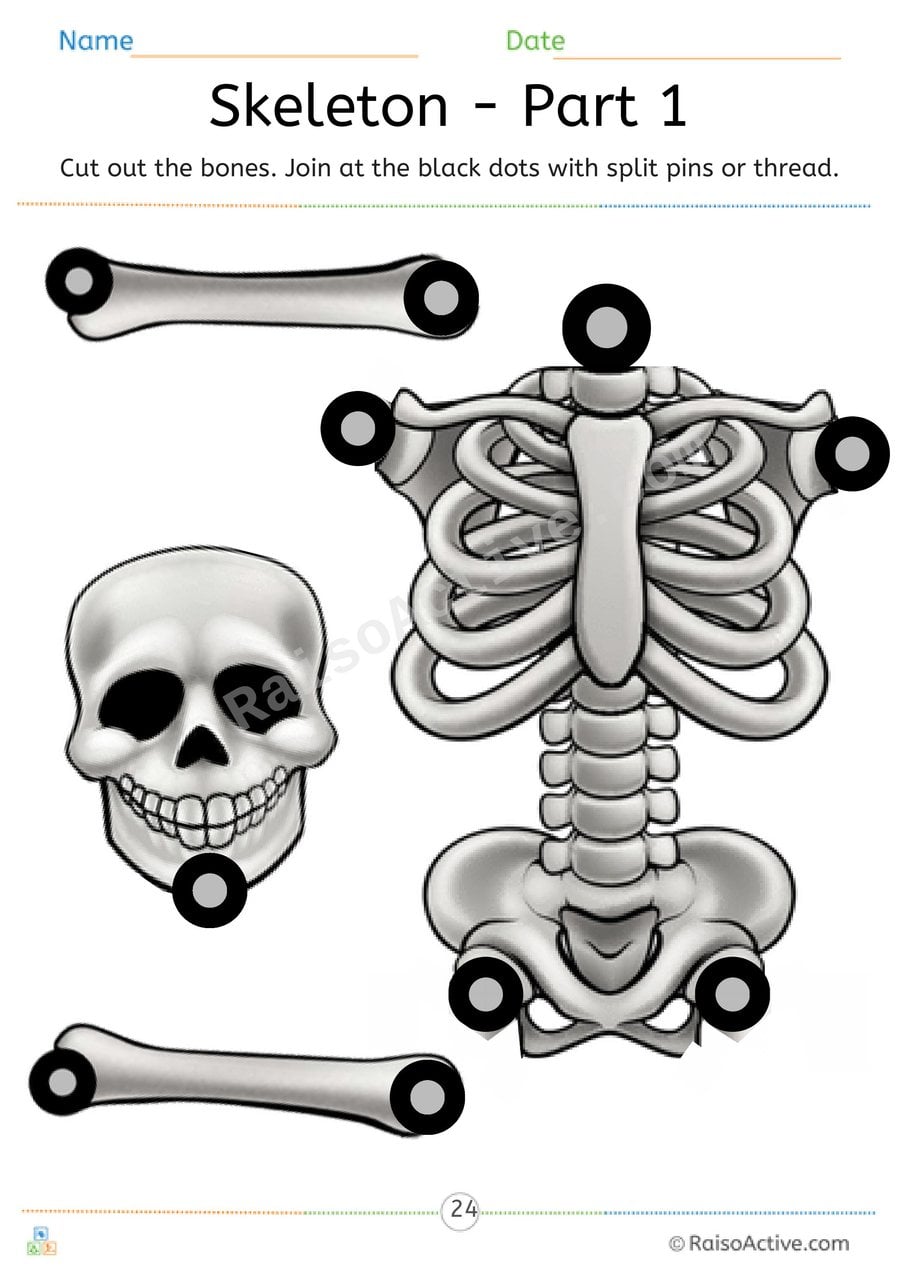
Skeleton Cut and Join Worksheet for Kids
Ages 3-5 · Preschool–Pre-KAges 3-5 · Nursery–ReceptionAges 3-5 · Nursery–LKGAges 3-5
This worksheet has children ages 3-5 cut out individual bone shapes and piece them together to assemble a skeleton, building scissor control and spatial reasoning as they figure out where each bone belongs relative to the others. Gluing the assembled bones onto a backing sheet also gives the activity a lasting, displayable result.

Keeping Our Environment Clean Worksheet for Kids
Ages 3-5 · Preschool–Pre-KAges 3-5 · Nursery–ReceptionAges 3-5 · Nursery–LKGAges 3-5
This worksheet builds early environmental awareness in children ages 3-5 by having them evaluate pictured actions — like throwing litter in a bin versus littering on the ground — and mark each one as good or bad for the environment. Making this judgment call requires children to connect a specific action to a broader consequence, an early form of cause-and-effect reasoning applied to environmental responsibility. Introducing this concept young helps normalize caring for shared spaces as a natural part of daily behavior rather than an abstract adult concern.
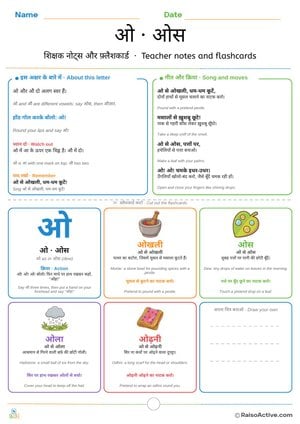
Hindi Letter ओ (o) Teacher Notes and Flashcards | ओ शिक्षक नोट्स और फ़्लैशकार्ड
Ages 3-7 · Preschool–Grade 1Ages 3-7 · Nursery–Year 2Ages 3-7 · Nursery–Class 1Ages 3-7
Teacher notes and six cut-out flashcards for ओ (o) with the words ओखली, ओस, ओला, ओढ़नी and ओजस. Each card has a sentence and a small action, and the page ends with a short song to sing and move to.

Navratri Picture Cards: Cut-Out Memory Match Game
Ages 4-6 · Pre-K–KindergartenAges 4-6 · Reception–Year 1Ages 4-6 · LKG–UKGAges 4-6
Children learn six Navratri words, match each picture to its word and clue, and practise memory and cutting skills.

Flags Flashcards: Learn About Countries and Their Flags!
Ages 3-6 · Preschool–KindergartenAges 3-6 · Nursery–Year 1Ages 3-6 · Nursery–UKGAges 3-6
These country flag flashcards give children ages 3-6 repeated visual exposure to flags from around the world, helping them build early geography awareness and visual memory for colors, stripes, and symbols. Learning each flag's matching country and capital also introduces the idea that places have names and boundaries, a foundational concept for later map and geography skills.

Soap & Pepper Science Experiment Worksheet for Preschoolers
Ages 3-5 · Preschool–Pre-KAges 3-5 · Nursery–ReceptionAges 3-5 · Nursery–LKGAges 3-5
This simple experiment introduces children ages 3-5 to the basic science of surface tension and how soap breaks it, using pepper flakes sprinkled on water as a visual demonstration. Watching the pepper scatter away the instant soap touches the water gives children a concrete, memorable example of cause and effect, an early building block for scientific thinking.

Animal Identification Worksheet for Preschoolers: Color the Correct Animal!
Ages 3-5 · Preschool–Pre-KAges 3-5 · Nursery–ReceptionAges 3-5 · Nursery–LKGAges 3-5
Reading or listening to a simple question and then coloring the animal that answers it correctly builds listening comprehension and animal knowledge in children ages 3-5, requiring them to match a spoken clue to the right picture rather than just naming animals they already recognize. This task strengthens the ability to process a question, consider several possible answers, and select the correct one, an early form of reasoning that supports later reading comprehension. The coloring step at the end also adds a satisfying creative reward for correctly identifying each animal.
Guides for this topic

Discovering Wonder: Nature-Based Learning Activities That Captivate Young Children
Explore nature-based learning activities for children ages 2–7 — leaf rubbings, bug hunts, nature journals, and seasonal Indian outdoor ideas that spark wonder.

Creating Engaging Themed Learning Units for Young Children: A Complete Guide to Integrated Learning
Discover how to create engaging themed learning units for young children that integrate literacy, maths, science, and art — with practical examples and free worksheets.
Hands-On Science Fun: Age-Appropriate Science Activities That Spark Curiosity in Preschoolers
Discover 10+ easy science experiments for preschoolers using Indian household items. Spark curiosity in children ages 2-6 with safe, play-based STEM activities.
Reviews
Every worksheet for ages 3–5, no watermark
Members download the full library of 1,000+ worksheets and every activity pack without watermarks or daily limits. One year costs ₹999 in India or $20 elsewhere.
See membership plansOr download any worksheet free with a watermark (5 a day).